Introduction
Total knee arthroplasty is the definitive operation for advanced tricompartmental osteoarthritis, and pain over the first two days determines whether a patient can stand, walk and work with the physiotherapist. Continuous adductor canal block has been adopted because a catheter in the canal can reduce that pain while avoiding the dense quadriceps weakness of a femoral nerve block [1-3]. The technique is still invasive. It needs ultrasound, a perineural catheter, an infusion device and surveillance for displacement and local-anaesthetic toxicity.
A fentanyl transdermal system is a different way to maintain continuous drug delivery. After application, fentanyl forms a depot in the skin and is absorbed for about 72 h, without a pump or a demand button [4]. The same property is why the licensed indication is narrow. Product labelling contraindicates the patch in patients who are not opioid tolerant and contraindicates it for acute and postoperative pain, because respiratory depression can be delayed and can be life-threatening [5].
The comparisons published so far answer neighbouring questions, not this one. Kim and colleagues found better pain scores and less use of antiemetics with continuous adductor canal block than with intravenous fentanyl patient-controlled analgesia added to a single-shot adductor canal block; quadriceps strength did not differ [6]. Matsumoto and colleagues found that a 12.5 µg/h patch, compared with a non-steroidal anti-inflammatory regimen, improved pain and recovery of strength on days 7 and 14 after arthroplasty [7]. Sathitkarnmanee and colleagues found that a 50 µg/h patch applied 10–12 h before surgery halved 48-hour morphine use compared with placebo, with statistically more nausea and vomiting and with no severe respiratory depression [8]. None of these trials compared a 25 µg/h patch plus scheduled acetaminophen with continuous adductor canal block, on a shared background of epidural anaesthesia and periarticular infiltration.
We asked whether that systemic regimen was a feasible substitute. The hypothesis was that pain, quadriceps grade and time to ambulation would be similar, and that opioid-related adverse effects might not be.
Methods
Study design and oversight
This was a single-centre, parallel-group randomised trial at M.O.S.C. Medical College, Kolenchery, Kerala, India, from January 2020 to June 2021. The institutional ethics committee approved the protocol. Every participant gave written informed consent. The trial was registered with the Clinical Trials Registry–India (CTRI/2020/01/030718). This report follows the CONSORT guideline for parallel-group trials [9].
Participants
Eligible patients were aged 40–80 years, with body-mass index 20–35 kg/m² and American Society of Anesthesiologists physical status I–III, and were scheduled for unilateral total knee arthroplasty for grade III or IV osteoarthritis. Exclusion criteria were known allergy to a study drug, cognitive impairment that prevented consent or use of a pain score, uncontrolled medical disease, and procedures requiring bone graft or metal augments. Opioid tolerance was neither an entry criterion nor a recorded baseline characteristic.
Randomisation and blinding
A computer-generated list assigned participants to adductor canal block or to systemic analgesia. Allocations were concealed in sequentially numbered opaque envelopes and were opened by an anaesthesiologist who took no other part in the study. One orthopaedic team did every operation. Pain and motor scores were recorded by an anaesthesia colleague who was not otherwise involved in the study. The trial was not blinded. A sham patch and a sham catheter were not used. Both the patch and the catheter were visible, so the assessments were not masked.
Perioperative care common to both groups
Premedication, on the night before surgery and again on the morning of surgery, was oral diazepam 5 mg, ranitidine 150 mg and ondansetron 4 mg. In the operating room, midazolam 1 mg was given intravenously. A further 1 mg was allowed at the anaesthesiologist’s discretion.
Anaesthesia was epidural. After a 3 mL test dose of lidocaine 2% with adrenaline 1:200 000, participants received 12–15 mL of bupivacaine 0.5% and then an infusion of bupivacaine 0.5% at 5 mL/h. No participant needed a further intraoperative epidural bolus. The catheter was retained so that it could be used after surgery for breakthrough pain. The time at which the intraoperative infusion was stopped was not recorded.
Near the end of the operation the surgeon injected a periarticular mixture of the Ranawat type: bupivacaine 0.5% 12 mL, ketorolac 30 mg, cefuroxime 750 mg, morphine 8 mg and adrenaline 500 µg, diluted to 50 mL with sodium chloride 0.9% [10,11]. Every participant received acetaminophen 1 g intravenously 30 min before closure. Ondansetron 4 mg was given intravenously every 8 h. A further 4 mg was allowed for nausea or vomiting, to a maximum of 24 mg in 24 h.
Interventions
Adductor canal block. After surgery, under ultrasound guidance, a Contiplex stimulating catheter (B. Braun Medical Inc., Pennsylvania, USA) was placed in the adductor canal and secured. A bolus of 30 mL ropivacaine 0.2% with fentanyl 1 µg/mL was followed by an infusion of the same solution at 5 mL/h. That infusion delivers fentanyl 5 µg/h after a 30 µg bolus.
Systemic analgesia. A fentanyl transdermal system releasing 25 µg/h was applied 3 h before the start of surgery, so that absorption would have begun by the end of the procedure. Acetaminophen 1 g intravenously every 8 h was then given in addition to the pre-closure dose. The time the patch was removed was not recorded. Scheduled postoperative acetaminophen was specified for this group only. The comparison is therefore between continuous adductor canal infusion and a fentanyl patch plus acetaminophen, not between the block and the patch alone.
Breakthrough pain
A visual analogue score of 3 or higher at rest was treated as breakthrough pain. The first rescue drug was tramadol 50 mg intravenously. If pain continued, an epidural bolus of ropivacaine 0.15% 5 mL was given, up to three boluses. A need for three boluses was the trigger for an epidural infusion of ropivacaine 0.15% at 5 mL/h.
Outcomes
Postoperative pain was the outcome used for the sample-size calculation. No single time point, and no single condition, was designated as the sole primary endpoint. Rest pain, pain on passive flexion and pain during physiotherapy are all reported. The P values are nominal.
Rest pain on a visual analogue scale (0, no pain; 10, worst pain imaginable), heart rate, blood pressure and oxygen saturation were recorded at 0, 1, 2, 3, 6, 12, 18, 24 and 48 h. Pain during passive knee flexion and during active physiotherapy was recorded at 24 and 48 h. Quadriceps strength was graded at 24 and 48 h on the Medical Research Council scale (0, no contraction; 5, normal power against full resistance) [12]. Sedation was graded on the Ramsay scale for 48 h. A score above 5 was defined as deep sedation [13]. Time to first ambulation and length of hospital stay were recorded.
Participants were asked to take weight on the operated leg on the first postoperative day and, when comfortable, to walk with a frame. Range-of-movement exercises started on day 1. Bicycle exercises and stairs were added by day 5, in preparation for discharge.
Sample size
Using the pain scores reported by Kim and colleagues in a repeated-measures analysis of variance, 21 participants in each group were estimated to provide 90% power at a two-sided alpha of 0.05 [6].
Statistical analysis
Analysis used IBM SPSS Statistics version 28 and included every randomised participant. Continuous baseline variables are mean and standard deviation and were compared with unpaired t tests. Categorical variables are number and percentage and were compared with the chi-square test or Fisher exact test. Pain scores and quadriceps grades were compared at each time with the Mann–Whitney U test, which is the test that corresponds to the Z statistics reported with the pain scores. Time to ambulation was compared by mean ranks. A two-sided P value below 0.05 was regarded as significant. No adjustment was made for the number of time points.
Results
Participant flow and baseline characteristics
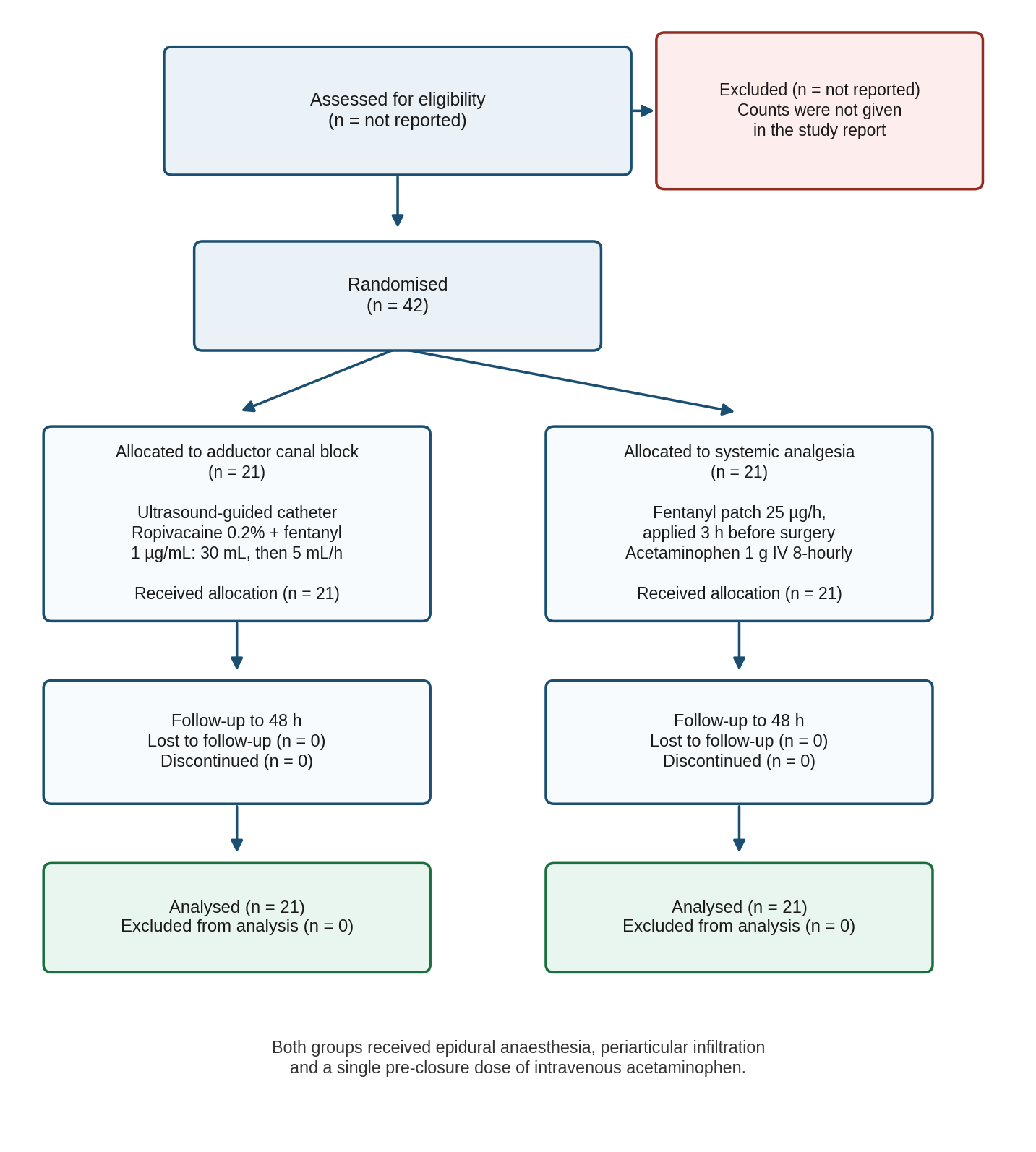
Forty-two participants were randomised, 21 to each group. All received the allocated treatment, none was lost, and all were analysed (Figure 1). The number assessed for eligibility was not available. Age, sex, body size, physical status and duration of surgery were similar in the two groups (Table 1). Nineteen of the 21 participants in each group were women.
| Characteristic | Adductor canal block (n = 21) | Systemic analgesia (n = 21) | P |
| Age, years | 66.76 ± 6.730 | 64.52 ± 7.434 | 0.312 |
| Sex, female / male, n | 19 / 2 | 19 / 2 | 1.00 |
| Height, cm | 158.14 ± 8.633 | 158.76 ± 6.300 | 0.792 |
| Weight, kg | 65 ± 9.209 | 63.95 ± 8.453 | 0.702 |
| Body-mass index, kg/m² | 25.957 ± 2.76 | 25.319 ± 2.54 | 0.440 |
| ASA physical status I / II / III, n (%) | 2 (9.5) / 14 (66.7) / 5 (23.8) | 5 (23.8) / 13 (61.9) / 3 (14.3) | 0.402 |
| Duration of surgery, min | 130.15 ± 21.566 | 128.59 ± 22.230 | 0.819 |
Values are mean ± SD or n (%). ASA, American Society of Anesthesiologists. P values for continuous variables are two-sided unpaired t tests calculated from the printed means, standard deviations and n = 21. Sex and ASA class were compared with the chi-square test.
Pain
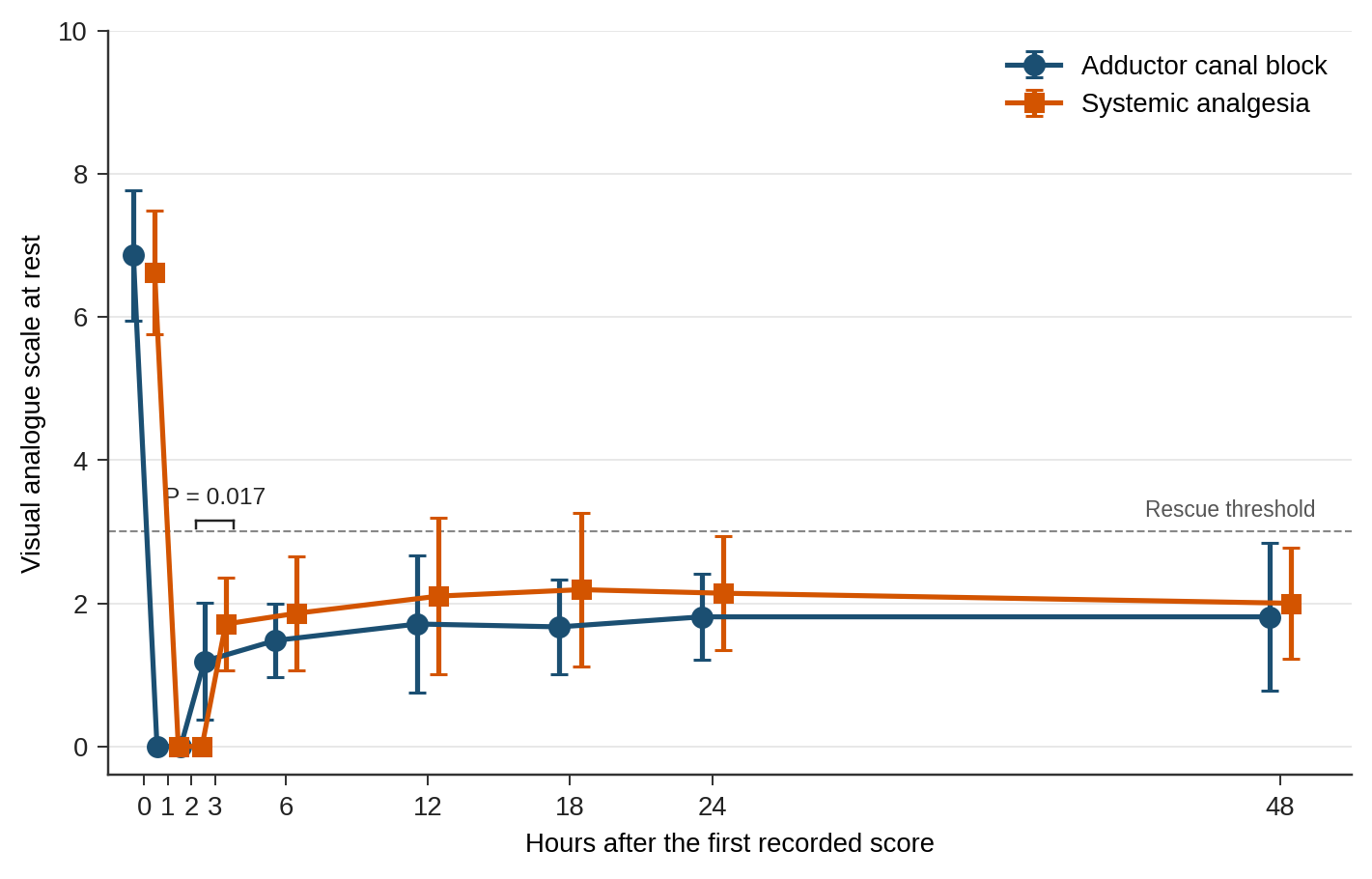
Rest pain followed the same course in both groups (Figure 2 and Table 2). The score at 0 h was moderate to severe. At 1 h and at 2 h it was zero in every participant. From 6 h to 48 h the mean score remained below 3. The only between-group difference was at 3 h, when systemic analgesia was higher than adductor canal block (median 2 versus 1; P = 0.017). That comparison is one of nine unadjusted tests.
| Time | ACBmean ± SD | ACBmedian | Systemicmean ± SD | Systemicmedian | Z | P |
| 0 h | 6.86 ± 0.910 | 7 | 6.62 ± 0.865 | 6 | −0.906 | 0.365 |
| 1 h | 0 | 0 | 0 | 0 | 0 | 1.00 |
| 2 h | 0 | 0 | 0 | 0 | 0 | 1.00 |
| 3 h | 1.19 ± 0.814 | 1 | 1.71 ± 0.644 | 2 | −2.384 | 0.017 |
| 6 h | 1.48 ± 0.512 | 1 | 1.86 ± 0.793 | 2 | −1.607 | 0.108 |
| 12 h | 1.71 ± 0.956 | 1 | 2.10 ± 1.091 | 2 | −1.318 | 0.187 |
| 18 h | 1.67 ± 0.658 | 2 | 2.19 ± 1.078 | 2 | −1.622 | 0.105 |
| 24 h | 1.81 ± 0.602 | 2 | 2.14 ± 0.793 | 2 | −1.345 | 0.179 |
| 48 h | 1.81 ± 1.030 | 1 | 2.00 ± 0.775 | 2 | −1.116 | 0.265 |
n = 21 in each group. ACB, adductor canal block. Visual analogue scale, 0–10. At 1 h and 2 h every score was 0.
Z and P are from unadjusted Mann–Whitney U tests. Nine time points were tested. Only the comparison at 3 h was below 0.05.
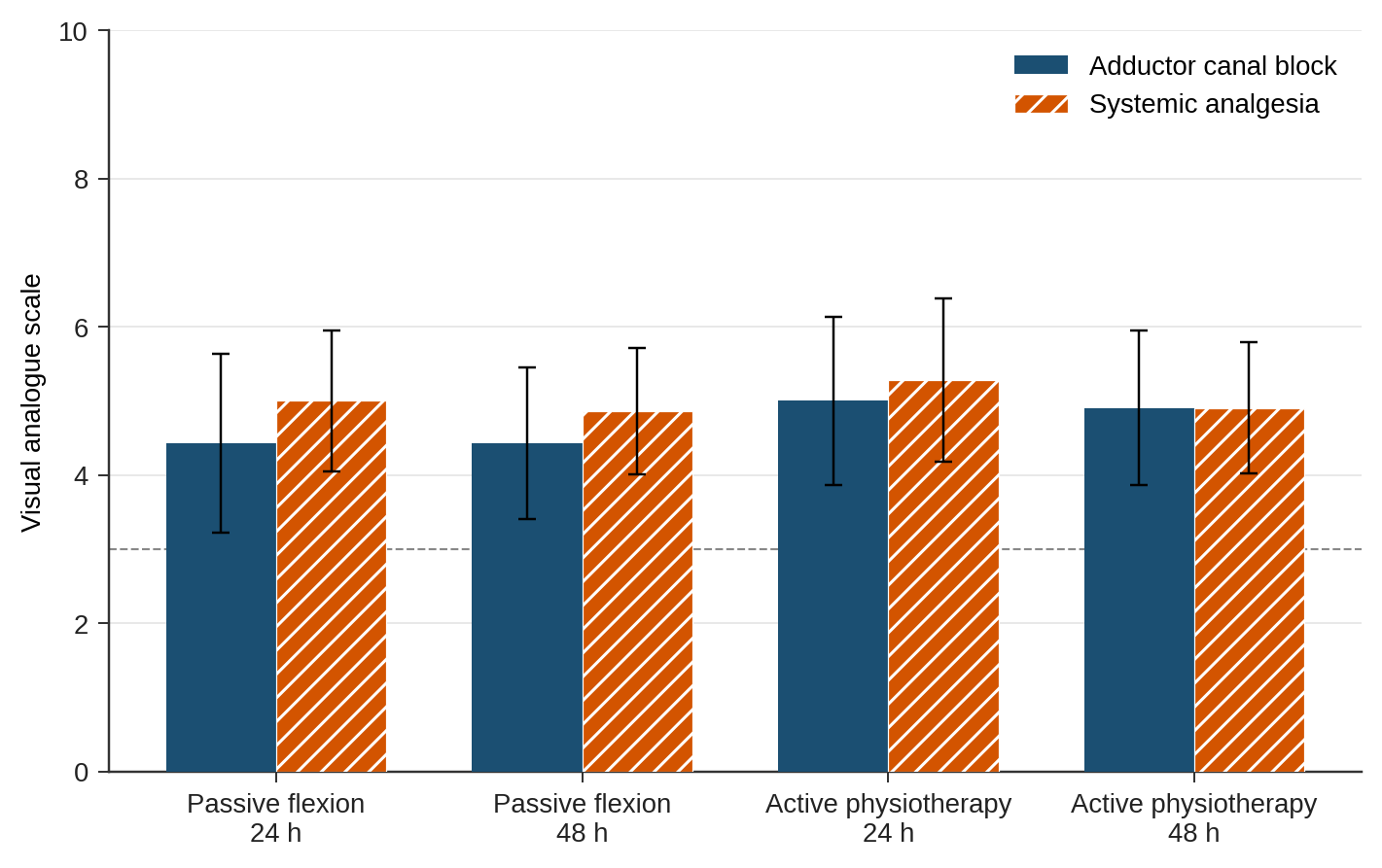
Pain on passive knee flexion and during active physiotherapy was moderate at both 24 h and 48 h, and the groups did not differ (Figure 3 and Table 3). Participants completed the physiotherapy. Within a few minutes of rest the score returned to the mild range, and that settling did not require a further dose of rescue analgesia.
| Assessment | ACBmean ± SD | ACBmedian | Systemicmean ± SD | Systemicmedian | P |
| Passive flexion, 24 h | 4.429 ± 1.207 | 5 | 5.000 ± 0.949 | 5 | 0.148 |
| Passive flexion, 48 h | 4.429 ± 1.028 | 5 | 4.857 ± 0.854 | 5 | 0.209 |
| Active physiotherapy, 24 h | 5.000 ± 1.140 | 5 | 5.286 ± 1.102 | 5 | 0.623 |
| Active physiotherapy, 48 h | 4.905 ± 1.044 | 5 | 4.905 ± 0.889 | 5 | 0.722 |
n = 21 per group. Visual analogue scale, 0–10. ACB, adductor canal block. P values are unadjusted Mann–Whitney tests.
Quadriceps strength and ambulation
Quadriceps grade did not differ between groups at 24 h or at 48 h (Table 4). The median grade was 2 at 24 h, movement with gravity eliminated, and 3 at 48 h, movement against gravity but not against resistance. The adductor canal infusion did not add a detectable motor deficit to that background. Both groups first walked with a frame at a mean of 38 h.
| Outcome | Adductor canal block (n = 21) | Systemic analgesia (n = 21) | P |
| MRC grade at 24 h, median (mean ± SD) | 2 (2.48 ± 0.51) | 3 (2.52 ± 0.51) | 0.760 |
| MRC grade at 48 h, median | 3 | 3 | 0.158 |
| Time to ambulation, h, mean ± SD | 38.3 ± 2.2 | 38.2 ± 1.9 | 0.860 |
MRC, Medical Research Council scale (0, no contraction; 5, normal power). Grades were compared with the Mann–Whitney U test. Time to ambulation was compared by mean rank (21.81 versus 21.19).
Rescue analgesia
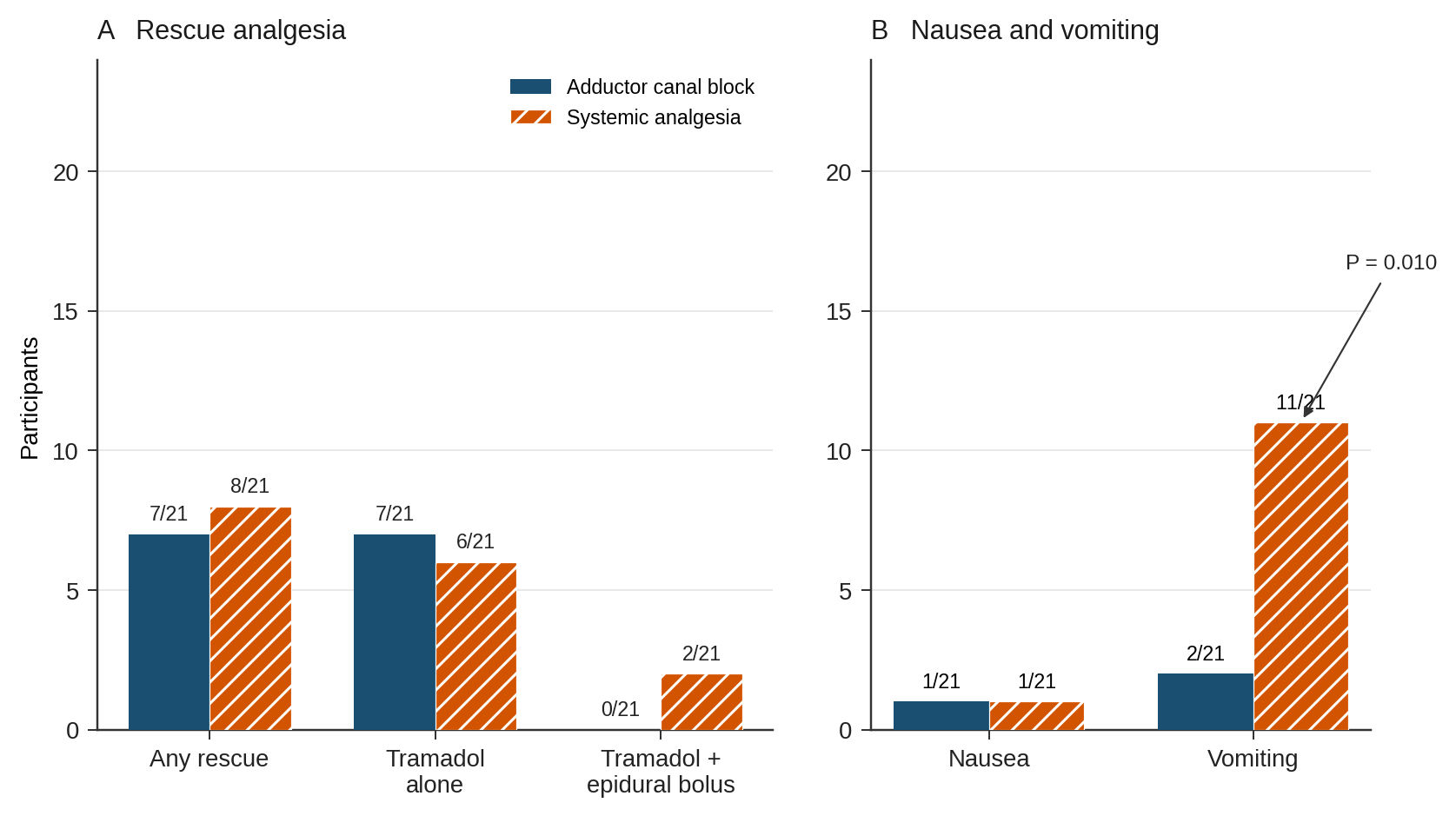
Rescue analgesia was required by 7 of 21 participants in the adductor canal group and by 8 of 21 in the systemic group (Table 5 and Figure 4A). Tramadol alone was sufficient for every rescued participant in the adductor canal group. Two participants in the systemic group also received epidural ropivacaine boluses. No participant in either group was started on an epidural infusion.
| Rescue pathway | Adductor canal block | Systemic analgesia |
| Any rescue analgesic, n/21 (%) | 7/21 (33.3) | 8/21 (38.1) |
| Tramadol alone, n/21 (%) | 7/21 (33.3) | 6/21 (28.6) |
| Tramadol alone, n/N of those rescued (%) | 7/7 (100) | 6/8 (75) |
| Tramadol plus epidural bolus, n/21 (%) | 0/21 (0) | 2/21 (9.5) |
| Tramadol plus epidural bolus, n/N of those rescued (%) | 0/7 (0) | 2/8 (25) |
| Epidural infusion started, n | 0 | 0 |
Breakthrough pain was a visual analogue score of 3 or higher at rest. Rescue was tramadol 50 mg intravenously, then epidural ropivacaine 0.15% in 5 mL boluses, up to three, then an infusion at 5 mL/h. No infusion was started.
Rows marked n/N use as the denominator the participants who received any rescue. All other percentages use the 21 participants in the group.
Adverse effects and length of stay
Nausea was reported by one participant in each group. Vomiting was more frequent with systemic analgesia than with adductor canal block (11 of 21 versus 2 of 21; P = 0.010) and settled with additional ondansetron (Table 6 and Figure 4B). Systolic blood pressure remained at or above 100 mmHg, and oxygen saturation remained between 97% and 100%. Every Ramsay score was 2 or 3, so no participant met the definition of deep sedation. No participant in the adductor canal group developed paraesthesia or clinical local-anaesthetic systemic toxicity. Length of stay was 4 to 6 days and did not differ between groups (Table 6).
| Outcome | Adductor canal block (n = 21) | Systemic analgesia (n = 21) | P |
| Nausea, n (%) | 1 (4.8) | 1 (4.8) | 1.00 |
| Vomiting, n (%) | 2 (9.5) | 11 (52.4) | 0.010 |
| Ramsay sedation score, observed range | 2–3 | 2–3 | — |
| Deep sedation (Ramsay score > 5), n | 0 | 0 | — |
| Paraesthesia related to the catheter, n | 0 | Not applicable | — |
| Clinical local-anaesthetic systemic toxicity, n | 0 | Not applicable | — |
| Length of stay, days, mean ± SD | 5.43 ± 0.676 | 5.57 ± 0.676 | 0.249 |
Nausea and vomiting were compared with the chi-square or Fisher exact test. Additional ondansetron was given for vomiting.
Deep sedation was a Ramsay score greater than 5. Every recorded score was 2 or 3. Oxygen saturation remained 97–100% and systolic pressure remained at least 100 mmHg.
Length of stay ranged from 4 to 6 days and was compared with an unpaired t test.
Discussion
On a shared background of epidural anaesthesia and periarticular infiltration, a 25 µg/h fentanyl patch plus scheduled acetaminophen produced movement-pain scores, quadriceps grades and a time to walking that this sample could not distinguish from continuous adductor canal block. Rest pain was also similar, except at 3 h. The difference that was both statistically and clinically clear was vomiting, which occurred in about half of the systemic group and in about one in ten of the block group.
The shape of the rest-pain curve limits how far the data can be read as a pure comparison of the two study treatments. Pain was absent at 1 and 2 h in every participant. That is the expected early effect of epidural bupivacaine together with periarticular local anaesthetic and morphine, both of which every participant received, and the time at which the epidural infusion was stopped was not recorded [10,11]. A randomised trial of periarticular ropivacaine, ketorolac, morphine and adrenaline, given without a nerve block, has already shown less opioid use and less pain on activity in the first hours after arthroplasty, which is the same window in which our two groups could not be separated [14]. A new block and a slowly absorbed patch would be difficult to separate while that background was still working. The patch had been applied only 3 h before incision. After application, fentanyl accumulates in the upper skin. Grond and colleagues placed the time from application to a minimum effective serum concentration at 1.2–40 h, and the time to maximum concentration at 12–48 h; after the patch is removed, absorption from the depot continues, with a terminal half-life of about 13–25 h [15]. Those estimates match measurements in surgical patients, in whom concentrations reached a plateau about 14 h after application and fentanyl was still being absorbed after the system was removed, with a terminal half-life of 17 h [16] Transdermal fentanyl is a recognised option in reviews of acute analgesia, but it was never a rapid-onset technique [17] Skin blood flow, temperature and cardiac output all change during an operation and all change transdermal uptake [4,18]. Clearance also varies widely between patients, through age, hepatic blood flow and CYP3A activity [19]. A lead time of 3 h is short relative to that pharmacology. The 10–12 h lead used by Sathitkarnmanee and colleagues, albeit at twice the dose and against placebo rather than against a nerve block, is closer to the time the patch needs [8].
The rescue data do not establish an important analgesic advantage for the block. Two participants in the systemic group, and none in the block group, needed an epidural bolus after tramadol. That is an absolute difference of two people. Kim and colleagues reported a larger separation, but their systemic arm was intravenous fentanyl patient-controlled analgesia added to a single-shot adductor canal block, not a patch, and both of their groups received a block [6]. Against a sham catheter, continuous adductor canal infusion of ropivacaine 0.2% reduced morphine use over 48 h and, on the second day, improved quadriceps strength and walking distance [20]. About one in three participants in each of our groups needed any rescue, and pain after physiotherapy settled without further drug. Those observations describe the whole package of care.
There is a second reason not to describe the block group as opioid-free. The adductor canal solution contained fentanyl 1 µg/mL, so that group received a 30 µg bolus and then 5 µg/h. The patch is rated to release 25 µg/h. The trial compares a low-rate perineural fentanyl–ropivacaine infusion with a higher nominal transdermal exposure plus acetaminophen. The excess vomiting sits more comfortably with that difference in opioid delivery than with any difference in the nerve block itself.
Quadriceps grade and walking time were the functional reasons to prefer an adductor canal catheter to a femoral nerve block [2,3]. In a placebo-controlled trial, adductor canal blockade reduced morphine use and pain during knee flexion and shortened the Timed Up and Go test at 24 h [21]. When the same catheter technique was compared directly with a femoral nerve catheter, quadriceps strength was 52% of baseline after adductor canal block and 18% after femoral nerve block, with no difference in pain or morphine use [22]. A cohort treated with an adductor canal catheter walked further on the first two postoperative days than a cohort treated with a femoral catheter, again with similar pain scores and opioid use [23]. We found no between-group difference in grade or in time to walking. That is what would be expected if the block added little motor weakness beyond the operation, the tourniquet and residual epidural local anaesthetic. The grades were not normal. A median of 2 at 24 h is not preserved power. The result shows that the block did not make the grade worse than systemic analgesia did, not that power was spared. Rousseau-Saine and colleagues measured isometric knee-extension force rather than a clinical grade. Continuous adductor canal block improved that force on the first postoperative day compared with sham, and did not change the primary endpoint, force at six weeks [24]. Zhang and colleagues showed that adductor canal infusion weakens quadriceps less than a femoral nerve infusion, at similar pain scores [3]. Sørensen and colleagues found that a block can increase force by relieving pain, without a clear gain in mobility [2].
The difference in vomiting was about 40 percentage points. Nausea, recorded separately, was uncommon and equal in the two groups, and vomiting settled with ondansetron. This is the adverse effect expected when more fentanyl is delivered systemically. In the first placebo-controlled trial of a postoperative fentanyl patch, rated at 75 µg/h and applied for shoulder surgery, vomiting occurred in 73% of the fentanyl group and 30% of the placebo group, and the respiratory rate was lower while the patch was in place [25]. The same direction is seen in the higher antiemetic use Kim observed when fentanyl was given intravenously [6], and in the higher nausea and vomiting scores Sathitkarnmanee observed when a 50 µg/h patch was compared with placebo after arthroplasty [8]. In major abdominal surgery, Arshad and colleagues found a 25 µg/h patch at least as effective as transdermal buprenorphine when the patch was applied 6 h before incision, with nausea or vomiting in 10% of the fentanyl group [26]. Matsumoto and colleagues, using 12.5 µg/h against a non-steroidal regimen, reported the analgesic and strength benefit in the second week rather than in the first 48 h, and did not report major harm [7]. Dose, comparator and timing differ enough that none of these studies replaces a blinded comparison with adductor canal block.
No participant became deeply sedated, oxygen saturation remained 97–100%, and systolic pressure remained at or above 100 mmHg. With 21 participants exposed to the patch, only very common serious harm can be excluded. Licensed labelling contraindicates this formulation for acute postoperative pain and for patients who are not opioid tolerant, because absorption from the skin depot continues after the patch is removed and because respiratory depression may appear late [5,15]. Opioid tolerance was not an inclusion criterion. These data do not establish the patch as a safe substitute for adductor canal block.
The trial was open, and the sample, although it met the calculation, is small. The number of patients screened and excluded was not logged. Scheduled acetaminophen was used only in the systemic arm. Nine rest-pain comparisons were made without adjustment, so the difference at 3 h is hypothesis-generating. More than 90% of the participants were women, and all were treated in one teaching hospital. The findings should not be generalised beyond that setting.
Conclusion
After unilateral total knee arthroplasty, a fentanyl transdermal system at 25 µg/h plus intravenous acetaminophen produced pain on movement, quadriceps grades and a time to walking similar to continuous adductor canal block, and caused more vomiting. Rest pain was also similar apart from a higher score at 3 h with the patch. The trial was small and unblinded, and a fentanyl patch is not an indicated treatment for acute postoperative pain in patients who are not known to be opioid tolerant. On these data, systemic analgesia of this type should not replace adductor canal block in routine practice.
Declarations
Ethics approval and consent to participate
The institutional ethics committee of M.O.S.C. Medical College, Kolenchery, approved the study. Written informed consent was obtained from every participant.
Trial registration
Clinical Trials Registry–India, CTRI/2020/01/030718.
Data availability
The de-identified participant-level dataset and the analysis syntax are available from the corresponding author on reasonable request, subject to institutional approval.
Authors’ contributions
All authors contributed to the design of the trial, the acquisition or interpretation of the data, and the drafting or critical revision of the manuscript. All authors approved the version submitted and agree to be accountable for the work.
Acknowledgements
The orthopaedic team performed all arthroplasties. Outcome scores were recorded by an anaesthesia colleague who was not otherwise involved in the study.
Funding
This study received no specific grant from any funding agency in the public, commercial or not-for-profit sectors.
Conflicts of interest
The authors declare no competing interests.