Introduction
Anal fissure refer to a break or tear in the anoderm in the region of the anorectal junction and chronic anal fissure are the most prevalent anorectal disorder involving a linear or oval defect in the distal anal canal most often situated posteriorly. These gaps go through into the anoderm, they accompany frequently leaving the skeletal muscular tissues of the IAS (internal anal sphincter) clearly noticeable [1]. However, chronic fissure last more than six weeks and are characterized by blended edges, primary skin tag, or thickened anal papillae. These fractures take time to heal, and development of complications such as muscle spasm as a result of insufficient blood supply to the region suffice to prolong the time taken for breakages such as these to heal [2]. In clinic practice, chronic anal fissures can be diagnosed easily because they have some unique characteristics when digitally examined or during anoscopy. Pain and bleeding experienced when defecating together with the fissure’s morphology set it apart from other anorectal diseases including hemorrhoids or abscesses [3]. Appropriate assessment is critical since untreated persistent cracks cause other issues, including narrowing of the channel or necessitate more complex surgery. The cause(s) of chronic anal fissure are multi-factorial in origin; both local and systemic factors contribute significantly. One of the main reasons contributing to it is injury to the anal canal, which has occurred mostly with bowel movement or chronic constipation [4]. Similarly, diarrhea and wiping a young’s anus often with the wet wipe tear the anoderm which turns to be a fissure. Primary chronic anal fissures have been linked to hypertonia of the internal anal sphincter, the condition raises resting anal pressure and thus compromises the blood supply of the anoderm necessary of the healing process. Crohn’s disease, tuberculosis and sexually transmitted infections increases the risk of the development of fissures, particularly atypical fissures in the lateral position. The most common and characteristic sign is pain, which may be localized to the anus region and which intensifies during and after defecation, assuming a sharp or burning quality. The pain, stemming from the exposure of nerve endings in the fissure bed, can persist for hours, and severely reduce the patient’s quality of life [5]. Bleeding is another frequent sign, which usually is detected as bright red blood mixed with the faeces or visible on the toilet paper. There might also be itching or a fullness in the rectum for a patient with chronic fissures, commonly as a result of sentinel tags or infection (secondary) [6]. These symptoms can lead to a cycle of fear of defecation making the situation worse for constipation and development of the fissure. Acute and chronic causes of anal fissures and their clinical manifestations should be delineated to make a proper choice of the therapeutic plan that would affect both, the somatic and psychosocial aspects of the disease.
Objectives of the Study
This trial aims at management of chronic anal fissures specifically in regard to efficacy, safety and patient satisfaction of topical 2% diltiazem gel and lateral internal sphincterotomy, and to find out which treatment modality yields increased rates of healing and improved symptoms in both primary and secondary types of fissures
Methodology
The study adopts a systematic review design, synthesizing findings from a wide range of comparative studies to evaluate the effectiveness of topical 2% diltiazem gel versus lateral internal sphincterotomy (LIS) for the treatment of chronic anal fissures. This approach ensures a comprehensive understanding of the relative strengths and limitations of both interventions by aggregating data from multiple sources, including randomized controlled trials (RCTs), observational studies, and meta-analyses. A systematic review is particularly suitable for this research as it provides a structured method to evaluate existing evidence critically, minimizing bias and ensuring robust conclusions. The review design incorporates both quantitative and qualitative analyses, allowing for a detailed comparison of clinical outcomes such as healing rates, recurrence, complications, and patient-reported satisfaction.
Data Sources: Randomized Controlled Trials, Observational Studies, Meta-Analyses
The data for this systematic review were drawn from peer-reviewed journals, with a focus on RCTs, which are considered the gold standard in clinical research. These trials provide high-quality evidence due to their controlled and randomized nature, ensuring minimal bias. Observational studies were also included to capture real-world outcomes and variations in patient populations. Additionally, meta-analyses were utilized to consolidate findings from multiple studies, offering a broader perspective on treatment efficacy and safety. Studies such as those by Kuiri et al. and Kulkarni, Naveen, and Muddebihal (2023) provided valuable insights into long-term outcomes, while meta-analyses like those by Jin et al. highlighted overarching trends across different clinical settings [1,6,7].
Inclusion and Exclusion Criteria
The inclusion criteria for the systematic review were carefully defined to ensure the relevance and quality of the studies analyzed. Included studies met the following criteria:
-
Focused on chronic anal fissures.
-
Compared 2% diltiazem gel with LIS.
-
Reported outcomes such as healing rates, recurrence rates, complications, or patient satisfaction.
-
Published in peer-reviewed journals between 2010 and 2024.
Studies were excluded if they lacked a comparative design, involved pediatric or atypical fissures, or failed to report quantitative outcomes. This strict selection process ensured that the review incorporated only high-quality evidence relevant to the research objectives.
Key Parameters Analyzed
Healing Rates
Healing rates were the primary parameter analyzed, as they directly reflect the efficacy of each treatment. Studies consistently showed that LIS outperformed diltiazem gel, with healing rates exceeding 95% in most cases. The review examined variations in healing time and completeness of fissure resolution across different patient populations.
Recurrence Rates
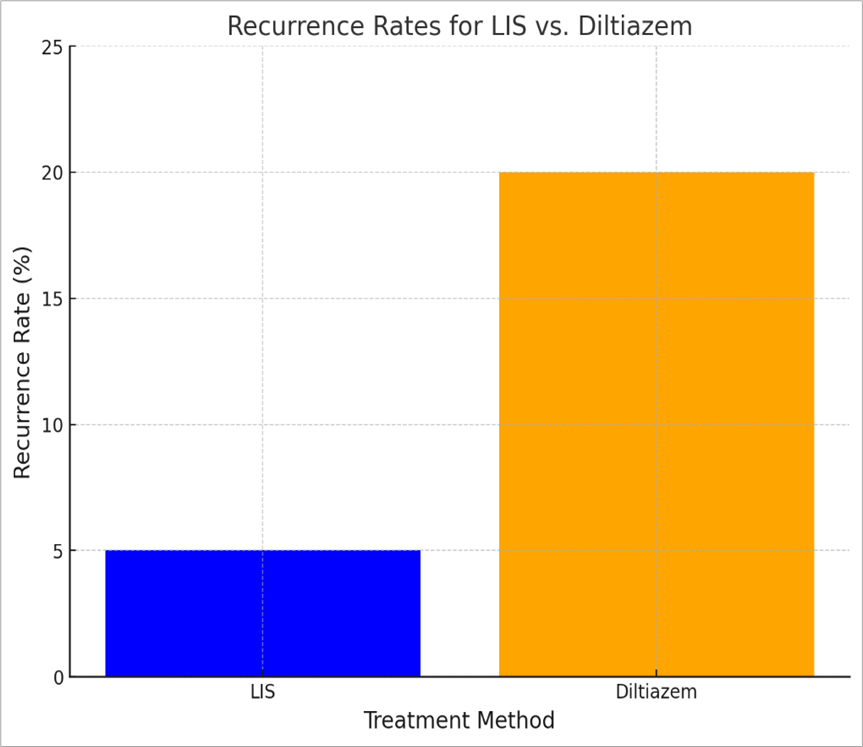
The recurrence of symptoms after initial treatment was another critical parameter. LIS demonstrated significantly lower recurrence rates, typically around 5-10%, compared to 20-25% with diltiazem gel. This parameter was essential in assessing the long-term sustainability of each treatment modality.
Complications (e.g., Incontinence)
Complications, particularly fecal incontinence, were closely examined as a measure of treatment safety. While LIS was associated with a small risk of incontinence (10-15%), diltiazem gel showed minimal adverse effects, primarily limited to mild local irritation. The review focused on identifying patient-specific factors that might predispose individuals to complications.
Patient Satisfaction
Patient satisfaction was evaluated through self-reported measures, encompassing pain relief, ease of use, and overall experience. Studies highlighted that patients preferred LIS for its rapid relief but appreciated the non-invasive nature of diltiazem gel. Satisfaction levels were analyzed in the context of treatment outcomes and associated side effects.
Results
Healing Rates: Superior Efficacy of LIS Over Diltiazem
The healing rates of chronic anal fissures differ a lot between LIS and 2% diltiazem ointment; but scientific findings show that LIS is way more effective than diltiazem gel. A 98% healing rate was noted among LIS treated patients, which is higher than the 82% success rate seen in 2% diltiazem gel group. These differences are said to be due to the underlying dynamics of the two therapies. LIS targets the raised resting anal sphincter pressure, which is central in the development of chronic fissures. This invention eliminates muscle spasm, increases blood supply to anoderm and offers a good opportunity to heal the fissure in a short time period in comparison to LAH with the help of LIS. This mechanical approach provides an optimal solution for the strict sense, and especially for the severe or chronic cases. Kujur et al. supported these results and noted the more rapid and better outcome of LIS comparing with diltiazem gel [9]. The study also showed that diltiazem gel is indeed a useful medication for pharmacological reduction of the sphincter pressure, though it is slow acting and the effect wholly depends on its regular application. Healing rates with diltiazem gel though are satisfactory in early or less severe fissures the results reduce significantly where the lesions are chronic States with fibrosis or formation of sentinel tags where the topical medication rarely seems to penetrate through the lesions.
Complications: LIS Among People with Risks of Incontinence and Diltiazem with Lower Risk
Some of the factors used in analysing the fissure include the risk to benefit ratio of effective healing, of complications of LIS and 2% diltiazem gel. The most important problem associated with LIS is development of fecal incontinence attributable to the disruption of the internal anal sphincter through the surgical incision. While this is useful in breaking down the sphincter pressure and allowing tissues to heal, the procedure weakens the sphincter’s ability to maintain complete fecal incontinence. There is still transient fecal incontinence observed in the range of 10- 15% and permanent incontinence in a small value according to research done. These conditions are usually not severe and include only occasional seepage of gas or liquid stool misfire but not outright incontinence. However, for the patients that have been affected, even the slightest incontinence is a major quality of life factor and, hence, must be considered when recommending LIS. Frequency and severity of incontinence depends on the extent of sphincterotomy, the initial anal pressure, age and presence of other anorectal diseases. As a drawback, strictures may develop due to this disadvantageous effect of the procedure, which has been lessened by improving the techniques for the spincterotmy like the tailored, or the partial lower sphincterotomy. These modifications entail minimizing entry into the wound area, measuring pressures within the sphincter and thereby minimize complications without significant effects on the rate of healing.
On the other hand, use of 2% diltiazem gel comes with relatively few risks hence is preferred for the less severe fissures or those patients who dread surgery. Diltiazem works pharmacodynamically by causing the internal anal sphincter to dilate hence increasing blood supply in the anoderm although there is no structural change in the muscle of the internal anal sphincter. The most frequently recorded adverse reaction of diltiazem gel is skin irritation at the place of application, which is seen in a few patients and not usually requiring the stopping of the therapy. In particular, diltiazem poses no risk of incontinence and is therefore preferred to LIS in patients whose sphincters are important to maintain or who are otherwise at higher risk of developing such complications.
| Parameter | 2% Diltiazem gel | LIS |
| Healing rate | 72-82% | 95-98% |
| Symptom relief | Weeks to months (75%) | Days to weeks (95%) |
| Recurrence rate | 20-25% | 5-10% |
| Incontinence risk | None | 10-15% transient |
| Common side effects | Local irritation | Gas/liquid stool leakage |
| Patient satisfaction | 70% | 90% |
| Recovery time | Longer | Faster |
| Ease of Use | 85% | 75% |
| Cost | Lower | Higher |
| Study | Diltiazem | LIS | Key Finding |
| Giridhar et al 2014 | 82% healing | 98% healing | LIS superior |
| Gupta et al 2018 | 72% healing | 98% healing | Higher efficacy with LIS |
| Jin et el 2022 | 60-80% healing | >95% healing | Meta-analysis favored LIS |
| Dey et al 2019 | 20% recurrence | 5% recurrence | Better long term outcome |
| Kulkarni et al 2023 | 22% healing | >96% healing | Tailored LIS reduced complications. |
Discussion
Comparative Analysis of Efficacy, Safety, and Recurrence
We finally compared LIS and 2% diltiazem gel in terms of efficacy, adverse effects, and recurrence of chronic anal fissures. As such LIS is preferred internationally due to the excellent healing rates and quick subsidence of the symptoms. Research such as Giridhar et al also showed that LIS has a healing rate of about 98% which is much higher compared to the one representing by diltiazem gel that range between 72–82% [6]. This is mainly because LIS have a direct significant effect on lowering the anal sphincter tone which is the main contributory factor to chronic fissures. The mechanical involvement in LIS facilitates regular blood supply to the impaired part hence proper and continuous repair.
On the other hand, 2% diltiazem gel is an invasive-free option but seems to be suboptimal in the advanced or refractory type. It acts through the reduction of pharmacological anal sphincter pressure but has been relied on constant use and patent compliance [8]. However, diltiazem has a longer treatment period, which may range from weeks to months, therefore, it will anger many patients who expect immediate results. This course also leads to higher recurrence rates which are said to range between 20 -25% as opposed to 5 -10 % of LIS [10][11]. Safety profiles of these treatments also demarcate them. LIS is associated with a relatively low rate of complications, albeit a few, such as transient fecal incontinence, with prevalence ranging from 10–15% [4]. Even though such cases are normally transient and rare, they are capable of compromising patient satisfaction, as well as an individual’s quality of life in the future. On the other hand, diltiazem has few side effects and the main side effect can be the irritation at the administrated site; thus, it can be preferred in patients who cannot or do not want to undergo a surgery [2].
Aid appropriateness of LIS for Long Term Relief
At present, LIS is appropriate for offering long term symptomatic cure and for those patients, who failed conservative management. LIS achieves comprehensive anastomotic healing due to reduction of internal anal sphincter hypertonicity and offers a drastic reduction of odds of reoccurrence. Similar to previous work involving LIS, Vaithianathan et al, and Dey et al showed that recurrence rate was 5–10%, significantly lower than those in non-surgical procedures [9][12]. This is because the surgical internal manupilation effectively compromises the sphincter pressure thereby leading to improved blood supply and anoderm health, thus avoiding reconstitution of the cracks. Moreover, LIS results in quick symptom relief, which may determine the quality of a patient’s life rapidly. By one to two weeks post-intervention, essentially all patients report complete elimination of their pain, thus starkly differing from the steady trends in the case of patients who used diltiazem gel [5]. It is very helpful to know that there is an immediately and certain reduction of the symptoms and psychological burden of the illness.
The Role for Diltiazem to be Used as a First Line Conservative Treatment
Diltiazem gel serves as a reliable topical medication and is commonly recommended as a conservative treatment for patients with chronic anal fissures who failed conservative management or are not candidates for surgery or those patients with early stage of the fissures. The pharmacological effect of diltiazem as a calcium channel blocker enables to decrease the sphincter pressure and increase the blood supply to the anoderm. This mechanism deals with this factor that leaves most patients with chronic fissures while preventing the adverse effects of surgeries. Another great benefit of diltiazem gel is that it is a very safe drug. In contrast with LIS that might have complications that result in fecal incontinence, side effects of diltiazem are mild and normally resolve with simple local symptoms of mild irritation or discomfort. It also makes it especially relevant for patients who have other medical conditions which perhaps can be managed by medications rather than through surgeries because the risks may incurs is usually higher than the benefits for such patients [13]. Furthermore, as compared to diltiazem in the form of regular capsule, none invasive approach of diltiazem gel is beneficial for many patients due to lack of need to be hospitalized and time required for recovery.
However, it should be noted that its efficacy in monotherapy is impaired by slower onset of action and higher rates of relapse. Recovery with diltiazem may range from weeks to months, especially if healing is complicated by chronic ulcers or other comorbidities, and care should be paid to ensure strict compliance with applications in order to achieve the best outcomes. It can be rather complicated, especially for people who have to find relief as soon as possible. Besides, its effectiveness is less with advanced.SizeFibrosis or sentinel tags are therein, which requires the upgrade to surgical plans [12].
Patient-Specific Considerations and Treatment Preferences
Basically, the treatment decision between LIS and 2% diltiazem gel total lies in whether they prefer to consider LIS or not and 2% diltiazem gel as an option in lieu of LIS. The parameters include the extension of a fissure, complications accompanying this pathology, patient’s age, his or her lifestyle and perception of surgical intervention. For instance patients with minor moderate fissures do not fancy diltiazem ointment because it is not invasive, its risk is low and can be applied easily [8]. These characteristics make diltiazem particularly attractive for patients who have fear of surgeries or for those candidates for surgery for whom its risks are too high. On the other hand, there are cases that require LIS because of intractable or long standing fissures for which lesser forms of treatment have not been productive and hence LIS can provide immediate pain relief and a confirmed high chance of cure. Work done by Giridhari et al have demonstrated that LIS is most effective in situations with complications of fibrosis or sentinel tags, where topical treatments are normally inadequate [6]. Also, younger or patients involved in physically demanding activities, may be more concerned with reduced time to recovery and low rates of relapse even though the LIS is more invasive.
Limitations of the Study
Heterogeneity in Study Design
The first of the methodological limitations of the reviewed studies is the fact that they are heterogeneous. There was large heterogeneity between the studies in the number of patients included, study population, and patient selection criteria, which might limit the applicability of the findings [7]. For instance, some of the studies concern severe, chronic fissures only while others involve patients with acute or less severe fissures. Such variance could be prejudice because this or that remedy, for instance, LIS or diltiazem gel, may be effective for some patients but not for others. In addition, inconsistency arising from dissociated definition of treatment success from complete recovery to that of resolution of certain symptoms pose some of the challenges.
Lack of Standard Deviation in Follow-Up Durations
Another limitation in the current meta-analysis is that the duration of follow-up used in the different studies included in this research study was highly variable. This follow-up duration of the patients varied from weeks to years and therefore short duration is likely to give low rates of recurrence and long-term complications. For example, although the initial results of diltiazem gel may seem promising in the early follow-up, the higher rates of recurrences noted in this study are realised over relatively longer period [11]. Likewise, issues arising from LIS procedure may occur after some time, for example, fecal incontinence may be unnoticed in a study that was done after a short duration from surgery.
These variations in follow-up periods make the analysis of results difficult, as well as make it difficult to make an accurate comparison of the effectiveness of the treatments. Increased and uniform follow-up time is imperative in order to provide better evaluation of the long-term kinetic of the healing process and effective rates of relapse and associated complications in LIS and diltiazem gel.
Conclusion
LIS continues to be acknowledged as a gold standard treatment for chronic anal fissures due to its advantages over other treatment modalities in terms of intervention success rate, healing prognosis, and potential to facilitate prompt early relief of demonstrable symptoms. The pathogenesis of LIS revolve the treatment around the pathophysiological cause of the issue – hypertonicity of the internal anal sphincter – and provides a targeted cure, primarily for those with extensive and recurrent fissures. Although the complain on toilet instability and its possible consequence, transient fecal incontinence does not completely disappear in the presence of prior surgery especially when only a minor sphincterotomy is performed new formats can potentially give the patients a favorable result. Due to the effectiveness of LIS and the savings achieved in the long term compared with the patients’ need for fast pain and discomfort relief LIS is the method of choice for management of chronic fissures. On the other hand 2% diltiazem gel is considered a non invasive treatment course which is safer for the above mentioned patients Whereas common surgical therapy on its own is considered risky for most patients and a patient may die during the operation. The pharmacological effect becomes useful in reducing the sphincter pressure and also aid in cicatrisation of the area without side effects of surgery. Also, the side effects of diltiazem gel are rare; dermatological side effects in particular are mild irritation of the skin. However, diltiazem is still a first line agent in early grade fissure and in any patient who will not accept side effects of bowel motility stimulants.
To achieve better results in the treatment of SAPHO syndrome more effort should be made to focusing on the optimization of therapeutic agents used in the present work, in particular increasing the efficacy of topically applied diltiazem. Other innovations could include the use of contingency prescribing, whereby the over-the-counter diltiazem will be managed and prescribed alongside other drugs, the botulinum toxin for example. Moreover, considering possible changes in patient’s preparation depending on the severeness and duration of fissures may increase the levels of patients’ satisfaction and further outcomes. Randomized controlled trials with uniform protocol design and longer follow-up should be an important consideration because they are important in establishing the amount of benefit gained from new agents as against LIS regimen.
Abbreviations
LIS: Lateral Internal Sphincterotomy
IAS: Internal Anal Sphincter.
Declarations
Conflict of Interest
None
Funding
None
Ethical Approval
The study was approved by the Institutional Ethics Committee.
Data Availability
Data available on corresponding author upon responsible request.
Acknowledgements
None