Introduction
Drug-induced, or toxic, myopathy refers to acute or subacute muscle symptoms, including weakness, myalgia, CPK elevation, or myoglobinuria, in patients without primary muscle disease following drug exposure [1]. Organellar damage, particularly mitochondrial toxicity, is the most probable mechanism. Statins, or 3-hydroxy-3-methylglutaryl-coenzyme A (HMG-CoA) reductase inhibitors, are among the most frequently implicated drugs, with myalgia being the most commonly reported adverse event, even in the absence of CPK elevation [2][3]. Symptoms range from mild myalgia to life-threatening rhabdomyolysis, typically developing within weeks to months of therapy and resolving upon discontinuation. Differentiating severe statin toxicity from immune-mediated necrotizing myopathy (IMNM) is challenging, especially in elderly patients with multiple comorbidities. Early identification is crucial, as drug-induced myopathies are often reversible if managed promptly. Risk stratification and predictive care models are now favored to mitigate such complications [4].
Case Report
A 76-year-old South Asian woman with hypertension presented with four days of sudden-onset fatigue, low back pain, and bilateral knee pain. She reported progressive weakness and inability to perform daily activities, with pain radiating to both thighs worsening on exertion. She had an inferior wall myocardial infarction in February 2024 and had been started on atorvastatin, increased to 80 mg 7–10 days before admission. Other medications included telmisartan 40 mg, ticagrelor 90 mg, and carvedilol 3.125 mg.
On examination, she was oriented with BP 130/80 mmHg, pulse 76 bpm, respiratory rate 18/min, and oxygen saturation 96% on room air. Neurological evaluation revealed significant bilateral proximal muscle weakness (upper limb 2/5; lower limb 0/5), with normal tone, reflexes, and sensory function.
Initial laboratory work-up showed elevated serum creatinine, deranged liver enzymes, and CPK of 8475 U/L. Echocardiography revealed basal inferior wall hypokinesia and left ventricular hypertrophy. Abdominal ultrasonography noted gallbladder sludge and increased renal cortical echogenicity. Hypoxia and severe presentation prompted early consideration of IMNM; high-resolution Computed Tomography (CT) showed patchy right lower lobe consolidation. Hepatitis viral markers were negative (Table 1).
| Parameter | Peak Value / Range | Reference Range | Clinical Interpretation |
| Creatine Kinase (CPK) | 8,475 → 79,600 IU/L | 26–192 IU/L | Severe muscle breakdown |
| Serum Creatinine | 1.54 mg/dL | 0.6–1.2 mg/dL | Acute kidney injury |
| AST/ALT | AST 1,665 U/L | 0–33 U/L | Muscle + liver involvement |
| Urine Myoglobin | 2,605 µg/L | 0–1,000 µg/L | Rhabdomyolysis |
| Anti-Jo-1 Antibody | Borderline | Negative | Non-specific, IMNM overlap? |
| Anti-HMG-CoA Reductase Ab | Negative | Negative | Statin-induced myopathy |
| Hepatitis, Dengue, Lepto | Negative | Negative | Infectious causes excluded |
| HbA1c | 7.1% | <5.7% | Diabetes, risk factor |
Work-up for autoimmune and infectious causes included Anti-Nuclear antibody (ANA), anti-HMG-CoA reductase antibody, and a myositis panel. Urine myoglobin was elevated (2605 µg/L), consistent with rhabdomyolysis-induced acute kidney injury. While awaiting results, statins were discontinued, and she received pulse methylprednisolone for five days, followed by oral prednisolone (50 mg/day), along with supportive care including oxygen, antibiotics, hydration, hepatoprotective agents, and dual antiplatelet therapy. This protocol was adopted to promptly address the potential for IMNM.
Three days later, the panel showed borderline anti-Jo-1 positivity, but negative anti-HMG-CoA reductase and other myositis antibodies confirmed severe toxic statin myopathy. Establishing this diagnosis was critical, as it significantly influences management and prognosis. Corticosteroids were tapered after pulse therapy, considering potential hypothalamic-pituitary-adrenal (HPA)-axis suppression. Serial CPK peaked at 79,600 U/L before declining. (Figure 1). The patient showed marked motor improvement after statin cessation, and physiotherapy was initiated.
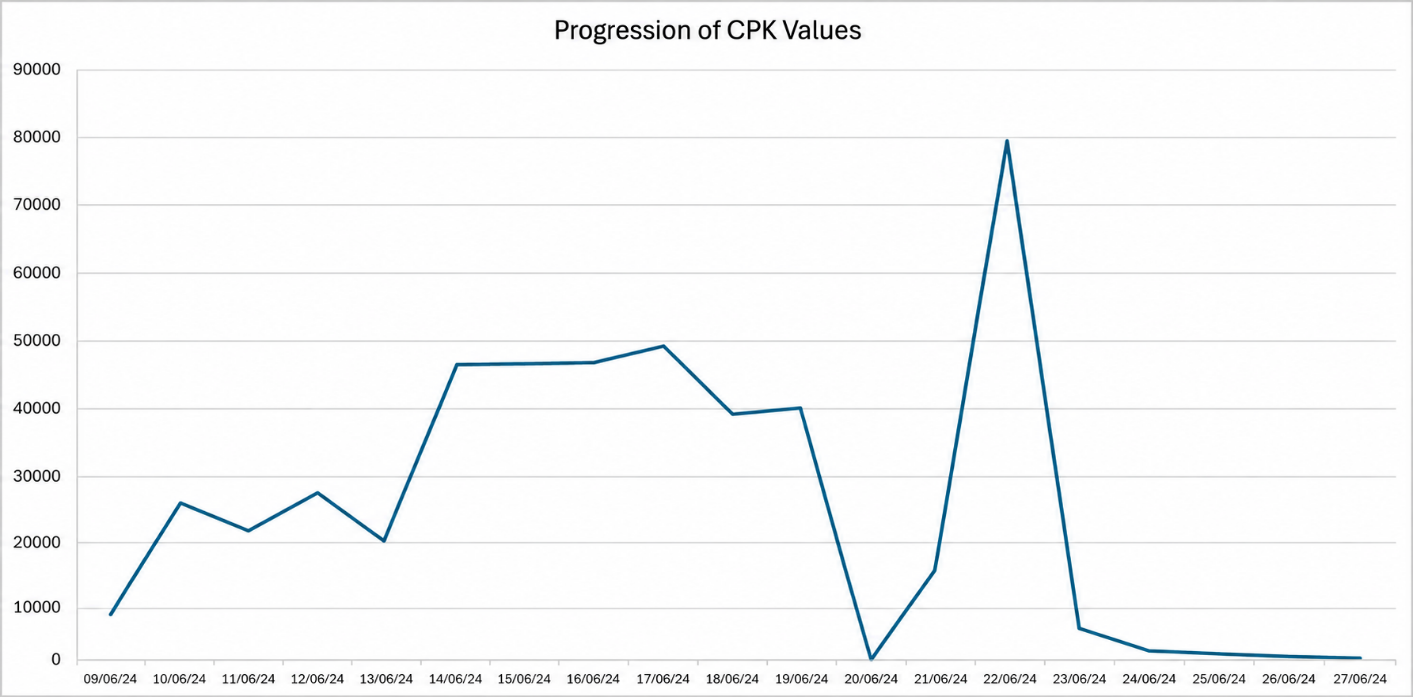
During admission, glycated hemoglobin (HbA1c) was 7.1%, prompting initiation of oral hypoglycemics. She was discharged after 26 days with a tapering prednisolone regimen (40 mg → 30 mg → 20 mg, weekly). Dual antiplatelet therapy and carvedilol were continued, given her acute coronary syndrome history. Dabigatran 110 mg twice daily was maintained per geriatric atrial fibrillation dosing guidelines. Sevelamer 50 mg thrice daily was started for hyperphosphatemia. She was counseled on physiotherapy, diabetic diet adherence, annual fundoscopy, and referred for non-statin lipid-lowering therapy review, but was lost to follow-up.
Discussion
Statin-associated muscle symptoms (SAMS) affect about 5% of patients, ranging from mild myalgia to rhabdomyolysis [4]. Myotoxicity mechanisms include mitochondrial dysfunction, autoimmune activation, and electrolyte disturbances [5][6]. Muscle tissue is particularly vulnerable due to its high perfusion and metabolic demand [7].
Differential diagnoses include endocrine disorders (hypothyroidism, hyperparathyroidism), genetic myopathies (Becker’s, Duchenne’s), metabolic disorders (glycogen or lipid storage diseases), and inflammatory myopathies (polymyositis, dermatomyositis) [8]. Steroid-induced myopathy was ruled out, as it usually presents with painless proximal weakness and normal CPK, unlike this patient. Although elevated CPK is a useful marker, normal levels do not exclude myopathy [9]. Muscle biopsy is often needed to confirm the diagnosis, but may be deferred in responsive cases.
Cerivastatin was historically the most myotoxic statin, but all statins carry some risk, particularly at higher doses. In the Study of the Effectiveness of Additional Reductions in Cholesterol and Homocysteine (SEARCH) trial, simvastatin-associated myopathy was linked to solute carrier organic anion transporter family member 1B1 (SLCO1B1) gene variants encoding the hepatic statin transporter Organic anion transporting polypeptide 1B1 (OATP1B1); homozygotes for reduced-function alleles had a 16.9-fold increased risk [10]. This pharmacogenomic insight supports personalized statin therapy.
In this case, atorvastatin was the likely causative agent. Differentiating IMNM from toxic statin myopathy was critical. While IMNM was initially suspected due to severe presentation, negative anti-HMG-CoA reductase antibody and dramatic response to statin withdrawal supported toxic statin myopathy. Despite high CPK levels, muscle strength and renal function improved with early intervention, further supporting this diagnosis.
Management includes immediate discontinuation of the offending statin, initiation of steroids in immune-mediated cases, aggressive hydration, hepatoprotection, and physical rehabilitation [9][10]. Statins should be replaced with alternative lipid-lowering strategies in high-risk individuals. In this patient, ezetimibe was considered, but long-term follow-up was not possible. A statin rechallenge was avoided, given age and presentation severity. All steps were consistent with European Society of Cardiology/ American Heart Association (ESC/AHA) SAMS guidelines.
Conclusion
Statin-induced myopathy, though uncommon, can be severe and disabling. This case highlights the importance of vigilance when prescribing high-dose statins, particularly in elderly patients with comorbidities. Differentiating IMNM from toxic myopathy, prompt diagnosis, drug cessation, and timely initiation of immunosuppressive and supportive therapies can lead to full clinical recovery.
List of abbreviations
Creatine kinase (CPK),
Immune-mediated necrotizing myopathy (IMNM)
Anti-3-hydroxy-3-methylglutaryl-coenzyme A (anti-HMG CoA)
3-hydroxy-3-methylglutaryl-coenzyme A (HMG-CoA)
Computed Tomography (CT)
Anti-Nuclear antibody (ANA)
Hypothalamic-pituitary-adrenal (HPA)
Glycated hemoglobin (HbA1c)
Statin-associated muscle symptoms (SAMS)
Study of the Effectiveness of Additional Reductions in Cholesterol and Homocysteine (SEARCH)
Solute carrier organic anion transporter family member 1B1 (SLCO1B1).
Organic anion transporting polypeptide 1B1 (OATP1B1)
European Society of Cardiology/ American Heart Association (ESC/AHA)
Declarations
Ethics approval and consent to participate
Written informed consent was obtained for participation in the study and use of the patient data for research and educational purposes. The procedures followed the guidelines laid down in the Declaration of Helsinki 1964, and as revised later.
Institute’s name – Ramaiah Medical College, Ramaiah University of Applied Sciences
Ethics committee – REG NO. ECR/215/INST/KA/2013/RR-22
Data Availability
All laboratory values and data have been embedded in the case report.
Conflicts of Interest
None
Funding Statement
None
Authors' contributions
Dr. Shaikh Mohammed Aslam: Principal idea and methodology, data analysis and interpretation, manuscript writing, proofreading and editing.
Dr. Mohammed Suhail K: Principal idea and methodology, data collection, data analysis and interpretation, manuscript writing, proofreading and editing
Dr. Pranav Bharadwaj Arun: Principal idea and methodology, data collection, data analysis and interpretation, manuscript writing, proofreading and editing
Dr. Ashwin Kulkarni: Principal idea and methodology, data analysis and interpretation, manuscript writing, proofreading and editing.
Acknowledgments
None
Supplementary Materials
None