Introduction
Nephrolithiasis is one of the most common urological disorders worldwide, characterized by renal calculi. Approximately 106 million new cases were reported worldwide in 2021, with an increase of 27% since 2000, predominantly in men [1]. Dietary and metabolic environmental factors are major contributors to the increasing prevalence of nephrolithiasis [2]. Percutaneous nephrolithotomy (PCNL) is the preferred surgical treatment for large kidney stones (>2 cm) and staghorn calculi. It is also commonly used for upper-tract calculi not responding to other treatments, cystine stones, lower pole stones, stones in anatomically abnormal kidneys, and stones resistant to extracorporeal shock wave lithotripsy [3, 4]. PCNL has evolved significantly since its introduction in the 1970s, in terms of instrumentation, imaging, and operative technique, resulting in better patient outcomes [5]. The prone position in PCNL has been the conventional approach, as the risk of colonic injury due to anatomical displacement of abdominal viscera is reduced [6]. This position also permits better access to the upper pole calyces, enabling a direct puncture tract aligned with the posterior calyceal system [7]. Despite these advantages, there are limitations associated with prone PCNL, including difficulty in airway management, longer patient positioning time, and hemodynamic instability in patients with cardiopulmonary comorbidities or obesity [8][9]. The supine position for PCNL gradually gained popularity, introduced to overcome these limitations [6][10]. The advantages of supine PCNL, including easier anesthetic management, optimum cardiovascular and airway control, reduced operative time, and the possibility of simultaneous retrograde intrarenal surgery, were first described by Valdivia et al. [11]. This position also reduces intrarenal pressure and the risk of sepsis, facilitating spontaneous drainage of irrigating fluid [12]. Moreover, it eliminates the need for patient repositioning after anaesthesia induction, thereby reducing operative time and logistical complexity. Despite these benefits, supine PCNL has raised concerns about accessing the upper pole calyces, as increased renal mobility can complicate kidney puncture and tract dilation [10]. Although prone PCNL is effective, it can be less suitable for patients with morbid obesity, compromised cardiopulmonary function, and skeletal deformities [8]. Several meta-analyses and comparative studies have assessed supine versus prone PCNL, but the findings remain inconsistent. Few studies report similar stone-free rates between the two positions, while others recommend slightly higher clearance rates in prone PCNL, particularly for complex or multiple calyceal stones [13][14]. Hence, this study provides a retrospective comparative analysis of supine versus prone PCNL with respect to operative time, stone clearance rate, postoperative complications, and overall safety profile.
Methods
Study design
This retrospective comparative observational study was conducted at the Institute of Nephro Urology over a period of one year.
Inclusion and exclusion criteria
Patients (aged ≥18 years; of either sex) undergoing PCNL for renal calculi in either supine or prone position, with kidney stones >2 cm or staghorn calculi, with available hospital records including operative and postoperative data, and considered fit for surgery under general or regional anesthesia were included in the study. Patients aged <18 years with congenital abnormalities (e.g., horseshoe kidney, ectopic kidney), with uncorrected coagulopathy or bleeding disorders, and having incomplete medical records or missing key perioperative data were excluded from the study. Those having urinary tract infection at the time of surgery, undergoing PCNL combined with other major urological procedures, and converted to open surgery or other alternative procedures intraoperatively were also excluded.
Data collection
Patients’ demographics, including age, gender, body mass index (BMI), stone size, location (renal pelvis, calyx, or staghorn), and comorbidities (diabetes and hypertension), were recorded. Preoperative parameters (hemoglobin, patient positioning (supine or prone), surgery time, number of access tracts, fluoroscopy time), and intraoperative parameters (bleeding, perforation, need for blood transfusion) were recorded.
Statistical analysis
Data were analyzed using the Statistical Package for the Social Sciences (SPSS) and GraphPad Prism software. Continuous variables were presented as mean (standard deviation), whereas categorical variables were presented as count (percentage). Two-sample t-tests were used to compare between groups. Categorical data were compared using chi-square tests, with Fisher’s exact test applied in lesser cell counts. A P value of <0.05 was considered statistically significant.
Results
A total of 100 patients were included in the present study, of which 50 were in group A (Supine PCNL) and the remaining 50 in group B (Prone PCNL). The mean age of patients was comparable between both groups (48.3 years vs. 46.7 years; P=0.57). Patients aged 51-60 years were significantly higher in group A compared to group B (34.0% vs. 14.0%; P=0.003). The mean BMI was 26.8 (5.7) kg/m² in group A and 27.4 (4.3) kg/m² in group B (P=0.57). The distribution of the side of stone involvement did not differ significantly between the two groups (P=0.18). In group A, 10.0% of patients had bilateral stones, 40.0% had left-sided stones, and 50.0% had right-sided stones. In group B, 20.0% of patients had bilateral stones, 46.0% had left-sided stones, and 34.0% had right-sided stones. The mean size of stones was comparable between both groups (P=0.177) (Table 1).
| Parameters | Group A (n=50) | Group B (n=50) | P value |
| Age (years), mean (SD) | 48.3 (13.4) | 46.7 (13.7) | 0.57 |
| Age (years) | 0.028 | ||
| ≤20 | 0 | 2 (4.0) | |
| 21-30 | 7 (14.0) | 1 (2.0) | |
| 31-40 | 9 (18.0) | 16 (32.0) | |
| 41-50 | 9 (18.0) | 14 (28.0) | |
| 51-60 | 17 (34.0) | 7 (14.0) | |
| 61-70 | 7 (14.0) | 8 (16.0) | |
| 71-80 | 1 (2.0) | 2 (4.0) | |
| Sex | 0.836 | ||
| Male | 32 (64.0) | 31 (62.0) | |
| Female | 18 (36.0) | 19 (38.0) | |
| BMI (kg/m²), mean (SD) | 26.78 (5.7) | 27.36 (4.3) | 0.566 |
| Side | |||
| Bilateral | 5 (10.0) | 10 (20.0) | 0.183 |
| Left | 20 (40.0) | 23 (46.0) | |
| Right | 25 (50.0) | 17 (34.0) | |
| Size of stone (mm), mean (SD) | 14.31 (7.3) | 16.74 (10.2) | 0.177 |
| Data presented as n (%), until unless otherwise specified. BMI, body mass index; SD, standard deviation. |
The distribution of stone positions significantly differed between the two groups (P=0.037). In group A, the most common positions of stones were renal pelvis (16.0%), proximal ureter (14.0%), and pelviureteric junction (12.0%). In group B, renal calculi (24.0%) and staghorn calculi (20.0%) were the most common positions of the stone (Table 2).
| Parameter | Category | Group A (n=50) | Group B (n=50) | P value |
| Position of Stone | B/L renal calculi | 1 (2.0) | 1 (2.0) | 0.037 |
| Distal ureter | 0 | 1 (2.0) | ||
| Inter and upper pole | 1 (2.0) | 0 | ||
| Left lower pole | 0 | 1 (2.0) | ||
| Left PUJ and right renal | 0 | 1 (2.0) | ||
| Lower calyx | 3 (6.0) | 2 (4.0) | ||
| Mid calyx | 1 (2.0) | 1 (2.0) | ||
| Mid ureter | 0 | 2 (4.0) | ||
| Multiple calculi | 2 (4.0) | 0 | ||
| Proximal and distal ureter | 1 (2.0) | 0 | ||
| Proximal ureter | 7 (14.0) | 4 (8.0) | ||
| PUJ | 6 (12.0) | 5 (10.0) | ||
| PUJ and pelvis | 3 (6.0) | 0 | ||
| Renal and lower pole | 0 | 1 (2.0) | ||
| Renal + distal ureter | 1 (2.0) | 0 | ||
| Renal calculi | 2 (4.0) | 12 (24.0) | ||
| Renal pelvis | 8 (16.0) | 4 (8.0) | ||
| Right and left multiple calculi | 1 (2.0) | 0 | ||
| Right kidney | 1 (2.0) | 0 | ||
| Right lower pole calyx | 1 (2.0) | 0 | ||
| Right proximal ureter and left renal pelvis | 1 (2.0) | 0 | ||
| Right PUJ | 3 (6.0) | 0 | ||
| Right PUJ and left renal | 1 (2.0) | 1 (2.0) | ||
| Right renal and left proximal | 1 (2.0) | 2 (4.0) | ||
| Staghorn calculi | 1 (2.0) | 10 (20.0) | ||
| Upper pole | 2 (4.0) | 2 (4.0) | ||
| Upper ureter | 2 (4.0) | 0 | ||
| Data is presented as n (%). PUJ, pelvi-ureteric junction. |
The number of puncture attempts was comparable between the two groups (P=0.15). In group A, most patients underwent a single puncture (96.0%), while 2 patients (4.0%) required two punctures. In group B, all patients (100.0%) underwent a single puncture. The mean operative time was 75.0 (32.9) minutes in group A and 71.0 (25.4) minutes in group B (P=0.50) (Table 3).
| Variable | Group A (n=50) | Group B (n=50) | P value |
| Puncture attempts | 0.153 | ||
| 1 | 48 (96.0) | 50 (100.0) | |
| 2 | 2 (4.0) | 0 | |
| Operative time (mins), mean (SD) | 75.0 (32.9) | 71.0 (25.4) | 0.498 |
| Data presented as n (%), until unless otherwise specified. |
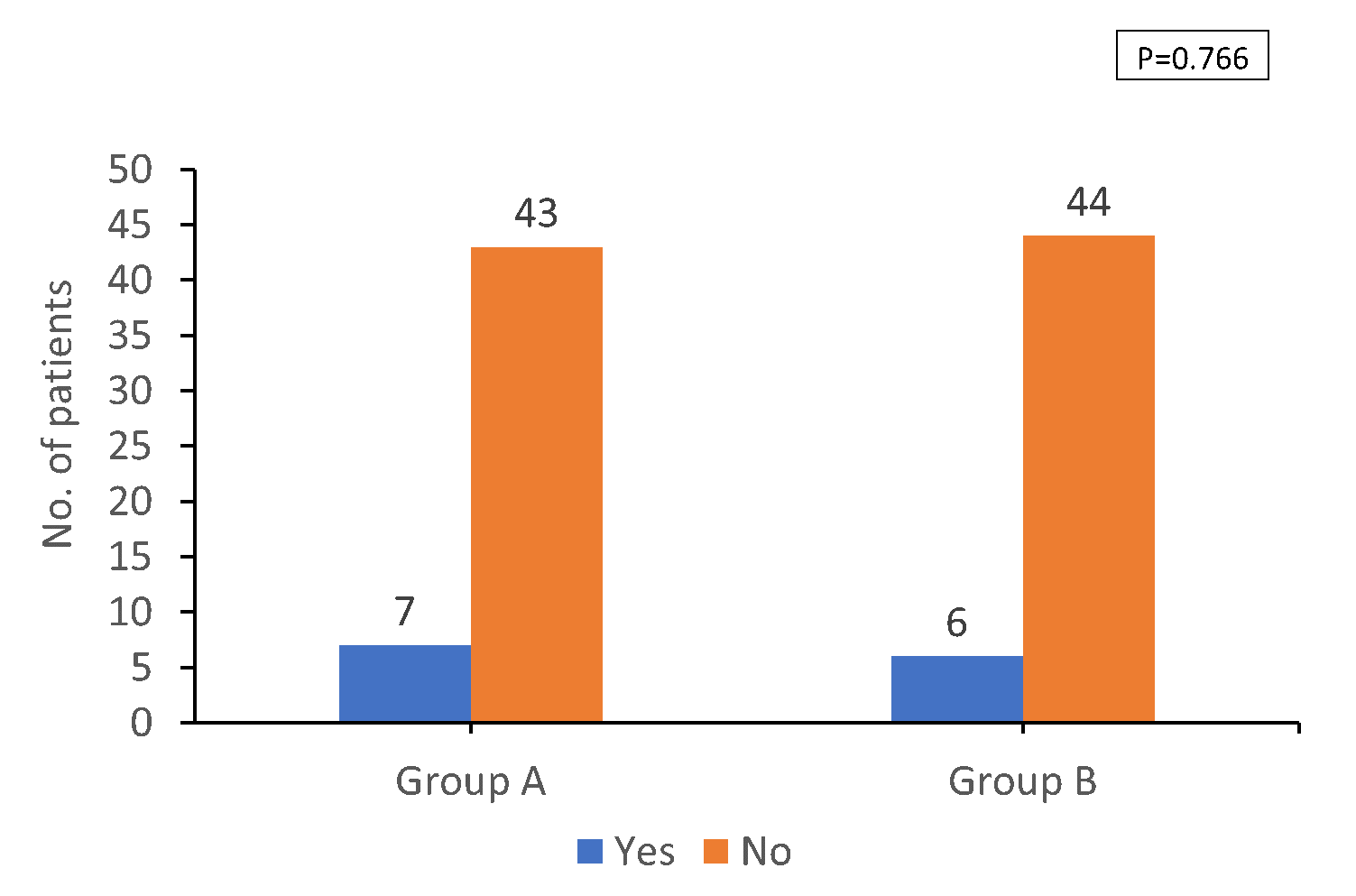
Post-operative blood transfusion rates were comparable between the two groups, showing no significant difference (P=0.766). In group A, 86.0% did not require transfusion, while 14.0% received transfusion. Similarly, in group B, 88.0% did not require transfusion, and 12.0% received a transfusion (Figure 1).
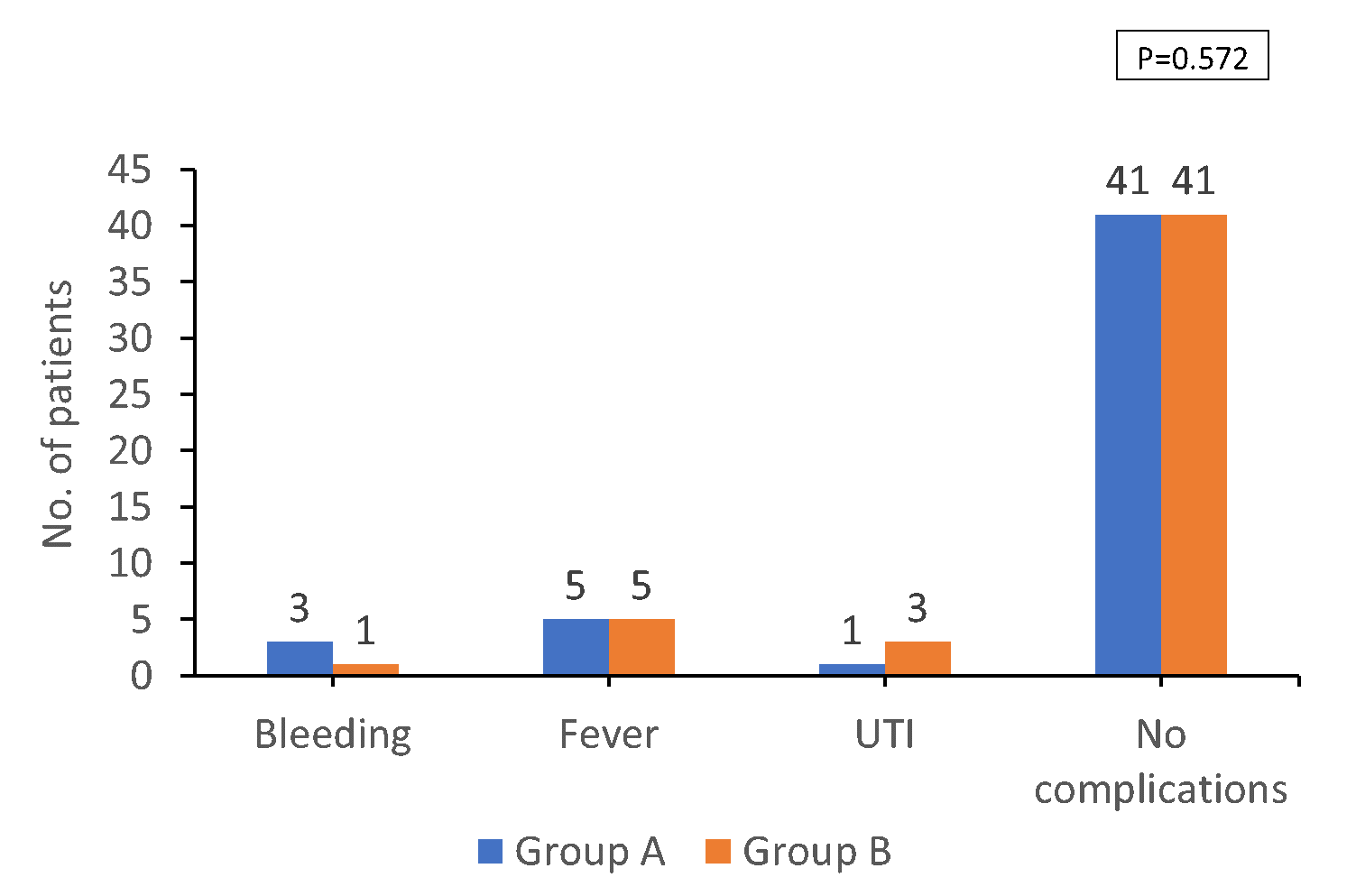
Post-operative complications were also comparable between the two groups, with no significant difference (P=0.572). In group A, 82.0% had no complications, 6.0% experienced bleeding, 10.0% developed fever, and 2.0% developed a urinary tract infection (UTI), while in group B, 2.0% experienced bleeding, 10.0% developed fever, and 6.0% developed a UTI (Figure 2).
Discussion
Prone PCNL has been a well-known technique for many years. Supine PCNL has also been proven to be an effective alternative since its introduction, as described by Valdivia et al. [11]. However, evidence remains limited for supine and prone PCNL in patients with complex renal stone disease and challenging anatomical variations [15].
The present study included 100 patients, divided equally between supine and prone PCNL groups. Patient age and the presence of comorbidities can influence patient positioning during PCNL surgery [8, 11]. In the present study, a significant difference in age distribution was observed (P=0.03), with most patients aged 51-60 years in the supine group and 31-40 years in the prone group. Valdivia et al. also reported that for supine PCNL, the age group (51 years) is older than for prone PCNL (48.8 years) [11]. In the present study, the ratio of males and females was similar between the two groups (P=0.84). In contrast, a previous study reported that male patients were significantly higher in both groups compared to female patients (P=0.002) [11].
In the present study, stone laterality (P=0.18) and stone size (P=0.18) did not differ significantly between groups, with stone position showing significant differences (P=0.04). Mondal et al. showed comparable stone laterality and stone positions between supine and prone PCNL [16]. Also, previous studies reported that the mean stone size did not differ between prone and supine groups, supporting the present findings [16][17].
In the current study, most patients required only a single puncture during PCNL surgery, and there were no significant differences between the two groups (P=0.153) for the number of punctures required during the surgery. In accordance with the current results, a previous study also reported that careful preoperative imaging reduces puncture requirements [18]. Postoperative blood transfusion rates were comparable in the present study (P=0.77), supported by a meta-analysis that revealed no significant difference in blood transfusion between prone and supine position in a PCNL surgery [19].
Postoperative complications were similar between groups (P=0.572), with bleeding, fever, and UTI being the most frequent events, corroborating previous findings [19][20] that complication rates are influenced by surgeon experience and stone characteristics rather than patient position.
This study has a few limitations that should be considered. First, its retrospective design may introduce selection bias and limit the ability to establish causal relationships. Second, the relatively small sample size may affect the generalizability of the findings.
Conclusion
Supine PCNL demonstrated a trend toward shorter operative time, with comparable blood transfusion rates and postoperative complications. These findings indicate that supine PCNL offers similar perioperative outcomes to prone PCNL, and the choice of position may be guided by patient characteristics and surgeon preference.
Declarations
Ethical Clearance
This was a retrospective analysis for which ethics committee approval was not considered necessary.
Conflict of Interest
The authors declare that they have no conflict of interest
Funding/ financial support
None
Contributors
Narendra JB and Ramanahalli SK contributed to the concept and design of the study, contributed to acquisition of data. Narendra JB and Ramanahalli SK participated in data analysis and interpretation of data, also involved in drafting the manuscript and critical revision. All authors critically reviewed the manuscript and provided approval on the final draft being submitted, and take complete responsibility of data accuracy. All authors met the International Committee of Medical Journal Editors (ICMJE) authorship criteria and all those who met the ICMJE authorship criteria are listed as authors.
Acknowledgements
None