Introduction
Enhanced Recovery After Surgery (ERAS), also referred to as fast-track surgery, is a systematised, multimodal perioperative management programme designed to reduce the physiological and psychological stress of surgery. ERAS principles encompass preoperative patient optimisation and counselling, goal-directed intraoperative fluid management, multimodal opioid-sparing analgesia, and structured postoperative rehabilitation, including early enteral nutrition and ambulation. By attenuating the neuroendocrine surgical stress response and maintaining physiological homeostasis, ERAS pathways reduce postoperative organ dysfunction, shorten recovery time, decrease complication rates, and may lower direct healthcare costs.
The ERAS concept was first described by Kehlet in 1997 in the context of colorectal surgery, demonstrating significant reductions in postoperative complications and length of hospital stay without an increase in readmission or mortality rates [1]. Subsequently, ERAS protocols have been adapted and prospectively validated across a broad range of surgical subspecialties, including hepatobiliary and pancreatic surgery [2][3].
Pancreaticoduodenectomy (PD), commonly referred to as the Whipple procedure, remains among the most complex abdominal operations, involving simultaneous reconstruction of the biliary, pancreatic, and gastrointestinal tracts. Improvements in surgical technique, anaesthesia, and perioperative care have reduced 30-day mortality to below 5% at high-volume centres; [4][5] however, postoperative morbidity remains considerable, ranging from 30% to 60%. Major drivers of morbidity include DGE, POPF, post-pancreatectomy haemorrhage (PPH), and wound-related complications, all of which prolong hospital stay, increase resource utilisation, and adversely affect oncological treatment timelines.
The 2019 ERAS Society guidelines for pancreaticoduodenectomy provide an evidence-based framework for perioperative care in PD; [3] however, institutional adoption remains variable and prospective data from tertiary centres in South Asia are limited. Furthermore, existing cohort studies require confirmation through prospective randomised controlled research. The present study was designed to prospectively describe perioperative outcomes following implementation of an institutional ERAS protocol in patients undergoing elective PD. Primary endpoints were postoperative morbidity (DGE and POPF) and length of hospital stay; secondary endpoints included PPH, 30-day re-intervention rate, 30-day readmission rate, and in-hospital mortality. The potential economic implications of a shorter hospital stay are of relevance to tertiary surgical centres in resource-constrained settings, although no cost or resource-utilisation analysis was undertaken in this study, and these findings are intended to serve as pilot data to inform future randomised controlled trials. This prospective cohort study has been reported in line with the STROCSS 2024 guidelines [6].
Methods
Study Design and Setting
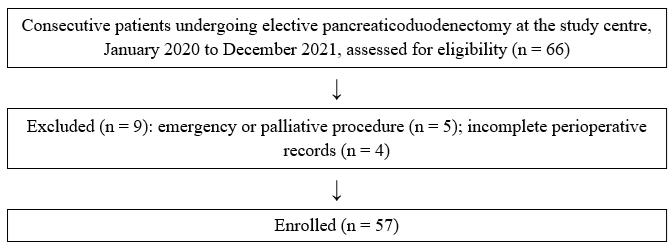
This prospective observational single-centre cohort study was conducted at the Department of Surgical Gastroenterology, Apollo Hospitals, Greams Road, Chennai, India (a tertiary care academic medical centre), between January 2020 and December 2021. All consecutive patients undergoing elective PD during the study period were evaluated for eligibility. The study was approved by the Institutional Ethics Committee, Apollo Hospitals, Chennai (EC Reg. No.: EC/NEW/INST/2020/527; IEC No.: AMH-DNB-022/02/21), and conducted in compliance with the World Medical Association Declaration of Helsinki, ICH-GCP guidelines, and ICMR National Ethical Guidelines 2017. Written informed consent was obtained from all participants.
Eligibility Criteria and Sample Size
Patients aged ≥18 years undergoing elective PD for any indication were eligible. Exclusion criteria were: (i) emergency or palliative procedure; (ii) American Society of Anesthesiologists (ASA) physical status ≥IV; and (iii) incomplete perioperative records. A total of 57 patients met the inclusion criteria and were enrolled.
As this was a prospective single-arm observational study designed to describe outcomes of a newly implemented institutional ERAS protocol, no formal a priori sample-size calculation was performed. The sample comprised all consecutive eligible patients over the two-year study period, representing the complete institutional census for the study period. Accordingly, the study was designed as a descriptive pilot study.
ERAS Protocol
The institutional ERAS protocol was developed in accordance with the 2019 ERAS Society guidelines for pancreaticoduodenectomy [3] and comprised standardised preoperative, intraoperative, and postoperative elements (Table 1). Compliance with each element was documented prospectively in a dedicated perioperative data sheet.
| Timing | ERAS Protocol Elements |
| Preoperative | Optimisation of comorbidities and nutritional status; preoperative counselling and patient education; incentive spirometry/prehabilitation; no mechanical bowel preparation; normal oral diet until 6 h before surgery; clear fluids until 2 h before surgery |
| Day of surgery | Antimicrobial prophylaxis within 60 min of skin incision; antithrombotic prophylaxis (compression stockings + LMWH); thoracic epidural analgesia; insertion of central venous line, nasogastric tube, urinary catheter, and intra-abdominal drains; active normothermia maintenance (forced-air warming) |
| POD 1 | Early ambulation; chest and limb physiotherapy; nasogastric tube removal (if no DGE); LMWH continuation; goal-directed intravenous fluid restriction; initiation of feeding jejunostomy feeds |
| POD 2 | Removal of thoracic epidural catheter and urinary catheter; initiation of oral liquid diet; progressive mobilisation |
| POD 3 | Removal of intra-abdominal drains if drain fluid amylase <3× ULN and output <30 mL/day |
| POD 4 | Initiation of oral solid diet; assessment for early discharge criteria |
DGE: delayed gastric emptying; LMWH: low-molecular-weight heparin; POD: postoperative day; ULN: upper limit of normal.
Surgical Technique
All procedures were performed by experienced hepatobiliary and pancreatic surgeons under general anaesthesia via midline laparotomy and bilateral subcostal (rooftop) extension, using the classic pylorus-resecting technique.
Resection: Standard Kocher manoeuvre, followed by dissection of the hepatoduodenal ligament, cholecystectomy, and ligation and division of the cystic duct and cystic artery using titanium ligating clips. The common bile duct was transected and the distal stump oversewn with Trusynth (polyglactin) 3-0 suture. The gastroduodenal artery was suture-ligated with Trulene (polypropylene) 2-0 suture. Stomach and proximal jejunum (10-15 cm distal to ligament of Treitz) were transected using a linear cutter stapler (Vertex, Healthium Medtech, India). The pancreatic neck was divided over the superior mesenteric vein-portal vein axis using electrocautery; haemostasis on the cut surface was secured with Trulene figure-of-eight sutures and Clinicel knitted oxidised regenerated cellulose (ORC) haemostat. The uncinate process was freed from the superior mesenteric vessels using electrocautery, Trusilk (silk) suture, and titanium clips.
Reconstruction (modified Child’s sequence): (i) Pancreaticojejunostomy: Duct-to-mucosa, two-layer anastomosis. Outer layer: interrupted 3-0 Trulene suture. Inner layer: interrupted 4-0/5-0 PD Synth (polydioxanone) suture, with a 5-Fr internal stent for ducts ≤3 mm. Invagination technique used selectively for soft or friable pancreas. (ii) Hepaticojejunostomy: Single-layer, end-to-side, ~10 cm distal to the Pancreaticojejunostomy, using interrupted 4-0 PD Synth suture (3-0 for ducts >10 mm). No routine biliary stent. (iii) Gastrojejunostomy: Antecolic, end-to-side, ~50-60 cm distal to the hepaticojejunostomy; two-layer technique using 3-0 Trusilk suture (outer layer) and inner layer with 2-0 Trusynth Plus Neo (triclosan-coated polyglactin 910) suture (Healthium Medtech, India). Stapled side-to-side technique used selectively.
Outcome Definitions
DGE was defined and graded (A/B/C) per ISGPS criteria. POPF was classified per the revised ISGPS 2016 definitions (biochemical leak [formerly Grade A POPF], Grade B, Grade C). PPH was defined and graded per ISGPS criteria. Postoperative LOS was calculated from the date of surgery to the date of discharge. The 30-day readmission rate was defined as any unplanned hospital readmission within 30 days of index discharge. The 30-day re-intervention rate was defined as any surgical, radiological, or endoscopic re-intervention required for a postoperative complication within 30 days of surgery, whether during the primary admission or after readmission. Primary endpoints were DGE, POPF, and postoperative LOS; secondary endpoints were PPH, 30-day re-intervention, 30-day readmission, and in-hospital mortality.
Statistical Analysis
Data were entered in Microsoft Excel (Microsoft Corp., Redmond, WA, USA) and analysed using SPSS version 25.0 (IBM Corp., Armonk, NY, USA). Normally distributed continuous variables are presented as mean ± standard deviation (SD); non-normally distributed variables as median with interquartile range (IQR). Categorical variables are expressed as frequencies and percentages. No between-group or subgroup comparisons were performed, and no hypothesis testing was undertaken; the analysis was purely descriptive.
Results
Patient Demographics and Preoperative Characteristics
A total of 57 patients undergoing elective PD were enrolled: 38 (66.7%) male and 19 (33.3%) female, with a mean age of 53 years. The participant flow from screening to final analysis is depicted in Figure 1. Comorbidities were present in 33 patients (57.9%): type 2 diabetes mellitus in 20, systemic hypertension in 18, coronary artery disease in 4, hypothyroidism in 4, and bronchial asthma in 2. The most common indication was periampullary carcinoma (n=34; 59.6%); other indications included carcinoma of the head of the pancreas, solid pseudopapillary neoplasm, neuroendocrine tumour, recurrent groove pancreatitis, intraductal papillary mucinous neoplasm (IPMN), and periampullary large adenoma. Patients with a low body mass index or serum albumin <3.0 g/dL received preoperative nutritional supplementation. Eleven patients (19.3%) required preoperative biliary drainage: nine underwent endoscopic retrograde cholangiopancreatography (ERCP) with biliary stent placement, and two required percutaneous transhepatic biliary drainage (PTBD) following unsuccessful ERCP.
Intraoperative Parameters
Mean operative duration was 5.51 h (SD 0.88; range 4.0-7.0) and mean estimated blood loss was 250.9 mL (SD 122.7). Five patients (8.8%) required intraoperative packed red blood cell (PRBC) transfusion. Goal-directed intraoperative fluid therapy yielded a mean intraoperative fluid volume of 2370 mL (SD 402.7). The mean main pancreatic duct diameter was 4.91 mm (SD 2.72; range 2-12 mm). Pancreatic texture was soft in 26 patients (45.6%) and firm in 31 (54.4%). Intraoperative parameters are summarised in Table 2.
ASA: American Society of Anesthesiologists.
| Parameter | Minimum | Maximum | Mean | SD |
| Operative duration (h) | 4.0 | 7.0 | 5.51 | 0.88 |
| Estimated blood loss (mL) | 100 | 750 | 250.9 | 122.7 |
| Intraoperative fluid volume (mL) | 1500 | 3000 | 2370.0 | 402.7 |
| Pancreatic duct diameter (mm) | 2 | 12 | 4.91 | 2.72 |
SD: standard deviation.
Postoperative Care and ERAS Compliance
Early ambulation was achieved in 55 patients (96.5%) on postoperative day (POD) 1; two were mobilised on POD 2 owing to haemodynamic instability. Thoracic epidural analgesia was continued for the first two postoperative days, followed by multimodal opioid-sparing analgesia. The urinary catheter was removed on POD 2 in most patients following cessation of epidural infusion. The nasogastric tube (NGT) was removed on POD 1 in patients without DGE; mean NGT retention was 3.26 days (SD 2.45), with prolonged retention exclusively in DGE patients. Oral liquid diet was initiated on POD 2 in most patients and as late as POD 10 in those with DGE. Feeding jejunostomy feeds were initiated on POD 1 in the 14 patients (24.6%) in whom a jejunostomy tube was placed. Oral solid diet commenced at a mean of POD 7.00 (SD 2.66; range POD 4-20). Adherence to the individual preoperative, intraoperative, and postoperative ERAS elements is summarised in Table 3, and postoperative care milestones are summarised in Table 4. Although POD 4 was the planned protocol milestone for initiation of the oral solid diet, the reported mean (POD 7.00) reflects actual patient-level practice.
| Phase | ERAS element (timing per Table 1) | Compliant, n/N (%) |
| Preoperative | Counselling and patient education | 57/57 (100%) |
| Nutritional optimisation (low BMI or albumin <3.0 g/dL) | 10/57 (17.5%) | |
| Incentive spirometry / prehabilitation | 57/57 (100.0%) | |
| No mechanical bowel preparation | 50/57 (87.7%) | |
| Oral diet until 6 h and clear fluids until 2 h before surgery | 50/57 (87.7%) | |
| Day of surgery | Antimicrobial prophylaxis within 60 min of skin incision | 57/57 (100.0%) |
| Antithrombotic prophylaxis (compression stockings + LMWH) | 57/57 (100.0%) | |
| Thoracic epidural analgesia | 53/57 (93.0%) | |
| Goal-directed intravenous fluid therapy | 45/57 (78.9%) | |
| Active normothermia maintenance | 57/57 (100.0%) | |
| Postoperative | Early ambulation on POD 1 | 55/57 (96.5%) |
| NGT removal on POD 1 (patients without DGE) | 24/48 (50.0%) | |
| Feeding jejunostomy feeds on POD 1 (patients with jejunostomy) | 12/14 (85.7%) | |
| Urinary catheter and epidural catheter removal on POD 2 | 51/57 (89.5%) | |
| Oral liquid diet initiated on POD 2 | 49/57 (86.0%) | |
| Drain removal on POD 3 (if amylase <3× ULN and output <30 mL/day) | 10/40 (25.0%) | |
| Oral solid diet initiated on POD 4 | 15/57 (26.3%) |
Compliance was defined as delivery of the element within the timeframe specified in Table 1. BMI: body mass index; DGE: delayed gastric emptying; LMWH: low-molecular-weight heparin; NGT: nasogastric tube; POD: postoperative day; ULN: upper limit of normal.
| Postoperative Parameter | n | Min (POD) | Max (POD) | Mean (POD) | SD |
| First ambulation | 57 | 1 | 2 | 1.04 | 0.19 |
| Urinary catheter removal | 57 | 2 | 4 | 2.49 | 0.60 |
| Nasogastric tube removal | 57 | 1 | 13 | 3.26 | 2.45 |
| Oral liquid diet commenced | 57 | 2 | 10 | 2.94 | 1.30 |
| Feeding jejunostomy feeds* | 14 | 1 | 3 | 1.85 | 0.86 |
| Oral solid diet commenced | 57 | 4 | 20 | 7.00 | 2.66 |
| HJ drain removal | 57 | 4 | 15 | 5.93 | 1.59 |
| PJ drain removal† | 47 | 4 | 12 | 5.71 | 2.29 |
*Jejunostomy tube placed in 14/57 patients. †PJ drain data available for 47 patients (10 patients had single-drain placement). HJ: hepaticojejunostomy; PJ: Pancreaticojejunostomy; POD: postoperative day; SD: standard deviation.
Postoperative Complications
Postoperative complications are summarised in Table 5. DGE occurred in 9 patients (15.8%): Grade A in 6 (10.5%) and Grade B in 3 (5.3%); no Grade C DGE was recorded. POPF occurred in 8 patients (14.0%): biochemical leak (formerly Grade A POPF) in 6 (10.5%) and Grade B POPF in 2 (3.5%); no Grade C POPF was observed. PPH occurred in one patient (1.8%) as extraluminal Grade B haemorrhage, managed conservatively with PRBC transfusion and coagulopathy correction; no re-intervention was required. One patient developed a gastrojejunostomy anastomotic leak (1.8%), managed conservatively. No hepaticojejunostomy anastomotic leak occurred. No patient required surgical, radiological, or endoscopic re-intervention during the primary admission. The 30-day re-intervention rate was 1.8% (1/57): one patient required surgical debridement for wound dehiscence following readmission. There was no in-hospital or 30-day mortality.
| Complication | n (%) | Management |
| Delayed gastric emptying (DGE) | 9 (15.8%) | Conservative |
| -Grade A | 6 (10.5%) | - |
| -Grade B | 3 (5.3%) | - |
| Postoperative pancreatic fistula (POPF) | 8 (14.0%) | Conservative |
| -Biochemical leak (formerly Grade A POPF) | 6 (10.5%) | - |
| -Grade B POPF | 2 (3.5%) | - |
| Post-pancreatectomy haemorrhage (PPH) | 1 (1.8%) | Conservative (transfusion) |
| Hepaticojejunostomy anastomotic leak | 0 (0%) | - |
| Gastrojejunostomy anastomotic leak | 1 (1.8%) | Conservative |
| Surgical site infection (SSI) | 1 (1.8%) | Conservative |
| 30-day re-intervention | 1 (1.8%) | Surgical (debridement for wound dehiscence after readmission) |
| In-hospital / 30-day mortality | 0 (0%) | - |
| 30-day readmission | 2 (3.5%) | - |
Postoperative Length of Stay and 30-Day Readmissions
Mean postoperative LOS was 7.2 days (range 4-20 days). The maximum LOS of 20 days occurred in a patient with Grade B DGE. Intra-abdominal drains were removed as early as POD 4; mean drain retention was 5.93 days (SD 1.59) at the hepaticojejunostomy site and 5.71 days (SD 2.29) at the pancreaticojejunostomy site. Two patients (3.5%) required readmission within 30 days: one for wound dehiscence requiring surgical debridement, and one for a gastrojejunostomy anastomotic leak concurrent with Grade B POPF, managed conservatively.
Discussion
This prospective study described perioperative outcomes following implementation of a structured, guideline-concordant ERAS protocol in 57 patients undergoing elective PD at a single tertiary care centre. The key findings were a mean postoperative LOS of 7.2 days, DGE in 15.8%, POPF in 14.0%, zero in-hospital mortality, and a 30-day readmission rate of 3.5% outcomes comparing favourably with published ERAS cohorts (Table 6). The comparisons with published cohorts in this section are descriptive only; because the present study has no control group, no formal statistical comparison was performed, and differences in patient selection, definitions, and study design limit direct comparability.
Preoperative optimisation encompassed nutritional supplementation for patients with hypoalbuminaemia or low body mass index, counselling, and prehabilitation with incentive spirometry. Eleven patients (19.3%) required preoperative biliary drainage; prior biliary instrumentation is a recognised risk factor for infectious complications and DGE. Intraoperative measures included thoracic epidural analgesia, active normothermia, and goal-directed fluid therapy yielding a mean intraoperative fluid volume of 2370 mL. Weinberg et al. demonstrated in a prospective multicentre randomised controlled trial that a restrictive, goal-directed fluid algorithm significantly improved outcomes in patients undergoing PD relative to liberal fluid strategies [7]. The mean operative duration (5.51 h) and blood loss (250.9 mL) compare favourably with Bai et al., who reported 355 min and 323 mL in their ERAS cohort [8].
DGE occurred in 15.8% (all Grade A or B), consistent with the published ERAS range of 10-20%. Nussbaum et al. reported a DGE rate of 17% in their ERAS cohort,[9] while Zouros et al. reported a significant reduction with ERAS (12%) versus conventional care (30%) [10]. Delayed gastric emptying prolongs NGT retention, delays oral nutrition, and extends hospital stay. Antecolic gastrojejunostomy and avoidance of routine NGT use are modifications that may further reduce DGE and merit prospective evaluation.
POPF occurred in 14.0%, all Grade B or lower; no Grade C fistula requiring re-intervention was observed. Zouros et al. reported 14.7% versus 22% with conventional care [10], and Kobayashi et al. reported 9% with fast-track management versus 27.8% with conventional care [11]. Soft pancreatic texture present in 45.6% of patients is the strongest predictor of POPF and may account for the observed rate. Early amylase-guided drain removal on POD 3 was not associated with increased fistula-related morbidity. The selective use of ORC haemostat at the pancreatic cut surface warrants prospective evaluation for its potential role in POPF risk reduction.
PPH was observed in one patient (1.8%), managed conservatively, comparing favourably with the 9.3% reported by Zouros et al. [10]. No hepaticojejunostomy anastomotic leak was observed. The 30-day readmission rate of 3.5% is consistent with the 3.2% reported by Bai et al. in their ERAS cohort versus 8.9% in a conventional care group [8], suggesting that readmissions were not excessive in this cohort, although, in the absence of a control group, this cannot be attributed to ERAS implementation.
The mean postoperative LOS of 7.2 days is at the lower end of the range reported in the ERAS series compared in Table 6, although this is a descriptive comparison and not a systematic ranking of published studies. Williamsson et al. reported 10 days (ERAS) versus 14 days (conventional care) [12], and Dai et al. reported a median LOS of 7.5 days (ERAS) versus 12 days (non-ERAS) [13]. A shorter LOS may have economic implications and is commonly used as a surrogate of patient recovery; however, no cost or resource-utilisation analysis was performed in this study. A comparative summary across published ERAS studies of pancreaticoduodenectomy is presented in Table 6.
| Outcome | Nussbaum[9] | Zouros[10] | Kobayashi[11] | Williamsson[12] | Dai[13] | Soriano[14] | Present study (n=57) |
| DGE (%) | 17 | 12 | 2 | 26 | 0 | 2.4 | 15.8 |
| POPF (%) | 38 | 14.6 | 9 | 22 | 41 | 17 | 14.0 |
| SSI (%) | 16 | 1.3 | 5 | 12 | 2.9 | 7.3 | 1.8 |
| LOS (days) | 11 | 10.6 | 21.9 | 10 | 7.5 | 14.2 | 7.2 |
DGE: delayed gastric emptying; LOS: length of hospital stay (mean or median as reported in the original studies); POPF: postoperative pancreatic fistula; SSI: surgical site infection. Studies listed in order of first citation in text. n values: Nussbaum n=100, Zouros n=75, Kobayashi n=100, Williamsson n=50, Dai n=68, Soriano n=41. Only studies of pancreaticoduodenectomy are included; comparisons are descriptive.
Limitations
The present study has several limitations. First, the single-centre observational design without a concurrent or historical control group precludes formal comparative evaluation of ERAS versus conventional perioperative care. Second, although adherence to individual ERAS elements is reported (Table 3), a composite compliance score was not calculated, limiting assessment of the relative contribution of specific protocol elements. Third, follow-up was restricted to 30 days; longer-term outcomes including health-related quality of life, oncological adequacy, and disease-specific survival were not assessed. Fourth, the modest sample size (n=57) limits the precision of estimates for low-frequency complications, and no formal sample-size calculation was performed. Fifth, no cost or resource-utilisation analysis was performed; therefore, no conclusions on the economic impact of the ERAS pathway can be drawn. A prospective randomised controlled trial or adequately powered multicentre cohort study is warranted to provide higher-level evidence and define the optimal configuration of ERAS elements for PD.
Conclusion
Implementation of a structured ERAS protocol for elective pancreaticoduodenectomy is safe and feasible in a tertiary care surgical setting. Combined with meticulous surgical technique and a multidisciplinary perioperative team, the ERAS pathway was associated with low rates of delayed gastric emptying and postoperative pancreatic fistula, a mean postoperative length of stay of 7.2 days, zero perioperative mortality, and a 30-day readmission rate of 3.5%. These findings support the feasibility of ERAS protocols for major pancreatic resections in this setting and underscore the need for prospective randomised controlled trials to define optimal protocol elements and validate long-term outcomes.
Declarations
Acknowledgements
The authors acknowledge the nursing staff, anaesthesiology team, and the multidisciplinary perioperative team at the study centre for their contribution to ERAS protocol implementation and data collection.
Ethics approval and consent to participate
The study was approved by the Institutional Ethics Committee, Apollo Hospitals, Chennai (EC Reg. No.: EC/NEW/INST/2020/527; IEC No.: AMH-DNB-022/02/21). The study was conducted in compliance with the World Medical Association Declaration of Helsinki, ICH-GCP guidelines, ICMR National Ethical Guidelines for Biomedical and Health Research involving Human Participants 2017, and New Drugs and Clinical Trial Rules 2019. Written informed consent was obtained from all participants.
Consent for publication
Not applicable.
Availability of data and materials
The datasets generated and analysed during this study are available from the corresponding author upon reasonable request.
Competing interests
The authors declare no competing interests.
Funding
This research received no specific grant from any funding agency in the public, commercial, or not-for-profit sectors.
Authors’ contributions (CRediT taxonomy)
Sunil Nagula: Conceptualisation, Data Curation, Writing-Original Draft, Project Administration, Supervision. Raghavendra D: Methodology, Formal Analysis, Writing-Original Draft, Writing-Review & Editing. Sudeepta Kumar Swain: Supervision, Writing-Review & Editing, Resources. Tirupporur Govindaswamy Balachandar: Supervision, Writing-Review & Editing, Resources.
Reporting guidelines
This study has been reported in line with the STROCSS 2024 guidelines.6