Introduction
India is, by any measure, a cricket-mad nation. The 2026 ICC Men's T20 World Cup, held just months before the FIFA tournament, drew over 500 million domestic viewers for India's matches alone – a scale that no football broadcast has ever approached. Against this backdrop, the arrival of the FIFA World Cup 2026 – jointly hosted by the United States, Canada and Mexico from June 11 to July 19, 2026 – might have been dismissed as a peripheral sporting distraction. Yet this was the largest World Cup in history: 48 teams, 104 matches over 39 days, broadcast in India entirely between 11:30 PM and 9:30 AM Indian Standard Time. The nine-to-thirteen-hour time-zone gap placed every kick-off squarely outside conventional working and academic hours, creating a uniquely Indian "morning-after effect": nocturnal viewing followed by curtailed sleep, impaired cognition, and reduced next-day functioning. Unlike host nations where disruption falls on daytime work, India faced a silent productivity and academic crisis that has, until now, escaped empirical scrutiny.
International evidence, though emerging, has conspicuously omitted India. A 2026 industry survey of 8,000 employees across eight countries estimated at least USD 17 billion in lost global workplace productivity, with over a third of employees planning to alter work schedules [1]. A separate US-focused estimate placed potential losses as high as USD 30 billion [2]. A Gulf-region survey of over a thousand professionals found that a majority intended to watch matches despite a comparable overnight window, with roughly three in ten expecting to arrive at work fatigued [3]. Yet neither dataset – nor any other – captured India's uniquely enormous workforce (over 500 million) and student population (over 250 million). This gap is not merely academic; it is a blind spot in public health and occupational policy.
The health consequences of sleep curtailment are well established. Systematic reviews link inadequate sleep to poorer academic performance in university cohorts [4], and a longitudinal Indian study among medical undergraduates demonstrated measurable cognitive decline with chronic sleep deprivation [5]. A single night of total sleep loss impairs adolescent neuro-behavioral performance [6]. In the occupational domain, presenteeism – working while impaired – shares antecedents with absenteeism but often carries an even larger productivity cost [7][8]. India's information-technology and business-process-outsourcing sector alone employs over five million professionals, a large proportion on night shifts that already overlap the tournament's broadcast window, raising the spectra of compounded fatigue [9].
Despite this alarming backdrop, no published Indian study has quantified the self-perceived impact of a major nocturnal global sporting event on workplace productivity and academic performance. This cross-sectional survey was therefore undertaken – not as a routine exercise, but as a landmark investigation to characterize FIFA World Cup 2026 viewing behavior among Indian working professionals and students, and to examine its association with next-day fatigue, productivity loss and academic disruption. The specific objectives were: (i) to determine the proportion of respondents who intended to watch matches and to characterize their viewing patterns; (ii) to compare morning-after fatigue and expected productivity/academic performance drop between viewers and non-viewers; and (iii) to explore variation in these outcomes across respondent type, gender and other sociodemographic strata. We hypothesized that even in a cricket-dominant culture, a substantial minority would engage with the tournament, and that this engagement would translate into measurable next-day impairment – a hypothesis with profound implications for India's employers, educators, and policymakers.
Methods
Study Design and Setting
A descriptive, cross-sectional, self-administered online survey was conducted using a structured, pre-validated, bilingual (English-Hindi) Google Forms questionnaire, disseminated nationally through professional networks, WhatsApp and college groups and social media during the FIFA World Cup 2026 window (June–July 2026). Reporting followed the STROBE (Strengthening the Reporting of Observational Studies in Epidemiology) checklist for cross-sectional studies.
Study Population
Indian residents aged 18 years and above, either enrolled as students (Class 12 and above) or employed in any capacity, with internet access and willingness to provide informed consent, were eligible. Individuals below 18 years, those residing outside India and those neither employed nor studying were excluded. Non-probability purposive sampling with snowball dissemination was used.
Sample Size
Assuming an expected prevalence of productivity disruption of 50% (no prior Indian estimate being available), 95% confidence and a 5% margin of error, the minimum calculated sample was 384; after adding a 10% non-response allowance, a target of at least 422 was set. Of 208 total submissions received, 169 respondents provided valid informed consent and form the analytic sample for this report; the remainder either declined participation or were excluded as incomplete/duplicate entries.
Instrument
The 34-item questionnaire captured sociodemographic profile; football interest and viewing intent; sleep duration on match nights; a six-item morning-after symptom-severity matrix (physical fatigue, difficulty concentrating, reduced motivation, irritability, headache/eye strain and slowed reaction time; each rated 1=None to 5=Extreme); expected productivity/academic performance drop; academic and workplace distraction items; employer/institutional flexibility; and two open-ended questions.
Ethical Considerations
The study protocol (Version No. 01, dated 03/07/2026) was reviewed and approved by the Institutional Ethics Committee (IEC) of the Andaman and Nicobar Islands Institute of Medical Sciences (ANIIMS), Sri Vijaya Puram, at its meeting held on 11-07-2026. A consent statement, naming the institution and investigators, was displayed at the top of the Google Form; all respondents provided digital click-through informed consent before proceeding. No personally identifying information was collected, and participation was entirely voluntary, with the freedom to withdraw at any point without consequence.
Statistical Analysis
Data exported from Google Forms were cleaned in Microsoft Excel (removal of non-consenting and duplicate entries) and analyzed using Python (pandas and SciPy libraries). Categorical variables were summarized as frequencies and percentages and compared using the chi-square test. A six-item composite morning-after fatigue score (range 6–30) was derived by summing the severity ratings. Composite/continuous scores were compared between two groups using the Mann-Whitney U test (with Welch's t-test reported as a parametric cross-check) and across more than two groups using the Kruskal-Wallis test. Associations between ordinal variables were assessed using Spearman's rank correlation. A two-tailed p-value <0.05 was considered statistically significant throughout.
Results
Of 169 consenting respondents, 88 (52.1%) were age 21–25 years, 87 (51.5%) were female, 81 (47.9%) male and one preferred not to disclose gender. By occupational category, 87 (51.5%) were students only, 47 (27.8%) working professionals or self-employed and 35 (20.7%) both studying and working. Most respondents (140/169, 82.8%) were fully in-person; 9 (5.3%) worked night/rotating shifts. Football interest was modest overall: 47 (27.8%) reported no interest at all, while 52 (30.8%) reported high or very high interest; 67 (39.6%) said they did not follow either football or cricket seriously, while 40 (23.7%) reported that FIFA excited them more than cricket. Fantasy-sports engagement for football was reported by 52 respondents (30.8%) (Table I).
| Characteristic | n | % |
| Age group (years) | ||
| 16–20 | 35 | 20.7 |
| 21–25 | 88 | 52.1 |
| 26–35 | 37 | 21.9 |
| 36–45 | 7 | 4.1 |
| 46 and above | 2 | 1.2 |
| Gender | ||
| Male | 81 | 47.9 |
| Female | 87 | 51.5 |
| Prefer not to say | 1 | 0.6 |
| Respondent category | ||
| Student only | 87 | 51.5 |
| Working professional / selfemployed | 47 | 27.8 |
| Both student and working | 35 | 20.7 |
| City/region | ||
| Andaman & Nicobar Islands | 110 | 65.1 |
| Metro city | 23 | 13.6 |
| Tier 2 city | 9 | 5.3 |
| Tier 3 city/town/rural | 27 | 16.0 |
| Work/study arrangement | ||
| Fully inperson | 140 | 82.8 |
| Hybrid | 10 | 5.9 |
| Fully remote/WFH | 10 | 5.9 |
| Night/rotating shift | 9 | 5.3 |
| Football interest | ||
| No interest at all | 47 | 27.8 |
| Low | 39 | 23.1 |
| Moderate | 31 | 18.3 |
| High | 25 | 14.8 |
| Very high | 27 | 16.0 |
| FIFA vs. cricket enthusiasm | ||
| Do not follow either seriously | 67 | 39.6 |
| Cricket excites more | 35 | 20.7 |
| FIFA excites more | 40 | 23.7 |
| Both equally | 27 | 16.0 |
| Fantasy football engagement | ||
| No | 117 | 69.2 |
| Yes – casual | 33 | 19.5 |
| Yes – active | 19 | 11.2 |
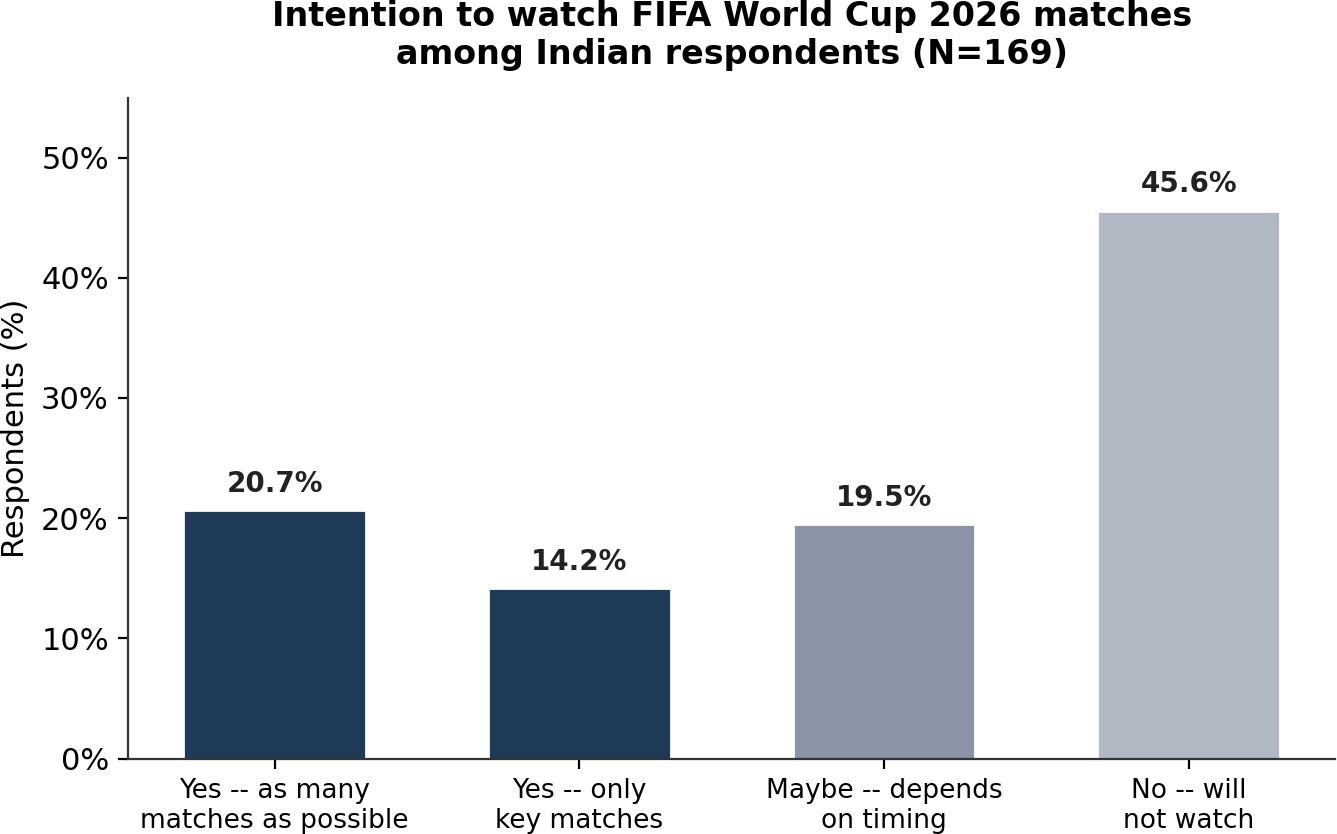
Ninety-two respondents (54.4%) intended to watch at least some World Cup matches ("viewers"), comprising 35 (20.7%) who planned to watch as many matches as possible and 24 (14.2%) who planned to watch only key matches, with a further 33 (19.5%) undecided ("maybe") and 77 (45.6%) who did not plan to watch at all (Figure 1). Among viewers, 43 (46.7%) reported they would stay up through the night at least on some occasions; on match nights, sleep duration was 4–6 hours for 36 respondents (the most common category) and under 2 hours for 8 respondents. Viewing intention differed significantly by gender (65/81 men vs. 26/87 women were viewers; χ²=40.85, df=1, p<0.001), by respondent type (39/47 professionals vs. 37/87 students were viewers; χ²=21.48, df=2, p<0.001), by age group (χ²=30.16, df=4, p<0.001) and by city tier (χ²=30.07, df=3, p<0.001), with professionals, men, older age groups and residents of metro/tier-2/tier-3 cities outside the Andaman and Nicobar Islands showing higher viewing intent (Table IV).
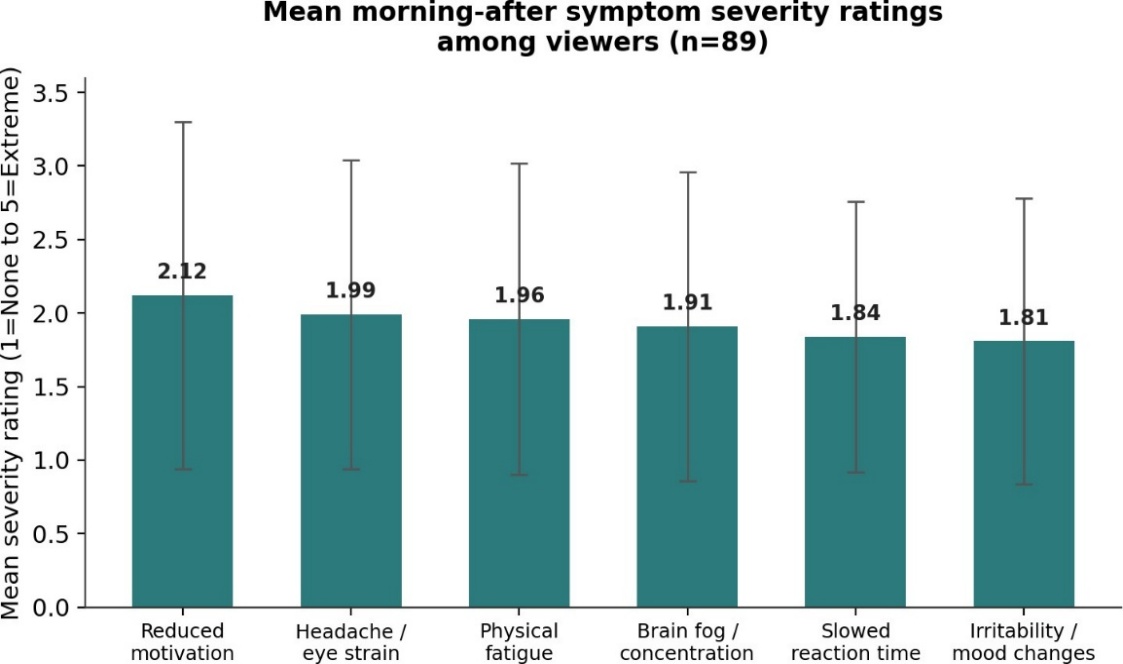
Among the 89 viewers with complete fatigue ratings, mean morning-after severity scores (1–5 scale) were highest for reduced motivation to work/study (mean 2.12) and physical fatigue (mean 1.96), followed by headache/eye strain (1.99), brain fog (1.91), slowed reaction time (1.84) and irritability (1.81) (Figure 2, Table II). The composite six-item fatigue score (range 6–30; n=150 with complete data) was significantly higher among viewers (median 11, IQR 6–16) than non-viewers (median 6, IQR 6–8) on the Mann-Whitney U test (U=3899, p<0.001; Welch t=4.15, p<0.001) (Table III).
| Variable | n / Mean (SD) | % |
| Viewing intent (n=169) | ||
| Yes – as many matches as possible | 35 | 20.7 |
| Yes – only key matches | 24 | 14.2 |
| Maybe – depends on timing | 33 | 19.5 |
| No – will not watch | 77 | 45.6 |
| Sleep duration on match nights (viewers, n=79) | ||
| More than 6 hours | 16 | 20.3 |
| 4–6 hours | 36 | 45.6 |
| 2–4 hours | 19 | 24.0 |
| Less than 2 hours | 8 | 10.1 |
| Morningafter symptom severity (viewers, n=89; 1=None–5=Extreme) | ||
| Physical fatigue | 1.96 (1.06) | — |
| Difficulty concentrating/brain fog | 1.91 (1.05) | — |
| Reduced motivation | 2.12 (1.18) | — |
| Irritability/mood changes | 1.81 (0.97) | — |
| Headache/eye strain | 1.99 (1.05) | — |
| Slowed reaction time | 1.84 (0.92) | — |
| Composite fatigue score (range 6–30) | 11.64 (5.17) | — |
Abbreviation 1: SD, standard deviation
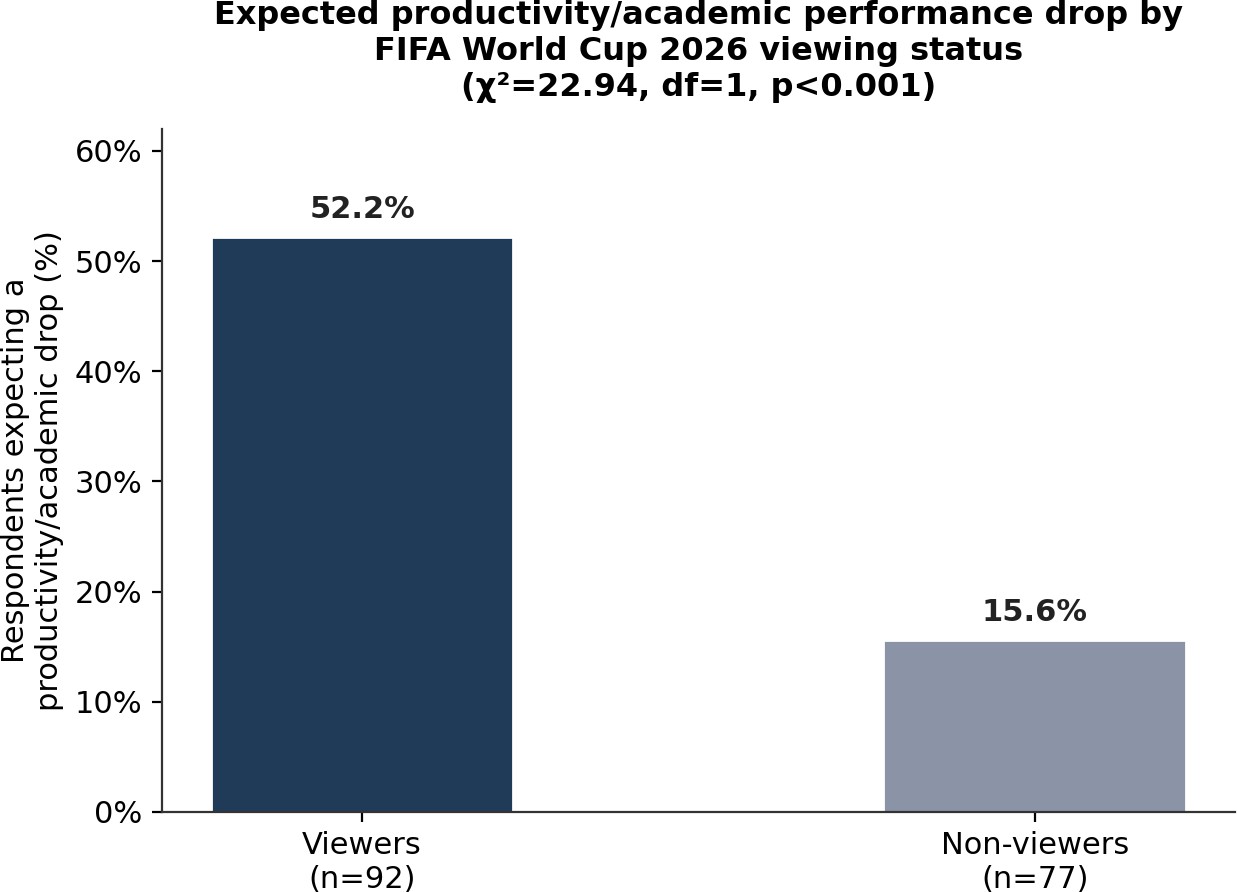
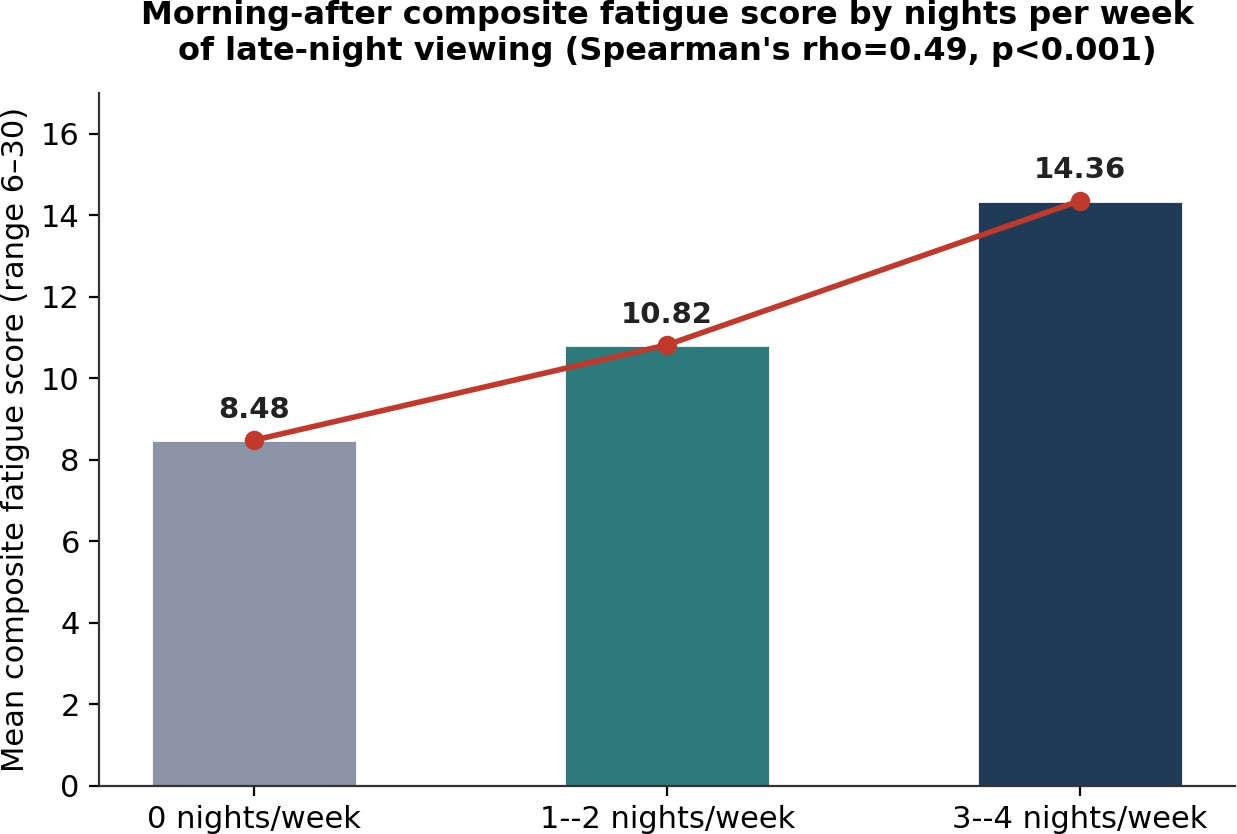
Overall, 60 of 169 respondents (35.5%) anticipated at least some drop in productivity or academic performance during the tournament period, most commonly in the 10–25% range (40/169, 23.7%); only 7 (4.1%) anticipated being "heavily impacted" (>50%). Expectation of any productivity drop was strongly associated with viewing status: 48/92 viewers (52.2%) versus 12/77 non-viewers (15.6%) anticipated a drop (χ²=22.94, df=1, p<0.001) (Figure 3, Table III). A clear dose-response relationship was observed between the number of nights per week respondents expected to stay up and both the composite fatigue score (Spearman's rho=0.49, p<0.001; mean fatigue score rising from 8.48 at 0 nights/week to 14.36 at 3–4 nights/week) (Figure 4) and expected productivity drop (rho=0.42, p<0.001). Self-reported sleep deficit on match nights also correlated with fatigue score (rho=0.33, p=0.003) (Table IV).
| Outcome | Non-viewers | Viewers | Test statistic |
| Composite fatigue score, median (IQR) | 6 (6–8), n=61 | 11 (6–16), n=89 | Mann-Whitney U=3899, p<0.001 |
| Any productivity/academic drop expected, n (%) | 12 (15.6) of 77 | 48 (52.2) of 92 | χ²=22.94, df=1, p<0.001 |
Abbreviation 1: IQR, interquartile range.
Composite fatigue scores differed significantly across respondent-type subgroups on the Kruskal-Wallis test (H=8.10, df=2, p=0.017), with the lowest median among students (6) and the highest among the "both student-and-working" subgroup (11); however, expected productivity/academic drop did not differ significantly by respondent type (H=4.53, p=0.104) (Table IV). Fantasy-football engagement was strongly associated with self-rated workplace/academic distraction from managing fantasy teams (Kruskal-Wallis H=41.25, p<0.001), with median distraction ratings rising from 1 ("Never") among non-users to 2 ("Rarely/Sometimes") among casual and active fantasy users. Among the 74 respondents reporting scheduled examinations during the tournament window, the proportion anticipating any productivity/academic drop (22/74, 29.7%) did not differ significantly from those without exams (χ²=1.49, p=0.222), suggesting that examination timing alone did not independently predict self-perceived disruption in this sample. Employer or institutional flexibility was uncertain for the majority: only 17 of 124 employed respondents (13.7%) expected explicit accommodation (WFH or tolerance for reduced output), while 59 (47.6%) did not know whether any policy existed and 48 (38.7%) anticipated standard attendance rules would be enforced regardless of the tournament.
| Comparison / correlation | Statistic | p-value |
| Viewing intent × gender | χ²=40.85, df=1 | <0.001 |
| Viewing intent × respondent type | χ²=21.48, df=2 | <0.001 |
| Viewing intent × age group | χ²=30.16, df=4 | <0.001 |
| Viewing intent × city tier | χ²=30.07, df=3 | <0.001 |
| Fatigue score × respondent type (Student/Professional/Both) | Kruskal-Wallis H=8.10, df=2 | 0.017 |
| Productivity/academic drop × respondent type | Kruskal-Wallis H=4.53, df=2 | 0.104 |
| Fantasy engagement × workplace distraction rating | Kruskal-Wallis H=41.25, df=2 | <0.001 |
| Exam status × any productivity/academic drop | χ²=1.49, df=1 | 0.222 |
| Nights/week viewing × fatigue score | Spearman's rho=0.49 | <0.001 |
| Nights/week viewing × productivity drop (ordinal) | Spearman's rho=0.42 | <0.001 |
| Sleep deficit × fatigue score | Spearman's rho=0.33 | 0.003 |
All tests two-tailed; p<0.05 considered statistically significant. IQR: interquartile range.
Discussion
This is the first Indian survey – and, to our knowledge, the first anywhere in the cricket-dominant South Asian context – to empirically characterize the self-perceived occupational and academic impact of the FIFA World Cup 2026's late-night broadcast schedule. Against a backdrop of cricket's overwhelming cultural and viewership dominance, the finding that just over half of respondents intended to watch at least some matches may seem modest. Yet it is a striking testament to the growing allure of global football in India. The proportion is substantially lower than the ~84% viewing intent reported among Middle Eastern professionals facing a comparable overnight window [3], and considerably lower than global workplace disruption estimates [1]. This disparity is precisely what makes our results so telling: even in a nation where cricket is virtually a religion, a FIFA World Cup can mobilise over half of a surveyed cohort to sacrifice sleep and risk next-day performance. The 2026 ICC Men's T20 World Cup, held only months earlier, drew over 500 million viewers for India's matches – a scale no football broadcast has approached – yet independent OTT audience data for the FIFA tournament showed that Indian engagement surged dramatically at the business end: one platform's viewership rose from 46.99 million unique viewers across the full tournament to 34.75 million, nearly three-quarters of the total, within the three-day quarter-final window alone, with the male-skewed audience share rising further [12]. This late-tournament concentration aligns with our observation that 26.1% of viewers intended to watch only "key matches" – knockouts, finals, or favourite teams – rather than the entire group stage. The "morning-after effect" we quantified may therefore have been disproportionately acute during the knockout rounds, a nuance that future studies should capture with time-stamped data.
Critically, among those who did watch, the consequences were unmistakable and clinically meaningful. The composite fatigue score for viewers was nearly double that of non-viewers (median 11 vs. 6), and the dose-response gradient between nights of late-night viewing and fatigue (Spearman's rho=0.49) mirrors laboratory evidence that even a single night of sleep restriction measurably degrades attention, reaction time and mood [6]. The most severely rated symptom – "reduced motivation to work or study" – is particularly telling. It suggests that the primary manifestation of the World Cup's morning-after effect in India may be presenteeism: showing up but functioning below par, rather than outright absenteeism. This distinction is economically critical, as presenteeism often carries a larger productivity cost than absence [7][8]. In a country where job security is prized and attendance is culturally mandated, employees are likely to turn up fatigued, creating a silent productivity drain that employers may not even recognise.
The marked gender and occupational disparities we observed are novel and demand attention. Male respondents and working professionals showed significantly higher viewing intent and fatigue burden than female respondents and students. This finding, unreported in prior global surveys, likely reflects a combination of cultural norms, shift-work patterns, and differential discretionary time. It also signals that the productivity impact may be heavily concentrated in male-dominated sectors such as IT, manufacturing, and logistics – a hypothesis that warrants sector-specific investigation. The absence of a significant association between having scheduled examinations and expecting academic disruption was surprising. It may indicate that Indian students, conditioned by high-stakes competitive exams, exercise anticipatory self-regulation – but this speculation requires objective actigraphic or performance-based confirmation. Conversely, the strong link between fantasy-football engagement and self-rated distraction (H=41.25, p<0.001) highlights an emerging disruption pathway distinct from match-viewing itself. With nearly one-third of respondents engaged in fantasy sports, and platforms like Dream11 boasting tens of millions of users [14], the cognitive load of managing virtual teams during work or study hours is a tangible and growing concern that employers and educators have yet to address.
Perhaps the most sobering finding is the institutional unpreparedness: only 13.7% of employed respondents expected explicit workplace accommodation, while nearly half were unaware of any relevant policy. This chasm between anticipated disruption and organisational readiness is consistent with the presenteeism literature's warning that unaddressed fatigue-related productivity loss can silently exceed the cost of sanctioned absence [7][8]. It also stands in stark contrast to the reactive administrative measures that emerged after our data collection – the state-level school holidays declared by Kerala, Manipur and Meghalaya, and Karnataka's extension of public-screening hours [15][17]. These actions, while commendable, were ad hoc and regional, underscoring the absence of a national framework for managing the societal impact of major nocturnal sporting events. Our study provides the empirical ammunition to move from reactive accommodation to proactive, evidence-based policy.
Strengths
This study has several strengths that elevate it beyond a routine survey. It is the first empirical investigation of its kind in India, filling a critical gap in the international literature that has persistently overlooked the world's most populous nation. The bilingual instrument and snowball dissemination enabled participation beyond a single linguistic or regional enclave, enhancing diversity. The use of a pre-validated, multi-item composite fatigue score, combined with non-parametric and parametric cross-checks, allowed a robust dose-response analysis rather than a simplistic binary comparison. The external corroboration from independently reported state-level school holidays provides real-world ecological validity, confirming that the "morning-after effect" is not merely a statistical abstraction but a lived reality recognised by policymakers. Importantly, the study was conducted under a formal, prospective institutional ethics approval (IEC, ANIIMS) with full oversight, including explicit recusal of the Co-Investigator who sits on the IEC, ensuring the highest standards of research integrity.
Limitations
We acknowledge important limitations. The cross-sectional, self-reported design precludes causal inference and is vulnerable to recall and social-desirability biases. We measured anticipated, not actual, productivity loss – a gap that future work should fill with objective metrics. The non-probability snowball sample, concentrated in a health-sciences institution and a single union territory, limits generalisability; the achieved sample of 169, though sufficient for many analyses, fell short of our pre-specified target of 422, reducing precision for subgroup comparisons. These findings should therefore be viewed as hypothesis-generating, awaiting confirmation in an adequately powered, multi-regional, probability-based sample.
In conclusion, this first-of-its-kind Indian investigation demonstrates that even in a cricket-obsessed nation, the FIFA World Cup 2026 commanded substantial late-night viewership, and that such viewing exacts a tangible toll on next-day fatigue, productivity, and academic performance – a toll that is dose-dependent, demographically patterned, and met with widespread institutional unpreparedness. The real-world validation from state-level holiday declarations [15][17] reinforces the urgency of our findings. We recommend that: (i) employers, especially in night-shift industries, issue transparent flexibility policies (staggered starts, tolerance for reduced output) ahead of future mega-events; (ii) educational institutions proactively adjust academic calendars, avoiding critical assessments on mornings after marquee fixtures, following the Kerala/Manipur/Meghalaya precedent [15][16] and in line with the National Health Policy [18] and the Occupational Safety, Health and Working Conditions Code [19]; (iii) future Indian research employ objective measures (actigraphy, validated fatigue scales, actual productivity metrics) and probability-based sampling to confirm and extend our estimates; and (iv) occupational-health and student-counselling services incorporate brief anticipatory sleep-hygiene guidance ahead of similarly timed global sporting events. The FIFA World Cup 2026 may have ended, but the lessons for India's workforce, classrooms, and policymakers are only beginning to be written – and this study provides the first critical chapter.
Declarations
Acknowledgements
The authors thank all respondents who participated in this survey and the institutions and professional networks that assisted with questionnaire dissemination. We also gratefully acknowledge the Institutional Ethics Committee, ANIIMS, for its thorough review and prospective approval of the study protocol (F. No. 1-366/ANIIMS/IEC/2026). We specifically appreciate the transparency and ethical rigor demonstrated by Dr. Prerna Singh, who, despite being a Co-Investigator, recused herself from the IEC deliberation on this proposal to avoid any conflict of interest.
Conflict of interest
The authors declare no conflict of interest, financial or otherwise, with any sports organization, broadcaster, fantasy-sports platform, employer or academic institution referred to in this study.
Funding/financial support
None. This study did not receive any specific grant from funding agencies in the public, commercial or not-for-profit sectors.
Data availability
De-identified data supporting the findings of this study are available from the corresponding author upon reasonable request.
Contributors
Dr. Samar Hossain – conceptualization, study design, questionnaire development, data collection, manuscript writing, final approval.
Dr. Aanchal Anand – questionnaire development, data collection, data cleaning, statistical analysis, manuscript review, final approval.
Dr. Ajay Raj Sethuraman – study supervision, methodological oversight, critical revision of the manuscript, final approval.
Dr. Prerna Singh – questionnaire validation, manuscript review, final approval.
Ethical Clearance
The study protocol (Version No. 01, dated 03/07/2026) was reviewed and approved by the Institutional Ethics Committee (IEC) of the Andaman and Nicobar Islands Institute of Medical Sciences (ANIIMS), Sri Vijaya Puram, at its meeting held on 11-07-2026. The IEC is registered under the Drug Controller General of India (DHR Reg. no. EC/NEW/INST/2023/AN/0385, dated 08.12.2023). Formal approval was conveyed vide F. No. 1-366/ANIIMS/IEC/2026, dated 20-07-2026. The approval is prospective for the entire duration of the study, subject to annual review. The study was conducted in accordance with the ICMR National Ethical Guidelines for Biomedical and Health Research Involving Human Participants (2017) [10] and the Declaration of Helsinki [11]. Written informed consent was obtained in digital form from all participants before enrolment.
Trial details
Not applicable (cross-sectional survey).