Introduction
Stroke remains one of the leading causes of death and long-term disability worldwide, with the global burden continuing to increase despite advances in prevention and acute care. According to the Global Burden of Disease Study 2021, stroke accounted for approximately 7.3 million deaths and 160.5 million disability-adjusted life years (DALYs) in 2021, underscoring the continuing need for effective long-term rehabilitation strategies [1,2]. Beyond focal motor deficits, stroke frequently results in a complex combination of cognitive, psychological, and functional impairments that may persist well beyond the acute phase and substantially affect survivors’ independence, social participation, and health-related quality of life [3,4].
Contemporary post-stroke rehabilitation has therefore progressively shifted from a deficit-centered model toward a multidimensional, participation-oriented approach. Motor recovery remains a major therapeutic goal, while cognitive and psychological sequelae are increasingly recognized as important determinants of functional recovery and social reintegration. Post-stroke cognitive impairment affects a substantial proportion of stroke survivors and is associated with poorer functional outcomes, as well as increased risks of recurrent stroke and mortality [5,6]. Moreover, post-stroke depression is a common and clinically important complication associated with poorer functional recovery, reduced quality of life, and other adverse outcomes [7,8]. Accordingly, recent rehabilitation guidelines emphasize the systematic assessment and management of cognitive and psychological impairments alongside physical rehabilitation [9].
Within this multidimensional framework, dual-task (DT) training has emerged as a promising rehabilitation strategy. DT training involves the simultaneous performance of a primary motor task and a concurrent cognitive or motor task, thereby increasing the attentional, executive, and motor demands placed on the individual. Unlike conventional single-task rehabilitation, DT paradigms more closely replicate the competing demands encountered during everyday activities, such as walking while talking, navigating an environment, carrying an object, or responding to external information [10,11]. By requiring the integration of motor and cognitive processes, DT training may promote adaptive allocation of attentional resources, improve task coordination, and enhance the ability to manage competing demands during functional activities [10,12].
Evidence accumulated over recent years supports the potential value of DT training after stroke, particularly for motor and mobility-related outcomes. Meta-analyses indicate that DT-based interventions can improve selected spatial and temporal gait parameters, balance, and lower-limb motor performance compared with conventional or single-task rehabilitation, although effects have not been consistent across all mobility outcomes [13,14]. More recent evidence has extended these observations to cognitive functioning. A 2025 systematic review and meta-analysis of 14 randomized controlled trials reported a modest but significant improvement in global cognitive function following combined physical exercise and cognitive DT training, with additional benefits observed in executive function and working memory [15]. Furthermore, a recent randomized controlled trial in individuals with post-stroke cognitive impairment demonstrated improvements in global cognitive performance following cognitive-motor DT training compared with conventional cognitive training [16].
Potential effects of DT-based rehabilitation may also extend beyond motor and cognitive performance to broader psychological and functional outcomes. Recent evidence suggests that cognitive-motor interventions incorporating virtual reality may improve mental status and activities of daily living in individuals with stroke, although the magnitude and consistency of these effects remain less well established than those reported for mobility-related outcomes [14]. This issue is clinically important because psychological sequelae after stroke are not merely co-occurring problems; depression is associated with poorer functional recovery and quality of life, while current evidence supports the potential effectiveness of non-pharmacological rehabilitation approaches for reducing post-stroke depressive symptoms [7,8,17]. Accordingly, interventions capable of simultaneously addressing physical, cognitive, and psychological dimensions may be particularly relevant to contemporary stroke rehabilitation.
Despite this growing body of evidence, an important methodological and conceptual gap remains. Most previous trials and systematic reviews have evaluated the effects of DT training separately for individual outcomes or outcome domains, generally focusing on gait, balance, or cognitive performance [13-15]. Consequently, it remains unclear whether DT training produces effects of comparable magnitude across motor, cognitive, and psychological domains or whether some domains are more responsive than others. This distinction is important because statistical significance within individual outcomes does not establish that intervention effects differ significantly between domains. Direct comparison of standardized effect magnitudes across domains may therefore provide a more informative characterization of the multidimensional response to DT training.
Addressing this question is particularly relevant in chronic stroke rehabilitation, where residual motor, cognitive, and psychological impairments frequently coexist and interact to influence participation and functional independence. A domain-specific analysis may help determine whether the benefits of DT training are predominantly motor, extend meaningfully to cognitive functioning, or include broader psychological effects. Such information could contribute to a more precise understanding of the therapeutic profile of DT training and inform the development of rehabilitation programs that better reflect the multidimensional nature of recovery after stroke.
Therefore, the present study conducted a secondary comparative analysis of a pilot randomized controlled trial to determine whether the magnitude of the effects of dual-task (DT) training, compared with conventional rehabilitation, differed across motor, cognitive, and psychological domains in individuals with chronic stroke. We hypothesized that the magnitude of the intervention effect would vary across domains, with larger effects expected for motor and psychological outcomes than for cognitive outcomes.
Methods
Study design and participants
The present study was conducted as a secondary comparative analysis of participants enrolled in a pilot, parallel-group randomized controlled trial comparing dual-task training with conventional rehabilitation (CR) in individuals with chronic stroke. The primary trial was designed to assess the feasibility and preliminary clinical effects of the intervention. The present analysis addressed a distinct research question, namely whether the magnitude of intervention effects differed across motor, cognitive, and psychological domains.
This study represents a secondary analysis of a pilot randomized controlled trial involving 70 adults with chronic stroke, randomly allocated in a 1:1 ratio to dual-task training (DT; n = 35) or conventional rehabilitation (CR; n = 35). Detailed information on eligibility criteria, recruitment, randomization, allocation concealment, intervention procedures, and follow-up assessments is available from the corresponding author upon reasonable request.
Briefly, participants had a clinically and neuroimaging-confirmed stroke and were at least 3 months post-stroke. All randomized participants completed the intervention and post-intervention assessment and were therefore included in the present secondary analysis.
Intervention
Participants allocated to the DT training group received a structured rehabilitation program combining motor and cognitive tasks performed concurrently. Each session lasted 45 minutes and was delivered three times per week for 12 weeks. Sessions consisted of a 5-minute warm-up, 35 minutes of dual-task training, and a 5-minute cool-down.
Participants allocated to the CR group received the same motor rehabilitation program, with comparable treatment frequency, session duration, and intervention period, but without the concurrent cognitive tasks. Both groups therefore received three 45-minute sessions per week for 12 weeks. Adherence was assessed based on attendance at scheduled sessions.
Outcome measures
The present analysis focused on three prespecified functional domains: motor, cognitive, and psychological functioning.
Motor function was assessed using the Demeurisse Motor Index (DMI), which measures voluntary motor strength in the upper and lower limbs. The overall score ranges from 0 to 100, with higher scores indicating better motor performance.
Cognitive function was assessed using the Montreal Cognitive Assessment (MoCA), a screening tool covering several cognitive domains, including executive functions, attention, memory, language, visuospatial abilities, and orientation. The total score ranges from 0 to 30, with higher scores indicating better cognitive performance.
Psychological functioning was assessed using the Montgomery–Åsberg Depression Rating Scale (MADRS), which quantifies the severity of depressive symptoms. Lower scores indicate fewer depressive symptoms and, consequently, better psychological status. The total score ranges from 0 to 60.
Two additional outcomes were examined as secondary functional outcomes:
-
Functional disability, assessed using the modified Rankin Scale (mRS), with lower scores indicating less disability.
-
Stroke-related quality of life and health status, assessed using the Stroke Impact Scale, version 3.0 (SIS 3.0), with higher scores indicating better health status and greater perceived recovery following stroke.
All outcomes were assessed at baseline and immediately after completion of the intervention.
Statistical analysis
Baseline characteristics were summarized as means and standard deviations (SDs) for continuous variables and frequencies and percentages for categorical variables. Between-group differences were assessed using independent-samples tests for continuous variables and χ² or Fisher’s exact tests for categorical variables, as appropriate. Standardized mean differences (SMDs) were used to assess baseline balance, without interpreting baseline differences as treatment effects.
Change scores from baseline to post-intervention were calculated for each outcome. Positive values indicated improvement for the Demeurisse Motor Index (DMI), Montreal Cognitive Assessment (MoCA), and Stroke Impact Scale 3.0 (SIS 3.0), whereas negative values indicated improvement for the Montgomery–Åsberg Depression Rating Scale (MADRS) and modified Rankin Scale (mRS). Between-group effects were expressed as mean differences in change with 95% confidence intervals (CIs).
To enable comparison across outcomes measured on different scales, standardized between-group effects were estimated using Hedges’ g with 95% CIs. Outcome directions were harmonized so that higher standardized values consistently represented greater improvement. The three prespecified primary domains were motor (DMI), cognitive (MoCA), and psychological (MADRS) functioning.
The primary analysis tested whether the magnitude of the intervention effect differed across domains using a Group × Domain interaction within a repeated-measures framework based on standardized change scores. A significant interaction was interpreted as evidence that the treatment effect differed across the motor, cognitive, and psychological domains. Where appropriate, post hoc pairwise comparisons were performed following the overall interaction test, with P values adjusted using the Holm procedure. Partial eta squared (ηp²) was reported for the Group × Domain interaction, and Hedges’ g for domain-specific effects.
Sensitivity analyses. Because cardiopathy was the only baseline characteristic showing a clinically relevant imbalance between groups, sensitivity analyses assessed its potential influence on the findings. For each outcome, adjusted between-group effects were estimated using linear models including treatment allocation, the corresponding baseline outcome value, and baseline cardiopathy as covariates, with heteroskedasticity-consistent HC3 standard errors. A second sensitivity analysis additionally adjusted the repeated-measures model for baseline cardiopathy to assess the robustness of the Group × Domain interaction.
Statistical significance and software. All tests were two-sided, with statistical significance set at P < 0.05. For the primary Group × Domain interaction, the F statistic, degrees of freedom, P value, and partial ηp² were reported. Given the pilot nature of the trial and the multiple outcomes examined, effect sizes and 95% CIs were emphasized alongside P values. Analyses were performed using Stata version 18.0 and jamovi version 2.6.44.
Results
Participants and intervention exposure
This study was a secondary comparative analysis of a pilot randomized controlled trial. Participant flow and recruitment procedures followed those of the parent trial. A total of 70 participants were randomized in a 1:1 ratio to the dual-task (DT) training group (n = 35) or conventional rehabilitation (CR) group (n = 35). All randomized participants completed the intervention and follow-up assessments and were included in the present analysis.
Baseline characteristics
The mean age was 53.9 ± 11.2 years in the DT group and 55.1 ± 12.9 years in the CR group (P = 0.694; SMD = −0.095), with men accounting for 57.1% of participants in both groups. Mean time since stroke was also comparable (10.4 ± 4.4 vs. 10.5 ± 5.3 months; P = 0.902; SMD = −0.030). Ischemic stroke was present in 60.0% and 71.4% of participants in the DT and CR groups, respectively (P = 0.314; SMD = −0.243). Cardiopathy was more frequent in the CR group than in the DT group (25.7% vs. 5.7%; P = 0.022; SMD = −0.572), whereas no statistically significant between-group differences were observed for the other cardiovascular risk factors or clinical characteristics.
Baseline motor function (DMI: 65.3 ± 12.9 vs. 63.0 ± 13.2; P = 0.463; SMD = 0.176), cognitive function (MoCA: 25.6 ± 5.4 vs. 24.2 ± 6.5; P = 0.324; SMD = 0.238), depressive symptoms (MADRS: 24.3 ± 14.9 vs. 21.9 ± 12.4; P = 0.472; SMD = 0.173), functional disability (mRS: 2.8 ± 1.1 vs. 2.9 ± 1.4; P = 0.701; SMD = −0.092), and stroke-related health status (SIS 3.0: 44.0 ± 12.2 vs. 44.0 ± 14.0; P = 0.992; SMD = 0.002) were comparable between groups (Table 1).
| Characteristics | DT training (n=35) | CR (n=35) | P value | SMD |
| Age, years, mean ± SD | 53.9 ± 11.2 | 55.1 ± 12.9 | 0.694 | −0.095 |
| Male sex, n (%) | 20 (57.1) | 20 (57.1) | 1.000 | 0.000 |
| Married/partnered, n (%) | 27 (77.1) | 28 (80.0) | 0.771 | −0.070 |
| Higher education (≥ Bac+), n (%) | 26 (74.3) | 21 (60.0) | 0.203 | 0.308 |
| Currently active, n (%) | 26 (74.3) | 21 (60.0) | 0.203 | 0.308 |
| Time since stroke, months, mean ± SD | 10.4 ± 4.4 | 10.5 ± 5.3 | 0.902 | −0.030 |
| Ischemic stroke, n (%) | 21 (60.0) | 25 (71.4) | 0.314 | −0.243 |
| Right-sided involvement, n (%) | 17 (48.6) | 13 (37.1) | 0.334 | 0.232 |
| Hypertension, n (%) | 16 (45.7) | 19 (54.3) | 0.473 | −0.172 |
| Diabetes mellitus, n (%) | 9 (25.7) | 4 (11.4) | 0.124 | 0.374 |
| Obesity, n (%) | 13 (37.1) | 10 (28.6) | 0.445 | 0.183 |
| Cardiopathy, n (%) | 2 (5.7) | 9 (25.7) | 0.022 | −0.572 |
| Alcohol consumption, n (%) | 18 (51.4) | 19 (54.3) | 0.811 | −0.057 |
| Current smoking, n (%) | 7 (20.0) | 6 (17.1) | 0.759 | 0.074 |
| Previous stroke, n (%) | 8 (22.9) | 10 (28.6) | 0.584 | −0.131 |
| Motor function – IMD, mean ± SD | 65.3 ± 12.9 | 63.0 ± 13.2 | 0.463 | 0.176 |
| PSCI – MoCA, mean ± SD | 25.6 ± 5.4 | 24.2 ± 6.5 | 0.324 | 0.238 |
| PSD – MADRS, mean ± SD | 24.3 ± 14.9 | 21.9 ± 12.4 | 0.472 | 0.173 |
| Functional disability – mRs, mean ± SD | 2.8 ± 1.1 | 2.9 ± 1.4 | 0.701 | −0.092 |
| Stroke-related health status – SIS 3.0, mean ± SD | 44.0 ± 12.2 | 44.0 ± 14.0 | 0.992 | 0.002 |
Abbreviations: DMI= Demeurisse Motor Index; MADRS= Montgomery–Åsberg Depression Rating Scale; MoCA= Montreal Cognitive Assessment; mRs = modified Rankin Scale; SD, standard deviation; SIS 3.0, Stroke Impact Scale version 3.0; SMD= standardized mean difference; DT= Dual-task; CR= Conventional rehabilitation
Note: Continuous variables are presented as mean ± SD and categorical variables as n (%). P values were derived from independent-samples tests, χ² tests, or Fisher’s exact tests, as appropriate. SMDs were calculated as standardized differences between groups. The baseline imbalance in cardiopathy was addressed in sensitivity analyses.
Changes in motor, cognitive, psychological, and functional outcomes
DT training resulted in greater improvements than conventional rehabilitation across most outcomes. Motor function improved by 12.6 points in the DT group versus 6.77 points in the CR group, corresponding to a between-group difference of 5.80 points (95% CI, 2.17–9.42; Hedges’ g = 0.76, 95% CI, 0.28–1.26; P = 0.002). Cognitive performance improved by 2.90 versus 2.31 points, with a non-significant between-group difference of 0.63 points (95% CI, −0.65 to 1.90; Hedges’ g = 0.23, 95% CI, −0.23 to 0.71; P = 0.327).
Depressive symptoms decreased by 15.9 points in the DT group versus 7.91 points in the CR group, yielding a between-group difference of −7.94 points (95% CI, −11.16 to −4.73; Hedges’ g = −1.17, 95% CI, −1.69 to −0.67; P < 0.001). Functional disability also improved more with DT training (−1.70 vs. −1.14 points; between-group difference, −0.54; 95% CI, −0.87 to −0.22; Hedges’ g = −0.78; P = 0.001). In addition, SIS 3.0 scores increased by 37.3 versus 19.88 points, corresponding to a between-group difference of 17.41 points (95% CI, 10.83–24.00; Hedges’ g = 1.25; P < 0.001).
Overall, the largest standardized effects were observed for stroke-related health status and depressive symptoms, followed by motor function and functional disability, whereas the cognitive effect was comparatively small and not statistically significant (Table 2).
| Outcome | DT change | CR change | Between-group difference (95% CI) | Hedges g (95% CI) | P |
| IMD | +12.6 | +6.77 | 5.80 (2.17–9.42) | 0.76 (0.28–1.26) | 0.002 |
| MoCA | +2.90 | +2.31 | 0.63 (−0.65–1.90) | 0.23 (−0.23–0.71) | 0.327 |
| MADRS | −15.9 | −7.91 | −7.94 (−11.16–−4.73) | −1.17 (−1.69–−0.67) | <0.001 |
| mRs | −1.70 | −1.14 | −0.54 (−0.87–−0.22) | −0.78 | 0.001 |
| SIS 3.0 | +37.3 | +19.88 | 17.41 (10.83–24.00) | 1.25 | <0.001 |
Abbreviations: CI, confidence interval; DT= Dual-task; CR= Conventional rehabilitation
Note: Values represent mean change from baseline to post-intervention. Positive changes indicate improvement for IMD, MoCA, and SIS 3.0, whereas negative changes indicate improvement for MADRS and mRs. Between-group differences represent the difference in mean change between the dual-task and conventional rehabilitation groups. Hedges’ g represents the standardized between-group effect size.
Comparative magnitude of effects across functional domains
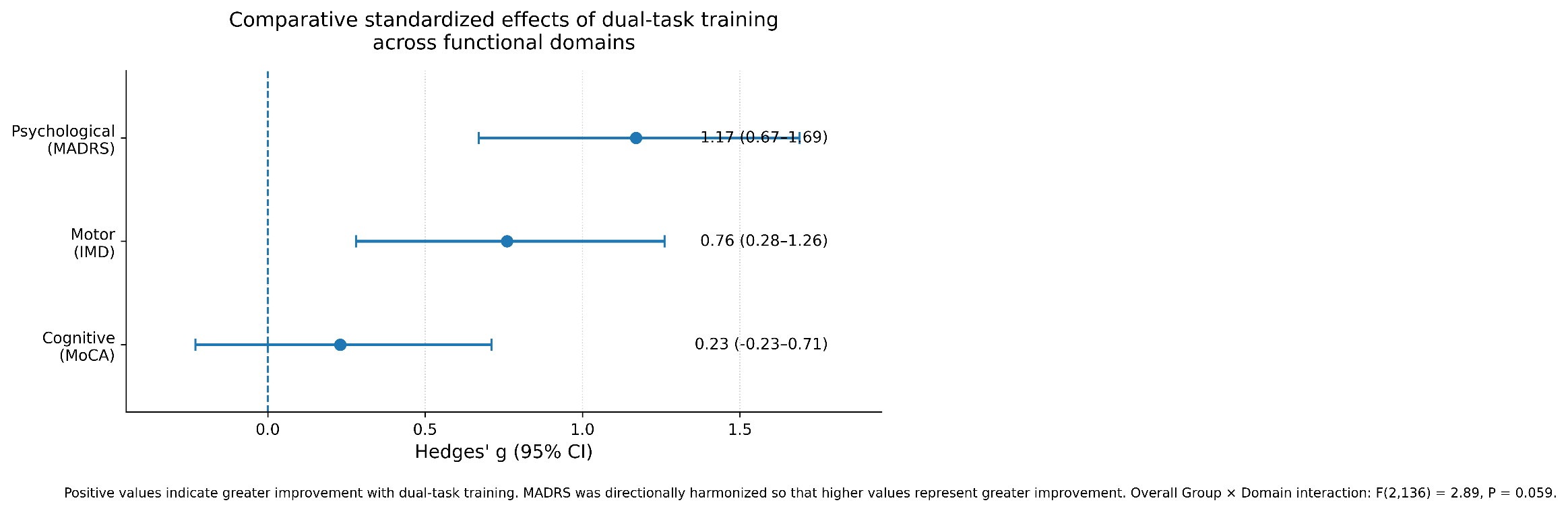
The magnitude of intervention effects differed descriptively across functional domains (Table 3). The largest standardized effect was observed for the psychological outcome, with a between-group difference of −7.94 points in MADRS scores (95% CI, −11.16 to −4.73; Hedges’ g = −1.17, 95% CI, −1.69 to −0.67; adjusted P < 0.001). The motor domain showed a moderate-to-large effect (between-group difference, 5.80 points; 95% CI, 2.17–9.42; Hedges’ g = 0.76, 95% CI, 0.28–1.26; adjusted P = 0.005), whereas the cognitive domain showed a small, non-significant effect (between-group difference, 0.63 points; 95% CI, −0.65 to 1.90; Hedges’ g = 0.23, 95% CI, −0.23 to 0.71; adjusted P = 0.327).
The overall Group × Domain interaction did not reach statistical significance (F(2,136) = 2.89, P = 0.059; partial η² = 0.041). Post hoc pairwise comparisons were likewise non-significant after Holm adjustment, although the comparison between the psychological and cognitive domains approached the conventional significance threshold (adjusted P = 0.056).
| Functional domain | Outcome measure | Between-group difference in change (95% CI) | Hedges’ g (95% CI) | Adjusted P-value* |
| Psychological | MADRS | −7.94 (−11.16 to −4.73) | −1.17 (−1.69 to −0.67) | <0.001 |
| Motor | IMD | +5.80 (2.17 to 9.42) | 0.76 (0.28 to 1.26) | 0.005 |
| Cognitive | MoCA | +0.63 (−0.65 to 1.90) | 0.23 (−0.23 to 0.71) | 0.327 |
Note: Between-group differences represent the difference in mean change between the dual-task and conventional rehabilitation groups. For MADRS, negative values indicate greater reductions in depressive symptoms and therefore greater improvement. Hedges’ g represents the standardized effect size. P values were adjusted for multiple comparisons using the Holm procedure.
Overall Group × Domain interaction: F(2,136) = 2.89, P = 0.059, partial η² = 0.041.
Sensitivity analysis adjusted for baseline cardiopathy
Results of the cardiopathy-adjusted sensitivity analyses are presented in Supplementary Table S1 and were consistent with the primary findings. DT training remained associated with significantly greater improvements in motor function (adjusted between-group difference, 5.98; 95% CI, 2.56–9.40; P < 0.001), cognitive function (1.01; 95% CI, 0.20–1.83; P = 0.016), depressive symptoms (−7.46; 95% CI, −10.02 to −4.89; P < 0.001), functional disability (−0.57; 95% CI, −0.89 to −0.24; P < 0.001), and stroke-related health status (16.03; 95% CI, 9.26–22.81; P < 0.001). The largest partial η² values were observed for depressive symptoms (0.355) and stroke-related health status (0.285).
| Outcome | Adjusted between-group difference (95% CI) | Partial η² | Robust P value* |
| Motor function – IMD | 5.98 (2.56 to 9.40) | 0.158 | <0.001 |
| Cognitive function – MoCA | 1.01 (0.20 to 1.83) | 0.078 | 0.016 |
| Psychological symptoms – MADRS | −7.46 (−10.02 to −4.89) | 0.355 | <0.001 |
| Functional disability – mRS | −0.57 (−0.89 to −0.24) | 0.177 | <0.001 |
| Stroke-related health status – SIS 3.0 | 16.03 (9.26 to 22.81) | 0.285 | <0.001 |
Abbreviations: CI, confidence interval; IMD, Motricity Index; MADRS, Montgomery–Åsberg Depression Rating Scale; MoCA, Montreal Cognitive Assessment; mRS, modified Rankin Scale; SIS 3.0, Stroke Impact Scale version 3.0.
Note: Models were adjusted for treatment allocation, the corresponding baseline outcome measure, and baseline cardiopathy. Robust HC3 standard errors were used to account for potential heteroscedasticity. Positive adjusted differences indicate greater improvement with dual-task training for IMD, MoCA, and SIS 3.0; negative differences indicate greater improvement for MADRS and mRS.
Sensitivity analysis of the Group × Domain interaction
The sensitivity analysis of the Group × Domain interaction is presented in Supplementary Table S2. The interaction remained essentially unchanged after adjustment for baseline cardiopathy [F(2,134) = 2.90; P = 0.058; partial η² = 0.041] compared with the primary model [F(2,136) = 2.89; P = 0.059; partial η² = 0.041]. Adjustment for the baseline cardiopathy imbalance therefore did not materially alter the magnitude or statistical significance of the Group × Domain interaction, supporting the robustness of the observed pattern across the motor, cognitive, and psychological domains.
| Model | Group × Domain F | df | P value | Partial η² |
| Primary model | 2.89 | 2, 136 | 0.059 | 0.041 |
| Adjusted for baseline cardiopathy | 2.90 | 2, 134 | 0.058 | 0.041 |
Note: The analysis was based on standardized change scores for motor, cognitive, and psychological outcomes, with score directions harmonized so that higher values consistently represented greater improvement. The sensitivity model additionally adjusted for baseline cardiopathy.
Discussion
Principal findings
This secondary comparative analysis of a pilot randomized controlled trial found that dual-task (DT) training resulted in greater improvements than conventional rehabilitation in motor function, depressive symptoms, functional disability, and stroke-related health status. Among the prespecified domains, the largest standardized effect was observed for depressive symptoms (Hedges’ g = −1.17), followed by motor function (g = 0.76), whereas the effect on global cognitive function was small (g = 0.23). Nevertheless, the prespecified Group × Domain interaction did not reach the conventional threshold for statistical significance (P = 0.059; partial η² = 0.041).
DT training was associated with significant benefits across several outcomes, with the largest effects observed for depressive symptoms and motor function among the prespecified domains; however, the formal Group × Domain interaction did not demonstrate statistically significant heterogeneity of treatment effects across domains. Accordingly, these findings should not be interpreted as definitive evidence that DT training produces statistically different effects across functional domains. Rather, they indicate a clinically relevant pattern, with larger observed effects on depressive and motor outcomes than on global cognitive performance, warranting confirmation in adequately powered trials.
Motor effects
The observed motor benefits are consistent with the growing body of evidence supporting DT training as an effective strategy for improving motor performance after stroke. In our study, motor function improved by 12.6 points with DT training compared with 6.77 points with conventional rehabilitation, corresponding to a between-group difference of 5.80 points and a moderate-to-large standardized effect (Hedges’ g = 0.76). This magnitude is consistent with recent evidence suggesting that cognitive-motor DT interventions can improve walking performance and lower-limb motor function compared with conventional or single-task rehabilitation. A 2025 systematic review and meta-analysis including 30 randomized controlled trials and 1,588 participants reported significant benefits of DT training for walking performance and lower-limb motor recovery [14,18].
The observed findings may be explained by the specific demands imposed by the simultaneous engagement of motor and cognitive processes. During DT activities, individuals must continuously allocate attentional resources between concurrent tasks, monitor their performance, and adapt motor responses to changing task demands. Repeated exposure to these competing demands may reduce cognitive-motor interference and enhance motor automaticity and adaptability. Previous randomized studies have shown that exercise-based interventions can reduce cognitive-motor interference during walking after stroke, supporting the ecological relevance of training that combines mobility with concurrent cognitive demands [19].
Importantly, our outcome measure was the Demeurisse Motor Index (DMI) rather than a task-specific measure of gait or balance. Therefore, the observed motor benefit suggests that the effects of DT training may extend beyond task-specific adaptations in walking. However, this interpretation should remain cautious because the DMI primarily reflects voluntary limb strength and does not directly assess dual-task gait performance, balance, or cognitive-motor interference. Future studies should therefore determine whether improvements in global motor impairment translate into better performance during ecologically relevant dual-task mobility activities.
Cognitive effects
In contrast to the motor findings, the unadjusted cognitive effect was small and not statistically significant. MoCA scores increased by 2.90 points in the DT group and by 2.31 points in the conventional rehabilitation group, yielding a between-group difference of 0.63 points (Hedges’ g = 0.23; P = 0.327). This finding is not necessarily inconsistent with the emerging literature supporting cognitive benefits of cognitive-motor DT interventions, as reported effects may vary according to intervention characteristics, patient populations, baseline cognitive status, and outcome measures [14,15,20].
After adjustment for baseline cardiopathy and baseline MoCA score, the between-group difference increased to 1.01 points (95% CI, 0.20–1.83; P = 0.016), suggesting that baseline imbalance and/or residual variability may have attenuated the unadjusted estimate. However, this adjusted finding should be interpreted cautiously. Although it indicates a statistically significant between-group difference in MoCA scores after adjustment, it does not establish that DT training has a stronger effect on cognition than on the other domains. Indeed, the prespecified Group × Domain interaction remained non-significant, indicating that the study did not provide definitive evidence of differential treatment effects across the cognitive, motor, and depressive-symptom domains.
This relatively modest cognitive effect may also reflect the characteristics of the intervention and outcome measure. The cognitive tasks were embedded within a broader motor rehabilitation program rather than delivered as a dedicated cognitive rehabilitation intervention, while the MoCA provides a global screening measure that may be less sensitive to domain-specific changes in executive function, attention, working memory, or processing speed. Accordingly, future adequately powered trials should incorporate domain-specific neuropsychological measures to determine whether DT training produces selective cognitive benefits that may not be fully captured by global screening instruments.
Depressions symptoms
The intervention effect was most pronounced for depressive symptoms. MADRS scores decreased by 15.9 points following DT training, compared with 7.91 points following conventional rehabilitation, corresponding to a between-group difference of −7.94 points and a large standardized effect (Hedges’ g = −1.17; 95% CI, −1.69 to −0.67; P < 0.001). This represented the largest domain-specific standardized effect observed in the present study.
This finding is clinically relevant because post-stroke depressive symptoms are strongly associated with poorer functional recovery and other adverse rehabilitation outcomes [6]. Recent systematic reviews have reported that exercise-based and other non-pharmacological interventions may reduce depressive symptoms after stroke, highlighting the potential role of active rehabilitation in addressing both the physical and psychological consequences of stroke [21,22]. A 2025 meta-analysis of exercise-based interventions likewise reported beneficial effects on depressive symptoms among stroke survivors [22].
However, the present findings should not be interpreted as demonstrating that DT training has a specific antidepressant effect. The intervention combined motor activity, cognitive stimulation, therapist interaction, repeated practice, and structured exposure to rehabilitation. Any of these components, either individually or in combination, may have contributed to the observed improvement in mood. Moreover, because the conventional rehabilitation group also demonstrated a substantial reduction in MADRS scores, part of the observed improvement may reflect the general psychological benefits of rehabilitation, increased physical activity, social interaction, therapeutic engagement, and positive expectations of recovery.
Nevertheless, the particularly large between-group effect observed for MADRS may suggest that DT training provides additional psychological benefits beyond those associated with conventional rehabilitation. One plausible explanation is that DT training provides repeated opportunities for active problem-solving, task mastery, sustained attentional engagement, and progressively more demanding motor and cognitive performance. Such experiences may enhance perceived competence and self-efficacy, while increased engagement in meaningful activities may contribute to improved mood. These mechanisms remain hypothetical, however, because self-efficacy, participation, social interaction, and neurobiological markers were not directly assessed in the present study. These potential mechanisms warrant prospective investigation using direct measures of self-efficacy, participation, social interaction, and neurobiological responses.
Functional disability and stroke-related health status
The observed effects on the modified Rankin Scale (mRS) and Stroke Impact Scale (SIS) 3.0 provide important complementary evidence regarding the clinical relevance of the intervention. Functional disability improved by an additional 0.54 points with DT training compared with conventional rehabilitation (Hedges’ g = −0.78; P = 0.001), while SIS 3.0 scores increased by 17.41 points more in the DT group (Hedges’ g = 1.25; P < 0.001). These findings suggest that the benefits of DT training extended beyond motor performance and disability to broader stroke-related health status.
This pattern is consistent with recent meta-analytic evidence indicating that DT-based interventions may improve activities of daily living in addition to motor and cognitive outcomes [14]. A 2025 systematic review and meta-analysis of 30 randomized controlled trials involving 1,588 participants reported significant improvements in walking performance, lower-limb motor function, cognitive function, mental status, and activities of daily living following cognitive-motor DT training, although effects were not consistently observed across all mobility outcomes [14].
The ecological nature of DT training may be particularly relevant to these findings. By requiring participants to perform motor tasks while simultaneously processing cognitive information, DT rehabilitation may more closely reproduce the attentional and motor demands encountered during everyday activities than isolated, impairment-focused exercises. This task-specific and contextually enriched approach may facilitate transfer of training effects to functional activities, although direct evidence demonstrating superior transfer to daily-life participation remains limited [14,23]. Previous systematic reviews have also suggested benefits of DT training for single-task gait and balance after stroke, while highlighting substantial heterogeneity and methodological limitations across studies [23].
The SIS 3.0 finding is particularly noteworthy because it captures a broader, patient-centered dimension of stroke-related health status than measures focused solely on impairment or disability. However, the magnitude of the observed SIS effect should be interpreted cautiously, as the SIS 3.0 encompasses multiple dimensions of stroke-related functioning and may be influenced by several aspects of rehabilitation, including mood, physical functioning, participation, and perceived recovery. The large standardized effect therefore indicates a substantial improvement in stroke-related health status, but does not establish which specific mechanisms accounted for this change.
Domain-specific trends in treatment effects
The principal finding of this study was the apparent gradient in standardized treatment effects across domains: psychological symptoms showed the largest effect (g = −1.17), followed by motor function (g = 0.76), whereas global cognition demonstrated a small effect (g = 0.23). This pattern is clinically noteworthy but should not be overinterpreted. The formal Group × Domain interaction did not reach statistical significance (P = 0.059), and none of the Holm-adjusted pairwise comparisons met the prespecified significance threshold. The comparison between the cognitive and psychological domains approached, but did not cross, the conventional significance threshold (adjusted P = 0.056).
Accordingly, the appropriate interpretation is that DT training produced different observed effect magnitudes across domains; however, the study did not provide definitive statistical evidence that these effect magnitudes differed significantly from one another. This distinction is important because statistically significant effects within individual outcomes do not, in themselves, demonstrate that treatment effects differ significantly between outcomes.
Link with recent evidence
Our findings are broadly consistent with current evidence supporting the multidimensional effects of dual-task training after stroke, while also highlighting heterogeneity across assessment domains. A recent systematic review and meta-analysis of 30 randomized controlled trials involving 1,588 participants reported significant improvements in walking performance, lower-limb motor function, cognitive function, mental status, and activities of daily living following cognitive-motor dual-task training [14]. However, no significant effects were observed for some measures of basic mobility and walking speed, underscoring the heterogeneity of treatment effects across functional domains [14].
More recently, an umbrella review of meta-analyses reported significant benefits of dual-task training across several motor outcomes, including step speed, stride length, walking endurance, walking performance, and balance, as well as executive function, global cognitive function, working memory, and cognitive flexibility [24]. However, the authors emphasized that the overall certainty of the evidence ranged from moderate to very low, supporting a cautious interpretation of the current evidence base [24].
Similarly, recent evidence suggests that the cognitive benefits of dual-task training may depend on intervention characteristics, including its duration, intensity, task complexity, and the level of cognitive engagement required [14,24]. The cognitive component of a dual-task program needs to be sufficiently challenging and progressively adapted to the individual's cognitive profile to elicit measurable improvements in global cognition. In our intervention, cognitive tasks were embedded within a broader motor rehabilitation program rather than delivered as part of a dedicated cognitive rehabilitation protocol. This may partly explain why the effect on MoCA scores was smaller than the effects observed for motor and psychological outcomes.
Psychological Outcomes
Psychological outcomes may also be interpreted in light of the broader evidence regarding physical activity and mood after stroke. A recent systematic review and meta-analysis of 24 randomized controlled trials showed that physical activity significantly reduced depressive symptoms after stroke, with multicomponent training demonstrating particularly favorable effects [25]. The analysis also suggested that interventions lasting at least 12 weeks and delivered at least three times per week may be associated with greater reductions in depressive symptoms [25].
Our findings complement this body of evidence by suggesting that a cognitive-motor rehabilitation program may also be associated with clinically meaningful reductions in depressive symptoms. Nevertheless, because few trials have directly compared the psychological effects of dual-task training with those of conventional rehabilitation, confirmatory studies are warranted before dual-task training can be considered specifically superior in terms of psychological outcomes.
Robustness of the Findings
It is important to note that adjustment did not materially alter the Group × Domain interaction in our cohort. The interaction remained non-significant and virtually unchanged in magnitude (unadjusted: F(2,136) = 2.89, P = 0.059, η²p = 0.041; adjusted: F(2,134) = 2.90, P = 0.058, η²p = 0.041). The stability of these findings suggests that the baseline imbalance in cardiopathy was unlikely to fully account for the observed pattern of domain-specific treatment effects. However, given the small sample size and the limited number of participants with cardiopathy, these sensitivity analyses should be interpreted as supportive evidence rather than definitive conclusions.
Clinical Implications
From a clinical perspective, the findings of the present study highlight the potential value of dual-task (DT) training as a multidimensional rehabilitation strategy rather than merely as a technique aimed at improving gait or balance. The concomitant improvements observed in motor function, depressive symptoms, functional disability, and stroke-related health status suggest that DT training may have broader clinical relevance in the rehabilitation of individuals with chronic stroke.
However, these findings do not justify replacing conventional rehabilitation with DT training on the basis of this pilot study alone. The most appropriate interpretation is that DT training may provide additional benefits when integrated into conventional rehabilitation, particularly with regard to motor and psychological outcomes. The relatively small cognitive effect further suggests that DT training should not necessarily be viewed as a substitute for targeted cognitive rehabilitation. Rather, combining DT training with domain-specific cognitive interventions may represent a more appropriate complementary strategy for patients with clinically significant cognitive impairment.
Strengths and Limitations
The present study has several strengths that warrant emphasis. First, it included participants from a pilot randomized controlled trial, providing a stronger basis for comparative inferences than an observational analysis. Second, the analysis was specifically designed to compare standardized treatment effects across multiple clinically relevant domains, rather than relying solely on separate significance tests within each domain. Third, the use of Hedges’ g, confidence intervals, multiplicity-adjusted pairwise comparisons, and a formal Group × Domain interaction enhanced the interpretability and statistical rigor of the analysis. Fourth, sensitivity analyses accounted for the only clinically relevant baseline imbalance and yielded results consistent with those of the primary analysis.
Several limitations should nevertheless be considered. First, this was a secondary analysis of a pilot randomized controlled trial with a relatively small sample. Given the small sample size, the study may have had limited power to detect modest heterogeneity in treatment effects across domains. Therefore, the non-significant Group × Domain interaction (P = 0.059) should not be interpreted either as evidence that treatment effects differed significantly across domains or as evidence of their equivalence. Second, only one measure was used to represent each primary domain. In particular, the MoCA is a global cognitive screening instrument and may have limited sensitivity to domain-specific changes in executive function, attention, or working memory induced by DT training. Third, the MADRS assesses the severity of depressive symptoms rather than psychological functioning as a whole; therefore, the term “psychological domain” should be interpreted specifically as referring to depressive symptoms. Fourth, assessments were restricted to the immediate post-intervention period, precluding conclusions regarding the persistence of treatment effects over time. Fifth, the open-label nature of the rehabilitation interventions introduces the possibility of performance and expectancy effects, particularly for subjective outcomes such as depressive symptoms and perceived health status. Finally, the intervention incorporated multiple motor and cognitive components, making it difficult to determine which specific elements of DT training were responsible for the observed benefits.
Conclusions
In this secondary analysis of a pilot randomized controlled trial, dual-task training was associated with greater improvements than conventional rehabilitation in motor function, depressive symptoms, functional disability, and stroke-related health status among individuals with chronic stroke. Among the prespecified domains, the largest standardized effect was observed for depressive symptoms, followed by motor function, whereas the effect on global cognitive function was small in the unadjusted analysis. However, the prespecified Group × Domain interaction was not statistically significant, and therefore differential treatment effects across the motor, cognitive, and psychological domains could not be established conclusively. These findings support the potential multidimensional value of dual-task training while emphasizing that domain-specific superiority remains uncertain. Adequately powered randomized controlled trials with domain-sensitive outcome measures and longer-term follow-up are warranted to determine whether the therapeutic effects of dual-task training differ across motor, cognitive, and psychological outcomes.
Declarations
Ethics approval
Ethical approval was obtained from the National Ethics Committee of the Ministry of Public Health of the Democratic Republic of the Congo before participant recruitment (Approval No. 452/CNES/BN/PMMF/2022, January 8, 2022).
The study was conducted in accordance with the principles of the Declaration of Helsinki and was approved by the relevant institutional ethics committee. Written informed consent was obtained from all participants before enrollment in the primary trial.
Funding
No external funding was received for this study.
Conflict of Interest
The authors declare that they have no competing interests.
Author contributions
Conceptualization: EK, DO; Methodology: EK, GB, CS, ML; Formal analysis: EK, TB, ML; Investigation: EK, TB, BM; Data curation: EK, TB, ML; Writing – original draft: EK; Writing – review & editing: EK, GB, CS, WK, DO; Visualization: DO; Supervision: BM, CS, GB, DO; Project administration: EK;
Data Availability
The dataset analyzed in this study is available from the corresponding author upon reasonable request, subject to applicable ethical and confidentiality requirements.