Introduction
Disaster preparedness is not a single-step intervention, but rather an ongoing process that includes identifying risks, crafting relevant policies, enhancing capabilities through training, and developing strategic response and recovery plans [1][2]. For healthcare workers, and EMS providers in particular, continuous and adaptive training is crucial for building the necessary skills to respond to emergencies efficiently [3][5]. Given the dynamic nature of disasters, educational approaches must also evolve to reflect emerging risks, innovative technologies, and the unique needs of specific communities [6].
Traditionally, EMS training has focused on physical safety and job efficiency. In a global study, it was found that providing the necessary education and training for improving EMS preparedness had a positive impact on reducing casualties and mitigating the effects of disasters [7]. Studies [6][8][12] have long recognised that training and education are critical components of disaster preparedness.
A recent systematic analysis by [13] of disaster preparedness in emergency medical service agencies revealed that there is inadequate EMS preparedness for disaster emergencies response and called for the need for further research on EMS preparedness toward disaster management. Additionally, the fatalities recorded as a result of floods and other disasters in South Africa, particularly in the eThekwini district, with over 80 fatalities in the 2019 floods, and recently the 2022 floods resulting in 435 fatalities and 80 missing victims, outnumbering the 1987 Durban floods, which also resulted in 506 fatalities [14]. This impact seen in Durban necessitates the investigation of EMS providers’ educational preparedness to deal with the different disaster emergencies in the eThekwini District [10]. states that the majority of disasters could have been prevented, losses mitigated or handled effectively if proper disaster preparedness measures, including adequately trained emergency care providers were in place. It is against this backdrop that this study seeks to establish the level of educational preparedness of emergency care providers for disaster management in the eThekwini district of South Africa.
Improving emergency care provider preparedness can improve EMS effectiveness in disaster events while also boosting society's overall resilience to disasters. Risk analysis, risk mitigation, and risk reduction measures are all aided by proper training and education in educational preparedness for health disaster response [10]. This study aims to add to the body of knowledge regarding the preparedness of emergency care providers for disaster health management in South Africa, specifically the eThekwini District.
Methods
Design
Due to the multifaceted nature of disaster preparedness, involving training, education, and skill development among EMS personnel – a convergent parallel mixed method design was employed. This approach combined quantitative and qualitative data collection and analysis, offering a well-rounded investigation of the concept.
Ethical considerations
Prior to any data being collected, ethical clearance was obtained from the Health Research Ethics Committee at North-West University (NWU-HREC) and the Provincial Health Research and Ethics Committee (PHREC) in KwaZulu-Natal. These approvals confirmed that the study complied with established protocols for conducting research involving human subjects. Formal permission to carry out the study was obtained from the district manager of Emergency Medical Services (EMS) in the eThekwini District.
Sampling
A combination of quota and a consecutive sampling technique were employed to recruit participants. The population, 587 emergency care providers comprise: Basic life supports (248); Intermediate life support (290); Critical care assistant (11); Emergency care technician (4); Paramedics (Three-year National Diploma-8), and Emergency care practitioners (26). In a qualitative-dominated mixed-method study, although research has shown that data saturation in qualitative studies could be achieved with a minimum of five participants [15][16], open ended surveys questions purposively seeking to elicit responses from diverse groups of participants require more samples to ensure all voices are included in the studies. Hence the research team proposed a minimum of five participants per category of emergency care providers, if possible, making a minimum of 51 participants (see Table 1) [17]. Although the research team proposed at least five participants from each category to represent the proportion of the population there were less than five Emergency Care Technicians in the population, hence their total number (4) was included. The recruitment of participants into the study was done using consecutive sampling, that is, the first participants to complete the survey up to the sample size were included in the study [18].
| Category | Proportion of Population | Minimum Sample |
|---|---|---|
| Basic Ambulance Assistants | 248 | 15 |
| Ambulance Emergency Assistants | 290 | 17 |
| Emergency Care Technicians | 4 | 4 |
| Critical Care Assistants | 11 | 5 |
| Paramedics (ANT) | 8 | 5 |
| Emergency Care Practitioners | 26 | 5 |
| Total | 587 | 51 |
Data collection
A structured questionnaire was developed that included both closed-ended questions (for quantitative analysis) and open-ended questions (to generate qualitative input). The quantitative section captured overall perceptions, self-reported levels of preparedness, and existing competencies among emergency medical service providers. The qualitative portion, in turn, allowed participants to elaborate on their responses, share their experiences, and offer practical suggestions to improve disaster training. Using one instrument for both data types ensured consistency in topic coverage and streamlined the data collection process. The questionnaire compromised of four sections (A,B,C,D). Section A, which sought to collect demographic information from the participants, contained six multiple choice questions. Section B consisted of six open ended questions that sought to collect data on the disaster education received by the participants. Section C contained four questions on educational preparedness of the participants. Lastly, Section D consisted of an open-ended question that sought participants’ recommendations for the improvement in educational preparedness of emergency care providers in the district. Also, a general comment question was asked.
Data collection was carried out via an anonymous online survey using the QuestionPro platform. Before participants could proceed, they were presented with a full study overview and a digital consent form. If consent was not given, the survey would automatically close. This ensured participants entered the study knowingly and willingly. Confidentiality and anonymity were strictly maintained throughout the research process. No identifying details were collected, and all responses were stored securely. Data collection continued until the targeted number of responses was obtained and information redundancy was achieved. The researcher oversaw the process to ensure quality but remained unaware of participant identities, safeguarding privacy and ensuring ethical rigor.
Data analysis
Descriptive statistics were used to summarize participant characteristics, such as their professional role, experience, and exposure to disaster-related training. Key indicators like perceived preparedness were measured using frequencies, means, and standard deviations to determine overall training coverage and preparedness levels. To explore deeper relationships within the data, the analysis included cross-tabulations and chi-square tests. These tools helped identify correlations between demographic details and how prepared participants felt, uncovering differences across professional categories, such as between basic and advanced life support providers. These findings offered a solid, data-driven basis for understanding the state of disaster readiness among ECPs in the region. Data from the open-ended questions were narratively synthesized and integrated with the quantitative questions on the same concepts, providing the audience with wholistic description of the phenomenon under study.
Results
Educational level and professional registration status of participants
The most common qualification among respondents was the Ambulance Emergency Assistant (AEA), comprising 36.5% of the sample. The Basic Ambulance Assistant (BAA) followed at 23.0%. These qualifications represent entry-to-mid-level training, often involving limited exposure to disaster-specific competencies or advanced clinical decision-making (see Table 2). A significant portion of respondents were registered as Ambulance Emergency Assistants (36.5%) or Basic Ambulance Assistants (23.0%), reaffirming the earlier observation of a workforce largely composed of entry- and mid-level practitioners. Only 13.5% of respondents held the Emergency Care Practitioner (ECP) designation – the highest level of registration under HPCSA – typically requiring a bachelor's degree in EMC.
| EMC education | Frequency | Percentage |
| Bachelor of Health Sciences in Emergency Medical Care (BHSc EMC) | 7 | 9.5 |
| Bachelor of Technology in Emergency medical Care (B-Tech EMC) | 3 | 4.1 |
| National Diploma in Emergency Medical Care (N.Dip EMC) | 6 | 8.1 |
| Diploma in Emergency Medical Care (D. EMC) | 2 | 2.7 |
| Emergency Care technician (ECT) | 4 | 5.4 |
| Critical Care Assistance (CCA) | 8 | 10.8 |
| Ambulance Emergency Assistance (AEA) | 27 | 36.5 |
| Basic Ambulance Assistance (BAA) | 17 | 23.0 |
| TOTAL | 74 | 100 |
Rescue training
Many (69.4%) of the participants participated in none (37.5), one (9.7) or two (22.2) disaster simulations throughout their year of EMC training. When simulation exposure is analysed according to education level, marked disparities become apparent (see Table 3). Individuals with advanced academic qualifications, such as the Bachelor of Technology in Emergency Medical Care or National Diploma in EMC, reported significantly more experience in simulations. For example, those with a BTech averaged five simulations, compared to only 2.32 among Ambulance Emergency Assistants (AEA). Further, among the few that participated in rescue training, only half had advanced medical rescue training. The rest had only basic medical rescue training.
| Number of simulations | Frequency | Percentage |
| One | 27 | 37.5 |
| Two | 7 | 9.7 |
| Three | 16 | 22.2 |
| Four | 7 | 9.7 |
| Five | 5 | 6.9 |
| Six | 2 | 2.8 |
| Seven | 8 | 11.1 |
| Total | 72 | 100 |
When simulation exposure is analysed according to education level, marked disparities become apparent. Individuals with advanced academic qualifications, such as the Bachelor of Technology in Emergency Medical Care or National Diploma in EMC, reported significantly more experience in simulations (see Table 4). For example, those with a BTech averaged five simulations, compared to only 2.32 among Ambulance Emergency Assistants (AEA).
| Variable | Response simulations | |||
| Category | Mean | SD | P-value | |
| Rescue training | No | 2.35 | 1.82 | 0.001386 |
| Yes | 3.76 | 2.01 | ||
| Training qualification type | Basic | 3.79 | 1.85 | 0.99 |
| Advanced | 3.93 | 2.16 | ||
| HPCSA registration | ANA | 2.32 | 1.75 | 0.1998 |
| BAA | 2.76 | 2.19 | ||
| ECP | 3.30 | 2.00 | ||
| ANT | 3.56 | 2.16 | ||
| ECT | 3.75 | 1.89 | ||
| EMC education | AEA | 2.32 | 1.75 | 0.182 |
| BHSc | 2.57 | 1.27 | ||
| BAA | 2.76 | 2.19 | ||
| CCA | 3.13 | 2.75 | ||
| ECT | 3.75 | 1.89 | ||
| Ndip | 4.00 | 1.73 | ||
| DEMC | 4.50 | 0.71 | ||
| BTech | 5.00 | 2.65 |
Impact of Rescue Training on Simulation Experience
A statistically significant relationship was found between rescue training and disaster simulation participation. Respondents who had received rescue training reported higher average simulation exposure (3.76) than those without (2.35), a difference confirmed by a Mann-Whitney U test (p = 0.001386). Interestingly, no statistically significant difference (p = 0.99) was found between basic and advanced training types regarding simulations, suggesting that exposure to rescue training, rather than its level, has a more pronounced influence on preparedness.
Level of EMC education and rescue training
the association between HPCSA category and rescue training was highly significant (p < 0.00001). Nearly all Emergency Care Practitioners had received rescue training, whereas the vast majority of Ambulance Emergency Assistants and Basic Ambulance Assistants had not. This pattern reflects an uneven distribution of training opportunities, with those in senior roles having greater access.
Although no statistically significant relationship was found between HPCSA category and the type of rescue training (p = 0.6722), advanced training still clustered among higher registration levels, particularly ECPs and ANTs. This could reflect institutional preferences or resource availability rather than formal policy.
A similarly significant relationship was found between EMC education and rescue training (p < 0.00001). All respondents with academic qualifications such as the BHSc, BTech, National Diploma, and Diploma had received rescue training, whereas most with AEA, BAA, or CCA qualifications had not. This highlights how academic pathways tend to offer more structured and comprehensive training, particularly in disaster preparedness.
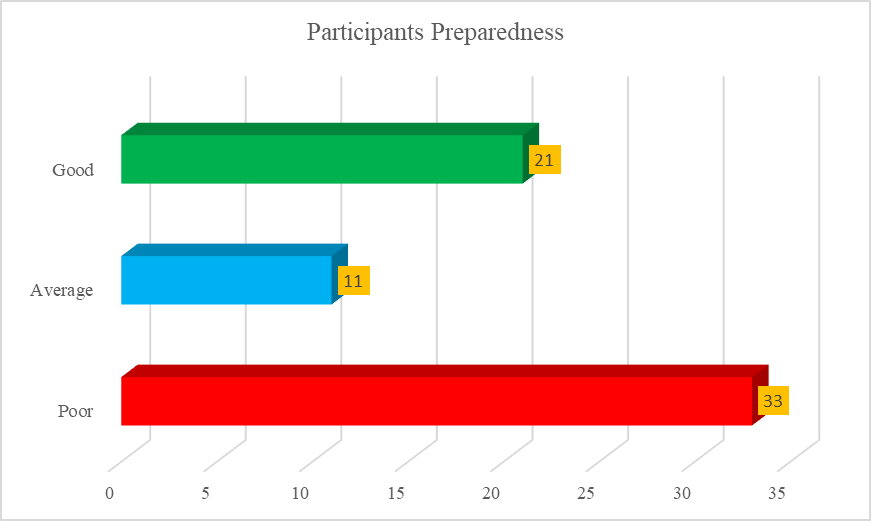
Despite these significant associations, simulation exposure did not differ statistically across education levels (p = 0.182) or HPCSA categories (p = 0.1998). Nonetheless, trends consistently showed that those with advanced qualifications and registrations reported more frequent simulation experiences, suggesting a meaningful, if not statistically definitive, relationship. When asked to assess their own readiness, majority of respondents (51%) rated their preparedness as poor. Mirroring the objective data which shows that those with minimal exposure to disaster simulations and little formal rescue training were more likely to report feeling underprepared. These findings suggest that current training systems are falling short in equipping the majority of the workforce with the tools they need to succeed in disaster contexts.
No statistically significant difference in the number of disaster response simulations and EMC education level (p = 0.182), although there was a clear trend indicating that individuals with advanced qualifications, such as the Bachelor of Technology and National Diploma in Emergency Medical Care, tended to report higher simulation exposure. However, the relationship between rescue training and simulation exposure was found to be strongly statistically significant (p = 0.001386), highlighting that those who had received rescue training participated in significantly more disaster response simulations than those who had not.
Practical Training Components
Practical training in disaster response also exhibits variability. While some ECPs have engaged in hands-on drills, extrication exercises, and mass casualty management scenarios, others reported no practical training experiences. One participant recalled participating in structural collapse and search and rescue exercises, while another described advanced simulation involving the establishment of functional field hospitals and field mortuaries. Conversely, several participants indicated a complete absence of practical training or expressed difficulty recalling such experiences. This disparity underscores the need for standardized and comprehensive practical training to enhance ECPs' preparedness for real-world disaster scenarios.
Participant AR3 recalled: “Structural collapse and search and rescue,” while Participant AR6 described advanced simulations: “Establish functional field hospital… field mortuary with patient identification files.” Yet others, like Participant NR6, stated plainly: “No practicals,” and Participant AR5 noted, “Do not recall,” indicating either an absence of training or a failure to deliver content in a memorable, applicable manner.
The disconnect between theoretical and practical training has left many ECPs feeling ill-equipped for real-world disasters. As Participant BR1 remarked:
“Managing a major incident,” was merely covered briefly, and lacked adequate practical engagement.
Simulation Drills and Workplace Training: Sporadic and Uneven
While some ECPs have received disaster-related training through hospital incident management systems or participated in international response missions, others reported no exposure to such training. A total of 36 participants noted that no disaster management training had been provided in their workplace, highlighting a critical gap in ongoing professional development and preparedness. For instance, while some respondents, such as Participant AR6, recalled highly detailed simulations like:
“Passenger aircraft crash in a populated urban area… high-rise building collapse following terror bombing,” many others had not participated in any simulations at all.
Fifteen participants explicitly indicated “none/nothing/nil/not done,” and others said they “do not recall” participating in any disaster simulation exercises. The lack of regular, realistic, and multidisciplinary simulation undermines confidence and competence in disaster scenarios.
Knowledge and Skills Deficits
Quantitative data highlighted specific knowledge areas where ECPs felt underprepared, including incident command systems, triage protocols, and inter-agency coordination. This was reinforced in qualitative comments, where participants consistently mentioned the need for deeper knowledge of disaster legislation, resource allocation, and cross-agency communication. For instance, Participant AR7 stated, “SOPs about disasters, how the paramedics are activated, who is in charge and our roles and responsibilities,” which reflects a lack of clarity in operational procedures that could critically hinder disaster response.
In terms of practical skills, both data sources pointed to major deficits. Skills in aquatic rescue, high-angle extrication, and equipment handling were repeatedly cited as either missing or underdeveloped. Participant BR3 simply responded, “swimming,” when asked about needed skills – an example of how even basic, scenario-specific competencies remain unaddressed in some training programs. Participants also expressed concern about a lack of leadership training and command-level decision-making ability in disaster scenarios, which could compromise response effectiveness during multi-agency emergencies.
Perceived Preparedness and Systemic Constraints
Perceived preparedness emerged as a major theme across both methodologies. In the survey, only a small percentage of participants rated themselves as well-prepared for real-world disaster response (see Figure 1). Qualitative data underscored this perception with a wide range of responses: some individuals, like Participant AR10, claimed they were “well equipped,” while others, such as NR6, plainly stated, “I am not trained for disasters, I don’t feel ready.” This split suggests that preparedness is as much a function of individual training experiences as it is of systemic curriculum design.
Importantly, even among those who had undergone some form of training, many felt that the real-world applicability of their education was limited. Participant AR6 insightfully remarked that “the reality of underfunded systems and poor performing structures was never accounted for in the 'Ideal World' training,” indicating that without resource-aligned training and contextual realism, theoretical education alone is insufficient.
Recommendations and Systemic Implications
Triangulated findings point to several actionable recommendations. Both quantitative and qualitative data affirm the need for standardized inclusion of disaster health management modules in all levels of ECP education. Frequent, practical simulation drills involving all stakeholders – including fire, police, and municipal agencies – should be institutionalized. There is also a clear need for legislative backing and inter-agency frameworks that clarify command roles, facilitate resource allocation, and integrate municipal disaster planning with healthcare provider training.
Moreover, qualitative responses such as those from Participant AR2, who suggested that “constant in-class and work-integrated learning of disaster management will be beneficial,” and Participant NR27, who called for “refresher courses twice a year,” point to the necessity of ongoing professional development. This aligns with international best practices that emphasize lifelong learning and scenario-based training to maintain readiness in high-risk professions.
Therefore, by triangulating the quantitative and qualitative data, this study reveals a critical gap in the educational preparedness of Emergency Care Providers for disaster health management in the eThekwini District. While some pockets of effective training exist, systemic inconsistencies, lack of simulation exposure, and inadequate CPD opportunities significantly undermine overall preparedness. The findings underscore the urgent need for curriculum reform, resource investment, and cross-sector collaboration to ensure that ECPs are fully equipped to manage the complex and evolving demands of disaster response. Addressing these issues is not merely an academic exercise but a public health imperative in a region increasingly vulnerable to climate-related and man-made disasters.
Discussion
The purpose of this study was to investigate the educational preparedness of emergency care providers (ECPs) for disaster health management in the eThekwini District of South Africa. By employing a mixed-methods approach, this research sought to provide a comprehensive understanding of ECPs' competencies, perceptions, and the contextual challenges they face in disaster response. The integration of quantitative and qualitative data offers a nuanced perspective on the strengths and gaps in current training programs and preparedness levels.
The findings from this mixed-methods study offer a comprehensive insight into the educational preparedness of Emergency Care Providers (ECPs) for disaster health management in the eThekwini District. By assessing current educational provisions, exploring perceived preparedness among ECPs, and evaluating systemic and contextual barriers to effective disaster response, the research highlights critical gaps in training, confidence, and institutional readiness. It also underscores opportunities for reform through targeted education, simulation-based training, and policy innovation.
The quantitative results revealed that a significant proportion of ECPs rated their preparedness for disaster situations as moderate to low, particularly in areas such as incident command, mass casualty triage, and emotional resilience. These findings align with global studies indicating that healthcare professionals often lack adequate exposure to disaster-specific training and experiential learning opportunities [33][34]. Less than half of the surveyed respondents had received formal disaster training in the past two years, and even fewer had participated in simulations or multi-agency exercises. This training deficit directly translated into a lack of confidence in critical areas such as coordination, leadership, and decision-making under pressure. The limited availability of Continuing Professional Development (CPD) activities focused on disaster response further exacerbated these issues, pointing to systemic weaknesses in curriculum design and professional support structures.
The qualitative findings corroborated and enriched these numerical insights. Thematic analysis of participant structured open-ended questionnaire revealed widespread concern regarding the inadequate integration of disaster management into both undergraduate and postgraduate Emergency Medical Services (EMS) curricula. Many respondents emphasized that their training had been largely theoretical, lacking hands-on simulations or rescue-specific modules. Participants repeatedly expressed the need for ongoing workshops, interagency drills, and skills refreshers, with several noting that practical disaster competencies – such as triage in chaotic environments, ethical decision-making under scarce resources, and psychosocial care – were either overlooked or superficially addressed in their educational programs. These sentiments align with literature advocating for Competency-Based Education (CBE) as a solution, which emphasizes real-world abilities across cognitive, affective, and psychomotor domains [19][35].
Crucially, the research also uncovered an emotional and psychological dimension to preparedness that is often absent from conventional disaster education. Many ECPs reported feeling emotionally unprepared for the mental stress of disaster scenarios. The psychological toll of mass casualties, ethical dilemmas, and exposure to trauma was evident in participant testimonies. These findings align with international research emphasizing the importance of Psychological First Aid (PFA), self-efficacy, and emotional regulation in disaster response [25][36][37]. Yet, such content remains marginal in most South African EMS curricula, highlighting a critical need for emotional resilience training alongside technical skill development.
The data also confirmed that ECPs' perceptions of their disaster preparedness are deeply intertwined with contextual and cultural challenges specific to the eThekwini District. Many providers operate in high-risk environments characterized by informal settlements, limited infrastructure, and linguistic diversity. Participants described challenges in communication with communities, ethical dilemmas related to unequal access to resources, and frustration with unclear emergency protocols. These contextual realities require culturally competent training that emphasizes community engagement, ethical sensitivity, and adaptability [21][22][38].
Moreover, the findings underscored a significant lack of interagency coordination and stakeholder integration in both training and response. ECPs described difficulties in working with fire services, police, and local municipalities due to inconsistent communication protocols and lack of joint drills. This fragmentation undermines efficiency and safety during actual disaster responses. The Sendai Framework for Disaster Risk Reduction [2] and studies by [28] have emphasized the need for integrated, multi-sectoral disaster training. Implementing such frameworks within local EMS systems would foster collaboration, clarify roles, and improve real-time coordination – ultimately enhancing patient outcomes and system resilience.
Another key finding was the systemic undervaluing of disaster education within EMS institutions. Many ECPs viewed disaster training as a “luxury” or secondary concern, often scheduled inconsistently or treated as optional. Several participants mentioned that their institutions prioritized daily clinical operations over future-focused preparedness, resulting in minimal investment in disaster drills, equipment, or curriculum development. This reflects wider critiques in the literature, which argue that disaster preparedness often receives inadequate policy attention and funding despite its critical importance [39][41]. For South Africa, where natural and man-made disasters are increasingly frequent, this constitutes a dangerous oversight.
Importantly, the findings point toward actionable strategies. Participants provided thoughtful and practical recommendations that could inform local and national reforms. These included the establishment of a mandatory disaster management module in EMS training, regular CPD workshops, and the use of simulation-based learning as a core instructional method. These recommendations are consistent with international best practices, such as the DITAC framework in Europe, which combines classroom learning with simulation, mental health support, and inter-agency collaboration [29][42]. In resource-constrained settings like eThekwini, even low-cost approaches such as tabletop simulations, peer-led drills, and community-based exercises could have significant impact.
Finally, the triangulation of quantitative and qualitative data reinforces the conclusion that the current level of educational preparedness among ECPs in the eThekwini District is insufficient for optimal disaster health management. While individual providers exhibit dedication, adaptability, and awareness of their limitations, the systemic structures surrounding them – curricula, institutions, policies, and inter-agency dynamics – fail to support their development as effective disaster responders. Addressing these gaps will require a coordinated effort involving educational institutions, health departments, disaster management agencies, and community stakeholders. Only through a holistic, context-sensitive approach can emergency care in South Africa become truly disaster-ready.
In summary, this study provides compelling evidence that disaster preparedness among emergency care providers in eThekwini is not merely a matter of knowledge or skill, but one of systemic transformation. The integration of competency-based, emotionally intelligent, and culturally aware training must become a national priority. This is not only vital for protecting public health in times of crisis but also for strengthening the everyday resilience of health systems facing chronic stressors. As disasters grow in complexity, so too must the training and support of those on the frontline. Without this investment, the human and societal costs of future emergencies will only escalate.
Conclusion and Recommendations
There is a need for ongoing workshops, interagency drills, and skills refreshers in practical disaster competencies, including triage in chaotic environments, ethical decision-making under resource scarcity, and psychosocial care. Continuous advocacy for transitioning emergency care education to competency-based education is essential to ensure that emergency care practitioners in training acquire real-world abilities across cognitive, affective, and psychomotor domains.
There is an urgent need to develop and adopt a standardized competency-based curriculum for disaster health management, including core disaster response competencies – such as triage, ethical decision-making, leadership under pressure, and inter-agency coordination assessed against standardized performance benchmarks [19][35] across all emergency care education institutions in South Africa. This curriculum should be under the oversight of the Health Professions Council of South Africa (HPCSA) and reflect international standards such as those proposed by the WHO and the Sendai Framework [2][20].
Declarations
Ethical Clearance
Ethical clearance was obtained from the Health Research Ethics Committee at North-West University (NWU-HREC) and the Provincial Health Research and Ethics Committee (PHREC) in KwaZulu-Natal.
Conflict of interest
The researchers have no conflicts of interest regarding this study.
Funding/ financial support
None
Contributors
All authors have equal contribution.
Acknowledgements
None