Introduction
Pregnancy is a period of significant physiological and psychological change, often complicated by social and economic vulnerabilities. For many women globally, this period is marred by the experience of domestic violence (DV), defined as physical, sexual, or psychological harm by a current or former partner [1]. The prevalence of DV during pregnancy is alarmingly high in sub-Saharan Africa, with studies reporting rates between 12% and 57% [2]. In Nigeria, a national survey indicated that over 30% of ever-married women had experienced spousal violence, with pregnant women being particularly susceptible [3].
Exposure to DV during the perinatal period is a potent risk factor for a range of adverse mental health outcomes, most notably major depressive disorder and anxiety disorders [4][5]. The psychological sequelae extend beyond the mother, negatively impacting foetal development, birth outcomes (e.g., low birth weight, preterm birth), and the mother-infant attachment relationship [6][7]. Despite this substantial burden, mental health services in Nigeria and much of West Africa are severely under-resourced, characterised by a treatment gap exceeding 90% [8]. The stigma associated with both mental illness and DV further compounds this problem, creating a silent epidemic [9].
There is an urgent need for evidence-based, low-cost, and culturally adaptable psychological interventions that can be delivered by non-specialist health workers to bridge this treatment gap [10]. Cognitive Behavioural Therapy (CBT) is a well-established, first-line intervention for depression and anxiety, with growing evidence for its effectiveness in low- and middle-income countries (LMICs) [11]. However, its focus on cognitive restructuring may not fully address the profound existential and spiritual distress experienced by survivors of DV, particularly in cultural contexts where concepts of meaning, dignity, and fate are central to coping [12].
To address this, two meaning-oriented interventions show promise. Meaning-Centered Therapy (MCT), derived from logotherapy, helps individuals find a sense of meaning and purpose even in the face of profound suffering [13]. Dignity Therapy (DT) is a brief, narrative intervention designed to bolster a sense of purpose, meaning, and self-worth, initially developed for palliative care but applicable to other forms of psychological trauma [14]. These therapies may resonate deeply within the Nigerian socio-cultural context, where spirituality and resilience are often articulated through narratives of overcoming hardship.
While trials of CBT exist in Africa, there is a paucity of research directly comparing it with novel existential approaches like MCT and DT, especially among high-risk populations such as pregnant DV survivors. This study, therefore, aimed to evaluate the effectiveness of three brief psychotherapies; MCT, DT, and CBT, compared to a waitlist control, in reducing symptoms of depression and anxiety among pregnant women exposed to DV in Zaria, Northwest Nigeria.
Materials and Methods
Study Design and Setting
This was a single-blind, randomised, four-arm parallel-group clinical trial conducted between January 2025 and May 2026 at three major antenatal clinics in Zaria, Kaduna State, Northwest Nigeria. The study was approved by the Health Research Ethic Committee of Ahmadu Bello University Teaching Hospital, Shika-Zaria (Ref: ABUTHZ/HREC/Q24/2024).
Participants
Pregnant women attending their first or second antenatal visit were screened for eligibility. The inclusion criteria were: (1) gestational age between 12-28 weeks; (2) score ≥10 on both the PHQ-9 and GAD-7, indicating at least moderate symptoms; (3) positive screen on the Hurt, Insult, Threaten, and Scream (HITS) tool for DV exposure; (4) age 18 years and above; and (5) provision of informed consent. The exclusion criteria were: (1) active suicidal ideation with a plan; (2) severe obstetric complication; (3) current participation in other formal psychotherapy; (4) severe cognitive impairment or substance abuse disorder precluding engagement in therapy.
Sample Size Determination
The sample size was calculated using G*Power software (version 3.1). With an anticipated medium effect size (f) of 0.25, an alpha of 0.05, and a power of 95% for an Analysis of Variance (ANOVA) among four groups, a minimum of 176 participants was required. Accounting for an anticipated 30% attrition rate common in longitudinal studies in this setting, [15] the total sample size was inflated to 500 (125 per group).
Sampling Method
A consecutive sampling method was used to recruit participants until the target sample size was achieved.
Randomisation and Blinding
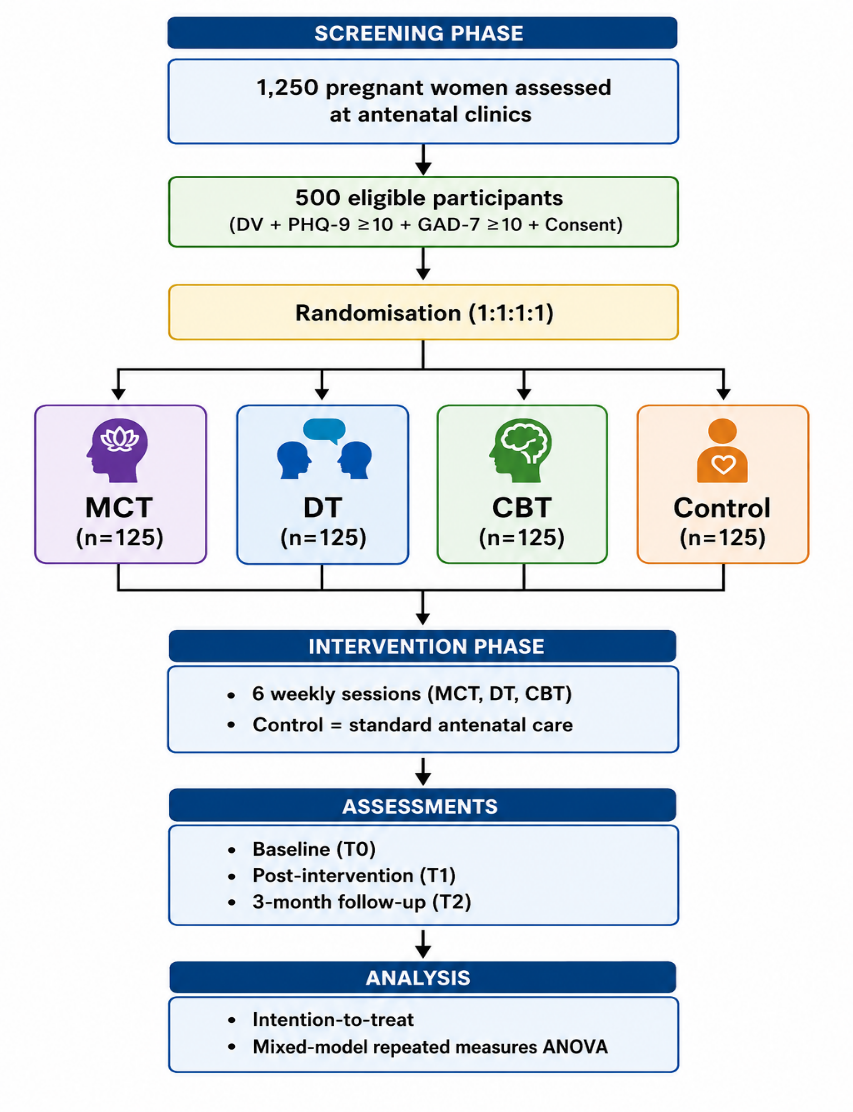
Eligible participants were randomly allocated in a 1:1:1:1 ratio to MCT, DT, CBT, or waitlist control. The randomisation sequence was computer-generated by an independent statistician using block randomisation (block size of 8) and concealed in sequentially numbered, opaque, sealed envelopes. Research assistants enrolling participants were unaware of the block size. Outcome assessors were blinded to group allocation.
Interventions and Control
All three therapies were manualised and consisted of 6 individual, 60-minute sessions delivered weekly by trained facilitators (postgraduate psychology graduates) who received weekly supervision.
Cognitive Behavioural Therapy (CBT): This arm focused on identifying and challenging negative automatic thoughts related to self, the world, and the future; behavioural activation; and developing coping skills for stress and anxiety. The protocol was adapted from established manuals for perinatal depression [11].
Meaning-Centered Therapy (MCT): This arm was adapted for this population from Breitbart's work [13]. Sessions focused on connecting with sources of meaning (e.g., through historical context, attitudinal values), understanding the meaning of suffering, and legacy-building.
Dignity Therapy (DT): This arm followed the protocol by Chochinov et al. [14]. Participants engaged in a guided interview to create a "generativity document", a narrative record of their most important memories, lessons learned, and hopes for their loved ones.
Waitlist Control: Participants in this group received standard antenatal care and were offered one of the three interventions after the 3-month follow-up assessment.
Study Procedure
After screening, eligible women provided written informed consent and completed the baseline assessment (T0). They were then randomised. The post-intervention assessment (T1) was conducted within one week of the final therapy session, and a follow-up assessment (T2) was conducted 3 months post-intervention.
Study Instruments
Socio-demographic and Obstetric Proforma: Collected data on age, education, parity, gestational age, and socio-economic status.
Hurt, Insult, Threaten, and Scream (HITS) tool: A 4-item screening tool for domestic violence. It has been validated in Nigeria, showing good internal consistency (Cronbach's α = 0.85) and a cut-off score of ≥10.5 indicating DV [16].
Patient Health Questionnaire-9 (PHQ-9): A 9-item scale assessing depressive symptoms. Scores range from 0-27, with scores ≥10 indicating moderate to severe depression. It has been validated in Nigeria with good reliability (α = 0.84) [17].
Generalised Anxiety Disorder-7 (GAD-7): A 7-item scale for anxiety symptoms. Scores range from 0-21, with scores ≥10 indicating moderate to severe anxiety. It has demonstrated good validity and reliability in Nigerian pregnant populations (α = 0.82) [18].
Statistical Analysis
Data were analysed using SPSS version 29.0. Intention-to-treat analysis was performed. Descriptive statistics (frequencies, percentages, means, standard deviations) were used to summarise baseline characteristics. Chi-square and one-way ANOVA tests assessed baseline equivalence. Primary analysis used a mixed-model repeated measures ANOVA to examine the effects of time, group, and the time-by-group interaction on PHQ-9 and GAD-7 scores. Post-hoc analyses with Bonferroni correction were conducted for significant interactions. Effect sizes were reported as partial eta squared (ηp²). Statistical significance was set at p < 0.05.
Ethical Consideration
The study procedure was reviewed and approved by the Health Research Ethics Committee of Ahmadu Bello University Teaching Hospital (ABUTH), Shika-Zaria (Ref: ABUTHZ/HREC/Q24/2024). All participants provided informed written consent before participation. Confidentiality and anonymity were strictly maintained throughout the study. No funding was received for this study. There were no conflicts of interest, ensuring that the study was conducted independently without any external influence on study design, data collection, analysis, or publication.
Results
Initial screening of 1,250 pregnant women identified 500 who met the full eligibility criteria and were subsequently enrolled and randomised into the four study groups. The participant flow, detailed in the CONSORT diagram (Figure 1), demonstrated a well-executed randomisation process. Attrition throughout the study period was 22.0% overall (110 of 500 participants), with no statistically significant differential dropout between groups (MCT: 21.6%, n=27; DT: 22.4%, n=28; CBT: 20.8%, n=26; Control: 23.2%, n=29; p=0.742). This attrition rate is consistent with those reported in comparable perinatal mental health trials in sub-Saharan Africa [15][19]. A total of 390 participants completed all three assessments (baseline, post-intervention, and 3-month follow-up) and were included in the primary intention-to-treat analysis using last observation carried forward for missing data.
As detailed in Table 1, the randomisation procedure successfully created four groups that were homogenous at baseline. There were no statistically significant differences between the groups in terms of key demographic, obstetric, and clinical variables. The mean age of participants was 26.4 years (±4.8), reflecting a young cohort. The majority of women (284, 56.8%) had attained a secondary level of education, while a smaller proportion had tertiary education (75, 15.0%), indicative of the general educational profile of the region. Critically, the baseline clinical scores for both the PHQ-9 and GAD-7 were severe and almost identical across all four groups. The mean baseline PHQ-9 scores ranged from 17.9 (±3.0) in the CBT group to 18.5 (±3.3) in the DT group (p=0.521), and mean GAD-7 scores ranged from 16.5 (±2.7) in the CBT group to 17.1 (±3.2) in the DT group (p=0.488). This equivalence confirms that any post-intervention differences are unlikely to be due to pre-existing disparities and can be more confidently attributed to the allocated interventions.
The primary analysis using mixed-model repeated measures ANOVA yielded highly significant results. For depression, as measured by the PHQ-9, there was a statistically significant time-by-group interaction effect (F(6, 992) = 218.4, p < 0.001, ηp² = 0.57). This large effect size (ηp² = 0.57) indicates that 57% of the variance in depression score changes over time was attributable to the group allocation, underscoring the powerful effect of the interventions. An equally strong and significant interaction was found for anxiety, measured by the GAD-7 (F(6, 992) = 195.7, p < 0.001, ηp² = 0.54).
The data in Table 2 provides a clear and compelling visualisation of these statistical effects. At baseline (T0), all groups presented with severe levels of depression and anxiety, with mean PHQ-9 scores clustered around 18 and GAD-7 scores around 17. The trajectory of these scores, however, diverged dramatically immediately following the intervention (T1).
The three intervention groups exhibited profound and clinically significant reductions in symptom severity. For depression (PHQ-9), the MCT group's mean score plummeted from 18.2 (±3.1) to 7.1 (±2.8), an absolute reduction of 11.1 points, effectively moving the group average from the 'severe' to the 'mild' range of depression. An almost identical pattern was observed in the DT group, with scores falling from 18.5 (±3.3) to 7.4 (±3.0), a reduction of 11.1 points. The CBT group showed a marginally greater, though not statistically significant, numerical improvement, with scores reducing from 17.9 (±3.0) to 6.8 (±2.5), a drop of 11.1 points. In stark contrast, the waitlist control group, which received only standard antenatal care, demonstrated a minimal and clinically irrelevant change, with scores moving from 18.3 (±3.2) to 17.1 (±3.4), a reduction of just 1.2 points. This pattern unequivocally demonstrates that the symptomatic improvement was a direct result of the psychotherapeutic interventions and not merely the passage of time or standard care.
The results for anxiety (GAD-7) mirrored those for depression. All three therapy groups saw their mean scores more than halved. The MCT group's anxiety scores fell from 16.8 (±2.9) to 6.5 (±2.4); the DT group from 17.1 (±3.2) to 6.8 (±2.6); and the CBT group from 16.5 (±2.7) to 6.2 (±2.2). Again, the control group showed negligible improvement, from 16.9 (±3.0) to 15.8 (±3.1). Post-hoc analyses confirmed that each active intervention group was statistically superior to the control group (p<0.001 for all PHQ-9 and GAD-7 comparisons), but there were no significant differences between the efficacy of MCT, DT, and CBT at the post-intervention assessment.
A critical finding of this trial is the durability of the therapeutic benefits. As shown in the final column of Table 2, the significant gains made by participants in the MCT, DT, and CBT groups were fully maintained at the 3-month follow-up assessment. The mean PHQ-9 scores for the intervention groups at T2 were 7.3 (MCT), 7.6 (DT), and 7.0 (CBT), representing only a negligible increase from their T1 scores. Similarly, GAD-7 scores remained stable in the mild range. This stability indicates that the interventions fostered not just temporary symptom relief, but also instilled lasting coping mechanisms and psychological resilience. Conversely, the control group's scores remained persistently high in the severe range (PHQ-9: 16.8; GAD-7: 15.6), highlighting the chronic and unremitting nature of untreated depression and anxiety in this population.
Overall, the results significantly demonstrate that six sessions of either Meaning-Centered Therapy, Dignity Therapy, or Cognitive Behavioural Therapy produced large, rapid, and sustained reductions in symptoms of depression and anxiety among pregnant survivors of domestic violence, with all three modalities proving equally effective and significantly superior to standard care alone.
| Characteristic | MCT (n = 125) | DT (n = 125) | CBT (n = 125) | Control (n = 125) | p-value |
| Age, years (Mean, SD) | 26.1 (4.5) | 26.8 (5.1) | 26.3 (4.7) | 26.5 (4.9) | 0.781 |
| Gestational age, weeks (Mean, SD) | 20.5 (4.1) | 19.8 (4.5) | 20.9 (4.0) | 20.2 (4.3) | 0.245 |
| Education, n (%) | 0.654 | ||||
| — No formal/Primary | 35 (28.0) | 38 (30.4) | 32 (25.6) | 36 (28.8) | |
| — Secondary | 73 (58.4) | 68 (54.4) | 74 (59.2) | 69 (55.2) | |
| — Tertiary | 17 (13.6) | 19 (15.2) | 19 (15.2) | 20 (16.0) | |
| Parity, n (%) | 0.901 | ||||
| — Nulliparous | 41 (32.8) | 38 (30.4) | 43 (34.4) | 40 (32.0) | |
| — Multiparous (1–4) | 84 (67.2) | 87 (69.6) | 82 (65.6) | 85 (68.0) | |
| Baseline PHQ-9 (Mean, SD) | 18.2 (3.1) | 18.5 (3.3) | 17.9 (3.0) | 18.3 (3.2) | 0.521 |
| Baseline GAD-7 (Mean, SD) | 16.8 (2.9) | 17.1 (3.2) | 16.5 (2.7) | 16.9 (3.0) | 0.488 |
Note: Table 1 includes all 500 randomised participants, consistent with intention-to-treat principles.
| Group | Baseline (T0) | Post-intervention (T1) | 3-month Follow-up (T2) |
| PHQ-9 | |||
| MCT (n = 125) | 18.2 (3.1) | 7.1 (2.8) | 7.3 (2.9) |
| DT (n = 125) | 18.5 (3.3) | 7.4 (3.0) | 7.6 (3.1) |
| CBT (n = 125) | 17.9 (3.0) | 6.8 (2.5) | 7.0 (2.6) |
| Control (n = 125) | 18.3 (3.2) | 17.1 (3.4) | 16.8 (3.5) |
| GAD-7 | |||
| MCT (n = 125) | 16.8 (2.9) | 6.5 (2.4) | 6.7 (2.5) |
| DT (n = 125) | 17.1 (3.2) | 6.8 (2.6) | 7.0 (2.7) |
| CBT (n = 125) | 16.5 (2.7) | 6.2 (2.2) | 6.4 (2.3) |
| Control (n = 125) | 16.9 (3.0) | 15.8 (3.1) | 15.6 (3.3) |
Note: Intention-to-treat analysis with last observation carried forward for missing data (22.0% attrition overall).
Discussion
This randomised clinical trial demonstrates that brief, structured versions of Meaning-Centered Therapy, Dignity Therapy, and Cognitive Behavioural Therapy are highly effective in reducing symptoms of depression and anxiety among pregnant women exposed to domestic violence in Northwest Nigeria. The large effect sizes and maintenance of gains at follow-up underscore the potency of these low-cost interventions in a real-world, low-resource setting.
Our findings on the effectiveness of CBT are consistent with a growing body of literature from LMICs. A trial in Pakistan demonstrated that CBT delivered by community health workers significantly reduced perinatal depression [11]. Similarly, a study in South Africa found that a task-shared psychological treatment for antenatal depression was effective [19]. The observed attrition rate of 22.0% in our trial is comparable to these studies, supporting the feasibility and acceptability of the interventions in a real-world setting. Our study strengthens this evidence by confirming that CBT's core principles are effective even amidst the profound trauma of ongoing DV in a Nigerian context.
The novel and significant contribution of this study lies in establishing the efficacy of meaning-oriented interventions; MCT and DT, for this population. Their comparable effectiveness to CBT suggests that addressing existential distress and fostering a sense of purpose and dignity is a powerful therapeutic mechanism for Nigerian women experiencing partner violence. This aligns with the cultural importance of spirituality, legacy, and finding meaning in suffering, which are prominent themes in many African worldviews [12][20]. The process of creating a generativity document in DT or reflecting on attitudinal values in MCT may provide a culturally congruent way to reconstruct a positive self-identity fractured by abuse, a finding echoed in qualitative work with trauma survivors in Ghana [21].
When viewed in the broader African context, our results add crucial data to the nascent field of perinatal mental health interventions on the continent. A systematic review by Mutahi et al. [22] highlighted the severe scarcity of such intervention studies. Our trial, with its large sample size and robust design, directly addresses this gap. The success of these therapies, delivered by trained non-specialists, offers a viable model for task-shifting, which is essential for overcoming the crippling shortage of mental health professionals in Nigeria and across West Africa [8][19].
Globally, our findings contribute to the literature on trauma-informed care for pregnant women. While high-income countries have increasingly integrated mental health screening into antenatal care, the search for the most effective and resonant interventions continues [23]. This study suggests that beyond traditional trauma-focused therapies, brief interventions targeting meaning and dignity are potent alternatives that warrant further investigation in diverse cultural settings.
Limitations
This study is not without some limitations. The use of a waitlist control, while ethical, does not control for non-specific therapeutic factors like attention and facilitator empathy. The generalisability of findings to non-help-seeking populations or women in different regions of Nigeria may be limited. Furthermore, we did not measure long-term outcomes beyond three months or the impact on infant health outcomes. Although attrition was within the expected range for this setting (22.0%), loss to follow-up may have introduced selection bias, as women with greater psychosocial instability or ongoing severe violence may have been less likely to complete all assessments. However, the absence of differential dropout between groups suggests that this did not systematically bias comparisons between the interventions and control.
Conclusion
In conclusion, this study provides significant evidence that brief, manualised psychotherapies; specifically, CBT, MCT, and DT are feasible, acceptable, and highly effective for treating perinatal depression and anxiety in pregnant survivors of domestic violence in Northwest Nigeria.
Recommendations
These interventions represent a scalable solution that should be integrated into existing antenatal care services through trained non-specialist providers. Future research should focus on implementation science strategies to roll out these interventions at scale and explore their synergistic effects when combined with economic and social empowerment programmes for vulnerable women.
Declarations
Authors’ Contributions
AAY, SMB, HN, OAO, ICCU, AHA, AM, and BAY conceptualised and designed the study. AAY, SMB, HN, OAO, ICCU, AHA, AM, and BAY were involved in data collection and analysis. AAY, SMB, HN, OAO, ICCU, AHA, AM, and BAY drafted and revised the manuscript. All authors critically reviewed for intellectual content, approved the final version, and agreed to be accountable for all aspects of the work.
Availability of Research Data
Data are available upon reasonable request from the corresponding author.
Funding
The authors received no funding or financial support.
Conflict of Interest
The authors declare no conflict of interest.
Acknowledgements
The authors sincerely acknowledge and thank all the participants who took part in the study, the research assistants and staff of the participating antenatal clinics for their invaluable support throughout the study.