Introduction
Laparoscopic cholecystectomy relies on CO₂ pneumoperitoneum to provide adequate visualization and working space [1]. However, insufflation can alter abdominal pressure, venous return, splanchnic blood flow, and systemic hemodynamics [2,3]. The liver is particularly sensitive to changes in portal circulation and oxygen delivery, making it vulnerable to transient hypoperfusion and oxidative stress [4]. Consequently, perioperative changes in liver function tests have been explored as indirect markers of hepatic stress [5]. Pneumoperitoneum usually is maintained at the pressure ranging from 12 to 16 mmHg [6,7].
Different strategies—including modifications in pneumoperitoneum pressure—may reduce physiologic impact while preserving operative feasibility [8,9,10]. Lower insufflation pressures (e.g., 10 mmHg) may reduce negative effects on hepatic microcirculation and oxygenation [11,12]. This prospective study compares postoperative liver function changes in patients undergoing laparoscopic cholecystectomy under 10 mmHg versus 14 mmHg CO₂ insufflation [8,9,13-15].
Materials and Methods
A single centre, Prospective, observational, randomized controlled study of 60 cases in Department of General Surgery, Graphic Era institute of Medical Sciences, Dehradun who were planned for Elective laparoscopic cholecystectomy of age, ranging from 18–65 years, diagnosed gallstone disease requiring laparoscopic cholecystectomy, having ASA physical status I–III, having ability to provide informed consent, with baseline LFTs within 1.5× upper limit of normal were included in study. Patient who was known chronic liver disease (cirrhosis, viral hepatitis with active disease), having obstructive jaundice or cholangitis, history of hepatotoxic drug use within 2 weeks, undergoing emergency surgery or conversion to open surgery, with significant renal failure or shock were excluded from the study. Patients were randomized using a computer-generated random sequence into: Group A (Low pressure): 10 mmHg CO₂& Group B (Standard pressure): 14 mmHg CO₂. Allocation concealment was done using sealed opaque envelopes. Then all patients underwent laparoscopic cholecystectomy using standardized anesthesia and surgical technique as per protocol. Pneumoperitoneum was created, for Group A: 10 mmHg CO₂ & for Group B: 14 mmHg CO₂. CO₂ insufflation was maintained throughout creation of pneumoperitoneum and during surgery, excluding brief adjustments for exposure. Standard Anesthesia Protocol was used i.e. Induction was done with (e.g., propofol), analgesia, and neuromuscular blockade. Ventilation maintained with lung-protective strategy (ETCO₂ managed to remain within target range), Standard monitoring: ECG, SpO₂, NIBP, capnography. Outcome were Measured into primary & secondary. Primary Outcome being Change in ALT from baseline to 24 hours postoperatively, while secondary Outcomes includes Change in AST (baseline to 6 h and 24 h), Change in total bilirubin (baseline to 6 h and 24 h), Change in ALP (baseline to 24 h), Change in GGT (baseline to 24 h), Change in albumin (baseline to 24 h), Hemodynamic variables: mean arterial pressure (MAP), heart rate, intraoperative variables: blood loss, operative time, complications were documented.
Data were collected at T0: Preoperative baseline (within 24 hours pre-surgery), T1: 6 hours postoperative, T2: 24 hours postoperative. Venous blood samples collected and analyzed using automated chemistry analyzers. Values of ALT (U/L), AST (U/L), ALP (U/L), Total bilirubin (mg/dL), GGT (U/L), Albumin (g/dL) were documented.
Sample size of 60 was considered assuming a clinically relevant difference in ALT change between groups, 30 per arm yields adequate power at α=0.05. Various statistical tools were used i.e. for Continuous variables: mean ± SD; analyzed using independent t-test or Mann–Whitney U test, Within-group changes: paired t-test / Wilcoxon, for Categorical variables: Chi-square/Fisher exact test & for Significance: p < 0.05.
Results
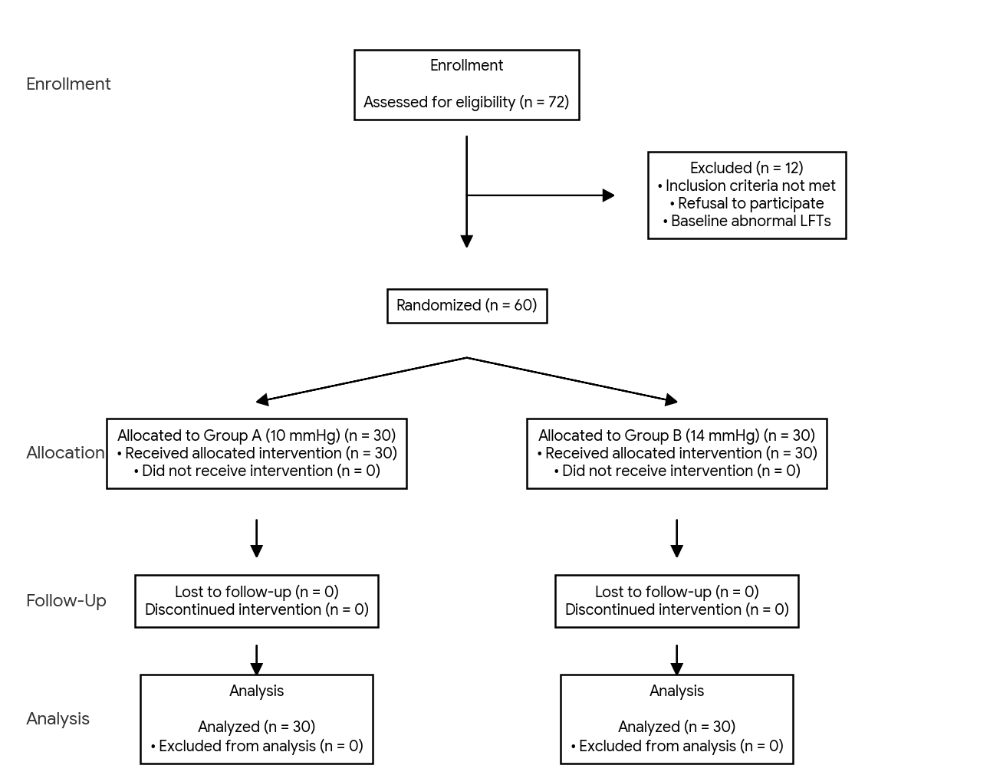
72 patients were assessed, out of which 12 (criteria not met / refusal / baseline abnormal LFTs) were excluded. Rest 60 patients were randomised, Completed and analysed. There was no conversions/open surgery was there in this dataset. Baseline Characteristics were documented i.e. Mean age was comparable (low: ~42 years; standard: ~44 years), Sex distribution was comparable, ASA grade was similar across groups. Baseline ALT/AST/bilirubin showed no significant differences.
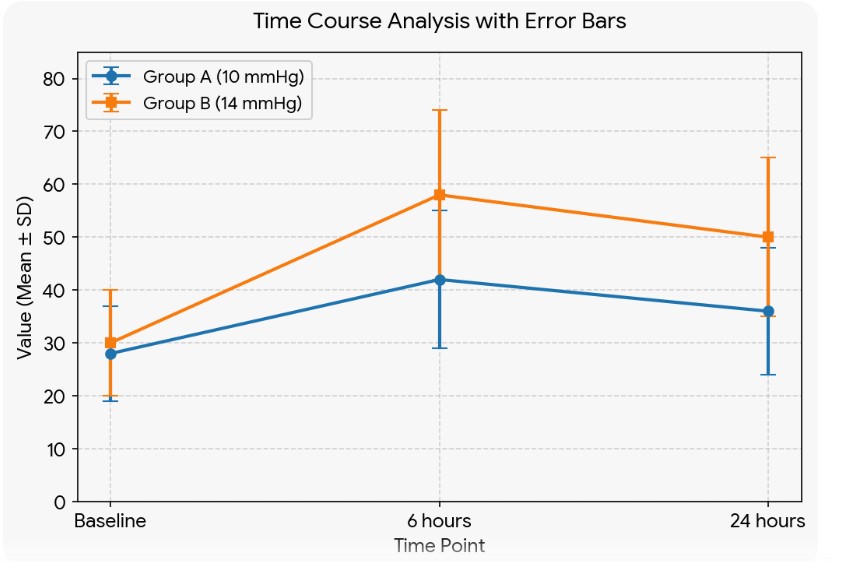
Baseline Mean ALT (U/L) in Group A (10 mmHg) was 28 ± 9 while in Group B (14 mmHg) was 30 ± 10, at 6 hours in Group A was ~42 ± 13 while in Group B was ~58 ± 16, at 24 hours in Group A was ~36 ± 12 while in Group B was ~50 ± 15. Primary endpoint: ALT rise at 24 hours was smaller in Group A (p-value < 0.05).
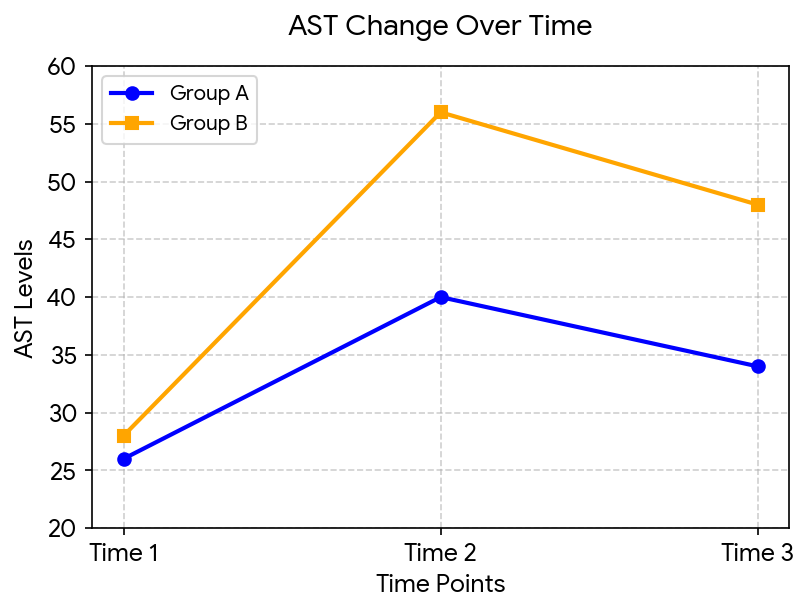
Baseline Mean AST (U/L) in Group A was ~26 ± 8 while in Group B was ~28 ± 9. At 6 hours in Group A was ~40 ± 12 while in Group B was ~56 ± 14. At 24 hours in Group A was ~34 ± 11while in Group B was ~48 ± 13.
There were small changes; no major between-group differences in Total bilirubin, mild post-op rise in both arms; low-pressure slightly lower in ALP values, while in GGT, similar trend to ALP; low-pressure attenuates rise. Albumin: minimal change by 24 hours in both groups (expected)
MAP and HR showed no significant long-term differences; low-pressure associated with slightly more stable trends. Operative time and blood loss were comparable. No major complications in either group in this dataset. Minor transaminitis represented by LFT elevations.
Discussion
This prospective comparison suggests that lower pneumoperitoneum pressure (10 mmHg) may reduce perioperative hepatic stress, reflected by attenuated postoperative increases in ALT and AST at 6 and 24 hours. The liver’s sensitivity to hemodynamic changes makes it plausible that elevated intra-abdominal pressure at 14 mmHg could reduce splanchnic perfusion and oxygen delivery, leading to greater hepatocellular injury markers.
Our findings align with the broader concept that pneumoperitoneum pressure can modulate systemic and regional physiology. While bilirubin and other cholestatic markers may change less dramatically over 24 hours, transaminases are often early indicators of hepatocellular stress. The clinical relevance depends on magnitude and duration of enzyme elevation; in the dataset, low pressure shows lower enzyme levels without evidence of overt liver dysfunction.
Conclusion
In this prospective study of 60 cases undergoing laparoscopic cholecystectomy, 10 mmHg CO₂ pneumoperitoneum was associated with smaller postoperative rises in ALT and AST compared with 14 mmHg, suggesting reduced hepatic stress.
Declarations
Ethics approval and consent to participate
The study was conducted in accordance with ethical principles for biomedical research involving human participants. Ethical approval was obtained from the Institutional Ethics Committee of Graphic Era Institute of Medical Sciences, Dehradun, Uttarakhand. Written informed consent was obtained from all participants prior to data collection. Confidentiality and anonymity of participants were strictly maintained.
List of abbreviations
LFT: Liver function test
ALP: Alkaline Phosphatase
ALT: Alanine Aminotransferase
CO2: Carbon Dioxide
ETCO₂: End-Tidal Carbon Dioxide
Data Availability
Data are available upon reasonable request from the corresponding author.
Conflicts of Interest
The authors declare no conflict of interest.
Funding Statement
The authors received no funding or financial support.
Authors' contributions
Dr. Aman Kamra Conceptualization, data collection, analysis, manuscript drafting Dr. Ankit Jain: Conceptualization, data collection, analysis, manuscript drafting Dr. Akash N Gaind: Conceptualization, data collection, analysis, manuscript review Dr. MK Srivastava: Supervision, critical revision of manuscript, Dr. Meetika: data collection, analysis, manuscript review
Acknowledgments
The authors sincerely acknowledge and thank all the participants who took part in the study.
References
-
O'Malley C, Cunningham AJ. Physiologic changes during laparoscopy. Anesthesiol Clin North Am. 2001 Mar;19(1):1-19. doi: 10.1016/s0889-8537(05)70208-x. PMID: 11244911.
-
Rasmussen IB, Berggren U, Arvidsson D, Ljungdahl M, Haglund U. Effects of pneumoperitoneum on splanchnic hemodynamics: an experimental study in pigs. Eur J Surg. 1995 Nov;161(11):819-26. PMID: 8749214.
-
Gutt CN, Oniu T, Mehrabi A, Schemmer P, Kashfi A, Kraus T, et al. Circulatory and respiratory complications of carbon dioxide insufflation. Digestive surgery. 2004;21: 95-105.doi: 10.1159/000077038
-
Glantzounis GK, Tselepis AD, Tambaki AP, Trikalinos TA, Manataki AD, Galaris DA, Tsimoyiannis EC, Kappas AM. Laparoscopic surgery-induced changes in oxidative stress markers in human plasma. Surg Endosc. 2001 Nov;15(11):1315-9. doi: 10.1007/s00464-001-0034-2. Epub 2001 Aug 16. PMID: 11727142.
-
Fawzy Ali, Reda & Aouf, Ahmed & Zaghloul, Mariam & Kandel, Mohamed. (2025). Effect of different pneumoperitoneum pressures in laparoscopic cholecystectomy on levels of transaminases and GGT, randomized clinical trial Effect of different pneumoperitoneum pressures in laparoscopic cholecystectomy on levels of transaminases and GGT, randomized clinical trial.
-
Gupta R, Kaman L, Dahiya D, Gupta N, Singh R. Effects of varying intraperitoneal pressure on liver function tests during laparoscopic cholecystectomy. J Laparoendosc Adv Surg Tech A. 2013 Apr;23(4):339-42. doi: 10.1089/lap.2012.0399. Epub 2013 Feb 28. PMID: 23448122.
-
Khan MA, Haq I, Ihsan Z, Daud M, Ahmad N, Ali H, Aslam F, Rehman SSU. The Impact of Intra-abdominal Pressure on Perioperative Outcomes in Laparoscopic Cholecystectomy. Cureus. 2024 Oct 17;16(10):e71679. doi: 10.7759/cureus.71679. PMID: 39553050; PMCID: PMC11568417.
-
Saway JP, McCaul M, Mulekar MS, McMahon DP, Richards WO. Review of Outcomes of Low Verses Standard Pressure Pneumoperitoneum in Laparoscopic Surgery. Am Surg. 2022 Aug;88(8):1832-1837. doi: 10.1177/00031348221084956. Epub 2022 Apr 20. PMID: 35442815.
-
Kanwer DB, Kaman L, Nedounsejiane M, Medhi B, Verma GR, Bala I. Comparative study of low pressure versus standard pressure pneumoperitoneum in laparoscopic cholecystectomy-A randomised controlled trial. Tropical Gastroenterology. 2010;30(3):171-74.
-
Barczyński M, Herman RM. The usefulness of low-pressure pneumoperitoneum in laparoscopic surgery. Folia Medica Cracoviensia. 2002;43(1-2):43-50.
-
Eryılmaz HB, Memiş D, Sezer A, Inal MT. The effects of different insufflation pressures on liver functions assessed with LiMON on patients undergoing laparoscopic cholecystectomy. Scientific World Journal. 2012; 2012:172575. doi: 10.1100/2012/172575. Epub 2012 Apr 24. PMID: 22619616; PMCID: PMC3349322.
-
Omari A, Bani-Hani KE. Effect of carbon dioxide pneumoperitoneum on liver function following laparoscopic cholecystectomy. J Laparoendosc Adv Surg Tech A. 2007 Aug;17(4):419-24. doi: 10.1089/lap.2006.0160. PMID: 17705719.
-
Gogoi M. Changes in Liver Enzymes during Laparoscopic Cholecystectomy under Low and Standard Pressure Pneumoperitoneum. Journal of Evolution of Medical and Dental Sciences. 2019; doi:10.14260/JEMDS/2019/791
-
Baksh SA, Muhammad S, Parvez U, Shirazi B, Khan MA. Impact of the Laparoscopic Approach on Liver Function Tests: Comparison of Elective Biliary and Non-biliary Procedures. Cureus. 2025 Mar 31;17(3):e81500. doi: 10.7759/cureus.81500. PMID: 40166793; PMCID: PMC11956381.
-
Meshram, S. B., Gujar, S., Sidam, K., & Maulick, T. (2016). Study of the Effect of the Rate of Flow of Carbon Dioxide Gas for Creation of Pneumoperitoneum on Cardiovascular System during Laparoscopic Surgeries. International Journal of Innovative Research in Medical Science, 1(04). https://doi.org/10.23958/ijirms/vol01-i04/01