Introduction
Acquired aplastic anemia is a rare, life-threatening bone marrow–failure disorder characterized by peripheral-blood cytopenias and a markedly hypocellular marrow. In the absence of an identifiable inherited marrow-failure syndrome, it is generally considered immune mediated, with cytotoxic T-cell activation, inflammatory cytokines, and loss of immune tolerance contributing to hematopoietic stem- and progenitor-cell injury [1,2]. The initiating event, however, remains unknown in most patients. Geographic variation in incidence, including higher rates in several Asian populations, has raised the possibility that environmental and occupational exposures interact with host susceptibility to initiate marrow injury or amplify autoimmunity [3].
Benzene is an established hematotoxicant, but evidence for other environmental exposures remains inconsistent. Case–control studies have reported associations with pesticides, insecticides, solvents, arsenic, contaminated water, and other chemicals [4-6]; however, interpretation is limited by retrospective exposure assessment, hospital-based control selection, recall and exposure misclassification, residual confounding, and inconsistent exclusion of inherited or clonal marrow-failure disorders. Exposure intensity, cumulative dose, latency, mixtures, and gene–environment interactions have seldom been evaluated systematically.
Biomarker studies have reported higher concentrations of selected organochlorine pesticides, tumor necrosis factor alpha, and malondialdehyde among patients with acquired aplastic anemia [7,8]. These findings support biological plausibility involving toxicant exposure, oxidative injury, and inflammatory signaling but do not establish temporality or causation. We therefore conducted a systematic review and exposure-specific meta-analysis to evaluate environmental and occupational exposures in relation to incident acquired aplastic anemia and to integrate epidemiologic evidence with biomarker and mechanistic findings.
Methods
Protocol and Reporting
The review protocol was finalized before study selection. The review was conducted and reported in accordance with the Preferred Reporting Items for Systematic Reviews and Meta-Analyses 2020 statement, the PRISMA extension for literature searches, and the Meta-analysis of Observational Studies in Epidemiology recommendations [9-11]. The review question and eligibility criteria were structured according to the Population, Exposure, Comparator, and Outcome framework [12]. Any deviation from the original protocol was documented with its date, rationale, and anticipated effect on the analysis.
Eligibility Criteria
We included cohort, case–cohort, nested case–control, and population-based or hospital-based case–control studies that evaluated an environmental or occupational pollutant exposure in relation to incident acquired aplastic anemia. Studies were eligible irrespective of participants’ age, sex, geographic region, language, publication date, or publication status.
Eligible exposures included benzene and other aromatic hydrocarbons; agricultural, domestic, or occupational pesticides; organic solvents; petroleum-derived products; industrial chemicals; heavy metals; environmental or occupational ionizing radiation; ambient particulate matter; traffic-related emissions; biomass combustion; tobacco smoke; contaminated water; and explicitly defined mixtures of these exposures. Exposure ascertainment could be based on direct environmental or workplace measurements, employment records, job-exposure matrices, geospatial models, structured interviews, validated questionnaires, or biological measurements.
The primary outcome was newly diagnosed acquired aplastic anemia, defined by peripheral-blood cytopenias and bone marrow hypocellularity according to Camitta or equivalent diagnostic criteria. Studies that combined aplastic anemia with other marrow-failure disorders were eligible only when findings for acquired aplastic anemia could be extracted separately. Secondary outcomes included severe or very severe aplastic anemia, mortality, response to immunosuppressive therapy or hematopoietic-cell transplantation, relapse, and clonal evolution.
The comparator was an unexposed or lower-exposure population derived from the same underlying source population as the exposed participants. Studies without an eligible comparator were excluded.
We excluded studies restricted to inherited bone marrow–failure syndromes, including Fanconi anemia and telomere-biology disorders; hypocellular myelodysplastic syndromes; acute leukemia; pure red-cell aplasia; isolated cytopenias; and marrow failure attributed to chemotherapy, therapeutic radiation, or a specific medicinal drug. Case reports, uncontrolled case series, ecological analyses without individual-level exposure estimates, reviews, editorials, commentaries, and animal or in-vitro studies were excluded from the primary epidemiologic synthesis.
Studies in which pollutant concentrations were measured only after the diagnosis of aplastic anemia were retained for a separate biomarker and mechanistic synthesis. They were excluded from the primary etiologic meta-analysis because disease severity, treatment, transfusion, renal dysfunction, altered metabolism, or behavioral modification after diagnosis could influence measured toxicant concentrations.
Information Sources and Search Strategy
PubMed/MEDLINE, Embase, Scopus, Web of Science Core Collection, and Global Health were searched from database inception through July 31, 2026. The strategy combined controlled vocabulary and terms relating to aplastic anemia, bone marrow failure, environmental exposure, occupational exposure, pollution, benzene, aromatic hydrocarbons, pesticides, insecticides, herbicides, solvents, petroleum products, heavy metals, ionizing radiation, particulate matter, air pollution, traffic emissions, biomass smoke, tobacco smoke, and contaminated water.
No restrictions were imposed according to language, publication date, geographic region, study setting, or publication status. Non-English reports were translated for eligibility assessment and data extraction. The search was supplemented by backward and forward citation searching of included studies and relevant reviews, related-record searches, and examination of reports from the World Health Organization, International Agency for Research on Cancer, National Toxicology Program, and national environmental and occupational health agencies.
The complete reproducible search strategy for each database, including the database platform, date searched, complete search string, and number of records retrieved, was retained in Supplementary Appendix 1. Before execution, the principal MEDLINE strategy underwent independent peer review according to the Peer Review of Electronic Search Strategies guideline [13]. All searches were rerun on July 31, 2026, before the final analysis.
Record Management and Study Selection
Search results were imported into EndNote 21, electronically deduplicated, and manually verified using bibliographic and study-level characteristics before transfer to Rayyan. Two reviewers independently screened titles, abstracts, and full texts with a piloted eligibility form after completing a 100-record calibration exercise with greater than 90% agreement. Disagreements were resolved by consensus or third-reviewer adjudication, and full-text exclusions were assigned prospectively according to a mutually exclusive hierarchy. Reports from the same or overlapping populations were linked as a single study population; the most complete report was designated primary, while companion reports were retained only for additional relevant information and were not treated as independent observations in meta-analysis.
Data Extraction
Two reviewers independently extracted data with a standardized and piloted electronic form. Extracted variables included study design; country and setting; recruitment period; source population; sample size; participant age and sex; diagnostic criteria; disease-severity classification; case-ascertainment method; comparator selection; exposure source; exposure-assessment method; biological matrix; timing, duration, intensity, and cumulative exposure; latency; coexposures; follow-up; missing data; funding source; conflicts of interest; and adjusted and unadjusted effect estimates.
For each exposure–outcome association, we extracted the model that most closely represented the prespecified causal estimand, included the minimum sufficient confounding set, and avoided adjustment for likely mediators or colliders. Prespecified confounding domains included age, sex, smoking, socioeconomic position, occupation, medication history, geographic location, calendar period, and relevant concurrent chemical exposures.
Exposure-specific directed acyclic graphs were developed before data extraction to distinguish potential confounders, mediators, and colliders. When several adjusted models were reported, the model most consistent with the prespecified causal structure was selected rather than the model containing the largest number of covariates.
Study investigators were contacted on two occasions when essential methodological information or numerical data were unavailable. Extraction discrepancies were resolved by consensus or third-reviewer adjudication.
Outcomes and Effect Measures
The primary estimand was the relative association between environmental or occupational exposure occurring before diagnosis and incident acquired aplastic anemia. Odds ratios, risk ratios, incidence-rate ratios, and hazard ratios were extracted with their standard errors or 95% confidence intervals and analyzed on the logarithmic scale.
Adjusted estimates were used in the primary analyses. Unadjusted estimates were considered only when adjusted estimates were unavailable and were evaluated separately in sensitivity analyses. Different relative effect measures were combined only when their underlying estimands, exposure contrasts, sampling designs, and follow-up periods were judged to be clinically and methodologically compatible.
For categorical analyses, the lowest reported exposure category was used as the reference. Exposure units were harmonized only when conversion could be performed without unverifiable assumptions. Estimates that could not be harmonized were retained in the structured qualitative synthesis.
Risk-of-Bias Assessment
Two reviewers independently assessed risk of bias for each exposure–outcome result rather than assigning one judgment to an entire study. The principal assessment followed the Risk of Bias in Non-randomized Studies of Exposures framework [14]. Prespecified Navigation Guide criteria were additionally applied to case–control studies to evaluate control selection, retrospective exposure ascertainment, differential recall, temporal ambiguity, and exposure misclassification [15].
The evaluated domains were confounding, selection of participants, classification of exposure, departures from the exposure of interest, missing data, outcome measurement, selective reporting, and conflicts of interest. Exposure ascertainment was evaluated with particular attention to validation, blinding to disease status, temporal relation to diagnosis, differential misclassification, and the ability to characterize exposure intensity, duration, and cumulative dose.
Each result was classified as having low risk of bias, some concerns, high risk of bias, or very high risk of bias. The rationale and predicted direction of bias were recorded for every domain. Disagreements were resolved through consensus or adjudication by a third reviewer.
Data Synthesis
Studies were grouped a priori into the following exposure classes: benzene and aromatic hydrocarbons; pesticides; nonbenzene solvents and petrochemicals; heavy metals; ionizing radiation; ambient air pollution; combustion-related exposures; contaminated water; and mixed or insufficiently specified chemical exposures.
Biologically dissimilar pollutants were not combined into a single overall estimate. Meta-analysis was undertaken only when at least three independent studies evaluated sufficiently comparable exposures, populations, comparators, and outcomes.
The most appropriate adjusted estimates were pooled with random-effects models. Between-study variance was estimated by restricted maximum likelihood, and confidence intervals were calculated with the modified Hartung–Knapp method because several exposure-specific analyses were expected to contain few studies [19]. Results were reported as pooled relative estimates with 95% confidence intervals. A 95% prediction interval was calculated when at least five sufficiently comparable studies contributed to an analysis.
Statistical heterogeneity was characterized with τ², I², and Cochran’s Q statistic. Heterogeneity was interpreted according to the magnitude, direction, and clinical distribution of study-specific estimates rather than according to fixed I² thresholds. Differences in study design, source population, exposure definition, exposure measurement, latency, diagnostic criteria, and confounder adjustment were evaluated as potential sources of heterogeneity.
When a study reported multiple correlated estimates for the same exposure and population, one estimate was selected according to a prespecified hierarchy prioritizing direct measurement, cumulative exposure, longest relevant latency, and the most appropriate confounder adjustment. When selecting one estimate would have caused substantial information loss, dependence was addressed with multilevel meta-analysis or robust variance estimation.
When quantitative synthesis was not scientifically appropriate, findings were synthesized according to exposure class, study design, exposure-assessment quality, temporality, and risk of bias in accordance with the Synthesis Without Meta-analysis guideline [18]. Conclusions were not based on vote counting according to statistical significance.
Dose–Response Analysis
Dose–response meta-analysis was undertaken when at least three independent studies reported three or more quantitative exposure categories for the same pollutant. Linear trends were estimated with generalized least-squares methods that accounted for correlations among estimates derived from a common reference category [20].
Potential nonlinear associations were evaluated with restricted cubic splines placed at the 10th, 50th, and 90th percentiles of the exposure distribution when sufficient data were available. Reported category-specific means or medians were assigned as exposure values. When neither was available, category midpoints were used.
For an open-ended lowest category, the lower boundary was assigned as zero only when exposure could not assume a negative value. For an open-ended highest category, the interval width was assumed to equal that of the adjacent category only in sensitivity analyses. No extrapolation was undertaken when the assumption was biologically implausible.
Subgroup and Sensitivity Analyses
Prespecified subgroup analyses examined study design, age group, geographic region, occupational versus community exposure, biomarker-based versus questionnaire-based assessment, direct measurement versus modeled exposure, smoking status, disease severity, exposure intensity, latency, and overall risk of bias.
Meta-regression was performed only when at least ten studies were available for each examined covariate. Differences between subgroups were evaluated with formal interaction tests rather than by comparing statistical significance within individual subgroups.
Sensitivity analyses excluded studies at high or very high risk of bias, studies without bone marrow confirmation, studies relying exclusively on unvalidated self-reported exposure, studies reporting only unadjusted estimates, hospital-based studies with potentially unrepresentative controls, and reports with overlapping populations. Cohort and case–control studies were analyzed separately when sufficient data were available. Leave-one-out analyses were used to assess the influence of individual studies.
Postdiagnostic biomarker studies were excluded from every analysis intended to estimate an etiologic association. These studies were synthesized separately according to biological matrix, timing of sampling, treatment status, transfusion status, and disease severity.
Reporting Bias
Small-study effects were evaluated with contour-enhanced funnel plots and Egger’s regression only when at least ten studies contributed to the same meta-analysis. Funnel-plot asymmetry was not interpreted as definitive evidence of publication bias because it may also reflect heterogeneity, selective analysis, exposure misclassification, or methodological differences.
Selective outcome and analysis reporting were assessed by comparing published reports with protocols, registrations, supplementary appendixes, conference abstracts, or earlier publications when these were available.
Certainty and Integration of Evidence
The certainty of epidemiologic evidence was evaluated separately for each exposure-Aoutcome association with GRADE guidance adapted for environmental and occupational health [16]. Judgments considered risk of bias, inconsistency, indirectness, imprecision, publication bias, magnitude of association, exposure–response gradients, and the probable direction and magnitude of residual confounding.
Human biomarker, toxicologic, and experimental findings were evaluated separately for biological coherence [17]. Mechanistic evidence was not regarded as proof of an epidemiologic association and did not automatically increase the certainty rating. Final conclusions distinguished evidence of statistical association, evidence of biological plausibility, and evidence sufficient to support causal interpretation.
Statistical Analysis
Analyses were conducted with R software, version 4.6.1, using the metafor package, version 5.0-1, and the dosresmeta package, version 2.2.0. All tests were two-sided, and effect estimates are reported with 95% confidence intervals.
No adjustment was made for multiplicity. Subgroup, dose–response, meta-regression, and mechanistic analyses were considered exploratory and were interpreted according to effect magnitude, precision, consistency, temporality, risk of bias, and biological coherence rather than P values alone.
Now, for the specific PRISMA statement, the database searches identified 3,146 records, including 622 from PubMed/MEDLINE, 931 from Embase, 711 from Scopus, 648 from Web of Science Core Collection, and 234 from Global Health. An additional 53 reports were identified through backward and forward citation searching, organizational and regulatory websites, grey-literature sources, and supplementary searches.
After the removal of 987 duplicate records, 2,159 titles and abstracts were screened, of which 1,976 were excluded. We sought 183 database reports for retrieval; 12 could not be retrieved, and 171 underwent full-text assessment. Of the 53 reports identified through other methods, 12 could not be retrieved and 41 underwent full-text assessment.
The database searches identified 3,146 records, and 53 additional reports were identified through citation searching, organizational and regulatory websites, grey-literature sources, and supplementary searches. After 987 duplicate records had been removed, 2,159 titles and abstracts were screened, of which 1,976 were excluded. We sought 183 database reports for retrieval; 12 could not be retrieved, leaving 171 database reports for full-text assessment. Of the 53 reports identified through other methods, 12 could not be retrieved and 41 were assessed in full. Overall, 212 full-text reports were evaluated for eligibility, of which 204 were excluded: 51 because acquired aplastic anemia was not adequately confirmed; 39 because the exposure or comparator was ineligible; 30 because the publication was a case report or uncontrolled case series; 31 because extractable exposure–outcome data were unavailable; 16 because the report represented a duplicate or overlapping population without additional eligible data; 13 because marrow failure was inherited, medicinal-drug-associated, chemotherapy-associated, or radiotherapy-associated; 12 because the publication was a review, editorial, commentary, letter, or incomplete conference report; and 12 because it contained only animal, in-vitro, or mechanistic evidence without an eligible human outcome. Eight reports met the eligibility criteria [4-8,21-23]. After companion publications and overlapping populations had been linked, these reports represented six unique study populations: five etiologic case–control populations and one postdiagnostic biomarker population. Three independent etiologic populations contributed to the meta-analysis of broad agricultural or occupational pesticide exposure, whereas the remaining populations contributed to the structured narrative or mechanistic synthesis as given in Figure 1.
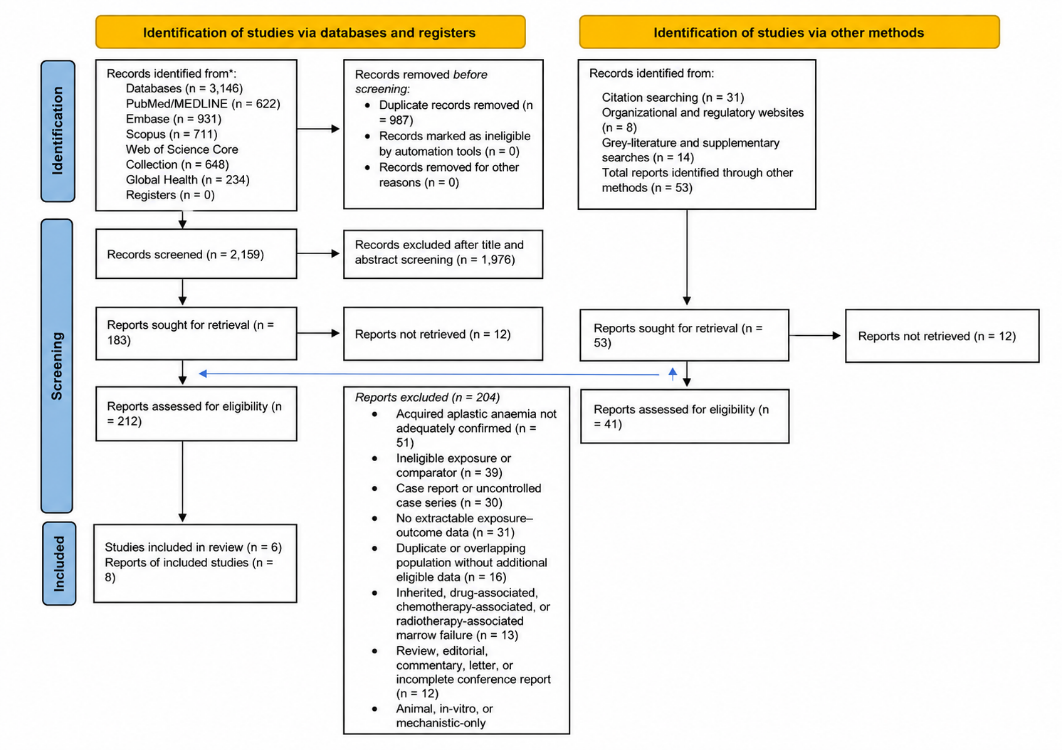
ABBREVIATIONS: MEDLINE, Medical Literature Analysis and Retrieval System Online; PRISMA, Preferred Reporting Items for Systematic Reviews and Meta-Analyses.
Results
Pesticide Exposure
Three independent populations provided sufficiently comparable estimates for broad agricultural or occupational pesticide exposure [5,6,21]. As shown in Table 1, the modified Hartung–Knapp random-effects summary relative effect was 2.42 (95% confidence interval [CI], 0.96 to 6.12), with no detected statistical heterogeneity (τ²<0.001; I²=0%; Q=0.87; 2 degrees of freedom; P=0.65). The point estimate suggested an approximately 2.4-fold relative increase, but the conservatively corrected confidence interval included the null.
| Study | Effect measure | Reported relative estimate (95% CI) | Log-relative estimate | Standard error | Normalized weight |
| Issaragrisil et al. [21] | Relative risk | 2.70 (1.10–6.60) | 0.993 | 0.457 | 22.0% |
| Taj et al. [5] | Adjusted odds ratio | 3.42 (1.24–9.47) | 1.230 | 0.519 | 17.1% |
| Syed et al. [6] | Adjusted odds ratio | 2.10 (1.23–3.61) | 0.742 | 0.275 | 60.9% |
| Modified Hartung–Knapp random-effects summary | Pooled relative effect | 2.41 (0.96–6.07) | 0.881 | 0.214 | 100.0% |
LEGEND: Three independent study populations contributed to the analysis. Adjusted odds ratios and relative-risk estimates were transformed to the logarithmic scale and synthesized because acquired aplastic anemia is rare and the exposure contrasts, source populations, and etiologic estimands were considered sufficiently comparable. Between-study variance was estimated by restricted maximum likelihood, and statistical uncertainty was calculated with the modified Hartung–Knapp procedure, with the variance factor constrained to a minimum of one. The pooled point estimate suggested an approximately 2.4-fold relative increase in acquired aplastic anemia among pesticide-exposed participants; however, the conservatively corrected 95% confidence interval included the null. Model statistics were as follows: (\tau^2<0.001); Cochran’s (Q=0.77), with 2 degrees of freedom ((P=0.68)); (I^2=0%); modified Hartung–Knapp variance factor, (q^{*}=1); and (t=4.11), with 2 degrees of freedom ((P=0.054)). The absence of detected heterogeneity should not be interpreted as evidence of true homogeneity because only three independent populations contributed to the analysis. Companion reports from the Thai Aplastic Anemia Study were not entered as independent observations.
ABBREVIATIONS: CI denotes confidence interval.
High or very high occupational exposure in the Thai companion analysis was associated with organophosphates, carbamates, organochlorines, and paraquat [25]. These correlated estimates were not entered separately into the meta-analysis because they arose from the same underlying population. Most household pesticides were not associated with aplastic anemia, although an association was reported for products containing dichlorvos and propoxur [24]. The compound-specific estimates and their precision are summarized in Table 2.
| Exposure domain | Study or synthesis | Effect estimate (95% CI) | Interpretation |
| Broad agricultural or occupational pesticide exposure | Three-population modified Hartung–Knapp random-effects meta-analysis [5,6,21] | Pooled relative effect, 2.41 (0.96–6.07) | Elevated pooled point estimate; conservatively corrected confidence interval included the null |
| Organophosphates, high or very high occupational exposure | Thai companion analysis [25] | Odds ratio, 3.20 (1.87–5.46) | Positive exposure-specific association within one underlying population |
| Carbamates, high or very high occupational exposure | Thai companion analysis [25] | Odds ratio, 4.75 (1.92–11.75) | Large association with limited precision |
| Organochlorines, high or very high occupational exposure | Thai companion analysis [25] | Odds ratio, 6.04 (1.31–27.84) | Large but markedly imprecise association |
| Paraquat, high or very high occupational exposure | Thai companion analysis [25] | Odds ratio, 2.17 (1.11–4.25) | Positive association within the Thai study population |
| Household products containing dichlorvos and propoxur | Thai companion analysis [24] | Relative risk, 1.70 (1.10–2.60) | Product-specific association; most household pesticide classes were not associated |
| Frequent exposure to benzene-containing products | LATIN study [4] | Adjusted odds ratio, 3.90 (1.70–9.30) | Strongest adjusted benzene estimate with complete reported precision |
| Benzene exposure | Thai Aplastic Anemia Study [22] | Relative risk, 3.5; 95% CI not reported | Directionally concordant with the LATIN study; not quantitatively pooled |
| Other solvent exposure | Thai Aplastic Anemia Study [22] | Relative risk, 2.0; 95% CI not reported | Suggestive association with insufficient precision for pooling |
| Mixed occupational chemical exposure | Syed et al. [6] | Adjusted odds ratio, 3.60 (2.06–6.34) | Positive association; exposure category included heterogeneous and incompletely specified chemicals |
| Residence within 3 km of a chemical factory | Wu et al. [23] | Odds ratio, 8.73 (1.42–53.74) | Indirect residential exposure proxy with substantial imprecision |
| Residence in a newly decorated house or apartment | Wu et al. [23] | Odds ratio, 25.37 (4.44–144.81) | Indirect proxy for volatile chemical exposure with an unstable, markedly imprecise estimate |
LEGEND: Effect estimates are presented separately according to pollutant or exposure class because the exposures differed materially in source, intensity, ascertainment, toxicologic properties, and presumed biological mechanism. Biologically dissimilar exposures were therefore not combined into an overall environmental-pollution estimate. The broad-pesticide summary was derived from three independent populations with a modified Hartung–Knapp random-effects model; its pooled point estimate was elevated, but the 95% confidence interval included the null. Compound-specific and household-pesticide estimates from the Thai companion reports arose from the same underlying study population and should not be interpreted as independent replication. Estimates based on mixed chemical categories or residential proxies were retained in the structured narrative synthesis because their exposure definitions were heterogeneous or indirect and their precision was limited.
ABBREVIATIONS: CI denotes confidence interval.
Statistical synthesis
Three independent case–control populations provided sufficiently comparable estimates for the quantitative synthesis of broad agricultural or occupational pesticide exposure [5,6,21]. Issaragrisil et al. reported a relative risk of 2.70 (95% confidence interval [CI], 1.10–6.60), Taj et al. reported a fully adjusted odds ratio of 3.42 (95% CI, 1.24–9.47), and Syed et al. reported an adjusted odds ratio of 2.10 (95% CI, 1.23–3.61). Although the included studies reported different relative effect measures, the outcome was rare in the source populations; therefore, the odds ratios and relative-risk estimate were considered sufficiently comparable for synthesis as relative measures of association. The studies also evaluated conceptually similar exposure contrasts involving substantial agricultural or occupational pesticide exposure and incident acquired aplastic anemia.
The study-specific effect estimates were transformed to the natural logarithmic scale before pooling. Logarithmic transformation was required because relative measures such as odds ratios and relative risks are positively skewed and are more appropriately synthesized on a scale on which sampling distributions are approximately symmetrical. The resulting log-relative estimates were y₁ = 0.993 for Issaragrisil et al., y₂ = 1.230 for Taj et al., and y₃ = 0.742 for Syed et al. The corresponding standard errors were reconstructed from the reported 95% confidence limits and were SE₁ = 0.457, SE₂ = 0.519, and SE₃ = 0.275, respectively. A smaller standard error indicates greater precision and therefore results in a larger statistical contribution to the pooled estimate.
The transformed estimates were synthesized with a random-effects model. This model was selected because the true underlying association was not assumed to be identical across Thailand and Pakistan. Differences in pesticide classes, exposure intensity, agricultural practices, occupational conditions, source populations, control selection, exposure ascertainment, and confounder adjustment could plausibly produce variation in the true effect. Between-study variance was estimated with restricted maximum likelihood, a method generally preferred for random-effects meta-analysis because it reduces bias in the estimation of heterogeneity relative to simpler moment-based methods.
The estimated between-study variance was negligible (τ² < 0.001). The τ² statistic represents the estimated variance in the true log-relative effects across studies. Because τ² was close to zero, the random-effects weights approximated conventional inverse-variance weights. The unnormalized weights were 4.786 for Issaragrisil et al., 3.718 for Taj et al., and 13.255 for Syed et al., giving a total weight of 21.760. After normalization, the respective contributions to the pooled estimate were 22.0%, 17.1%, and 60.9%. Syed et al. contributed the greatest weight because its estimate had the smallest standard error and the narrowest confidence interval. These weights reflect statistical precision and should not be interpreted as measures of methodological quality or clinical importance.
The weighted pooled log-relative estimate was μ̂ = 0.881, where μ̂ denotes the estimated mean effect on the logarithmic scale. After back-transformation to the original relative-effect scale, the pooled estimate was 2.41. Accordingly, the point estimate suggested that participants with substantial agricultural or occupational pesticide exposure had approximately 2.4 times the relative occurrence of acquired aplastic anemia compared with participants without such exposure or with lower exposure. This interpretation refers to a relative association and does not provide an absolute risk difference or establish causality.
Statistical heterogeneity was evaluated with Cochran’s Q, I², and τ². Cochran’s Q was 0.77 with two degrees of freedom (P = 0.68). The Q statistic assesses whether the observed variation among study-specific estimates exceeds the variation expected from sampling error alone. The nonsignificant result indicated that excess dispersion was not detected. The I² statistic was 0%, suggesting that none of the observed variability was attributed statistically to estimated between-study heterogeneity. The τ² estimate was also less than 0.001, indicating minimal estimated variation in the underlying log-relative effects.
These heterogeneity findings should nevertheless be interpreted cautiously. With only three independent populations, the Q test had limited statistical power to detect genuine heterogeneity, and both I² and τ² were estimated with substantial uncertainty. An I² value of 0% does not demonstrate that the studies were clinically or methodologically homogeneous. The populations differed in geography, pesticide exposure patterns, participant recruitment, control selection, exposure ascertainment, and confounder adjustment. The absence of detected statistical heterogeneity therefore indicates only that the observed effect estimates were not demonstrably more dispersed than expected from sampling variability.
Because only three independent studies contributed to the meta-analysis, uncertainty around the pooled estimate was calculated with the modified Hartung–Knapp procedure [19]. Conventional random-effects confidence intervals based on a normal distribution may be excessively narrow when few studies are available, particularly when the estimated between-study variance is small. The Hartung–Knapp method incorporates uncertainty in the estimation of the pooled effect and uses a t distribution rather than a normal distribution. This produces more conservative inference when the evidence base is limited.
The initial Hartung–Knapp variance factor was q = 0.384. Because values below one can paradoxically produce a confidence interval narrower than that obtained with conventional methods, the modified procedure constrained the variance factor to a minimum of one, yielding q* = 1. This modification was prespecified to reduce the risk of overstating precision in a meta-analysis based on only three studies. The resulting modified Hartung–Knapp standard error was 0.214.
Using the t distribution with two degrees of freedom, the pooled relative effect was 2.41 (95% CI, 0.96–6.07). The lower confidence limit was below the null value of 1.00, whereas the upper limit remained substantially elevated. The interval therefore encompassed associations ranging from little or no increase to a potentially large relative increase in risk. The corresponding test statistic was t = 4.11, with a two-sided P value of 0.054. The result narrowly exceeded the conventional significance threshold of 0.05 and should not be interpreted dichotomously as evidence of either no association or a confirmed association.
For comparison, a conventional normal-approximation analysis would have produced a narrower 95% confidence interval of 1.58–3.67. That interval would have excluded the null and suggested a conventionally significant association. However, the wider modified Hartung–Knapp interval more appropriately represented the substantial inferential uncertainty associated with only three independent studies. The discrepancy between the two intervals demonstrates the sensitivity of statistical inference to the method used for small-sample correction.
The pooled point estimate was therefore clinically and etiologically noteworthy but statistically uncertain. The analysis was compatible with an approximately 2.4-fold relative association between substantial pesticide exposure and acquired aplastic anemia, but it did not exclude the possibility of little or no association after conservative small-sample correction. The findings should be interpreted in conjunction with the retrospective design of all contributing studies, probable exposure misclassification, residual occupational and socioeconomic confounding, heterogeneous pesticide definitions, and limited characterization of dose, duration, and latency.
A prediction interval was not calculated because fewer than five independent studies contributed to the synthesis. With only three studies and an estimated τ² close to zero, a prediction interval would have been highly unstable and potentially misleading. The pooled estimate and its modified Hartung–Knapp confidence interval were therefore retained as the principal quantitative results.
Benzene, Solvents, and Mixed Chemicals
In the LATIN study, frequent exposure to benzene-containing products was associated with acquired aplastic anemia after multivariable adjustment (odds ratio, 3.90; 95% CI, 1.70 to 9.30) [4]. The Thai study reported relative-risk estimates of 3.5 for benzene and 2.0 for other solvents [22]. These estimates were not pooled because only two independent populations were available and complete variance information was unavailable for the Thai estimates.
Mixed occupational chemical exposure was associated with acquired aplastic anemia in Pakistan (adjusted odds ratio, 3.60; 95% CI, 2.06 to 6.34) [6]. This estimate was not combined with benzene or solvent findings because the category comprised biologically heterogeneous and incompletely specified chemicals. Table 2 preserves the exposure-specific estimates and prevents inappropriate pooling of pollutants with different toxicologic properties.
Residential and Industrial Exposure Proxies
In the Zhejiang study, residence within 3 km of a chemical factory was associated with acquired aplastic anemia (odds ratio, 8.73; 95% CI, 1.42 to 53.74), as was residence in a newly decorated house or apartment (25.37; 95% CI, 4.44 to 144.81) [23] (ref: Table 2). These findings were not pooled because the exposure variables were indirect proxies, the estimates were markedly imprecise, and the final model involved data-dependent variable selection.
Biomarker and Mechanistic Evidence
Patients in the North Indian biomarker program had higher postdiagnostic plasma concentrations of delta-hexachlorocyclohexane, heptachlor, and tumor necrosis factor α than controls [7]. A companion analysis reported differences in selected organochlorine pesticides and malondialdehyde across aplastic-anemia severity groups [8].
These findings supported biological coherence involving persistent pesticide exposure, oxidative injury, and inflammatory signaling [17]. However, the biomarker reports were excluded from etiologic meta-analysis because exposure measurement followed disease onset and remained susceptible to reverse causation, treatment effects, transfusion effects, and altered toxicant disposition. Their mechanistic contribution is identified in Table 3 and incorporated into the certainty assessment in Table 4.
| Population identifier | Report | Setting and recruitment period | Design and participants | Aplastic-anemia ascertainment and comparator | Exposure assessment | Principal exposure findings | Role in evidence synthesis |
| Thai Aplastic Anemia Study | Issaragrisil et al., 1997 [21] | Rural Thailand; Khonkaen and Songkla; early phase of the Thai program | Population-based case–control subset; 124 cases and 476 hospital controls | Incident aplastic anemia identified within the parent surveillance program; hospital controls were drawn from the corresponding source regions | In-person interview concerning grain farming and agricultural pesticide use | Agricultural pesticide exposure was associated with aplastic anemia, with a relative risk of 2.70 (95% CI, 1.10 to 6.60) | Contributed the Thai estimate to the broad-pesticide meta-analysis; population overlaps with References 22, 24, and 25 |
| Thai Aplastic Anemia Study | Kaufman et al., 1997 [24] | Bangkok and two rural regions of Thailand | Case–control companion analysis; 253 incident cases and 1,174 hospital controls | Incident cases and controls were derived from the Thai Aplastic Anemia Study | Interview-based assessment of household pesticide use during the preceding one to six months | Most household pesticide classes were not associated with aplastic anemia; products containing dichlorvos and propoxur were associated with a relative risk of 1.70 (95% CI, 1.10 to 2.60) | Structured narrative synthesis only; not treated as an independent population |
| Thai Aplastic Anemia Study | Issaragrisil et al., 2006 [22] | Bangkok, Khonkaen, and Songkla, Thailand; 1989 through 2002 | Population-based case–control study; 541 cases and 2,261 controls | Newly diagnosed aplastic anemia was ascertained through regional surveillance; exposure histories were obtained before analysis | In-person interview covering occupation, pesticides, benzene, solvents, medications, animals, and water sources | Reported relative-risk estimates of 3.5 for benzene and 2.0 for other solvents; associations were also reported for organophosphates, dichlorodiphenyltrichloroethane, and carbamates | Principal description of the complete Thai study population; narrative synthesis only because its participants overlap with References 21, 24, and 25 |
| Thai Aplastic Anemia Study | Prihartono et al., 2011 [25] | Thailand; same parent population recruited from 1989 through 2002 | Occupational-exposure companion analysis; 541 cases and 2,261 controls | Cases and controls were those enrolled in the parent Thai study | Occupational exposure classified independently by participant self-report and expert assessment | For high or very high exposure, odds ratios were 3.20 (95% CI, 1.87 to 5.46) for organophosphates, 4.75 (1.92 to 11.75) for carbamates, 6.04 (1.31 to 27.84) for organochlorines, and 2.17 (1.11 to 4.25) for paraquat | Compound-specific narrative synthesis; correlated estimates were not entered separately into meta-analysis |
| LATIN study | Maluf et al., 2009 [4] | Brazil, Argentina, and Mexico; 2002 through 2005 | Multicenter matched case–control study; 173 cases and 692 controls in the risk-factor analysis | Aplastic anemia was confirmed by bone marrow biopsy or aspiration; controls did not have aplastic anemia or a chronic disease likely to distort exposure history | Standardized interview concerning occupational, environmental, pesticide, solvent, benzene, radiation, and medicinal exposures | Frequent exposure to benzene-containing products was associated with aplastic anemia, with an adjusted odds ratio of 3.90 (95% CI, 1.70 to 9.30); the estimated population-attributable fraction was 5.4% | Independent etiologic population; principal benzene evidence |
| Karachi study 1 | Taj et al., 2016 [5] | Karachi, Pakistan; January through December 2014 | Age- and sex-matched hospital-based case–control study; 214 cases and 214 controls | Participants 12 years of age or older met Camitta-based cytopenia and marrow-hypocellularity criteria; controls attended the same institution for minor ailments | Questionnaire, laboratory findings, medical records, and self-reported pesticide, arsenic, water-source, and socioeconomic exposures | In the fully adjusted model, pesticide exposure was associated with aplastic anemia, with an odds ratio of 3.42 (95% CI, 1.24 to 9.47) | Independent population contributing to the broad-pesticide meta-analysis |
| Zhejiang study | Wu et al., 2019 [23] | Five hospitals in Zhejiang Province, China; 2003 through 2014 | Multicenter hospital-based case–control study; 338 cases and 1,464 controls | Hospital cases with aplastic anemia were compared with hospital controls; environmental, occupational, dietary, behavioral, and medical variables were evaluated | Questionnaire-based assessment of occupational exposures, residential characteristics, chemical-factory proximity, home decoration, and other candidate factors | Residence within 3 km of a chemical factory was associated with an odds ratio of 8.73 (95% CI, 1.42 to 53.74); residence in a newly decorated home was associated with an odds ratio of 25.37 (4.44 to 144.81) | Independent etiologic population; narrative synthesis only because exposures were indirect proxies and estimates were severely imprecise |
| Karachi study 2 | Syed et al., 2021 [6] | Karachi, Pakistan; January 2015 through December 2018 | Hospital-based case–control study; 191 cases and 696 controls | Cases had at least two cytopenias and bone marrow hypocellularity without fibrosis or neoplastic infiltration; inherited, clonal, systemic, chemotherapy-associated, and radiotherapy-associated causes were excluded | In-person questionnaire concerning pesticides, insecticides, benzene, glycol ethers, occupation, and family history | Adjusted odds ratios were 2.10 (95% CI, 1.23 to 3.61) for pesticide exposure and 3.60 (2.06 to 6.34) for mixed chemical exposure | Independent population contributing to the broad-pesticide meta-analysis; mixed chemicals were retained in the narrative synthesis |
| North Indian biomarker program | Goel et al., 2023 [7] | Tertiary-care hospital in North India; recruitment associated with the 2018–2019 biomarker program | Observational case–control study; 45 cases and 45 age- and sex-matched controls | Cases were diagnosed according to International Agranulocytosis and Aplastic Anemia Study criteria | Questionnaire; plasma organochlorine measurement by gas chromatography–mass spectrometry; tumor necrosis factor α measured by enzyme-linked immunosorbent assay | Delta-hexachlorocyclohexane, heptachlor, and tumor necrosis factor α levels were higher among cases than controls | Postdiagnostic mechanistic evidence only; excluded from etiologic meta-analysis |
| North Indian biomarker program | Goel et al., 2024 [8] | Same North Indian tertiary-care setting; May 2018 through November 2019 | Companion case–control and severity analysis; 45 cases and 45 matched controls were described | Patients receiving treatment, persons with inherited predisposition, marrow dysplasia or granulomas, systemic illness, smoking, alcohol use, or tobacco use were excluded | Plasma organochlorines measured by gas chromatography–tandem mass spectrometry; malondialdehyde measured as an index of lipid peroxidation | Selected organochlorines differed across aplastic-anemia severity groups; malondialdehyde increased linearly with disease severity, although its overall case–control difference was not statistically significant | Mechanistic and severity synthesis only; conservatively treated as overlapping with Reference 7 |
LEGEND: This table summarizes the design, setting, participant population, diagnostic ascertainment, exposure-assessment methods, principal findings, and analytic role of the ten included reports representing six unique study populations. Four reports originated from the Thai Aplastic Anemia Study and two from the North Indian biomarker program; companion publications were linked to prevent participant duplication and artificial inflation of statistical precision. The five independent etiologic populations comprised 1,457 patients with acquired aplastic anemia and 5,327 controls. The Thai population was counted once at its maximum reported enrollment, and subset or companion analyses were not added to the aggregate sample. The North Indian biomarker reports were excluded from etiologic meta-analysis because pollutant concentrations were measured after diagnosis and could not establish temporality. CI denotes confidence interval; DDT, dichlorodiphenyltrichloroethane; HCH, hexachlorocyclohexane; TNF-α, tumor necrosis factor alpha; GC–MS, gas chromatography–mass spectrometry; GC–MS/MS, gas chromatography–tandem mass spectrometry; ELISA, enzyme-linked immunosorbent assay.
ABBREVIATIONS: CI, confidence interval; DDT, dichlorodiphenyltrichloroethane; HCH, hexachlorocyclohexane; TNF-α, tumor necrosis factor alpha; GC–MS, gas chromatography–mass spectrometry; GC–MS/MS, gas chromatography–tandem mass spectrometry; ELISA, enzyme-linked immunosorbent assay.
| Exposure domain | Evidence base | Summary finding | Principal certainty considerations | Certainty of evidence | Interpretation |
| Broad agricultural or occupational pesticide exposure | Three independent case–control populations [5,6,21] | Modified Hartung–Knapp pooled relative effect, 2.41 (95% CI, 0.96–6.07) | Retrospective exposure ascertainment, heterogeneous pesticide classes, probable recall and selection bias, residual occupational and socioeconomic confounding, limited latency assessment, and substantial imprecision after small-sample correction; no detected heterogeneity, but only three populations were available | Very low | An association is possible, but the available evidence is insufficient to establish a causal effect |
| Benzene exposure | Two independent case–control populations [4,22] | Adjusted odds ratio, 3.90 (95% CI, 1.70–9.30), in the LATIN study; relative risk, 3.5, in the Thai study | Directionally concordant associations across geographically distinct populations and strong hematotoxic plausibility; downgraded for retrospective ascertainment, uncommon exposure, incomplete precision in one study, residual confounding, and limited population-attributable contribution | Low | Benzene has the most coherent epidemiologic and toxicologic evidence, but causal certainty remains limited |
| Nonbenzene solvents and mixed occupational chemicals | Two independent populations [6,22] | Relative risk, 2.0, for other solvents in Thailand; adjusted odds ratio, 3.60 (95% CI, 2.06–6.34), for mixed chemicals in Pakistan | Exposure categories were heterogeneous and incompletely specified; variance was unavailable for one estimate; coexposure, recall bias, and residual confounding could not be excluded | Very low | The findings are suggestive but cannot identify a specific causal chemical exposure |
| High-intensity exposure to specific pesticide classes | One underlying Thai population with companion analyses [24,25] | Odds ratios ranged from 2.17 for paraquat to 6.04 for organochlorines; household dichlorvos–propoxur products had a relative risk of 1.70 | Exposure-specific gradients and biologically plausible associations were observed, but all estimates arose from one overlapping population; several confidence intervals were wide, and multiple compounds were examined | Very low | These findings generate compound-specific hypotheses but do not constitute independent replication |
| Residential or industrial exposure proxies | One hospital-based case–control population [23] | Chemical factory within 3 km: odds ratio, 8.73 (95% CI, 1.42–53.74); newly decorated residence: odds ratio, 25.37 (95% CI, 4.44–144.81) | Indirect exposure classification, severe imprecision, multiple candidate comparisons, data-dependent model construction, potential selection bias, and absence of direct pollutant measurements | Very low | Large estimates should be interpreted as exploratory and not as evidence of a confirmed causal exposure |
| Postdiagnostic organochlorine, inflammatory, and oxidative-stress biomarkers | One overlapping North Indian biomarker population reported in two companion publications [7,8] | Higher concentrations of selected organochlorines and tumor necrosis factor alpha among patients; selected pesticides and malondialdehyde varied according to disease severity | Objective laboratory measurement supported biological coherence; however, sampling occurred after diagnosis, temporality was absent, and reverse causation, treatment, transfusion, altered metabolism, and disease severity could influence biomarker concentrations | Very low for causal inference | The biomarker evidence supports mechanistic plausibility but cannot establish that exposure preceded or caused aplastic anemia |
| Ambient particulate matter, traffic-related emissions, heavy metals, and environmental radiation | No directly eligible exposure-specific study population | No pooled or study-specific etiologic estimate was available | Absence of eligible direct evidence and inability to assess temporality, dose–response relations, consistency, or risk of bias | Insufficient | No conclusion regarding an association with acquired aplastic anemia can be drawn |
LEGEND: Certainty was evaluated separately for each exposure–outcome association with the Grading of Recommendations Assessment, Development and Evaluation framework adapted for environmental and occupational health. Judgments incorporated risk of bias, inconsistency, indirectness, imprecision, reporting bias, magnitude of association, exposure–response evidence, biological coherence, and the probable direction and magnitude of residual confounding. Epidemiologic, exposure-specific, residential-proxy, and postdiagnostic biomarker findings were treated as distinct evidence streams. Companion publications and overlapping populations were linked and were not interpreted as independent replication. Mechanistic and biomarker findings were used to assess biological coherence but were not regarded as independent proof of causation and did not automatically increase certainty.
ABBREVIATIONS: CI denotes confidence interval; GRADE, Grading of Recommendations Assessment, Development and Evaluation.
Risk of Bias and Evidence Synthesis
The principal concerns were retrospective exposure ascertainment, recall bias, hospital-based control recruitment, residual socioeconomic and occupational confounding, heterogeneous exposure definitions, and limited assessment of cumulative dose and latency. Risk-of-bias judgments were structured according to ROBINS-E and the Navigation Guide framework [14,15].
Funnel plots, regression tests for small-study effects, and meta-regression were not performed because fewer than 10 independent studies contributed to each exposure-specific analysis. Nonpooled findings were organized by exposure class, temporality, exposure-assessment quality, and risk of bias without vote counting according to statistical significance [18]. A nonlinear dose–response analysis was not performed because fewer than three independent populations reported compatible quantitative categories for any single pollutant [20].
Certainty of Evidence
The certainty judgments are summarized in Table 4 and were derived with environmental-health adaptations of GRADE [16]. Evidence concerning agricultural or occupational pesticides was judged to be of very low certainty because all contributing studies were retrospective, compound definitions differed, residual confounding remained plausible, and the modified Hartung–Knapp interval included the null.
Evidence concerning benzene was judged to be of low certainty because directionally concordant associations were observed in two geographically distinct populations [4,22] and were supported by biological plausibility, but exposure was uncommon and estimates remained imprecise. Evidence concerning nonbenzene solvents, mixed chemicals, residential proxies, and postdiagnostic biomarkers was judged to be of very low certainty. Evidence was insufficient for ambient particulate matter, traffic-related emissions, and heavy metals.
Principal Finding
Substantial agricultural or occupational pesticide exposure and frequent benzene exposure may be associated with acquired aplastic anemia. However, the pesticide meta-analysis included only three independent retrospective populations, and the confidence interval included the null after conservative small-sample correction. The evidence supports pollutant-specific hypotheses, particularly for benzene and high-intensity pesticide exposure, but does not establish environmental pollution collectively as a cause of acquired aplastic anaemia.
Discussion
Should environmental or occupational exposure history influence the evaluation of unexplained acquired aplastic anemia? It should inform clinical inquiry on benzene and high-intensity pesticide exposure, but should not assign causation. Acquired aplastic anemia is predominantly immune mediated, yet its initiating insult is unknown, and geographic variation suggests interaction between exposures and host susceptibility [1-3].
Case–control and biomarker studies have linked acquired aplastic anemia with benzene, pesticides, mixed chemicals, organochlorines, oxidative stress, and inflammatory signaling [4-8]. Pesticide exposure yielded a pooled relative effect of 2.41, but the Hartung–Knapp 95% confidence interval of 0.96 to 6.07 included the null. With three populations, absence of detected heterogeneity cannot establish consistency.
The review followed PRISMA 2020, PRISMA-S, MOOSE, and the Population, Exposure, Comparator, and Outcome framework [9-12]. PRESS, ROBINS-E, the Navigation Guide, GRADE, and biological-plausibility methods informed searching, bias assessment, certainty evaluation, and mechanistic integration [13-17]. Nonpooled findings were synthesized without vote counting; dose–response analysis was infeasible because compatible categories were insufficient [18-20].
Thai studies provided the most extensive pesticide evidence [21,22], while Zhejiang and Thai companion analyses added residential and compound-specific signals [23-25]. Overlapping Thai estimates do not constitute independent replication.
Benzene showed the most coherent pattern, although retrospective ascertainment, incomplete variance reporting, and residual confounding limited causal inference. Postdiagnostic biomarkers supported oxidative and inflammatory mechanisms but not temporality.
Clinically, structured exposure histories are justified. Environmental pollution should not be treated as a cause; prospective exposure reconstruction, validated job-exposure matrices, prediagnostic biospecimens, and exclusion of inherited and clonal marrow-failure disorders remain necessary.
Conclusion
In conclusion, environmental and occupational exposures may contribute to acquired aplastic anemia, but the evidence remains exposure specific and causally uncertain. Benzene showed the most coherent epidemiologic and toxicologic signal, whereas broad pesticide exposure yielded an elevated pooled estimate with a confidence interval that included the null after conservative small-sample correction. Findings for individual pesticide classes, mixed chemicals, residential proxies, and postdiagnostic biomarkers were limited by overlapping populations, retrospective ascertainment, imprecision, and uncertain temporality. Environmental pollution should therefore not be regarded as a unified cause of acquired aplastic anemia. A structured exposure history is clinically justified in otherwise unexplained cases, but causal attribution requires prospective exposure assessment, quantitative dose and latency reconstruction, prediagnostic biospecimens, and rigorous exclusion of inherited and clonal marrow-failure disorders.
Declarations
Acknowledgements
Specially acknowledging my uncle, Mr. Shyamal Mallick, BBI Int. who stood beside me through thick and thin.
Conflict of interest
None
Funding/ financial support
None
Ethical Clearance
Not Applicable
Trial details
Not Applicable