Introduction
Drug promotional literature (DPLs) is used as a promotional tool to advertise new drugs that entering into markets to the health care professionals [1]. For the rational use of drugs WHO formulated the ethical criteria for new drug promotion and has recommended pharmaceuticals industries to implement the guidelines as it is the only source for treating physicians to update about the existing and novel drugs.
DPLs provide the information about the new drug for the health care professionals. The following are the WHO criteria to be followed by pharmaceutical industries for the completeness of DPL The names of the active ingredients using either international non-proprietary names or the approved generic names of the drug: The Brand name, Content of active ingredient per dosage form or regimen, Name of other ingredients known to cause problems, i.e., adjuvant, Approved therapeutic uses, Dosage form or regimen, Side effects and major adverse drug reaction, Precautions, contraindications, and warnings, Major interactions, Name and address of the manufacturer or distributor, Reference to scientific literature as appropriate [3].
In many of the DPLs the WHO criteria are not well documented to provide adequate information and as more picture presentations instead [4].
In most of the Drug promotional literatures the Generic name, Brand name and Indications and Uses were mentioned clearly but the safety information like adverse effects, precautions and drugs interactions were not documented completely. Side effects and drug interactions should be more of case-based discussion. The font size used to for the safety information was small in size and usually at the bottom of the page [5].
Regional Ethics Committee in metropolitan cities in India collects complaints about unethical drug promotion and report to the Drug Controller General of India to take necessary legal steps to regulate pharmaceutical companies to fulfil the WHO criteria of DPLs [2]. So, in order to improve the analysis of DPLs completeness, each criterion of WHO guidelines can be assigned scoring and adding the scores of all criteria will give us the total score to evaluate the completeness of DPLs effectively is needed. DPAs can be highly informative as it provides the authentic information. In drug promotion the pharmaceutical companies not following the ethical principles in promoting their products [6].
Compared to non-Indian journals, the smaller number of information are provided in drug promotional literature of Indian journals regarding the dosage regimen, side effects, precautions, contraindications, warnings especially the name of other ingredients were not mentioned in the journals [7,8].
In order to improve the knowledge of the newly evolving drugs and to avoid irrational prescriptions, drugs interactions the drug promotional literature (DPL) should contain all the criteria which has been given by the WHO guidelines.
Hence it becomes necessary to analyse the DPLs periodically for its completeness of WHO’s ethical criteria and any lacunae in adhering the WHO criteria can be reported accordingly. So, in order to improve the analysis of DPLs completeness, each criterion of WHO guidelines need assigned scoring. No other studies have done the scoring system for WHO guidelines to evaluate the completeness of DPLs. Therefore, this study aims to formulate the validated scoring system for WHO guidelines and evaluate the DPLs using the newly formed scoring tool.
Aim and Objective
-
Assignment of specific scores for each WHO criteria of DPL guideline by registered medical practitioners of various Departments in a Tertiary care hospital to develop the DPL scoring system and check for its reliability and validity.
-
To analyse the DPLs using the newly developed scoring system of WHO guidelines.
Methodology
A Prospective analytical study was conducted after obtaining ethics committee approval (22/044) in a tertiary care centre, South India. Informed consent was obtained from randomly selected 60 registered medical practitioners of various departments in a tertiary care hospital and documentation of scoring data for each criteria of WHO was collected. Then, scoring data of each criteria was analysed using frequency distribution and final scoring was formulated for each criteria of WHO. For the assessment of reliability and validity of scoring system, randomly one DPL was selected and involved 30 registered medical practitioners for critical evaluation using the framed scoring system and data of all the 30 participants were analysed using Cronbach's Alpha.
Later, randomly selected 100 DPLs from various departments of the tertiary care centre were included for critical appraisal using the newly developed scoring system of WHO guidelines. Critical appraisal data of 100 DPLs were analysed using frequency distribution and categorised in to Poor (Incomplete DPL with gross deficit not adhering to WHO criteria); Good (Incomplete DPL; partially adhering to WHO criteria) Excellent (Adequate information in drug promotional literature with 100% adherence to WHO criteria).
Results
| WHO Criteria | Yes | No | |
| 1 | Active ingredient with in or generic name | +2 | -2 |
| 2 | The brand name | +1 | -1 |
| 3 | Amount of active ingredients per dose | +2 | -2 |
| 4 | Other ingredient known to cause problem i.e, adjuvant | +1 | -1 |
| 5 | Approved therapeutic uses | +2 | -2 |
| 6a | Dosage form | +1 | -1 |
| 6b | Dosage schedule | +1 | -1 |
| 7a | Safe information including side effects and ADR (major) | +2 | -2 |
| 7b | Precautions, warnings | +1 | -1 |
| 7c | Contraindications | +1 | -1 |
| 7d | Major drug interactions | +2 | -2 |
| 8a | Name OF manufacturer / distributor | +1 | -1 |
| 8b | Address of manufacture | +1 | -1 |
| 9 | Reference to scientific literature as appropriate | +1 | -1 |
| Highest Score adhering to above all criteria | 19 |
>18: Excellent (Adequate information in drug promotional literature with 100% adherence to WHO criteria)
10 -17: Good (Incomplete DPL not adhering to WHO criteria)
< 9: Poor (Incomplete DPL with gross deficit not adhering to WHO criteria)
| Case Processing Summary | |||
| N | % | ||
| Cases | Valid | 11 | 100.0 |
| Excludeda | 0 | .0 | |
| Total | 11 | 100.0 | |
| Listwise deletion based on all variables in the procedure. | |||
| Reliability Statistics | |||
| Cronbach's Alpha | N of Items | ||
| .880 | 30 |
Statistical analysis was done by using Cronbach's Alpha. The reliability statistics were found to be 0.880 which indicates good reliability and internal consistency of scoring data [9].
Discussion
This study has developed the validated total maximum score for Drug promotional literature criteria completely adhering to WHO criteria and the value is 19. Score of 18 and above is EXCELLENT: indicates the adequacy of information in drug promotional literature adhering to WHO criteria. Score ranges from 10 to 17 are GOOD: inadequate information in drug promotional literature not completely adhering to WHO criteria. Score less than or equals 9 is POOR (below average): indicates the Incomplete DPL with gross deficit not adhering to WHO criteria. In previous critical analysis studies of DPLs Rode et al, used the same criteria but without the scoring system but in this study, DPLs were evaluated with the new scoring system and gave a new dimension in analysing to found the valid DPLs [10].
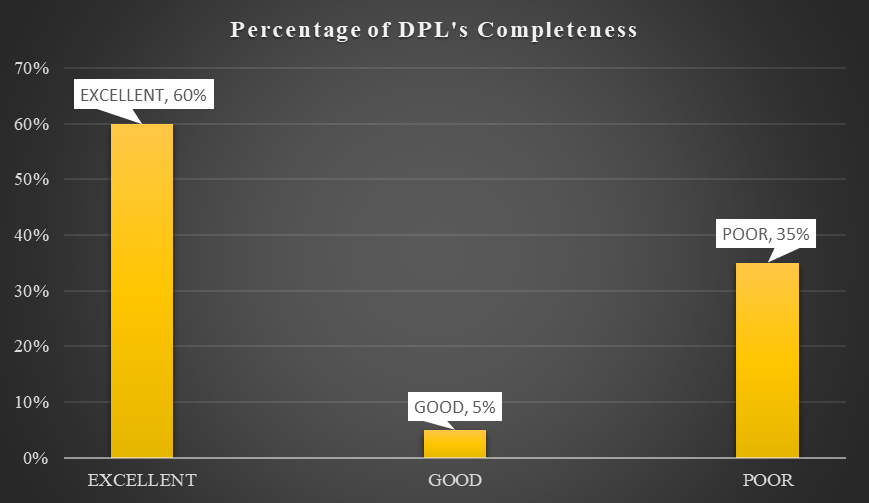
In the second phase of this study, 100 randomly selected DPLs were evaluated using new developed scoring for WHO criteria. In that percentage adherence of DPL's Completeness to the newly developed scoring system of WHO guidelines revealed 60% of DPLs found to be Excellent, indicating the adequacy of information in drug promotional literature adhering to WHO criteria. 5% of DPLs were found to be GOOD indicating incomplete adherence to the WHO criteria with few deficits which could be rectified by the drug manufacturing companies by changing their DPL development policy and remaining 35% of DPLs were found to be POOR indicating a gross deficit in the information and definitely need to refine their contents to get adherence to the standard WHO guidelines.
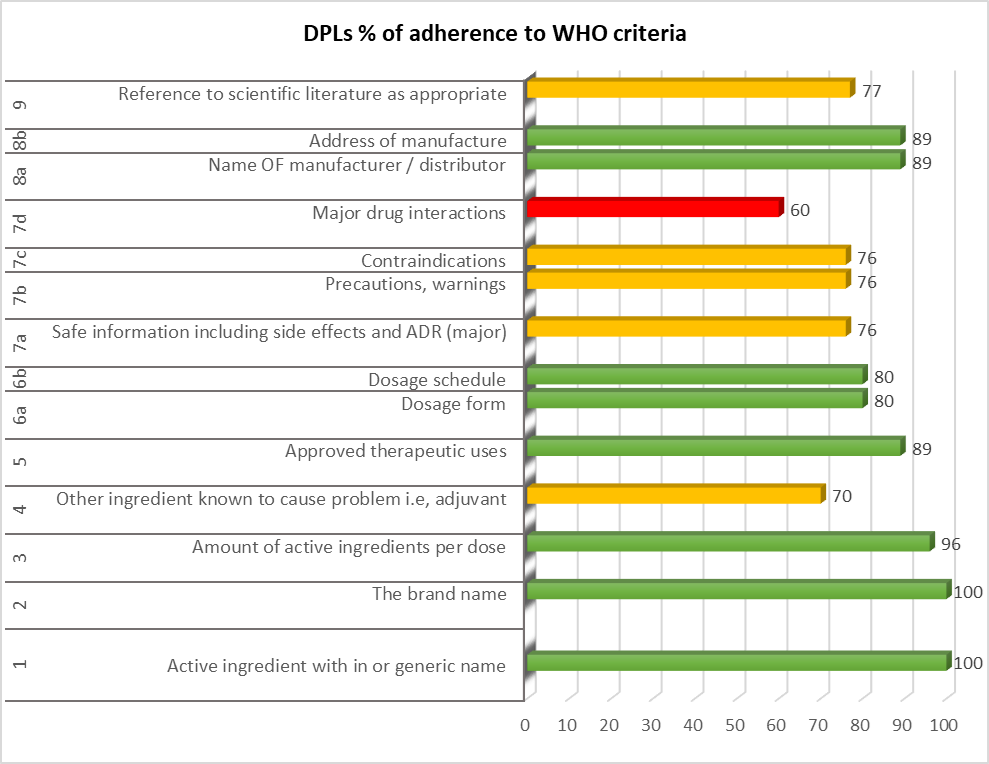
When analysing the individual criteria of WHO in the DPLs, it was found that Generic name, Brand name, and Active ingredients were found to be complete 100%. Whereas, criteria’s denoting the uses, dosage form, dosage schedule, Name and Address of manufacturer were found to be >80% in the evaluated DPLs. Similarly in the previous articles published by Hailu, Haftom Gebregergs et al., also stated the same deficits in the articles which can be refined by the change in the manufacturer’s policy in developing DPLs. In case of essential details regarding adverse drug reactions, contraindications, or drug interactions it was found to be >70 % and few define number of DPLS were missing this aspect. In the previous studies also stated 72% of the brochure did not mention the safety feature of the drug promoted [11]. In most of the DPLs details on the drug interactions and scientific references were missing and needs definite intervention by the manufacturers to improve their DPL standards. Therefore, the apex regulatory authorities controlling the drug industry in their respective countries should put effort into enforcing a law that will improve the quality of DPLs.
In this CBME curriculum era, critical appraisal of DPLs being one of the certifiable competencies to be learned by the medical students, it is at most important to understand why the DPLs are being evaluated for critical appraisal by students. The growing medical undergraduates show able to differentiate the valid DPLs from the other DPLs with the unnecessary promotional contents. This quality will help them to choose the effective drug from different brands during consultation which in turn will improve the quality of care given to their patients. In order to inculcate this practice in the developing medical undergraduates, it is ideal to make them learn the critical appraisal of the DPLs in depth. Here the new scoring system of the WHO guidelines for critical appraisal of DPLs will give them better learning curve and will support them to acquire knowledge on the valid DPLs. Faculty of second year MBBS graduates can adopted this teaching learning method of new scoring system in critical appraisal of DPLs for giving practice to the second year MBBS undergraduates.
Conclusion
Hence incorporating the scoring for evaluating the critical appraisal of the DPL will show promising development in the teaching learning methods of the CBME curriculum. The growing medical undergraduates will be able to differentiate the valid DPLs, in turn they will choose the effective drug from different brands during their medical management of treating patients. This new dimension of scoring system in critical appraisal of DPLs will support the drug manufacturers in enforcing a law that will improve the quality of DPLs.
List of abbreviations
DPL: Drug promotion Literature
CBME: Competency Based Medical Education
Declarations
Ethics approval and consent to participate
The study was conducted in accordance with ethical principles for biomedical research involving human participants. Ethical approval was obtained from the Institutional Ethics Committee of PSG Institute of Medical sciences and Research (22/044). Written informed consent was obtained from all participants prior to data collection. Confidentiality and anonymity of participants were strictly maintained.
Data Availability
The datasets used and/or analysed during the current study are not publicly available due to confidentiality considerations but are available from the corresponding author on reasonable request.
Conflicts of Interest
NIL
Funding Statement
Self Funding
Acknowledgments
Thankful do the department of Pharmacology for their support.
Authors’ contribution
All four authors contributed to the proposal drafting, data collection, Data analysis and Manuscript writing.