Introduction
Acute cholecystitis (AC), typically presents with gall stones and relatively leads to serious complications. One of the most frequent reasons for emergency hospital admissions for abdominal discomfort worldwide is acute cholecystitis. This acute inflammatory disorder of the gallbladder is usually caused by gallstones that block the cystic duct (calculous cholecystitis); less frequently, other non-lithiasis causes (acalculous cholecystitis) might cause it [1].
In affluent countries, 10–15% of adults suffer from gallstone disease, and those who have gallstones have a 1-3% lifetime chance of getting acute cholecystitis. The condition can range from mild inflammation to severe gangrenous or perforated cholecystitis, which, if not identified and treated quickly, can lead to sepsis and multiorgan failure. For the purpose of directing treatment choices, reducing complications, and allocating surgical or critical care resources as efficiently as possible, early disease severity identification is essential [2,3].
Gallstones continues to be a serious public health issue. Although prevalence rates are lower among Asian communities, and range between 10% and 20% in the Western world, epidemiological studies show rising tendencies as Western food patterns are increasingly adopted. In India, gallstones are a serious health problem; estimates of their prevalence range from 2% to 9% [4]. This indicates that gallstones, which can cause acute cholecystitis, are present in a sizable part of the population.
Three to ten percent of individuals who arrive to emergency rooms complaining of stomach pain have acute cholecystitis. About 20% of persons with symptomatic gallstones are predicted to develop AC at some point in their lives [5]. Although both sexes are affected, females are slightly more likely to have gallstones than males; however, male patients frequently exhibit more severe symptoms. Comorbid individuals and the elderly are especially vulnerable to problems and unfavourable results [6].
Gallstones block the cystic duct in over 90% of patients because of inflammation, making cholecystitis a prevalent condition in hepatobiliary and pancreatic surgery. Complications include gangrene, perforation, and abscess formation might result from postponing treatment [6,7]. According to studies, between 22 and 30 percent of people have severe cholecystitis, but because of the wide range of symptoms and imaging results, it can be challenging to make an accurate diagnosis [7]. For postoperative patients, it is essential to identify and treat severe cholecystitis as soon as possible in order to avoid complications and doctor-patient conflicts.
Gallstone blockage of the cystic duct causes elevated intraluminal pressure, gallbladder wall ischaemia, and subsequent bacterial infection in the classic pathophysiology of acute calculous cholecystitis. If left untreated, the initial sterile inflammation could develop into necrosis and perforation. Although less frequent, bile stasis, gallbladder hypoperfusion, and infection without gallstones are the main causes of acalculous cholecystitis in critically ill individuals [8].
Tumour necrosis factor-alpha (TNF-α) and interleukins (IL-1, IL-6) are proinflammatory cytokines that are released along with the migration of neutrophils and macrophages as part of the inflammatory cascade. In extreme situations, these mediators cause systemic inflammatory response syndrome (SIRS) and intensify local tissue damage. The immune cell profile in circulation is further altered by lymphocyte death and redistribution, which raises neutrophil levels and lowers lymphocyte counts, resulting in a larger NLR [9].
Murphy's sign or positive mass, discomfort, and soreness in the right upper quadrant are common symptoms that patients display [10]. Gallstones in older adults with cholecystitis are becoming more common as our nation's population ages, and so are the condition's complications, admission, readmission, and mortality rates. Elderly people may have varied degrees of gallbladder atherosclerosis and stenosis due to the presence of underlying illnesses [11].
The neutrophil/lymphocyte ratio (NLR) has been proposed as a biomarker for systemic inflammation in recent years [12]. This sort of response is defined by an increase in neutrophils and a decrease in lymphocytes. The production of inflammation-induced arachidonic acid metabolites and platelet-activating factors, as well as cortisol-induced stress, can cause neutrophils to rise and lymphocytes to decrease, resulting in relative lymphopenia. As a result, NLR is thought to better represent the underlying inflammatory process [13].
CRP levels can increase quickly when the body goes through an inflammatory reaction brought on by an infection, stress, or other factors. An acute-phase protein called CRP is elevated in reaction to stimulation or trauma. Studies have demonstrated that serum CRP levels are a sensitive measure of tissue damage and are strongly correlated with the degree of surgical harm [13,14].
According to Tokyo recommendations from 2007 that were revised in 2018 [15]. Both clinical and radiographic diagnosis of severe cholecystitis are difficult. The morbidity and mortality rates of patients with severe AC and those with uncomplicated AC are substantially different [16]. To prevent complications, patients who are at risk of developing severe cholecystitis must be appropriately diagnosed and treated. There is mounting evidence to support the use of NLR to assess the prognosis of malignant and inflammatory illnesses [12]. Its use in older patients with gallstones and cholecystitis hasn't been documented, though Clinical indicators (fever, right upper quadrant pain, Murphy's sign), laboratory testing (leucocytosis, increased liver enzymes, C-reactive protein), and imaging results (ultrasound demonstrating gallbladder wall thickening, pericholecystic fluid, impacted stone) are all used to diagnose AC. Even though they are thorough, current scoring systems like the Tokyo Guidelines (TG18) severity grading [15] take into account a number of clinical, laboratory, and imaging characteristics, which may not always be possible in situations with limited time or resources. Furthermore, traditional indicators of illness severity, such as C-reactive protein and total leukocyte count, are not always accurate or precise [16].
Although imaging techniques including computed tomography, hepatobiliary scintigraphy, and ultrasonography are essential for diagnosis, they offer little insight into the systemic response and inflammatory burden. As a result, there has been an increase in interest in easily accessible, reasonably priced biomarkers that can assist stratify the severity of AC and represent the systemic inflammatory condition [12-14,17].
The neutrophil-to-lymphocyte ratio (NLR) is one of these that has shown promise. It is a straightforward, readily available metric that is derived from a standard complete blood count (CBC) and is being studied more and more as a systemic inflammation indicator in a number of inflammatory and infectious illnesses [13].
Systemic inflammation in acute cholecystitis causes relative lymphopenia as a result of stress-induced cortisol production and lymphocyte redistribution to lymphoid tissues, as well as neutrophilia as a result of the innate immune response. The NLR is a sensitive and comprehensive indicator of inflammation and physiological stress because of this dual reaction [18,19].
The diagnostic and prognostic utility of NLR in diseases such acute appendicitis, pancreatitis, sepsis, cardiovascular disorders, and cancers has been highlighted in recent research. Recent research has indicated that higher NLR levels are associated with more severe acute cholecystitis, sequelae such gangrene or perforation, longer hospital stays, and the requirement for emergency surgery or switching from laparoscopic to open cholecystectomy [20-22].
There is disagreement over cutoff values that are appropriate for various groups, and routine use of NLR to predict severity in AC is still not generally standardised, despite its promising role [22]. Verifying the efficiency of NLR as a trustworthy marker for determining the severity of acute cholecystitis has substantial clinical significance due to its affordability, ease of use, and repeatability, particularly in environments with limited resources [23].
In developing nations like India, where access to specialised laboratory testing or advanced imaging may be restricted and healthcare resources may be scarce, the use of a straightforward, affordable tool such as the NLR could significantly help doctors with patient triage.
Through a methodical investigation of the correlation between NLR and the acute cholecystitis severity rating in preoperative NLR and disease severity. Establish the ideal cutoff point for cholecystitis severity prediction and examine its prognostic significance in predicting surgical results and complications.
Incorporating NLR into routine preoperative evaluation procedures would speed up assessment of need for surgical intervention, lower morbidity, and maximise the utilisation of medical resources.
The purpose of this study is to evaluate the predictive usefulness of the preoperative neutrophil-to-lymphocyte ratio (NLR) in patients with acute cholecystitis (AC), with the aim of facilitating early detection of severe and complicated acute cholecystitis and determining an optimal NLR cut-off value that can differentiate between various grades of disease severity. The study aims to correlate NLR with complicated cholecystitis and established severity grading systems and to assess its ability to predict disease prognosis and clinically relevant outcomes, including operative difficulty, the need for conversion to open surgery or laparotomy, postoperative complications, and duration of hospital stay. Early and accurate severity grading is essential for identifying high-risk patients who may require immediate biliary drainage, close clinical monitoring, timely surgical intervention, or selective transfer to the intensive care unit (ICU). Since NLR can be easily calculated from a routine complete blood count, it represents a simple, readily available, and low-cost inflammatory marker that may serve as an effective predictor of severe AC. Evaluating its role in acute cholecystitis may therefore provide a practical tool for early risk stratification, guide appropriate clinical and surgical decision-making, optimize resource utilization, and ultimately improve patient outcomes.
Materials and Methods
This prospective, observational, single-center study was conducted in the Department of Surgery at a tertiary care hospital. The total study duration was 18 months, from January 2024 to June 2025, including protocol preparation, Institutional Ethics Committee approval, data collection, statistical analysis, and report preparation. Data collection was undertaken prospectively over a period of 12 months following Ethics Committee approval, while data entry, statistical analysis, and interpretation were completed during the final three months of the study.
The study was initiated after obtaining approval from the Institutional Ethics Committee. Written informed consent was obtained from all participants prior to enrolment. Patient identity and study-related data were kept strictly confidential throughout the study. The study was conducted in accordance with the principles of the Indian Council of Medical Research (ICMR) National Ethical Guidelines for Biomedical and Health Research Involving Human Participants, 2017, and the International Council for Harmonisation–Good Clinical Practice (ICH-GCP E6[R2]) guidelines.
Adult patients aged >18 years of either sex who were diagnosed with acute cholecystitis according to the American Association for the Surgery of Trauma (AAST) criteria and were willing to participate and provide informed consent were eligible for inclusion. Patients with liver failure, renal failure, heart failure, malignancy, acute pathological conditions other than acute cholecystitis, or those unwilling to provide informed consent were excluded from the study.
A sample size of 70 patients was calculated based on the study by Lee et al.,[3] which reported a prevalence of severe cholecystitis of 20.4% and a sensitivity of 70.5% for an NLR cut-off of 3.0 in predicting severe cholecystitis.
A structured case record form (CRF) was used to record relevant demographic, clinical, laboratory, intraoperative, and postoperative information. Demographic and baseline characteristics included age, sex, hospital identification number, contact details, and date of admission. Preoperative variables included the diagnosis and complete blood count, with particular emphasis on the differential leukocyte count. The neutrophil-to-lymphocyte ratio (NLR) was calculated from the preoperative differential leukocyte count and evaluated in relation to the severity of acute cholecystitis. Intraoperative parameters included operative complications and estimated blood loss. Postoperative parameters, including the date of discharge and duration of hospital stay, were also documented. The association of preoperative NLR with disease severity and relevant perioperative outcomes was subsequently evaluated.
All hematological investigations used for the study were part of the routine diagnostic evaluation and standard clinical management of patients with acute cholecystitis. Complete hemogram testing was performed as part of the hospital's standard of care; therefore, participation in the study did not require any additional blood investigations or impose any additional financial burden on the patients.
Continuous variables were assessed for normality using the Kolmogorov–Smirnov test. Normally distributed continuous variables were expressed as mean ± standard deviation (SD), and comparisons between groups were performed using Student's t-test. Non-normally distributed continuous variables were presented as median and interquartile range (25th–75th percentile) and compared using the Mann–Whitney U test. Categorical variables were expressed as frequencies and percentages. Correlations between relevant variables were assessed using Spearman's rank correlation coefficient. Receiver operating characteristic (ROC) curve analysis was performed to assess the discriminatory ability of NLR and determine the optimal NLR cut-off value for predicting severe acute cholecystitis. A p-value <0.05 was considered statistically significant. All statistical analyses were performed using Statistical Package for the Social Sciences (SPSS), version 21.0.
Results
A total of 70 patients were included in the study. Out of these, 28 were male patients (40%) and 42 (60%) were female patients (Table 1).
| Gender | No. | Percent |
| Male | 28 | 40 |
| Female | 42 | 60 |
| Total | 70 | 100 |
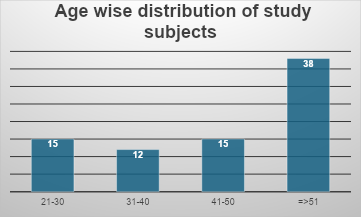
Out of 70 patients, 35.71% of patients belong to the age groups 31-40 years, followed by age group 21-30 years and 41-50 years with equal distribution. The group with age =/ >51 years had 12 patients overall owing to 17.14% of total study population (Figure 1).
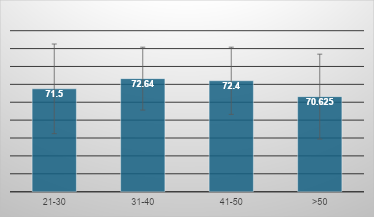
The mean differential neutrophil count showed relatively little variation across the different age groups. Patients aged 21–30 years had a mean neutrophil count of 71.50 ± 5.01%, while those aged 31–40 years and 41–50 years had mean values of 72.64 ± 3.51% and 72.40 ± 3.75%, respectively. Patients aged >50 years had a mean neutrophil count of 70.63 ± 4.74%. Thus, no clear age-related trend in differential neutrophil count was observed (Figure 2).
On gender-wise analysis, females had a slightly higher mean differential neutrophil count than males (72.01 ± 2.51% vs. 70.23 ± 3.62%). However, the difference between males and females was not statistically significant (p = 0.932) (Table 2).
| Gender | Mean differential neutrophil count | p value |
| Male | 70.23+/- 3.62 | 0.932 |
| Female | 72.01+/- 2.51 |
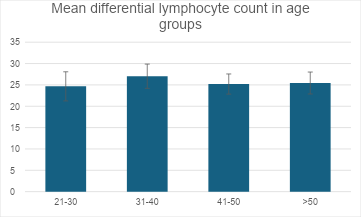
The mean differential lymphocyte count varied modestly across age groups. Patients aged 21–30 years had a mean lymphocyte count of 24.66 ± 3.41%, compared with 27.03 ± 2.84% among those aged 31–40 years, 25.20 ± 2.36% among those aged 41–50 years, and 25.44 ± 2.57% among patients aged >50 years. No consistent age-related pattern in lymphocyte count was apparent (Figure 3)
The mean differential lymphocyte count was 23.60 ± 1.36% among males and 24.90 ± 2.63% among females. Although females demonstrated a numerically higher lymphocyte count, the difference was not statistically significant (p = 0.654) (Table 3).
| Gender | Mean differential neutrophil count | p value |
| Male | 23.6+/1.36 | 0.654 |
| Female | 24.9+/- 2.63 |
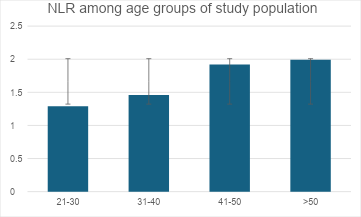
The NLR demonstrated a numerical increase with advancing age. The mean NLR was 1.29 ± 0.83 among patients aged 21–30 years and increased to 1.46 ± 0.92 among those aged 31–40 years. Patients aged 41–50 years had a mean NLR of 1.92 ± 0.72, while those aged >50 years had the highest mean NLR of 1.99 ± 0.99. These findings suggest a numerical trend toward higher NLR values with increasing age; however, statistical significance for the differences across age groups was not available (Figure 4)
Gender-wise analysis showed a mean NLR of 1.77 ± 0.36 among males and 1.65 ± 0.52 among females. The difference was not statistically significant (p = 0.721), indicating that NLR did not differ significantly according to gender in the study population (Table 4).
| Gender | Mean Neutrophil-lymphocyte ratio | P value |
| Male | 1.77+/0.36 | 0.721 |
| Female | 1.65+/- 0.52 |
The relationship between NLR and the severity of acute cholecystitis was assessed according to the AAST grading system. The mean NLR was 1.86 ± 0.84 among patients with Grade I acute cholecystitis, 1.75 ± 0.79 in Grade II, 1.88 ± 0.81 in Grade III, 1.93 ± 0.92 in Grade IV, and 1.90 ± 0.98 in Grade V.
Although slightly higher mean NLR values were observed in some of the higher AAST grades, there was considerable overlap between the groups, and a consistent stepwise increase in NLR with increasing disease severity was not demonstrated. The overall difference in NLR across the AAST severity grades was not statistically significant (p = 0.1773). Therefore, based on the available data, NLR alone did not demonstrate a statistically significant association with AAST grade.
The differential neutrophil count, differential lymphocyte count, and NLR did not differ significantly according to gender. A numerical increase in NLR was observed with advancing age, although the statistical significance of this trend could not be established from the available data. Similarly, while some higher AAST grades demonstrated numerically higher NLR values, the differences across severity grades were not statistically significant. Consequently, the present analysis did not establish a definitive NLR cut-off value for differentiating severe from non-severe acute cholecystitis. Further evaluation using individual patient-level data and receiver operating characteristic (ROC) curve analysis would be required to determine the discriminatory performance and optimal cut-off value of NLR for predicting severe acute cholecystitis.
Discussion
Compared to mild cholecystitis, severe cholecystitis is linked to more negative clinical characteristics. Therefore, it is crucial to identify severe cholecystitis early and take action before it worsens in order to prevent complications. These patients are more likely to sustain injuries to the right hepatic artery during surgery, the biliary ducts, etc.
The clinical, laboratory, and imaging evidence-based TG18/TG13 criteria are employed to diagnose AC and determine the severity of the condition. Nevertheless, despite all the advancements in diagnostic and treatment techniques in the modern period, delays in diagnosis still occur, more frequently in some patient groups (especially in elderly patients and cases with comorbidities). Morbidity and death rates may rise as a result of disease progression and major complications such gangrenous cholecystitis, abscess, and perforation, which are more common in these patient groups. Thus, determining the degree of inflammation is crucial for deciding on a course of treatment and a prognosis. There is still a need for new metrics on the topic, as inflammatory markers have recently been linked to the prognosis and severity of many cancer kinds and inflammatory illnesses.
A straightforward, affordable, non-invasive, and precise prediction method is essential in a rising nation like India. Our healthcare professionals in rural settings and tertiary care facilities may also use this approach to efficiently manage patients.
Neutrophilia is typically caused by the production of platelet-activating factors and metabolites of arachidonic acid, which are triggered by gallbladder inflammation. Since cortisol-induced stress causes relative lymphopenia at the same time, the NLR is a good indicator of the ongoing inflammatory process.
In the present study, majority of patients were females owing to 60% of the total study population which is comparable with the study conducted by Khalid MU et al in 2023 showing 66.8% females with acute cholecystitis in the total study population.
The average patient age in our study was 54.9 years. After the age of fifty, the incidence of AC was seen to be rising. Of the patients with severe cholecystitis, 84% were older than 50. As a result, it is seen that the severity of cholecystitis increases with age. Studies by Chawla et al. and Lee et al. also found an increased incidence of AC with age. In those over 60, multiple organ failure syndrome can quickly develop from severe cholecystitis. As a result, proactive measures for suitable treatment based on AC severity are crucial.
In the present investigation, we found that a preoperative NLR of 3.2 is helpful in distinguishing between mild and severe cholecystitis by correlating with the AAST scoring. Thus, NLR could be used to establish surgical priority in patients with unclear CT results who are at risk of developing from simple to severe cholecystitis.
CT and ultrasound exams, which are frequently used for diagnosis, might not be able to predict advanced AC with any degree of accuracy. According to a study by Goiayev et al. on 1115 patients who had surgery for acute calculous cholecystitis, there is a 92% chance of complicated AC, such as gangrenous, perforated, emphysematous, or necrotising AC, even in cases where the gallbladder wall is ≤ 4.85 mm if the NLR > 5.65 and the total leukocytes exceed 8100/mm3. With an immunomodulatory function, NLR is a low-cost, simple-to-calculate inflammatory biomarker that combines the relative ratio of neutrophils, the first line of cellular defence in acute inflammation, and lymphocytes.
We discovered that, with an AUC of 0.824 at a cut-off value >4.19., the NLR was the most effective in forecasting advanced AC. With a high sensitivity of 93.7% and a low sensitivity of 55.7%, the NLR also has a decent predictive value for conversion (AUC = 0.804, cut-off value of 4.24).
Another recent study found a cut-off value of 4.17 for moderate to severe AC, with a predictive value similar to that of CRP. Micic et al. found a similar cut-off value of 4.18 for predicting advanced AC with a 78.3% sensitivity and 74.3% specificity on 136 patients who underwent LC for acute cholecystitis.
Turhan et al. [36] discovered a higher "cut-off" value of 5.5 for the NLR, which had an excellent predictive value, 80.8% sensitivity, and 80.1% specificity. However, the authors' selection criteria for the complex AC group in their study, which included extremely advanced gallbladder wall alterations such perforation, gangrenous cholecystitis, and emphysematous cholecystitis, may help to explain this. There is still no universally accepted definition of what constitutes a "difficult cholecystectomy." We included significant local inflammation in the current study in accordance with Manuel Velasques et al.'s recommendations [37], which made it impossible to achieve the critical view of safety. However, in line with our results, Turhan et al. [37] also discovered a correlation between the PLR and inflammation, but with a lower predictive value for complex AC (AUC = 0.704 vs. 0.873, respectively) than the NLR. In a study involving 130 patients who had AC surgery, Diez Ares et al. discovered that a CRP value of >100 mg/dL and an NLR value of >5 were independent risk factors for gangrenous cholecystitis. These factors had a good predictive value, as indicated by ROC curves (AUC = 0.75 vs. AUC = 0.80, respectively), and should be considered when choosing a course of treatment, given that the best results in gangrenous AC are obtained with an early laparoscopic cholecystectomy.
Elevated NLR is typically a sign of the systemic response in patients with inflammatory and other related malignant conditions. According to the underlying molecular basis of NLR, these patients' plasma contains higher amounts of pro-inflammatory cytokines (such as IL-1ra, IL-6, IL-7, IL-8, and IL-12).11–13 Additionally, cancer patients with elevated NLR showed high levels of macrophage peritumoral infiltration. As a result, increased NLR seems to be a reliable sign of innate immune response up-regulation.
Gallbladder perforation and gangrenous cholecystitis are two typical manifestations of severe cholecystitis. Up to 30–35% of patients with cholecystitis develop gangrenous cholecystitis. This happens because the inflammation stops the gallbladder's blood flow, which leads to gangrenous changes. According to reports, the mortality rate for these patients can reach 22%, and it is closely linked to other serious side effects like peritonitis, gallbladder perforation, and abscess formation.
Here, we used ROC curve analysis to determine the cut-off value for severe cholecystitis, which came out to be 3.0. The analysis's reliability for this NLR value of 3.0 was satisfactory, with a sensitivity of 70.6% and a specificity of 70.1%. As a result, we think that the 3.0 NLR cut-off value is appropriate and reliable.27–30 To confirm the cut-off value and more accurately determine an ideal NLR with the ideal and appropriate prognostic power in cholecystitis, more research is necessary.
In the present study, individuals with moderate to severe acute cholecystitis had a considerably higher mean differential lymphocyte count than those with milder illness. The mean DLC for patients with mild disease was 25.44 +/- 3.82 among the age groups.
In our study, a substantial neutrophilic response to inflammation was also indicated by the mean differential neutrophil count, which was significantly higher in severe cases 71.82 +/- 3.91 than in moderate instances. These results are consistent with those of Kucuk et al. (2013), who found a positive correlation with AAST severity grading in AC and both leukocyte and neutrophil counts. According to their research, gangrenous and perforated cholecystitis patients had much more neutrophilia than those with less severe conditions. In the current investigation, individuals with moderate to severe acute cholecystitis had a considerably higher mean total leukocyte count (TLC) than those with milder illness.
Our study demonstrated that when there are clinical signs of acute cholecystitis, a total leucocyte count with a cut-off level of 11.0x10⁹/μL carries a sensitivity of 67.1%, specificity of 73.3%, positive predictive value of 80.3%, and a negative predictive value and diagnostic accuracy of 57.9% and 69.5%, respectively. This is comparable to other studies like Beliaev et al., who reported a sensitivity of 73.0%, a specificity of 76.0%, and a diagnostic accuracy of 74.0%. They also reported that total leucocyte counts alone were not sufficient in establishing or denying a diagnosis of acute cholecystitis.
In this study we aimed to evaluate the role of the neutrophil-lymphocyte ratio (NLR) as a simple, cost-effective, and accessible inflammatory marker in predicting the severity of acute cholecystitis. Our findings indicate that elevated NLR values are significantly associated with increased disease severity, correlating well with clinical, radiological, and intraoperative findings. This supports the utility of NLR as a reliable prognostic tool in early risk stratification and management planning. By incorporating NLR into routine diagnostic protocols, clinicians may improve decision-making, especially in resource-limited settings, leading to timely surgical intervention and better outcomes. Further large-scale prospective studies are recommended to validate these findings and to standardize NLR cut-off values for clinical use.
An important strength of this study is the evaluation of NLR, an objective, inexpensive, and widely available laboratory parameter, in a common surgical emergency where early risk stratification can influence management. Its simplicity makes it particularly relevant to resource-constrained and rural healthcare settings.
The study has several limitations. It was conducted at a single center with a relatively small sample size, which may limit the generalizability of the findings. NLR can also be influenced by concurrent infections, systemic inflammatory conditions, chronic diseases, and physiological stress, potentially affecting its specificity. Furthermore, long-term follow-up was not undertaken, limiting assessment of its relationship with recurrence and long-term outcomes. A definitive clinically applicable NLR cut-off could not be established.
Conclusion
NLR is a simple, inexpensive, objective, and readily available adjunct for assessing the severity of acute cholecystitis. Its incorporation into early clinical assessment may facilitate risk stratification, guide timely surgical decision-making, and optimize resource utilization. Larger multicenter prospective studies are required to validate these findings and establish standardized NLR cut-off values for routine clinical practice.
Declarations
Ethical Approval and Consent to Participate
All procedures performed in this case series were conducted in accordance with institutional ethical standards and the principles of the Declaration of Helsinki. Ethical approval was obtained from the appropriate institutional review board where required. Written informed consent was obtained from all patients or their legal guardians prior to the procedures.
Consent for Publication
Written informed consent for publication of clinical details and images was obtained from the patients or their legal guardians. All identifying information has been anonymized to protect patient confidentiality.
Availability of Supporting Data
The data supporting the findings of this study are available from the corresponding author upon reasonable request, subject to institutional and ethical regulations.
Competing Interests
The authors declare that they have no competing interests related to this work.
Funding
This study received no specific grant from any funding agency in the public, commercial, or not-for-profit sectors.
Authors’ Contributions
All authors contributed substantially to the conception, data acquisition, analysis, drafting, and critical revision of the manuscript. All authors have read and approved the final version of the manuscript.