Introduction
Cholecystectomy is a common procedure, primarily performed to treat gallbladder stones [1,2]. The post-surgical prognosis is excellent, but certain complications, including cystic duct remnant syndrome, have been reported [3,4]. This syndrome refers to the persistence of a segment of the cystic duct after surgery, which is susceptible to becoming the site of a secondary lithiasis, leading to debilitating pain. It constitutes a rare clinical entity that clinicians consider less frequently, which justifies its late diagnosis, often several years after the onset of symptoms in patients who have undergone cholecystectomy. We are currently witnessing the promotion of subtotal cholecystectomy, which can nevertheless be complicated by this syndrome; hence the necessity of evoking it as a differential diagnosis for any case of post-cholecystectomy right upper quadrant pain.
Once suspected, the diagnosis is confirmed by imaging through Magnetic Resonance Cholangiopancreatography (MRCP) or Bili-MRI. These imaging techniques identify the cystic remnant and the associated lithiasis. Management is surgical, and the prognosis is good, resulting in the resolution of pain. This syndrome is rarely reported in the literature, which justifies the interest shown in its publication to enrich the literature and report certain observed particularities.
Through this observation, we illustrate a case of a stone-containing cystic duct remnant responsible for chronic post-cholecystectomy pain and propose a review of the literature on this misunderstood complication.
Clinical Observation
A 63-year-old man with no significant medical history had undergone laparoscopic cholecystectomy seven years prior for symptomatic gallstones. The initial intervention was reportedly uneventful. He presented with chronic RUQ pain that had progressed over several months. The clinician initially suspected a recurrence of the biliary pain the patient had experienced before his surgery. These pains were intermittent, non-radiating, and occurred without fever, transit disturbances, jaundice, nausea, or vomiting.
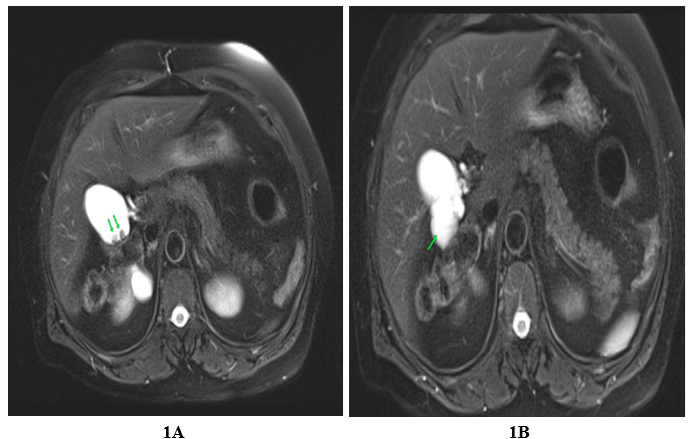
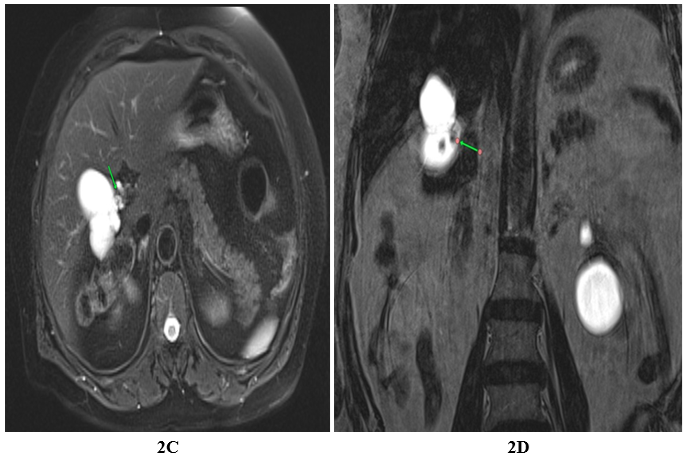
Clinical examination was unremarkable, with no guarding or palpable masses, although deep palpation elicited tenderness over the liver. Laboratory investigations showed normal liver function (AST, ALT, ALP, GGT, total and conjugated bilirubin) and no inflammatory syndrome. An initial abdominal ultrasound was inconclusive, showing no stones, biliary duct dilation, or hepatic masses. Due to this diagnostic difficulty, an MRCP was performed, revealing a 6 cm cystic duct remnant containing two stones (6.5 mm and 7.8 mm), without dilation of the intra- or extra-hepatic biliary tracts.
A laparoscopic surgical revision was decided upon. Intraoperative exploration confirmed the presence of the stone-containing cystic duct remnant. A complete excision of the remnant was performed without complications, and pathological analysis confirmed its benign nature. Post-operative recovery was smooth, and the patient remained asymptomatic at a six-month follow-up.
Discussion
Our patient is 63 years old. Cases of stone-containing cystic duct remnant reported in the literature span a broad age range, from young adults to patients in their eighties, as recently illustrated by Rathore et al.,[5]. Although gallstones are more common in women, post-cholecystectomy complications such as stump stones can occur regardless of sex [4].
The reported prevalence of this condition is estimated to range from 2% to 4% [4], yet few cases have been reported in North Africa [6,7]. No study on this pathology has been reported in Morocco to date, and the case we are reporting is the first to be documented at the national level in Morocco. This case serves to alert clinicians to the existence of this pathology in the hospital environment and calls for awareness within the framework of continuing medical education. While the management of these residual gallstone remnants is well-documented by several teams in Asia and Europe, as illustrated by the post-operative relief criteria of Shankari et al.,[3] and the laparoscopic approach of Palanivelu et al.,[4] their semiology remains an essential topic to integrate into continuing medical education.
We questioned the origin of this disparity: could it be explained by the more frequent use of total cholecystectomy in Africa, versus subtotal cholecystectomy (which is associated with a higher risk of stone-containing cystic duct remnants) in developed countries [4]? The lack of widespread access to advanced diagnostic tools such as Magnetic Resonance Cholangiopancreatography (MRCP) may also explain the underestimation of this condition in our setting [3]. Finally, the lack of awareness among many African clinicians regarding this entity could contribute to its under-reporting.
According to a recent systematic review by Latenstein et al., persistent symptoms following a cholecystectomy can be observed in 10% to 30% of patients, and their etiologies are multiple: Oddi sphincter dysfunction, functional digestive disorders, biliary stricture, operative complications, or even residual lithiasis [8]. Among these causes, the stone-containing cystic duct remnant remains under-reported in the literature, although it constitutes an important diagnosis that should not be neglected when facing persistent right upper quadrant pain.
The persistent right upper quadrant (RUQ) pain syndrome after cholecystectomy, often termed post-cholecystectomy syndrome (PCS), concerns up to 10–20% of operated patients according to some series [3,9]. Our case, with intermittent pain in the RUQ caused by a stone-containing cystic duct remnant, fits into this symptomatic spectrum, highlighting the need for a rigorous etiological exploration. Among the many possible etiologies, the stone-containing cystic duct remnant constitutes a rare but underestimated cause, whose exact incidence remains unknown [10].
The persistence of a segment of the cystic duct during cholecystectomy can be asymptomatic or, as in our case, become the site of secondary lithiasis. This lithiasis can lead to intermittent obstruction and irritation of the biliary tract, thus causing biliary-type pain in the RUQ, often without biological disturbances or dilation of the biliary tracts [11]. Latenstein et al.,(2019), in their systematic review covering more than 130 studies, emphasize that the etiologies of persistent post-cholecystectomy symptoms are often multifactorial and under-diagnosed [8]. This etiological ambiguity contributes to a delay in recognizing certain specific complications, such as the lithiasic cystic duct remnant syndrome, especially when the pains are intermittent or when initial examinations like ultrasound are non-contributory.
This diagnostic delay is aggravated by the absence of a standardized protocol for long-term postoperative follow-up, the under-utilization of MRCP, and the frequent attribution of symptoms to functional digestive disorders, such as dyspepsia or irritable bowel syndrome [12]. Thus, a lack of knowledge regarding the stump syndrome, combined with a non-specific clinical presentation, can prolong the diagnostic delay from several months to several years. In our context, this diagnostic delay is likely accentuated by the limited availability of advanced imaging resources, including MRCP and endoscopic ultrasound (EUS), and insufficient awareness among African clinicians regarding this type of rare but debilitating complication.
Vasil et al., propose a structured diagnostic approach for post-cholecystectomy syndrome, integrating a complete clinical, biological, and morphological evaluation. According to their analysis, postoperative right upper quadrant pain should prompt consideration, after excluding extra-biliary causes, of residual lithiasis, biliary tract stricture, or a pathological cystic remnant [13]. Their therapeutic strategy is based on a hierarchy according to the endoscopic or surgical accessibility of the cause. Cases of stone-containing cystic duct remnant, although rare, must be identified quickly to propose appropriate management and avoid long-term complications.
The 2016 EASL recommendations on the management of gallstones insist on the importance of a complete exploration of the biliary tract before and during cholecystectomy to limit the risk of residual lithiasis [14]. They also emphasize that any persistent post-cholecystectomy pain should evoke residual lithiasis, particularly in the cystic remnant, especially in cases of difficult cholecystectomy or anatomical anomalies [14]. The use of MRCP is recommended to detect these complications. On the therapeutic level, management must be adapted to endoscopic or surgical accessibility, with a preference for a minimally invasive approach when possible.
Regarding diagnosis, imaging plays a central role. MRCP is the imaging modality of choice for identifying a stone-containing cystic duct remnant and associated calculi [15]. The series reported by Chowbey et al., demonstrated that patients presenting with persistent post-cholecystectomy pain frequently harbored a long cystic duct remnant or a stone-containing gallbladder remnant, and that laparoscopic re-operation resulted in sustained symptom resolution [16].
The persistence of a residual cystic remnant after cholecystectomy is a well-recognized cause of late biliary complication, notably residual lithiasis, which can lead to a presentation of cystic stump syndrome. The case presented illustrates this type of complication, occurring several years after a cholecystectomy. It highlights the importance of intraoperative technical choices and their long-term impact.
In this context, the surgical strategy adopted, particularly in difficult dissection situations, deserves to be discussed. Subtotal cholecystectomy, described as an “absolute weapon” by Pitre in complex inflammatory situations or sclerosis of Calot's triangle, has established itself as a safe option to avoid injury to the main biliary tracts [17]. It consists of partially resecting the gallbladder while leaving a gallbladder remnant, generally closed or drained, depending on the case.
However, while this technique reduces the risk of iatrogenic injury, it potentially exposes the patient to another category of complications, particularly in cases of incomplete closure, a long remnant, or persistent stones. Strict control of the remnant, performing an intraoperative cholangiography if possible, as well as verifying the absence of residual stones, are therefore crucial steps in the prevention of secondary lithiasis [18,19]. Thus, subtotal cholecystectomy should be perceived not only as a rescue strategy in complex cases but also as a demanding technique requiring technical rigor to limit distant complications. The case presented underscores the value of prolonged follow-up in patients operated on by this method, particularly if the remnant was long or difficult to access.
Treatment depends on the symptomatology and the anatomy of the remnant. Endoscopy (ERCP) can allow for the extraction of stones if the remnant is accessible and in continuity with the main bile duct [20], but it often fails when the remnant is isolated. In these cases, a surgical re-intervention, most often laparoscopic, is necessary [21]. However, this surgery can be technically difficult due to postoperative adhesions and the loss of anatomical landmarks.
In our case, the diagnosis of a stone-containing cystic duct remnant was established by MRCP, which demonstrated a 6-cm cystic duct remnant containing two stones measuring 6.5 mm and 7.8 mm. Surgical revision allowed for a complete excision, with total resolution of pain at a six-month follow-up. This case illustrates the necessity of considering a stone-containing cystic duct remnant in the differential diagnosis of persistent RUQ pain after cholecystectomy. Particular attention should be paid to the initial operative technique to avoid excessively long remnants, while respecting the principles of the “critical view of safety”.
Conclusion
A cystic duct remnant containing stones is a rare but treatable cause of persistent pain after cholecystectomy. It is a rare but significant complication of cholecystectomy that can occur several years after the intervention. It must be considered in the face of any persistent or recurrent right upper quadrant pain in a patient previously operated on for gallbladder stones.
The increasing prevalence of subtotal cholecystectomies in complex situations mandates special attention to the management of the gallbladder remnant. A rigorous technical approach and prolonged monitoring are essential to reduce the risk of residual lithiasic complications.
Declarations
Ethical Considerations
The ethical approval was obtained from the ethical committee of Mohamed VI University Hospital, Cadi Ayyad University, Marrakech, Morocco
Funding Statement
None
Conflicts of Interest
The authors declare that they have no conflicts of interest
Data Availability
Data are available on corresponding author upon responsible request.
Acknowledgments
None