Introduction
Lymphedema is a chronic condition affecting the limbs, chest wall, abdomen and genitals, occurring due to accumulation of lymphatic fluid in the interstitial space between skin and muscles. Lymphedema can be of primary or secondary aetiology. Majority of cases are secondary, with mostly being due to filarial infection from Wuchereria bancrofti, Brugia malayi or timori predominantly in tropical parts of Asia, Africa . However, in Western countries, it’s mainly due to lymph nodal dissection done for breast cancer, pelvic malignancies . India is the country with highest burden of infected cases of lymphedema amounting to 42% of global endemic population . As lower limb lymphedema is directly related to functionality and independence of an individual, it can affect mobility, functionality, daily activities, professional, social interaction and mental health therefore, affecting the quality of life. As there is no per say standard treatment for lymphedema, preventive strategies play a pivotal role in its management, which includes education, guided aerobic and resistance exercise, usage of compression sleeves, and manual lymph drainage (MLD), all of which have demonstrated efficacy in randomized trials and clinical practice. Surgical managements are mainly seen in the resource sufficient countries, in resource limiting settings, preventive strategies make up the cornerstone of management. The above-mentioned study was undertaken to systematically evaluate the impact of limb volume reduction achieved through therapy on quality of life. This study aims to provide clinically significant evidence to support the usage of compression therapy as an effective patient centred management strategy for lower limb lymphedema in resource limited settings.
Methods
This Single centre, non-blind, prospective observational study carried out in Department of General Surgery, King George’s Medical University, Lucknow, Uttar Pradesh over a period of January 2023 to April 2024. This study approved by ethical clearance Reference code: XXII-PGTSC-IIA/P3 date 19.06.2024. Patients with lower limb lymphedema of any grade i.e. grade I, grade II, and grade III, of filarial aetiology, who are at least 16 years old and have given their informed consent
Pre compression therapy protocol
All the patient presenting to OPD were clinically evaluated and clinical diagnosis of lower limb lymphedema was made. Patient demographics details, socio-economic status were documented, grade of lymphedema was marked, Brunners grading was used for classification purpose which included Grade 1 – early oedema, which improves with limb elevation, Grade 2 – represents pitting oedema that does not resolve with elevation and Grade 3 describes fibroadipose deposition and skin changes. History of radiotherapy, lymph node surgeries, presence of metastatic disease or trauma was noted to rule out secondary causes of lymphedema other than filariasis
Peri-compression therapy protocol
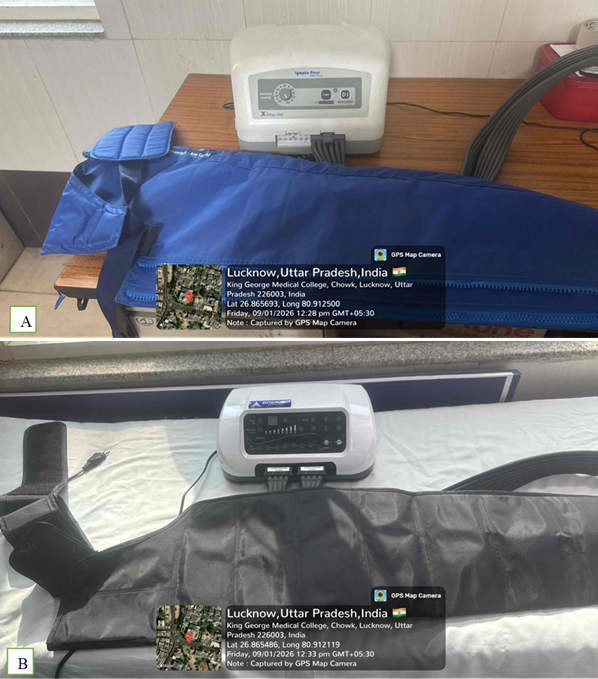
was given using Multi chamber pneumatic compression device (Figure 1 A&B), at the pressure of 80-120 mmHg for 45 minutes daily for 12 months. The sleeve inflation pressure started at foot level with 120mmHg which decrease by 20% in groin, the inflation time 50 seconds/chamber (8 chamber) amounting to 400 seconds for whole sleeve, it is 50 second /chamber deflations, each compression procedure will be composed of 9-10 cycle.
Follow up
The measurements were taken after the first use of IPC device and then at following 6 months, 12months. Patient were advised to wear compression stockings after the and change its size 6 monthly. each individual patient was interviewed using Lymphatic Filariasis Specific Quality of Life Questionnaire (LFSQQ). LFSQQ is a validated questionnaire developed by Institute of Applied Dermatology, Kerala, India to assess the quality of life (QoL) of lymphatic filariasis patients. The questionnaire includes various domains of problems related to lymphatic filariasis. It assesses the patient ‘s health status in the past 30 days through 7 domains: Self-care, mobility, usual activities, disease burden, pain/discomfort, psychological health and social participation. Each domain has various numbers of questions/items which address the problems due to the disease status. Each item is scored under five categories -no problem (4 score), mild (3 score), moderate (2score), severe (1 score) and most severe (0 score). Since some questions may not be applicable for all patients, the overall quality of life is calculated according to raw score and total questions answered. Overall score and quality of life response will be calculated.
Calculation of Limb Volume
-
Firstly, we divided the limb into segments at every 4-5 cm to measure the circumference at each segment of limb.
-
Then we converted the circumference to radius by using formula r = C/2π
-
For calculating the volume of each limb segment, we used the truncated cone volume formula –
Where:
V = Volume of each segment (cm3)
h = height/length of the segment in cm
r1, and r2 = radii at the two ends of the segment
4.Summing of all segment volumes was done to get total volume of the limb.
Statistical analysis
The data collected were documented in Microsoft Excel (2018-19). For statistical evaluation, SPSS (Statistical Package for the Social Sciences) and GraphPad PRISM 5 software were used. Categorical data were presented as proportions and percentages, whereas quantitative data were represented as mean (SD). Unpaired t-test was utilised to compare two groups of normally distributed quantitative variables. To assess correlations, Pearson, Spearman and linear regression were employed. Multiple comparisons of data across various follow ups were analysed using one was ANOVA test. A significance threshold of 5% was set for the results.
Results
144 patients were enrolled in the study, out of which 90 were males (62.5%) while 54 were females (37.5%), suggestive of male pre-dominance of lower limb lymphedema. Mean age of presentation was 41.61 ± 14.54. The present study showed that lower limb lymphedema most commonly affected the field workers (34%), followed by farmers (27.7%), House wives (22.9%), students (12.5%) and teachers (2.77%). The mean duration of occurrence of lymphedema in all subject was found to be 6.17 ± 4.131 years, with a minimum duration of 0.5 years to a maximum of 25 years (Table 1). The grades of lower limb lymphedema in the subjects were found to be very unevenly distributed, with the maximum percentage for 'grade 2' at 83.3%, followed by grade 3 at 13.2% and only 3.5% for grade 1(Table 2). Correlation between duration of lymphedema and modified kuppuswamy score was found to be positively correlated, which is supported with Pearson r value of 0.4366, as well as with the positive linear slope in linear regression graph (p-value < 0.0001). Most of lymphedema cases were attached with upper- lower (M-KS range 5-10) and lower middle (M-KS range 11-15) class and some were also attached with upper-middle M-KS range of 16-20. The upper class (M-KS range 26-29) cases were very rare and almost no case from very poor SES (Table 3, Figure 2). The correlation between the grades of lymphedema and modified kuppuswamy score was found to be inversely correlated as indicated by Spearman r’value of -0.1125(Figure 3). The pre-management (before any compression management) mean LFSQQ score was found to be 75.63 ± 14.55, which was significantly lower than the 6-month post-management LFSQQ score of 79.78 ± 12.8 with a significant p-value < 0.0001. Further increase in the follow-up to 12 months showed an increased LFSQQ score to 82.81 ± 14.23 with a significant p-value < 0.0001(Table 4, Figure 4). The mean pre-compression limb volume for all study participants was measured to be 10940 ± 804.3 cm3, which is significantly higher than the post-compression means limb volume of 10020 ± 738.0cm3, with a highly significant p-value <0.0001(Table 5, Figure 5).
| Duration of lymphedema occurrence (in years) | ||
| Minimum | Maximum | Mean ± SD |
| 0.5 year | 25 years | 6.17 ± 4.131 |
The average duration of occurrence of lower limb lymphedema in all subjects was found to be 6.17 ± 4.131 years, with a minimum duration of 0.5 years to a maximum of 25 years
| Grade of lymphedema | |||||
| Grade 1 | Grade 2 | Grade 3 | |||
| Number | % | Number | % | Number | % |
| 5 | 3.5% | 120 | 83.3% | 19 | 13.2% |
The grades of lower limb lymphedema in the subjects were found to be very unevenly distributed, with the maximum percentage for 'grade 2' at 83.3%, followed by grade 3 at 13.2% and only 3.5% for grade 1
| Correlation between ‘Duration of lymphedema’ vs. Modified Kuppuswamy score | |
| Pearson r | p-value (two-tailed) |
| 0.4366 | < 0.0001 *** |
| Linear regression between ‘Duration of lymphedema’ vs. Modified Kuppuswamy score | |
| Slope | p-value |
| 0.4761 ± 0.2142 | < 0.0001 *** |
The correlation between ‘Duration of Lymphedema’ and Modified Kuppuswamy Score was found to be positively correlated, which is well supported with Pearson ‘r’ value 0.4366. Also, the correlation was found to be highly significant with p-value < 0.0001.
The positive linear slope obtained in the linear regression graph indicated that the ‘Duration of Lymphedema’ of most of the study subjects was found to be very well supported by the M-KS Score, which was very significant with p-value < 0.0001.
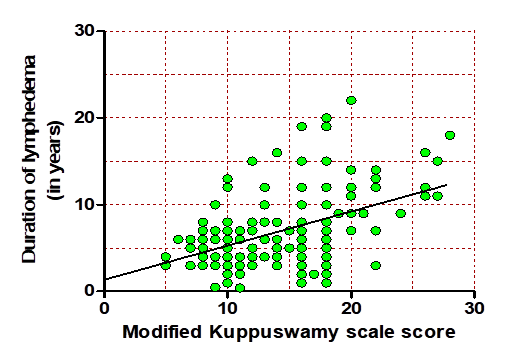
The positive linear slope obtained in the linear regression graph indicated that the ‘Duration of Lymphedema’ of most of the study subjects was found to be very well supported by the M-KS Score, which was very significant with p-value < 0.0001. Most of lymphedema cases were attached with upper- lower (M-KS range 5-10) and lower middle (M-KS range 11-15) class and some were also attached with upper-middle M-KS range of 16-20. The upper class (M-KS range 26-29) cases were very rare and almost no case from very poor SES (M-KS range below 5)
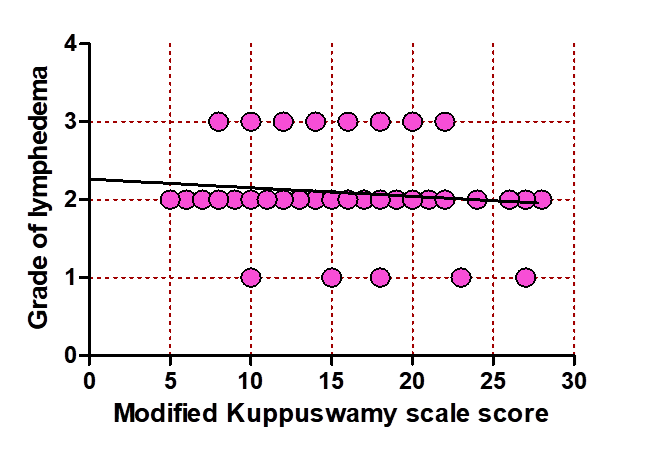
The correlation between ‘Grades of Lymphedema’ and Modified Kuppuswamy Score was found to be inversely correlated as indicated by Spearman ‘r’ value of -0.1125. The correlation between ‘Grades of Lymphedema’ and Modified Kuppuswamy Score was found to be inversely correlated as indicated by Spearman ‘r’ value of -0.1125. Also, the correlation was not found to be significant with p-value equal to 0.1793
| Follow-ups | Mean ± SD of LFSQQ score | Paired t-test based p-value | ANOVA based p-value |
| Pre-management | 75.63 ± 14.55 | p-value between pre-management and 6 months < 0.0001 *** p-value between pre-management and 12 months < 0.0001 *** | p-value between all successive follow-ups < 0.0001 *** |
| After 6 months | 79.78 ± 12.8 | ||
| After 12 months | 82.81 ± 14.23 |
The pre-management (before any compression management) mean LFSQQ score was found to be 75.63 ± 14.55, which was significantly lower than the 6-month post-management LFSQQ score of 79.78 ± 12.8 with a significant p-value < 0.0001. Further increase in the follow-up to 12 months showed an increased LFSQQ score to 82.81 ± 14.23 with a significant p-value < 0.0001
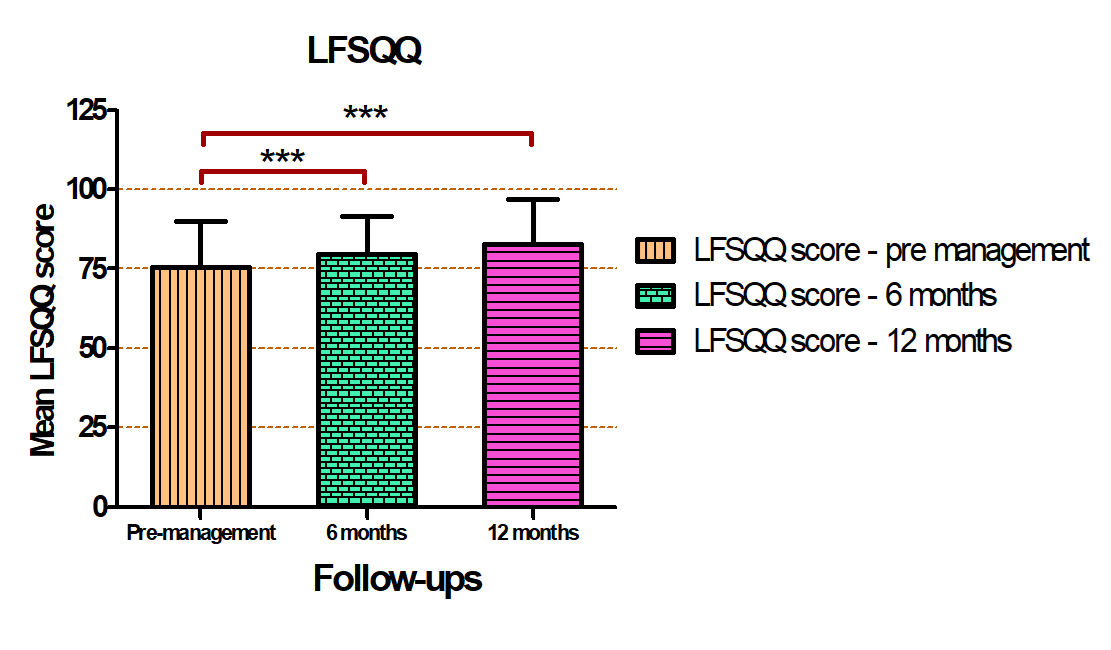
The pre-management (before any compression management) mean LFSQQ score was found to be 75.63 ± 14.55, which was significantly lower than the 6-month post-management LFSQQ score of 79.78 ± 12.8 with a significant p-value < 0.0001. Further increase in the follow-up to 12 months showed an increased LFSQQ score to 82.81 ± 14.23 with a significant p-value < 0.0001
| Limb Volume (in cm3) | Paired t-test based p-value | |
| Pre-compression | Post-compression | |
| 10940 ± 804.3 | 10020 ± 738.0 | < 0.0001*** |
The mean pre-compression limb volume for all study participants was measured to be 10940 ± 804.3 cm3, which is significantly higher than the post-compression mean limb volume of 10020 ± 738.0cm3, with a highly significant p-value <0.0001
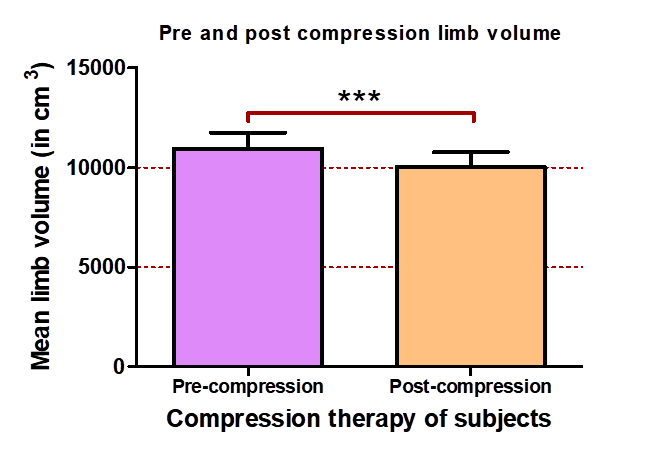
The mean pre-compression limb volume for all study participants was measured to be 10940 ± 804.3 cm3, which is significantly higher than the post-compression mean limb volume of 10020 ± 738.0cm3, with a highly significant p-value <0.0001
Discussion
The present prospective study evaluated the impact of IPC on lower limb volume reduction and quality of life using the Lymphatic filariasis specific quality of life questionnaire (LFSQQ).
Demography and Epidemiology
In the current study, lower limb lymphedema was predominantly seen in male individuals (62.5%), which is contrasting to most international literature reporting higher incidence in female cohorts. A study conducted by Kwarteng et al.,(2019) in Ghana, posted an incidence of 70.4% of filarial lymphedema in female patients , similar findings were seen in a study done by Mengistu et al.,(2024) in Ethiopia, where 62% of patients were females. In Indian scenario, multiple studies reported a heterogeneity in the gender specific distribution of the condition, A very recent study done by Kumar et al.,(2025) working on a prospective study on quality of life of filariasis patients in a north Indian tertiary care centre, reported the male versus female contribution to lower limb lymphedema as 63.6% and 36.4% in 154 cases of lower limb lymphedema. While on the other hand, another recent study done by Azhar et al.,(2025) in their cross- sectional study conducted among 1226 individuals of Odisha, India, reported 54.2% female cases of lower limb lymphedema, which is although having a female predominance but is very less as compared to its international counterparts . Plausible explanation for this gender ratio can be explained by a mix of behavioural practices, as in Indian context, its mainly the male population who are mainly actively involved with the outdoor activities and therefore are at more risk for exposure. The biased gender distribution can also be attributed to under reporting of female cases due to social stigma, which is commonly seen in the rural settings.
The mean age of presentation in our study was 41.61 ± 14.54 years in our cohorts which aligns closely with recent Indian studies. A very recent study by Kumar et al. (2025) closely aligns with our current study, reporting the mean and range of ages for the lower limb lymphedema patients were 41.27±14.71 years (15-75 years) . As mainly the working-class population is being affected, it causes a significant impairment in functionality of an individual, livelihood disruption and psychosocial burden, highlighting the importance of understanding the quality-of-life focused outcomes rather than evaluation of limb volume alone.
Occupational exposure and Socioeconomic status
A noteworthy observation was the higher prevalence of lymphedema among the field workers (34%) and farmers (27.7%), indicating increase risk of exposure to mosquito vectors, repeated minor grade traumas and inadequate hygiene practices. However, no such similar studies were reported in other literature. The study showcased an increased incidence among the upper lower (M-KS range 5 to 10) and lower middle (M-KS range 11-15) class and some were also attached to upper middle M-KS range of 16-20. This association can be explained by increase health care access and increase awareness to health condition. Hemalatha and Prabhakar (2016) conducted a study on lower limb lymphedema also showed that more than 50% of study population belonged to upper lower .
In our study, it was observed that as the socioeconomic status improved (as evaluated by modified Kuppuswami scale) the grade of lymphedema decreased as confirmed by negative spearman value of -0.1125, suggesting that socio-economic constraints contributed to delay of diagnosis and prolong mobility and impaired functional capacity indirectly worsening the socio-economic burden.
Disease Severity
Majority of patient presented with Brunner’s grade 2 lymphedema (83.3%), followed by grade 3 disease (13.2%). Based on Brunner ‘s Classification, Kumar et al (2025) reported the 30.5 %, 40% and 30% lower limb lymphedema cases of Grade I, II and Grade III, respectively. The predominance of the intermediate stage findings from this study as well as other Indian studies likely reflects the late health care seeking behaviour combined with the social stigmata associated with the physical presentation of patient along with slow progression typical of filarial lymphedema. Although, International society of lymphology staging is considered to be the standard staging system for lymphedema, the Brunner’s classification was used due to its simplicity and widespread clinical usage and also since all the patients had clinically apparent lymphedema, it was considered to be sufficient for evaluation of severity assessment.
Impact of Intermittent Lymphatic compression on Limb volume
The present study demonstrated a significant reduction in mean limb volume following IPC i.e 10940 ± 804.3 cm3, which is significantly higher than the post-compression means limb volume of 10020 ± 738.0cm3, with a highly significant p-value <0.0001. A study Dunn et al (2022) used for the Treatment of Lower Limb Lymphedema for duration ranged from 10 days to 12 weeks and found a significant reduction in limb volume ranging from 5.8% to 45.3% .An Indian study by Manjula Ei al (2002) used seven sequential for filarial lymphoedema for 6 months and revealed that 12 patients with grade II filarial lymphedema had >26% reduction in oedema volume immediately after compression .
Quality of Life outcomes
A major strength of this study was the utilisation of LFSQQ, a disease specific, validated tool for assessing the QoL in patients of lymphedema. The present study showed a progressive and statistically significant improvement in the LFSQQ score at both 6 and 12 months follow (pre management LFSQQ of 75.63 ± 14.55, improved to 79.78 ± 12.8 at 6 months, and further improved to 82.81 ± 14.23 at the end of 12 months, p-value < 0.001). The improvement encompassed multiple domains such as mobility, self-care, pain, social participation and disease burden, highlighting the importance of IPC therapy not only in improvement of physical health but also in the improvement of psychosocial health. Thomas et al (2014) compared the three Quality of Life instruments in the cases of different lymphatic filariasis grades: DLQI, WHODAS 2.0, and LFSQQ and suggesting that the LFSQQ showed highest feasibility and internal consistency with grades and QoL assessment of lymphedema patients with assessment value a = 0.97. Study done by Kumar et al (2025), emphasised the importance of LFSQQ in evaluation of quality of life, showcasing lower scores for patient with higher grade and longer duration of the disease . Notable, most of the existing literature have used LFSQQ as a cross-sectional assessment tool. To our best of knowledge, this is probably among the few studies to longitudinally asses the QoL improvement using LFSQQ following IPC therapy, therefore adding novel evidence to current literature.
Limitations
The study has some shortcomings despite its advantages. The results of this single-centre observational study might not be broadly applicable. The significance of the results may have been impacted by the lack of a control group and the long-term therapy's dependence on patient compliance. Longer follow-up is also necessary to evaluate the influence on complications such cellulitis and the durability of benefits.
Conclusion
Particularly in areas where filariasis is widespread, lower limb lymphedema is a chronic illness that significantly limits function and lowers quality of life. According to the LFSQQ, this prospective observational study shows that therapy significantly reduces limb volume and improves disease-specific quality of life over time. Compression therapy has been shown to enhance both the physical and mental elements of the condition, as evidenced by the reported benefits across several quality-of-life domains. IPC is a useful conservative therapy option for lower limb lymphedema due to its safety, practicality, and efficacy, particularly in settings with limited resources. To validate long-term results and improve management approaches, more multicentric studies with longer follow-ups are advised.
Declarations
Ethical Approval
The ethical approval was obtained from the ethical committee of King George's Medical University, Lucknow, Uttar Pradesh, India.
Role of Authors
PS: Concept design, collection of data, generation of manuscript, editing of manuscript, statistical analysis, assessing of review of literature.
MK: Concept design, collection of data, generation of manuscript, editing of manuscript, statistical analysis, assessing of review of literature.
SK: Editing of manuscript, statistical analysis, assessing of review of literature.
SK: Statistical analysis and review of literature.
Source of funding
The authors did not receive support from any organization for the submitted work.
No funding was received to assist with the preparation of this manuscript.
No funding was received for conducting this study.
No funds, grants, or other support was received
Conflict of interest
None
Data Availability
All data available on corresponding author upon responsible request.
Acknowledgements
None