Introduction
Body Dengue fever is one of the most important mosquito-borne viral infections affecting tropical and subtropical regions, with a rapidly increasing global incidence. Caused by any of the four dengue virus serotypes (DENV-1 to DENV-4) and transmitted primarily by Aedes aegypti mosquitoes, dengue represents a major public health challenge, particularly in endemic countries such as India, where seasonal outbreaks continue to place a substantial burden on healthcare systems [1]. Although most infections are self-limiting, a proportion of patients develop severe disease requiring hospitalization and close clinical monitoring [2,3].
In addition to the classical manifestations of fever, headache, myalgia, arthralgia, and thrombocytopenia, gastrointestinal and hepatic involvement is increasingly recognized as an important component of dengue infection [1,4]. Symptoms such as nausea, vomiting, and abdominal pain are common, while hepatic dysfunction, reflected by elevated serum transaminases and hyperbilirubinemia, occurs with varying severity. Abdominal ultrasonographic findings, including gallbladder wall thickening, hepatomegaly, splenomegaly, and ascites, have also been reported and may support clinical assessment, particularly in hospitalized patients [5,6].
The present prospective observational study was undertaken to evaluate the gastrointestinal symptoms, hepatic involvement, abdominal examination findings, and ultrasonographic manifestations among adult patients with serologically confirmed dengue fever admitted to a tertiary care centre, and to describe their frequency and clinical profile.
Methods
Study Design and Setting
This prospective hospital-based observational study was conducted at Ashraya Multi-speciality Hospital, Chikkamagaluru, India, during 2024–2025. The study aimed to evaluate the gastrointestinal manifestations, hepatic involvement, abdominal examination findings, and ultrasonographic features among adult patients with serologically confirmed dengue fever. A total of 150 consecutive eligible patients admitted during the study period were enrolled.
Study Population
Adult patients aged 18–55 years admitted with dengue fever were screened for eligibility. Only patients with serologically confirmed dengue infection were included. Demographic characteristics, including age and sex, were recorded at the time of admission.
Inclusion Criteria
-
Age 18–55 years.
-
Serologically confirmed dengue fever.
-
Admission to Ashraya Multi-speciality Hospital during the study period.
-
Provision of written informed consent.
Exclusion Criteria
-
Mixed infections.
-
History of alcohol consumption for ≥10 years.
-
Pre-existing systemic illnesses, including hypertension or diabetes mellitus.
Clinical Assessment and Data Collection
A structured case record form was used to collect demographic and clinical data at admission. Patients were evaluated for gastrointestinal symptoms, including nausea, vomiting, abdominal pain, and other relevant complaints. A detailed abdominal examination was performed to assess for hepatomegaly, splenomegaly, hepatosplenomegaly, and other abnormal clinical findings.
Laboratory and Imaging Evaluation
All patients underwent routine laboratory investigations, including complete blood count and liver function tests comprising serum aspartate aminotransferase (AST), alanine aminotransferase (ALT), and total bilirubin. Results were interpreted using the institutional laboratory reference ranges. Screening for malarial parasite by fluorescence test (MPFT), HIV, and hepatitis B surface antigen (HBsAg) was performed when clinically indicated as part of the institutional evaluation protocol. Abdominal ultrasonography was performed when clinically indicated to evaluate hepatic and splenic enlargement, gallbladder wall thickening, ascites, and other abdominal abnormalities.
Statistical Analysis
Data were analyzed using descriptive statistical methods. Categorical variables are presented as frequencies and percentages. Findings are presented in s summarizing the demographic characteristics, gastrointestinal manifestations, abdominal examination findings, liver function abnormalities, and ultrasonographic features of the study population.
Ethical Considerations
The study protocol was approved by the Institutional Ethics Committee of Ashraya Multi-speciality Hospital (IEC No. AMSH\IEC\2024-25\14) before study initiation. Written informed consent was obtained from all participants prior to enrollment. The study was conducted in accordance with the principles of the Declaration of Helsinki and institutional ethical guidelines.
Results
Baseline Characteristics and Clinical Manifestations
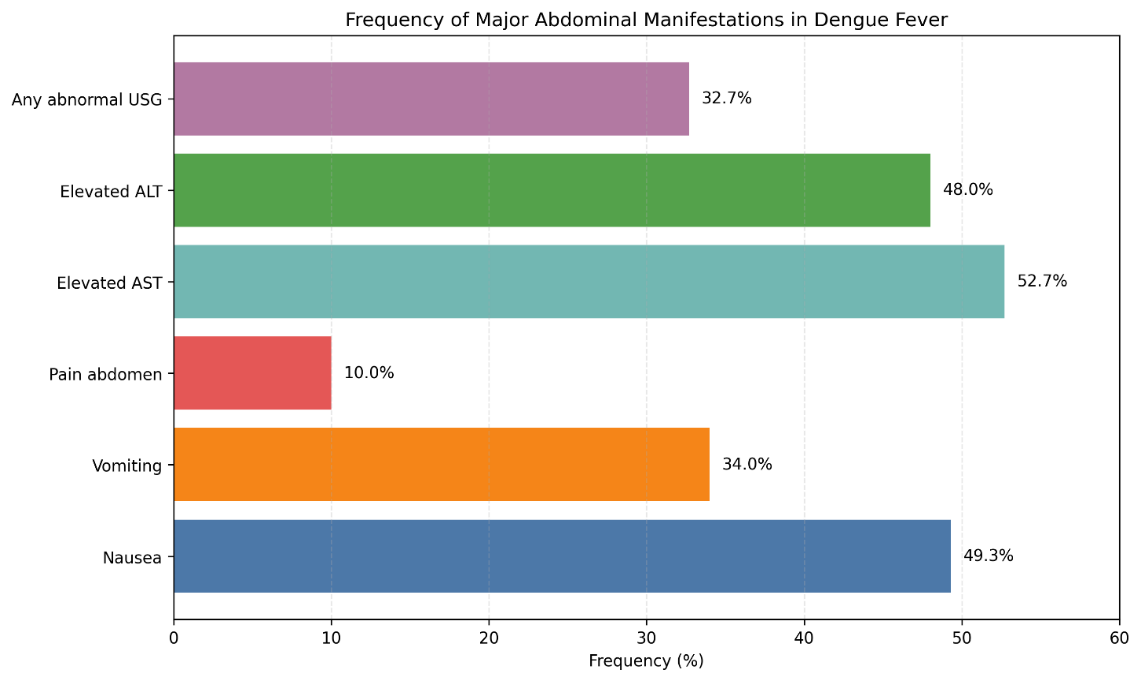
A total of 150 adults with serologically confirmed dengue fever were enrolled in this prospective observational study. The study population predominantly comprised young adults, with the highest proportion belonging to the 21–30-year age group, followed by individuals aged 31–40 years. Male patients constituted the majority of the study population. Gastrointestinal manifestations were common at presentation, with nausea being the most frequently reported symptom, followed by vomiting and abdominal pain. These findings indicate that gastrointestinal involvement is a frequent component of the clinical presentation of adult dengue fever. Abdominal examination revealed that most patients had no clinically detec abnormalities. Among those with abnormal findings, splenomegaly was the most commonly observed clinical sign, whereas hepatosplenomegaly was identified only in a small proportion of patients. The baseline demographic characteristics, gastrointestinal manifestations, and abdominal examination findings are summarized in 1.
| Characteristic | Frequency (n) | Percentage (%) |
| Age Group (years) | ||
| ≤ 20 | 22 | 14.7 |
| 21–30 | 87 | 58.0 |
| 31–40 | 28 | 18.7 |
| 41–50 | 11 | 7.3 |
| >50 | 2 | 1.3 |
| Sex | ||
| Male | 126 | 84.0 |
| Female | 24 | 16.0 |
| Gastrointestinal Symptoms* | ||
| Nausea | 74 | 49.3 |
| Vomiting | 51 | 34.0 |
| Abdominal pain | 15 | 10.0 |
| Abdominal Examination Findings | ||
| Normal | 127 | 84.7 |
| Splenomegaly | 21 | 14.0 |
| Hepatosplenomegaly | 2 | 1.3 |
Note: Symptoms were not mutually exclusive
Liver Biochemistry
Biochemical evaluation demonstrated evidence of hepatic involvement in a substantial proportion of patients. Elevation of serum aspartate aminotransferase (AST) was the most common liver function abnormality, followed by elevated alanine aminotransferase (ALT). Increased total bilirubin levels were observed less frequently than transaminase abnormalities. Overall, these findings suggest that mild to moderate hepatic dysfunction is a common feature among adults hospitalized with dengue fever. The distribution of liver biochemical abnormalities is presented in 2.
| Laboratory Parameter | Frequency (n) | Percentage (%) |
| Elevated AST (SGOT) | 79 | 52.7 |
| Elevated ALT (SGPT) | 72 | 48.0 |
| Elevated Total Bilirubin | 25 | 16.7 |
AST = Aspartate Aminotransferase; ALT = Alanine Aminotransferase. Elevated values were defined according to the institutional laboratory reference ranges.
Ultrasonographic Findings
Abdominal ultrasonography was normal in the majority of patients. Among those with abnormal imaging findings, splenomegaly was the most frequently detected abnormality, followed by gallbladder wall thickening. Minimal ascites and hepatomegaly were observed only in a few patients. These ultrasonographic findings are consistent with the spectrum of abdominal involvement described in dengue fever and may complement clinical and laboratory assessment in hospitalized patients. A detailed summary of the ultrasonographic findings is provided in 3, and the overall frequency of gastrointestinal, liver biochemical, and imaging abnormalities is illustrated in Figure 1.
| Ultrasonographic Finding | Frequency (n) | Percentage (%) |
| Normal | 101 | 67.3 |
| Splenomegaly | 27 | 18.0 |
| Gallbladder wall thickening | 17 | 11.3 |
| Minimal ascites | 3 | 2.0 |
| Hepatomegaly | 2 | 1.3 |
Note: Ultrasonography was performed on all 150 patients. Findings reflect the highest observed frequency of abdominal imaging abnormalities during the hospital admission.)
Discussion
The present prospective observational study demonstrated that gastrointestinal and hepatic manifestations were common among adults with serologically confirmed dengue fever. Nausea was the most frequent gastrointestinal symptom, followed by vomiting and abdominal pain. Biochemical evidence of hepatic involvement was observed in a substantial proportion of patients, with elevated AST occurring more frequently than elevated ALT. Ultrasonographic evaluation revealed splenomegaly as the most common imaging abnormality, followed by gallbladder wall thickening, while most patients had normal abdominal ultrasonography. These findings are consistent with the recognized multisystem involvement of dengue infection and support the role of clinical, biochemical, and imaging assessment in hospitalized patients [7,8].
The gastrointestinal manifestations observed in the present study are broadly comparable with previous Indian studies. Hariprasad et al. reported vomiting as the predominant gastrointestinal symptom among hospitalized dengue patients, while Vaidya et al. and AT et al. also identified vomiting and abdominal pain as common presenting features [9-11]. Similarly, Singh et al. observed nausea and vomiting in nearly half of their patients, with abdominal pain occurring less frequently. The lower frequency of vomiting and abdominal pain in the present study may reflect differences in patient characteristics, disease severity, referral patterns, or circulating dengue virus serotypes. Persistent vomiting and severe abdominal pain have also been recognized by the World Health Organization as warning signs that warrant close clinical monitoring because they may precede progression to severe dengue [12,13].
Hepatic involvement was another important finding in the present study. Elevated AST was more frequent than elevated ALT, consistent with observations from several clinical studies and systematic reviews. Vaidya et al. demonstrated marked elevations of AST and ALT among hospitalized patients, while Campana et al., in a systematic review, concluded that AST elevation is the most frequent biochemical abnormality and is associated with increasing disease severity [10,14]. Similar findings have been reported by Arun et al. and Swamy et al., who described hepatic dysfunction ranging from mild transaminitis to acute hepatitis in dengue infection. The predominance of AST over ALT is believed to reflect both hepatocellular injury and skeletal muscle involvement, highlighting the systemic inflammatory response associated with dengue virus infection [15,16].
Abdominal ultrasonography showed that splenomegaly and gallbladder wall thickening were the most frequent abnormalities, although the majority of patients had normal imaging findings. Similar ultrasonographic findings have been described by Vaidya et al., who reported gallbladder edema and ascites as common manifestations of plasma leakage. Campana et al. also identified hepatomegaly, gallbladder wall thickening, ascites, and pleural effusion as imaging findings frequently associated with severe dengue. Previous studies by Setiawan et al. further demonstrated that gallbladder wall thickening may be one of the earliest ultrasonographic manifestations of plasma leakage and can precede overt clinical deterioration. However, these abnormalities are not specific to dengue and should always be interpreted in conjunction with clinical findings and laboratory parameters [6,10,14,17].
The present findings have important clinical implications. Gastrointestinal symptoms, elevated liver enzymes, and ultrasonographic abnormalities may complement routine clinical assessment in hospitalized adults with dengue fever and help identify patients who require closer observation and supportive management. Early recognition of these manifestations may facilitate timely monitoring and appropriate clinical decision-making. The present study adds to the growing body of evidence from India demonstrating that gastrointestinal and hepatic involvement are common manifestations of adult dengue fever. Nevertheless, larger multicentre studies are needed to further clarify the prognostic significance of these clinical, biochemical, and imaging findings.
This single‑centre, hospital‑based study of 150 adults (18-55 years; 84% male) may overrepresent symptomatic or referred cases and underrepresent children, older adults, and mild community‑managed infections; exclusion of patients with chronic systemic illness, long‑term alcohol use, or mixed infections may further bias the cohort toward healthier individuals. Some investigations (abdominal ultrasonography, malaria/HIV/HBsAg screening) were performed only when clinically indicated, and biochemical results were reported using institutional reference ranges, which may introduce measurement bias and limit comparability with other studies. The modest sample size, lack of stratified analyses by disease severity, serotype, or time since symptom onset, and absence of longitudinal follow‑up further limit assessment of associations and long‑term outcomes. To mitigate bias, we enrolled consecutive eligible inpatients using prespecified inclusion/exclusion criteria, collected data with structured case‑record forms and predefined definitions, performed laboratory testing in the accredited institutional laboratory, and documented the indications and timing for selectively performed tests; imaging was interpreted per routine radiology practice. Therefore, while our findings are applicable to adults aged 18–55 years admitted with serologically confirmed dengue at a tertiary referral centre in coastal Karnataka, caution is required when generalizing to pediatric or elderly populations, outpatient settings, other regions, or areas with different circulating dengue serotypes and healthcare‑seeking behaviors.
In conclusion adults with serologically confirmed dengue fever, nausea was the most common gastrointestinal manifestation, while elevated AST was the predominant liver biochemical abnormality. Although abdominal ultrasonography was normal in most patients, splenomegaly and gallbladder wall thickening were the most frequent imaging abnormalities among those with abnormal findings. These clinical, biochemical, and ultrasonographic features may complement routine assessment of hospitalized patients with dengue fever and contribute to a more comprehensive evaluation of disease manifestations.
Declarations
Acknowledgements
The authors sincerely thank the patients who participated in this study. The authors also acknowledge the support of the Department of General Medicine, Department of Radiology, Central Clinical Laboratory, and the staff of Ashraya Multi-speciality Hospital, Chikkamagaluru, for their assistance with patient care, laboratory investigations, data collection, and ultrasonographic evaluations during the conduct of the study.
Conflict of interest declaration
The authors declare that they have no conflicts of interest related to this study.
Funding/ financial support
This research received no specific grant from any funding agency in the public, commercial, or not-for-profit sectors. The study was conducted using the institutional resources of Ashraya Multi-speciality Hospital, Chikkamagaluru.
Contributors
Dr. Sumuk M S, Department of Neurology, Ashraya Multi-speciality Hospital, Chikkamagaluru, Karnataka, India – Conceptualization, study design, patient recruitment, data collection, data interpretation, manuscript drafting, and final approval.
Dr. Anupama Marnal B A, Assistant Professor, Department of Obstetrics and Gynaecology, Chikkamagaluru Institute of Medical Sciences, Chikkamagaluru-577133, Karnataka, India – Study supervision, data interpretation, critical revision of the manuscript, and final approval.
Dr. Prathap Kumar J, Associate Professor, Department of Anatomy, Chikkamagaluru Institute of Medical Sciences, Chikkamagaluru-577133, Karnataka, India – Study supervision, critical revision of the manuscript, and final approval.
Ethical Clearance
The study protocol was approved by the Institutional Ethics Committee of Ashraya Multi-speciality Hospital, Chikkamagaluru (IEC No. AMSH\IEC\2024-25\14). Written informed consent was obtained from all participants before enrolment. The study was conducted in accordance with the ethical principles of the Declaration of Helsinki and applicable institutional guidelines.
Trial details
This was an investigator-initiated, prospective, hospital-based observational study. As this was a non-interventional observational study, prospective clinical trial registration was not applicable.