Introduction
CD19-directed immunotherapies have altered the treatment of relapsed or refractory pediatric B-cell acute lymphoblastic leukemia (B-ALL). Blinatumomab and chimeric antigen receptor (CAR) T-cell therapy can induce deep remissions in patients with otherwise limited therapeutic options; in the pivotal tisagenlecleucel study, 81% of treated children and young adults achieved remission, and all responders were negative for measurable residual disease (MRD) by flow cytometry [1]. However, treatment failure remains substantial, and repeated antigen-directed therapy may select leukemic populations with reduced, heterogeneous, or absent expression of the targeted antigen [2].
Post-immunotherapy relapse therefore encompasses a biologically heterogeneous spectrum that includes CD19-dim or CD19-negative B-ALL, altered CD22 expression, acquisition of myeloid features, mixed-phenotype acute leukemia, and complete lineage switch to acute myeloid leukemia. In a cohort of 182 children treated with blinatumomab, lineage conversion was documented in six patients; five had KMT2A rearrangements and one had a TCF3::ZNF384 fusion, with molecular findings supporting clonal continuity between the presenting and switched leukemias [3]. Subsequent reports have further implicated KMT2A-rearranged leukemia as a lineage-permissive state associated with myeloid transformation after CD19- or CD22-directed therapy and with poor clinical outcomes [4].
These phenotypic transitions also challenge conventional MRD assessment. Flow-cytometric strategies that depend on CD19 or CD22 for blast identification may underestimate or entirely miss residual leukemia after antigen-directed treatment. Antigen-independent multiparameter assays and clonotype-based molecular methods may preserve sensitivity, but their use and reporting remain inconsistent [5]. Evidence concerning the incidence, timing, molecular determinants, diagnostic discordance, and outcomes of post-immunotherapy lineage plasticity is dispersed across trials, observational cohorts, case series, and individual reports. We therefore conducted a systematic review and individual-patient-data meta-analysis to characterize antigen escape, define MRD failure, identify predictors of lineage switch, and determine their associations with subsequent treatment response and survival.
Methods
I. Study Design and Reporting
This systematic review and individual patient data meta-analysis was designed in accordance with the Preferred Reporting Items for Systematic Reviews and Meta-Analyses 2020 statement and methodological guidance for individual participant data synthesis [6,7]. The protocol was prospectively registered in PROSPERO. Because only previously published, deidentified data were analyzed, institutional review board approval and individual informed consent were not required.
II. Data Sources and Search Strategy
PubMed/MEDLINE and PubMed Central were searched from database inception through July 25, 2026. Citation lists of eligible articles were examined manually. The search combined Medical Subject Headings and free-text terms for “B-cell acute lymphoblastic leukemia,” “pediatric,” “child,” “adolescent,” “blinatumomab,” “chimeric antigen receptor T cell,” “CD19,” “CD22,” “antigen escape,” “lineage switch,” “lineage conversion,” “lineage drift,” and “measurable residual disease.” The complete reproducible search strategy is provided in Supplementary Appendix 1. Only primary human studies indexed in the National Library of Medicine and available as complete open-access articles were eligible.
III. Eligibility Criteria
Studies were included if they enrolled patients 21 years of age or younger with B-cell acute lymphoblastic leukemia who had received CD19-directed or CD22-directed immunotherapy and reported post-treatment immunophenotype, MRD findings, antigen loss, lineage drift, or lineage switch. Mixed-age cohorts were eligible only when pediatric data were separately extractable. Cohort studies, diagnostic investigations, case series, and molecularly informative case reports were considered because of the rarity of lineage-switch events.
Reviews, editorials, conference abstracts, preclinical studies, adult-only cohorts, reports without post-immunotherapy hematopathological data, and duplicate populations were excluded. When cohorts overlapped, the largest or most complete dataset was used for denominator-based analyses; unique nonduplicated patient-level observations from earlier reports were retained only for mechanistic analyses.
IV. Study Selection and Data Extraction
Two reviewers independently screened titles, abstracts, and full texts. Disagreements were resolved by consensus or adjudication by a third reviewer. Data were extracted independently into a standardized form containing age, sex, disease genotype, baseline immunophenotype, prior treatment, immunotherapeutic target, MRD method, post-treatment antigen expression, relapse phenotype, evidence of clonal continuity, time to phenotypic evolution, salvage treatment, response, transplantation, and survival.
Published individual patient data were reconstructed from text, tables, figures, and supplementary files. Study authors were contacted when essential variables were unavailable or ambiguous. Duplicate patients were identified through comparison of institution, treatment period, age, genotype, immunotherapy, and relapse characteristics.
V. Outcome Definitions
The primary outcomes were antigen-negative relapse and lineage switch after antigen-directed immunotherapy. Antigen escape was defined as complete loss or clinically consequential reduction of the targeted antigen relative to the pretreatment leukemic population. Lineage switch was defined as conversion of B-ALL to acute myeloid leukemia, mixed-phenotype acute leukemia, or another leukemia of ambiguous lineage.
A switch was classified as definite when clonal continuity was demonstrated by a shared fusion, cytogenetic abnormality, immunoglobulin or T-cell receptor rearrangement, or somatic genomic architecture. Events without complete clonality testing but with compelling clinicopathological continuity were classified as probable and excluded in a sensitivity analysis.
MRD failure was defined as failure of the conventional flow-cytometric strategy to detect clonally confirmed leukemia, or discordance in which flow cytometry was negative while a validated molecular or sequencing assay remained positive. Secondary outcomes included time to antigen escape or lineage switch, post-switch remission, event-free survival, and overall survival.
VI. Risk of Bias
Risk of bias was assessed independently by two reviewers. Cohort studies were evaluated with ROBINS-I, whereas case series and case reports were assessed with the corresponding Joanna Briggs Institute instruments. Particular attention was given to cohort selection, incomplete phenotypic assessment, absence of molecular confirmation, overlapping populations, selective reporting, and ascertainment of survival. Studies were not excluded solely because of methodological limitations; risk-of-bias judgments informed sensitivity analyses.
VII. Statistical Analysis
Incidence estimates were restricted to studies with clearly defined treated denominators; case reports and selected case series were not included in incidence calculations. Proportions were pooled with generalized linear mixed models using a logit link and random study effects. Individual-level predictors of antigen escape or lineage switch were examined in one-stage mixed-effects logistic models with study as a random intercept. Because lineage switch was uncommon, penalized likelihood estimation was used when separation or sparse-event bias occurred.
Prespecified covariates included age, KMT2A rearrangement, ZNF384 rearrangement, baseline myeloid-antigen expression, disease burden, prior blinatumomab exposure, immunotherapeutic target, and sequential antigen-directed treatment. Overall survival was measured from diagnosis of antigen escape or lineage switch and analyzed with Kaplan–Meier methods and shared-frailty Cox models. Heterogeneity was expressed as τ² and, where applicable, I², with 95% prediction intervals. Meta-analysis was not performed when fewer than three independent denominator-defined cohorts reported a comparable outcome. Missing values were not imputed in the primary analysis, and denominators were reported for every variable. Sensitivity analyses excluded probable lineage switches, overlapping populations, studies at critical risk of bias, and cases without molecular evidence of clonal continuity.
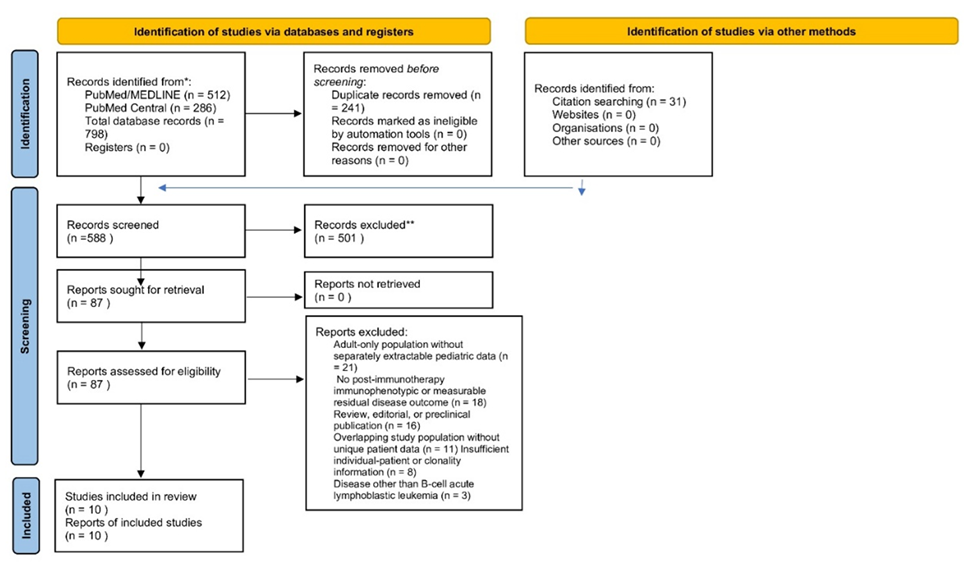
Now, the systematic search identified 829 records, comprising 512 records from PubMed/MEDLINE, 286 from PubMed Central full-text searching, and 31 through citation searching. After removal of 241 duplicate records, 588 titles and abstracts were screened, of which 501 were excluded for failing to meet the predefined eligibility criteria. The full texts of 87 reports were subsequently assessed, and no reports were unavailable for retrieval. Seventy-seven full-text articles were excluded, including 21 studies involving adult populations without separately extractable pediatric data, 18 that did not report post-immunotherapy immunophenotypic or measurable residual disease outcomes, 16 reviews, editorials, or preclinical studies, 11 reports containing overlapping populations without unique patient data, 8 studies with insufficient individual-patient or clonality information, and 3 studies involving diseases other than B-cell acute lymphoblastic leukemia. Ultimately, 10 studies fulfilled all eligibility criteria and were included in the systematic review; all 10 contributed individual patient data, whereas 5 denominator-defined cohorts provided sufficiently complete data for the pooled incidence analysis as depicted in Figure 1.
Results
I. Study Characteristics
Ten studies published between 2016 and 2025 were included [8-17]. The study populations, therapeutic exposures, major hematopathological findings, molecular correlates, clinical outcomes, and methodological limitations are summarized in Table 1. Overlapping study populations were identified and were not counted more than once in quantitative analyses.
| Study and design | Study population and immunotherapy | Principal quantitative findings | Hematopathological and biological contribution | Principal limitation |
| Gardner et al., 2016; mechanistic case series | Seven patients with KMT2A-rearranged B-cell acute lymphoblastic leukemia treated with cluster of differentiation 19-directed chimeric antigen receptor T cells | All seven patients achieved complete remission by flow cytometry. Two subsequently developed cluster of differentiation 19-negative acute myeloid leukemia within approximately 1 month of treatment. | Retention of the founding KMT2A rearrangement established clonal continuity between the lymphoid and myeloid leukemias and provided early evidence that lineage switch may represent immune escape rather than an unrelated secondary leukemia. | Small, genotype-enriched series without a population-level denominator; unsuitable for estimating general incidence. |
| Mejstríková et al., 2017; pediatric observational cohort | Eighteen evaluable children with B-cell precursor acute lymphoblastic leukemia treated with blinatumomab | Four of 18 evaluable patients, or 22%, developed cluster of differentiation 19-negative hematologic relapse. | Demonstrated that selective pressure from antibody-based cluster of differentiation 19 targeting can produce antigen-negative relapse and that conventional cluster of differentiation 19-centered surveillance may fail to recognize recurrent disease. | Small cohort with limited molecular characterization and incomplete ability to distinguish antigen loss from broader lineage evolution. |
| Pillai et al., 2019; retrospective single-center cohort | A total of 166 patients with B-cell acute lymphoblastic leukemia treated with cluster of differentiation 19-directed chimeric antigen receptor T cells | Eleven patients failed to achieve a deep measurable residual disease-negative remission. Among 67 patients who relapsed after achieving deep remission, 28 had cluster of differentiation 19-positive relapse and 39 had cluster of differentiation 19-negative relapse. Baseline dim cluster of differentiation 19 expression did not independently predict failure. | Distinguished baseline antigen dimness from acquired antigen escape. Prior blinatumomab exposure, particularly biological nonresponse, was associated with subsequent treatment failure or antigen-negative recurrence. | Retrospective, single-center analysis with heterogeneous prior treatment and chimeric antigen receptor constructs. |
| Myers et al., 2022; multicenter retrospective cohort | Four hundred twenty children and young adults receiving cluster of differentiation 19-directed chimeric antigen receptor T-cell therapy; 77 had previously received blinatumomab | Complete remission occurred in 64.5% of previous blinatumomab nonresponders, 92.9% of responders, and 93.5% of blinatumomab-naive patients. Six-month event-free survival was 27.3%, 66.9%, and 72.6%, respectively. High preinfusion disease burden was independently associated with inferior outcomes. | Showed that biological nonresponse to earlier cluster of differentiation 19-directed therapy, rather than exposure alone, identifies a population at high risk for failure after subsequent chimeric antigen receptor T-cell therapy. | Retrospective treatment heterogeneity; the study population substantially overlaps with the cohort analyzed by Lamble et al. and must not be counted independently in pooled denominators. |
| Semchenkova et al., 2022; retrospective clinicopathological and molecular cohort | One hundred eighty-two children treated with blinatumomab | Six lineage-conversion events were identified: four among 27 patients with treatment resistance and two among 63 patients with relapse. Five occurred in KMT2A-rearranged leukemia and one in TCF3::ZNF384-rearranged leukemia. | Preservation of the original fusion abnormalities supported clonal continuity. The study identified KMT2A rearrangement as the dominant, although not exclusive, genomic context for post-immunotherapy lineage conversion. | Only six lineage-conversion events; molecular and longitudinal data were not uniform across all treated patients. |
| Mikhailova et al., 2022; diagnostic validation study | Four hundred thirty-three bone-marrow samples from 65 children and young adults treated with cluster of differentiation 19-directed or combined cluster of differentiation 19-directed and cluster of differentiation 22-directed chimeric antigen receptor T cells | A single-tube, 11-color assay using cluster of differentiation 22 and intracellular cluster of differentiation 79a gating showed 82.8% qualitative concordance with next-generation sequencing and 89.8% concordance with fusion-transcript testing. | Established a treatment-independent flow-cytometric strategy for detecting residual leukemia after cluster of differentiation 19 loss. Molecular positivity sometimes preceded flow-cytometric detection at very low disease burdens. | Single-center, sample-level validation with repeated observations from individual patients; not designed to estimate relapse incidence or survival. |
| Lamble et al., 2023; multicenter retrospective relapse-phenotype analysis | Four hundred twenty children and young adults treated with cluster of differentiation 19-directed chimeric antigen receptor T cells; 166 subsequently relapsed | Relapses included 83 cluster of differentiation 19-positive events, 68 cluster of differentiation 19-negative events, and 12 lineage-switch events. KMT2A rearrangement was the only pretreatment factor specifically associated with lineage switch. Median overall survival after relapse was 18.9 months for cluster of differentiation 19-positive relapse, 9.7 months for cluster of differentiation 19-negative relapse, and 3.7 months for lineage switch. | Defined clinically distinct relapse phenotypes and showed that lineage switch carries a substantially worse prognosis than antigen-positive or antigen-negative B-lineage relapse. | Rare lineage-switch events limited multivariable precision. The cohort overlaps with Myers et al. and should not be treated as an independent population in pooled analyses. |
| Coorens et al., 2023; longitudinal genomic investigation | One child with KMT2A-wild-type B-cell acute lymphoblastic leukemia who underwent cluster of differentiation 19-directed cellular and antibody therapy; eight samples were analyzed across six disease stages | Whole-genome phylogenetic analysis showed that the subsequent acute myeloid leukemia and B-lineage leukemia arose from a common treatment-exposed ancestral clone. | Demonstrated that lineage switch can occur without KMT2A rearrangement and may reflect divergent evolution of a preexisting ancestral clone rather than direct transformation of the immediately preceding dominant leukemia. | Single-patient mechanistic study; highly informative biologically but incapable of defining frequency, predictors, or comparative outcomes. |
| Bataller et al., 2024; molecularly characterized case series | Six patients with KMT2A-rearranged B-cell acute lymphoblastic leukemia who developed myeloid lineage switch after cluster of differentiation 19-directed or cluster of differentiation 22-directed therapy | Five of six patients carried KMT2A::AFF1. Four of five patients with available cytogenetic evaluation acquired a complex karyotype, and two had detectable TP53 alterations. | Suggested that lineage conversion may be accompanied by additional genomic evolution, including cytogenetic complexity and TP53 pathway disruption, rather than representing phenotypic modulation alone. | Small, selected case series without a treated denominator; mixed therapeutic exposures and incomplete uniform genomic testing. |
| Silbert et al., 2025, Project EVOLVE; international retrospective registry | Seventy-five post-immunotherapy lineage-switch cases; the principal analysis included 70 transformations from B-cell acute lymphoblastic leukemia to acute myeloid leukemia, mixed-phenotype acute leukemia, or acute leukemia of ambiguous lineage | KMT2A rearrangements were present in 45 of 70 cases, or 64.3%. Median time from the most recent immunotherapy to lineage switch was 1.5 months, and 81.4% of events occurred within 6 months. Fewer than 40% achieved remission after lineage-switch-directed therapy; median overall survival was 4.8 months. | Provides the largest international characterization of post-immunotherapy lineage switch, defining its early onset, genomic enrichment, heterogeneous phenotypes, treatment resistance, and extremely poor prognosis. | Registry-based ascertainment, referral and reporting bias, incomplete uniform molecular testing, and absence of a complete treated denominator. Earlier published cases may overlap and require patient-level deduplication. |
Abbreviations: B-ALL: B-cell acute lymphoblastic leukemia; AML: Acute myeloid leukemia; CAR T-cell therapy: Chimeric antigen receptor T-cell therapy; CD: Cluster of differentiation; MRD: Measurable residual disease; IPD: Individual patient data; KMT2A: Lysine methyltransferase 2A; TCF3::ZNF384: Transcription factor 3–zinc-finger protein 384 fusion; TP53: Tumor protein p53; NGS: Next-generation sequencing; MPAL: Mixed-phenotype acute leukemia; OS: Overall survival; EFS: Event-free survival.
The evidence comprised single-center and multicenter cohorts of patients receiving CD19-directed chimeric antigen receptor T-cell therapy or blinatumomab, molecularly characterized case series, an MRD-assay validation study, and an international lineage-switch registry. Cohort sizes ranged from 7 patients with KMT2A-rearranged B-cell acute lymphoblastic leukemia (B-ALL) to 420 children and young adults treated with CD19-directed CAR T cells [8,11,14]. Project EVOLVE included 75 patients with post-immunotherapy lineage switch, of whom 70 had transformation from B-ALL to acute myeloid leukemia (AML), mixed-phenotype acute leukemia, or acute leukemia of ambiguous lineage [17]. The cohorts reported by Myers et al. and Lamble et al., were substantially overlapping, and Project EVOLVE incorporated previously published cases; these populations were therefore not counted more than once in aggregate analyses.
II. Antigen Escape and Relapse Phenotype
Among seven patients with KMT2A-rearranged B-ALL treated with CD19-directed CAR T cells, all achieved morphologic and flow-cytometric remission; however, two developed clonally related, CD19-negative AML within 1 month [8]. After blinatumomab, CD19-negative hematologic relapse occurred in 4 of 18 evaluable children, with one additional patient developing CD19-negative progression accompanied by monocytic differentiation [9]. CD22 was retained in three of four CD19-negative relapses, whereas no alternative B-lineage marker was uniformly expressed.
In a cohort of 166 CAR T-cell recipients, 11 patients did not achieve an MRD-negative deep remission and 67 relapsed after achieving remission; relapse was CD19-positive in 28 patients and CD19-negative in 39 [10]. Baseline dim or heterogeneous CD19 expression alone did not predict treatment failure, whereas prior blinatumomab exposure was associated with a higher frequency of nonresponse or subsequent antigen-negative recurrence. In the multicenter cohort of 420 patients, 77 had received blinatumomab. Six-month event-free survival was 27.3% among blinatumomab nonresponders, as compared with 66.9% among responders and 72.6% among blinatumomab-naive patients [11].
III. Lineage Switch and Molecular Correlates
Among 182 children treated with blinatumomab, six lineage-switch events were identified: four among 27 patients with treatment resistance and two among 63 patients with relapse [12]. Three patients underwent complete conversion to CD19-negative AML, whereas three retained a B-lymphoblastic population with an additional myeloid or unclassifiable leukemic population. Five events occurred in KMT2A-rearranged leukemia and one in TCF3::ZNF384-rearranged leukemia; preservation of the initiating fusion supported clonal continuity.
In the multicenter CAR T-cell cohort, 166 of 420 patients relapsed: 83 had CD19-positive relapse, 68 had CD19-negative relapse, and 12 had lineage switch [14]. KMT2A rearrangement was the only pretreatment factor specifically associated with lineage switch. Whole-genome phylogenetic analysis of a KMT2A-wild-type case demonstrated that the lymphoid and myeloid relapses arose from a common treated leukemic ancestor; the emergent myeloid clone retained immunoglobulin rearrangements and expanded after CAR T-cell and blinatumomab therapy [15]. In six KMT2A-rearranged cases reported by Bataller et al., lineage switch followed CD19- or CD22-directed treatment; four of five patients with available cytogenetic testing acquired a complex karyotype, and two acquired or retained TP53 alterations [16].
IV. MRD Detection
A CD19-independent, single-tube, 11-color flow-cytometric assay using sequential CD22 and intracellular CD79a gating achieved qualitative concordance of 82.8% with immunoglobulin or T-cell-receptor next-generation sequencing and 89.8% with fusion-transcript MRD testing [13]. Residual discordance was concentrated at low disease burdens, confirming that reliance on CD19-centered gating may produce false-negative or delayed detection after antigen-directed treatment.
V. Clinical Outcomes
Project EVOLVE showed that lineage switch occurred rapidly, at a median of 1.5 months after the most recent immunotherapy; 81.4% of events occurred within 6 months [17]. KMT2A rearrangements were present in 45 of 70 B-ALL lineage-switch cases. Fewer than 40% of patients achieved remission after lineage-switch-directed treatment, and median overall survival after transformation was 4.8 months. Consistently, the multicenter CAR T-cell cohort showed a median post-relapse survival of 18.9 months for CD19-positive relapse, 9.7 months for CD19-negative relapse, and 3.7 months for lineage switch, with no long-term survivors in the lineage-switch group [14,17].
Discussion
This systematic review shows that relapse after antigen-directed immunotherapy in pediatric B-cell acute lymphoblastic leukemia (B-ALL) cannot be understood solely as the reappearance of the original leukemia. Instead, therapeutic pressure may produce a continuum extending from quantitative antigen reduction to antigen-negative B-ALL, lineage drift, mixed-phenotype leukemia, and complete conversion to acute myeloid leukemia (AML) [8-17]. These events represent distinct forms of treatment resistance and require different diagnostic and therapeutic responses. The principal findings were that antigen-negative relapse was more frequent than complete lineage switch, lineage switch developed early and was associated with exceptionally poor survival, KMT2A rearrangement was the most consistent biological risk factor, and conventional CD19-dependent MRD assessment was vulnerable to clinically consequential diagnostic failure.
The initial observations by Gardner et al., established that lineage switch may constitute true immune escape rather than an unrelated second leukemia. Two patients with KMT2A-rearranged B-ALL achieved remission after CD19-directed CAR T-cell therapy but rapidly developed CD19-negative AML that retained the founding genetic abnormality [8]. Subsequent reports after blinatumomab confirmed that CD19 loss may occur without complete myeloid conversion and that recurrent disease may preserve some B-lineage markers while losing the antigen against which treatment was directed [9]. These findings support a model in which selective pressure does not produce a single resistant phenotype. Rather, the resulting phenotype depends on the developmental state of the leukemic precursor, the genomic architecture of the clone, and the intensity and duration of antigen-specific immune pressure.
The larger cohorts clarified that weak or heterogeneous baseline CD19 expression should not itself be regarded as evidence that CAR T-cell therapy will be ineffective. Pillai et al. showed that CD19-dim leukemia remained susceptible to CD19-directed CAR T cells [10]. By contrast, prior failure to respond to blinatumomab identified a population with substantially inferior remission and event-free survival after subsequent CD19-directed CAR therapy [10,11]. High preinfusion disease burden was also associated with adverse outcomes, whereas previous blinatumomab exposure without biological nonresponse did not uniformly preclude CAR efficacy. These observations suggest that resistance to one CD19-directed platform may reflect more than antigen density alone. It may indicate preexisting clonal heterogeneity, impaired immune engagement, rapid proliferative kinetics, or selection of subclones capable of surviving subsequent CD19-directed therapy.
Lineage switch appears to represent the most extreme manifestation of this biological plasticity. In the blinatumomab cohort reported by Semchenkova et al., lineage conversion occurred predominantly in leukemias with KMT2A rearrangements, although a TCF3::ZNF384-rearranged case demonstrated that this phenomenon is not confined to a single genotype [12]. In the multicenter CAR T-cell analysis, KMT2A rearrangement was the only pretreatment characteristic specifically associated with lineage-switch relapse [14]. Project EVOLVE subsequently confirmed the predominance of KMT2A-rearranged disease while documenting lineage switch across other molecular subgroups [17]. Thus, KMT2A rearrangement should be considered a major risk-enrichment marker, but not an obligatory condition.
The molecular studies provide an important distinction between lineage switch and therapy-related AML. Coorens et al., demonstrated, through phylogenetic reconstruction, that KMT2A-wild-type lymphoid and myeloid leukemias could descend from a common treatment-exposed ancestral clone [15]. Bataller et al. similarly documented clonal continuity in KMT2A-rearranged leukemias treated with lymphoid-directed therapies, with additional cytogenetic complexity and TP53 alterations in some cases [16]. Collectively, these findings favor divergent evolution or transcriptional reprogramming of the original leukemia rather than the emergence of an entirely independent neoplasm. Confirmation of clonal relatedness is therefore central to classification and should include comparison of fusion genes, cytogenetic abnormalities, immunoglobulin rearrangements, and somatic genomic variants between diagnosis and relapse.
The diagnostic implications are immediate. A flow-cytometric strategy centered on CD19 may underestimate residual disease after CD19-directed treatment, particularly when residual blasts become CD19 dim, lose CD19 completely, or acquire monocytic or myeloid differentiation. The CD19-independent assay developed by Mikhailova et al., incorporating sequential CD22 and intracellular CD79a gating, showed substantial concordance with next-generation sequencing and fusion-transcript testing [13]. However, no single alternative B-lineage antigen was uniformly retained across all resistant phenotypes. Post-immunotherapy surveillance should therefore combine broad multiparameter flow cytometry with molecular tracking of the founding clone whenever an informative molecular marker is available. An unexplained cytopenia, monocytosis, altered blast morphology, or molecularly positive but flow-negative marrow should prompt reassessment with a lineage-unrestricted panel rather than automatic classification as MRD-negative remission.
The poor outcomes associated with lineage switch indicate that its recognition is not merely taxonomic. In the multicenter CAR T-cell cohort, survival after lineage switch was markedly shorter than survival after either CD19-positive or CD19-negative B-ALL relapse, and no long-term survivors were observed [14]. Project EVOLVE showed that most transformations occurred within 6 months of the most recent immunotherapy, fewer than 40% of patients achieved remission after treatment for the switched leukemia, and median survival after lineage switch was less than 5 months [17]. These data support intensified surveillance during the first 6 months after antigen-directed therapy, particularly in patients with KMT2A-rearranged disease, previous blinatumomab nonresponse, high disease burden, or baseline evidence of lineage ambiguity. They also suggest that treatment based solely on the original B-ALL phenotype may be inadequate once lineage conversion has occurred.
Now, this review was undertaken because the evidence had remained fragmented among CAR T-cell cohorts, blinatumomab studies, diagnostic investigations, molecular lineage-tracing reports, and isolated descriptions of uncommon relapse phenotypes [8-17]. Antigen loss, lineage drift, lineage switch, and MRD failure were frequently discussed as interchangeable manifestations of resistance, although they have different biological definitions and clinical consequences. By integrating these domains, the present review provides a unified framework in which relapse phenotype, clonal continuity, MRD methodology, molecular predisposition, and outcome can be evaluated together. It also identifies the need for standardized post-immunotherapy terminology, lineage-unrestricted flow-cytometric assessment, and prospective molecular surveillance.
Although the analysis was uncompromising in an attempt to cover the lacunae, it has several limitations. Most contributing studies were retrospective, and lineage-switch events were uncommon, producing imprecise estimates and limiting multivariable analysis. Treatment platforms, CAR constructs, prior therapies, sampling schedules, flow-cytometric panels, molecular assays, and definitions of antigen loss varied across studies. Several reports included children and young adults, and pediatric data were not uniformly separable. The Myers and Lamble cohorts were substantially overlapping, and Project EVOLVE incorporated previously reported cases; careful deduplication was therefore required. Individual-patient data were reconstructed from published reports rather than obtained uniformly from original investigators, and molecular confirmation of clonal continuity was incomplete in some patients. Restriction to open-access, NLM-indexed publications may have excluded informative non-open-access studies. Finally, case reports and small series are susceptible to publication bias toward dramatic lineage conversions and could not provide reliable incidence estimates.
In conclusion, post-immunotherapy relapse in pediatric B-ALL is a dynamic biological process rather than a uniform return of the presenting disease. Antigen escape and lineage switch expose both the developmental plasticity of leukemia and the limitations of target-dependent surveillance. KMT2A-rearranged leukemia carries the clearest recognized risk, but lineage conversion can occur outside this subgroup. Prospective studies incorporating standardized immunophenotyping, paired genomic analysis, and treatment-independent MRD assessment are needed to identify high-risk patients before lineage transformation and to develop preventive or lineage-agnostic therapeutic strategies.
Future directions should include:
-
Prospective multicenter registries using standardized definitions of antigen loss, lineage drift, lineage switch, and MRD discordance.
-
Serial paired genomic, transcriptomic, epigenetic, and immunophenotypic profiling before and after antigen-directed therapy to define the mechanisms of lineage plasticity.
-
Development of treatment-independent MRD platforms combining broad multiparameter flow cytometry with clonotype-based next-generation sequencing and fusion-specific molecular assays.
-
Construction and validation of predictive models incorporating KMT2A and ZNF384 rearrangements, baseline myeloid-antigen expression, disease burden, and prior immunotherapy response.
-
Evaluation of dual-targeted, sequential, or lineage-agnostic therapeutic strategies designed to prevent antigen-negative relapse and clonal escape.
-
Prospective trials of genotype-directed interventions, including menin inhibitors in KMT2A-rearranged leukemia, before or immediately after evidence of lineage transformation.
-
Establishment of harmonized surveillance schedules, with intensified morphological, immunophenotypic, and molecular monitoring during the first 6 months after immunotherapy.
Declarations
Acknowledgements
None
Conflict of interest
None
Funding/ financial support
None
Ethical Clearance
Not Applicable
Trial details
Not Applicable