Introduction
Bronchiectasis is a chronic respiratory disorder characterized by irreversible bronchial dilatation, impaired mucociliary clearance, persistent airway inflammation, and recurrent respiratory infections. The disease is associated with substantial morbidity, frequent exacerbations, progressive decline in lung function, impaired quality of life, and increased healthcare utilization. Despite advances in antimicrobial therapy and airway clearance strategies, recurrent bacterial infection remains a major determinant of disease progression and adverse clinical outcomes. In particular, persistent bacterial colonization contributes to recurrent infective exacerbations and progressive airway damage, although its prevalence is frequently under-recognized during clinically stable phases of the disease [1,2].
Identification of the causative pathogen through sputum culture remains fundamental to the management of infective exacerbations, enabling targeted antimicrobial therapy and supporting antimicrobial stewardship. However, sputum cultures are not uniformly positive during exacerbations, and the clinical characteristics that distinguish culture-positive from culture-negative patients remain incompletely understood. Previous studies have reported inconsistent associations between demographic factors, symptom burden, radiological extent of disease, comorbidities, and microbiological findings, reflecting the heterogeneous nature of bronchiectasis. Consequently, the absence of robust clinical predictors of bacterial culture positivity complicates early risk stratification and personalized therapeutic decision-making in routine clinical practice [3]. Furthermore, chronic colonization with pathogens such as Pseudomonas aeruginosa has been associated with increased symptom burden, disease progression, and mortality, underscoring the need for improved methods to identify patients at greater risk of clinically significant bacterial infection [4,5].
Conventional statistical approaches such as logistic regression are widely used to identify independent predictors of clinical outcomes but primarily evaluate linear relationships between variables. In contrast, machine learning techniques such as Classification and Regression Trees (CART) can identify non-linear interactions and generate clinically interpretable decision rules that may complement traditional statistical modelling. Although machine learning has increasingly been applied across respiratory medicine, its application to predicting sputum culture positivity in bronchiectasis remains limited, particularly using interpretable models that can support routine clinical decision-making. Future predictive models may also benefit from integrating clinical variables with emerging biomarkers and airway microbiome characteristics to improve individualized risk assessment [6].
Accordingly, the present study aimed to evaluate the demographic, clinical, radiological, and microbiological determinants of sputum culture positivity among patients with HRCT-confirmed bronchiectasis using conventional statistical methods while exploring the performance of an interpretable CART model for classifying sputum culture status based on routinely available clinical variables.
Material and Methods
Study Design
A hospital-based retrospective observational analytical study was conducted to evaluate the demographic, clinical, radiological and microbiological factors associated with sputum culture positivity among patients with bronchiectasis. A supervised machine learning approach was also employed to explore the predictive performance of routinely collected clinical variables.
Study Setting
The study was conducted at Karuna Medical College Hospital, Vilayodi, Chittur, Palakkad, Kerala, India, a tertiary care teaching hospital providing specialized respiratory care for patients from rural, semi-urban and urban populations. Patient records maintained within the Department of Pulmonary Medicine formed the basis of this retrospective analysis.
Study Period
January 2022 to December 2023
Ethical Approval
The study was conducted following approval from the Institutional Ethics Committee of Karuna Medical College, Palakkad, Kerala, India. Owing to the retrospective observational design, patient confidentiality was maintained throughout the study. The requirement for informed consent was waived by the Institutional Ethics Committee owing to the retrospective nature of the study.
Eligibility Criteria
Inclusion Criteria
Patients fulfilling all of the following criteria were included:
-
Age ≥18 years.
-
HRCT-confirmed bronchiectasis.
-
Clinical presentation consistent with acute infective exacerbation.
-
Availability of sputum culture reports.
-
Availability of complete demographic, clinical and radiological records.
Exclusion Criteria
Patients were excluded if they had:
-
Recent antibiotic exposure within the preceding 14 days.
-
Non-infective exacerbations.
-
Active pulmonary tuberculosis.
-
Concurrent malignancy.
-
Missing or incomplete clinical records.
Sample Size
A total of 107 consecutive eligible patients were included. Since this was a retrospective observational study utilizing existing hospital records, no formal sample size estimation was performed and all eligible patients meeting the study criteria during the study period were included.
Research Question
Which demographic, clinical and radiological characteristics independently predict sputum culture positivity among patients with bronchiectasis, and can machine learning improve classification using routinely collected clinical variables?
Aim
To evaluate the demographic, clinical, radiological, and microbiological determinants of sputum culture positivity among patients with bronchiectasis and to explore whether routinely available clinical variables could classify patients according to sputum culture status.
Objectives
Primary Objective
To identify independent predictors of sputum culture positivity using multivariable logistic regression.
Secondary Objectives
-
To describe the demographic, clinical and radiological profile of patients with bronchiectasis.
-
To characterize the microbiological spectrum of sputum isolates.
-
To determine factors associated with sputum culture positivity using univariate statistical analysis.
-
To evaluate the predictive performance of a Classification and Regression Tree (CART) model.
-
To compare findings from the retrospective cohort with the accompanying systematic review and evidence synthesis.
Study Variables
Primary Outcome Variable
Sputum culture positivity
Patients demonstrating isolation of one or more bacterial pathogens on sputum culture were classified as Culture Positive, whereas patients without bacterial growth were classified as Culture Negative.
Predictor Variables
Demographic Variables: Age and Sex
Clinical Variables: Fever, cough, hemoptysis and breathlessness
Comorbidity Variables: Smoking, Type 2 Diabetes Mellitus (T2DM) and immunosuppressive therapy
Physical Examination Variables: Clubbing, crepitations and rhonchi
Radiological Variables: Right upper lobe, right middle lobe, right lower lobe, left upper lobe and left lower lobe
Microbiological Variables: Streptococcus pneumonia, staphylococcus aureus, pseudomonas aeruginosa, klebsiella spp., acinetobacter spp., escherichia coli and haemophilus influenzae
Prior to statistical analysis, categorical variables were transformed into binary numerical variables with present, male, culture positive coded as 1, and female, absent, culture negative coded as 0.
Derived Variables
Symptom Score
A composite symptom score was created by assigning one point for each symptom present for namely fever, cough, hemoptysis and breathlessness
Possible score: 0–4
Higher scores indicated greater symptom burden.
Lobe Score
Radiological disease extent was quantified by assigning one point for each pulmonary lobe involved for namely Right upper lobe, right middle lobe, right lower lobe, left upper lobe and left lower lobe.
Possible score: 0–5
Higher scores represented more extensive bronchiectatic involvement.
Comorbidity Score
A composite comorbidity score was generated by summing smoking, T2DM and immunosuppressive therapy.
Possible score: 0–3
Higher scores reflected a greater burden of comorbidity.
To complement conventional statistical modelling, a Classification and Regression Tree (CART) model was developed to evaluate whether routinely available demographic, clinical, and radiological variables could classify patients according to sputum culture status. The dataset was randomly partitioned into training and validation subsets using a fixed random seed. The CART model was developed using the training dataset, and its predictive performance was evaluated on the independent validation dataset. Model performance was assessed using classification accuracy, sensitivity, specificity, positive predictive value (PPV), negative predictive value (NPV), and the area under the receiver operating characteristic curve (AUROC).
Data Collection, Synthesis and Statistical Analysis
Data were extracted retrospectively from patients' medical records and corresponding microbiology laboratory reports using a pre-designed standardized data collection proforma developed for the study. The proforma captured demographic characteristics, clinical presentation, smoking history, comorbidities, radiological findings, sputum culture results, and relevant microbiological variables.
Data were entered, coded according to a predefined coding scheme, and organized in Microsoft Excel 2016. Variables were assessed for normality using the Shapiro–Wilk test. As the principal continuous variables were not normally distributed, they were summarized using the median and interquartile range (IQR) and compared using the Mann–Whitney U test. Categorical variables were expressed as frequencies and percentages and analysed using the Chi-square test or Fisher's exact test, as appropriate.
Variables demonstrating clinical relevance were entered into a multivariable binary logistic regression model to identify independent predictors of sputum culture positivity. Results were reported as adjusted odds ratios (ORs) with corresponding 95% confidence intervals (CIs). Candidate predictors were selected a priori based on clinical relevance.
Multicollinearity was assessed using variance inflation factors (VIF). All predictor variables demonstrated acceptable VIF values (maximum VIF = 3.44), indicating no evidence of problematic multicollinearity. The number of predictors was also considered in relation to the available culture-positive events to reduce the risk of overfitting.
To complement conventional statistical modelling, a Classification and Regression Tree (CART) model was developed using routinely available clinical variables to evaluate whether demographic, clinical, and radiological variables contained sufficient information to classify patients according to sputum culture status. Model performance was assessed using classification accuracy, sensitivity, specificity, positive predictive value (PPV), negative predictive value (NPV), and the area under the receiver operating characteristic curve (AUROC).
Data cleaning, statistical analysis, machine learning modelling, and graphical visualization performed using R version 4.5.3, with a two-sided p value <0.05 considered statistically significant.
Results
Study Cohort
A total of 107 patients with HRCT-confirmed bronchiectasis who fulfilled the study eligibility criteria were included in the retrospective analysis. Among these, 41 patients (38.3%) had positive sputum cultures, while 66 patients (61.7%) had no bacterial growth (Table 1). The study cohort was subsequently evaluated to characterize demographic, clinical, radiological and microbiological features, identify factors associated with sputum culture positivity, and develop predictive statistical and machine learning models.
| Variable | Value |
| Total patients | 107 |
| Age (years), Median (IQR) | 67.0 (52.5–73.0) |
| Male | 59 (55.1%) |
| Female | 48 (44.9%) |
| Smoking | 39 (36.4%) |
| Fever | 38 (35.5%) |
| Cough | 84 (78.5%) |
| Hemoptysis | 4 (3.7%) |
| Breathlessness | 86 (80.4%) |
| Type 2 Diabetes Mellitus | 32 (29.9%) |
| Immunosuppressive Therapy | 1 (0.9%) |
| Clubbing | 43 (40.2%) |
| Crepitations | 32 (29.9%) |
| Rhonchi | 41 (38.3%) |
| Right Upper Lobe | 8 (7.5%) |
| Right Middle Lobe | 36 (33.6%) |
| Right Lower Lobe | 29 (27.1%) |
| Left Upper Lobe | 14 (13.1%) |
| Left Lower Lobe | 26 (24.3%) |
| Symptom Score, Median (IQR) | 2 (2–2) |
| Lobe Score, Median (IQR) | 1 (0–2) |
| Comorbidity Score, Median (IQR) | 1 (0–1) |
| Culture Positive | 41 (38.3%) |
Microbiological Profile
Among patients with culture-positive sputum, Klebsiella spp. was the most frequently isolated pathogen, followed by Pseudomonas aeruginosa, while the remaining bacterial isolates were encountered less frequently (Table 2). Overall, the microbiological profile demonstrated a heterogeneous distribution of pathogens isolated from bronchiectasis sputum samples.
| Organism | n (%) |
| Klebsiella spp. | 15 (14.0%) |
| Pseudomonas aeruginosa | 8 (7.5%) |
| Streptococcus pneumoniae | 6 (5.6%) |
| Staphylococcus aureus | 6 (5.6%) |
| Escherichia coli | 4 (3.7%) |
| Acinetobacter spp. | 2 (1.9%) |
| Haemophilus influenzae | 1 (0.9%) |
Univariate Analysis
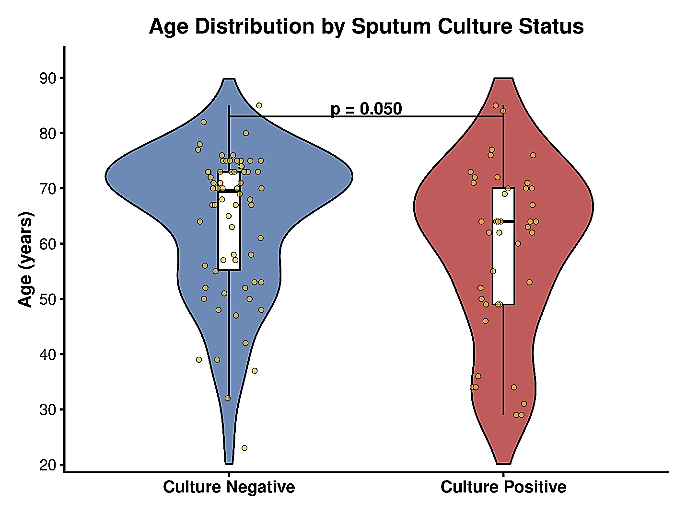
Comparison of continuous variables between culture-positive and culture-negative patients demonstrated a borderline difference in age (p = 0.050), whereas symptom burden, radiological extent of disease and overall comorbidity burden were comparable between the two groups (Table 3). No statistically significant differences were observed for the derived Symptom Score, Lobe Score or Comorbidity Score. The distribution of age according to sputum culture status is illustrated in Figure 1.
| Variable | Culture Negative Median (Iqr) | Culture Positive Median (Iqr) | Test | P-Value |
| Age | 69.5 (55.25–73.00) | 64.0 (49.00–70.00) | Mann–Whitney U | 0.050 |
| Symptom Score | 2 (2–2) | 2 (1–3) | Mann–Whitney U | 0.268 |
| Lobe Score | 1 (0–2) | 1 (0–2) | Mann–Whitney U | 0.419 |
| Comorbidity Score | 1 (0–1) | 0 (0–1) | Mann–Whitney U | 0.074 |
Analysis of categorical variables identified hemoptysis as the only variable significantly associated with sputum culture positivity (p = 0.020) (Table 4). No statistically significant associations were observed for demographic characteristics, respiratory symptoms, comorbidities, physical examination findings or lobar involvement.
| Variable | Test | p-value |
| Gender | Chi-square | 0.658 |
| Smoking | Chi-square | 0.155 |
| Fever | Chi-square | 0.222 |
| Cough | Chi-square | 0.740 |
| Hemoptysis | Fisher's Exact | 0.020 |
| Breathlessness | Chi-square | 0.821 |
| Type 2 Diabetes Mellitus | Chi-square | 0.444 |
| Immunosuppressive Therapy | Fisher's Exact | 1.000 |
| Clubbing | Chi-square | 1.000 |
| Crepitations | Chi-square | 1.000 |
| Rhonchi | Chi-square | 0.621 |
| Right Upper Lobe | Fisher's Exact | 1.000 |
| Right Middle Lobe | Chi-square | 1.000 |
| Right Lower Lobe | Chi-square | 0.285 |
| Left Upper Lobe | Chi-square | 0.208 |
| Left Lower Lobe | Chi-square | 1.000 |
Multivariable Logistic Regression
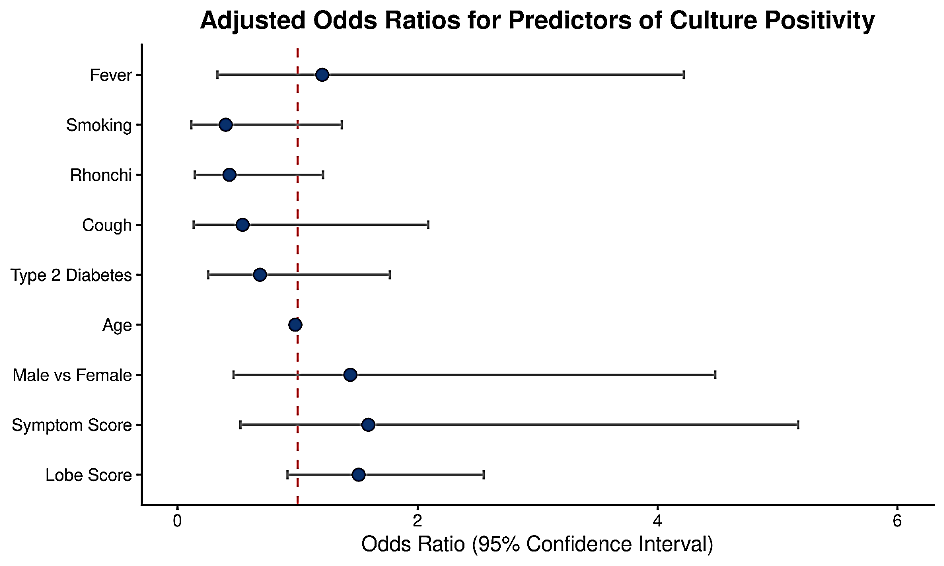
Variables considered clinically relevant were entered into a multivariable logistic regression model to identify independent predictors of sputum culture positivity. None of the evaluated variables remained independently associated with culture positivity following adjustment. The complete regression model is presented in Table 5 and the adjusted odds ratios with 95% confidence intervals are visually summarized in Figure 2.
| Predictor | Adjusted OR | 95% CI | p-value |
| Age | 0.98 | 0.95–1.01 | 0.176 |
| Smoking | 0.57 | 0.23–1.34 | 0.205 |
| Fever | 1.59 | 0.69–3.67 | 0.271 |
| Model Statistics | |||
| Statistic | Value | ||
| Null Deviance | 142.44 | ||
| Residual Deviance | 136.30 | ||
| AIC | 144.30 |
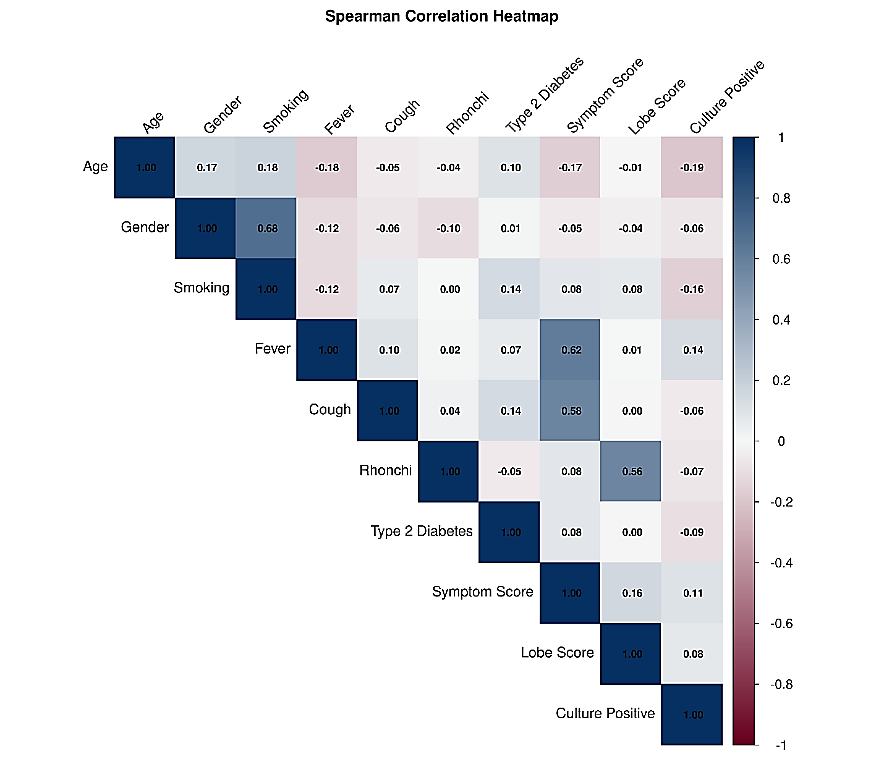
A Spearman correlation heatmap was constructed to visualize pairwise associations among the clinical predictors included in the multivariable analysis (Figure 3). Overall, correlations between predictors were weak to moderate, supporting the absence of problematic multicollinearity identified by variance inflation factor analysis.
Machine Learning Analysis
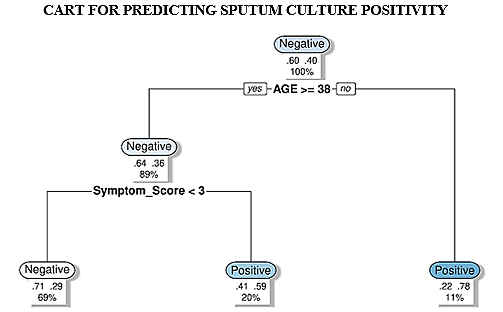
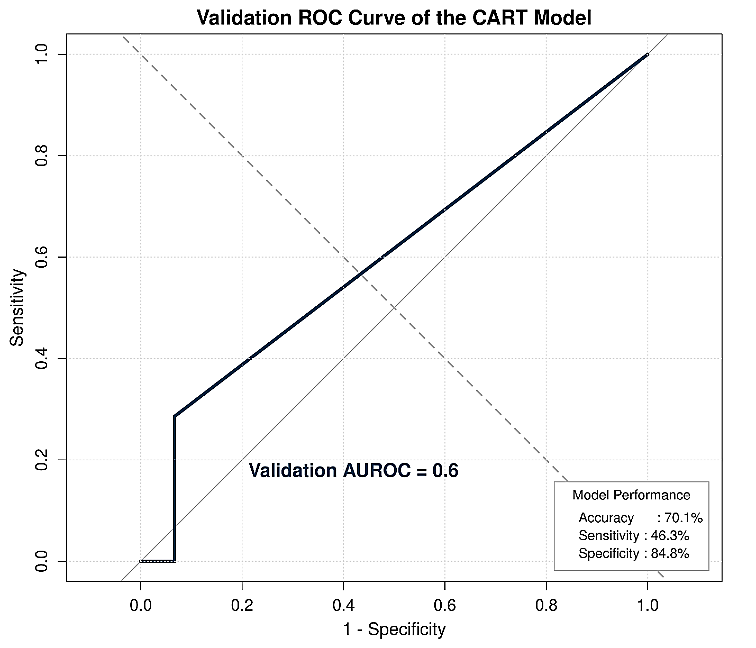
A Classification and Regression Tree (CART) model was developed to explore whether routinely available demographic and clinical variables could classify patients according to sputum culture status. The model achieved an overall classification accuracy of 70.1%, with higher specificity than sensitivity. The final CART model and its decision rules are presented in Figure 4.
The validation AUROC was 0.600, indicating modest discrimination in unseen data (Table 6 & Figure 5). This finding suggests that routinely available clinical variables alone have limited discriminatory ability for distinguishing culture-positive from culture-negative patients.
| Performance Metric | Value |
| Accuracy | 70.1% |
| Sensitivity | 46.3% |
| Specificity | 84.8% |
| Positive Predictive Value | 65.5% |
| Negative Predictive Value | 71.8% |
| Validation AUROC | 0.600 |
Footnote: The training AUROC was 0.809, whereas the validation AUROC was 0.600, indicating reduced performance on unseen data and suggesting possible overfitting.
Discussion
Principal Findings
The present hospital-based retrospective analytical study evaluated demographic, clinical, radiological, and microbiological predictors of sputum culture positivity among 107 patients with HRCT-confirmed bronchiectasis. Approximately two-fifths of patients demonstrated positive sputum cultures. Although hemoptysis was significantly associated with culture positivity in univariate analysis, no independent clinical predictors remained significant following multivariable adjustment. Similarly, the exploratory CART model demonstrated only modest discriminatory performance despite good specificity. Collectively, these findings indicate that routinely available clinical variables alone are insufficient to reliably predict sputum culture positivity, reinforcing the continued importance of microbiological confirmation to guide antimicrobial therapy in bronchiectasis.
Demographic Characteristics
The median age of the study cohort reflects the well-recognized predominance of bronchiectasis among older adults. Although age demonstrated a borderline association with sputum culture positivity in univariate analysis, this relationship was not sustained following multivariable adjustment, suggesting that increasing age alone is unlikely to independently determine bacterial isolation. Similar observations have been reported in previous bronchiectasis cohorts, where advancing age was associated with disease prevalence rather than microbiological status. Furthermore, geographical variations in pathogen prevalence, including the higher frequency of nontuberculous mycobacterial infection reported in North American compared with European cohorts, highlight the influence of regional epidemiology on chronic airway infection [7].
Male patients constituted a slight majority of the study population; however, sex was not associated with sputum culture positivity. Likewise, smoking history did not demonstrate an independent relationship with culture outcomes, consistent with previous reports indicating that demographic characteristics alone possess limited discriminatory value for predicting microbiological status in bronchiectasis [8].
Clinical Presentation
Chronic cough and breathlessness were the predominant presenting symptoms, reflecting the characteristic clinical manifestations of bronchiectasis. Their lack of association with sputum culture positivity is clinically plausible because these symptoms often persist as consequences of chronic structural airway damage irrespective of active bacterial infection. In contrast, hemoptysis demonstrated a significant association with culture positivity during univariate analysis. Hemoptysis in bronchiectasis is frequently attributed to chronic airway inflammation, bronchial artery hypertrophy, recurrent infection, and increased vascular fragility. Although this association did not persist after multivariable adjustment, it suggests that patients presenting with hemoptysis may warrant prompt microbiological evaluation, while also emphasizing the multifactorial mechanisms underlying bleeding episodes in chronic airway disease [9].
Comorbidity Burden
Smoking history and type 2 diabetes mellitus were common among study participants but were not independently associated with sputum culture positivity. Similarly, the derived Comorbidity Score did not differ significantly between culture-positive and culture-negative patients. These findings suggest that the measured burden of comorbid illness may exert less influence on bacterial isolation than disease-specific mechanisms such as impaired mucociliary clearance, airway colonization, and structural lung damage. Although chronic pulmonary comorbidities including chronic obstructive pulmonary disease and asthma are known to impair local airway defense mechanisms, their contribution may be mediated through disease severity rather than directly determining sputum culture positivity [10].
Radiological Extent of Disease
Lower lobe involvement predominated within the present cohort; however, neither individual lobar involvement nor the composite Lobe Score demonstrated a significant association with sputum culture positivity. These observations indicate that the anatomical extent of bronchiectasis alone may not reliably predict bacterial isolation. Rather, microbiological colonization is likely influenced by a complex interaction between airway architecture, host immunity, and previous infectious insults. Previous studies have demonstrated stronger relationships between quantitative radiological scoring systems, such as the Bhalla and Reiff scores, and disease severity, bacterial burden, and exacerbation frequency. Likewise, radiological features including bronchial wall thickening, mucus plugging, and cavitary changes have been associated with distinct microbiological profiles, particularly Pseudomonas aeruginosa and Aspergillus species [11,12].
Microbiological Profile
Klebsiella spp. was the most frequently isolated organism, followed by Pseudomonas aeruginosa, differing from many international bronchiectasis registries in which Pseudomonas aeruginosa predominates. Such variation likely reflects differences in regional epidemiology, healthcare exposure, antimicrobial prescribing practices, and microbial ecology. In addition, conventional culture techniques may underestimate microbial diversity compared with molecular approaches such as 16S rRNA sequencing, which can identify fastidious and unculturable organisms [13]. Published studies have also reported increasing antimicrobial resistance among Gram-negative respiratory pathogens, further emphasizing the importance of obtaining sputum cultures before initiating empirical antibiotic therapy and maintaining ongoing local microbiological surveillance to support antimicrobial stewardship [14].
Logistic Regression Findings
Multivariable logistic regression was performed to account for potential confounding while identifying independent predictors of sputum culture positivity. Despite the inclusion of clinically relevant variables, no predictor remained statistically significant following adjustment. Furthermore, multicollinearity assessment demonstrated acceptable variance inflation factors for all predictors, indicating that the absence of significant associations was unlikely to reflect excessive collinearity within the model. Instead, these findings suggest that sputum culture positivity in bronchiectasis is unlikely to be determined by any single demographic or clinical characteristic and more probably reflects the interaction of multiple biological, microbiological, and environmental factors that were not fully captured within the retrospective dataset.
Machine Learning Findings
To complement conventional statistical modelling, an exploratory Classification and Regression Tree (CART) model was developed using routinely available clinical variables. The model demonstrated moderate overall accuracy and high specificity but comparatively low sensitivity, with a validation AUROC of 0.600 indicating modest discrimination. The initial decision node identified an age threshold of 38 years, while Symptom Score provided further stratification among older patients. Although these decision rules are clinically interpretable, the younger subgroup comprised only a small proportion of the study population and therefore requires cautious interpretation. The reduction in performance from training to validation datasets suggests a degree of overfitting, which is unsurprising given the relatively modest sample size. Nevertheless, the model illustrates how interpretable machine learning can complement traditional statistical approaches by identifying clinically understandable, non-linear decision pathways while highlighting the need for external validation in larger prospective cohorts.
Clinical Implications
The present findings suggest that routinely available demographic, clinical, and radiological variables should complement rather than replace microbiological investigation in patients with bronchiectasis. Routine sputum culture therefore remains indispensable for guiding targeted antimicrobial therapy and supporting antimicrobial stewardship. Although the exploratory CART model demonstrated only modest predictive performance, the integration of conventional statistical modelling with interpretable machine learning provides a promising framework for future clinical decision-support systems. Validation in larger multicentre cohorts incorporating additional clinical, laboratory, radiological, and molecular predictors will be essential before such models can be implemented in routine clinical practice.
Conclusion
Routine clinical and radiological variables failed to independently predict sputum culture status, confirming that these features alone cannot substitute for formal microbiological testing to guide targeted antimicrobial therapy. While the exploratory CART model generated clinically interpretable decision pathways, its modest validation performance prevents immediate clinical adoption. This dual analytical approach demonstrates how statistical modeling and machine learning can complement each other to build future decision-support frameworks in respiratory medicine. However, the single-centre retrospective design, modest sample size (N = 107), and an aerobic-only protocol that might have omitted fastidious or anaerobic organisms, potentially inflating culture-negative rates, limit the broader generalizability of these insights. External validation within larger prospective, multicentre cohorts using broader molecular sequencing is needed to optimize this predictive model.
Declarations
Ethical Approval
The ethical approval was obtained already from the Institute of Karuna Medical College and Hospital.
Source of Funding
Nil
Conflicts of Interests
None
Acknowledgements
We would like to thank the General Manager, Mr.Rahim for the support and cooperation in conducting the study.
Article Category
Original Research Article