Introduction
Stroke remains one of the leading cause of mortality and long-term disability worldwide. Recent estimates indicate that more than 12 million people experience a first-ever stroke each year, while over 100 million stroke survivors live with persistent long-term sequelae. Despite substantial advances in acute stroke management, many survivors continue to experience persistent physical, cognitive, and psychosocial impairments that compromise functional recovery and quality of life (QoL) [1,2].
PSD is among the most common and disabling neuropsychiatric complications following stroke. Systematic reviews and meta-analyses estimate that approximately one-third of stroke survivors develop clinically significant depressive symptoms, although reported prevalence ranges from 20% to 65% depending on the study population, assessment tools, and time elapsed since stroke [3-5]. PSD has been consistently associated with poorer functional recovery, reduced participation in rehabilitation, lower treatment adherence, diminished quality of life, greater caregiver burden, and increased mortality [3,6]. Consequently, the early identification of patients at risk of PSD has become an essential component of comprehensive stroke rehabilitation.
The pathophysiology of PSD is complex and multifactorial. Biological mechanisms include disruption of frontolimbic neural networks, monoaminergic dysfunction, neuroinflammation, hypothalamic–pituitary–adrenal axis dysregulation, and impaired neuroplasticity following brain injury [3,7]. However, biological alterations alone do not fully explain the development of depression after stroke. Psychological and social factors, including cognitive impairment, loss of independence, functional disability, reduced social participation, and environmental stressors also play a substantial role in emotional adjustment during rehabilitation [3,8].
Among these psychosocial determinants, perceived social support has received increasing attention in recent years. It encompasses the emotional, instrumental, informational, and appraisal support provided by family members, friends, and significant others [9,10]. According to the stress-buffering hypothesis, adequate social support mitigates the psychological impact of stressful life events by enhancing coping capacity and resilience [10]. Recent systematic reviews have shown that higher perceived social support is associated with a lower risk of psychological disorders after stroke, whereas social isolation and inadequate family support predict poorer psychological and functional outcomes [11,12]. Emerging evidence further suggests that perceived social support may moderate the relationship between functional disability and depressive symptoms, supporting its potential protective role throughout the rehabilitation process [13].
Although these associations have been well documented in high-income countries, evidence from sub-Saharan Africa remains scarce. In low-resource settings such as the Democratic Republic of the Congo, stroke rehabilitation services are generally underdeveloped, routine screening for emotional disorders is rarely incorporated into post-stroke care, and access to specialized psychosocial support remains limited. Financial constraints, shortages of rehabilitation resources, and heavy reliance on informal caregivers are also likely to influence both perceived social support and psychological recovery after stroke [14]. Therefore, findings from high-income settings may not be directly generalizable to this context.
To date, few studies have examined the relationship between perceived social support and depressive symptoms among stroke survivors undergoing rehabilitation in Central Africa. Generating locally relevant evidence is therefore essential to identify modifiable psychosocial determinants of PSD and to inform comprehensive rehabilitation strategies tailored to resource-limited settings.
Accordingly, the present study aimed to investigate factors associated with post-stroke depressive symptoms among stroke survivors receiving rehabilitation in Kinshasa, Democratic Republic of the Congo, with a particular focus on perceived social support. We also examined whether perceived social support moderates the association between functional dependence and depressive symptoms.
Methods
Study Design and Setting
This analytical cross-sectional study was conducted between March 2022 and March 2023 at two tertiary rehabilitation centers in Kinshasa, Democratic Republic of the Congo (DRC): the University Clinics of Kinshasa (CUK) and the Physical Rehabilitation Center for Persons with Disabilities (CRHP). The study aimed to investigate the association between perceived social support and post-stroke depressive symptoms within a biopsychosocial framework of stroke recovery.
Participants
Participants were adult stroke survivors aged 18 years or older who were receiving outpatient rehabilitation during the study period. Eligible participants were required to have a diagnosis of stroke confirmed by brain computed tomography (CT) and/or magnetic resonance imaging (MRI), provide written informed consent, and be able to complete the study assessments independently or with the assistance of a reliable caregiver when necessary.
Patients were excluded if they had severe aphasia or neurological deficits preventing reliable communication, a history of major psychiatric disorders preceding stroke, severe impairment of consciousness, incomplete clinical data, or declined to participate.
Sample Size and Sampling
Participants were recruited using a consecutive non-probability sampling strategy. All eligible patients attending the participating rehabilitation centers during the study period were invited to participate.
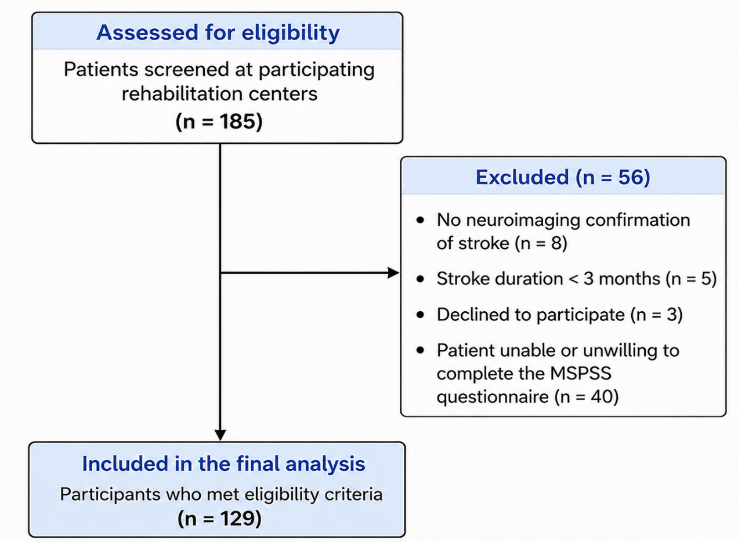
A total of 185 patients were screened for eligibility. After applying the inclusion criteria, 56 patients were excluded because of the absence of neuroimaging confirmation of stroke (n = 8), stroke duration of less than 3 months (n = 5), refusal to provide informed consent (n = 3), or missing data due to non-completion of the perceived social support questionnaire (n = 40). Consequently, 129 participants met the eligibility criteria and were included in the final analysis.
Study Variables
Outcome Variable
The primary outcome was the presence of post-stroke depressive symptoms, assessed using the Montgomery–Åsberg Depression Rating Scale (MADRS). The MADRS is a clinician-administered instrument comprising 10 items, each scored from 0 to 6, yielding a total score ranging from 0 to 60. Consistent with previous studies, depressive symptoms were defined as a MADRS score >7 (15-17) and analyzed as a binary outcome (presence versus absence of depressive symptoms).
Main Exposure Variable
The primary explanatory variable was perceived social support, assessed using the Multidimensional Scale of Perceived Social Support (MSPSS) developed by Zimet et al.,[18]. The MSPSS consists of 12 items evaluating perceived support from family, friends, and significant others. Each item is rated on a seven-point Likert scale ranging from 1 ("very strongly disagree") to 7 ("very strongly agree"). The overall MSPSS score was calculated as the mean of all 12 items, in accordance with the original scoring recommendations, and categorized as low (1.0–2.9), moderate (3.0–5.0), or high (5.1–7.0) perceived social support.
Covariates
Potential confounding variables included age, sex, marital status, educational level, stroke subtype, recurrent stroke, functional dependence, cognitive impairment, and treatment adherence.
Clinical Assessments
Functional dependence was assessed using the Modified Rankin Scale (mRS), a seven-level disability scale ranging from 0 (no symptoms) to 6 (death). Clinically significant functional dependence was defined as an mRS score ≥3 [19].
Global cognitive function was evaluated using the Montreal Cognitive Assessment (MoCA), a 30-point screening instrument. Cognitive impairment was defined as a MoCA score <26 [20].
Data Collection
Data were collected through face-to-face interviews conducted by trained research assistants using a standardized questionnaire. Sociodemographic characteristics, clinical history, rehabilitation-related information, and psychosocial variables were obtained directly from participants. The MSPSS, MADRS, mRS, and MoCA were administered according to their standardized administration procedures. Additional clinical information was extracted from medical records to complete missing data when necessary.
Statistical Analysis
Statistical analyses were performed using Jamovi version 2.6.44 (The Jamovi Project, Sydney, Australia). The normality of continuous variables was assessed using the Shapiro–Wilk test. Continuous variables were summarized as mean ± standard deviation (SD) or median with interquartile range (IQR), as appropriate, whereas categorical variables were expressed as frequencies and percentages.
Binary logistic regression analyses were performed to identify factors associated with post-stroke depressive symptoms. Variables with a P value <0.20 in univariable analyses were entered into a multivariable logistic regression model to identify factors independently associated with depressive symptoms. Results are presented as crude odds ratios (ORs) and adjusted odds ratios (aORs) with their corresponding 95% confidence intervals (95% CI).
To investigate whether perceived social support modified the association between functional dependence and post-stroke depressive symptoms, an interaction term between perceived social support and functional dependence was included in the multivariable logistic regression model. Statistical significance was defined as a two-sided P value <0.05.
Ethical Considerations
The study was conducted in accordance with the principles of the Declaration of Helsinki. Furthermore, the authors affirm their commitment to the principles set forth in the United Nations Universal Declaration of Human Rights and confirm that the conduct of this study complied with these principles.
Ethical approval was obtained from the National Ethics Committee of the Ministry of Public Health of the Democratic Republic of the Congo before participant recruitment (Approval No. 452/CNES/BN/PMMF/2022). Administrative authorization was also obtained from the participating rehabilitation centers. Written informed consent was obtained from all participants prior to enrollment. All collected data were anonymized and used exclusively for research purposes.
Results
Participant Selection
Among the 185 patients assessed for eligibility, 56 (30.3%) were excluded because of the absence of neuroimaging-confirmed stroke (n = 8), stroke duration of less than 3 months (n = 5), refusal to participate (n = 3), or missing MSPSS data due to non-completion of the questionnaire by 40 participants. The final analytical sample comprised 129 participants (69.7%) (Figure 1).
Baseline Characteristics
Participants aged ≥60 years accounted for 38.8% of the study population, followed by those aged 50–59 years (36.4%) and those younger than 50 years (24.8%). Men represented 55.0% of the participants, and 61.2% were married. Regarding educational attainment, 46.5% had completed secondary education, whereas only 21.7% had attained higher education.
Ischemic stroke was observed in 76.0% of participants. Functional dependence (modified Rankin Scale [mRS] ≥3) was present in 57.4% of patients, cognitive impairment (Montreal Cognitive Assessment [MoCA] <26) in 49.6%, irregular treatment adherence in 40.4%, and recurrent stroke in 24.0%. Low, moderate, and high levels of perceived social support were reported by 38.0%, 35.7%, and 26.3% of participants, respectively. Overall, post-stroke depressive symptoms (Montgomery–Åsberg Depression Rating Scale [MADRS] >7) were identified in 45.0% of the study population (Table 1).
| Characteristic | Category | n (%) |
| Age (years) | <50 | 32 (24.8) |
| 50–59 | 47 (36.4) | |
| ≥60 | 50 (38.8) | |
| Sex | Male | 71 (55.0) |
| Female | 58 (45.0) | |
| Marital status | Married | 79 (61.2) |
| Single/Widowed | 50 (38.8) | |
| Educational level | Primary | 41 (31.8) |
| Secondary | 60 (46.5) | |
| Higher | 28 (21.7) | |
| Stroke subtype | Ischemic | 98 (76.0) |
| Hemorrhagic | 31 (24.0) | |
| Stroke recurrence | Yes | 31 (24.0) |
| No | 98 (76.0) | |
| Functional dependence (mRS ≥3) | Yes | 74 (57.4) |
| No | 55 (42.6) | |
| Cognitive impairment (MoCA <26) | Yes | 64 (49.6) |
| No | 65 (50.4) | |
| Irregular treatment adherence | Yes | 52 (40.4) |
| No | 77 (59.6) | |
| Perceived social support (MSPSS) | Low | 49 (38.0) |
| Moderate | 46 (35.7) | |
| High | 34 (26.3) | |
| Post-stroke depressive symptoms (MADRS >7) | Yes | 58 (45.0) |
| No | 71 (55,0) |
Factors Associated with Post-Stroke Depressive Symptoms
Univariable Analysis
In the univariable analysis (Table 2), low perceived social support was significantly associated with post-stroke depressive symptoms (OR = 3.90, 95% CI: 1.72–8.61; P < 0.001). Functional dependence (OR = 2.80, 95% CI: 1.33–5.80; P = 0.005), cognitive impairment (OR = 2.44, 95% CI: 1.17–5.90; P = 0.015), and irregular treatment adherence (OR = 2.16, 95% CI: 1.03–4.50; P = 0.030) were also significantly associated with post-stroke depressive symptoms. Recurrent stroke showed a borderline association (OR = 1.95, 95% CI: 0.97–3.91; P = 0.045).
Tableau 2: Factors associated with post-stroke depressive symptoms: univariate analysis
| Factor | Crude OR | 95% CI | P value |
| Low perceived social support (vs. high perceived social support) | 3.90 | 1.72–8.61 | <0.001 |
| Functional dependence | 2.80 | 1.33–5.80 | 0.005 |
| Cognitive impairment | 2.44 | 1.17–5.90 | 0.015 |
| Irregular treatment adherence | 2.16 | 1.03–4.50 | 0.030 |
| Recurrent stroke | 1.95 | 0.97–3.91 | 0.045 |
Multivariable Analysis
After adjustment for potential confounding factors (Table 3), low perceived social support remained independently associated with post-stroke depressive symptoms (adjusted OR [aOR] = 4.12, 95% CI: 1.94–8.75; P < 0.001). Other variables independently associated with post-stroke depressive symptoms included age ≥60 years (aOR = 2.24, 95% CI: 1.14–4.38; P = 0.018), functional dependence (aOR = 2.59, 95% CI: 1.27–5.25; P = 0.005), cognitive impairment (aOR = 2.20, 95% CI: 1.16–4.21; P = 0.023), and irregular treatment adherence (aOR = 1.98, 95% CI: 1.05–3.74; P = 0.032). Although recurrent stroke remained positively associated with depressive symptoms, the association did not reach statistical significance after adjustment (aOR = 1.78, 95% CI: 0.96–3.31; P = 0.060).
| Factor | β | SE | Z | Adjusted OR (aOR) | 95% CI | P value |
| Low perceived social support | 1.41 | 0.37 | 3.73 | 4.12 | 1.94–8.75 | <0.001 |
| Age ≥60 years | 0.80 | 0.33 | 2.37 | 2.24 | 1.14–4.38 | 0.018 |
| Functional dependence | 0.94 | 0.34 | 2.65 | 2.59 | 1.27–5.25 | 0.005 |
| Cognitive impairment | 0.80 | 0.35 | 2.38 | 2.20 | 1.16–4.21 | 0.023 |
| Irregular treatment adherence | 0.68 | 0.31 | 2.14 | 1.98 | 1.05–3.74 | 0.032 |
| Recurrent stroke | 0.57 | 0.30 | 1.86 | 1.78 | 0.96–3.31 | 0.060 |
Moderating Effect of Perceived Social Support
A statistically significant interaction was observed between functional dependence and low perceived social support (β = −0.74; OR = 0.48, 95% CI: 0.25–0.92; P = 0.027), indicating that the association between functional dependence and post-stroke depressive symptoms varied according to the level of perceived social support (Table 4).
| Interaction term | β | OR | 95% CI | p value |
| Dépendance × soutien social faible | -0,74 | 0,48 | 0,25–0,92 | 0,027 |
Discussion
Key Findings
This study investigated the association between perceived social support and post-stroke depression (PSD) among patients undergoing rehabilitation in Kinshasa, Democratic Republic of the Congo. Four main findings emerged. First, nearly half of the participants presented clinically significant depressive symptoms, underscoring the substantial burden of depression during post-stroke recovery. Second, low perceived social support was highly prevalent, affecting more than one-third of the study population. Third, after adjustment for sociodemographic and clinical confounding factors, low perceived social support remained the strongest independent factor associated with PSD, together with older age, functional dependence, cognitive impairment, and suboptimal treatment adherence. Finally, perceived social support demonstrated a significant moderating effect on the relationship between functional disability and depressive symptoms, suggesting that adequate social resources may buffer the adverse psychological impact of post-stroke disability.
Prevalence of Post-Stroke Depression and Underlying Mechanisms
The prevalence of post-stroke depression (PSD) identified in this study was observed in approximately half of the participants, representing the upper range of estimates reported in previous international studies. Recent systematic reviews have suggested that nearly one-third of stroke survivors experience depressive symptoms after stroke, although reported prevalence rates vary substantially according to study design, diagnostic criteria, timing of assessment, and screening instruments used [21-23]. The relatively high prevalence observed in our cohort may reflect the specific challenges associated with stroke care in resource-constrained settings, including delayed access to rehabilitation services, persistent neurological impairments, limited availability of mental health support, and socioeconomic vulnerabilities [24].
The pathophysiology of PSD is increasingly understood as a complex and multifactorial process involving the interplay between biological, functional, and psychosocial determinants. Beyond neurobiological mechanisms, including neuroinflammatory pathways, disruption of fronto-limbic circuits, and alterations in monoaminergic neurotransmission, psychosocial factors such as social isolation, loss of functional independence, and reduced engagement in daily activities play a critical role in the development and persistence of emotional distress after stroke [4,8]. Our findings reinforce the importance of incorporating systematic psychosocial assessment and targeted interventions into comprehensive stroke rehabilitation programs.
Perceived social support and post-stroke depression
The principal finding of this study is the strong and independent association between low perceived social support and post-stroke depression (PSD). Patients reporting low perceived social support were more than four times as likely to experience PSD as those with higher levels of perceived support, even after adjustment for sociodemographic and clinical characteristics. The magnitude of this association suggests that perceived social support is not merely a predictor of depression but a major psychosocial determinant of emotional recovery following stroke.
These findings are consistent with a growing body of evidence identifying perceived social support as one of the strongest predictors of psychological well-being among stroke survivors. Recent meta-analyses have demonstrated that low perceived social support is associated with a substantially increased risk of PSD, whereas supportive family relationships and active community engagement promote emotional adjustment, resilience, and long-term recovery [13,14]. Furthermore, longitudinal studies have shown that stroke survivors who perceive greater social support report higher levels of self-efficacy, hope, and social participation, all of which contribute to reducing the severity of depressive symptoms [14].
Several mechanisms may account for these findings. Perceived social support provides emotional reassurance, practical assistance with activities of daily living, sustained encouragement to adhere to rehabilitation programs, and opportunities for meaningful social interaction. Collectively, these resources alleviate loneliness, reduce perceived stress and feelings of helplessness, and strengthen adaptive coping strategies and psychological resilience throughout the rehabilitation process.
Functional disability and cognitive impairment
Functional dependence remained independently associated with post-stroke depressive symptoms, corroborating previous studies that have consistently identified disability as one of the strongest predictors of post-stroke depression (PSD) [10]. Functional limitations often result in loss of independence, reduced participation in family and community life, and increased reliance on caregivers, all of which may adversely affect self-esteem and emotional well-being. These detrimental consequences are likely to be particularly pronounced in resource-limited settings, where access to multidisciplinary rehabilitation services and community reintegration programs remains insufficient [25,26].
Furthermore, cognitive impairment was independently associated with an increased risk of depressive symptoms, supporting previous evidence of a close bidirectional relationship between post-stroke cognitive impairment and depression [4,22,27]. Cognitive decline affects executive functioning, attention, and memory, thereby limiting patients' ability to actively engage in rehabilitation, maintain social relationships, and adapt effectively to stroke-related disability. Moreover, depression and cognitive impairment may share common neurobiological mechanisms involving cerebrovascular injury, neuroinflammation, impaired neuroplasticity, and disrupted brain network connectivity [4,20].
Older age and treatment adherence
Older age also emerged as an independent factor associated with post-stroke depression (PSD). Older stroke survivors generally experience greater neurological impairment, a higher burden of comorbidities, increased functional dependence, and reduced social participation, all of which contribute to heightened psychological vulnerability. Furthermore, ageing is often accompanied by shrinking social networks and diminished access to social resources, which may further exacerbate the emotional consequences of stroke.
Irregular treatment adherence was also independently associated with depressive symptoms, suggesting a potentially bidirectional relationship. Depression may impair motivation, executive functioning, and self-management abilities, leading to poorer adherence to prescribed medications and rehabilitation programs. Conversely, suboptimal treatment adherence may delay functional recovery, prolong disability, and increase psychological distress. These findings underscore the importance of implementing integrated rehabilitation strategies that simultaneously address mental health and promote long-term adherence to treatment.
Moderating role of perceived social support
One of the major contributions of the present study is the demonstration that perceived social support may substantially modify the relationship between functional dependence and post-stroke depressive symptoms. Stroke survivors reporting higher levels of perceived social support appeared less vulnerable to the psychological burden imposed by disability, a finding consistent with the stress-buffering hypothesis proposed by Cohen and Wills [12]. According to this theoretical framework, social relationships protect individuals from the adverse emotional effects of stressful life events by providing emotional, informational, and instrumental resources.
Our findings also corroborate previous evidence indicating that perceived social support acts as a mediator or moderator of the relationship between disability, participation restrictions, and psychological well-being after stroke [11,28,29]. In many African settings, where family members constitute the primary source of long-term care, strengthening family involvement and community support networks may represent a culturally appropriate and economically sustainable strategy for enhancing emotional recovery and reducing the burden of post-stroke depression.
Clinical implications
The findings of this study have important implications for post-stroke rehabilitation in resource-limited settings. Routine screening for post-stroke depressive symptoms should be incorporated into standard follow-up care, particularly among patients with persistent motor and cognitive impairments. Assessment of perceived social support should likewise become an integral component of comprehensive stroke rehabilitation, as it facilitates the identification of patients at increased risk of psychological distress beyond neurological deficits alone.
Interventions aimed at strengthening social support, including caregiver training, family-centered rehabilitation, peer support programs, community-based rehabilitation initiatives, and multidisciplinary psychosocial care may substantially reduce the burden of post-stroke depression and improve rehabilitation outcomes. Furthermore, strategies to enhance long-term treatment adherence should be integrated into rehabilitation programs, as sustained engagement with medical care may simultaneously promote functional recovery and psychological well-being.
Strengths and limitations
This study has several notable strengths. First, to the best of our knowledge, it is among the first studies conducted in Africa to examine perceived social support both as an independent determinant and as a moderator of post-stroke depressive symptoms. Second, the inclusion of a broad range of demographic, clinical, cognitive, and psychosocial variables enabled adjustment for important potential confounders and provided a comprehensive biopsychosocial perspective on emotional recovery after stroke.
Nevertheless, several limitations should be acknowledged. First, the cross-sectional design precludes any inference of causality between perceived social support and post-stroke depressive symptoms. Second, participants were recruited from two tertiary rehabilitation centers in Kinshasa, which may limit the generalizability of the findings to stroke survivors receiving care in primary healthcare facilities, rural settings, or areas with limited access to rehabilitation services. Finally, the use of self-reported measures is inherently subject to reporting bias and may have been influenced by the participants' current emotional state.
Large-scale, prospective, multicenter longitudinal studies involving more representative populations are warranted to clarify the temporal relationship between perceived social support and post-stroke depression. Such studies should also evaluate whether interventions aimed at strengthening family and community support can improve both psychological and functional outcomes following stroke.
Conclusion
Nearly half of stroke survivors undergoing rehabilitation in Kinshasa experienced clinically significant depressive symptoms. Low perceived social support was independently associated with post-stroke depressive symptoms, alongside older age, functional dependence, cognitive impairment, and poor treatment adherence. Moreover, perceived social support significantly moderated the association between functional dependence and depressive symptoms, supporting its potential stress-buffering role during post-stroke recovery. These findings underscore the importance of integrating psychosocial assessment, together with family- and community-based support strategies, into comprehensive stroke rehabilitation programs, particularly in resource-limited settings. Prospective longitudinal and interventional studies are warranted to determine whether strengthening social support can reduce the burden of post-stroke depression and improve long-term recovery.
Declarations
Ethical Approval
Ethical approval was obtained from the National Ethics Committee of the Ministry of Public Health of the Democratic Republic of the Congo before participant recruitment (Approval No. 452/CNES/BN/PMMF/2022). Administrative authorization was also obtained from the participating rehabilitation centers. Written informed consent was obtained from all participants prior to enrollment. All collected data were anonymized and used exclusively for research purposes.
Author contributions
Conceptualization: EK; Methodology: EK, CS, GB, WK; Formal analysis: EK, TB, NN; Investigation: EK, TB, NN, BM; Data curation: EK, TB, NN; Writing – original draft: EK; Writing – review & editing: EK, GB, ML, CS, VL, DO; Visualization: WK; Supervision: BM, GB, CS; Project administration: EK;
Conflict of Interest
The authors declare that they have no competing interests or conflicts of interest related to this study.
Funding
This research received no specific grant from any f1unding agency in the public, commercial, or not-for-profit sectors.
Data availability
The database used and/or analyzed for this study is available from the corresponding author upon reasonable request.
Acknowledgments
The authors sincerely thank the rehabilitation staff, the stroke survivors who participated in this study, and their informal caregivers for their valuable time, cooperation, and contribution to this research.
The authors also acknowledge the use of artificial intelligence-assisted language tools to improve the English language and readability of the manuscript. All AI-generated text was carefully reviewed, edited, and verified by the authors, who take full responsibility for the accuracy, integrity, and final content of the manuscript.