Introduction
Hemoperitoneum is a life-threatening surgical emergency characterized by the accumulation of blood within the peritoneal cavity resulting from traumatic or non-traumatic intra-abdominal hemorrhage. Without prompt diagnosis and definitive surgical control of bleeding, ongoing blood loss may rapidly progress to hemorrhagic shock, multiple organ dysfunction, and death. Consequently, successful management depends on timely surgical intervention combined with effective perioperative resuscitation and anesthetic care [1-3].
The anesthesiologist plays a pivotal role in the perioperative management of patients with hemoperitoneum by securing the airway, restoring hemodynamic stability, correcting hypovolemia and coagulopathy, maintaining adequate tissue oxygenation, and facilitating early surgical hemostasis. Current principles of perioperative management emphasize damage-control resuscitation, balanced blood transfusion strategies, judicious crystalloid administration, prevention of hypothermia, acidosis, and coagulopathy, as well as the early use of antifibrinolytic therapy when appropriate [4-7].
The epidemiology of hemoperitoneum differs considerably across healthcare settings. In high-income countries, traumatic abdominal injuries remain the leading cause of hemoperitoneum, whereas gynecological emergencies, particularly ruptured ectopic pregnancy, account for most cases in low- and middle-income countries [8-10]. These epidemiological differences have important implications for anesthetic management because patients in resource-limited settings frequently present with delayed diagnosis, severe anemia, advanced hemorrhagic shock, and restricted access to blood products and perioperative resources.
In sub-Saharan Africa, the anesthetic management of emergency abdominal hemorrhage is further complicated by delayed referral, limited availability of blood products, shortages of monitoring equipment and essential anesthetic drugs, and the absence of standardized institutional massive transfusion protocols [11-13]. These constraints often require anesthesiologists to adapt evidence-based recommendations to local resource limitations while maintaining patient safety during emergency surgery.
Despite the high burden of emergency hemoperitoneum in the Democratic Republic of the Congo, published evidence describing perioperative anesthetic practices, transfusion management, and perioperative outcomes remains scarce. Most available studies from the region have focused primarily on surgical management, with limited emphasis on anesthetic care and factors associated with adverse perioperative outcomes [14,15]. Generating local evidence is therefore essential to guide clinical decision-making, optimize perioperative management, and support the development of context-specific protocols for emergency abdominal hemorrhage.
Accordingly, this study aimed to describe the anesthetic management of patients undergoing emergency surgery for hemoperitoneum at the Centre Hospitalier Mère et Enfant Monkole, Democratic Republic of the Congo, and to identify factors independently associated with intraoperative adverse events and postoperative complications.
Methods
Study design and setting
This single-center retrospective observational cohort study was conducted in the Department of Anesthesiology and Critical Care of the Centre Hospitalier Mère et Enfant Monkole, a secondary referral hospital in Kinshasa, Democratic Republic of the Congo. Consecutive patients who underwent emergency surgery for intraoperatively confirmed hemoperitoneum between January 2012 and January 2025 were identified from operating room registers, anesthesia records, operative reports, and hospital medical records. The study is reported in accordance with the Strengthening the Reporting of Observational Studies in Epidemiology (STROBE) statement.
Participants
All consecutive patients who underwent emergency surgery for hemoperitoneum during the study period were screened for eligibility. Patients were eligible if the diagnosis of hemoperitoneum was confirmed intraoperatively and complete perioperative data were available, including demographic characteristics, preoperative clinical assessment, anesthetic records, operative reports, and postoperative hospital outcomes. Patients with incomplete medical records preventing assessment of the study variables or outcomes were excluded. Consecutive inclusion of all eligible patients was used to minimize selection bias.
Data collection
Data were retrospectively extracted from pre-anesthetic assessment forms, anesthesia records, operative reports, operating room registers, postoperative recovery charts, and hospital medical records using a standardized case report form. Data extraction was performed by trained investigators to ensure consistency and completeness.
Variables
Baseline demographic variables included age, sex, and body mass index (BMI). Clinical variables comprised the etiology of hemoperitoneum, pre-existing comorbidities, cardiovascular and respiratory examination findings, American Society of Anesthesiologists (ASA) physical status classification, Mallampati airway classification, and preoperative hemoglobin level.
Perioperative variables included the anesthetic technique, the agents used for induction and maintenance, neuromuscular blocking drugs, tranexamic acid administration, perioperative blood transfusion, the duration of anesthesia, the duration of surgery, and the qualifications of the attending anesthesiologist and surgeon.
Preoperative anemia was classified according to the World Health Organization criteria. Anesthesia duration and surgical duration were categorized using a threshold of 120 minutes because this cutoff corresponded to the upper quartile of procedure duration in the study population and was considered clinically relevant for prolonged emergency surgery.
Outcomes
The primary outcome was the occurrence of intraoperative adverse events, defined as any documented episode of clinically significant hypotension, hypertension, hemorrhagic shock, cardiac arrhythmia, cardiac arrest, difficult airway requiring advanced airway management, or other anesthesia-related complications occurring between the induction of anesthesia and the completion of surgery.
The secondary outcome was the occurrence of postoperative complications before hospital discharge, including medical complications, surgical complications, postoperative blood transfusion, reoperation, and all-cause in-hospital mortality.
Statistical analysis
Continuous variables were summarized as mean ± standard deviation (SD) or median with interquartile range (IQR), according to data distribution, whereas categorical variables were expressed as frequencies and percentages.
Comparisons between groups were performed using Student's t-test or the Mann–Whitney U test for continuous variables, depending on data distribution, and Pearson's chi-square test or Fisher's exact test for categorical variables, as appropriate.
Factors associated with intraoperative adverse events and postoperative complications were initially explored using univariable logistic regression. Variables considered clinically relevant or presenting a P value <0.20 in univariable analyses were entered into separate multivariable logistic regression models using a backward stepwise elimination procedure to identify independent predictors. Adjusted odds ratios (aORs) with 95% confidence intervals (95% CIs) were reported. Statistical significance was defined as a two-sided P value <0.05.
Because of the retrospective design, only patients with complete data were included in the analyses; therefore, no imputation of missing data was performed. All statistical analyses were conducted using IBM SPSS Statistics version 22.0 (IBM Corp., Armonk, NY, USA).
Bias
Several measures were implemented to minimize bias. Consecutive inclusion of all eligible patients during the study period reduced the risk of selection bias. Information bias was minimized using a standardized data collection form and the extraction of data from multiple complementary sources, including anesthesia records, operative reports, and hospital medical records. Data extraction was performed by trained investigators following predefined study procedures.
Ethics
The Ethics Committee of the School of Public Health at the University of Kinshasa approved the study protocol (Approval No. ESP/CE/86/2026). Given the retrospective nature of the study and the use of anonymized, routinely collected clinical data, the requirement for informed consent was waived by the Ethics Committee. We strictly maintained patient confidentiality throughout the study by anonymizing all data before analysis. The study was conducted in accordance with the ethical principles of the Declaration of Helsinki.
Results
Study population
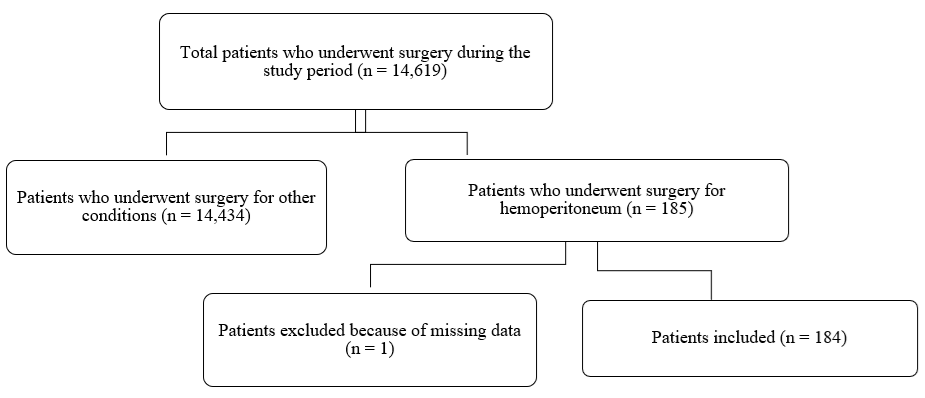
Between January 2012 and January 2025, 185 consecutive patients underwent emergency surgery for hemoperitoneum at the Centre Hospitalier Mère et Enfant Monkole. One patient was excluded because of incomplete perioperative records, leaving 184 patients for the final analysis (Figure 1).
Baseline demographic and clinical characteristics
The study population consisted predominantly of young women, with a mean age of 29.8 ± 10.1 years (range, 4–80 years). Patients aged 20–39 years represented more than three-quarters of the cohort (76.6%), and women accounted for 88.6% of all participants. The mean body mass index was 21.3 ± 10.9 kg/m², with normal-weight patients representing the largest BMI category. Hematological disorders were the most frequent comorbidity (17.4%), whereas abnormal cardiovascular and respiratory examination findings were documented in 34.8% and 27.7% of patients, respectively. Ruptured ectopic pregnancy was the leading cause of hemoperitoneum (47.3%), followed by traumatic splenic rupture (19.0%), ruptured hemorrhagic ovarian cyst (16.3%), other abdominal trauma (11.4%), and postoperative bleeding (6.0%) (Table 1).
| Characteristic | Mean ± SD / n | % |
| Age (years) | 29.8 ± 10.1 | — |
| Range | 4–80 | — |
| Age group (years) | ||
| <20 | 23 | 12.5 |
| 20–39 | 141 | 76.6 |
| 40–59 | 18 | 9.8 |
| ≥60 | 2 | 1.1 |
| Sex | ||
| Male | 21 | 11.4 |
| Female | 163 | 88.6 |
| BMI (kg/m²) | 21.3 ± 10.9 | — |
| BMI category | ||
| Underweight | 43 | 23.4 |
| Normal weight | 70 | 38.0 |
| Overweight | 42 | 22.8 |
| Obesity | 29 | 15.8 |
| Comorbidities | ||
| Cardiovascular disease | 10 | 5.4 |
| Respiratory disease | 6 | 3.3 |
| Liver disease | 9 | 4.9 |
| Hematological disorders | 32 | 17.4 |
| Cardiovascular examination | ||
| Normal | 120 | 65.2 |
| Abnormal | 64 | 34.8 |
| Respiratory examination | ||
| Normal | 133 | 72.3 |
| Abnormal | 51 | 27.7 |
| Etiology of hemoperitoneum | ||
| Ruptured ectopic pregnancy | 87 | 47.3 |
| Traumatic splenic rupture | 35 | 19.0 |
| Ruptured hemorrhagic ovarian cyst | 30 | 16.3 |
| Other abdominal trauma | 21 | 11.4 |
| Postoperative bleeding | 11 | 6.0 |
Legend: Continuous variables are presented as mean ± standard deviation (SD), while categorical variables are presented as number (n) and percentage (%). BMI: body mass index.
Perioperative anesthetic management
Most patients were classified as ASA physical status II (33.2%) or III (36.4%), indicating a substantial burden of systemic disease before surgery. General anesthesia with endotracheal intubation was the predominant anesthetic technique (84.2%), whereas spinal anesthesia was performed in only 14.7% of patients. Preoperative anemia was highly prevalent, with severe anemia affecting 46.7% of patients. Overall, 54.9% required perioperative blood transfusion, while tranexamic acid was administered in 31.5%. Among patients receiving general anesthesia, ketamine was the most frequently used induction agent (53.5%), succinylcholine was the predominant neuromuscular blocking agent (93.5%), and isoflurane was the most used maintenance anesthetic (61.3%) (Table 2).
Table 2 : Perioperative anesthetic management
| Characteristic | N | % |
| ASA physical status | ||
| I | 38 | 20.7 |
| II | 61 | 33.2 |
| III | 67 | 36.4 |
| IV | 17 | 9.2 |
| V | 1 | 0.5 |
| Mallampati classification | ||
| I | 149 | 81.0 |
| II | 32 | 17.4 |
| III | 3 | 1.6 |
| Anesthetic technique | ||
| General anesthesia with intubation | 155 | 84.2 |
| Spinal anesthesia | 27 | 14.7 |
| Combined spinal/general anesthesia | 2 | 1.1 |
| Preoperative hemoglobin status | ||
| Normal | 27 | 14.7 |
| Mild anemia | 26 | 14.1 |
| Moderate anemia | 45 | 24.5 |
| Severe anemia | 86 | 46.7 |
| Blood transfusion | 101 | 54.9 |
| Patients included (n = 184) | 58 | 31.5 |
| Induction agent (n = 157) | ||
| Ketamine | 84 | 53.5 |
| Propofol | 47 | 29.9 |
| Ketamine + propofol | 26 | 16.6 |
| Neuromuscular blocker (n = 155) | ||
| Succinylcholine | 145 | 93.5 |
| Atracurium | 9 | 5.8 |
| Rocuronium | 1 | 0.6 |
| Maintenance anesthetic (n = 155) | ||
| Isoflurane | 95 | 61.3 |
| Sevoflurane | 50 | 32.2 |
| Ketamine alone | 8 | 5.2 |
| Ketamine + inhalational agent | 2 | 1.3 |
Legend: Percentages for anesthetic drugs were calculated among patients receiving general anesthesia.
Perioperative outcomes
Intraoperative adverse events occurred in 37 patients (20.1%), while postoperative complications developed in 34 patients (18.5%). The overall in-hospital mortality rate was 5.4%. Approximately one-third of anesthetic and surgical procedures lasted at least 120 minutes. Most procedures were performed by specialist anesthesiologists (82.1%) and specialist surgeons (66.8%) (Table 3).
Table 3 : Perioperative outcomes
| Outcome | n | % |
| Intraoperative adverse events | 37 | 20.1 |
| Postoperative complications | 34 | 18.5 |
| In-hospital mortality | 10 | 5.4 |
| Anesthesia duration ≥120 min | 54 | 29.3 |
| Surgery duration ≥120 min | 54 | 29.3 |
| Procedures performed by specialist anesthesiologist | 151 | 82.1 |
| Procedures performed by specialist surgeon | 123 | 66.8 |
Legend: Mortality corresponds to all-cause in-hospital mortality.
Factors associated with intraoperative adverse events
In univariable logistic regression, ASA physical status ≥III and anesthesia duration ≥120 minutes were associated with intraoperative adverse events. After adjustment for potential confounding factors, prolonged anesthesia duration remained the only independent predictor of intraoperative adverse events (adjusted OR, 2.24; 95% CI, 1.04–4.82; P=0.039), whereas the association with ASA physical status was no longer statistically significant (Table 4).
| Variable | Unadjusted OR (95% CI) | p-value | Adjusted OR (95% CI) | p-value |
| Age ≥30 years | 1.20 (0.60–2.50) | 0.530 | 1.10 (0.30–2.00) | 0.120 |
| Female sex | 1.50 (0.60–3.50) | 0.308 | 1.10 (0.20–2.10) | 0.230 |
| ASA ≥III | 2.00 (1.07–3.80) | 0.032 | 1.80 (0.70–4.80) | 0.190 |
| Blood transfusion | 2.00 (1.07–3.80) | 0.086 | 1.10 (0.40–2.90) | 0.846 |
| Anesthesia duration ≥120 min | 2.20 (1.10–4.20) | 0.015 | 2.24 (1.04–4.82) | 0.039 |
Legend: OR, odds ratio; CI, confidence interval.
Factors associated with postoperative complications
In multivariable logistic regression analysis, ASA physical status ≥III was independently associated with postoperative complications (adjusted OR, 13.10; 95% CI, 3.53–48.57; P<0.001). No independent association was observed for sex, preoperative hemoglobin level, blood transfusion, or surgery duration. Although perioperative blood transfusion was not independently associated with postoperative complications, patients who received blood transfusions had a significantly higher in-hospital mortality than those who did not (OR, 8.02; 95% CI, 0.99–64.68; P=0.024), suggesting that transfusion may represent a marker of greater hemorrhagic severity rather than an independent determinant of adverse outcomes (Table 5 & 6).
| Variable | Adjusted OR (95% CI) | p-value |
| Female sex | 1.20 (0.30–3.20) | 0.102 |
| ASA ≥III | 13.10 (3.53–48.57) | <0.001 |
| Low hemoglobin | 1.10 (0.50–2.10) | 0.210 |
| Blood transfusion | 0.60 (0.10–2.10) | 0.470 |
| Surgery duration ≥120 min | 1.01 (0.40–2.40) | 0.110 |
| Blood transfusion | Survivors n (%) | Deaths n (%) | OR (95% CI) | p-value |
| No | 82 (98.8) | 1 (1.2) | Reference | — |
| Yes | 92 (91.1) | 9 (8.9) | 8.02 (0.99–64.68) | 0.024 |
Legend: Adjusted odds ratios were obtained from multivariable logistic regression. In-hospital mortality refers to death occurring before hospital discharge.
Discussion
In this retrospective cohort study conducted at a secondary referral hospital in the Democratic Republic of the Congo, we found that emergency surgery for hemoperitoneum was predominantly performed in young women, mainly because of ruptured ectopic pregnancy. Perioperative management was characterized by a high prevalence of severe preoperative anemia, frequent use of general anesthesia with endotracheal intubation, and substantial blood transfusion requirements. Intraoperative adverse events and postoperative complications occurred in approximately one-fifth of patients, whereas the in-hospital mortality rate remained relatively low. Importantly, prolonged anesthesia duration was independently associated with intraoperative adverse events, while ASA physical status ≥III was the strongest independent predictor of postoperative complications.
The predominance of young women and the high proportion of ruptured ectopic pregnancies observed in our cohort are consistent with reports from other low- and middle-income countries, where gynecological emergencies remain the leading cause of non-traumatic hemoperitoneum [8-10]. In contrast, abdominal trauma is the predominant etiology in most high-income countries. These epidemiological differences have important implications for anesthetic management because patients frequently present with severe anemia, hypovolemia, and hemorrhagic shock requiring immediate resuscitation before definitive surgical treatment.
Nearly half of our patients had severe preoperative anemia and more than half required perioperative blood transfusion, highlighting the considerable burden of hemorrhage in this population. These findings reflect the challenges commonly encountered in resource-limited settings, where delayed presentation, limited blood product availability, and the absence of formal massive transfusion protocols may compromise optimal resuscitation [11-13]. Despite these constraints, the relatively low in-hospital mortality observed in our study suggests that timely surgical intervention combined with appropriate anesthetic management can achieve acceptable outcomes even in resource-constrained environments.
General anesthesia with endotracheal intubation was the predominant anesthetic technique, reflecting the emergency nature of surgery, the high risk of aspiration, and the frequent presence of hemodynamic instability. Ketamine was the most commonly used induction agent, consistent with its favorable cardiovascular profile in hypovolemic patients and its widespread use in emergency anesthesia [1-3]. The frequent use of succinylcholine further illustrates the need for rapid sequence induction in patients considered at high risk of pulmonary aspiration.
One of the principal findings of this study was the independent association between prolonged anesthesia duration and intraoperative adverse events. Longer anesthetic procedures may reflect greater surgical complexity, more severe hemorrhage, technical difficulties, or delayed achievement of hemostasis. This finding emphasizes the necessity of early diagnosis, rapid transfer to the operating room, effective communication between anesthetic and surgical teams, and prompt hemorrhage control to reduce perioperative morbidity [3-6].
ASA physical status ≥III emerged as the strongest independent predictor of postoperative complications. This observation is consistent with previous studies demonstrating that preoperative physiological status is a major determinant of postoperative outcomes following emergency surgery [1,2]. In resource-limited settings, patients with advanced systemic disease or severe physiological derangement may particularly benefit from early identification, optimization whenever feasible, and enhanced postoperative monitoring.
Although perioperative blood transfusion was associated with higher in-hospital mortality, it was not independently associated with postoperative complications after adjustment for confounding factors. This finding should be interpreted cautiously because transfusion is more likely to reflect the severity of hemorrhage than to represent a direct cause of adverse outcomes. Patients requiring transfusion generally have greater blood loss, more profound anemia, and more severe hemodynamic compromise, making transfusion an indicator of disease severity rather than an independent prognostic factor [3,4].
Our study provides valuable evidence regarding anesthetic management of emergency hemoperitoneum in a resource-limited setting, where published data remain scarce. The inclusion of consecutive patients over a 14-year period, standardized data collection, and evaluation of both intraoperative and postoperative outcomes strengthen the validity of our findings. Nevertheless, several limitations should be acknowledged. The retrospective single-center design limits causal inference and may reduce the generalizability of the results. Changes in anesthetic practice, monitoring equipment, and perioperative protocols over the 14-year study period may also have influenced patient management. In addition, several clinically relevant variables, including estimated blood loss, severity of hemorrhagic shock, fluid resuscitation volume, vasopressor use, lactate concentration, and postoperative intensive care management, were inconsistently available and therefore excluded from the analyses.
Finally, residual confounding cannot be completely excluded despite multivariable adjustment.
Overall, our findings emphasize the importance of rapid perioperative management, early risk stratification, and multidisciplinary coordination in improving outcomes among patients undergoing emergency surgery for hemoperitoneum in resource-limited settings. Future prospective multicenter studies are warranted to validate these findings and support the development of standardized perioperative management protocols adapted to similar healthcare environments.
Conclusion
Emergency surgery for hemoperitoneum in this resource-limited setting was characterized by a predominance of young women with gynecological causes, a high prevalence of severe preoperative anemia, and frequent perioperative blood transfusion. Despite these challenges, perioperative outcomes were acceptable, with an in-hospital mortality of 5.4%. Prolonged anesthesia duration and ASA physical status ≥III were independently associated with adverse perioperative outcomes, highlighting the importance of early risk stratification, timely surgical intervention, and optimized anesthetic management. These findings provide locally relevant evidence that may contribute to improving perioperative care and inform the development of context-specific clinical protocols for emergency abdominal hemorrhage in resource-limited settings.
Declarations
Ethics approval and consent to participate
Ethical approval for this study was obtained from the Ethics Committee of the School of Public Health of the University of Kinshasa (Approval No. ESP/CE/86/2026). The requirement for informed consent was waived because of the retrospective design of the study and the use of anonymized data.
Consent for publication
Not applicable
Availability of data and materials
The datasets generated and analyzed during the current study are available from the corresponding author on reasonable request, subject to institutional approval and applicable ethical requirements.
Competing interests
The authors declare that they have no competing interests.
Funding
The authors received no specific funding for this work.
Authors' contributions
PMN conceived and designed the study, collected the data, performed the statistical analysis, interpreted the data, and drafted the manuscript. AMB contributed to the study design, methodology, statistical analysis, and interpretation of the findings and critically revised the manuscript. WM, AM, PK, RM, DK, AI, KA, DKK, EA, JN, MB, and BB contributed to data collection, data validation, interpretation of the results, and critical revision of the manuscript. All authors read and approved the final manuscript and agree to be accountable for all aspects of the work.
Acknowledgements
The authors sincerely thank the medical, nursing, anesthesia, surgical, and medical records staff of the Centre Hospitalier Mère Enfant Monkole for their invaluable support in patient care and assistance with data retrieval. The authors also acknowledge the Department of Anesthesiology and Critical Care of the University Clinics of Kinshasa for its scientific and academic support throughout this study.