Introduction
Human bites are comparatively rare with respect to other mammalian bites, like dog and cat bites [1]. After dogs and cats, it is the third most frequent bite. Males in the 20–30 age range are more likely to have it [2]. It falls into one of two categories: occlusive or non-occlusive. Occlusive bites are rarely observed to occur outside of the face [3]. The ear was the most frequently injured part of the face, accounting for almost 65% of all HB-related facial injuries [4].
They result in severe disfigurement and have the potential to cause serious injuries due to the high risk of infection [5]. It is estimated that human saliva contains up to 50 different types of bacteria, or nearly 108 microorganisms per milliliter. This is one of the reasons why human bites are believed to have higher rates of infection than other injuries [6].
Human bites can potentially spread systemic diseases and have a tendency to infect the area where the bite damage occurred. Inadequate management of these injuries can result in social and psychological repercussions in addition to visual issues. Therefore, the diagnosis and treatment of human bites require particular attention [7].
Human bites are usually related to murder or attempted murder, rape, sexual assault, child abuse, and kidnapping, and they are usually caused by interpersonal violence. These wounds, which can affect the nose, ears, eyelids, lips, and face, are among the main causes of facial abnormalities [2,8]. Antibiotics are advised prophylactic-ally in the management of these wounds [9-12].
Case report
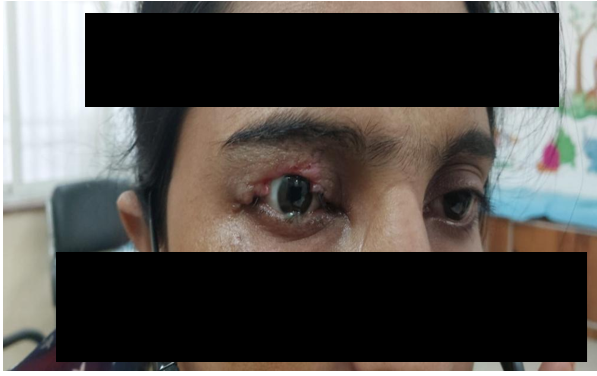
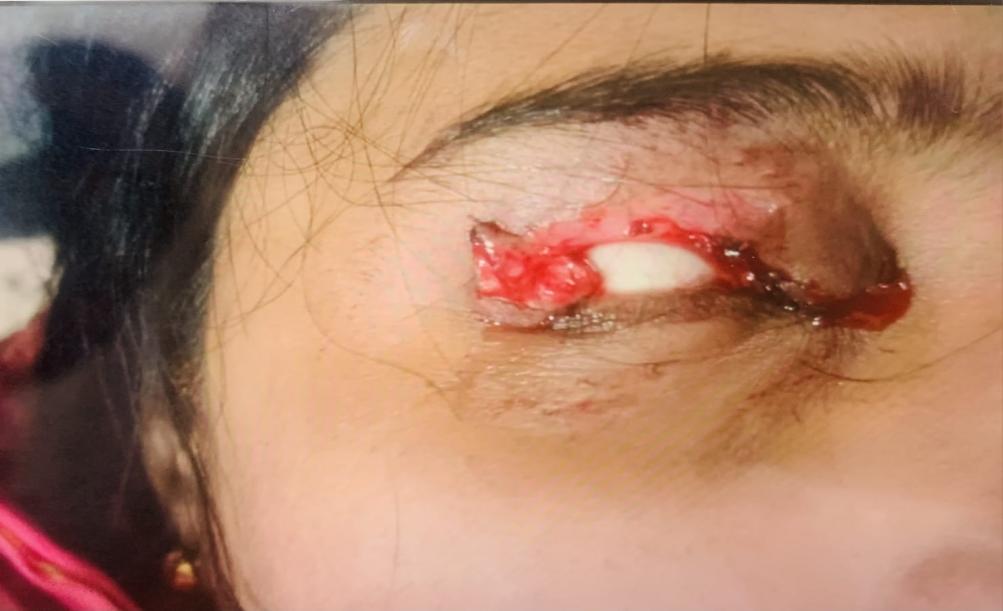
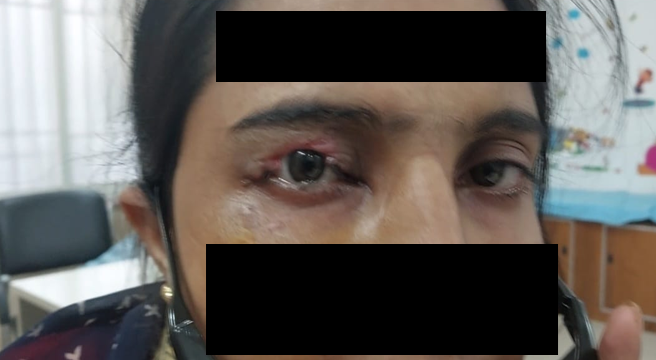
A 33-year-old female without any known co-morbidity presented with the human bite in the last week of September 2024. This happened during social conflict with a neighbor in morning hours. There was oozing of blood from bite area and it was evident from history and subsequent documentary proof. After initial treatment at the primary level and other health centers, it was finally referred to our immunization clinic at tertiary care hospital for animal bites management and immunization. Patient was very anxious and concerned with the gravity of problem. Being a female, she was also worried with social stigma associated with the condition. Human Bite was on the upper lid of the right eye (Figure 1,2 and 3). However, lower eye lid and left eye were wholly intact. On examination, there was a skin tear of approximately 3x2 cm in size. Her weight was recorded on digital weighing scale as 54kg as it was necessary for deciding dose of rabies immunoglobulin for administration in view of category-III bite. Patient was explained regarding the case report for study purpose and she has given the consent for the same.
Management
She was given initial treatment at the primary health center, where wound cleaning was done, tetanus toxoid was given intramuscularly, and antibiotic prophylaxis was given. Subsequently, she was referred to higher centers and lastly to our hospital. In our immunization clinic, at first patient was reassured and counselled to be free of fear and apprehension due to the psychological impact of violence. A detailed sequence of events of social conflict was noted down. After that, a thorough and detailed medical history was taken. She never had any history of human or animal bites and bleeding disorder. She has no any history of any other co-morbidity like hypertension or diabetes. She was hepatitis B and HIV negative on investigation. Wound inspection and assessment were done which had sign of inflammation like redness, swelling. Then wound cleaning was done with povidone iodine after opening the wound area and explained about the precaution to be maintained. The anti-rabies vaccination (purified vero cell rabies vaccine) was given intramuscular route according to current Essen Regimen schedule on the days 0, 3, 7, 14 and 28. Eight ml of (equivalent to 1200-I.U. as 150 I.U./mL in Berirab P) of Human rabies immunoglobulin (Berirab P) was given according to weight which was recorded as 54 kg. She was called for follow-up for further treatment. On follow up remaining Anti-Rabies Vaccination was given. After the treatment, a special counseling session was given which was reinforced at each visit and further courses of actions were explained.
Result
On the first visit the patient was anxious and apprehensive. However, the patient’s condition was improved after treatment, and the wound was on course of healing on subsequent visits. The symptoms improved with each follow-up. The patient’s fear also decreased and she felt confident to take part in normal daily activities and other chores after the counselling.
Discussion
Human bite injuries can be observed in any anatomical location, including the face and head, cheek, nose, lips, ear extremities, breasts, and genitalia. The majority of human bite injuries are clenched fist injuries that happen on the hands. However, lip bite injuries are extremely uncommon; just a small number of cases have been documented in the literature [6]. Human bites are usually related to murder or attempted murder, rape, sexual assault, child abuse, and kidnapping, and they are usually caused by interpersonal violence [2,8].
Human bite injuries frequently require a multidisciplinary approach for therapy, even if they can be effectively treated with basic sutures and complete surgical washing [1]. Depending on the extent of tissue loss, the location of the tissue loss, and the different local flaps that can be used with little to no site for secondary healing, we advise that all human bites that do not exhibit overt symptoms of infection be closed with careful preparation [7]. Public awareness of potential problems from human bite injuries would reduce their frequency and motivate sufferers to seek treatment as soon as possible.
Since complete irrigation and careful wound debridement are the best ways to lower the risk of infection, they should not be undervalued. The treatment plan also includes tetanus prophylaxis for all non-immunized bite sufferers. before final medical or surgical treatment [5].
Declarations
Patient Consent
The authors ascertain that they have obtained all appropriate patient consent forms, in which the patient has given his consent for his images and other clinical findings to be reported in a journal. The patient understands that his name and initials will not be published and due efforts will be made to mask his identity, but anonymity cannot. be guaranteed.
Data Availability
All data available upon corresponding author upon responsible request.
Acknowledgement
To my patient who supported and willingly participated in this research.
Conflict of interest
There is no conflict of interest among all authors.
Source of funding
The author declares that there is no source of funding.