Introduction
Induction of labour (IOL) is one of the most common obstetric procedures of the modern era of obstetrics, and is recommended when the risks of continuing a pregnancy are outweighed by the benefits of delivery [1,2]. Failed induction is still a challenge for the clinicians as it can lead to longer labour and higher chances of caesarean delivery. Recent evidence has suggested that giving an appropriate amount of time after rupture of membranes before inducing labor when it has failed is important to decrease unnecessary operative delivery without compromising the safety of mother and fetus [2-4].
There are multiple maternal, obstetric and cervical factors that determine successful induction of labour, not one. The Bishop score is still the most commonly used bedside assessment of the cervical favourability prior to induction and systematic evidence suggests this is of modest value and further investigation is required for assessment of other objective clinical and biochemical parameters which may improve induction prediction [5,6].
Fetal Fibronectin (fFN) is one of the biomarkers that have been studied as a biochemical marker of cervical remodelling and is being studied for its potential clinical use in evaluating the status of the cervix prior to labour. The use of its value to assess the success of labour induction is still under question, however, and it is likely that its clinical value will be greatest when used in conjunction with existing maternal, obstetric and cervical characteristics, rather than being used as a single predictor [7,8].
While multiple maternal, obstetric and cervical factors have been linked to induction of labour, the independent contribution of these factors after controlling for potential confounding factors is less well understood, especially when assessing women with an unfavourable cervix [2,3,5]. Multivariable regression analysis is a suitable statistical method for determining independent risk factors for failed induction and for obtaining a relative measure for the contribution of each clinical variable. Hence, the present study was aimed to determine the independent clinical variables of women having unfavourable cervix who underwent failed induction of labour using a multivariable regression analysis.
Methods
Study Design and Setting
This was a prospective observational study, to determine the independent clinical factors that are related to unfavourable cervix at term and failure to induce labour. Demographic, obstetric, cervical and biochemical data from the mother were collected and analysed using multivariable logistic regression to identify factors independently associated with a failed induction.
The study was carried out in Department of Obstetrics and Gynaecology, GSVM Medical College, Kanpur, Uttar Pradesh, India, a tertiary care teaching hospital offering complete obstetric care for both low-risk and high-risk pregnancies.
Study Duration
The study took place for 18 months (November 2024 - April 2026)
Study Population and Eligibility Criteria
Consecutive eligible pregnant women admitted for induction of labour at term during the study period were screened for eligibility. Women fulfilling the inclusion criteria and providing written informed consent were enrolled in the study.
Pregnant women were considered eligible if they had a singleton pregnancy with cephalic presentation at a gestational age of 37 weeks or more, required induction of labour for a medical or obstetric indication, and had an unfavourable cervix at admission, as determined by a low Bishop score. Only women who provided written informed consent to participate were included in the study.
Those pregnant women who had multiple pregnancy, placenta praevia, unexplained antepartum haemorrhage, previous uterine scar, previous caesarean section and myomectomy, premature rupture of membranes before taking cervicovaginal sample, clinical evidence of intrauterine infection, major foetal congenital anomalies, or abnormal non-stress test before induction were excluded from the study.
Sampling and Sample Size
The sample size for the original prospective study was determined using Slovin's formula. Consecutive sampling was employed, and all eligible women meeting the selection criteria were enrolled until the predetermined sample size of 200 participants was reached.
Study Procedure
Eligible women were selected after getting informed written consent, post approval from the Institutional Ethics Committee. A structured case record form was used to obtain baseline socio-demographic and obstetric data, such as maternal age, body mass index (BMI), parity, booking status, educational status, socioeconomic status, gestational age, indication for induction, and relevant obstetric history.
All participants underwent an in-depth obstetric examination. The Bishop score was used to assess cervical status clinically. Before the digital vaginal exam, a swab of the posterior vaginal fornix was taken using sterile precautions for qualitative fFN testing as per manufacturer's guidelines. Following this, transvaginal ultrasound was done to assess cervical length prior to induction induction.
As clinically necessary, labour induction was performed following institutional protocol, either by pharmacological or mechanical means of cervical ripening. When needed, Oxytocin augmentation was given. Routine maternal and foetal surveillance of the participants was carried out during labour and labour progress was evaluated as per standard obstetric practice.
Study Outcome
The main outcome of the study was failed induction of labour, which was defined as induction that led to caesarean delivery due to the institution's protocol that failed to achieve vaginal delivery. The outcome variable was analysed as a binary endpoint (successful versus failed induction).
Failed induction was independently associated with the predictor variables evaluated: maternal age, BMI, parity, Bishop score, cervical length (transvaginal ultrasonography), booking status, educational status, socioeconomic status, method of induction, and fFN status. The variables chosen were those that have been recognised or are likely to be clinically relevant to labour induction outcomes.
Data Collection
A predesigned structured data collection proforma was used to record clinical, obstetric, laboratory and labour outcome data which were all collected prospectively.
Statistical Analysis
IBM SPSS Statistics version 27.0 (IBM Corp., Armonk, NY, USA) was used to enter data into a Microsoft Excel spreadsheet and perform statistical analyses. Continuous variables were tested for normality and presented as mean ± standard deviation or median (interquartile range), as appropriate. Categorical variables were presented as frequencies and percentages.
Continuous variables were analysed as continuous measures without categorisation unless clinically defined categories were required for descriptive presentation. Categorical variables were analysed according to their predefined clinical categories.
The independent Student's t-test or Mann–Whitney U test was used for continuous variables, while the Chi-square test or Fisher's exact test was used for categorical variables, as appropriate.
Variables considered clinically relevant and those showing an association with the outcome in univariable analysis were entered into a multivariable binary logistic regression model to identify independent predictors of failed induction of labour. Adjusted odds ratios (AORs) with 95% confidence intervals (CIs) were reported. A two-sided p value <0.05 was considered statistically significant.
There were no missing data for the variables included in the analysis; therefore, complete-case analysis was performed.
Ethical Considerations
The study protocol was reviewed and approved by the Institutional Ethics Committee (Biomedical Health & Research), GSVM Medical College, Kanpur (Approval No. EC/BMHR/2024/219; approval dated 07 November 2024). Written informed consent was obtained from all participants before enrolment. Confidentiality of participant information was maintained throughout the study, and all procedures were performed in accordance with the ethical principles of the Declaration of Helsinki.
Results
The maternal demographic, obstetric, cervical, and induction-related characteristics of the 200 women with an unfavourable cervix who went for induction of labour is described in Table I. The mean age of the mothers was 26.03 ± 4.76 years while the mean body mass index was 25.98 ± 3.47 kg/m². This clearly indicates that the population mainly consisted of young adult women with an average overweight BMI. More than half of the subjects were nulliparous (121, 60.5%) while 79 (39.5%) were multiparous. The mean bishop score was 4.45 ± 1.11, depicting an unfavourable status of cervix and the mean cervical length was 2.94 ± 0.46 cm. Coming to antenatal care status, 124 (62.0%) were booked cases while 76 (38.0%) were unbooked cases. Regarding educational status, the most common was secondary education (77, 38.5%) followed by primary education (73, 36.5%), graduate education (30, 15.0%), and illiterate (20, 10.0%). As far as the socioeconomic status was concerned, 81 (40.5%) subjects were from lower class, 80 (40.0%) from the middle class, and 39 (19.5%) from the upper socioeconomic class. fFN test results showed that 116 patients (58.0%) were fFN positive, whereas 84 patients (42.0%) were fFN negative. A variety of methods of induction was used, with the most common combination being Prostaglandin E₂ (PGE₂), intracervical Foley’s catheter, and Misoprostol (69, 34.5%); then intracervical Foley’s catheter and Misoprostol (31, 15.5%); PGE₂ and intracervical Foley’s catheter (24, 12.0%); and PGE₂, intracervical Foley’s catheter and Oxytocin (23, 11.5%). Other methods were used in smaller quantities, representing less than 10% of all the studied patients.
| Variable | Category / Statistic | Overall (N = 200) |
| Age (years) | Mean ± SD | 26.03 ± 4.76 |
| Body Mass Index (kg/m²) | Mean ± SD | 25.98 ± 3.47 |
| Parity | Nulliparous | 121 (60.5) |
| Multiparous | 79 (39.5) | |
| Bishop score | Mean ± SD | 4.45 ± 1.11 |
| Cervical length (cm) | Mean ± SD | 2.94 ± 0.46 |
| Booking status | Booked | 124 (62.0) |
| Unbooked | 76 (38.0) | |
| Educational status | Illiterate | 20 (10.0) |
| Primary | 73 (36.5) | |
| Secondary | 77 (38.5) | |
| Graduate | 30 (15.0) | |
| Socioeconomic status | Lower | 81 (40.5) |
| Middle | 80 (40.0) | |
| Upper | 39 (19.5) | |
| fFN status | Positive | 116 (58.0) |
| Negative | 84 (42.0) | |
| Induction method | Misoprostol | 2 (1.0) |
| PGE₂ | 4 (2.0) | |
| Intracervical Foley’s catheter | 9 (4.5) | |
| Intracervical Foley’s catheter + Misoprostol | 31 (15.5) | |
| Intracervical Foley’s catheter + Oxytocin | 10 (5.0) | |
| Intracervical Foley’s catheter + Misoprostol + Oxytocin | 16 (8.0) | |
| PGE₂ + Intracervical Foley’s catheter | 24 (12.0) | |
| PGE₂ + Intra-cervical Foley’s catheter + Misoprostol | 69 (34.5) | |
| PGE₂ + Intra-cervical Foley’s catheter + Oxytocin | 23 (11.5) | |
| PGE₂ + Misoprostol | 4 (2.0) | |
| Misoprostol + Oxytocin | 3 (1.5) | |
| PGE₂ + Intra-cervical Foley’s catheter + Misoprostol + Oxytocin | 5 (2.5) |
BMI: body mass index; fFN: fetal fibronectin; kg/m²: kilograms per square meter; cm: centimetres; PGE₂: prostaglandin E₂; SD, standard deviation.
Table II highlights the differences in the demographic, obstetric, cervical and clinical profile of pregnant women with success versus failure in induction of labor. The mean body mass index for women with failed induction of labor was significantly higher than that of women with successful induction of labor (28.16 ± 3.32 kg/m2 and 24.53 ± 2.74 kg/m2, respectively; p < 0.001). Nulliparous women were significantly more common in the failed induction group (77.5% vs. 49.2%; p = 0.002). Successful induction was more common in booked women, while unbooked women had a relatively high rate of failed induction of labor (p < 0.001). Also, education level and social class had significant relation to induction (p < 0.001 and p = 0.001, respectively), with low levels of both factors being relatively more common in women with failed induction. Positive fFN status was significantly more common in the successful induction group (77.5% vs. 28.8%), while negative fFN status was more common in the failed induction group (71.2% vs. 22.5%) (p < 0.001). However, maternal age (p = 0.210), cervical length (p = 0.179), and mode of induction (p = 0.135) were not significantly related to induction outcome. Although the Bishop score differed significantly between the two groups (p < 0.001), this association should be interpreted alongside the multivariable analysis to determine its independent predictive value.
| Variable | Successful Induction (Vaginal) (n = 120) | Failed Induction (LSCS) (n = 80) | Test Statistic | p value |
| Age (years) | 26.38 ± 5.09 | 25.51 ± 4.19 | t = 1.258 | 0.21 |
| Body Mass Index (kg/m²) | 24.53 ± 2.74 | 28.16 ± 3.32 | t = -8.111 | <0.001 |
| Parity | χ² = 17.014 | 0.002 | ||
| Nulliparous | 59 (49.2) | 62 (77.5) | ||
| Multiparous | 61 (50.8) | 18 (22.5) | ||
| Bishop score | 4.67 ± 1.10 | 4.14 ± 1.05 | t = 3.400 | <0.001 |
| Cervical length (cm) | 2.90 ± 0.48 | 2.99 ± 0.42 | t = -1.348 | 0.179 |
| Booking status | χ² = 14.039 | <0.001 | ||
| Booked | 87 (72.5) | 37 (46.3) | ||
| Unbooked | 33 (27.5) | 43 (53.7) | ||
| Educational status | χ² = 17.048 | <0.001 | ||
| Illiterate | 7 (5.8) | 13 (16.3) | ||
| Primary | 35 (29.2) | 38 (47.5) | ||
| Secondary | 56 (46.7) | 21 (26.2) | ||
| Graduate | 22 (18.3) | 8 (10.0) | ||
| Socioeconomic status | χ² = 13.026 | 0.001 | ||
| Lower | 41 (34.2) | 40 (50.0) | ||
| Middle | 46 (38.3) | 34 (42.5) | ||
| Upper | 33 (27.5) | 6 (7.5) | ||
| Induction method | χ² = 59.971 | 0.135 | ||
| Misoprostol | 1 (0.8) | 1 (1.3) | ||
| PGE₂ | 2 (1.7) | 2 (2.5) | ||
| Intracervical Foley’s catheter | 6 (5.0) | 3 (3.8) | ||
| Intracervical Foley’s catheter + Misoprostol | 17 (14.2) | 14 (17.5) | ||
| Intracervical Foley’s catheter + Oxytocin | 9 (7.5) | 1 (1.3) | ||
| Intracervical Foley’s catheter + Misoprostol + Oxytocin | 12 (10.0) | 4 (5.0) | ||
| PGE₂ + Intracervical Foley’s catheter | 13 (10.8) | 11 (13.8) | ||
| PGE₂ + Intracervical Foley’s catheter + Misoprostol | 38 (31.7) | 31 (38.8) | ||
| PGE₂ + Intracervical Foley’s catheter + Oxytocin | 18 (15.0) | 5 (6.3) | ||
| PGE₂ + Misoprostol | 3 (2.5) | 1 (1.3) | ||
| Misoprostol + Oxytocin | 3 (2.5) | 0 (0.0) | ||
| PGE₂ + Intracervical Foley’s catheter + Misoprostol + Oxytocin | 2 (1.7) | 3 (3.8) | ||
| fFN status | χ² = 46.829 | <0.001 | ||
| Positive | 93 (77.5) | 23 (28.8) | ||
| Negative | 27 (22.5) | 57 (71.2) |
BMI: body mass index; cm: centimeter; fFN: fetal fibronectin; kg/m²: kilograms per square meter; LSCS: lower segment caesarean section; PGE₂: prostaglandin E₂; SD: standard deviation; t: Student's t-test; χ²: Chi-square test.
Table III shows the multivariable logistic regression model that identifies independent factors predicting failed induction of labour after controlling for possible confounders. Higher body mass index predicted a higher probability of failed induction of labour (AOR = 1.585, 95% CI: 1.298–1.935; p < 0.001). However, being booked for antenatal care reduced significantly the probability of failure to induce labour relative to being unbooked (AOR = 0.196, 95% CI: 0.067–0.576; p = 0.003). Likewise, fFN status being positive was significantly associated with lower probabilities of failed induction compared to when fFN status is negative (AOR = 0.084, 95% CI: 0.027–0.264; p < 0.001) (Figure 1). There were no associations between age, parity, Bishop score, and cervical length with failed induction of labour after controlling for other factors (all p > 0.05). Although education status (p = 0.016) and socioeconomic status (p = 0.001) were significantly associated with the dependent variable, odds ratios for these variables are not provided since they are multi-category factors in the regression model. The induction method also was not independently associated with failed induction of labour (p = 0.773).
| Predictor | Adjusted OR (AOR) | 95% CI | p value |
| Age (years) | 1.003 | 0.889–1.132 | 0.964 |
| Body Mass Index (kg/m²) | 1.585 | 1.298–1.935 | <0.001 |
| Parity Number (P) | 0.524 | 0.257–1.070 | 0.076 |
| Bishop score | 0.663 | 0.430–1.021 | 0.062 |
| Cervical length (cm) | 0.814 | 0.268–2.475 | 0.717 |
| Booking status | 0.196 | 0.067–0.576 | 0.003 |
| Educational status | — | — | 0.016 |
| Socioeconomic status | — | — | 0.001 |
| Induction method | — | — | 0.773 |
| fFN positive | 0.084 | 0.027–0.264 | <0.001 |
AOR: adjusted odds ratio; BMI: body mass index; CI: confidence interval; cm: centimeter; fFN: fetal fibronectin; kg/m²: kilograms per square meter; OR: odds ratio.
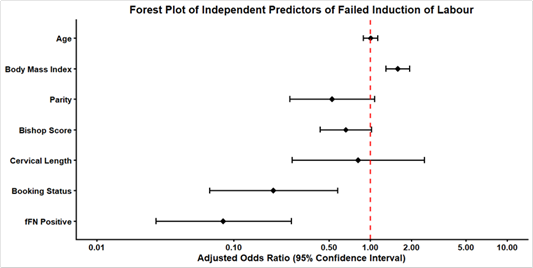
Forest plot showing AORs with 95% confidence intervals from the multivariable logistic regression model. Higher maternal body mass index was independently associated with an increased likelihood of failed induction, whereas booked antenatal status and positive fFN status were independently associated with a lower likelihood of failed induction. Age, parity, Bishop score, and cervical length were not statistically significant independent predictors.
Maternal and neonatal outcome in successfully induced and failed induction cases have been compared in Table IV. The duration from the time of induction to delivery was significantly shorter in cases of successful induction as compared to failed induction (15.40 ± 5.50 vs. 18.31 ± 6.45 hours; p = 0.001). As anticipated, all the women in the successfully induced group had vaginal delivery, while all women in the failed induction group had lower segment caesarean section (LSCS) (p < 0.001). For the women undergoing LSCS, the most common indication for caesarean delivery was fetal distress/ non-stress test (NST)/ meconium stained liquor (56.3%), followed by non-progression of labor (10.0%), cephalopelvic disproportion (8.8%), induction failure (7.5%), deep transverse arrest (6.3%), hypertensive disorders (5.0%), miscellaneous obstetric indications (5.0%), and placenta previa (1.3%). The pattern of maternal complications was similar for both groups, without any statistically significant difference (p = 0.169). Similarly, there was no statistically significant difference in the mean birth weight between successfully induced and failed induction (p = 0.142). However, neonatal intensive care unit (NICU) admission rate was significantly higher in neonates delivered after failed induction cases than successful induction cases (73.8% vs. 11.7%; p < 0.001). Neonatal complications were also significantly more common in failed induction group (73.8% vs. 13.3; p < 0.001)
| Variable | Successful Induction (Vaginal) (n = 120) | Failed Induction (LSCS) (n = 80) | Test Statistic | p value |
| Induction-to-delivery interval (hours) | 15.40 ± 5.50 | 18.31 ± 6.45 | t = -3.314 | 0.001 |
| Mode of delivery | χ² = 200.000 | <0.001 | ||
| Vaginal delivery | 120 (100.0) | 0 (0.0) | ||
| LSCS | 0 (0.0) | 80 (100.0) | ||
| Indication for Caesarean Section | χ² = 200.000 | <0.001 | ||
| Fetal distress / Non-reassuring NST / Meconium-stained liquor | — | 45 (56.3) | ||
| Cephalopelvic disproportion | — | 7 (8.8) | ||
| Deep transverse arrest | — | 5 (6.3) | ||
| Induction failure | — | 6 (7.5) | ||
| Non-progress of labour | — | 8 (10.0) | ||
| Hypertensive disorders | — | 4 (5.0) | ||
| Placenta previa | — | 1 (1.3) | ||
| Miscellaneous obstetric indications | — | 4 (5.0) | ||
| Maternal complications | χ² = 22.410 | 0.169 | ||
| None | 106 (88.3) | 66 (82.5) | ||
| Postpartum haemorrhage (PPH) | 8 (6.7) | 4 (5.0) | ||
| Blood transfusion | 3 (2.5) | 2 (2.5) | ||
| Miscellaneous maternal complications | 3 (2.5) | 8 (10.0) | ||
| Birth weight (kg) | 2.84 ± 0.37 | 2.93 ± 0.45 | t = -1.473 | 0.142 |
| NICU admission | χ² = 79.937 | <0.001 | ||
| Yes | 14 (11.7) | 59 (73.8) | ||
| No | 106 (88.3) | 21 (26.2) | ||
| Neonatal complications | χ² = 114.396 | <0.001 | ||
| None | 104 (86.7) | 21 (26.3) | ||
| Any neonatal complication | 16 (13.3) | 59 (73.8) |
Kg: kilogram; LSCS: lower segment caesarean section; NICU: neonatal intensive care unit; NST: non-stress test; PPH: postpartum haemorrhage; SD: standard deviation; t: Student's t-test; χ²: Chi-square test.
The predictive performance of the multivariable logistic regression model for failed induction of labour is presented in Table V. The overall statistical significance (p < 0.001) of the model obtained using the Omnibus test suggests that the variables used in the model are able to help differentiate between successful and failed induction of labour. The goodness of fit of the model is rather high, as indicated by the Nagelkerke R² value of 0.727 meaning that around 72.7% of variance in the outcome of the induction can be explained by the predictors. The result of the Hosmer-Lemeshow test (p = 0.237) is not statistically significant meaning that there is good concordance between observed and predicted outcomes and thus, an adequate fit of the model. The overall classification accuracy of the model is 89.9% with sensitivity of 86.3% for failed induction and specificity of 92.4% for successful induction. In addition, the area under Receiver operating characteristic (ROC) curve is 0.947 (Figure 2).
| Parameter | Value |
| Omnibus model p value | <0.001 |
| Nagelkerke R² | 0.727 |
| Hosmer–Lemeshow p value | 0.237 |
| Classification accuracy | 89.9% |
| Sensitivity | 86.3% |
| Specificity | 92.4% |
| AUC / ROC value | 0.947 |
AUC: area under the curve; ROC: receiver operating characteristic.
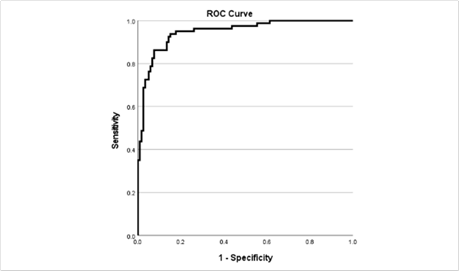
Receiver operating characteristic (ROC) curve demonstrating the discriminatory ability of the multivariable logistic regression model to predict failed induction of labour. The model showed excellent predictive performance, with an AUC of 0.947, indicating high accuracy in distinguishing women with successful and failed induction outcomes.
Discussion
A multivariable logistic regression of 200 women with an unfavourable cervix was used to assess clinical factors for failed IOL in this prospective observational study. Higher BMI, booking status, fFN, education status, and socioeconomic status were independently associated with the induction outcome after adjustment for potential confounding. Conversely, no independent association with multivariable adjustment was found for maternal age, parity, Bishop score, cervical length or induction method, suggesting that these apparent effects were driven by other clinical factors. The multivariable model showed excellent predictive performance, supporting its potential use in pre-induction risk stratification.
These independent relationships of increasing BMI with failed IOL (adjusted OR 1.585; 95% CI 1.298–1.935; p <0.001) are consistent with the growing evidence linking maternal obesity to an increased risk of induction failure. Maged et al. in a prospective cohort study of 288 women who had undergone IOL showed that obesity was an independent risk factor for caesarean delivery (OR 2.02; 95% CI 1.1–3.7). Within a standardised induction protocol Hamm et al. (2021) reported a significantly higher failure rate with obesity (47.8% versus 26.7%) which they attributed to a biological cause, a finding which is consistent with the present data (9, 10). Erbey et al. (2026) found that BMI was an independent predictor in their cohort of 501 women in the Robson classification (AOR 1.489; 95% CI 1.254–1.767), where the percentage of women with failed induction of labour increased from 2.9% in women who were normal weight to 15.2% in Class III obesity [11]. The same study by Nabilah et al. (2026) revealed that the excessive gain in weight during pregnancy was an independent risk factor for induction failure in obesity cases [12]. Adipokine dysregulation may reduce myometrial sensitivity to oxytocin and prostaglandins, contributing to induction failure [13].
The odds of failed IOL were significantly lower in women booked antenatal status (adjusted OR 0.196; 95% CI 0.067–0.576; p = 0.003). Antenatal care offers formalised chances to identify and manage factors that can complicate labour, and to optimise managing comorbidities before labour is induced. The present association was corroborated in another study by Bagayoko (2023) that analysed data from the mobile health programme in Kenya, which reported an increased risk of intrapartum complications at the first pregnancy checkup (14). The WHO antenatal care guidelines of 2016 also highlight that mothers who receive more frequent care during pregnancy will have a lower perinatal morbidity (15). Residual confounding related to healthcare-seeking behaviour cannot be excluded.
A negative fFN was independently associated with increased risk of failed IOL (adjusted OR 0.084; 95% CI 0.027-0.264; p<0.001). fFN reflects biochemical cervical maturation and may predict cervical readiness beyond digital examination. In a prospective study of 73 nulliparous term women with a Bishop score <5, Uygur et al. (2016) found only fFN was an independent significant predictor of vaginal delivery within 24 hours on binary logistic regression (OR 6.168; 95% CI 1.897–20.059), which agrees with the current model [16]. A systematic review by Michail et al. (2025) of 36 studies from 2013 to 2025 found that using biochemical markers alongside ultrasound cervical parameters increased the accuracy of the prognosis compared to clinical scoring alone [17]. However, a partial disagreement was reported by Sciscione et al. (2005), who reported that in a cohort of 241 nulliparas having a Intracervical Foley’s catheter ripening, there was no association between fFN and a rate of vaginal delivery, likely reflecting differences in study population and induction protocol. This finding that the fFN remains an independent predictor, even after adjusting for Bishop score and cervical length, indicates that it assesses biologic cervical readiness beyond the information provided by the clinical Bishop score [18].
Educational and socioeconomic status also showed significant overall association with failed induction in the multivariable model, indicating that social determinants may have an effect on labour outcomes apart from and in addition to traditional obstetric variables. These findings suggest that social determinants influence induction outcomes, although category-specific odds ratios were not estimated. In line with these, Schildberger et al. (2015) noted that mothers from lower socioeconomic status were more likely to have pregnancy complications, induce their labour and deliver by caesarean section, while maternal education seemed to have a beneficial effect by enhancing health literacy and involvement in maternity services [19]. Likewise, Baron et al. (2015) showed that women with lower levels of education had poorer health behaviours, fewer opportunities for prenatal education, and fewer utilization of preventive maternal health services, which could have indirect impacts on the labor / delivery process [20].
Both parity and Bishop score were not significant in this multivariable model, and the same observation is appropraite for the other variables considered, namely maternal age, cervical length, and induction method, which are well known to be confounding and/or mediating with each other between failed IOL. As was confirmed by Abdullah et al. (2022), the strong correlation between transvaginal cervical length and the Bishop score (r = 0.745; p <0.001) suggests that they share variance and thus may affect each other's coefficients when used together on multivariable analysis; similarly, multiple ultrasound cervical parameters failed to achieve independent significance on multivariable analysis in women with an unfavourable cervix, as seen by İleri et al. (2023) [21,22]. The findings are similar to other multivariable prediction research where univariable predictors were found to be reduced after adjustment [11,12].
Previous prediction models incorporating conventional clinical predictors reported AUCs of 0.76–0.79 [23,24]. The higher discrimination observed in the present model may reflect the additional predictive contribution of booking status and fFN beyond traditional obstetric variables, although external validation is required before confirming this advantage. The model showed clinically useful sensitivity (86.3%) and specificity (92.4%). Vallikkannu et al. (2017) showed that biochemical markers can substantially augment discrimination beyond the clinical assessment alone, as is suggested in the current model. The model has not undergone internal validation using bootstrapping; therefore, external validation is required before clinical implementation [25].
BMI, engagement with antenatal care, Educational status, Socioeconomic status and fFN status, were found to be independently predictive, and may provide a structured approach for pre-induction counselling in women with an unfavourable cervix. Women with high BMI should be given clear counselling about the independent impact of adiposity on induction failure; and ideally weight management advice from early pregnancy. The association between unbooked antenatal status and failed induction highlights the importance of early antenatal registration, and can potentially guide extra resources to women who have not booked in time. If fFN testing is available, a negative result could lead to further comprehensive pre-induction counseling. These determinants are not intended to be a substitute for clinical judgment, a high predicted probability of failed induction is not a contraindication to IOL when the indication is maternal or fetal compromise.
The advantages of the design are prospective, the comprehensive set of predictors was systematically collected and used, and the use of fFN in addition to traditional cervical assessors allows a formal assessment of the independent contribution of fFN. All three study objectives (association, independent prediction, and relative contribution) have been captured in one model, which is important to study the key clinical questions concerning risk stratification prior to induction.
Limitations
Limitations are that it is a single centre study, which limits generalisability to populations with varying demographics, induction practices, or healthcare infrastructure. The sample size was modest relative to the number of predictors, and the resulting model is in some ways a hypothesis-generating model. No external validation has been carried out and reported performance figures may be an overestimate of discriminatory ability. Unmeasured factors that might affect induction management, such as nutritional status, previous cervical procedures and factors related to the clinician cannot be ruled out as sources of residual confounding.
Conclusion
In conclusion, the presence of unfavourable cervix at term was independently linked to the outcome of labour induction, with higher maternal BMI, unfavourable booking status, fFN status, maternal education level, and socioeconomic status independently linked to the outcome of labour induction after adjusting for potential confounding factors, while maternal age, parity, Bishop score, cervical length, and induction method failed to maintain independent significance. The results showed that for induction to be a success, biological, clinical and sociodemographic factors play a role in addition to cervical assessment. The multivariable prediction model showed good discrimination and calibration, with the potential to be used for pre-induction risk stratification and counselling patients. However, the results of this study should be regarded as preliminary in a single-centre observational study and should be confirmed by other studies conducted externally before they are routinely used in clinical practice. Further multi-centre research is justified to confirm this model in different populations and to assess if objective markers and social factors when added to the pre-induction assessment will enhance clinical decision making and maternal outcomes.
Declarations
Ethical Clearance
The study was approved by the Institutional Ethics Committee (Biomedical Health & Research), GSVM Medical College, Kanpur (Approval No. EC/BMHR/2024/219; approval dated 07 November 2024). Written informed consent was obtained from all participants.
Conflict of Interest
The authors declare that they have no conflicts of interest related to this study.
Funding/ financial support
The authors received no financial support for the research, authorship, and/or publication of this article.
Contributors
Yukti Agarwal, Department of Obstetrics and Gynaecology, Ganesh Shankar Vidyarthi Memorial Medical College, Uttar Pradesh, India
Shaily Agarwal, Department of Obstetrics and Gynaecology, Ganesh Shankar Vidyarthi Memorial Medical College, Uttar Pradesh, India
Renu Gupta, Department of Obstetrics and Gynaecology, Ganesh Shankar Vidyarthi Memorial Medical College, Uttar Pradesh, India
Neena Gupta, Department of Obstetrics and Gynaecology, Ganesh Shankar Vidyarthi Memorial Medical College, Uttar Pradesh, India
Seema Dwivedi, Department of Obstetrics and Gynaecology, Ganesh Shankar Vidyarthi Memorial Medical College, Uttar Pradesh, India
Bandana Sharma, Department of Obstetrics and Gynaecology, Ganesh Shankar Vidyarthi Memorial Medical College, Uttar Pradesh, India
Divya Dwivedi, Department of Obstetrics and Gynaecology, Ganesh Shankar Vidyarthi Memorial Medical College, Uttar Pradesh, India
Authors’ Contributions
All authors contributed substantially to the conception of the study, data acquisition, analysis, drafting, and critical revision of the manuscript. All authors have read and approved the final version of the manuscript.
Acknowledgements
The authors would like to thank all the participants who consented to participate in this study and the staff of the Department of Obstetrics and Gynaecology, GSVM Medical College, Kanpur, for their support during data collection.
Trial Details
This study was a prospective observational study and was not registered as a clinical trial.