Introduction
Multidrug-resistant tuberculosis (MDR-TB) represents a formidable global health challenge, with its protracted, complex, and often toxic treatment regimens posing a severe test of human resilience. The World Health Organisation (WHO) estimates that there were approximately 410,000 new cases of rifampicin-resistant TB globally in 2022, with Nigeria bearing a significant and disproportionate share of this burden [1]. Within Nigeria, the Northwest region is a particular hotspot, characterised by poverty, limited healthcare infrastructure, and cultural barriers that exacerbate the challenges of TB control and amplify patient suffering [2].
The ordeal of MDR-TB extends far beyond its physical pathology. The diagnosis itself is often perceived as a death sentence, triggering intense fear, stigma, and social isolation [2,3]. The lengthy treatment course, which can span 9 to 18 months, is frequently accompanied by debilitating side-effects, including hearing loss, gastrointestinal distress, and psychiatric manifestations that profoundly disrupt patients' lives [4]. Consequently, it is unsurprising that MDR-TB patients exhibit among the highest rates of common mental disorders of any chronic illness population. Systematic reviews indicate that the prevalence of depression and anxiety can exceed 50%, constituting a parallel epidemic of psychological distress that is frequently overlooked in resource-constrained clinical settings [5,6].
However, a growing body of qualitative evidence suggests that the distress experienced by MDR-TB patients is not merely psychological but is fundamentally existential and spiritual in nature [7]. Patients frequently report a profound loss of meaning, purpose, and hope for the future. They grapple with questions of "Why me?" and confront their mortality in a stark and unsettling manner. Furthermore, the loss of functional capacity, social roles, and economic productivity can eviscerate an individual's sense of dignity and self-worth, leading to a state of demoralisation and dignity-related distress [8]. This existential suffering is a potent, independent driver of poor quality of life and can significantly undermine the motivation and willpower required to persist with arduous treatment, thereby contributing to non-adherence, treatment failure, and further drug resistance [9].
Despite the WHO's advocacy for the integration of mental health support into TB care, its implementation in settings like Nigeria remains sparse and typically focuses on basic counselling or psychoeducation [10]. Cognitive Behavioural Therapy (CBT) is a well-validated intervention for anxiety and depression and has shown promise in improving adherence in chronic illnesses by targeting maladaptive thoughts and behaviours [11]. However, its primary focus on symptom reduction may not fully address the deeper layers of existential and spiritual anguish that are central to the MDR-TB experience [12].
To specifically target this existential suffering, novel psychotherapeutic approaches have been developed in palliative care settings. Meaning-Centered Psychotherapy (MCP), grounded in the work of Viktor Frankl, is designed to help patients with life-threatening illnesses sustain or discover a sense of meaning, purpose, and hope, even in the face of extreme adversity [12,13]. Similarly, Dignity Therapy (DT) is a brief, individualised intervention that directly addresses dignity-related distress by allowing patients to articulate a narrative of their life, reinforcing their sense of worth, legacy, and continued value to others [14]. While the efficacy of MCP and DT is established in high-income country palliative care contexts, their application and, critically, their direct comparison against an established modality like CBT and a control group within an active MDR-TB treatment programme in sub-Saharan Africa is virtually unexplored.
This study therefore sought to address this critical evidence gap. We conducted a randomised controlled trial to evaluate and compare the efficacy of three distinct brief psychotherapies; MCP, DT, and CBT, against a waitlist control condition. The primary aim was to determine their impact on conventional psychological outcomes (anxiety and depression), core existential dimensions (spiritual well-being and dignity-related distress), and health-related quality of life among MDR-TB patients in Northwest Nigeria, with assessments extending to a 6-month follow-up to evaluate the sustainability of any therapeutic effects.
Materials and Methods
Study Design
This was a single-blind, parallel-group, randomised controlled trial with a 1:1:1:1 allocation ratio. The trial compared three active psychotherapeutic interventions; Meaning-Centered Psychotherapy (MCP), Dignity Therapy (DT), and Cognitive Behavioural Therapy (CBT), against a waitlist control condition. Outcome assessors were blinded to group allocation, while therapists delivering the interventions could not be blinded due to the nature of the psychotherapeutic modalities.
Study Setting
The study was conducted over an 18-month period (January 2024 to June 2025) across 7 TB Clinics (5 Federal and 2 State Health Facilities) distributed across all seven states of Northwest Nigeria.
Study Participants
A total of 280 MDR-TB patients attending the participating TB Clinics were recruited for the study. All participants were adults (≥18 years) with a confirmed diagnosis of MDR-TB, who had been on treatment for less than one month at the time of enrolment. The diagnosis of MDR-TB was confirmed through GeneXpert MTB/RIF assay or culture-based drug susceptibility testing, in accordance with Nigerian national TB guidelines.
Inclusion Criteria
Participants were eligible for enrolment if they met all of the following criteria: (1) Confirmed diagnosis of MDR-TB, (2) Age ≥ 18 years, (3) Initiation of MDR-TB treatment within the preceding one month (≤ 4 weeks) at the time of enrolment, (4) Provision of written informed consent to participate in the study, and (5) Ability to communicate effectively in English, Hausa, or Pidgin English (the predominant languages in Northwest Nigeria), either independently or with the assistance of a trained translator.
Exclusion Criteria
Participants were excluded from the study if they met any of the following criteria: (1) Severe cognitive impairment that would preclude meaningful participation in psychotherapeutic sessions, (2) Active psychotic disorder or acute psychiatric crisis requiring immediate psychiatric hospitalisation, (3) Current participation in another psychotherapeutic or psychiatric interventional study, and (4) Inability to complete the study assessments due to severe physical illness or impending death, as determined by the treating physician
Sample Size Determination
The sample size was calculated using G*Power software (version 3.1.9.7; Heinrich-Heine-Universität Düsseldorf, Germany). For a mixed-model analysis of variance (ANOVA) with a within-between interaction, the following parameters were specified: a medium-to-large effect size (f = 0.25) for the primary time × group interaction, an alpha level of 0.05, statistical power of 0.95, four groups, three repeated measurements, and a conservative correlation among repeated measures of 0.5. These parameters yielded a total sample size of 252 participants. Accounting for an anticipated 10% attrition rate over the 6-month follow-up period, the target sample size was adjusted to 280 participants (70 per group).
Sampling Method
A multi-stage sampling approach was employed: All 12 eligible Federal and State TB facilities in the region were invited; 7 consented. To ensure representativeness, participating and non-participating facilities were compared on key characteristics (patient volume, staffing, location), with no significant differences detected (p > 0.05). Within each participating facility, consecutive sampling was used to enroll all eligible patients presenting during the recruitment period, with proportional quotas applied based on each facility's annual MDR-TB patient volume to ensure regional representation.
Randomisation and Blinding
Following baseline assessment (T₀), participants were randomly allocated (1:1:1:1) to MCP, DT, CBT, or a waitlist control using a computer-generated sequence concealed in sequentially numbered, opaque, sealed envelopes. An independent research assistant, uninvolved in assessment or therapy delivery, opened the envelopes. Outcome assessors were blinded to group allocation throughout. Therapists could not be blinded due to the nature of the interventions.
Interventions
Participants in all three intervention groups received six weekly, individual 45–60-minute sessions over eight weeks, delivered by trained primary healthcare workers (nurses/community health workers) who underwent a standardised 40-hour training programme with ongoing supervision. Fidelity was monitored through audio-recording and review of 20% of sessions using modality-specific checklists.
Meaning-Centered Psychotherapy (MCP): Adapted from Breitbart's model [12,13], sessions explored sources of meaning (historical, attitudinal, creative, experiential) through didactic and reflective exercises, helping patients sustain purpose despite adversity.
Dignity Therapy (DT): Based on Chochinov's protocol [14], a guided interview elicited participants' life narratives, culminating in a generativity document to reinforce their legacy, worth, and value to loved ones.
Cognitive Behavioural Therapy (CBT): Grounded in Beck's model [11], sessions targeted illness-related negative automatic thoughts, cognitive restructuring, behavioural activation, and problem-solving for treatment adherence and side-effect management.
Waitlist Control Group: Participants in the waitlist control group received standard MDR-TB medical care, which included pharmacological treatment, routine clinical monitoring, and basic health education. They did not receive any psychotherapeutic intervention during the study period. However, consistent with ethical principles, participants in this group were offered a choice of one of the three active psychotherapies (MCP, DT, or CBT) after the completion of the 6-month follow-up assessment. This "waitlist" design ensured that all participants eventually had access to psychotherapeutic support, while providing a rigorous control comparison during the active study phase.
All interventions were culturally adapted for the Nigerian context (including translation into Hausa and Pidgin English) through a rigorous forward-backward translation and cognitive debriefing process.
Study Instruments
Outcomes were assessed at baseline (T0), immediately post-intervention (T1), and at 6-month follow-up (T2). The primary outcomes were dignity-related distress and spiritual well-being. Secondary outcomes were anxiety, depression, and quality of life. Instruments used were:
Sociodemographic questionnaire
Key variables collected include age, marital status, gender, tribe, diagnosis, etc.
Hospital Anxiety and Depression Scale (HADS): A 14-item scale with two 7-item subscales for Anxiety (HADS-A) and Depression (HADS-D). Scores range from 0–21 for each subscale, with ≥8 indicating caseness [15]. It has been validated and widely used in Nigeria [16].
Functional Assessment of Chronic Illness Therapy-Spiritual Well-Being (FACIT-Sp-12): A 12-item measure of spiritual well-being comprising Meaning, Peace, and Faith subscales. Total scores range from 0–48, with higher scores indicating better spiritual well-being [17].
Patient Dignity Inventory (PDI): A 25-item instrument measuring various sources of dignity-related distress on a 5-point scale. Total scores range from 25–125, with higher scores indicating greater distress [19]. It demonstrated excellent internal consistency in this study (Cronbach's α = 0.92).
World Health Organization’s Quality of Life-Bref (WHOQOL-BREF): A 26-item instrument assessing quality of life. This analysis used the Physical Health, Psychological, and Social Relationships domain scores, transformed to a 0–100 scale [20]. It is extensively validated in Nigeria [18,21].
All instruments were validated in Nigerian populations or rigorously translated and culturally adapted.
Study Procedure
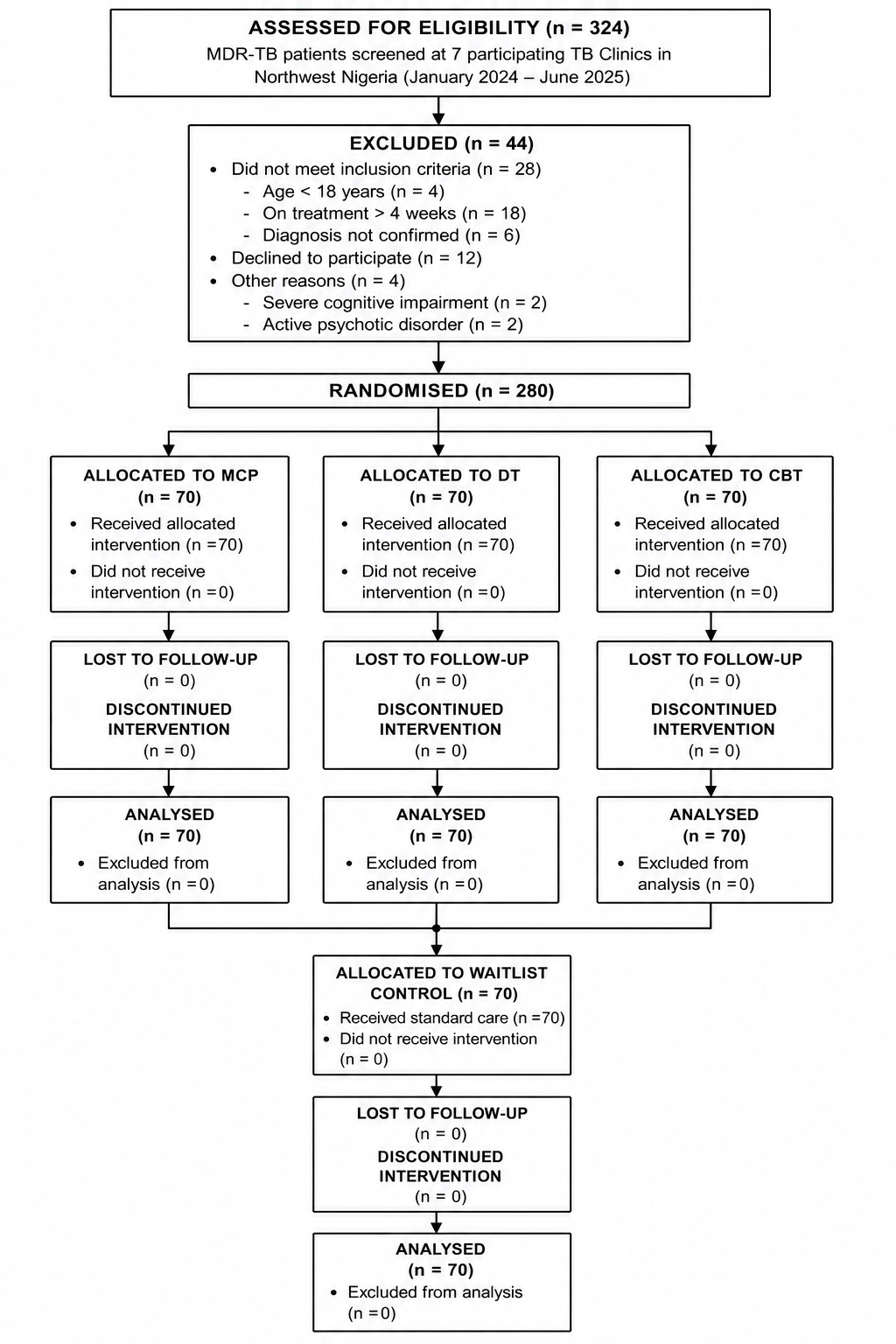
Eligible participants completed the baseline assessment (T0) and were then randomly allocated to one of four groups using a computer-generated randomisation sequence concealed in opaque envelopes: MCP group (n=70), DT group (n=70), CBT group (n=70), or a waitlist control group (n=70). The control group received standard palliative care and was offered one of the interventions after the study period. Assessments were repeated immediately post-intervention (T1) and at six-month follow-up (T2) by research assistants blinded to group allocation.
After the completion of the 6-month follow-up assessment, participants in the waitlist control group were offered a choice of one of the three active psychotherapies (MCP, DT, or CBT) as an ethical consideration. This offer was made known to participants at the time of consent to minimise any distress related to being in the control group.
Ethical Consideration
The study received ethical approval from the Health Research Ethics Committee of Ahmadu Bello University Teaching Hospital, Zaria (Ref: ABUTHZ/HREC/C37/2024), with additional approvals from all participating facilities. All participants provided written informed consent in their preferred language (English, Hausa, or Pidgin English). Confidentiality was strictly maintained; personal identifiers were removed and replaced with unique study IDs. Participants could withdraw at any time without consequence. Those experiencing significant distress were referred to psychiatric services. Transportation reimbursement was provided, and the waitlist control group was offered a therapy of choice post-study.
Statistical Analysis
Analyses were performed using IBM SPSS (v.29.0) on an intention-to-treat basis. Missing data were handled using multiple imputation (MICE) with five imputed datasets. A 4 (Group: MCP, DT, CBT, Control) × 3 (Time: T₀, T₁, T₂) mixed-model ANOVA was conducted for each outcome. When significant time × group interactions were found, post-hoc tests with Bonferroni correction explored simple effects. Sphericity was assessed using Mauchly's test, with Greenhouse-Geisser corrections applied where necessary. Effect sizes were reported as partial eta-squared (η²ₚ). Statistical significance was set at p < 0.05. Sensitivity analyses (per-protocol and complete-case) were conducted to test the robustness of findings.
Results
All 280 participants were retained through the 6-month follow-up. Table 1 presents the baseline demographic and clinical characteristics of the 280 participants across the four study groups. The mean age of participants was approximately 36 years across all groups, with standard deviations ranging from ±10.7 to ±11.4 years. Gender distribution was relatively balanced, with male participants comprising between 54.3% and 58.6% across groups. The majority of participants (78.6%-82.9%) had secondary education or less. Marital status showed that 61.4%-65.7% of participants were married across groups, while unemployment rates ranged from 55.7% to 60.0%. Clinical characteristics indicate that the mean time on MDR-TB treatment was approximately 2 weeks (±0.7-0.9 weeks) across all groups. HIV co-infection rates ranged from 20.0% to 24.3%, and previous TB treatment history was reported by 65.7%-70.0% of participants. Baseline HADS-Anxiety scores ranged from 15.8 (±3.1) to 16.1 (±2.9), and HADS-Depression scores ranged from 14.9 (±3.3) to 15.2 (±3.0) across groups. All p-values for between-group comparisons were non-significant (p>0.05), indicating successful randomisation and baseline equivalence.
The mixed-model ANOVA revealed a statistically significant main effect of time and a significant time × group interaction for all outcome measures (p < .001). The main effect of group was also significant (p < .001). Table 2 displays the mean scores and standard deviations for all outcome measures across three time points: baseline (T0), post-intervention (T1), and 6-month follow-up (T2). For HADS-Anxiety, all intervention groups showed substantial reductions from baseline (15.8-16.1) to post-intervention (6.9-7.8) and maintained these gains at follow-up (6.8-7.3), while the control group remained stable (16.0 at baseline to 15.7 at follow-up). Similar patterns were observed for HADS-Depression, with intervention groups decreasing from 14.9-15.2 at baseline to 6.8-7.4 at follow-up, compared to minimal change in controls (15.1 to 15.3).
For the FACIT-Sp-12, MCP and DT groups showed marked improvements from baseline (22.5-23.0) to post-intervention (35.9-36.8) and further gains at follow-up (37.5-38.1). The CBT group showed moderate improvement (22.8 to 31.8), while controls remained unchanged (22.7 to 22.5). The Patient Dignity Inventory scores demonstrated substantial reductions in MCP and DT groups from baseline (87.8-88.5) to follow-up (40.8-42.1), compared to more modest reductions in CBT (89.1 to 51.5) and no change in controls (88.3 to 88.5).
All WHOQOL-BREF domains showed similar patterns of improvement. For Physical Health, intervention groups improved from approximately 45 at baseline to 69-71 at follow-up, compared to stable scores in controls (45.0 to 44.9). Psychological domain scores increased from approximately 38 to 66-68 in intervention groups versus no change in controls (38.0 to 37.8). Social Relationships domain showed improvements from approximately 42 to 70-74 in intervention groups, while controls remained around 42. All time × group interaction effects were statistically significant (p<0.001) with F-values ranging from 35.74 to 75.83 across different outcome measures.
Post-hoc analyses of the significant time × group interactions revealed that, for HADS-A and HADS-D, all three therapy groups (MCP, DT, CBT) showed significant and sustained reductions in anxiety and depression from T0 to T1 and T2 (all p < .001 vs. control). The control group showed no significant change. For FACIT-Sp-12 and PDI, MCP and DT groups demonstrated significantly greater improvements in spiritual well-being and reductions in dignity-related distress at T1 and T2 compared to both the CBT and control groups (p < .001). The CBT group showed a modest but significant improvement compared to the control (p < .01), but this was significantly less than the existential therapies. For WHOQOL-BREF, all three therapy groups showed significant and equivalent improvement in the Physical, Psychological, and Social Relationships domains compared to the control group (p < .001), with gains maintained at follow-up.
| Characteristic | MCP (n = 70) | DT (n = 70) | CBT (n = 70) | Control (n = 70) | p-value |
| Age (years), mean ± SD | 36.2 ± 11.0 | 35.8 ± 10.7 | 36.5 ± 11.4 | 35.9 ± 11.1 | 0.97 |
| Male, n (%) | 40 (57.1) | 38 (54.3) | 39 (55.7) | 41 (58.6) | 0.96 |
| Education ≤ secondary, n (%) | 57 (81.4) | 56 (80.0) | 58 (82.9) | 55 (78.6) | 0.91 |
| Married, n (%) | 45 (64.3) | 43 (61.4) | 44 (62.9) | 46 (65.7) | 0.95 |
| Unemployed, n (%) | 40 (57.1) | 42 (60.0) | 39 (55.7) | 41 (58.6) | 0.97 |
| Time on MDR-TB treatment (weeks), mean ± SD | 2.1 ± 0.8 | 2.2 ± 0.7 | 2.0 ± 0.9 | 2.1 ± 0.8 | 0.65 |
| HIV co-infection, n (%) | 15 (21.4) | 16 (22.9) | 14 (20.0) | 17 (24.3) | 0.93 |
| Previous TB treatment, n (%) | 48 (68.6) | 46 (65.7) | 49 (70.0) | 47 (67.1) | 0.96 |
| Baseline HADS-Anxiety, mean ± SD | 15.8 ± 3.1 | 16.1 ± 2.9 | 15.9 ± 3.2 | 16.0 ± 3.0 | 0.94 |
| Baseline HADS-Depression, mean ± SD | 14.9 ± 3.3 | 15.2 ± 3.0 | 15.0 ± 3.4 | 15.1 ± 3.1 | 0.96 |
Abbreviations: MCP = Meaning-Centered Psychotherapy; DT = Dignity Therapy; CBT = Cognitive Behavioural Therapy; HADS = Hospital Anxiety and Depression Scale; MDR-TB = Multidrug-Resistant Tuberculosis.
| Outcome measure | Group | Baseline (T₀) | Post-intervention (T₁) | 6-month follow-up (T₂) | Time × Group Interaction F (df, error), p |
| HADS-Anxiety | MCP | 15.8 (3.1) | 7.5 (2.5) | 7.1 (2.3) | |
| DT | 16.1 (2.9) | 7.8 (2.6) | 7.3 (2.4) | F(6, 552) = 45.21, p < 0.001 | |
| CBT | 15.9 (3.2) | 6.9 (2.2) | 6.8 (2.1) | ||
| Control | 16.0 (3.0) | 15.8 (3.1) | 15.7 (3.2) | ||
| HADS-Depression | MCP | 14.9 (3.3) | 7.2 (2.4) | 6.8 (2.2) | |
| DT | 15.2 (3.0) | 7.4 (2.5) | 7.0 (2.3) | F(6, 552) = 52.67, p < 0.001 | |
| CBT | 15.0 (3.4) | 7.0 (2.3) | 6.9 (2.2) | ||
| Control | 15.1 (3.1) | 15.2 (3.2) | 15.3 (3.0) | ||
| FACIT-Sp-12 (Total) | MCP | 22.5 (5.8) | 36.8 (4.5) | 38.1 (4.1) | |
| DT | 23.0 (5.5) | 35.9 (4.8) | 37.5 (4.3) | F(6, 552) = 68.95, p < 0.001 | |
| CBT | 22.8 (5.7) | 31.5 (5.1) | 31.8 (4.9) | ||
| Control | 22.7 (5.6) | 22.9 (5.7) | 22.5 (5.8) | ||
| Patient Dignity Inventory | MCP | 88.5 (12.1) | 45.2 (8.8) | 42.1 (7.9) | |
| DT | 87.8 (11.8) | 43.5 (8.5) | 40.8 (7.5) | F(6, 552) = 75.83, p < 0.001 | |
| CBT | 89.1 (12.4) | 52.1 (9.5) | 51.5 (9.2) | ||
| Control | 88.3 (12.0) | 87.9 (12.2) | 88.5 (11.9) | ||
| WHOQOL-BREF Physical | MCP | 45.1 (8.9) | 68.5 (7.8) | 70.2 (7.1) | |
| DT | 44.8 (9.2) | 67.9 (8.1) | 69.5 (7.4) | F(6, 552) = 40.15, p < 0.001 | |
| CBT | 45.3 (8.7) | 69.8 (7.5) | 71.0 (6.9) | ||
| Control | 45.0 (9.0) | 45.8 (9.1) | 44.9 (9.3) | ||
| WHOQOL-BREF Psychological | MCP | 38.2 (7.5) | 65.8 (6.9) | 67.5 (6.2) | F(6, 552) = 48.33, p < 0.001 |
| DT | 37.8 (7.8) | 64.9 (7.2) | 66.8 (6.5) | ||
| CBT | 38.5 (7.4) | 66.2 (6.8) | 67.1 (6.3) | ||
| Control | 38.0 (7.6) | 38.5 (7.7) | 37.8 (7.9) | ||
| WHOQOL-BREF Social | MCP | 42.5 (9.1) | 71.2 (8.2) | 73.0 (7.5) | F(6, 552) = 35.74, p < 0.001 |
| DT | 41.9 (9.4) | 72.5 (8.5) | 74.1 (7.8) | ||
| CBT | 42.8 (8.9) | 70.8 (8.0) | 72.5 (7.3) | ||
| Control | 42.2 (9.2) | 42.8 (9.3) | 41.9 (9.5) |
Abbreviations: HADS = Hospital Anxiety and Depression Scale; FACIT-Sp-12 = Functional Assessment of Chronic Illness Therapy–Spiritual Well-Being; WHOQOL-BREF = World Health Organization Quality of Life–BREF; MCP = Meaning-Centered Psychotherapy; DT = Dignity Therapy; CBT = Cognitive Behavioural Therapy.
Discussion
This randomised controlled trial provides good evidence for the efficacy of brief psychotherapies in addressing the multifaceted distress of MDR-TB patients. The significant time × group interactions confirm that MCP, DT, and CBT are active interventions, producing superior and sustained outcomes across psychological, existential, and quality of life domains compared to standard care alone.
The significant reductions in anxiety and depression across all therapy groups align with established literature on psychological interventions for chronic illness [6,11]. The sustained benefits at 6-month follow-up are particularly noteworthy, suggesting these brief therapies can instigate lasting change. The equivalent effectiveness of all three modalities for these symptoms indicates that reducing overall suffering, whether through cognitive restructuring or existential rediscovery, ameliorates core symptoms of depression and anxiety.
The most salient findings concern the primary outcomes of spiritual well-being and dignity-related distress. The superior and sustained efficacy of MCP and DT on the FACIT-Sp-12 and PDI underscores their specific mechanism of action. By directly addressing existential concerns; helping patients find meaning (MCP) and reaffirm their inherent worth and legacy (DT), these therapies target a dimension of suffering that is particularly acute in MDR-TB [8]. While CBT improved psychosocial functioning, its more modest effect on these existential outcomes highlights its different therapeutic focus and suggests that existential distress requires targeted, non-symptom-focused interventions [12,13].
The significant improvements in all WHOQOL-BREF domains for all therapy groups demonstrate their broad benefits for patient-reported health outcomes. The fact that all therapies were equally effective in improving physical, psychological, and social quality of life suggests that the pathway to enhanced life quality in this population can be achieved through multiple psychological avenues. The improvement in social relationships is crucial, as stigma and isolation are major challenges in MDR-TB [2,3,21].
The 100% retention rate and successful delivery by trained primary healthcare workers underscore the feasibility and acceptability of integrating such mental health support into routine TB care in Nigeria, addressing a critical gap in the current system [22]. This finding aligns with the growing evidence base supporting task-shifting approaches for mental health interventions in low-resource settings [22].
The strengths of this study include the randomised controlled design, the comparison of three active psychotherapies against a control group, the use of validated outcome measures, the excellent retention rate, and the inclusion of a 6-month follow-up period to assess sustainability of effects.
Limitations
This study is not without some limitations. First, while assessors were blinded, therapists and participants could not be blinded due to the nature of the interventions, introducing potential performance bias. However, the use of self-report measures with good psychometric properties mitigates this concern. Second, the study was conducted at a single centre in Northwest Nigeria, which may limit generalisability to other regions or countries with different cultural and healthcare contexts. Third, we did not measure treatment adherence directly, though improvements in psychological and existential outcomes are known mediators of adherence. Fourth, the waitlist control group received standard care, but a placebo or attention-control condition might have provided a more rigorous comparison for non-specific therapeutic effects. Finally, while the therapies were delivered by trained primary healthcare workers, we did not assess fidelity to the therapeutic protocols using session recordings or external supervision ratings, which should be included in future studies.
Conclusion
Meaning-Centered Psychotherapy, Dignity Therapy, and Cognitive Behavioural Therapy are all efficacious for reducing psychological distress and improving quality of life in MDR-TB patients, with benefits sustained at 6-month follow-up. However, MCP and DT confer specific, superior benefits for spiritual well-being and dignity-related distress, addressing a critical dimension of suffering that CBT does not fully capture. We recommend that a suite of psychotherapies, with particular emphasis on existential therapies, be integrated as core components of holistic, patient-centred MDR-TB care in Nigeria and similar settings.
Recommendations
Based on the findings from this trial, we recommend the integration of brief psychotherapies, particularly Meaning-Centered Psychotherapy and Dignity Therapy, into the standard care package for patients with multidrug-resistant tuberculosis in Nigeria. These interventions effectively address the profound psychological and existential distress that undermines treatment adherence and quality of life. By task-shifting delivery to trained primary healthcare workers, this model provides a scalable, cost-effective, and sustainable strategy to deliver holistic, patient-centred care, ultimately contributing to improved treatment outcomes and patient well-being within the national TB control programme.
Declarations
Authors’ Contributions
AAY, SMB, AMA, AIA, and BAY conceptualised and designed the study. AAY, SMB, AMA, AIA, and BAY were involved in data collection and analysis. AAY, SMB, AMA, AIA, and BAY drafted and revised the manuscript. All authors critically reviewed for intellectual content, approved the final version, and agreed to be accountable for all aspects of the work.
Availability of Research Data
Data are available upon reasonable request from the corresponding author.
Funding
The authors received no funding or financial support.
Conflict of Interest
The authors declare no conflict of interest.
Acknowledgements
The authors sincerely thank all the participants, research assistants, and the staff and leadership of all the participating facilities, for their support and cooperation throughout the study.