Introduction
Heat is an important environmental and occupational health hazard [1]. The World Health Organization (WHO) recognizes heat stress as a leading cause of weather-related mortality and notes that extreme heat can worsen pre-existing illnesses, including asthma and mental health conditions [2]. Children are particularly vulnerable to extreme heat because of their developing thermoregulatory capacity and dependence on adults for hydration, rest, and protection [3]. Heat exposure may present with headache, dizziness, excessive thirst, fatigue, cramps, nausea, and dehydration, and severe exposure may progress to heat exhaustion or heatstroke [4]. Studies also suggest that extreme heat may contribute to respiratory morbidity, renal stress, mental health effects, and other acute health outcomes among children [5].
Within schools, heat exposure affects both health and learning outcomes. A study conducted in South Africa found that student-perceived heat-related symptoms increased with rising classroom temperatures [6]. Compared with the broader literature on heat-related health risks among children [3], evidence specific to school and classroom heat exposure remains limited. At the same time, a primary school-based intervention study in China demonstrated that structured heatwave education significantly improved children’s heat-related knowledge and adaptive practices, highlighting the policy relevance of school-based heat preparedness programs [7].
The urban setting of Patna makes this study especially relevant. Patna is a densely populated city administered by the Patna Municipal Corporation, which covers 75 wards and multiple municipal circles [8]. This urban context is important because school children may be exposed to heat not only during travel and outdoor activities, but also inside crowded classrooms, poorly ventilated buildings, and concrete-dominated neighbourhoods. Bihar has also experienced recurrent heatwave conditions in recent years, with heat alerts and advisories being issued for several districts, including Patna [9]. The presence of operational weather services through IMD and the Meteorological Centre, Patna, provides an opportunity to link school health preparedness with locally available weather forecasts, alerts, and public health advisories. Therefore, studying heatwave preparedness in urban government schools of Patna can generate practical evidence for school-based heat action planning.
Government schools are an important setting for this study because they serve a large number of children from socially and economically vulnerable families and are closely linked with public health and education systems. In India, the School Health Programme under Ayushman Bharat emphasizes school-based health promotion, health screening, referral services, first aid, and health education through trained Health and Wellness Ambassadors [10]. National disaster-management guidance also emphasizes safe school infrastructure, preparedness planning, early warning, and risk-reduction measures, which are relevant for school-based heatwave preparedness [11]. WHO also recognizes school health services as an organized approach to supporting the health needs of enrolled school-age children and adolescents [12]. However, there is limited empirical evidence from urban government schools in Bihar on whether school-level conditions such as drinking-water access, classroom ventilation, shade, heat-awareness activities, and first-aid readiness are associated with heat-related symptoms among students. Therefore, the present study aimed to estimate the prevalence of heat-related symptoms, assess school-level heatwave preparedness, and identify student-level and school-level factors associated with heat-related symptoms among urban government school children in Patna, Bihar.
Methodology
Study design and setting
This school-based cross-sectional study was conducted among students of government urban schools in Patna, Bihar, from April to June 2025, corresponding to the pre-monsoon hot season. The study assessed heat-related symptoms among students and school-level heatwave preparedness using a structured student questionnaire and school observation checklist.
The study was conducted in government schools located within the Patna Municipal Corporation area. Patna Municipal Corporation covers 75 wards under six administrative circles, which provided a framework for urban sampling. Meteorological information for the study period was linked with publicly available weather warnings and advisories issued for Bihar by IMD/Met Centre Patna.
Study population and eligibility criteria
The study population included students aged 10-16 years studying in classes VI to X in selected government urban schools of Patna. Schools were eligible if they were under government and located within the Patna urban municipal boundary.
Students were included if they had been enrolled in the selected school for at least six months, were present on the day of the survey, and provided written assent along with written parental or guardian consent. The six-month enrollment criterion was used to ensure that students had adequate exposure to the school environment, including classroom conditions, drinking-water facilities, school routines, outdoor activities, and heat-related practices.
Students were excluded if they were seriously ill on the survey day, unable to provide assent, or did not have parental or guardian consent.
Sample size
The sample size was calculated using an assumed prevalence of 50% for heat-related symptoms, as no prior school-based estimate from urban government schools in Patna was available. A 95% confidence level, 5% absolute precision, design effect of 1.8, and allowance for non-response were considered. Using the formula for estimating a single proportion, n = Z²pq/d², the initial sample size was calculated as 384. After applying the design effect, the sample size became 691. To allow for non-response and to facilitate feasible allocation across selected schools, the target sample size was rounded to 800 students.
Sampling technique
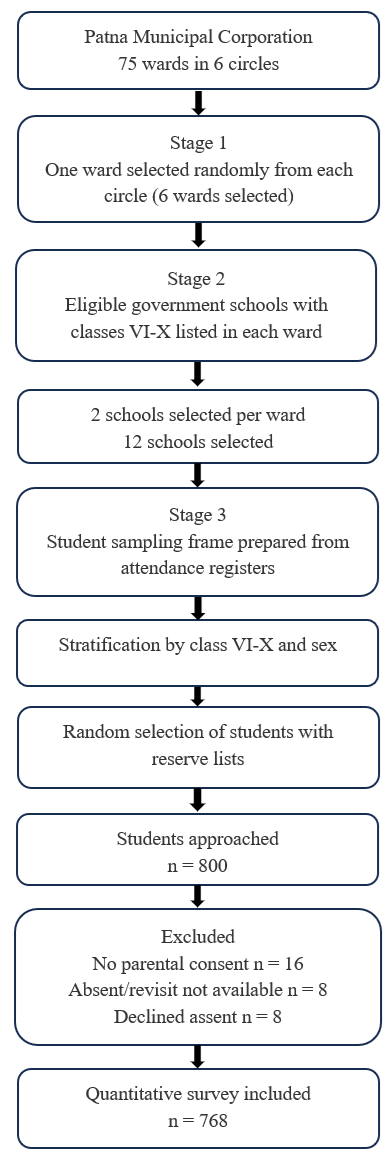
A multistage random sampling method was used. The six administrative circles of Patna Municipal Corporation were considered as geographic strata. In the first stage, one ward was selected randomly from each of the six municipal circles. In the second stage, two eligible government schools were selected randomly from each selected ward using the verified school list. Thus, a total of 12 government schools were selected.
The required student sample was allocated to each selected school in proportion to enrollment in classes VI to X. Within each school, students were stratified by class and sex, and selected by simple random sampling using the attendance register. If a selected student was absent or did not have parental consent, another student from the same class-sex stratum was selected randomly from the reserve list.
Study tools and data collection
Data were collected using a pretested student questionnaire and a school observation checklist. The student questionnaire was administered in Hindi and included information on age, sex, class, school travel, outdoor exposure, hydration practices, heat-warning awareness, heat-related symptoms during the previous seven days, absenteeism related to heat, and healthcare-seeking behaviour.
The school observation checklist assessed drinking-water availability, classroom ventilation, functional fans, electricity supply, shaded spaces, first-aid and ORS availability, displayed heat advisories, timetable changes during hot days, and classroom crowding.
After written permission from the school principal, parent or guardian consent was obtained before data collection. On the survey day, written assent was obtained from eligible students. The questionnaire was administered in the classroom. Teachers were requested not to stand near students during survey completion to allow honest responses. The school observation checklist was completed on the same visit through direct observation and brief discussion with the head teacher.
Outcome variable
The primary outcome was the presence of any heat-related symptom during the preceding seven days. Heat-related symptoms included headache, excessive thirst, dizziness, weakness or fatigue, muscle cramps, nausea or vomiting, reduced urine output, fainting, or confusion.
Data analysis
Quantitative data were entered in Microsoft Excel and analysed using IBM SPSS Statistics version 27. Descriptive statistics were presented as frequencies and percentages for categorical variables and as mean with standard deviation or median with interquartile range for continuous variables, as appropriate.
Associations between heat-related symptoms and selected student-level and school-level factors were first assessed using the chi-square test. Variables with P < 0.20 in bivariable analysis were entered into the multivariable logistic regression model. Since students were clustered within schools, school-level clustering was accounted for by using cluster-robust standard errors in the logistic regression model. Adjusted odds ratios with 95% confidence intervals were reported, and P < 0.05 was considered statistically significant. School-level variables were assigned to students according to the school in which they were enrolled.
Ethical considerations
Ethical approval was obtained from the Institutional Ethics Committee before fieldwork. Written permission was obtained from the school principals of participating schools. Written informed consent was obtained from parents or guardians, and written assent was obtained from participating students. Participation was voluntary, and students were informed that they could refuse or withdraw at any time. Confidentiality was maintained throughout the study. Any student who appeared unwell or reported severe heat-related symptoms during data collection was provided first aid at school and referred to the nearest appropriate government health facility.
Results
A total of 12 urban government schools from six Patna Municipal Corporation circles participated in the study. Of 800 students approached, 768 were included in the final analysis, giving a response rate of 96.0%. The mean age of the students was 13.3 ± 1.8 years. As shown in Table 1, most students were aged 13-14 years (40.1%), and 52.1% were girls. Walking was the most common mode of travel to school (40.5%), followed by public/shared motorized transport (35.9%). More than one-third of students (36.6%) had a one-way travel time of more than 20 minutes. Morning assembly in open sun during hot days was reported by 50.9% of students, while 37.4% reported drinking water fewer than three times during school hours. Only 29.4% had heard a heat alert or advisory in the preceding month, and 23.6% knew at least three danger signs of heat-related illness.
| Variables | Characteristic | N (%) |
| Age group | 10-12 years | 259 (33.7) |
| 13-14 years | 308 (40.1) | |
| 15-16 years | 201 (26.2) | |
| Sex | Male | 368 (47.9) |
| Female | 400 (52.1) | |
| Class | VI | 145 (18.9) |
| VII | 151 (19.7) | |
| VIII | 160 (20.8) | |
| IX | 157 (20.4) | |
| X | 155 (20.2) | |
| Mode of travel to school | Walking | 311 (40.5) |
| Bicycle | 156 (20.3) | |
| Public/shared motorized transport | 276 (35.9) | |
| Private two-wheeler with family | 25 (3.3) | |
| One-way travel time >20 minutes | 281 (36.6) | |
| School-based heat exposure during hot season | Morning assembly conducted in open sun during hot days | 391 (50.9) |
| Outdoor sports/recreation after 10:30 AM in preceding week | 247 (32.2) | |
| Hydration and heat-warning awareness | Carries personal water bottle | 503 (65.5) |
| Drinks water fewer than 3 times during school hours | 287 (37.4) | |
| Heard any heat alert/advisory in preceding month | 226 (29.4) | |
| Knew at least 3 danger signs of heat-related illness | 181 (23.6) |
School-level observations are summarized in Table 2. Several preparedness gaps were noted. Only 4 schools had shaded or indoor space for morning assembly, 5 had drinking-water points on each teaching floor, and 4 had functional fans in all observed classrooms. Heat-specific preparedness was limited, with only 3 schools having a record of heat-related timetable modification or contingency planning and 2 schools displaying heat advisories or temperature information. Teachers in 10 schools reported heat-related discomfort complaints among students during the hot season.
| Variables | School-level indicator | Schools, n (%) |
| Classroom and building-related heat exposure | At least one top-floor classroom used for classes VI-X | 9 (75.0) |
| Majority of class sections had >50 students seated | 7 (58.3) | |
| Cross-ventilation adequate in most observed classrooms | 5 (41.7) | |
| Functional fans available in all observed classrooms | 4 (33.3) | |
| Water, shade and cooling facilities | Drinking water continuously available during the school visit | 8 (66.7) |
| Drinking-water point available on each teaching floor | 5 (41.7) | |
| Shaded or indoor space available for morning assembly | 4 (33.3) | |
| Tree shade or built shade available in student outdoor areas | 3 (25.0) | |
| Power backup available for teaching block or school office | 2 (16.7) | |
| Heatwave preparedness and school response | First-aid kit with ORS sachets available | 4 (33.3) |
| Heat advisory, poster, or temperature information displayed | 2 (16.7) | |
| Record of heat-related timetable modification or contingency planning | 3 (25.0) | |
| Reported heat-related problems | Teachers reported heat-related discomfort complaints among students during the hot season. | 10 (83.3) |
As shown in Table 3, 286 students (37.2%) reported at least one heat-related symptom during the preceding seven days. The most common symptoms were headache (20.1%), excessive thirst (18.1%), dizziness (13.4%), and weakness/fatigue (12.5%). Forty-six students (6.0%) reported missing class or going home early because of heat.
| Symptoms | Students, n (%) | |
| Any heat-related symptom | 286 (37.2) | |
| Reported symptoms* | Headache | 154 (20.1) |
| Excessive thirst | 139 (18.1) | |
| Dizziness | 103 (13.4) | |
| Weakness/fatigue | 96 (12.5) | |
| Muscle cramps | 61 (7.9) | |
| Nausea/vomiting | 38 (4.9) | |
| Reduced urine output | 32 (4.2) | |
| Fainting/confusion | 9 (1.2) | |
| School-related impact | Missed class or went home early because of heat | 46 (6.0) |
Students could report more than one symptom; therefore, individual symptom percentages are not mutually exclusive.
Among students with heat-related symptoms, the most common care-seeking response was home rest and oral fluids only (51.7%), followed by being seen by a teacher or receiving school first aid (25.2%). Consultation with a UPHC/PHC or government doctor was reported by 12.6%, while hospital or emergency visits were uncommon (1.4%) (Table 4).
| Care-seeking response | Students, n (%) |
| Home rest and oral fluids only | 148 (51.7) |
| Seen by teacher or school first aid | 72 (25.2) |
| Consulted UPHC/PHC or government doctor | 36 (12.6) |
| Consulted private clinic/pharmacy | 26 (9.1) |
| Hospital/emergency visit | 4 (1.4) |
Percentages were calculated among students who reported any heat-related symptom during the preceding seven days, n = 286.
In bivariable analysis, heat-related symptoms were significantly associated with longer travel time, morning assembly in open sun, outdoor sports or recreation after 10:30 AM, drinking water fewer than three times during school hours, inadequate shaded assembly space, and lack of continuous drinking water at school. Heat alert awareness and knowledge of at least three danger signs were associated with lower odds of symptoms. Female sex was not significantly associated with heat-related symptoms (Table 5).
| Factor | With factor heat symptoms n/N (%) | Without factor heat symptoms n/N (%) | Crude OR (95% CI) | P value |
| Female sex | 154/400 (38.5) | 132/368 (35.9) | 1.12 (0.83-1.50) | 0.451 |
| One-way travel time >20 minutes | 128/281 (45.6) | 158/487 (32.4) | 1.74 (1.29-2.36) | <0.001 |
| Morning assembly conducted in open sun during hot days | 168/391 (43.0) | 118/377 (31.3) | 1.65 (1.23-2.22) | 0.001 |
| Outdoor sports/recreation after 10:30 AM in preceding week | 118/247 (47.8) | 168/521 (32.2) | 1.92 (1.41-2.62) | <0.001 |
| Drinks water fewer than 3 times during school hours | 154/287 (53.7) | 132/481 (27.4) | 3.06 (2.25-4.16) | <0.001 |
| Heard any heat alert/advisory in preceding month | 66/226 (29.2) | 220/542 (40.6) | 0.60 (0.43-0.84) | 0.003 |
| Knew at least 3 danger signs of heat-related illness | 51/181 (28.2) | 235/587 (40.0) | 0.59 (0.41-0.85) | 0.004 |
| School had poor classroom ventilation | 152/375 (40.5) | 134/393 (34.1) | 1.32 (0.98-1.77) | 0.065 |
| School had inadequate shaded assembly space | 204/498 (41.0) | 82/270 (30.4) | 1.59 (1.16-2.18) | 0.004 |
| School had no continuous drinking water during visit | 121/256 (47.3) | 165/512 (32.2) | 1.88 (1.39-2.56) | <0.001 |
Percentages were calculated row-wise. OR: odds ratio; CI: confidence interval.
In multivariable logistic regression, drinking water fewer than three times during school hours remained the strongest independent predictor of heat-related symptoms (aOR 2.74, 95% CI 1.95-3.86). Other significant predictors included one-way travel time of more than 20 minutes, morning assembly in open sun, outdoor sports/recreation after 10:30 AM, poor classroom ventilation, lack of continuous drinking water, and inadequate shaded assembly space. Knowledge of at least three danger signs showed a protective association, while heat alert awareness was not statistically significant after adjustment (Table 6).
| Variable | aOR (95% CI) | P value |
| One-way travel time >20 minutes | 1.62 (1.16-2.27) | 0.005 |
| Morning assembly conducted in open sun during hot days | 1.48 (1.05-2.09) | 0.025 |
| Outdoor sports/recreation after 10:30 AM in preceding week | 1.58 (1.11-2.25) | 0.011 |
| Drinks water fewer than 3 times during school hours | 2.74 (1.95-3.86) | <0.001 |
| Poor classroom ventilation | 1.41 (1.01-1.96) | 0.044 |
| No continuous drinking water during visit | 1.55 (1.10-2.18) | 0.012 |
| Inadequate shaded assembly space | 1.49 (1.03-2.15) | 0.034 |
| Heard any heat alert/advisory in preceding month | 0.74 (0.51-1.08) | 0.120 |
| Knew at least 3 danger signs of heat-related illness | 0.69 (0.47-0.99) | 0.046 |
aOR: adjusted odds ratio; CI: confidence interval.
Discussion
The present school-based cross-sectional study found that heat-related symptoms were common among urban government school children in Patna. More than one-third of students reported at least one heat-related symptom during the preceding seven days. Headache, excessive thirst, dizziness, and weakness/fatigue were the most commonly reported symptoms, while 6.0% of students missed class or went home early because of heat. These findings suggest that heat exposure during the pre-monsoon hot season is not only a matter of discomfort, but also an important school health issue that may affect students’ daily participation and learning.
The prevalence of heat-related symptoms in this study was 37.2%, which is substantial. Children are more vulnerable to heat because of their developing thermoregulatory capacity, dependence on adults for access to water and rest, and limited control over school routines and outdoor exposure [2,3]. Previous evidence has shown that heat exposure can contribute to dehydration, fatigue, dizziness, respiratory problems, renal stress, and other acute health effects among children [3,5]. Therefore, the present findings add important local evidence from urban government schools of Patna, where students may be exposed to heat during travel, morning assembly, outdoor activity, and inside crowded or poorly ventilated classrooms.
The symptom pattern observed in this study was biologically plausible. Excessive thirst and reduced urine output indicate dehydration risk, while headache, dizziness, and weakness suggest early heat strain. WHO explains that heat stress occurs when the body is unable to lose excess heat because of high environmental temperature, humidity, low air movement, radiant heat, or inadequate cooling [2]. This helps explain why inadequate hydration was the strongest independent predictor in the present study. Students who drank water fewer than three times during school hours had nearly three times higher odds of heat-related symptoms. This finding is practically important because it can be addressed through simple school-level measures.
The hydration findings also show that individual behaviour alone is not enough. Although many students carried a personal water bottle, more than one-third still drank water fewer than three times during school hours. Lack of continuous drinking-water availability at school was also associated with higher odds of symptoms. This suggests that carrying water must be supported by regular water breaks, easy refilling, teacher reminders, and uninterrupted safe drinking-water supply. During hot months, schools should not wait for students to complain of thirst; regular hydration should become part of the school routine.
Outdoor exposure during school hours was another important factor. Morning assembly in open sun and outdoor sports or recreation after 10:30 AM were independently associated with heat-related symptoms. These findings are understandable because direct sunlight and physical activity increase heat load, especially when students are already dehydrated or have travelled in hot weather. WHO recommends avoiding direct sun and strenuous activity during peak heat periods and emphasizes the protective role of shade [2], Therefore, shifting morning assembly to shaded or indoor areas and avoiding outdoor activities during late morning or afternoon hours may help reduce heat-related symptoms among students.
Longer travel time to school was also associated with increased odds of heat-related symptoms. In this study, walking was the most common mode of travel, and more than one-third of students had one-way travel time of more than 20 minutes. This means that many students may already be exposed to heat before entering the school. School preparedness should therefore include measures at the time of arrival, such as access to drinking water, allowing students to rest briefly if needed, and avoiding prolonged assembly immediately after arrival on very hot days.
The school-level observations revealed important preparedness gaps. Only a few schools had shaded or indoor spaces for assembly, functional fans in all observed classrooms, ORS-containing first-aid kits, displayed heat advisories, or records of heat-related timetable modification. Poor classroom ventilation, lack of continuous drinking water, and inadequate shaded assembly space were associated with higher odds of symptoms. These findings should be interpreted cautiously because only 12 schools were studied, but they still point toward modifiable school-level conditions. A South African classroom study also reported that students perceived heat-health symptoms increased with warmer classroom temperatures, supporting the importance of classroom environment in heat-related discomfort [6].
Awareness and knowledge also played an important role. In this study, students who knew at least three danger signs of heat-related illness had lower odds of symptoms after adjustment, while simply having heard a heat alert was not significant after adjustment. This suggests that general awareness of heat alerts may not be enough unless students know what symptoms to recognize and what action to take. A school-based intervention study in China showed that structured heatwave education improved heat-related knowledge and adaptive practices among students and parents [7]. Similar health education activities can be incorporated into Indian schools through the School Health Programme under Ayushman Bharat, which emphasizes school-based health promotion, first aid, referral services, and trained Health and Wellness Ambassadors [10].
The care-seeking pattern in the present study also has practical relevance. Among students with symptoms, most managed with home rest and oral fluids, while about one-fourth were seen by a teacher or received school first aid. Hospital visits were uncommon, suggesting that most symptoms were mild to moderate. However, this should not reduce concern. Rather, it highlights that teachers and school staff are often the first responders. Schools should keep ORS, maintain first-aid kits, train teachers to identify warning signs, and have a clear referral plan for severe symptoms.
This study has some limitations. Being cross-sectional, it cannot establish causality. Symptoms were self-reported for the preceding seven days and may be affected by recall bias. Objective classroom temperature, humidity, or wet-bulb globe temperature measurements were not recorded. Also, only 12 schools were included, so school-level associations should be interpreted carefully. Despite these limitations, the study has important strengths. It included a large sample of 768 students, used multistage random sampling, assessed both student-level and school-level factors, and accounted for clustering within schools during analysis.
Overall, this study shows that heat-related symptoms are common among urban government school children in Patna and are linked with both student-level behaviours and school-level preparedness gaps. Inadequate hydration, longer travel time, open-sun assembly, outdoor activity after 10:30 AM, poor classroom ventilation, lack of continuous drinking water, and inadequate shade were important associated factors. Strengthening school-based heatwave preparedness through regular water breaks, safe drinking-water supply, shaded assembly, avoidance of outdoor activity during peak heat, improved ventilation, displayed heat advisories, ORS availability, and teacher-led heat-health education may help reduce heat-related symptoms among students [10-12].
Declarations
Reporting guideline
This study is reported in accordance with the STROBE statement for cross-sectional studies.
Ethics approval and consent to participate
The study was approved by the Institutional Ethics Committee, Indira Gandhi Institute of Medical Sciences (IGIMS), Patna, Bihar, India. Written informed consent was obtained from the parents/guardians of all participating students, and written assent was obtained from the participating students. Written permission to conduct the study was obtained from the principals of the participating schools.
Funding
This research received no specific grant from any funding agency in the public, commercial, or not-for-profit sectors.
Data availability statement
The de-identified student-level dataset, the school observation checklist data, and the analysis code supporting the findings of this study are available from the corresponding author on reasonable request.
Conflicts of interest
The authors declare no conflict of interest.
Authors’ contributions
All authors made substantial contributions to the conception and design of the study, data collection, data analysis and interpretation, drafting of the manuscript, and critical revision of the manuscript for important intellectual content. All authors read and approved the final version of the manuscript and agree to be accountable for all aspects of the work in accordance with the ICMJE authorship criteria.
Acknowledgements
The authors sincerely thank the principals, teachers, students, and parents/guardians of the participating schools for their cooperation and support throughout the study.