Introduction
Heart failure (HF) is a complex clinical syndrome defined by the American College of Cardiology/American Heart Association as impaired ventricular filling or ejection of blood due to structural/functional impairments [1]. The point prevalence of HF was 1.2%, increasing with each age category, ranging from 0.04% (18-44 years) to 20.9% (>85 years) [2]. The estimated prevalence of HF in India is 8–10 million people, with a rising incidence due to ischemic heart disease, hypertension, and diabetes. The incidence of HF in coronary heart disease patients is 0.4% to 2.3% per year, which means 120000–690000 Indians could have an established symptomatic HF because of Chronic heart disease (CHD) every year [3]. The mortality and morbidity rates are quite high and affect the quality of life of patients and increase the health care-related costs [4]. Despite robust evidence from large randomized controlled trials supporting guideline-directed medical therapy (GDMT), underutilization and suboptimal drug dosing remain common problems.
Currently, the American College of Cardiology/American Heart Association(ACC/AHA) classifies the stages of CHF into Stage A: at risk for Heart failure (with co-morbidities such as diabetes, hypertension, cardiovascular disease, etc), Stage B: Pre-Heart failure (structural heart disease, evidence of increased filling pressures, persistently increased natriuretic peptide and cardiac troponin levels), Stage C: Symptomatic heart failure, Stage D: Advanced heart failure (symptoms that affect the daily life and requires frequent hospitalization) [1]. As Left ventricular ejection fraction has a significant role in prognosis and treatment outcomes, the classification based on Left ventricular ejection fraction(LVEF) is as follows: 1. HF with reduced ejection fraction (HFrEF): LVEF ≤ 40%, 2. HF with mildly reduced/mid-range ejection fraction (HFmrEF): LVEF = 41–49% and 3. HF with preserved ejection fraction (HFpEF): LVEF ≥ 50% [1].
Pharmacological therapy according to heart failure guidelines (ACC/AHA) for the treatment of heart failure with reduced ejection fraction (HFrEF) consists of 4 main drugs: 1) Renin-angiotensin system inhibition with angiotensin receptor-neprilysin inhibitors (ARNIs), Angiotensin-converting enzyme (ACE) inhibitors or Angiotensin II receptor blockers (ARBs), 2) Beta-blockers, 3) Mineralocorticoid receptor antagonists (MRAs) and 4) Sodium-glucose co-transporter 2 (SGLT2) inhibitors. Additional therapies include loop diuretics, Ivabradine, Hydralazine, Digoxin, Vericiguat, and intravenous Iron for iron deficiency. The management of HFmrEF and HFpEF is also similar, with preference of SGLT2 inhibitors for Class IIa, whereas angiotensin-converting enzyme inhibitors (ACEI) /ARB/ARNI, Beta-blockers, MRA and diuretics for symptom relief, preferred for Class IIb [5].
Although evidence-based guidelines for congestive heart failure (CHF) management are well established, real-world prescribing in resource-limited settings frequently diverges from recommendations due to clinical, patient-related, and socioeconomic constraints. Drug utilization data from South India remain sparse, with existing literature inadequately reflecting regional factors, affordability barriers and limited access to newer therapeutic agents. Tertiary care centres in this region serve diverse socioeconomic populations and represent an important setting for generating context-specific prescribing evidence. In the absence of such data, designing targeted quality improvement and health policy interventions remains challenging. This study was therefore undertaken to systematically analyse drug utilization patterns in CHF, with particular focus on beta blockers and the patient-specific and socioeconomic determinants of prescribing.
Material &Methods
This is a retrospective, single-centred, observational study involving heart failure patients who had either attended as out-patients / had been admitted as inpatients in the Department of Cardiology, at a tertiary care hospital in Coimbatore between November 2022 and November 2024. The study was initiated after receiving approval from the Institutional Human Ethics Committee (24/508). The sample size was calculated using the formula: n = Z² × p(1−p) / d², where Z = 1.96 (at 95% confidence level), p = 0.53 (estimated prevalence of CHF, based on prior literature), and d = 0.05 (allowable margin of error of 5%). This yielded a sample size of approximately 383 patients. A total of 158 patients who met the inclusion criteria were enrolled using a consecutive sampling method within the defined timeframe of the study. Although this falls below the calculated minimum, the sample is consistent with single-centre drug utilization studies conducted in comparable tertiary care settings in South India, and the findings are interpreted accordingly with appropriate acknowledgement of this as a limitation.Patients aged 18 years and above with a confirmed diagnosis of Congestive heart failure who attended the Cardiology outpatient department or were admitted to the Cardiology ward during the study period were included in the study. Case records were obtained from the Medical Records Department for data collection and further analysis. Demographic details, co-morbidities, duration of illness, age at onset of disease, precipitating factors, smoking/alcohol history were recorded. Patients were stratified as HFrEF (EF <40%), HFpEF (≥40%) and HFmrEF (EF 40-50%) and the prescribed drugs were recorded. The data collected above was entered in a Microsoft Office Excel sheet 2007 version and analysed using Descriptive statistics. The data obtained is presented as a percentage.
Results
Table 1 presents the detailed distribution of individual drugs prescribed across all major pharmacological classes among the 158 study patients. Among the loop diuretics, furosemide was the most commonly prescribed agent (61%, n=96), followed by torsemide (25%, n=40), accounting for a combined loop diuretic utilization of 86% (n=136). Within the aldosterone antagonist class, spironolactone was the predominant agent (55%, n=87), with eplerenone prescribed in only 3 patients (2%). Among the RAAS inhibitors, ramipril (13%, n=21) was more frequently prescribed than enalapril (4%, n=6) within the ACE inhibitor class, while telmisartan (9%, n=14) was the most commonly used ARB, followed by valsartan (4%, n=6) and olmesartan (1%, n=2). Sacubitril/valsartan was prescribed in 19 patients (12%). SGLT2 inhibitors were prescribed in 24 patients (15%), exclusively in those with concomitant Type 2 Diabetes Mellitus; individual drug-level data were unavailable from case records. Among beta blockers, metoprolol was the most frequently prescribed agent (21%, n=33), followed by carvedilol (18%, n=29), bisoprolol (6%, n=10) and nebivolol (4%, n=7). Digoxin was the only inotropic agent prescribed, used in 25 patients (16%), predominantly in those with concomitant atrial fibrillation or refractory symptoms despite optimized therapy.
| S. No. | Drug class | Individual drugs | n | Percentage used % (n=158) |
| 1. | Loop diuretics | Furosemide | 96 | 61% |
| Torsemide | 40 | 25% | ||
| 2. | Aldosterone antagonist | Spironolactone | 87 | 55% |
| Eplerenone | 3 | 2% | ||
| 3. | ACE inhibitors | Ramipril | 21 | 13% |
| Enalapril | 6 | 4% | ||
| 4. | Angiotensin receptor blockers | Telmisartan | 14 | 9% |
| Olmesartan | 2 | 1% | ||
| Valsartan | 6 | 4% | ||
| 5. | ARNI | Valsartan-sacubitril | 19 | 12% |
| 6. | SGLT 2 inhibitors* | Dapagliflozin/Empagliflozin | 24 | 15% |
| 7. | Inotropes | Digoxin | 25 | 16% |
*Individual drug-level data for SGLT2 inhibitors were unavailable from case records. Cumulative percentage exceeds 100% due to combination regimens.
Discussion
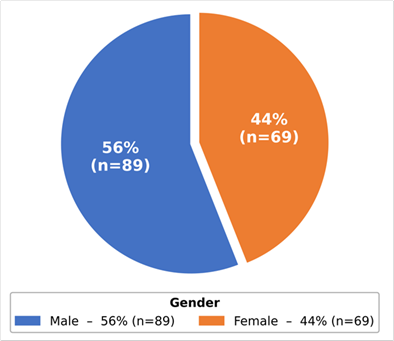
The present study evaluated the drug utilization pattern in patients with heart failure at a tertiary care center and demonstrated a predominance of symptomatic therapy along with the adoption of guideline-directed medical therapy (GDMT). It was evident from the findings of this study that heart failure is more prevalent in males than in females (Figure 1), which is consistent with the previous study findings [6].
Loop diuretics were the most frequently prescribed agents, 87% (Figure 2), reflecting their primary role in relieving congestion and symptomatic improvement. Among the loop diuretics, Furosemide (61%) was more commonly prescribed than Torsemide (25%) (Table 1). Similar high utilization of diuretics (around 80–85%) has been reported in other hospital-based heart failure drug utilization studies, particularly in South Asian populations [7]. While diuretics are essential for symptom control, they do not confer mortality benefit, underscoring the importance of optimizing disease-modifying therapy.
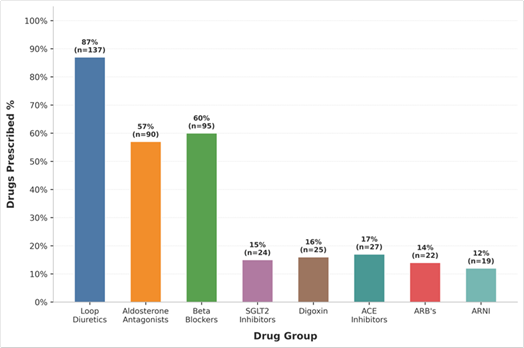
Aldosterone antagonists were prescribed in 57% (Figure 2) of patients, which is comparable to utilization rates reported in observational registries evaluating the real-world adherence to GDMT [8]. Among the aldosterone antagonists, the use of spironolactone was 55% and eplerenone 2% (Table 1). Their proven mortality benefit in HFrEF supports its broader use in eligible patients, although concerns regarding hyperkalemia and renal dysfunction may limit prescription in routine practice.
ACE inhibitors (17%) were prescribed more frequently than ARBs (14%) in the present study (Figure 2), which is in line with the guideline recommendation towards the use of ACE inhibitors as first-line therapy unless contraindicated [1].
Beta-blockers were prescribed in 60% (Figure 2) of patients. Although this reflects moderate adherence, it is lower than rates reported in large international registries. For example, national heart failure registries from Europe have documented beta-blocker utilization exceeding 75–80% in eligible patients [9]. Earlier registry data, such as the SOLVD study, also demonstrated underutilization of evidence-based therapies during earlier phases of guideline dissemination [5], highlighting persistent gaps between evidence and practice.
Among beta-blockers in our study, metoprolol (26%) and carvedilol (24%) were the most commonly used agents, followed by bisoprolol (6%) and nebivolol (4%) (Figure 3). International registry data indicate that metoprolol and bisoprolol are frequently preferred due to strong outcome data [2]. The predominance of metoprolol and carvedilol in the present study is consistent with guideline-endorsed agents for HFrEF [4].
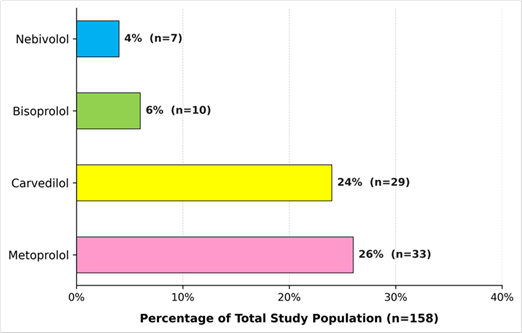
On analysis of patient-specific factors in the selection of drugs, it was evident that carvedilol has been used in patients with coexisting hypertension due to its additional alpha-blocking property, whereas metoprolol has been preferred in patients with ischemic heart disease and arrhythmias due to its cardioselective property. The lower utilization of bisoprolol could be due to local availability or prescribing familiarity. Nebivolol use, though limited, has been preferred for elderly patients or those requiring better tolerability.
Sacubitril/valsartan (12%) showed relatively low uptake, similar to findings from recent utilization trend analyses, where ARNI adoption remains gradual due to cost and access barriers [6]. Despite strong evidence demonstrating superiority over ACE inhibitors in reducing cardiovascular mortality and hospitalization, financial constraints may significantly limit its use in resource-constrained settings.
Digoxin was prescribed in 16% of patients, consistent with contemporary practice where its role is largely restricted to patients with atrial fibrillation or persistent symptoms despite optimized therapy [4]. The use of SGLT-2 inhibitors was limited to patients with heart failure along with Type 2 Diabetes Mellitus.
Drug selection in heart failure is influenced by multiple patient-related factors, including age, blood pressure, renal function, electrolyte status, co-morbidities (such as diabetes, COPD, atrial fibrillation), and prior drug intolerance. Economic factors and healthcare access also significantly impact prescribing decisions. The observed pattern in this study likely reflects a combination of clinical judgment, patient profile, drug tolerability, and affordability considerations.
Strengths and Limitations
Strengths
This study provides real-world drug utilization data from a tertiary care setting in South India, a region that is underrepresented in the global heart failure literature despite carrying a disproportionate burden of the disease. It also captures individual drug-level prescribing data and not merely drug class utilization - thereby offering a better understanding of prescribing behaviour than many comparable studies. The inclusion of both patient-related and socioeconomic determinants of therapy adds depth to the study.
Limitations
The most significant limitation of the study is that the sample size of 158 patients falls below the pre-calculated minimum of 383, which may limit the statistical precision of some estimates and reduce the generalizability of findings beyond the study centre. Also, it is a single-centre cross-sectional study; the results may not be representative of prescribing practices across other institutions or regions of South India.
Conclusion
Diuretics were the most commonly used group of drugs focusing on symptomatic management, followed by the use of neurohormonal antagonists. The patient-specific factors, such as clinical contraindications, economic considerations in the selection of the following drugs, such as ACE inhibitors/ARBs/ARNI, Beta-blockers and SGLT 2 inhibitors, play an important role in reflecting their utilization rates, and hence this remains an area for improvement as they are the life-prolonging drugs. Hence, future efforts should focus on overcoming these multi-dimensional barriers in order to facilitate the wider integration of guideline-directed medical therapy. Strengthening of multi-disciplinary approach by involving clinical pharmacologists for analyzing drug-drug interactions, monitoring of adverse effects and evidence based dose titrations, specialized nursing staffs trained in heart failure for education on fluid restriction and salt intake and tele-monitoring of symptoms, dieticians to take care of nutritional aspects, medical social workers for home visits and help in providing access to effective generic drugs for drugs such as ARNI that are cost effective to improve the long term outcomes for heart failure patients in South India.
Declarations
Conflicts of Interest
The authors declare that there is no conflict of Interest
Acknowledgements
The authors wish to express their sincere gratitude to the Head of Department, Cardiology, for granting permission to conduct this study.
Data Availability Statement
The data that support the findings of this study are available from the corresponding author upon reasonable request and subject to institutional approval.
Authors' Contribution Statement
All authors have read and agreed to the published version of the manuscript:
Conceptualization: Dr. K. Bhuvaneswari, Dr. K. Archana; Methodology: Dr. K. Bhuvaneswari, Dr. K. Archana; Software: Mr. Varun; Validation: Dr. K. Bhuvaneswari, Dr. K. Archana; Formal Analysis: Dr. K. Archana, Mr. Varun; Investigation: NA; Resources: Dr. K. Archana; Data Curation: Mr. Varun; Writing (Original Draft): Mr. Varun; Writing (Review and Editing): Dr. K. Bhuvaneswari, Dr. K. Archana; Visualization: Dr. K. Bhuvaneswari, Dr. K. Archana, Mr. Varun Supervision: Dr. K. Archana; Project Administration: Dr. K. Bhuvaneswari; Funding Acquisition: NA.