Introduction
Sepsis remains one of the leading causes of morbidity and mortality worldwide. Defined as a life-threatening organ dysfunction caused by a dysregulated host response to infection, sepsis constitutes a medical emergency that requires early recognition and prompt management to prevent progression to septic shock, multiple organ failure, and death [1-3]. Despite considerable advances in diagnostic and therapeutic strategies over the past decades, sepsis continues to represent a major global public health challenge and remains one of the leading causes of death among critically ill patients admitted to intensive care units (ICUs) [2,4].
According to the Global Burden of Disease (GBD) Study, approximately 49 million cases of sepsis and 11 million sepsis-related deaths occurred worldwide in 2017, accounting for nearly 20% of all global deaths [1]. More recent GBD analyses have confirmed that severe infections and their complications continue to impose a substantial burden of morbidity and mortality, particularly in low- and middle-income countries (LMICs) [5]. Consequently, the World Health Organization (WHO) has recognized sepsis as a global health priority and has called for strengthened surveillance systems, improved diagnostic capacity, and equitable access to evidence-based management, especially in resource-limited settings [3].
Within ICUs, sepsis accounts for a considerable proportion of admissions. International systematic reviews and meta-analyses have reported hospital mortality rates ranging from 25% to 35% among patients with sepsis, while mortality frequently exceeds 40–50% in patients with septic shock [2,6,7]. Patient outcomes are influenced by several factors, including advanced age, underlying comorbidities, delayed diagnosis, severity of organ dysfunction, multidrug-resistant bacterial infections, and the availability and quality of critical care resources [6,8,9].
In high-income countries such as France, continuous improvements in sepsis recognition, implementation of the Surviving Sepsis Campaign recommendations, availability of advanced hemodynamic monitoring, rapid microbiological diagnostics, mechanical ventilation, renal replacement therapy, and timely administration of appropriate antimicrobial therapy have contributed to progressive reductions in sepsis-related mortality [4,10]. Nevertheless, sepsis remains associated with substantial mortality, prolonged ICU stays, and considerable healthcare expenditures in these settings [4].
In contrast, the management of sepsis in resource-limited countries, particularly in sub-Saharan Africa, continues to face numerous challenges, including delayed healthcare access, limited intensive care capacity, inadequate diagnostic facilities, restricted availability of organ support therapies, shortages of trained healthcare personnel, and a high burden of severe community-acquired infections [3,11]. These constraints contribute to significantly higher mortality rates than those reported in high-income countries [7,11].
In the Democratic Republic of the Congo (DRC), epidemiological data on sepsis in intensive care remain scarce. However, the limited available evidence suggests particularly high mortality among critically ill septic patients. A recent prospective multicenter cohort study conducted in Lubumbashi identified septic shock, higher severity scores, mechanical ventilation, multiple organ dysfunction, and several biological abnormalities as independent predictors of ICU mortality, highlighting the impact of limited healthcare resources on patient outcomes [12]. Similar findings have been reported in other African countries, including Ethiopia, where mortality among septic ICU patients remains substantially higher than that observed in developed countries [13].
Several studies have consistently demonstrated that mortality in sepsis is associated with advanced age, pre-existing chronic diseases, acute kidney injury, neurological impairment, elevated serum lactate concentrations, high Sequential Organ Failure Assessment (SOFA) and Acute Physiology and Chronic Health Evaluation II (APACHE II) scores, as well as delays in the initiation of appropriate antimicrobial therapy [8,9,14,15]. Identifying these prognostic factors is essential for improving risk stratification and optimizing therapeutic strategies across different healthcare settings.
However, few studies have directly compared mortality rates and associated prognostic factors among septic patients admitted to ICUs operating under markedly different healthcare conditions, particularly between a well-equipped intensive care unit in a high-income country such as France and a resource-limited ICU in the Democratic Republic of Congo. Such comparisons may be helpful in understanding how differences in healthcare infrastructure, diagnostic capabilities, therapeutic resources, and clinical management influence patient outcomes.
Therefore, the present study aimed to compare the frequency of mortality and its associated factors among patients admitted to intensive care units for sepsis in a French tertiary-care hospital and in a tertiary hospital in the Democratic Republic of Congo.
Methods
Study Design and Setting
This multicenter retrospective comparative cohort study was conducted to compare the frequency of ICU mortality and its associated factors among adult patients admitted for sepsis in two healthcare settings with different levels of resources: a well-resourced setting in France and a resource-limited setting in the Democratic Republic of the Congo (DRC).
The study was conducted in four intensive care units (ICUs) from three tertiary-care hospitals. In the DRC, three ICUs from two tertiary referral hospitals located in Kinshasa participated in the study: two ICUs of Ngaliema Clinic and one ICU of Diamant Clinic. These hospitals provide tertiary critical care within a resource-constrained healthcare system. In France, the study included the ICU of the Grand Hôpital de l'Est Francilien (GHEF), Meaux site, a tertiary referral hospital equipped with advanced diagnostic facilities, comprehensive organ-support technologies, and multidisciplinary intensive care services.
Patients admitted to the three ICUs in Kinshasa constituted the resource-limited cohort, whereas those admitted to the ICU of the Grand Hôpital de l'Est Francilien, Meaux site, constituted the well-resourced cohort. The study included all eligible patients admitted between January 1, 2025, and May 31, 2025.
Participants
All consecutive adult patients (aged ≥18 years) admitted to one of the participating ICUs with a diagnosis of sepsis during the study period were screened for eligibility.
Eligible patients were those whose medical records documented sepsis according to the study operational definition. Consecutive exhaustive sampling was used to minimize selection bias.
Patients were excluded if their medical records lacked information regarding the primary outcome (ICU mortality) or key explanatory variables required for statistical analyses. Patients transferred from another ICU after more than 24 hours of admission were also excluded when complete baseline data were unavailable.
Operational Definitions
Sepsis was defined according to the Sepsis-3 concept as documented in the medical record, requiring evidence of suspected, probable, or microbiologically confirmed infection associated with at least one documented acute organ dysfunction.
Organ dysfunction was considered present when at least one of the following clinical conditions was documented: persistent hypotension requiring vasopressor therapy; acute respiratory failure requiring supplemental oxygen therapy, invasive mechanical ventilation, or documented oxygen desaturation; acute alteration of consciousness (confusion, obtundation, or Glasgow Coma Scale score <15); oliguria; or peripheral hypoperfusion characterized by cold extremities, mottling, prolonged capillary refill time, or clinical shock.
The quick Sequential Organ Failure Assessment (qSOFA) score was calculated whenever sufficient clinical information was available and was analyzed as a prognostic variable only. Owing to the retrospective design and the heterogeneous availability of physiological data across participating centers, qSOFA was not used as an inclusion criterion.
ICU mortality was defined as all-cause death occurring during the ICU stay.
Data Collection
Data were retrospectively extracted from paper-based and electronic medical records using a standardized case report form developed before study initiation. The same data collection procedures and operational definitions were applied across all participating centers to ensure data consistency.
Information was collected by trained investigators and subsequently verified to identify inconsistencies or missing information. Prior to statistical analysis, all patient identifiers were removed, and each participant was assigned a unique study identification number to ensure confidentiality.
Variables
The primary outcome variable was ICU mortality, defined as all-cause death occurring during the ICU stay.
The primary exposure variable was the healthcare setting, categorized as a well-resourced setting (France) or a resource-limited setting (Democratic Republic of the Congo).
Other explanatory variables included patients' demographic characteristics (age and sex), participating hospital and ICU, type of admission (medical or surgical), pre-existing comorbidities, qSOFA score at ICU admission, and the number of documented organ dysfunctions.
Infection-related variables included the presumed or confirmed source of infection, microbiological documentation, and the isolated pathogen(s), when available. Laboratory variables comprised blood lactate concentration categorized according to clinically relevant thresholds.
Treatment-related variables included the initial empirical antimicrobial therapy, subsequent adaptation or de-escalation of antibiotic treatment, the requirement for invasive mechanical ventilation and its duration, vasopressor therapy and its duration, and other organ-support interventions when available.
Outcome Measure
The primary endpoint was all-cause ICU mortality during the index ICU admission.
Bias
Several measures were implemented to reduce potential bias. Consecutive inclusion of all eligible patients minimized selection bias, while standardized operational definitions and identical data collection procedures across study sites reduced information bias. Multivariable regression analysis was used to control for potential confounding factors associated with ICU mortality.
Study Size
No formal sample size calculation was performed because of the retrospective observational design. Instead, exhaustive consecutive sampling was used, and all eligible patients admitted during the study period were included in the analysis.
Statistical Analysis
All statistical analyses were performed using R software (version 4.4.1). Continuous variables were assessed for normality using the Shapiro–Wilk test and graphical methods. Normally distributed variables were summarized as mean ± standard deviation (SD), whereas non-normally distributed variables were expressed as median and interquartile range (IQR). Categorical variables were presented as frequencies and percentages.
Baseline characteristics were analyzed separately within each cohort (France and Kinshasa) by comparing survivors and non-survivors. Continuous variables were compared using Student's t test or the Mann–Whitney U test, as appropriate, while categorical variables were compared using Pearson's chi-square test or Fisher's exact test.
Factors associated with ICU mortality were first explored using univariable logistic regression analyses performed separately for each cohort. For the French cohort, variables identified in the univariable analysis together with clinically relevant variables were included in the multivariable logistic regression model. For the Kinshasa cohort, the limited sample size allowed only variables significantly associated with ICU mortality in the univariable analysis (p < 0.05) to enter the multivariable model, reducing the risk of overfitting. Results are presented as odds ratios (ORs) with 95% confidence intervals (95% CIs). A two-sided p value < 0.05 was considered statistically significant.
Missing data were handled using complete-case analysis. Patients with missing information on the outcome or variables included in the regression models were excluded from the corresponding analyses. No imputation of missing data was performed.
Ethical Considerations
This study was conducted in accordance with the ethical principles of the Declaration of Helsinki and received ethical approval from the Ethics Committee of the School of Public Health, University of Kinshasa (Approval No. ESP/CE/85B/2026). Administrative authorization was obtained from the participating hospitals before data collection. Given the retrospective observational design of the study and the exclusive use of routinely collected, fully anonymized clinical data, the requirement for written informed consent was waived by the Ethics Committee in accordance with applicable institutional and national regulations. o protect patient privacy, all personal identifiers were taken out before data extraction, and each participant was given a unique study identification code. The anonymized database was password-protected and accessible only to the study investigators. No identifiable patient information was included in the analyses or dissemination of the study findings.
Results
Distribution of deaths in the two patient cohorts
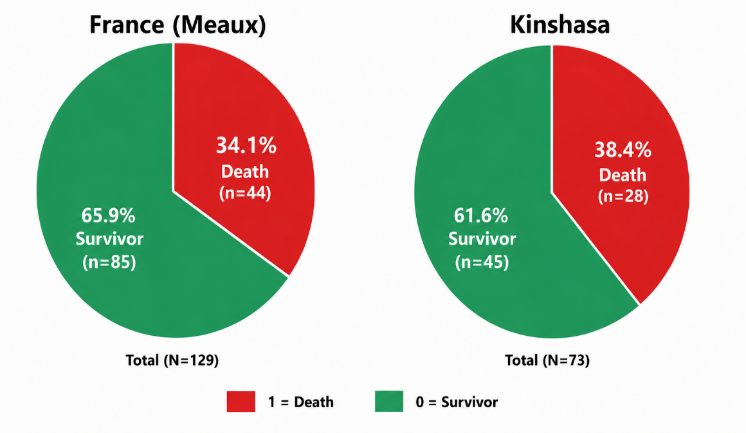
The figure below shows the distribution of clinical outcomes (survival and death) in the two patient groups studied, namely those from France (Meaux) and Kinshasa. It allows for a comparison of the proportions of deaths and survivors between the two groups.
Demographic and Clinical Characteristics According to ICU Outcome
Table 1 summarizes the demographic and clinical characteristics of patients based on ICU outcomes in both the high-income country (HIC) and low-income country (LIC) cohorts. In both cohorts, patients who died were significantly older than survivors (both p < 0.01). Diabetes mellitus was significantly associated with ICU mortality in the HIC cohort (p = 0.021) and showed a borderline association in the LIC cohort (p = 0.069). Renal insufficiency was significantly associated with mortality only in the LIC cohort (p = 0.017), whereas respiratory failure was associated with mortality exclusively in the HIC cohort (p < 0.01). No statistically significant associations were found between ICU mortality and sex, type of admission, cardiopathy in the LIC cohort, or immunosuppression.
| Variable | HIC Death (n=44) | HIC Survivor (n=85) | P | LIC Death (n=28) | LIC Survivor (n=45) | p |
| Age | 71.8 ± 11.0 | 65.7 ± 13.8 | <0.01 | 65.0 [48.8–76.2] | 50.0 [29.0–64.0] | <0.01 |
| Male sex | 26 (59.1) | 55 (64.7) | 0.53 | 17 (60.7) | 21 (46.7) | 0.24 |
| Type of admission, n (%) | 0.35 | 0.47 | ||||
| Medical | 39 (88.6) | 70 (82.4) | 24 (85.7) | 41 (91.1) | ||
| Surgical | 5 (11.4) | 15 (17.6) | 4 (14.3) | 4 (8.9) | ||
| Cardiopathy | 34 (77.3) | 47 (55.3) | 0.014 | 20 (71.4) | 27 (60.0) | 0.32 |
| Diabetes mellitus | 19 (43.2) | 20 (23.5) | 0.021 | 14 (50.0) | 13 (28.9) | 0.069 |
| Immunosuppression | 12 (27.3) | 23 (27.1) | 0.98 | 1 (3.6) | 1 (2.2) | 1.00 |
| Renal insufficiency | 9 (20.5) | 8 (9.4) | 0.079 | 8 (28.6) | 3 (6.7) | 0.017 |
| Respiratory failure | 15 (34.1) | 12 (14.1) | <0.01 | 1 (3.6) | 3 (6.7) | 1.00 |
Legend. Data are presented as mean ± standard deviation, median [interquartile range], or number (%), as appropriate. HIC: High-income country (France). LIC: Resource-limited setting (Democratic Republic of the Congo).
Disease Severity Indicators According to ICU Outcome
Disease severity at ICU admission was strongly associated with mortality in both healthcare settings (Table 2). In the HIC cohort, non-survivors had significantly higher mean qSOFA scores than survivors (2.61 ± 0.58 vs. 2.09 ± 0.65; p < 0.001). In the LIC cohort, a qSOFA score of 3 was observed predominantly among non-survivors (71.4%), whereas survivors most frequently presented with a qSOFA score of 2 (86.7%) (p < 0.001). Likewise, the number of organ dysfunctions was strongly associated with ICU mortality in both cohorts. Nearly all non-survivors had multiorgan dysfunction, while survivors more commonly presented with one or two organ dysfunctions (both p < 0.001).
| Variable | HIC Death (n=44) | HIC Survivor (n=85) | P | LIC Death (n=28) | LIC Survivor (n=45) | p |
| qSOFA category, n (%) | <0.001 | <0.001 | ||||
| 1 | 2 (4.5%) | 14 (16%) | 0 (0.0) | 3 (6.7) | ||
| 2 | 13 (30%) | 49 (58%) | 8 (28.6) | 39 (86.7) | ||
| 3 | 29 (65.5%) | 22 (26%) | 20 (71.4) | 3 (6.7) | ||
| Number of organ dysfunctions, n (%) | <0.001 | <0.001 | ||||
| One organ | 1 (2.3) | 28 (32.9) | 0 (0.0) | 23 (51.1) | ||
| Two organ | 2 (4.5) | 35 (41.2) | 1 (3.6) | 19 (42.2) | ||
| Multiorgan | 41 (93.2) | 22 (25.9) | 27 (96.4) | 3 (6.7) |
Legend. Data are presented as mean ± standard deviation (SD) or number (%). HIC: High-income country (France). LIC: Resource-limited setting (Democratic Republic of the Congo). qSOFA: quick Sequential Organ Failure Assessment score
Infection-Related, Laboratory, and Therapeutic Characteristics According to ICU Outcome
Table 3 presents the infection-related, laboratory, and therapeutic characteristics according to ICU outcome. In both cohorts, higher blood lactate concentrations were significantly associated with ICU mortality (p < 0.01 in HIC and p < 0.001 in LIC). Adaptation of antimicrobial therapy following antimicrobial susceptibility testing was associated with survival in the HIC cohort (p < 0.01), whereas no significant association was observed in the LIC cohort. Longer durations of antibiotic therapy and vasopressor treatment were significantly associated with mortality in the LIC cohort but not in the HIC cohort. The distribution of isolated pathogens differed significantly between survivors and non-survivors only in the HIC cohort (p < 0.01), while no association was observed for the source of infection in either setting.
| Variable | HIC Death (n=44) | HIC Survivor (n=85) | p | LIC Death (n=28) | LIC Survivor (n=45) | p |
| Blood lactate | 1.30 ± 0.82 | 0.87 ± 0.90 | <0.01 | 2.0 [1.0–2.0] | 0 [0–1.0] | <0.001 |
| Duration of antibiotic therapy | 5.95 ± 7.01 | 3.68 ± 5.23 | 0.062 | 4.0 [3.0–6.5] | 0 [0–0] | <0.001 |
| Duration of vasopressor therapy | 4.18 ± 4.89 | 2.75 ± 2.81 | 0.079 | 4.0 [3.0–5.5] | 2.0 [0–3.0] | <0.001 |
| Length of ICU stay | 7.75 ± 7.90 | 8.49 ± 6.82 | 0.60 | 4.0 [3.0–7.25] | 5.0 [3.0–6.0] | 0.81 |
| Empirical antibiotic therapy, n (%) | 0.24 | 0.099 | ||||
| Monotherapy | 17 (38.6) | 42 (49.4) | 5 (17.9) | 2 (4.4) | ||
| Combination therapy | 27 (61.4) | 43 (50.6) | 23 (82.1) | 43 (95.6) | ||
| Antibiotic adaptation after susceptibility testing, n (%) | <0.01 | 0.47 | ||||
| No adaptation | 28 (63.6) | 29 (34.1) | 24 (85.7) | 41 (91.1) | ||
| Adaptation | 16 (36.4) | 56 (65.9) | 4 (14.3) | 4 (8.9) | ||
| Source of infection, n (%) | 0.33 | 0.59 | ||||
| Undocumented | 4 (9.1) | 17 (20.0) | 0 (0.0) | 1 (2.2) | ||
| Pulmonary | 28 (63.6) | 45 (52.9) | 17 (60.7) | 24 (53.3) | ||
| Abdominal | 7 (15.9) | 18 (21.2) | 4 (14.3) | 7 (15.6) | ||
| Urinary | 3 (6.8) | 3 (3.5) | 3 (10.7) | 10 (22.2) | ||
| Other | 2 (4.5) | 2 (2.4) | 4 (14.3) | 3 (6.7) | ||
| Isolated pathogen, n (%) | <0.01 | 0.65 | ||||
| No pathogen isolated | 29 (65.9) | 31 (36.5) | 23 (82.1) | 35 (77.8) | ||
| Gram-negative bacilli | 10 (22.7) | 39 (45.9) | 3 (10.7) | 8 (17.8) | ||
| Gram-positive cocci | 5 (11.4) | 15 (17.6) | 2 (7.1) | 2 (4.4) |
Legend. Data are presented as mean ± standard deviation, median [interquartile range], or number (%). HIC: High-income country (France). LIC: Resource-limited setting (Democratic Republic of the Congo).
Multivariable Analysis of Factors Associated with ICU Mortality in the French cohort
A multivariable logistic regression model was performed to identify independent predictors of ICU mortality. As shown in Table 4, antibiotic adaptation according to antimicrobial susceptibility testing and the number of organ dysfunctions were significantly associated with ICU mortality. All other variables, including age, qSOFA score, lactate level, cardiopathy, diabetes mellitus, respiratory failure, and type of isolated pathogen, were not statistically significant after adjustment.
| Variable | Odds Ratio (OR) | 95% CI | p-value |
| Cardiopathy | 0.32 | 0.08 – 1.21 | 0.18 |
| Respiratory failure | 0.93 | 0.28 – 3.11 | 0.89 |
| Diabetes mellitus | 0.58 | 0.17 – 2.00 | 0.39 |
| Type of isolated pathogen | 1.27 | 0.49 – 3.29 | 0.61 |
| Antibiotic adaptation (post-antibiogram) | 4.81 | 1.12 – 20.59 | 0.034 |
| Age | 0.96 | 0.92 – 1.01 | 0.11 |
| qSOFA score | 0.64 | 0.23 – 1.77 | 0.42 |
| Lactate level | 0.90 | 0.48 – 1.70 | 0.74 |
| Number of organ dysfunctions | 0.05 | 0.01 – 0.20 | <0.001 |
Legend. CI: confidence intervals. OR: Odds ratios. qSOFA: quick Sequential Organ Failure Assessment score
Multivariable Analysis of Factors Associated with ICU Mortality in the Kinshasa cohort
After multivariable adjustment in the Kinshasa patients, only the qSOFA score remained independently associated with ICU mortality (OR = 1.62, 95% CI: 1.08–2.42; p = 0.020). This indicates that, after accounting for other clinical variables, disease severity at admission—captured by qSOFA—was the only robust predictor of ICU outcome in this setting. Other variables, including age, renal insufficiency, blood lactate concentration, and duration of antibiotic therapy, were not independently associated with mortality after adjustment, suggesting that their univariable associations were largely explained by confounding with overall illness severity. Importantly, this finding suggests these variables are clinically relevant, but their prognostic effect overlaps with the global severity of illness in this cohort.
| Variable | Odds Ratio (OR) | 95% CI | p-value |
| Age | 1.00 | 0.96–1.04 | 0.98 |
| Renal insufficiency | 1.28 | 0.51–3.24 | 0.60 |
| qSOFA score | 1.62 | 1.08–2.42 | 0.020 |
| Lactate level | 0.81 | 0.33–2.03 | 0.66 |
| Duration of antibiotic therapy | 1.02 | 0.84–1.25 | 0.83 |
Legend. CI: confidence interval; OR: odds ratio; qSOFA: quick Sequential Organ Failure Assessment score.
Discussion
This multicenter retrospective comparative cohort study evaluated ICU mortality and associated factors among septic patients admitted to a well-resourced ICU in France and three ICUs in Kinshasa, DRC. ICU mortality was 34.1% and 38.4%, respectively. Although numerically higher in the resource-limited setting, the study was not powered to assess between-group differences. These findings are consistent with published data reporting ICU mortality of 25–35% in sepsis and higher rates in low- and middle-income countries [2,7,9,11].
Disease severity at ICU admission was the main determinant of outcome in both cohorts. Older age was associated with mortality in univariable analyses but lost significance after adjustment, suggesting that its effect is mediated through acute illness severity rather than being an independent predictor [8,14].
Markers of organ dysfunction were the strongest predictors of mortality. Higher qSOFA scores and a higher number of organ dysfunctions were associated with ICU mortality in both cohorts. After adjustment, the number of organ dysfunctions remained the main independent predictor in the French cohort, whereas qSOFA remained the only independent predictor in Kinshasa. These findings are consistent with Sepsis-3 definitions and previous studies identifying organ failure burden as the key determinant of prognosis in sepsis [9,12,15].
Blood lactate and renal insufficiency were associated with mortality in univariable analyses but were not independently predictive after adjustment, indicating that their prognostic value is largely explained by overall severity of illness and multiorgan dysfunction [8,15].
Differences between settings were observed in microbiological diagnosis and antimicrobial management. In France, antibiotic adaptation following susceptibility testing was associated with outcome, likely reflecting improved diagnostic access and survivor-related bias. In Kinshasa, microbiological documentation and antibiotic adaptation were limited and not associated with outcome, consistent with restricted laboratory capacity in low-resource settings [3,11].
Overall, although the biological determinants of mortality remained consistent across settings, variations in access to diagnostics and critical care resources influenced the outcomes. Resource-limited ICUs face constraints in organ support, microbiological testing, and trained personnel, which may limit timely optimization of care [12,13].
Strengths and limitations
This study directly compares two healthcare systems using standardized definitions and separate multivariable analyses. However, its retrospective design, limited sample size, and absence of complete severity scores (SOFA, APACHE II) limit causal inference and generalizability.
Conclusion
ICU mortality in sepsis remains high in both settings. Disease severity, particularly organ dysfunction, is the main determinant of outcome. qSOFA appears useful for risk stratification in resource-limited environments. Strengthening early recognition of organ dysfunction and improving access to diagnostic and critical care resources may improve sepsis outcomes globally.
Declarations
Conflict of Interest
The authors declare that they have no competing interests.
Funding
No funding was received for this study.
Author Contributions
Christian Badiambile: Conceptualization, data collection, manuscript drafting. Arriel Makembi Bunkete: Study design, statistical analysis, data interpretation, manuscript revision. Wilfrid Mbombo: Data validation, data collection. Patrick Mukuna: Reviewed and approved the final manuscript. Patrick Kobo: Reviewed and approved the final manuscript. Vivien Hong Tuan Ha: Reviewed and approved the final manuscript. Gabriel Makeya: Data collection, critical revision of the manuscript. Audry Kwamadio: Data collection. Jules Kapiamba: Data collection. Athur Isamba: Data collection. Médard Bulabula: Methodological support, statistical guidance. Joseph Nsiala: Data collection, data interpretation. Berthe Barayigha: Supervision, manuscript revision. All authors read and approved the final version of the manuscrip
Acknowledgements
The authors thank the medical and nursing staff of the intensive care units in Kinshasa and Meaux for their support in data collection and patient management.
Consent for Publication
Not applicable.
Availability of Data and Materials
The datasets used and analyzed during the current study are available from the corresponding author on reasonable request.