1. Introduction
Dyslipidemia is an abnormal level of cholesterol or fats in the blood, characterized by elevated levels of low-density lipoprotein cholesterol (LDL-C) and triglycerides or decreased levels of high-density lipoprotein cholesterol (HDL-C) [1]. These dysregulated cholesterol levels pose a substantial risk factor for atherosclerotic cardiovascular diseases (ASCVD), leading to a public health crisis and worldwide deaths. Global reports estimate that dyslipidemia affects roughly 53% of United States adults [2,3]. While in India, the prevalence of dyslipidemia-related disease has amplified over the past thirty years. According to the Indian Council of Medical Research-India Diabetes (ICMR-INDIAB) study, 81.2% of the Indian adults are affected by this condition [4].
Multiple guidelines for cholesterol management have been proposed by the European Society of Atherosclerosis (EAS) and the European Society of Cardiology (ESC). Current guidelines recommend LDL-C targets based on an individual's cardiovascular risk profile. For primary prevention, an LDL-C goal of <100 mg/dL is generally recommended, whereas a target of <70 mg/dL is advised for secondary prevention [5]. The Cardiology Society of India (CSI) clinical practice guidelines advocate more stringent LDL-C goals, recommending targets of <40 mg/dL, <55 mg/dL, <70 mg/dL, and <100 mg/dL for patients categorized as extremely high-risk, very high-risk, high-risk, and moderate-/low-risk, respectively [6]. Statins remain the mainstay of preventive treatment to lower LDL-c levels in the bloodstream [5]. Statins such as atorvastatin and rosuvastatin are effective 3-hydroxy-3-methylglutaryl coenzyme A (HMG-CoA) reductase inhibitors that block the cholesterol production in the hepatocytes, resulting in reduced LDL-C plasma levels [7,8]. However, a large proportion of individuals is either not able to attain the target LDL-C levels with maximally allowed statin dose or unable to tolerate such doses due to deleterious side effects [7,8]. In this case, guidelines recommend combining statin with another cholesterol inhibitor, such as ezetimibe. Ezetimibe is a selective cholesterol absorption inhibitor that acts by blocking the Niemann–Pick C1-Like 1 (NPC1L1) transporter in the small intestine, thereby reducing intestinal cholesterol absorption and lowering circulating LDL-C levels [9]. Owing to its complementary mechanism of action, ezetimibe is frequently combined with statin therapy to achieve greater reductions in LDL-C. Several contemporary guidelines recommend the combination of rosuvastatin and ezetimibe for patients requiring intensive lipid lowering, particularly those with established atherosclerotic cardiovascular disease (ASCVD), secondary prevention indications, or other high-risk ASCVD profiles [5,6].
Multiple clinical trials and meta-analyses have demonstrated that combination therapy with rosuvastatin and ezetimibe produces substantial reductions in LDL-C levels compared with rosuvastatin monotherapy, with reported reductions ranging from approximately 50% to 70% in patients with hypercholesterolemia, including those at high cardiovascular risk and those with concomitant comorbidities [10-15]. The extent of LDL-C reduction is influenced by baseline lipid levels, cardiovascular risk profile, and statin dose. Owing to their complementary mechanisms of action, rosuvastatin and ezetimibe provide broader lipid modification, resulting in reductions in total cholesterol, triglycerides, and LDL-C, along with modest increases in HDL-C. Importantly, available evidence suggests that the addition of ezetimibe to rosuvastatin does not adversely affect the overall safety and tolerability profile of treatment [10-15].
The findings of the ROZEL trial further support the efficacy of the rosuvastatin–ezetimibe single-pill combination (SPC), demonstrating superior attainment of LDL-C targets compared with statin therapy alone in patients with hypercholesterolemia, while maintaining a favorable safety profile. Reflecting the growing evidence base supporting combination lipid-lowering therapy, fixed-dose combinations of rosuvastatin and ezetimibe have received regulatory approval from both the US Food and Drug Administration (FDA) and the European Medicines Agency (EMA) [16].
Despite the compelling evidence from clinical studies, there is a paucity of real-world data evaluating the effectiveness and safety of this combination in the diverse population, such as that in India. Therefore, the present study was designed to evaluate the real-world effectiveness and safety of rosuvastatin combined with ezetimibe in Indian patients with dyslipidemia.
2. Methodology
2.1 Study Design
The present clinical study was a multicenter, retrospective, cross-sectional, observational, real-world evidence study to evaluate the effectiveness and safety of the rosuvastatin and ezetimibe combination in patients with dyslipidemia. An appropriate Ethics Committee (EC) approved the study protocol. The study followed the “Ethical Guidelines for Biomedical Research on Human Participants’ outlined by the Indian Council of Medical Research (ICMR). The study employed existing patient data from routine clinical practice to understand the lipid management approach in India. The identity of patients used in this study was not revealed at any point during the study. Data from the prescriptions and laboratory reports were captured in the case record forms (CRFs).
2.2 Patient Population
A total of 2,736 patients from multiple centers across India were included in this retrospective study. Eligible participants were adults (≥18 years) diagnosed with dyslipidemia who had received rosuvastatin–ezetimibe combination therapy for at least 3 months and had available lipid profile data both before and after treatment initiation. Patients with incomplete medical records, missing lipid profile data, active liver disease, or severe renal impairment were excluded from the analysis. As this was a retrospective real-world study, treatment decisions, including initiation of rosuvastatin–ezetimibe therapy, were made at the discretion of the treating physician as part of routine clinical practice.
2.3 Study Assessments
The study primarily assessed the real-world effectiveness and safety of rosuvastatin combined with ezetimibe in Indian patients with dyslipidemia. Patient medical records were studied to gather information regarding clinical and demographic characteristics such as age, gender, geographic location (state, urban/rural), body weight, and body mass index (BMI). Lifestyle-related risk factors, including smoking status, alcohol consumption, and tobacco use, were assessed along with the presence of dyslipidemia-associated comorbid conditions to understand the risk profile of the patient population. Effectiveness assessments included changes in lipid parameters, including total cholesterol, LDL-C, HDL-C, and triglycerides from baseline to follow-up. Additionally, changes in body weight were also evaluated. Safety assessments were performed by reviewing patient records for the occurrence of adverse events during the therapy.
2.4 Statistical Analysis
All statistical analyses were performed using SAS (SAS Institute Inc., Cary, NC, USA). Continuous variables were summarized as mean and standard deviation (SD), while categorical variables were presented as frequencies and percentages. Baseline demographic characteristics, cardiovascular risk factors, comorbidities, and treatment dose distributions were analyzed descriptively to characterize the study population. All statistical analyses were performed using two-tailed tests, and a p-value of <0.05 was considered statistically significant. Comparisons between baseline and 3-month follow-up values for continuous efficacy parameters, including total cholesterol, LDL-C, HDL-C, triglycerides, and body weight, were performed using paired t-tests. The percentage change from baseline was also calculated for each parameter. Safety outcomes were summarized descriptively as the frequency and proportion of patients reporting adverse events.
3. Results
3.1 Demographics and Baseline Characteristics
A total of 2,736 patients were included in this real-world analysis. The mean age of the study population was 60.54 ± 11.96 years, and 65.0% of participants were male. Based on body mass index (BMI) classification, 45.5% of patients had a normal BMI, while 37.1%, 11.3%, and 6.1% were categorized as overweight, obese, and underweight, respectively (Table 1). Lifestyle-related cardiovascular risk factors were prevalent in the study population. Alcohol consumption was reported by 22.4% of patients, while 19.8% were active smokers and 19.4% reported tobacco use. A family history of dyslipidemia was documented in 30.9% of participants (Table 1).
| Variable | Category | N (%) |
| Age | Mean ± SD | 60.54 ± 11.96 |
| Gender | Male | 1,778 (65.0) |
| Female | 958 (35.0) | |
| BMI Category (kg/m²) | Underweight (<18.5) | 166 (6.1) |
| Normal (18.5–22.9) | 1,245 (45.5) | |
| Overweight (23.0–24.9) | 1,015 (37.1) | |
| Obese (>25) | 310 (11.3) | |
| Lifestyle Risk Factors | Active smoker | 543 (19.8) |
| Alcohol intake | 613 (22.4) | |
| Tobacco use | 531 (19.4) | |
| Family History | Family history of dyslipidaemia | 846 (30.9) |
3.2 Baseline Comorbid Conditions
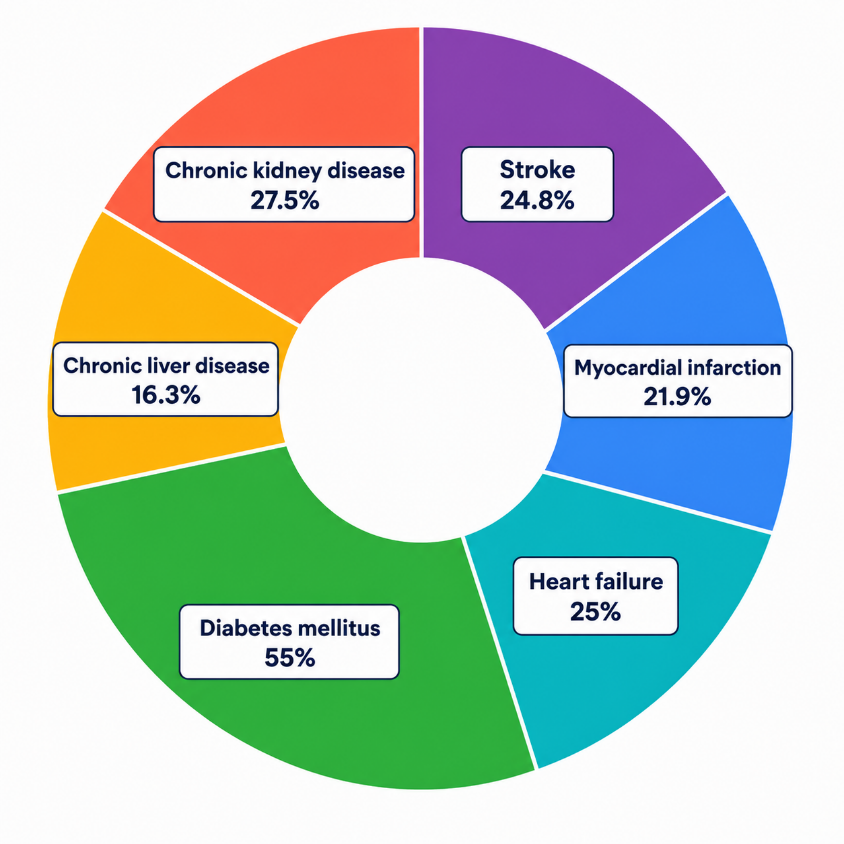
The study population exhibited a substantial burden of comorbid conditions. Diabetes mellitus (DM) was the most prevalent comorbidity, affecting 55.0% of patients, followed by chronic kidney disease (CKD) (27.5%), heart failure (HF) (25.0%), stroke (24.8%), myocardial infarction (MI) (21.9%), and chronic liver disease (16.3%) (Figure 1). Overall, more than one-fifth of the study population had established cardiovascular or renal comorbidities, reflecting the complex clinical profile of patients receiving rosuvastatin–ezetimibe therapy in routine practice.
3.3. Dose Distribution of Rosuvastatin–Ezetimibe Therapy
Among patients receiving combination therapy, the rosuvastatin–ezetimibe 10/10 mg formulation was the most commonly prescribed regimen, accounting for 58.8% of prescriptions. The remaining 41.2% of patients received the 20/10 mg formulation.
3.4. Changes in Lipid Parameters and Body Weight at 3 Months
Significant improvements in lipid parameters were observed after 3 months of rosuvastatin–ezetimibe therapy (Figure 2). Mean total cholesterol decreased from 237.16 ± 57.28 mg/dL at baseline to 191.10 ± 47.07 mg/dL at follow-up, representing a 19.4% reduction (p < 0.001). Similarly, mean LDL-C levels declined from 135.11 ± 52.07 mg/dL to 107.25 ± 37.64 mg/dL, corresponding to a 20.6% reduction (p < 0.001). Mean triglyceride levels decreased from 202.64 ± 68.81 mg/dL to 171.57 ± 58.65 mg/dL, reflecting a 15.3% reduction (p < 0.001). In contrast, mean HDL-C levels increased modestly from 56.76 ± 36.86 mg/dL to 57.47 ± 30.70 mg/dL, representing a 1.3% increase (p < 0.001).
A statistically significant reduction in body weight was also observed during follow-up. Mean body weight decreased from 74.05 ± 10.38 kg at baseline to 70.74 ± 9.72 kg at 3 months, corresponding to a 4.5% reduction (p < 0.001).
3.5 Safety Outcomes
Adverse events were infrequently reported during the study period. Overall, 6 patients (0.2%) experienced at least one adverse event. The reported adverse events were mild in nature and included musculoskeletal pain and elevated alanine aminotransferase (ALT) levels. No serious adverse events were documented during the study period.
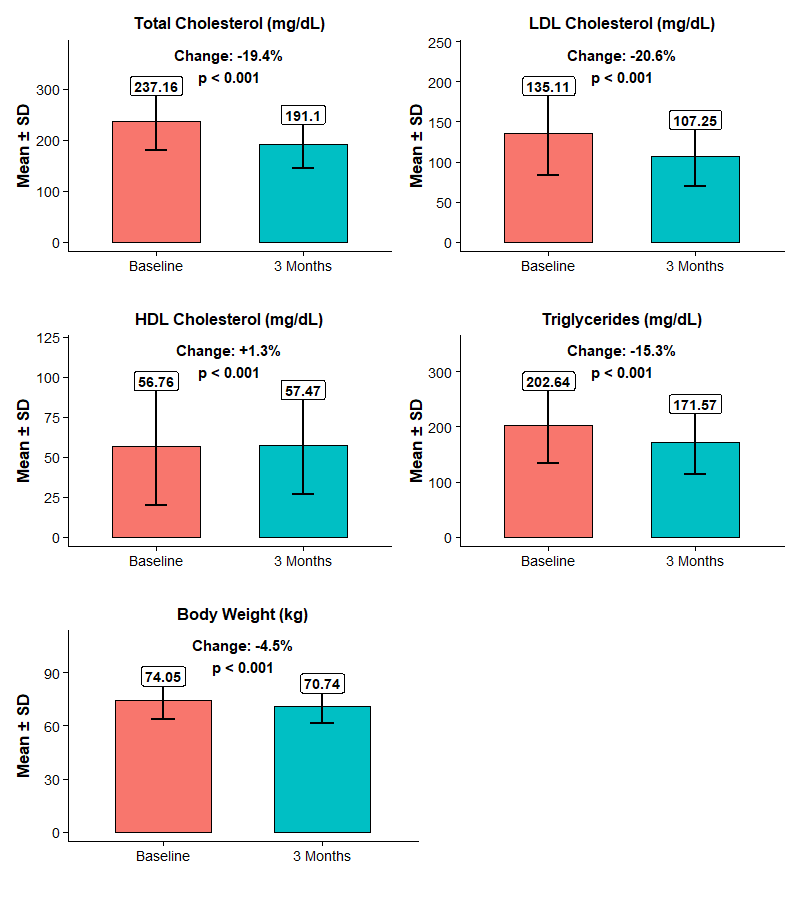
Mean values (±SD) of total cholesterol, LDL-C, HDL-C, triglycerides at baseline and after 3 months of treatment in 2,736 patients with dyslipidemia. All changes from baseline were statistically significant (p < 0.001).
4. Discussion
In this retrospective, real-world, multicenter study, the demographic and clinical characteristics of the cohort reflected a high-risk dyslipidemia population. The mean age of the study population was above 60 years, with a predominance of male patients, consistent with the greater burden of cardiovascular risk typically observed among older men. Nearly half of the cohort was overweight or obese, and lifestyle-related risk factors were common. The study population also had a substantial cardiometabolic comorbidity burden, including DM, HF, stroke, and MI. This clinical profile suggests that rosuvastatin plus ezetimibe was prescribed to a complex, high-risk Indian population requiring intensive lipid-lowering therapy, thereby enhancing the real-world relevance of the observed lipid-lowering effects.
Rosuvastatin plus ezetimibe therapy was associated with clinically meaningful improvements in key lipid parameters among high-risk Indian patients with dyslipidemia. The findings demonstrated consistent reductions in atherogenic lipids, including LDL-C, total cholesterol, and triglycerides, along with a modest increase in HDL-C levels. These improvements were observed in a population with a high prevalence of comorbidities such as DM, CKD, and established cardiovascular disease. A significant reduction in body weight was also observed over the 3-month follow-up period. Although a statistically significant reduction in body weight was observed during follow-up, this finding should be interpreted cautiously. Given the retrospective design and the high burden of comorbidities, changes in body weight may have been influenced by concurrent lifestyle interventions, dietary modification, or other co-administered therapies. Therefore, the observed reduction cannot be attributed solely to rosuvastatin–ezetimibe therapy. The safety findings indicated that the combination therapy was well tolerated, with very few adverse events reported. Collectively, these observations support the effectiveness of rosuvastatin plus ezetimibe therapy in routine clinical practice among patients at elevated cardiovascular risk.
The efficacy findings of the present study, particularly the 20.6% reduction in LDL-C, are consistent with those reported in previous randomized clinical trials (RCTs) and meta-analyses. The ROZEL phase 3 RCT demonstrated that a single-pill combination (SPC) of rosuvastatin and ezetimibe at low doses significantly reduced LDL-C levels by 21.98% in patients with hypercholesterolemia and was superior to rosuvastatin 10 mg monotherapy, which achieved an 8.12% reduction [11]. Choi et al. reported that an SPC containing rosuvastatin 10 mg and ezetimibe 10 mg was non-inferior to rosuvastatin 20 mg in reducing LDL-C levels among ASCVD patients with T2DM (20.5% vs. 13.5%) [10]. Similarly, a phase 4 study by Moon et al. showed that the combination of moderate-intensity rosuvastatin and ezetimibe resulted in greater improvements in lipid parameters (63.90% vs. 55.44%) and enabled a higher proportion of high-risk ASCVD patients with T2DM to achieve LDL-C targets compared with high-intensity rosuvastatin alone [15]. Other RCTs have also demonstrated the superior efficacy of combination therapy over monotherapy, reporting substantial LDL-C reductions, including those by Yang et al., Kim et al. and Hong et al.[17-19].
Although the magnitude of LDL-C reduction observed in the present study was lower than that reported in several RCTs, those studies were conducted under highly controlled conditions with stricter eligibility criteria, fixed-dose treatment regimens, and closer monitoring of treatment adherence. In contrast, the current study reflects routine clinical practice and includes a broader spectrum of patients with multiple comorbidities and varying baseline characteristics. It is also possible that a proportion of patients were receiving prior lipid-lowering therapy before initiation of rosuvastatin–ezetimibe combination treatment, which may have influenced the magnitude of LDL-C reduction observed. Despite the relatively lower percentage reduction, the observed improvement in LDL-C remained clinically meaningful in this high-risk population. However, the reduction remained below the ≥50% threshold generally recommended for high-risk patients by contemporary guidelines [5]. These findings suggest that while combination therapy significantly improved lipid parameters, some patients may require closer follow-up, optimization of treatment adherence, dose intensification, or additional lipid-lowering therapies to achieve recommended LDL-C targets.
The safety findings of the present study are also consistent with those reported in clinical trials, including the ROSE-CH study conducted by Ji et al., which demonstrated a favorable safety profile for rosuvastatin–ezetimibe combination therapy, even in high-risk populations with multiple comorbidities [10,11,14,15]. A meta-analysis of 11 studies involving 1,963 participants further confirmed the efficacy of combination therapy in reducing total cholesterol, LDL-C, and triglyceride levels in individuals with high-risk ASCVD [13]. The reduction in body weight observed in the present study should be interpreted with caution. Given the substantial comorbidity burden within the study population, this finding cannot be attributed solely to rosuvastatin–ezetimibe therapy. Although patients in the current study had higher baseline LDL-C levels and a greater prevalence of comorbidities than those enrolled in many RCTs, the overall pattern of response, particularly the reduction in LDL-C, was consistent with published evidence.
International guidelines issued by the ESC and EAS emphasize aggressive LDL-C lowering as a key strategy for reducing cardiovascular risk. These guidelines recommend LDL-C targets of <70 mg/dL for high-risk patients and <55 mg/dL for very high-risk individuals, including those with established ASCVD, advanced chronic kidney disease, or diabetes with additional risk factors [5]. When LDL-C goals are not achieved with statin therapy alone, the addition of ezetimibe is recommended. In the present study, rosuvastatin plus ezetimibe therapy produced substantial reductions in LDL-C levels among patients with dyslipidemia. The magnitude of LDL-C lowering observed supports the clinical utility of early combination therapy, particularly in patients with multiple comorbidities and elevated cardiovascular risk.
The study has several strengths, including its large sample size, multicenter design, and inclusion of a diverse real-world population representative of routine clinical practice across India. It provides valuable insights into treatment patterns, effectiveness, and safety among patients with multiple comorbidities, thereby enhancing the external validity of the findings. Nevertheless, certain limitations should be acknowledged. The retrospective observational design precludes causal inference and is subject to selection bias. The absence of a comparator arm, lack of LDL-C target attainment analysis, potential underreporting of adverse events, and relatively short follow-up period should be considered when interpreting the findings.
Taken together, this real-world observational study provides evidence supporting the effectiveness and tolerability of rosuvastatin plus ezetimibe combination therapy in Indian patients with dyslipidemia.
5. Conclusion
In this retrospective real-world analysis of Indian patients with dyslipidemia, rosuvastatin plus ezetimibe therapy was associated with significant improvements in lipid parameters and demonstrated a favorable tolerability profile. These findings highlight the potential role of combination lipid-lowering therapy in the management of high-risk patients who may require additional LDL-C reduction beyond that achieved with statin therapy alone. The results provide real-world evidence supporting the effectiveness of rosuvastatin–ezetimibe therapy in routine clinical practice. Further prospective studies with longer follow-up and controlled study designs are warranted to evaluate long-term cardiovascular outcomes and optimize treatment strategies across diverse patient populations.
6. Declarations
Acknowledgements
We acknowledge the assistance of Gunjan Chauhan and the professional writing team in manuscript preparation.
Conflict of interest declaration
Dr. Bhagyashree Mohod, Dr. Mayur Mayabhate, Dr. Akhilesh Sharma are full-time employees of Alkem Laboratories Ltd.
Funding/ financial support: None
Ethical Clearance
Approved by Independent Ethics Committee