Introduction
Cardiovascular diseases (CVD) are a major cause of death among patients with advanced renal diseases [1,2]. However, the risk of developing cardiac dysfunction is not limited to end-stage kidney disease [3,4]. Several studies have shown that serum creatinine is an independent predictive marker for assessing renal function (GFR) [5]. Patients undergoing dialysis have a higher prevalence of coronary artery plaques [6,7], but the direct association of renal function with plaque severity remains unclear. It is therefore important to investigate whether renal function indices can directly predict the risk of CAD.
Liver function tests are routinely performed in clinical practice. Although chronic low serum albumin concentration is not directly related to the occurrence of CVD, a sudden decrease may serve as an early warning sign for cardiac disorders. Studies have reported a significant correlation between the aspartate aminotransferase/alanine aminotransferase ratio (AAR) and chronic liver diseases, as well as adverse long-term cardiac outcomes [8]. However, another study found no association between liver function indices and coronary atherosclerosis [L/C]. These conflicting findings suggest that a combination of liver and renal function markers may be useful in predicting CAD.
Inflammation plays a crucial role in the development and progression of cardiovascular disorders. Serum albumin is uniquely affected by inflammation and infection [9]. Lower serum albumin levels have been associated with a higher risk of myocardial infarction (MI), stroke and poor CAD outcomes [10-12]. Low albumin and globulin concentrations have also been shown to predict adverse cardiovascular events in patients with stable CAD [13-15]. Furthermore, decreased serum albumin concentration has independently proven to be a useful predictor of CAD in patients with preserved kidney function [16]. These outcomes have also been linked to cigarette smoking, which increases susceptibility to inflammatory responses [8,17].
Atherosclerotic disease, a leading cause of mortality worldwide, is characterized by chronic arterial inflammation and lipid peroxidation [18]. Bilirubin acts as a potent antioxidant and restricts lipid peroxidation [19-22]. However, the role of serum bilirubin in adverse cardiovascular events remains controversial [23]. Kunutsor et al.,(2015) suggested an independent inverse association between serum bilirubin concentrations and cardiovascular disorders [24], while other evidence indicates a possible non-linear relationship with CAD occurrence [25].
Transaminases have long been used to assess liver function [26]. Aspartate aminotransferase (AST) is present in several tissues, including the liver, kidney and lungs, whereas alanine aminotransferase (ALT) is mainly found in hepatocytes. Hepatocellular injury results in the release of AST and ALT into the bloodstream [27]. A study evaluating the alanine aminotransferase-to-lymphocyte ratio (ALR) concluded that ALR can independently predict coronary angiogram plaques in CAD patients undergoing percutaneous coronary investigations [28].
Although creatinine is primarily considered a renal marker, it has also been linked to insulin resistance, dyslipidemia and coronary artery disorders. Bagheri et al. (2019) reported a significant correlation between serum creatinine and renal function markers, but not with insulin or inflammatory markers [29]. Based on existing evidence, this study aims to investigate whether a combination of liver and kidney function indices can predict the risk of CAD incidence.
Methodology
In this cross-sectional retrospective study, we included patients who had undergone a coronary angiogram due to angina or chest pain. These patients were admitted to the cardiology department at a tertiary hospital in southern India. We conducted the study after receiving ethical clearance from the Manipal Institutional Ethics Committee (IEC 503/2017). The study was conducted in the Department of Physiology at Kasturba Medical College over an 11-month period in 2017. The study population included participants between 35 and 70 years of age, with no history of acute or chronic cardiac, liver, or renal disorders. We enrolled 131 age-matched male cases and controls, as well as 97 age-matched female cases and controls, for a total of 528 participants.
In the presented scientific article, competent researchers were enlisted to conduct a retrospective case-control study that gathered a comprehensive assemblage of data from electronic medical databases. The data curation process included basic demographic details, past hospitalizations and medical histories, and family histories of diseases. Coronary angiography was performed as a routine check-up for each individual, as advised by the cardiology consultant. Based on the angiogram report, individuals were categorized as cases or controls. Cases were defined as individuals with at least 50% stenosis in the epicardial artery, while controls were individuals with less than 50% stenosis.
Blood samples were collected from each participant, and serum was prepared and tested to evaluate liver and kidney function. Liver function test (LFT) parameters included total bilirubin, direct bilirubin, serum albumin, serum globulin, aspartate aminotransferase (AST), alanine transaminase (ALT), and alkaline phosphatase (ALP). Kidney function test (KFT) parameters included serum urea, creatinine, sodium, and potassium. The aim of the study was to assess liver and renal function indices for early detection and prediction of CAD.
Statistical Analysis
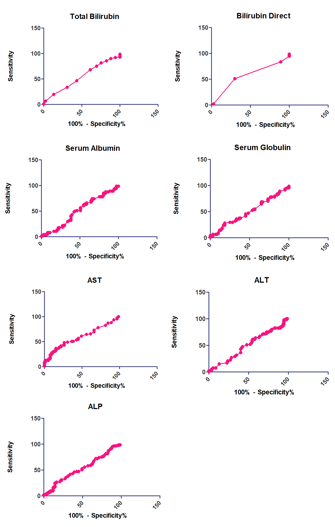
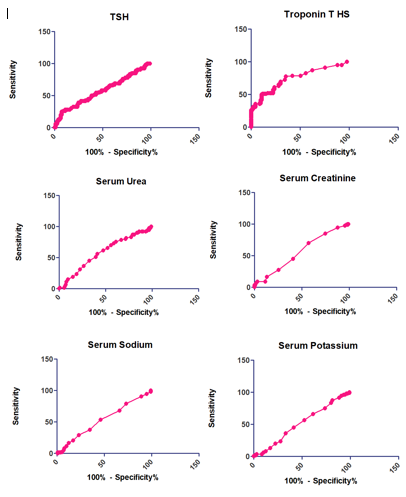
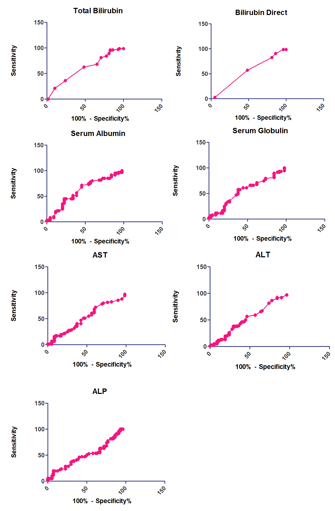
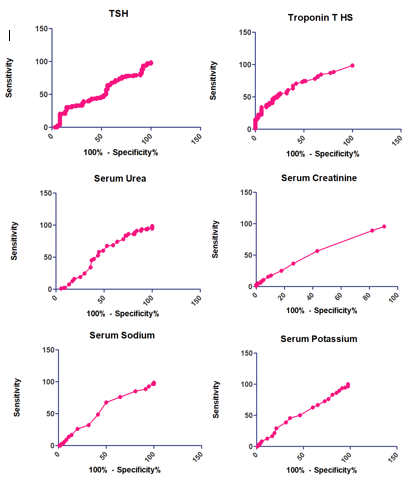
The curated data were analyzed using Graphpad Prism version 5.0, and the results were reported as median (interquartile range) due to the non-skewed distribution of data. Receiver operating characteristic (ROC) analysis was performed to determine the diagnostic performance of liver and renal function parameters. The ROC analysis involved determining the optimal cut-off, area under the curve (AUC), sensitivity, specificity, and Youden Index. The level of significance was set at a p-value of less than 0.05.
Results
Comparison of liver and kidney function indices in CAD cases and controls
Table I summarizes the general profile measurements of the liver function test and kidney function test in the study sample (males and females). The total number of study population included 228 subjects, out of which 57% (n=131) were males and 43% (n=97) were females. Both male and female cases and controls were matched by age, wherein the mean age are such as: 55.27±8.59 (male cases), 55.34±8.58 (male controls), 57.84±7.72 (female cases) and 57.90±7.85 (female controls) respectively. Statistical analysis exhibits a statistical significant difference in bilirubin direct, AST and serum urea in male cases compared to controls, whereas a significant difference in serum albumin and serum creatinine in female cases as and when compared to controls.
| Characteristics | Male cases (n=131) | Male controls (n=131) | p-value | Female cases (n=97) | Female controls (n=97) | p-value |
| Total bilirubin | 0.60(0.40-0.78) | 0.60(0.40-1.00) | 0.0531 | 0.40(0.30-0.60) | 0.38(0.10-0.50) | 0.0737 |
| Bilirubin direct | 0.10(0.10-0.20) | 0.20(0.20-0.30) | 0.0002 | 0.10(0.10-0.20) | 0.20(0.10-0.20) | 0.4421 |
| Serum albumin | 4.32(4.20-4.60) | 4.33(4.08-4.60) | 0.8138 | 4.32(4.05-4.59) | 4.10(3.78-4.41) | 0.0468 |
| Serum globulin | 2.80(2.53-3.10) | 2.90(2.61-3.30) | 0.1766 | 3.14(2.70-3.31) | 3.00(2.60-3.26) | 0.3056 |
| AST | 31.0(20.0-60.0) | 24.0(19.0-38.0) | 0.0254 | 30.0(21.0-41.5) | 28.0(19.0-42.0) | 0.6830 |
| ALT | 25.00(18.00-42.25) | 26.00(17.00-42.75) | 0.9147 | 20.50(16.00-36.75) | 19.00(15.00-36.00) | 0.5129 |
| ALP | 82.00(67.50-98.50) | 79.00(67.00-92.00) | 0.4236 | 84.0(68.0-105.8) | 84.0(71.0-103.5) | 0.7920 |
| TSH | 1.85(1.13-2.97) | 2.21(1.50-3.17) | 0.0520 | 2.485(1.195-3.450) | 2.32(1.48-3.82) | 0.5841 |
| Troponin T hs | 0.066(0.011-0.737) | 0.009(0.006-0.020) | <0.001 | 0.039(0.009-0.390) | 0.011(0.005-0.027) | 0.0002 |
| Serum urea | 20.0(17.0-26.0) | 23.0(18.0-30.0) | 0.0230 | 21.00(17.50-27.00) | 24.00(16.00-30.25) | 0.4432 |
| Serum creatinine | 1.0(0.9-1.2) | 1.0(0.8-1.2) | 0.0736 | 0.8(0.7-1.0) | 0.7(0.7-0.9) | 0.0317 |
| Serum sodium | 139.0(137.0-141.0) | 140.0(138.0-142.0) | 0.3140 | 139.0(136.0-140.0) | 139.5(137.0-141.0) | 0.1920 |
| Serum potassium | 4.30(4.08-4.50) | 4.30(4.00-4.60) | 0.6521 | 4.360±0.5139 | 4.314±0.5096 | 0.5288 |
ROC curves for assessing accuracy of predictors for CAD
Table II indicates the AUC, optimal cut-off, measurements of sensitivity and specificity, Youden Index for encapsulating the diagnostic accuracy of liver and kidney function indices in prediction of CAD for both males and females. The ROC curve analysis was performed so as to evaluate the diagnostic predictability of a parameter and effectively correlate it with other markers. Outliers from the male and female control group were culminated and optimal cut-off points were determined. Both liver and kidney function indices could not demonstrate acceptable discrimination in ROC with value >0.7 in AUC.
| Characteristics | Males/Females | AUC | Optimal Cut-off | Sensitivity (%) | Specificity (%) | Youden Index |
| Total bilirubin | Males | 0.5398 | <0.65 | 68.48 | 38.42 | 0.06 |
| Females | 0.5895 | <0.45 | 62.67 | 51.72 | 0.15 | |
| Bilirubin direct | Males | 0.5679 | <0.15 | 51.09 | 69.86 | 0.21 |
| Females | 0.5361 | <0.15 | 57.33 | 51.72 | 0.09 | |
| Serum albumin | Males | 0.5021 | <4.415 | 62.16 | 45.21 | 0.07 |
| Females | 0.6146 | >4.13 | 71.67 | 54.55 | 0.27 | |
| Serum globulin | Males | 0.05051 | <2.765 | 45.95 | 55.00 | 0.01 |
| Females | 0.5589 | >3.125 | 57.63 | 62.22 | 0.20 | |
| AST | Males | 0.5954 | >30.5 | 50.54 | 63.74 | 0.14 |
| Females | 0.5206 | >25.5 | 60.53 | 44.07 | 0.05 | |
| ALT | Males | 0.5008 | <29.5 | 59.78 | 45.65 | 0.06 |
| Females | 0.5331 | >19.5 | 56.58 | 53.45 | 0.1 | |
| ALP | Males | 0.5342 | >86.5 | 41.94 | 65.93 | 0.08 |
| Females | 0.5135 | <78.5 | 40.79 | 63.16 | 0.04 | |
| TSH | Males | 0.5760 | <2.265 | 58.18 | 51.38 | 0.09 |
| Females | 0.5257 | <2.81 | 64.10 | 44.0 | 0.08 | |
| Troponin T hs | Males | 0.7505 | >0.0105 | 77.67 | 64.52 | 0.43 |
| Females | 0.6832 | >0.0135 | 67.09 | 61.29 | 0.29 | |
| Serum urea | Males | 0.5815 | <22.5 | 61.83 | 52.71 | 0.15 |
| Females | 0.5325 | <22.5 | 58.06 | 55.32 | 0.13 | |
| Serum creatinine | Males | 0.5636 | >0.95 | 70.00 | 43.08 | 0.13 |
| Females | 0.5878 | >0.75 | 56.84 | 56.84 | 0.14 | |
| Serum Sodium | Males | 0.5359 | <139.5 | 53.85 | 53.85 | 0.08 |
| Females | 0.5546 | <139.5 | 67.71 | 50.0 | 0.19 | |
| Serum Potassium | Males | 0.5162 | >4.25 | 56.92 | 47.69 | 0.05 |
| Females | 0.5300 | >4.45 | 45.83 | 64.21 | 0.1 |
Discussion
A reversed interconnection of increased serum bilirubin concentration with the appearance and severity of coronary artery plaques have been intimidated. The protective effects of serum bilirubin with regard to the existence and intensity of plaques or stenosis have recently been established wherein serum bilirubin levels were inversely proportional to atherosclerosis in a dose-dependent format [30]. Atherosclerosis causes attenuation of vascular nitric oxide via oxidization of low-density lipoproteins (LDL) which further leads to the stiffening of the arterial wall thereby ultimately leading to platelet aggregation and thrombus formation. On the contrary, the anti-oxidative properties of bilirubin inhibits systemic inflammatory response therewith inhibiting the aggregation of platelets [31].
Evidence proves bilirubin to have an anti-inflammatory, anti-oxidative and anti-proliferative properties. A causal relationship between the presence of CAD and low serum bilirubin concentration is yet to be established. In our study, the total bilirubin concentration between the cases and controls were comparable whereas direct bilirubin concentration displays a significant fall among the male cases as compared to the controls. The anti-oxidative effect of bilirubin might be partly related to the inhibition of xanthine oxidase, which is a common phenomenon in hyperuricemia [32]. As hyperuricemia is closely associated with dyslipidemia and insulin resistance, the linkage between serum levels of bilirubin and the occurrence of coronary artery plaques might be underlined in these mechanisms.
As discussed, severe pathological conditions can lead to tissue damage which further accelerates the release of AST thereby denoting AAR as a potential biomarker. Elevated AAR has proven to be an independent predictive biomarker in patients with arrhythmogenic cardiomyopathy [33], which is at par with the outcome in our study. Our results are consistent with previously published study wherein the authors have conducted a multivariate regression analysis so as to conclude AAR as an independent predictive marker for adverse cardiovascular mortality and cardiac mortality [34]. The probable explanation for this mechanism is an elementary, underlying cardio-hepatic inter-linkage that correlates the reduced hepatic blood flow and decreased concentration of ALT with myocardial dysfunction thereby further correlating the AAR with coronary artery plaques.
Lower levels of serum albumin is typically in association with all cardiac-related myopathies and related deaths [35,36]. On other words, an increase in serum albumin level expedites into a marked reduction in coronary heart disease and cardiovascular mortality rate [37]. Our study displays a contradictory result as the serum albumin concentration decreases in the male cases compared to controls, whereas significantly rises among the female cases compared to the respective controls. Scientists recommends the correlation to be a reason for the enormous conventional risk factors associated with CAD [35]. Even though serum albumin has never been identified as a marker of the coronary arterial dysfunction, the substantial lack of possible pathogenesis of the effect of albumin on CAD prevalence makes it a potential research topic.
Serum creatinine is considered to be a traditional potential risk factor of CAD among Chinese population [2]. In our study, the serum creatinine levels are comparable among the male cases and controls. Although among females, the serum creatinine concentration significantly improved the risk of CAD prediction. Our study therefore concurs with previous studies [38-40], thereby validating the results. Contrarily, a glance at the serum urea concentration which normally rises in case of CAD has drastically reduced among the cases in our study group. The elevation of serum urea in cardiovascular events usually takes places as a result of decreased glomerular filtration rate (GFR), increased tubular reabsorption of urea as well as rise in the uptake of urea concentration for excretion. The reduction in serum urea in patients with CAD remains open for a debate.
Despite of the extensive nature of our study design and the effort to simultaneously correlate the liver and kidney function parameters with CAD, there are some major potent limitations in our study. First of all, our study patients are only those individuals who have undergone a coronary angiogram in a single-centric, tertiary care unit of South India. As such, these patients represents only a sub-set of the population affected by CVD thereby do not exactly reflects the actual scenario of patients with adverse cardiac events. Secondly, the sample size is not adequate enough. Even though it was appropriately generated, most of the liver and kidney function indices fails to detect the exact correlation with the incidences of CAD. Hence, it is recommended to conduct a similar study plan in a large-scale cohort. Third, a prospective randomized clinical trial would prove to be more effective. Fourth, it is paramount to apply a similar study design even in the younger generation to validate the generalization of the study. Fifth, owing to the observational nature of the study design, the correlation of the liver and kidney function indices along with the mortality rate of the patients were not possible.
Conclusion
To summarize, we conclude that patients with at least 50% stenosis in the epicardial artery displays very little changes in liver or kidney function indices. We fail to enumerate an inter-relationship between the liver or renal dysfunction with the incidence or severity of CAD and risk of mortality. Probably an all-inclusive, wide ranged prospective study would be able to find out the associated co-relationship.
Declarations
Acknowledgement
All the authors who are directly involved in the study would sincerely like to thank the participants of the study for successful data curation and completion of the work. We would also like to show our sincerest gratitude to all the staffs of the Department of Physiology and Department of Cardiology of Kasturba Medical College, Manipal, for their immeasurable help during data collection.
Conflict of Interest
The authors declare that there are no competing interests related to this study.
Financial support
There were no financial support received during the conduct of this study.
Authors’ Contributions
All authors contributed substantially to the conception and design of the study, literature review, data acquisition, data curation, statistical analysis, interpretation of findings and manuscript preparation. The authors were also involved in scientific advising, critical revision of the manuscript for important intellectual content, and overall supervision of the work. All authors have reviewed, approved and agreed to the final version of the manuscript and accept responsibility for the integrity and accuracy of the work.
Ethical Clearance
The study was conducted in compliance with the ethical guidelines established by the Institutional Ethics Committee and adhered to the principles outlined in the Declaration of Helsinki (1964), along with its later revisions and amendments. Prior to commencement, ethical approval was obtained from the Institutional Ethics Committee (Approval No. IEC 503/2017).