Introduction
The precise quantification of CD34+ hematopoietic stem cells (HSC) remains a fundamental prerequisite for the success of hematopoietic stem cell transplantation (HSCT), as it serves as the primary predictor for stable hematologic recovery [1]. Clinical data suggest that a threshold of at least 2 x 10⁶ CD34+ cells/kg body weight is necessary to ensure consistent neutrophil and platelet engraftment, whereas sub-optimal doses are frequently linked to higher rates of graft failure [2,5]. To minimize inter-laboratory discrepancy, the International Society of Hematotherapy and Graft Engineering (ISHAGE) established a standardized four-parameter gating protocol, which is currently regarded as the definitive method for stem cell enumeration [3,4]. This protocol is typically executed using either a single-platform (SP) approach, which utilizes internal bead standards for direct calculation, or a dual-platform (DP) approach that relies on the integration of flow cytometric data with external white blood cell counts from a hematology analyzer [3,6]. While SP method is often cited for superior reproducibility, DP methods continue to provide a cost-effective alternative in resource-constrained clinical settings [3,6]. Consequently, validating the statistical agreement between SP and DP methodologies is essential to ensure that institutional cost-saving measures do not undermine the diagnostic fidelity required for patient safety [6].
The study was aimed to compare the results obtained from SP and DP methodologies and identify any discrepancies alongwith comparison of the cost effectiveness of both the methods.
Materials and Methods
This retrospective observational study was conducted in the Hematopathology laboratory of Dr. B. Borooah Cancer Institute (BBCI), Guwahati, for duration of two-years from January, 2024 to January, 2026. The study comprises of 50 patients, from whom a total of 152 tests were analyzed.
Aim: To evaluate the utility of single platform (SP) versus dual platform (DP) techniques for CD34+ stem cell enumeration by flow cytometry.
Objectives:
-
Primary Objective: To compare CD34+ stem cell counts obtained results obtained from SP and DP methodologies by flowcytometry
-
Secondary Objective: To compare the cost of SP and DP methodologies for CD34+ stem cell enumeration by flowcytometry
The inclusion criteria encompassed all samples for which CD34+ stem cell enumeration was performed at the BBCI laboratory within the specified study period. To maintain data consistency, any tests conducted in external facilities were excluded.
The methodology followed a standardized collection protocol where 2 mL samples were obtained at three critical intervals: pre-apheresis, mid-apheresis, and post-apheresis. These samples were collected in Ethylenediaminetetraacetic Acid (EDTA) tubes to ensure cellular stability. The Total Leucocyte Count (TLC) was determined using the Sysmex XN-1000 automated hematology analyzer, which utilizes fluorescent flow cytometry for precise cell differentiation [7]. This count serves as a primary parameter in the ISHAGE (International Society of Hematotherapy and Graft Engineering) protocol to calculate the absolute CD34+ cell concentration, which is essential for determining the adequacy of the peripheral blood stem cell graft [8]. For samples where the TLC exceeded the linear capacity of the analyzer, a dilution strategy using PBS (mentioned in Table 1) was implemented to maintain the accuracy of the subsequent flow cytometric enumeration [4,7,9]. Our institute uses the Beckman Coulter DxFlex (3 lasers and 13 parameters) flow-cytometer, which employs high-sensitivity avalanche photodiode (APD) detectors. These detectors provide good resolution for identifying the characteristically dim CD45 expression and low side scatter (SSC) profile of the progenitor population[10].
| Specimen Category | TLC (103 /μl) | Titration Ratio | Optimized Diluent | Technical Objective |
| Baseline/Peripheral | < 30 | Undiluted | None | Maximize rare event detection sensitivity. |
| Pre-Apheresis | 30 – 60 | 1:2 | PBS | Maintain linear signal on Sysmex/Flow cell. |
| Mid-Apheresis | 60 - 150 | 1:5 to 1:10 | PBS | Mitigate antibody consumption/depletion. |
| Very High Yield | >150 | 1:20 or higher | PBS | Adjust density to 10–30 X 106 cells/mL. |
Hematopoietic stem cell (HSC) enumeration was performed using the Beckman Coulter Stem Kit (IM3630) reagent system. This single-platform assay utilized a monoclonal antibody cocktail of CD34 PE (Clone 581) and CD45 FITC (Clone J33) to delineate the progenitor population, while cell viability was strictly monitored via 7-Amino-actinomycin D (7-AAD) staining [4]. Following a Stain-Lyse-No wash protocol, erythrocytes were removed using a 10X Ammonium Chloride solution to prevent cell loss associated with centrifugation [6]. For precise absolute quantification, Stem-Count fluorospheres were incorporated into the assay, allowing for the direct calculation of cells per microliter. Data acquisition was managed via CytExpert software, with subsequent analysis performed in Kaluza v2.3.1 using the standardized ISHAGE gating strategy [8]. This sequential gating approach (Boolean gating system)—identifying CD45+ leukocytes, CD34+ clusters, and the characteristic low side-scatter blast window—ensures high specificity by excluding non-specific events and debris [11]. To ensure clinical reproducibility, all samples were processed in duplicate with a corresponding control tube, utilizing the mean value of the dual runs for the final reported HSC count [10].
Sample preparation for flow cytometric enumeration of CD34+ hematopoietic stem cells is standardized using established protocols such as the ISHAGE (International Society of Hematotherapy and Graft Engineering) guidelines [4]. The process begins with antibody staining, where 20μl of a CD45/CD34 antibody cocktail and a corresponding isoclonic control are added to separate tubes to identify the target cell population and account for non-specific binding [12]. Approximately 100μl of the sample is introduced to each tube via reverse-pipetting to ensure volumetric precision, followed by a 20-minute incubation in the dark to facilitate optimal fluorochrome-antigen binding [12,13]. Following staining, red blood cells are removed using a "lyse-no-wash" method; this involves adding 2mL of a 1X lysing solution and incubating for 10 minutes to clear erythrocytes while preserving the integrity of nucleated cells [13]. For absolute cell quantification in a single-platform assay, 100μl of fluorescent counting beads are added via reverse-pipetting before data acquisition [12,14].
The enumeration of viable CD34+ hematopoietic stem cells (HSCs) is achieved through a triple-fluorophore gating protocol that adheres strictly to the ISHAGE guidelines, ensuring high sensitivity and reproducibility [4]. To ensure high statistical power and diagnostic reliability, duplicate samples were prepared [4]. Following the ISHAGE-based stop-gate criteria, at least 1,25,000 viable CD45+ events were collected, aiming for a minimum of 100 viable CD34+ cells to minimize the coefficient of variation in rare event analysis and 2500 beads [6,15].
Gating Strategy
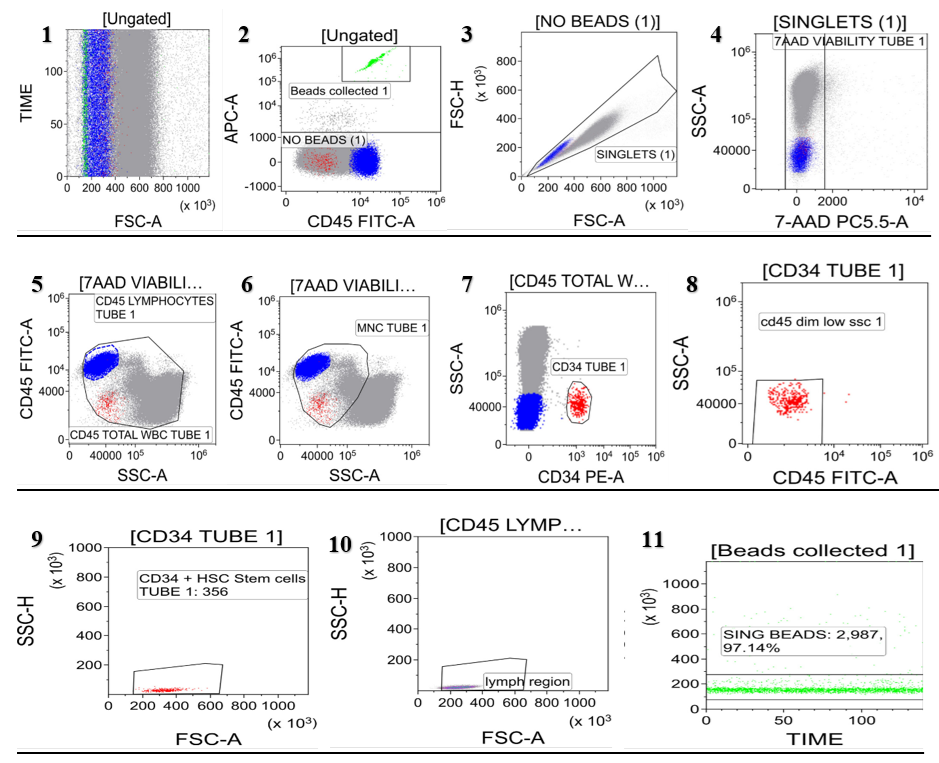
Flow cytometric analysis of PBSC on Beckman Coulter DxFlex flow-cytometer with Stem-Kit reagent (by Beckman Coulter) using ISHAGE protocol. Plot 1 shows the time vs FSC-A to enumerate the data acquisition was done right; Plot 2 separates the CD45+ leucocytes and the beads; Plot 3 gates the CD45+ leucocytes into singlets; Plot 4 separates viable CD45+ leukocytes excluding dead 7-AAD cells; Plot 5 and 6 separates CD45+ leucocytes and mononuclear cells; Plot 7 gates CD34+ cells with dim expression for CD45; Plot 8 identifies a cluster of events meeting all the fluorescence and light scatter criteria of ISHAGE Guidelines for CD34+ HSCs; Plots 9 and 10 shows lymphocyte specific gate; Plot 11 encloses the Stem-Count Fluorospheres singlet population.
Calculations
The absolute quantification of CD34+ hematopoietic stem cells was calculated using two distinct approaches to validate measurement accuracy. For the Single-Platform (SP) method, absolute counts (expressed as 106 /L) were derived by determining the ratio of CD34+ events to counting beads, multiplied by the known bead concentration. In contrast, the Dual-Platform (DP) method integrated flow cytometric data with hematological parameters, calculating the count based on the Total Leukocyte Count (TLC) and the proportional relationship between CD45+ and CD34+ events.
To evaluate the analytical concordance between the SP and DP methods, Spearman’s correlation coefficient (R2) was utilized, with a threshold of R2 > 0.7 established as the benchmark for a strong correlation. Furthermore, the precision of the assay was monitored via the median coefficient of variation (CV) for pre-apheresis, mid-apheresis, and post-apheresis samples, where a CV < 10% was predefined as the standard for high-quality, reproducible data.
Results
In our study, there were a total of 50 patients, with a male to female Ratio (M: F) of 3:1. The ratio of Allogeneic (ALLO) procedures to Autologous (AUTO) procedures is 0.52:1.
Total 152 samples were analyzed for 50 patients with median values of CD34+ HSC/microL for single platform method was 100.64 in the preharvest, 1784.82 in mid harvest, 1744.03 in end harvest samples whereas with dual platform method it was 110.63 in the preharvest, 1682.12 in mid harvest and 1623.33 in end harvest samples.
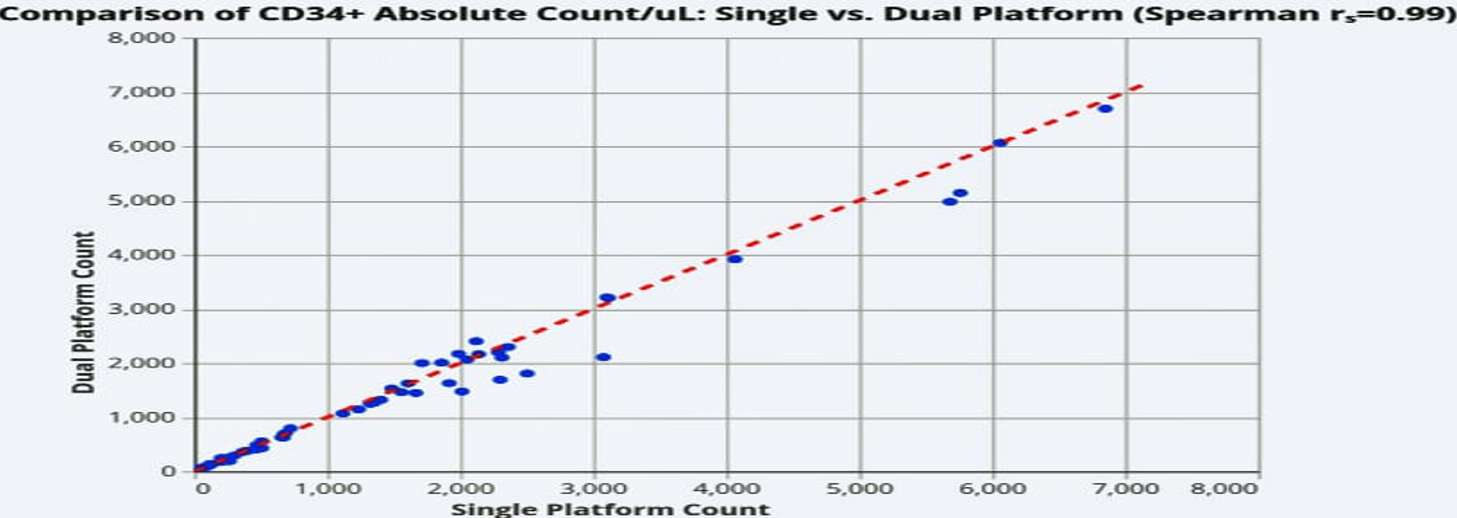
When compared, both SP and DP absolute CD34+ HSC counts/microL showed excellent concordance with Spearman correlation coefficient in pre-apheresis samples of 0.9912 (p = 0.0000), mid-apheresis samples of 0.9802 (p = 0.0000) and post-apheresis samples of 0.9822(p=0.0000) (Table 2, Figure 2).
| Sample type | SP CD34+ HSC (mean and range) | DP CD34+ HSC (mean and range) | Spearman correlation coefficient between SP and DP (Pvalue) | Median CV% between SP and DP values |
| Pre-harvest | 100.64 (4.09-1712.27) | 110.63 (4.02-1999.00) | 0.9912(0.0000) | 5.10 |
| Mid harvest | 1784.82 (200.12-6850.62) | 1682.12 (174.30-6692.20) | 0.9802(0.0000) | 3.90 |
| End harvest | 1744.03 (260.22-6060.88) | 1623.33 (189.80-6062.51) | 0.9822(0.0000) | 4.60 |
The Spearman correlation coefficient between Dual platform and Single Platform for all sample stages is 0.9947, depicted by the scatter plot (Figure 1). This result indicates an extremely strong, near-perfect positive monotonic relationship between the two measurements. p-value of 0.0000 (which is less than a common significance level like 0.05) suggests that this observed correlation is statistically significant, meaning it is highly unlikely to have occurred by random chance.
The cost analysis of both the approaches for CD34+ HSC enumeration showed DP being more cost effective (Table 3) alongwith a detailed analysis of the reagents used.
| Method | Cost |
| Single platform | INR 520 |
| Dual platform | INR 308 |
| Item name | Code | No.of tests | Cost per test(company) | Cost per test (BBCI) |
| Stem cell kit | IM 3630 | 50 | 3103 | 409.09 |
| CD45 FITC | IM0782 U | 200 | 215 | 70 |
| CD34 PE | A07776 | 200 | 336 | 108.9 |
| 7AAD PC 5.5 | A07704 | 200 | 107 | 30 |
| Optilyse C | A11895 | 200 | 125 | 33.27 |
| Sample tube | 2523749 | 250 tubes/packetEach test requires 2 tubes | 35 | 18.9 |
| Sheath fluid | B73613 | 200 | 26.2 | 9.4 |
| TLC cost | U722 | 350 | 70 |
Discussion
In early 1995, the International Society of Hematotherapy and Graft Engineering (ISHAGE) established a Stem Cell Enumeration Committee to validate a simple, rapid, and sensitive flow cytometric method to quantitate CD34+ cells in peripheral blood and apheresis products used in auto and allo-transplants of haematopoietic stem cells [4]. Engraftment success depends on solely on adequate CD34+ stem cell count [20].
Studies have been done over the years since 1995 to standardize the gating methods and procedure for CD34+ HSC enumeration. Many studies have been done over the past 30 years to compare the single platform and dual platform methods and have suggested correlation between both the platforms for enumeration of CD34+ cells [12,16-19], which was also seen in our study. The SP method relies on a single flow cytometer and a known calibrated number of fluorescent beads that are added to the sample. The DP method utilized values obtained from a conventional hematology analyzer for total leucocyte count (TLC) and flow cytometry for the number of CD34+ events.
Single platform has been suggested as better due to lesser variability in the results across different laboratories [16,17]. Dual platform is cost-effective as compared to single-platform, useful in resource-constrained settings, with similar results as the single platform approach.
| STUDY | AUTHORS Year of Publication | FINDINGS |
| Flow cytometric enumeration of CD34+ hematopoietic stem cells: A comparison between single- versus dual-platform methodology using the International Society of Hematotherapy and Graft Engineering protocol [12] | Mohandoss M et al, Manipal, 2019 | Both single versus dual platform had similar results in CD34+ cell counts (peripheral blood sample (r = 0.92; P < 0.001) and PBSC product sample (r = 0.85; P < 0.001). The single platform provides rapid results with ease of procedure. |
| Comparison of single versus double platform analysis for CD34+ hematopoietic stem cell enumeration using International Society of Hematotherapy and Graft Engineering protocol and consensus among hematopathologists [16] | Nadeem NF et al, JIPMER, Puducherry, India, 2025 | SP is recommended but more expensive while DP is cheaper and useful in cost-constrained setting with fair degree of agreement among hematopathologists. |
| Validation of the single-platform ISHAGE protocol for enumeration of CD34+ hematopoietic stem cells in umbilical cord blood in a Brazilian center [17] | Carla Cristina et al, Brazil, 2020 | ISHAGE protocol-based single-platform approach is the most appropriate methodology for CD34+ cells enumeration |
| Enumeration of CD34+ haemopoietic stem cells: comparative study of the performance of the SYSMEX XN-1000 hematology analyzer in a dual-platform approach versus a single-platform approach [18] | Berhili A et al, Morocco, 2021 | Both SP and DP approaches were effective and yield similar results. DP seems to be a simple and affordable approach that is well suited to the needs of laboratories where this type of analyzer is available. |
| Comparison of single and dual-platform assay formats for CD34+ haematopoietic progenitor cell enumeration [19] | J.W. Gratama et al, Department of Clinical and Tumor Immunology, Netherland, 2001 | This study suggested that single-platform methodology can reduce the variation in absolute CD34+ cell numbers between laboratories. |
Conclusion
Both the SP and DP methods have excellent correlation. The SP method is widely recommended; its use is limited by the high costs associated with specialized reagents and additional procurement of beads. Conversely, the DP method is more popular as a cost-effective alternative for centers with resource constraints.
Declarations
Ethical Clearance
Ethical approval was obtained from the Ethics Committee.
Funding/ financial support
None
Conflict of interest declaration
The authors declare that there are no conflicts.
Authors’ Contributions
All authors contributed substantially to the conception of the study, data acquisition, analysis, drafting, and critical revision of the manuscript. All authors have read and approved the final version of the manuscript.
Acknowledgements
None