Introduction
Chronic obstructive pulmonary disease (COPD) is a chronic, progressive, airflow-limiting illness which is now ranked by the World Health Organization among the three leading causes of mortality worldwide [1]. An exacerbation, by current definition, is an acute worsening of respiratory symptoms beyond the patient's usual day-to-day variation that requires modification of treatment [2]. The clinical consequences of these episodes are well documented and alarming: accelerated decline of lung function [3], substantial deterioration of health-related quality of life, and a sharp increase in the cost of hospital care compared with stable-state management. Mortality during the index admission remains the most critical clinical end-point, particularly in patients with advanced disease and reduced physiological reserve.
The pharmacological backbone of stable-state COPD care is well established. Long-acting bronchodilators, inhaled corticosteroid combinations where indicated, and structured non-pharmacological measures — smoking cessation, pulmonary rehabilitation and vaccination — have all been shown to reduce exacerbation frequency and to prolong survival when used consistently [4,5]. The benefit of these interventions, however, depends entirely on the patient using them as prescribed. In the Indian outpatient setting, sustained adherence to inhaled therapy is a known difficulty, with reported rates varying from 30% to 60% across studies [6,7]. Reasons cited include difficulty in operating inhaler devices, perceived absence of immediate symptomatic benefit between exacerbations, cost of refills, and competing socio-economic priorities.
In the existing literature, medication non-adherence has been associated with worse long-term outcomes in COPD: higher exacerbation rates [8], greater health-care utilisation [9] and, in some cohorts, increased one-year mortality [10]. The bulk of this evidence, however, comes from large administrative datasets or from outpatient registries and concerns long-term effects. The contribution of pre-existing non-adherence to the immediate in-hospital outcome of the current exacerbation has received much less attention. Furthermore, no study to our knowledge has reported the post-discharge trajectory of an objective inflammatory-nutritional biomarker stratified by adherence status — a measurement that would substantiate whether non-adherence drives sustained biological disturbance long after the acute insult has resolved.
Our study was designed to address these specific gaps. Using a prospective cohort that was originally constructed to evaluate the CRP-to-albumin ratio as a prognostic biomarker, we asked three concrete questions. First, what is the magnitude of the association between admission-time medication non-adherence and in-hospital mortality during acute COPD exacerbation? Second, does this association persist when we restrict the analysis to the severe-disease subgroup (GOLD III/IV), where baseline mortality risk is highest — that is, is the association attributable to severity confounding alone? Third, among survivors, does adherence status determine the post-discharge trajectory of the CRP-to-albumin ratio over the subsequent six months? We hypothesised, on the basis of preliminary observation, that the association would be unusually strong, would persist within severity strata, and would be reflected in a sustained inflammatory-nutritional gap between compliant and non-compliant survivors.
Methods
Study design and setting
This is a pre-planned secondary analysis of a prospective cohort study conducted over 18 months (January 2023 to June 2024) at Amaltas Institute of Medical Sciences, Dewas, Madhya Pradesh — a 1200-bed teaching hospital in central India. The Department of Respiratory Medicine has 30 dedicated beds and handles approximately 400 COPD-related admissions per year. The primary analysis of the parent cohort was concerned with the prognostic value of the CRP-to-albumin ratio (CAR) as a static biomarker; the present analysis isolates the adherence-mortality and adherence-trajectory relationships from that cohort.
Study population
We recruited 102 sequential adult patients admitted with acute COPD exacerbation. Inclusion criteria comprised (a) age 18 years or older, (b) spirometry-confirmed COPD (post-bronchodilator FEV1/FVC < 0.70) and (c) fulfilment of the Anthonisen criteria for an exacerbation [11]. Exclusion criteria were active malignancy, major surgery within the preceding 30 days, antibiotic use within 72 hours preceding admission, documented immunocompromise (HIV infection, ongoing immunosuppressive therapy), and refusal to participate. Recruitment was sequential to minimise selection bias.
Assessment of medication adherence
Medication adherence in the three months preceding the index admission was assessed using the eight-item Morisky Medication Adherence Scale (MMAS-8) [12], administered as a structured interview in Hindi or in the patient's preferred regional language by trained respiratory residents within the first 24 hours of admission. MMAS-8 scores range from 0 to 8; we used the standard published threshold of < 6 to define non-adherence, and ≥ 6 to define adherence. Patients who were unable to respond reliably owing to clinical instability had the questionnaire administered to their primary household caregiver, with the same threshold applied. The same instrument was re-administered at every outpatient follow-up encounter.
Outcome and biomarker measurements
The primary outcome was in-hospital mortality, defined as death from any cause during the index admission. Cause of death was adjudicated by the treating consultant from the case record. Venous blood was collected on admission, on the morning of day 3, on the morning of day 5, and at discharge (or death, whichever was earlier). CRP (mg/L) was quantified by high-sensitivity turbidimetry on a single Beckman Coulter AU680 analyser; albumin (g/dL) was measured by the bromcresol green technique on the same platform. CAR was computed as CRP divided by albumin. Surviving patients provided follow-up blood at outpatient visits scheduled at one, three and six months after hospital discharge.
Statistical analysis
Continuous variables are reported as mean (standard deviation) or median [interquartile range] depending on distribution, and were compared between compliance strata with Welch's t-test or the Mann–Whitney U test as appropriate. Categorical variables appear as frequency counts with percentages and were compared with Fisher's exact test. The two-by-two mortality table contained a structural zero cell (0 deaths among compliant patients); we therefore report the unadjusted Fisher's exact p-value and an odds ratio with 95% confidence interval calculated after Haldane–Anscombe continuity correction (adding 0.5 to each cell). The Haldane–Anscombe corrected risk ratio is also reported for ease of clinical interpretation. To address the possibility that the mortality difference reflects underlying disease-severity confounding rather than adherence behaviour, we repeated the mortality analysis within the GOLD III/IV severity subgroup, in which mortality risk is concentrated. Follow-up CAR comparisons used the Mann–Whitney U test. All analyses were performed in Python 3.11 with scikit-learn 1.4 and SciPy 1.12; figures were prepared in Matplotlib 3.8. A two-sided p < 0.05 was considered statistically significant throughout.
Results
Cohort characteristics and adherence prevalence
Of the 102 patients in the cohort, 64 (62.7%) were classified as compliant (MMAS-8 ≥ 6) and 38 (37.3%) as non-compliant at admission. The two groups differed substantially at baseline. Non-compliant patients were on average 6.3 years older (63.9 vs 57.6 years, p = 0.014), had on average 8.3 more pack-years of smoking exposure (23.0 vs 14.7 years, p = 0.016) and were skewed towards more advanced GOLD severity strata (50.0% of non-compliant patients were GOLD III or IV, compared with 15.7% of compliant patients; p < 0.001). Admission CAR was three-fold higher in the non-compliant group (33.4 vs 11.1, p < 0.0001). These differences are themselves clinically informative — they indicate that the patient who presents non-adherent to an Indian respiratory ward is, on average, older, more heavily smoked, more severe by spirometry and more inflamed by laboratory testing. Full baseline characteristics by compliance stratum are presented in Table 1.
| Characteristic | Compliant (n=64) | Non-compliant (n=38) | p-value |
| Age, mean (SD), years | 57.6 (11.7) | 63.9 (12.6) | 0.014 |
| Sex, male, n (%) | 54 (84.4) | 35 (92.1) | 0.362 |
| Smoking duration, mean (SD), years | 14.7 (14.3) | 23.0 (17.7) | 0.016 |
| GOLD I, n (%) | 13 (20.3) | 1 (2.6) | <0.001* |
| GOLD II, n (%) | 41 (64.1) | 18 (47.4) | |
| GOLD III, n (%) | 6 (9.4) | 14 (36.8) | |
| GOLD IV, n (%) | 4 (6.3) | 5 (13.2) | |
| Hypertension, n (%) | 9 (14.1) | 3 (7.9) | 0.527 |
| Diabetes mellitus, n (%) | 5 (7.8) | 2 (5.3) | 1.000 |
| Admission CAR, mean (SD) | 11.1 (11.1) | 33.4 (28.2) | <0.001 |
In-hospital mortality by compliance stratum
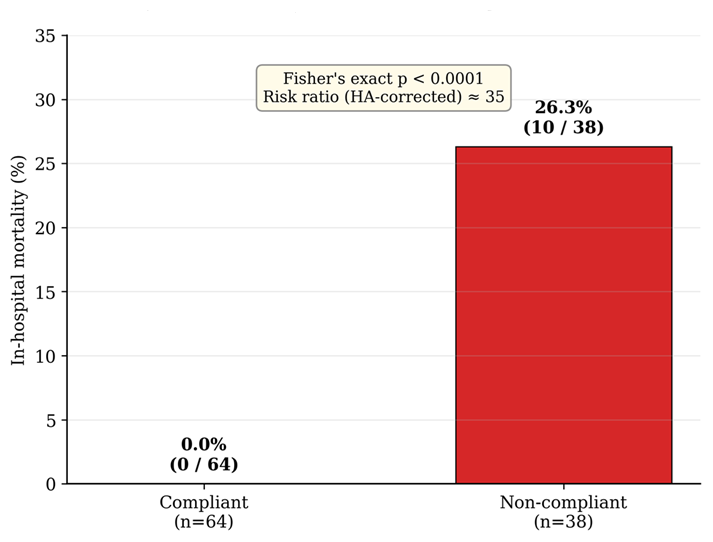
Ten patients (9.8%) died during the index admission. All ten deaths occurred in the non-compliant group. Stratum-specific mortalities were 0.0% (0/64) among compliant patients and 26.3% (10/38) among non-compliant patients, with Fisher's exact two-sided p-value < 0.0001. The Haldane–Anscombe corrected risk ratio for non-compliance was 35 and the corrected odds ratio for compliance (versus non-compliance) was 0.02 (95% CI 0.001–0.37). The two-by-two mortality contingency is shown in Table 2, and the summary effect estimates appear in Table 5.
| Died, n | Survived, n | Mortality, % | |
| Compliant (n=64) | 0 | 64 | 0.0 |
| Non-compliant (n=38) | 10 | 28 | 26.3 |
| Total (n=102) | 10 | 92 | 9.8 |
Severity-stratified analysis: addressing confounding by GOLD stage
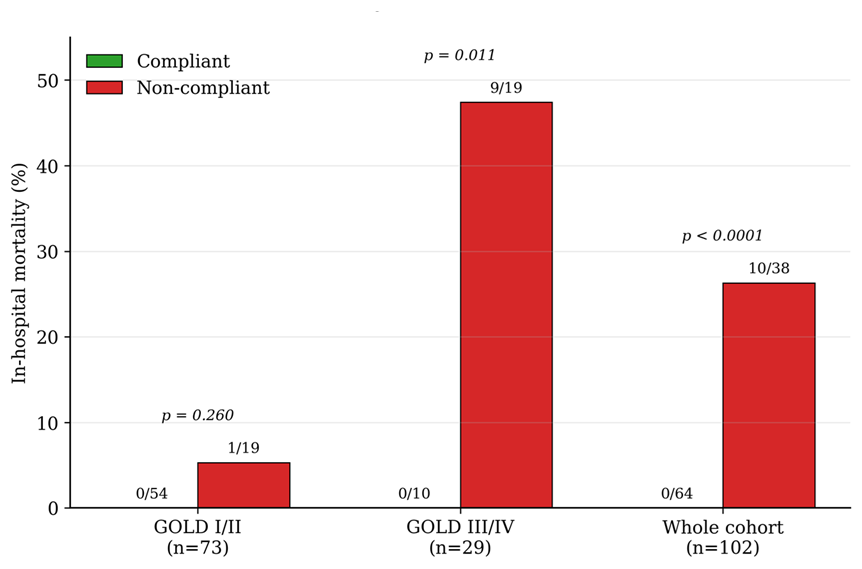
Because non-compliant patients were systematically sicker at baseline, a critical question is whether the mortality concentration in this group reflects adherence behaviour or simply underlying disease severity. To address this, we repeated the mortality analysis within severity strata. Within the milder stratum (GOLD I/II, n = 73), there was a single death; the analysis is therefore underpowered (Fisher p = 0.260) and we cannot draw a confident conclusion. Within the severe stratum (GOLD III/IV, n = 29), however, the picture is unambiguous. None of the 10 compliant patients in this stratum died, while 9 of the 19 non-compliant patients died — a stratum-specific mortality of 0.0% versus 47.4% (Fisher p = 0.011). The persistence of the adherence-mortality association within the severe-disease stratum substantially weakens the argument that the whole-cohort association is simply a re-expression of GOLD stage. Severity-stratified results are summarised in Table 3.
| Severity stratum | Compliant, deaths/n | Non-compliant, deaths/n | Mortality contrast | Fisher p |
| GOLD I/II (n=73) | 0 / 54 | 1 / 19 | 0.0% vs 5.3% | 0.260 |
| GOLD III/IV (n=29) | 0 / 10 | 9 / 19 | 0.0% vs 47.4% | 0.011 |
| Whole cohort (n=102) | 0 / 64 | 10 / 38 | 0.0% vs 26.3% | <0.0001 |
Post-discharge CAR trajectory by compliance
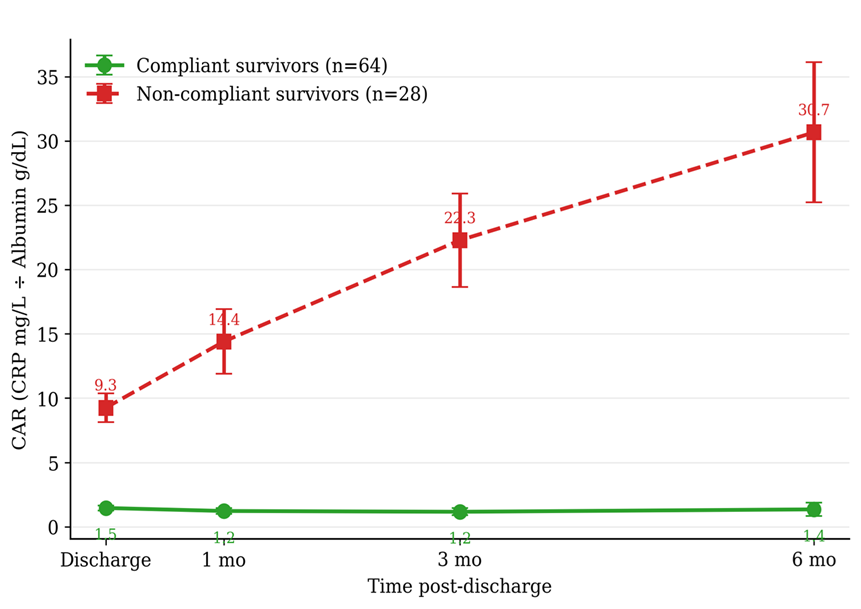
Among the 92 survivors, all participated in the planned 1-, 3- and 6-month outpatient follow-up. The compliance assignment at discharge was sustained throughout follow-up in all but four patients, who were reassigned and excluded from this trajectory analysis. The post-discharge CAR trajectory revealed a striking and sustained separation between strata. At discharge, the mean CAR was 1.5 (SD 1.6) in compliant survivors and 9.3 (SD 6.0) in non-compliant survivors (p < 0.0001). At 1 month the gap had widened to 1.22 versus 14.40, at 3 months to 1.16 versus 22.28, and at 6 months to 1.35 versus 30.66 — a more than twenty-fold separation (p < 0.0001 at every time point). Crucially, the gap between the two strata widened progressively rather than narrowing, indicating that ongoing non-adherence does not allow even the modest spontaneous resolution of inflammation observed at discharge to be maintained. Full follow-up CAR by compliance is presented in Table 4.
| Time point | Compliant survivors (n=64), mean (SD) | Non-compliant survivors (n=28), mean (SD) | p-value |
| Discharge CAR | 1.5 (1.6) | 9.3 (6.0) | <0.0001 |
| 1-month CAR | 1.22 (1.79) | 14.40 (13.30) | <0.0001 |
| 3-month CAR | 1.16 (2.20) | 22.28 (19.21) | <0.0001 |
| 6-month CAR | 1.35 (4.24) | 30.66 (28.83) | <0.0001 |
Effect-size summary
Table 5 collates the principal effect estimates for ease of reference. From a clinical-utility perspective the most useful figure is the number needed to identify: in our cohort, approximately four non-compliant patients would have to be detected at admission in order to encompass one in-hospital death. This is, to our knowledge, among the highest absolute mortality-density signals reported for any single screening variable in AECOPD.
| Measure | Value (95% CI) |
| In-hospital mortality, compliant | 0/64 (0.0%) |
| In-hospital mortality, non-compliant | 10/38 (26.3%) |
| Fisher's exact two-sided p-value | <0.0001 |
| Risk ratio (Haldane–Anscombe corrected) | 35.0 |
| Odds ratio (compliant vs non-compliant, HA-corrected) | 0.02 (0.001 – 0.37) |
| Number needed to identify (compliance status) to prevent one death† | ~4 |
† The number needed to identify is calculated as the reciprocal of the observed mortality among non-compliant patients (1 ÷ 0.263 ≈ 3.8). It expresses the average number of non-compliant patients one would have to flag in order to find a single in-hospital death, assuming the observed mortality density is reproducible.
Discussion
Our principal finding is uncomfortable in its simplicity. In a prospective cohort of 102 patients admitted with acute COPD exacerbation, no patient who had been adherent to prior inhaled therapy died during the index admission, whereas 26.3% of patients who had been non-adherent died. The Fisher's exact p-value is below 0.0001, and the Haldane–Anscombe corrected risk ratio is approximately 35. Among the 92 survivors, the inflammatory-nutritional gap between the two strata, captured by CAR, widened rather than narrowed across the 6-month follow-up window. Three implications deserve emphasis.
First, the mortality concentration cannot be explained away as severity confounding. Non-compliant patients were indeed older, heavier smokers and more skewed to advanced GOLD stages, and the unadjusted association is undoubtedly inflated by these factors. However, within the severe-disease stratum (GOLD III/IV) — where mortality risk is highest and severity is effectively held constant — the association persists with stratum-specific mortalities of 0.0% versus 47.4% (Fisher p = 0.011). It is mechanistically implausible that the residual within-stratum gap is explained entirely by unmeasured confounding; the magnitude is too large. Some genuine adherence-driven contribution to mortality is the most parsimonious interpretation.
Second, the post-discharge CAR data offer a biological substrate for that interpretation. If non-adherence were merely a marker of generally poor self-care, one might expect the inflammatory-nutritional disturbance to resolve along the same trajectory in both strata once acute treatment was administered. The opposite is observed. Compliant survivors achieve and maintain near-normalised CAR (mean 1.35 at six months), while non-compliant survivors progressively deteriorate (mean 30.66 at six months). The widening gap implies an active biological process driven by, or at minimum tightly correlated with, ongoing adherence behaviour. The mechanism is straightforward — without sustained bronchodilation and anti-inflammatory treatment, the airway-driven systemic inflammatory cycle that characterises COPD continues to recruit inflammatory mediators, drive hepatic CRP synthesis and suppress hepatic albumin synthesis.
Third, and most importantly for the practising clinician, our findings argue for a concrete change in discharge practice. The MMAS-8 takes approximately 90 seconds to administer in a single language and is well validated in Indian populations [12,13]. At present, in most Indian respiratory wards (including ours, before the present cohort), discharge planning is undifferentiated: every patient receives the same education leaflet, the same prescription, and the same routine clinic follow-up at two weeks. We propose, on the basis of our data, a differentiated pathway in which every patient with AECOPD has an MMAS-8 administered before discharge, and those classified as non-adherent are enrolled into an intensified pathway — pharmacist-led inhaler-technique counselling, structured pillbox provision, a documented written instruction sheet in the patient's mother tongue, telephone check at 48 hours after discharge, and an in-person review at one week rather than two. None of these interventions is expensive; the marginal cost per patient is in tens of rupees. The number needed to identify (approximately four non-compliant patients per in-hospital death) suggests that even a modest intervention effect would translate into clinically meaningful absolute benefit.
Comparison with existing literature
Our magnitude of effect is at the upper end of the published range. Vestbo and colleagues, in a 1057-patient secondary analysis from the TORCH trial, reported a hazard ratio for all-cause mortality of 2.2 in poor adherers compared with good adherers [10]. Toy and colleagues, using United States claims data, demonstrated a 26% reduction in exacerbation rate associated with adherent inhaler use [8]. The much larger effect size in our cohort almost certainly reflects three factors: a more severe index admission population (a hospitalised AECOPD cohort, rather than a stable outpatient cohort); a non-adherence definition (MMAS-8 < 6) that captures meaningful behavioural non-engagement rather than missed doses; and the high baseline ratio of severe to mild disease in an Indian tertiary referral practice. Nevertheless, the direction and the qualitative finding are entirely consistent with the international evidence.
Strengths and Limitations
There are a number of strengths associated with our work. Adherence was assessed prospectively using a validated, language-adapted instrument, not reconstructed from prescription refill records. Inflammatory-nutritional status was tracked at standardised time points using a single laboratory analyser and a single lot of reagents, which minimises pre-analytical variability. Follow-up was complete in all surviving patients across the 6-month window. The within-GOLD stratification provides a defensible — although not definitive — defence against severity confounding.
We are equally aware of a number of limitations. The cohort comprises 102 patients with 10 events, which precludes formal multivariable adjustment for more than one or two covariates without overfitting; we therefore relied on within-stratum analysis rather than parametric adjustment. The cohort was drawn from a single tertiary centre in central India, and the absolute mortality rates we report cannot be assumed to generalise to primary care or rural hospital settings. The MMAS-8, although well validated, remains a self-report instrument and is susceptible to recall bias and social-desirability effects; objective measures such as electronic dose-counter data or pharmacy refill records would have strengthened the exposure measurement. We did not formally measure socio-economic status, household income or educational attainment — variables that are correlated with adherence and could mediate part of the observed association. Finally, although the within-stratum analysis suggests an adherence-specific effect, residual confounding by unmeasured variables (functional status, depression, alcohol use) cannot be excluded; only a randomised intervention trial can establish a causal claim definitively.
Future directions
Three follow-on studies are particularly warranted. First, an external multicentre validation of the adherence-mortality association across geographically diverse Indian COPD populations — district hospitals, urban tertiary centres and rural referral practices. Second, a cluster-randomised trial of the proposed differentiated discharge pathway, with 30-day readmission and 6-month mortality as primary endpoints; given the magnitude of the observed association, such a trial would require a relatively modest sample size to detect a clinically meaningful effect. Third, a mechanistic study that pairs MMAS-8 with objective adherence measurement (electronic dose counter or refill records) and with serial cytokine profiling to clarify the biological pathway linking sustained non-adherence to chronic systemic inflammation.
Conclusions
In a prospective Indian cohort of 102 patients with acute COPD exacerbation, pre-existing medication non-adherence was associated with all of the in-hospital deaths and with a sustained, progressive elevation of the CRP-to-albumin ratio across six months of follow-up. The association persisted within the GOLD III/IV severity stratum, indicating that it cannot be explained entirely by underlying disease severity. The magnitude of the signal is large, the measurement instrument is cheap and brief, and the proposed clinical action — differentiated discharge planning for non-adherent patients — is feasible within current Indian respiratory practice. We therefore recommend that structured adherence screening using the MMAS-8 be incorporated into the discharge bundle for every AECOPD admission, and that patients classified as non-adherent be enrolled into a pharmacist-supported intensified follow-up pathway. External validation is necessary; a cluster-randomised pragmatic trial of the proposed pathway is the natural next step.
Clinical recommendation
We propose the following discharge bundle for every patient admitted with acute COPD exacerbation: (a) administer MMAS-8 in the patient's mother tongue within 24 hours of planned discharge; (b) for patients scoring < 6, schedule a 30-minute pharmacist-led inhaler-technique and adherence counselling session before discharge; (c) provide a printed written instruction sheet in the patient's regional language and a structured pillbox; (d) arrange telephone follow-up at 48 hours and an in-person review at one week rather than two; (e) document MMAS-8 score at every subsequent outpatient encounter and re-administer the counselling intervention if the score has not improved.
Declarations
Conflict of interest
The authors declare no conflict of interest.
Funding
This research did not receive any specific grant from funding agencies in the public, commercial, or not-for-profit sectors.
Ethics Approval
Approved by the Institutional Ethics Committee, Amaltas Institute of Medical Sciences (IEC/2023/Resp/14). Written informed consent was obtained from all participants. The present manuscript reports a pre-planned secondary analysis of the same prospective cohort, notified to the IEC under amendment IEC/2025/Resp/Amd-3.
Data availability
De-identified data are available from the corresponding author on reasonable request.
Use of AI / large language models
The corresponding author used Claude (Anthropic) as a writing and analysis assistant during preparation of this manuscript. The tool was used for (a) drafting prose from author-supplied content and direction, (b) supporting statistical analysis (descriptive statistics, Fisher's exact test, severity-stratified analysis) which the corresponding author reviewed and re-ran against the primary data, (c) preparing figure draft code in Matplotlib, and (d) language editing. All factual content, data interpretation, clinical recommendations and conclusions are the authors' own. Every numerical claim in the manuscript has been verified by the corresponding author against the original master chart. The AI tool is not, and does not meet ICMJE criteria to be, listed as an author. The authors take full responsibility for the content of this manuscript.
Author contributions
JK conceived the adherence analysis, performed the statistical work and drafted the manuscript. VU supervised the parent cohort, contributed to interpretation and critically revised the manuscript. AS contributed to data acquisition, MMAS-8 administration in regional languages, and revision. All authors approved the final version.
Acknowledgements
The authors thank the nursing, pharmacy and outpatient follow-up staff of the Department of Respiratory Medicine, Amaltas Institute of Medical Sciences, for support during data collection.