Introduction
Pre-eclampsia is a complex, multisystem hypertensive disorder of pregnancy defined by new-onset hypertension after 20 weeks of gestation, accompanied by proteinuria, end-organ dysfunction, or both [1]. It complicates 2–8% of all pregnancies globally and remains one of the leading causes of maternal and perinatal morbidity and mortality, accounting for approximately 76,000 maternal deaths and 500,000 perinatal deaths annually worldwide [2,3]. In India, hypertensive disorders of pregnancy contribute to approximately 8-9% of maternal deaths, with pre-eclampsia representing the most severe form. The burden is disproportionately high in low- and middle-income countries, including many parts of India, where late presentation, limited antenatal surveillance, and restricted access to advanced monitoring tools significantly worsen outcomes [4,5]. Timely identification of women at risk during the first trimester is therefore a public health priority, as it permits prophylactic interventions, most notably low-dose aspirin initiated before 16 weeks of gestation, which has been demonstrated to reduce the incidence of preterm pre-eclampsia by up to 62% in high-risk pregnancies [6].
The pathophysiology of pre-eclampsia is initiated by defective trophoblast invasion and inadequate remodelling of the spiral arteries during early placentation, resulting in placental ischaemia, oxidative stress, and the release of antiangiogenic factors such as soluble fms-like tyrosine kinase-1 (sFlt-1) and soluble endoglin into the maternal circulation. These factors drive widespread endothelial dysfunction, vasoconstriction, increased vascular permeability, and activation of the coagulation system, the hallmarks of established pre-eclampsia [7]. Platelet activation occurs early in this cascade: endothelial injury exposes subendothelial collagen, triggering adhesion and aggregation of platelets at the sites of vascular damage. In response to accelerated platelet consumption, the bone marrow releases larger, more immature platelets. These larger platelets are metabolically and enzymatically more active, producing greater quantities of thromboxane A₂ and other vasoactive mediators, which further amplify vasoconstriction and the prothrombotic state [8].
Current first-trimester screening methods, including the combined Fetal Medicine Foundation algorithm using mean arterial pressure, uterine artery pulsatility index, and placental growth factor, provide good predictive accuracy but require specialised ultrasound and biochemical testing that are often unavailable in resource-limited settings [9]. Biomarkers such as placental growth factor, soluble fms-like tyrosine kinase-1/placental growth factor ratio, and pregnancy-associated plasma protein-A are also costly and require dedicated platforms. Therefore, there is a need for simple, affordable, and widely accessible markers for routine antenatal care [10].
Mean Platelet Volume (MPV), a routinely reported parameter in the complete blood count, reflects platelet size and activity. Elevated MPV is a marker of platelet activation, an early event in the pathogenesis of pre-eclampsia. As an inexpensive and readily available test requiring no additional samples or equipment, MPV has attracted interest as a potential screening marker. Several studies have reported higher first-trimester MPV values in women who subsequently develop pre-eclampsia. However, evidence from Indian populations remains limited [11,12]. Therefore, the present study was therefore designed to evaluate the utility of first-trimester MPV as a predictor of pre-eclampsia in routine antenatal care at a tertiary care centre.
Materials and Methods
Study Design
This prospective observational study was conducted among 150 pregnant women with singleton gestations between 11 and 14 weeks at a tertiary care center in Kanpur, India, serving a predominantly low-resource population over a period of 1.5 years.
Study Population
The sample size was calculated using Cochran’s formula, considering an estimated prevalence of pre-eclampsia of 11%, with a 95% confidence interval and a 5% margin of error for the Kanpur population. The calculated sample size was 151; however, 150 eligible pregnant women were included in the final analysis. Pregnant women with singleton pregnancies between 11 and 14 weeks of gestation attending routine first-trimester antenatal visits were enrolled consecutively. Gestational age was confirmed by crown-rump length measurement on first-trimester ultrasonography. Women with pre-existing chronic hypertension, diabetes mellitus, renal disease, or other systemic illnesses were excluded.
Data Collection and Follow-Up
At recruitment, venous blood samples were collected under aseptic conditions, and mean platelet volume (MPV) was measured using a standardized automated hematology analyzer (Medonic-M analyzer). All participants were followed prospectively until delivery, and the development of pre-eclampsia was determined based on established diagnostic criteria.
Statistical Analysis
Statistical analysis was performed using IBM SPSS Statistics (Version 25.0). Continuous variables were expressed as mean ± standard deviation and compared using the independent samples t-test. The association between MPV and pre-eclampsia was evaluated using Pearson’s correlation coefficient.
To determine independent predictors, binary logistic regression analysis was performed, and results were reported as odds ratios (OR) with 95% confidence intervals (CI). The diagnostic performance of MPV was assessed using receiver operating characteristic (ROC) curve analysis, with calculation of the area under the curve (AUC). A p-value of <0.05 was considered statistically significant.
Results
A total of 150 antenatal women were included in the study, of whom 19 (12.7%) developed pre-eclampsia during the course of pregnancy. Women who subsequently developed pre-eclampsia had significantly higher MPV values compared to those who remained normotensive (12.00 ± 1.09 fL vs. 11.11 ± 1.61 fL; p = 0.004), indicating a significant association between elevated MPV in early pregnancy and the later development of pre-eclampsia (Table I).
| Group | MPV (Mean ± SD) |
| Normotensive (n= 131) | 11.11 ± 1.61 fL |
| Pre-eclampsia (n =19) | 12.00 ± 1.09 fL |
Receiver Operating Characteristic Analysis
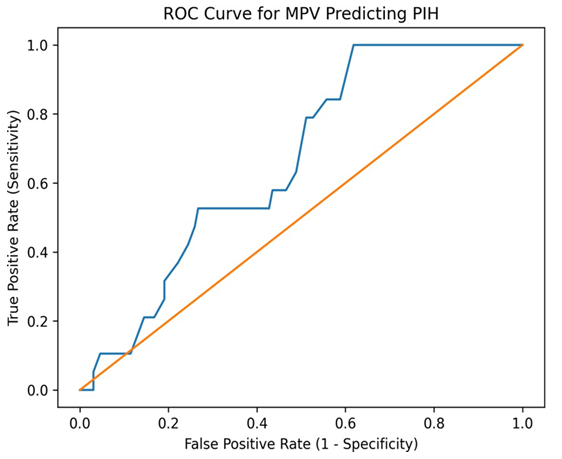
Receiver operating characteristic (ROC) curve analysis was performed to evaluate the predictive performance of first-trimester MPV for pre-eclampsia. The analysis yielded an area under the curve (AUC) of 0.663 with a standard error of 0.072 (95% CI: 0.522–0.803; p < 0.001), indicating moderate predictive performance (Table II). At a cut-off value of 10.6 fL, MPV demonstrated a sensitivity of 100%, specificity of 38.2%, positive predictive value (PPV) of 18.3%, and negative predictive value (NPV) of 100% for predicting pre-eclampsia (Table III).
| Test Variable | AUC | Std. Error | p-value | 95% CI (Lower–Upper) |
| MPV (1st Visit) | 0.663 | 0.072 | <0.001 | 0.522 – 0.803 |
| Marker | MPV (fL) |
| Cut-off Value | 10.6 |
| Sensitivity (%) | 100 |
| Specificity (%) | 38.2 |
| PPV (%) | 18.3 |
| NPV (%) | 100 |
ROC Analysis
The ROC curve was positioned above the diagonal reference line, indicating the predictive ability of first-trimester MPV for pre-eclampsia. Analysis demonstrated moderate predictive performance with an area under the curve (AUC) of 0.663. At a cut-off value of 10.6 fL, MPV achieved a sensitivity of 100% and specificity of 38.2%, suggesting its potential utility as a screening marker for early prediction of pre-eclampsia (Figure I).
Logistic Regression Analysis
Logistic regression analysis demonstrated that MPV was significantly associated with pregnancy-induced hypertension (OR = 1.459, 95% CI: 1.049–2.031, p = 0.025). The findings indicated that for every 1 fL increase in first-trimester MPV, the odds of developing pre-eclampsia increased by 45.9%, supporting MPV as an independent predictor of disease development (Table IV).
| Predictor | B | S.E. | Wald | p-value | OR (Exp(B)) | 95% CI for OR |
| MPV | 0.378 | 0.169 | 5.03 | 0.025 | 1.459 | 1.049 – 2.031 |
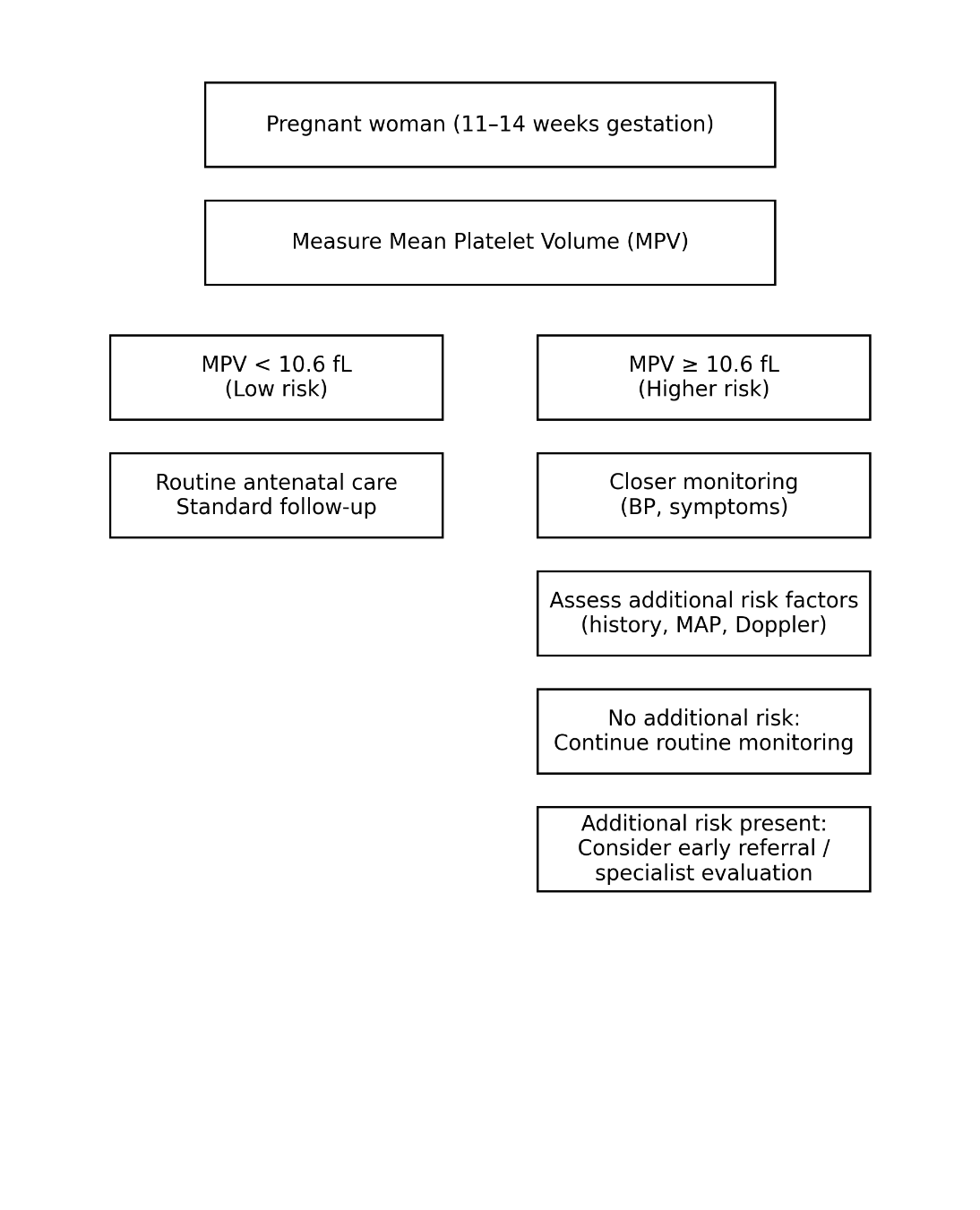
Based on the predictive performance of first-trimester mean platelet volume, a clinical algorithm was developed to illustrate its potential application in early antenatal risk stratification (Fig. II). Using a cut-off value of 10.6 fL, women with lower values were classified as low risk for developing pre-eclampsia, whereas those exceeding the threshold were identified for closer surveillance and early preventive management.
Discussion
This prospective study evaluated first-trimester MPV as a predictor of pre-eclampsia in 150 antenatal women at a tertiary care centre in Kanpur. Pre-eclampsia developed in 19 women (12.7%). Mean MPV was significantly higher in the pre-eclampsia group (12.00 ± 1.09 fL) than in normotensive women (11.11 ± 1.61 fL; p = 0.004), and logistic regression showed that each 1 fL increment in MPV increased the odds of pre-eclampsia by 45.9% (OR = 1.459; 95% CI: 1.049–2.031; p = 0.025). ROC analysis yielded an AUC of 0.663 with a cut-off of 10.6 fL, sensitivity 100%, specificity 38.2%, and NPV 100%.
The elevated MPV in pre-eclampsia is explained by accelerated platelet turnover driven by endothelial injury. As platelets are consumed at sites of vascular damage, the bone marrow compensates by releasing larger, more metabolically active platelets that produce greater amounts of thromboxane A₂, promoting vasoconstriction and a prothrombotic milieu. Dundar et al. (2008), in a longitudinal cohort of 1336 pregnant women, showed that MPV in the pre-eclampsia group rose progressively and diverged significantly from normotensive controls from 24 weeks of gestation onward, preceding the clinical diagnosis by a mean of 4.6 weeks [13]. Our study extends this observation by demonstrating a measurable and statistically significant MPV difference as early as 11–14 weeks, well before symptom onset, supporting the premise that platelet activation is an early event in pre-eclampsia pathophysiology.
The predictive performance in our study closely parallels that reported by Oğlak et al. (2021), who conducted a retrospective case-control study involving 94 mild pre-eclampsia cases, 107 severe pre-eclampsia cases, and 100 normotensive controls in Turkey. They reported a first-trimester MPV cut-off of 10.65 fL, which is nearly identical to our cut-off of 10.6 fL, with a sensitivity of 63.7%, specificity of 65.0%, and an AUC of 0.663, which was exactly the same as the AUC observed in our study [14]. The close agreement across two different populations and study designs adds credibility to this cut-off range. However, our sensitivity was considerably higher at 100% (versus 63.7%), likely because we prioritised a low cut-off to maximise case capture, resulting in a lower specificity (38.2% versus 65.0%). Temur et al. (2021) reported a cut-off of 9.15 fL with a sensitivity of 58.7% and specificity of 61.7%, demonstrating that lower cut-off values trade specificity for sensitivity, consistent with our findings [15]. In a larger context, the systematic review and meta-analysis by Ye et al. (2023), pooling 22 studies, reported a pooled sensitivity of 67.6%, specificity of 71.0%, and an SROC-AUC of 0.7889 for MPV across all gestational windows; for studies using MPV before 16 weeks, the AUC was 0.728 [11]. Our AUC of 0.663 is modestly lower, consistent with the generally weaker discriminative performance of very early first-trimester measurements compared with mid-trimester assessments in that meta-analysis.
Thakkar et al. (2025), in a prospective cohort study measuring platelet indices at 14-18 weeks of gestation, reported that MPV alone (cut-off >10.2 fL) demonstrated excellent predictive performance for early-onset pre-eclampsia, with an AUC of 0.921, sensitivity of 85.6%, and specificity of 92.4%. When combined with PDW (>16.5 fL) and platelet count (<180 × 10³/µL), the predictive accuracy further improved, achieving an AUC of 0.951 and specificity of 99.1%. Although their combined platelet parameter model substantially outperformed our single-marker approach, the MPV cut-off identified in their study (10.2 fL) was comparable to our cut-off of 10.6 fL. Moreover, our assessment was performed earlier in pregnancy (11-14 weeks versus 14-18 weeks), which may offer a greater opportunity for timely risk stratification and preventive intervention [12]. Udeh et al. (2024), in a prospective cohort of 648 pregnant women measured at 14–18 weeks, reported MPV (cut-off > 9.4 fL) with 82.8% sensitivity and 96.1% specificity for early-onset pre-eclampsia, with an incidence of only 5.9%. The superior specificity in that study compared to ours (96.1% versus 38.2%) is substantially attributable to their lower disease prevalence, which inherently reduces false-positive rates [16]. In contrast, the 12.7% pre-eclampsia prevalence in our study, reflective of a high-risk referral population, raises the prior probability and compresses specificity at any given cut-off.
The 100% NPV at our cut-off of 10.6 fL is the most clinically relevant finding of this study. No woman with MPV below this threshold developed pre-eclampsia, indicating that a low MPV reliably excludes the condition in this population. This is particularly valuable in a screening context where ruling out high-risk status at the first antenatal visit allows reallocation of monitoring resources. The PPV of 18.3% is low, meaning that most women who test positive will not develop pre-eclampsia; this is expected given the overall prevalence of 12.7% and the wide cut-off chosen to maximise sensitivity. Oğlak et al. (2021) did not specifically report NPV, while Udeh et al. (2024) achieved an NPV of 97.7% at their MPV cut-off, slightly lower than ours despite their higher specificity, owing to the lower disease prevalence in their cohort [14,16]. These comparisons confirm that NPV is intrinsically linked to disease prevalence and that our 100% NPV should be interpreted within the context of our study population.
In conclusion, this prospective observational study demonstrated that first-trimester mean platelet volume is significantly associated with the subsequent development of pre-eclampsia and independently increases the likelihood of disease occurrence. Women who developed pre-eclampsia had significantly higher mean platelet volume values compared with normotensive women. At a cut-off value of 10.6 fL, mean platelet volume showed excellent sensitivity and negative predictive value, indicating its usefulness as an early screening marker, particularly for identifying women at low risk of developing pre-eclampsia.
Although the overall predictive performance was moderate, mean platelet volume is inexpensive, readily available, and routinely measured as part of standard complete blood count testing, making it highly suitable for incorporation into routine antenatal care, especially in resource-limited settings. Early identification of at-risk pregnancies may support timely surveillance and preventive strategies. Further large-scale multicentre studies are warranted to validate these findings and determine whether combining mean platelet volume with clinical and biochemical markers can improve predictive accuracy for pre-eclampsia.
Declarations
Ethical Clearance
Ethical approval was obtained from the Ethics Committee (For Biomedical Health & Research), GSVM Medical College, Kanpur (Ref No.: EC/BMHR/2024/174). Written informed consent was obtained from all participants prior to enrolment.
Funding/ financial support
This research received no specific grant from any funding agency in the public, commercial, or not-for-profit sectors.
Conflict of interest declaration
The authors declare that there are no conflicts of interest related to this study.
Authors’ Contributions
All authors contributed substantially to the conception of the study, data acquisition, analysis, drafting, and critical revision of the manuscript. All authors have read and approved the final version of the manuscript.
Acknowledgements
The authors would like to thank all participants who took part in this study and the staff of the Department of Obstetrics and Gynaecology and laboratory personnel of the participating institution for their support.
Trial Details
This study was a prospective observational study and was not registered as a clinical trial.