Introduction
Obstructive sleep apnoea syndrome (OSAS) is a condition characterized by recurrent episodes of upper airway obstruction during sleep, resulting in intermittent hypoxia, sleep fragmentation, excessive daytime sleepiness, impaired cognitive function, and reduced quality of life [1]. The pathophysiology of OSA involves complex interactions between upper airway anatomy, neuromuscular control, and ventilatory instability [2]. OSA is increasingly recognized as an important public health problem because of its association with cardiovascular disease, metabolic dysfunction, and increased mortality [3,4]. In addition, untreated OSA contributes substantially to motor vehicle accidents and occupational injuries, thereby increasing the overall healthcare and socioeconomic burden [5].
The prevalence of OSA has increased considerably over recent decades, although a substantial proportion of affected individuals remain undiagnosed [6]. Despite advances in diagnostic technology, polysomnography (PSG) remains the gold standard investigation for diagnosing OSA; however, its limited availability, high cost, and requirement for specialized sleep laboratories restrict widespread use [7]. Consequently, several screening questionnaires have been developed to identify individuals at high risk for OSA and prioritize referral for definitive diagnostic testing.
Among the commonly used screening tools, the Epworth Sleepiness Scale (ESS) and Berlin Questionnaire (BQ) are widely accepted because of their simplicity and ease of administration. The ESS is a validated questionnaire that measures subjective daytime sleepiness by assessing the likelihood of falling asleep in various daily situations [8]. The Berlin Questionnaire was specifically designed to identify individuals at increased risk for OSA based on symptoms of snoring, daytime sleepiness, obesity, and hypertension [9]. Previous systematic reviews and meta-analyses have demonstrated variable diagnostic performance of these screening instruments across different populations and clinical settings [10].
OSA is increasingly recognized in the Indian population, with studies reporting a significant prevalence of sleep-disordered breathing among middle-aged adults [11]. The Berlin Questionnaire has also been validated in Indian populations and has shown acceptable performance as a screening tool for identifying individuals at risk of OSA [12]. Although several studies have compared the performance of ESS and BQ, limited data are available from Kerala and the South Indian population using level III sleep studies in routine clinical practice. Therefore, the present study was undertaken to compare the diagnostic performance of the Epworth Sleepiness Scale and Berlin Questionnaire for screening OSA among adults with clinical suspicion of the disorder and to provide region-specific evidence regarding their utility in routine clinical settings.
Materials and Methods
Study design and participants: This cross-sectional observational study was conducted in the Department of Respiratory Medicine at a tertiary care teaching hospital in central Kerala, India, over a period of 18 months. Adult patients aged more than 18 years with clinical suspicion of obstructive sleep apnea (OSA) who were willing to provide written informed consent were consecutively enrolled. Clinical suspicion of OSA was based on the presence of one or more symptoms suggestive of sleep-disordered breathing, including habitual snoring, witnessed apneas, excessive daytime sleepiness, non-restorative sleep, morning headache, nocturnal choking episodes, or unexplained fatigue, as assessed by the treating pulmonologist. Patients with a prior diagnosis of OSA and those already receiving continuous positive airway pressure (CPAP) or bilevel positive airway pressure (BiPAP) therapy for any indication were excluded. The sample size was calculated using the reported sensitivity of the Berlin Questionnaire (71%) from the study by Dixit et al.,[13]. The Berlin Questionnaire sensitivity was selected for sample size estimation because it was the primary screening tool of interest and demonstrated higher sensitivity than the Epworth Sleepiness Scale in previous studies. Using a 95% confidence level and an absolute allowable error of 10%, the minimum required sample size was estimated to be 80 participants
Clinical assessment and data collection: A detailed clinical history and physical examination were performed for all enrolled participants. After obtaining informed consent, participants completed both the Epworth Sleepiness Scale (ESS) and the Berlin Questionnaire (BQ). To improve comprehension and response accuracy, the questionnaires were translated into the local language and administered by trained personnel. Anthropometric measurements, including body mass index, neck circumference, waist circumference, and Mallampati score, were recorded using standard techniques.
Sleep study and diagnostic criteria: All participants subsequently underwent a level III sleep study using a portable monitoring device (ResMed, San Diego, California, USA), performed either in the hospital or at home. The device recorded nasal airflow, oxygen saturation by pulse oximetry, and thoracic and abdominal respiratory effort using effort belts. Airflow obstruction was identified by the absence of airflow despite the presence of respiratory effort. The apnea–hypopnea index (AHI) was calculated for each participant and used to diagnose and classify the severity of OSA in accordance with the American Academy of Sleep Medicine guidelines. OSA severity was categorized as mild (5–14 events per hour), moderate (15–29 events per hour), or severe (≥30 events per hour). A score greater than 10 on the Epworth Sleepiness Scale was considered indicative of excessive daytime sleepiness, and participants were classified as being at high risk for OSA on the Berlin Questionnaire if two or more categories were positive.
Data were entered into Microsoft Excel and analysed using IBM SPSS Statistics version 25. Continuous variables were expressed as mean ± standard deviation, and categorical variables as frequencies and percentages. Associations between categorical variables were assessed using Chi-square test or Fisher’s exact test wherever appropriate. The diagnostic performance of ESS and BQ was assessed by calculating sensitivity, specificity, positive predictive value, negative predictive value, and overall diagnostic accuracy, using sleep study findings as the reference standard. Receiver operating characteristic curve analysis was performed to assess discriminative ability. A p value of less than 0.05 was considered statistically significant.
Results
A total of 80 participants were included in the study. The mean age of the study population was 54.2 ± 11.3 years, with the majority belonging to the 51–59-year age group. Females constituted 45 (56.25%) participants, while 35 (43.75%) were males.
Based on sleep study findings, obstructive sleep apnea (OSA) of varying severity was diagnosed in 62 participants (77.5%), while 18 participants (22.5%) had normal sleep study results. OSA was significantly more prevalent among participants aged more than 50 years (p = 0.0002). Among participants aged 50 years or younger, OSA was present in 56%, whereas the prevalence increased to 93% among those older than 50 years. There was no statistically significant difference in the prevalence of OSA between males and females.
A statistically significant association was observed between OSA and higher body mass index (BMI ≥35 kg/m²; p = 0.037). Increased neck circumference (≥40 cm) was also significantly associated with the presence of OSA (p = 0.027). Waist circumference was ≥90 cm in almost all participants irrespective of OSA status, limiting its discriminatory value as a screening parameter. OSA showed significant associations with metabolic comorbidities including diabetes mellitus (p = 0.040), hypertension (p = 0.011), and dyslipidaemia (p = 0.0029). Higher Mallampati scores were strongly associated with the presence of OSA (p = 0.000067). Pulmonary arterial hypertension, particularly mild to moderate disease, was also significantly associated with OSA (p = 0.00027). The distribution of demographic characteristics, anthropometric variables, and comorbid conditions in relation to OSA status is shown in Table 1.
| Variable | Category | No OSA | OSA(Mild/Moderate/Severe) | p value |
| Age group | ≤50 yrs | 15(44.1%) | 19(55.99%) | 0.0002 |
| >50 | 3 (6.5%) | 43(93.5%) | ||
| Gender | Male | 6(17.1%) | 29(82.9%) | 0.458 |
| Female | 12(26.7) | 33(73.3) | ||
| BMI | < 35 | 12(35.3%) | 22(64.7%) | 0.037 |
| ≥ 35 | 6(13%) | 40(87%) | ||
| Neck Circumference | <40 cm | 12(36.4%) | 21(63.6%) | 0.027 |
| ≥40 cm | 6(12.8%) | 41(87.2) | ||
| Diabetes mellitus | No DM | 14(32.6%) | 29(67.4%) | 0.040 |
| DM | 4(10.8%) | 33(89.2%) | ||
| Hypertension | No HTN | 14(35.9%) | 25(64.1%) | 0.011 |
| HTN | 4(9.8%) | 37(90.2%) | ||
| Dyslipidaemia | No DLP | 11(45.8%) | 13(54.2%) | 0.0029 |
| DLP | 7(12.5%) | 49(87.5%) | ||
| Waist circumference | <90 cm | 0 (0%) | 2(100%) | 1.00 |
| ≥90 cm | 18(23.1%) | 60(76.9%) | ||
| Mallampati score | 1 | 4(80%) | 1(20%) | 0.000067 |
| 2 | 9(45%) | 11(55%) | ||
| 3 | 4(14.8%) | 23(85.2%) | ||
| 4 | 1(3.6%) | 27(96.4%) | ||
| PAH | No PAH | 17(40.5%) | 25(59.5%) | 0.00027 |
| Mild PAH | 1(3.3%) | 30(96.7%) | ||
| Moderate PAH | 0(0%) | 7(100%) |
Abbreviations: BMI, Body Mass Index; DM, Diabetes Mellitus; HTN, Hypertension; DLP, Dyslipidaemia; PAH, Pulmonary Arterial Hypertension.
Using a cutoff score of greater than 10, the Epworth Sleepiness Scale classified 29 participants (36.2%) as being at high risk for OSA. ESS demonstrated a sensitivity of 29.0%, specificity of 38.9%, positive predictive value of 62.1%, negative predictive value of 13.7%, and an overall diagnostic accuracy of 31.3%. The Berlin Questionnaire classified a larger proportion of participants as being at high risk for OSA and demonstrated a sensitivity of 83.9%, specificity of 22.2%, positive predictive value of 78.8%, negative predictive value of 28.6%, and an overall diagnostic accuracy of 70.0%. The comparative diagnostic performance of both screening tools is presented in Tables 2 and 3.
| Tool | Risk Category | OSA Present (YES) | OSA Absent (NO) | Total |
| ESS CAT | High Risk | 18 (TP) | 11 (FP) | 29 |
| Low Risk | 44 (FN) | 7 (TN) | 51 | |
| Total | 62 | 18 | 80 | |
| RLIN | High Risk | 52 (TP) | 14 (FP) | 66 |
| Low Risk | 10 (FN) | 4 (TN) | 14 | |
| Total | 62 | 18 | 80 |
Abbreviations: TP, True Positive; FP, False Positive; FN, False Negative; TN, True Negative.
Table III. Diagnostic Performance of ESS CAT and BERLIN CAT
| Tool | Sensitivity | Specificity | PPV | NPV | Accuracy |
| ESS CAT | 29.0% | 38.9% | 62.1% | 13.7% | 31.3% |
| BERLIN | 83.9% | 22.2% | 78.8% | 28.6% | 70.0% |
Abbreviations: ESS, Epworth Sleepiness Scale; PPV, Positive Predictive Value; NPV, Negative Predictive Value.
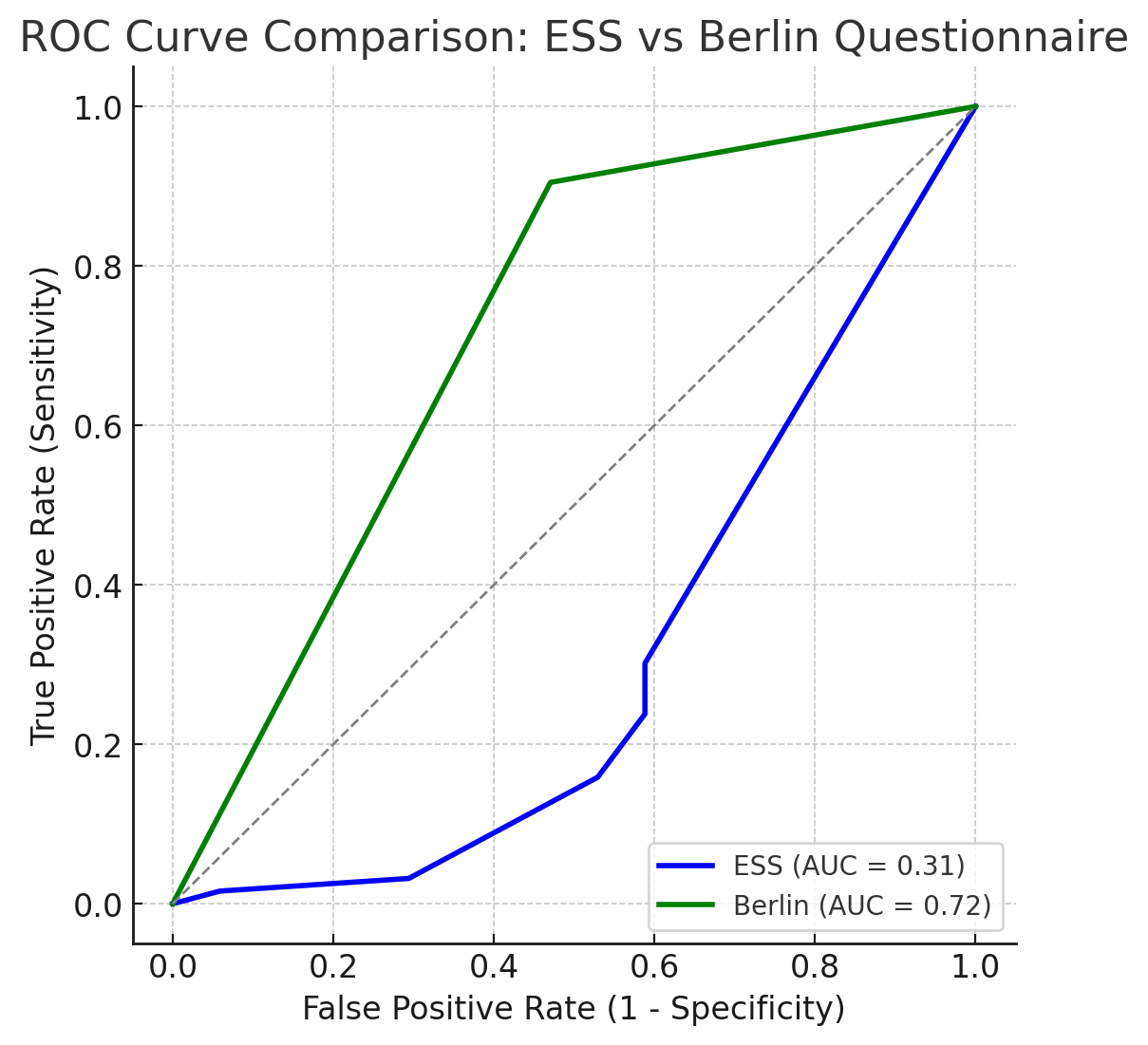
Receiver operating characteristic curve analysis demonstrated poor discriminative ability for the Epworth Sleepiness Scale, with an area under the curve of 0.31. In contrast, the Berlin Questionnaire showed better diagnostic performance, with an area under the curve of 0.72.
Discussion
The present cross-sectional observational study evaluated the diagnostic performance of the Epworth Sleepiness Scale (ESS) and the Berlin Questionnaire (BQ) in screening for obstructive sleep apnea (OSA) among adults with clinical suspicion of the disorder. The findings indicate that the Berlin Questionnaire demonstrates superior diagnostic utility compared to ESS in identifying individuals at risk for OSA. Similar findings have been reported by Goyal et al.,[14] and Sil et al.,[15], who observed better screening performance of the Berlin Questionnaire compared with ESS in Indian populations.
OSA is a major global health concern, with recent estimates suggesting that nearly one billion adults worldwide may be affected by the disorder [16]. Age greater than 50 years, higher body mass index, increased neck circumference, and higher Mallampati scores were significantly associated with the presence of OSA in this study. These findings are consistent with previous reports and reflect the contribution of obesity and upper airway anatomy to OSA pathogenesis [17,18]. Increased upper airway collapsibility and pharyngeal critical closing pressure have been identified as important mechanisms contributing to airway obstruction during sleep [19]. Experimental studies have further demonstrated that negative inspiratory pressure can precipitate upper airway collapse in susceptible individuals [20].
Large epidemiological studies have shown that advancing age and obesity are among the strongest predictors of OSA [21]. Gender-related differences in sleep-disordered breathing have also been described, although no statistically significant sex difference was observed in the present study [22]. The significant association between OSA and metabolic comorbidities such as diabetes mellitus, hypertension, and dyslipidaemia observed in our study is also supported by previous Indian community-based studies demonstrating a strong relationship between OSA and cardiometabolic risk factors [23].
ESS demonstrated low sensitivity and specificity, indicating limited utility as a standalone screening tool for OSA. ESS primarily assesses subjective daytime sleepiness, which may be influenced by individual perception, cultural factors, and variability in symptom recognition. As a result, patients with significant sleep-disordered breathing but minimal perceived daytime sleepiness may be misclassified.
In contrast, the Berlin Questionnaire showed high sensitivity and better overall diagnostic accuracy. By incorporating symptoms such as snoring and witnessed apneas along with anthropometric and comorbidity-based risk factors, the Berlin Questionnaire provides a more comprehensive assessment of OSA risk. These findings are in agreement with previous studies that have demonstrated higher sensitivity of the Berlin Questionnaire compared with ESS, particularly in identifying moderate to severe OSA [10,13-15]. ROC curve analysis in the present study further supports this observation, with the Berlin Questionnaire demonstrating good discriminative ability, whereas ESS showed poor diagnostic discrimination.
The strengths of this study include its cross-sectional design, use of sleep study as the reference standard, and evaluation of two widely used screening tools in an Indian clinical setting. However, certain limitations should be acknowledged. The study was conducted at a single centre with a relatively small sample size, which may limit generalisability. Additionally, the reliance on questionnaire-based responses introduces subjectivity, and the use of a level III sleep study instead of in-laboratory polysomnography may have influenced diagnostic precision.
Despite these limitations, the findings suggest that the Berlin Questionnaire may be preferred over ESS for initial screening of OSA in routine clinical practice. The use of simple, high-sensitivity screening tools can facilitate early identification of high-risk individuals and enable timely referral for definitive diagnostic testing.
Conclusion
In this study, the Berlin Questionnaire demonstrated superior diagnostic performance compared with the Epworth Sleepiness Scale for screening obstructive sleep apnea. Compared with ESS, the Berlin Questionnaire incorporates important risk factors such as snoring, daytime symptoms, and comorbidities, thereby achieving higher sensitivity and better overall diagnostic performance. Hence, it can be recommended as a more robust and clinically useful tool for initial screening in patients with suspected OSA.
Declarations
Acknowledgements
The authors express their sincere gratitude to all participants who took part in this study. We also thank the faculty, residents, technicians, and nursing staff of the Department of Respiratory Medicine, Jubilee Mission Medical College & Research Institute, Thrissur, Kerala, for their support during participant recruitment, data collection, and sleep study procedures.
Conflict of Interest
The authors declare that they have no conflicts of interest related to this study.
Funding / Financial Support
This research received no specific grant from any funding agency in the public, commercial, or not-for-profit sectors. No financial support was received for the conduct of this study.
Contributors
Dr. Nikhila Abraham: Conceptualization, study design, data collection, data analysis, manuscript drafting, and final approval of the manuscript. Dr. Supriya Adiody: Study supervision, methodology, data interpretation, critical revision of the manuscript, and final approval of the manuscript. Dr. Unni R Baby: Data analysis, interpretation of results, manuscript revision, and final approval of the manuscript.
Ethical Clearance
The study was approved by the Institutional Ethics Committee of Jubilee Mission Medical College & Research Institute, Thrissur, Kerala, India (IEC Reference No. 47/24/IEC/JMMC & RI). Written informed consent was obtained from all participants prior to enrolment. The study was conducted in accordance with the principles of the Declaration of Helsinki.