Introduction
Breast milk acts as the fundamental biological defence system which delivers vital nutrition together with immune support that newborns need for their survival [1]. The World Health Organization mandates breastfeeding initiation during the first hour after birth and exclusive breastfeeding for six months yet worldwide healthcare systems face major obstacles when enforcing these guidelines [2]. The national indicators show progress in India yet infant feeding practices remain a complex system where medical procedures combine with traditional cultural practices [2].
The state of Bihar shows different patterns when it comes to changes in maternal health status. The National Family Health Survey (NFHS-5) [3] shows 58.9% of mothers practice exclusive breastfeeding yet this number hides important differences between urban and peri-urban areas like Patna [4]. The urban slums of Patna have shown through recent investigations that their condition is worse. The practice of exclusive breastfeeding for six months only involved 27.6% of mothers while 23% of them started breastfeeding during the first hour after birth [4]. The process of breastfeeding initiation gets delayed because people follow cultural practices which require them to give honey or sugar water before breastfeeding and they also think colostrum is dangerous and cannot be digested.
A paradox exists where maternal literacy does not guarantee optimal practice [2]. Although a significant proportion of mothers visiting tertiary care centres may hold formal degrees, studies have shown that only 20% possess correct knowledge regarding the timing of initiation. Clinical determinants create additional obstacles for healthcare professionals to apply best practices in their work. For instance, the rising rate of Caesarean sections in tertiary settings significantly delays the onset of lactation and physical mother-infant contact. The healthcare system maintains regular contact with patients but breastfeeding counselling during pregnancy remains extremely insufficient because many women never receive proper lactation advice from their medical professionals [5].
Healthcare professionals operating within high-volume tertiary care facilities need to understand the social and epidemiological elements which affect patient compliance with medical protocols [4]. The research in Patna aims to determine the knowledge levels and factors that affect breastfeeding practices among hospital patients which will help develop targeted solutions for these at-risk families.
Materials and Methods
This study was a hospital based cross-sectional study conducted at a tertiary care hospital situated in Patna, Bihar, over a six-month period following ethical clearance from the Institutional Ethics Committee. Our study population comprised mothers with children aged 0 to 24 months who attended the immunization OPD. Utilizing a convenience sampling technique, we recruited a total of 250 participants; this sample size was calculated using the Cochran’s formula of n = [Z2 * p * (1 - p)] / d2 based on an estimated exclusive breastfeeding prevalence of 82% [6] and subsequently adjusted to account for potential non-response. We specifically included mothers who expressed willingness to participate, while excluding those who declined consent.
Data collection relied on a pre-tested, semi-structured questionnaire which developed through extensive literature review, texts and related government document, in the English then translated to local language Hindi and back translated to the English. It was designed to capture socio-demographic details and assess awareness and practices regarding breastfeeding. Prior to full-scale implementation, a pilot study conducted to evaluate the tool's feasibility, consistency and flow of questionnaire then it subsequently modified to ensure clarity and ease of understanding for the subjects. We manually verified collected data daily for completeness and consistency before entering it into Jamovi software version 2.7.13 for analysis. Statistical evaluation involved calculating descriptive statistics such as means, frequencies, percentages, and standard deviations, while associations between variables were ascertained using the Chi-square test. Multivariable logistic regression was performed to calculate Adjusted Odds Ratios (AOR) and 95% Confidence Intervals (CI) for EBF practice, controlling for maternal age, education rank, number of children, household income, and antenatal counselling. Additionally, EBF compliance was stratified by infant age: current EBF status was assessed for infants under 6 months, while retrospective EBF recall was analysed for children aged 6 to 24 months. Socioeconomic status was classified using the Modified B.G. Prasad Scale, updated for June 2025 using the All-India Consumer Price Index for Industrial Workers (CPI-IW = 145.0, base year 2016 = 100) [6].
Results
A total of 250 mothers participated in the study, presenting a mean age of 25.4 ± 4.2 years. The demographic profile was predominantly characterized by younger mothers, with 72.8% falling within the 20-27 years age bracket. The majority of households were nuclear in structure, accounting for 71.6% of the sample. In terms of socioeconomic stratification based on the Modified B.G. Prasad Scale, updated for June 2025 using the All-India CPI-IW (145.0, base year 2016=100), the largest proportion of participants belonged to Class II (Upper Middle) (32.4%), followed by Class I (Upper) (23.2%) and Class III (Middle) (20.4%), while occupational data revealed that a substantial 81.2% of the respondents were homemakers. Educational attainment within the cohort was diverse, ranging from those with no formal education (8.0%) to those possessing graduate or higher degrees (16.4%). The complete sociodemographic distribution is detailed in (Table 1).
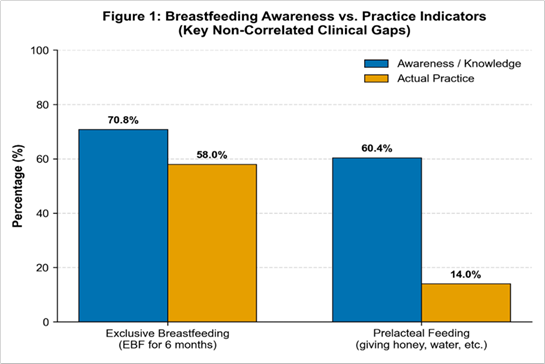
A distinct gap was seen between maternal awareness and the actual execution of recommended breastfeeding protocols (Figure 1). Although awareness regarding the importance of colostrum was robust at 87.2%, knowledge concerning the critical necessity of initiating breastfeeding within the first hour of birth was suboptimal, recorded at only 45.6%. Furthermore, while 70.8% of the study population demonstrated awareness of the six-month exclusive breastfeeding (EBF) recommendation, the translation of this knowledge into practice was lower, with 58.0% of mothers self-reporting strict adherence to EBF guidelines. The prevalence of prelacteal feeding remains a concern, as 14% of mothers reported administering substances other than breast milk. Age-stratified analysis showed that among infants under 6 months (n=64), the prevalence of current EBF was 56.3% (n=36), whereas for children aged 6 to 24 months (n=186), the retrospective EBF adherence rate was 58.6% (n=109). Regarding breastfeeding difficulties reported by 73 mothers (29.2%), the most common barriers were pain (n=27, 37.0%), sore nipples/mastitis (n=24, 32.9%), and lack of time (n=22, 30.1%). Mothers in nuclear families reported time constraints more frequently (32.0%, n=16/50) than those in joint families (26.1%, n=6/23), although overall EBF practice did not differ significantly by family type (59.2% in nuclear vs. 54.9% in joint; p=0.633).
Statistical analysis identified maternal education and antenatal counselling as significant determinants of positive breastfeeding behaviours (Table 2). Mothers possessing a graduate degree or higher exhibited a more than threefold increase in the likelihood of practicing EBF (OR: 3.33; 95% CI: 1.09–10.21; p=0.032) compared to the reference group of mothers with no formal education. Similarly, the receipt of antenatal counselling proved to be a potent predictor of improved outcomes; 72.0% of mothers who received counselling practiced exclusive breastfeeding compared to 37.0% among those who did not, yielding a significant odds ratio of 4.38 (95% CI: 2.55–7.52; p < 0.001). To identify independent predictors, a multivariable logistic regression was performed (Table 3). Antenatal counselling was the strongest independent predictor of EBF practice; mothers who received counselling had a more than fourfold increase in EBF odds (AOR: 4.14; 95% CI: 2.39–7.17; p < 0.001). Maternal education rank was also independently associated with EBF practice, with each unit increase in education rank corresponding to a 26.1% increase in EBF odds (AOR: 1.26; 95% CI: 1.06–1.51; p = 0.011). Confounding factors such as maternal age, household income, and number of children were not significantly associated with EBF practice.
| Variables | Frequency (Percentage) N (%) |
| Mother’s age (years) | |
| <20 | 26 (10.4%) |
| 20-27 | 182 (72.8%) |
| ≥28 | 42 (16.8%) |
| Parity | |
| Primipara | 112 (44.8%) |
| Multipara | 138 (55.2%) |
| Birth order of child | |
| 1 | 124 (49.6%) |
| >1 | 126 (50.4%) |
| Type of family | |
| Nuclear | 179 (71.6%) |
| Joint | 71 (28.4%) |
| Socioeconomic Status (Modified B.G. Prasad 2025) | |
| Class I (Upper) | 58 (23.2%) |
| Class II (Upper Middle) | 81 (32.4%) |
| Class III (Middle) | 51 (20.4%) |
| Class IV (Lower Middle) | 40 (16.0%) |
| Class V (Lower) | 20 (8.0%) |
| Education | |
| No formal education | 20 (8.0%) |
| Primary | 62 (24.8%) |
| Middle | 51 (20.4%) |
| High school | 43 (17.2%) |
| Intermediate | 33 (13.2%) |
| Graduate/higher | 41 (16.4%) |
| Occupation | |
| Homemaker/ Unemployed | 203 (81.2%) |
| Employed | 32 (12.8%) |
| Labor/Self-employed | 15 (6.0%) |
| Variables | Mothers (N=250) | EBF Practice n (%) | Odds Ratio (95% CI) | P-value† |
| Education Level | ||||
| No formal | 20 | 9 (45.0%) | 1.00 (ref.) | - |
| Primary | 62 | 30 (48.4%) | 1.15 (0.42 – 3.15) | 0.792 |
| Middle | 51 | 28 (54.9%) | 1.49 (0.53 – 4.21) | 0.453 |
| High school | 43 | 26 (60.5%) | 1.87 (0.64 – 5.46) | 0.250 |
| Intermediate | 33 | 22 (66.7%) | 2.44 (0.78 – 7.64) | 0.121 |
| Graduate/higher | 41 | 30 (73.2%) | 3.33 (1.09 – 10.21) | 0.032* |
| Antenatal Counselling | ||||
| Received | 150 | 108 (72.0%) | 4.38 (2.55 – 7.52) | <0.001* |
| Not received | 100 | 37 (37.0%) | 1.00 (ref.) | - |
† P-values calculated using Chi-square test (Fisher's exact test used for cell sizes < 5).* Indicates statistical significance (p < 0.05).
| Predictor | Regression Coefficient (β) | Standard Error (SE) | Adjusted Odds Ratio (AOR) (95% CI) | P-value |
| Intercept | 0.636 | 2.117 | 1.890(0.030 – 119.74) | 0.764 |
| Maternal Education Rank | 0.232 | 0.091 | 1.261(1.055 – 1.507) | 0.011* |
| Antenatal Counselling | 1.421 | 0.280 | 4.142(2.393 – 7.168) | <0.001* |
| Maternal Age (years) | -0.013 | 0.027 | 0.988(0.936 – 1.042) | 0.644 |
| Log Household Income | -0.145 | 0.197 | 0.865(0.588 – 1.272) | 0.462 |
| Number of Children | 0.035 | 0.116 | 1.035(0.825 – 1.300) | 0.765 |
LLR p-value < 0.001; * indicates statistical significance (p < 0.05).
Discussion
The results of our study illuminate a stark reality: in a tertiary care setting in Patna, knowing what is right for an infant does not always translate into doing what is right. The majority of mothers understood colostrum's immune benefits at 87.2%, yet only 45.6% of them started breastfeeding during the first hour after birth. The local pattern exists beyond this area because it matches larger regional patterns which appear in Bihar according to NFHS-5 data that shows 58.9% of children under six months receive exclusive breastfeeding while 31.1% start breastfeeding too late [3]. The number of babies born at hospitals continues to rise yet health facilities fail to reach the delivery timing standards set by the World Health Organization [8].
The way maternal education affects breastfeeding success stands as a crucial factor. Research shows that mothers who achieved graduate-level education or higher were three times more likely to practice exclusive breastfeeding (EBF) than women who never attended school. Research shows that better health knowledge helps women fight against traditional cultural practices like prelacteal feeding which 14% of our participants reported8. Education acts as a shield, allowing mothers to navigate complex clinical environments, especially when facing the physical and psychological recovery associated with Caesarean sections, which often delay the onset of lactation [10].
Our research shows that antenatal counselling delivers the highest value when it comes to actionable results. The mothers who received specific guidance during pregnancy achieved a better rate of EBF practice at 72.0% compared to 37.0% in the control group (p < 0.001). The study supports the "self-efficacy" model of maternal care because healthcare providers who focus on antenatal breastfeeding education help mothers build confidence to manage physical and social breastfeeding challenges [5]. Through self-help groups and technical support programs community-based interventions prove that resource-limited environments can sustain behavioural change by connecting clinical advice to home-based practice [11].
The study shows that 14% of participants still use prelacteal feeding which means that cultural beliefs about honey and sugar water continue to exist strongly. The medical centre IGIMS exists yet people still believe colostrum causes digestion problems which prevents babies from getting the proper care they need. The solution demands a method which goes beyond medical protocols because it needs culturally sensitive health communication techniques that include family elders who control feeding decisions for newborns in both nuclear and joint family setups [12].
Our multivariable logistic regression model confirms that the benefit of antenatal counselling on EBF practice is independent of maternal education and family income. Even after controlling for socioeconomic factors, receiving counselling was associated with a 4.14-fold increase in the odds of EBF compliance. This underscores that clinical health education interventions are a critical public health strategy, capable of transcending economic barriers and empowering mothers of all backgrounds to adhere to recommended infant feeding guidelines.
Furthermore, by stratifying our analysis by child age, we addressed the methodological challenge of pooling infants of varying age groups. The prevalence of current EBF among infants under 6 months (56.3%) was slightly lower than the retrospective recall of completed 6-month EBF among older children (58.6%), indicating that EBF practice is dynamic and highlighting the need for continuous postnatal support. Additionally, nuclear household structures were associated with higher reporting of time constraints as a breastfeeding barrier (32.0% vs. 26.1% in joint families). This suggests that mothers in nuclear families, who lack the childcare support of extended family members, face a higher time burden and may require targeted social support systems to sustain exclusive breastfeeding.
Limitations of the study
As this was a cross-sectional study, temporality could not be ascertained. The study may not be generalized to other parts of country because of the difference in socio-demographic and economic conditions and as well as the inclusion of health centre only.
Conclusion
This study reveals a substantial gap between maternal knowledge and actual breastfeeding practices at a tertiary care centre in Patna, India. While awareness of colostrum and exclusive breastfeeding is high, timely initiation remains low, and exclusive breastfeeding is practiced by only a fraction of mothers. Maternal education and antenatal counselling are the key independent predictors of positive breastfeeding behaviours. Targeted, structured antenatal counselling is critical to bridging this knowledge-practice gap and dismantling deep-rooted cultural barriers like prelacteal feeding.
Declarations
Acknowledgements
We thank all the participants who participated in this study, and the clinical and nursing staff at the immunization clinic.
Conflict of interest
The authors have no conflicts of interest to declare.
Funding/ financial support
This research did not receive any financial support.
Ethical Clearance
The study was approved by the Institutional Ethics Committee, Indira Gandhi Institute of Medical Sciences (IGIMS), Patna, Bihar, India (IEC Reference: 372/IEC/IGIMS/2025). The Written informed consent was obtained from the participants, and confidentiality was ensured.