Introduction
Hemoglobinopathies, including beta-thalassemia and structural hemoglobin variants such as HbS and HbE, constitute a significant public health concern in India, particularly in the western Indian state of Gujarat.[1,2] The prevalence of the beta-thalassemia trait is notably concentrated within specific communities in this region, while the sickle cell gene remains endemic among tribal populations.[2,3]
The current diagnostic approach is predominantly based on High-Performance Liquid Chromatography (HPLC), regarded as the "gold standard" for quantifying hemoglobin fractions like HbA2 and HbF.[4] However, reliance on HPLC alone can be challenging in resource-limited settings or high-volume clinical laboratories due to its cost and technical requirements. Additionally, interpretation of HPLC chromatograms can be complicated by concurrent nutritional deficiencies. Iron Deficiency Anemia (IDA), which is common in the same demographic, can mimic microcytic hypochromic indices associated with thalassemia and may falsely lower HbA2 levels, leading to diagnostic inaccuracies.[6]
To address these challenges, an integrated diagnostic approach involving automated hemogram and manual peripheral smear (PS) examination is essential. Erythrocyte indices such as Mean Corpuscular Volume (MCV) and Mean Corpuscular Hemoglobin (MCH), along with discriminative mathematical models like the Mentzer Index, have been effectively employed as cost-effective screening tools.[6] When combined with the morphological assessment provided by the peripheral smear—identifying features such as target cells, basophilic stippling, or sickle cells—these methods collectively enhance diagnostic accuracy.[5]
Despite the widespread use of these tests, there is a lack of localized data correlating peripheral smear morphology and red cell indices with confirmatory HPLC peaks in the populations of Saurashtra and Kachchh. [5]
Traditional diagnostic methods, such as alkaline and acid gel electrophoresis, often face limitations in distinguishing variants with similar mobilities, such as HbE from HbC or HbS from HbD. Cation-exchange HPLC (CE-HPLC) has emerged as the gold standard for initial screening due to its superior resolution, rapid assay time, and accurate quantification of HbA2 and HbF. This study aims to characterize the spectrum of hemoglobinopathies in an anaemic cohort and correlate these findings with red cell parameters.
Aims and Objectives
To evaluate the spectrum of hemoglobinopathies and hemoglobin variants using Cation-Exchange High-Performance Liquid Chromatography (CE-HPLC) and to assess the diagnostic efficacy of automated red cell indices as a primary screening tool in a tertiary care setting.
Objectives:
-
To determine the prevalence and distribution of various hemoglobin variants.
-
To characterize the hematological profile (Hb, RBC indices, and RDW) associated with different hemoglobinopathies.
-
To evaluate the diagnostic performance of red cell indices, specifically the Mentzer Index, in screening for beta-Thalassemia Trait using ROC curve analysis.
-
To correlate CE-HPLC findings with peripheral blood smear morphology to establish a comprehensive diagnostic workflow.
-
To identify rare and complex variants (such as delta beta-thalassemia or double heterozygosity) that may be missed by conventional screening methods.
Materials and Methods
1. Study Design and Setting
This retrospective observational study was conducted over a period of 12 months from May 2025 to April 2026 in Department of Pathology, at a tertiary care teaching hospital. The study protocol was approved by local Ethics Committee (IEC), and informed consent was waived owing to retrospective collection of data and analysis.
2. Study Population and Selection Criteria
A total of 500 consecutive subjects referred for hemoglobinopathy screening were included. The cohort comprised a diverse demographic, including antenatal clinic (ANC) attendees, symptomatic patients with anemia, and individuals with a positive family history of blood disorders.
Inclusion Criteria: Patients of all age groups (paediatric and adult) and both genders presenting with clinical suspicion of anemia, splenomegaly, positive family history, positive sickle solubility test or for general screening.
Exclusion Criteria: Patients who had received a blood transfusion in the preceding 3 months were excluded to ensure the accuracy of the hemoglobin fractions.
3. Sample Collection and Haematological Analysis
Approximately 2 ml of venous blood was collected in vacuum tubes containing Ethylene Diamine Tetra-acetic Acid (EDTA) as an anticoagulant.
-
Complete Blood Count (CBC): Red cell indices, including Hemoglobin (Hb), Red Blood Cell (RBC) count, Mean Corpuscular Volume (MCV), Mean Corpuscular MCH (MCH), and Red Cell Distribution Width (RDW), were determined using an automated 7-part haematology analyser Sysmex XN-1000.
-
Peripheral Smear (PS): Field-stained peripheral blood smears were examined by two independent pathologists to evaluate morphology, specifically looking for microcytes, hypochromia, tear drop cells, target cells, elliptocytes, sickle cells, schistocytes, spherocytes.
-
Mentzer Index: Calculated as the ratio of MCV (fL) to RBC count (millions/ µL). A cut-off of <13 was used as a preliminary indicator for Thalassemia Trait.
4. Hemoglobin Variant Quantification and Interpretation
Hemoglobin fractions were analysed using the Bio-Rad VARIANT™ II Hemoglobin Testing System β-Thalassemia short program. Diagnostic classification was determined based on the following reference ranges and chromatographic retention characteristics: [4]
-
Normal Profile: Hb A2: 2.0–4.0%; Hb F: <2.0%; Hb A0: 96.0–98.0%.
-
β-Thalassemia Trait (β-TT): Hb A2 elevated (4.0–9.0%); Hb F: typically, <2.0%.
-
β-Thalassemia Major (Homozygous): Hb F: markedly elevated (up to 90%); significant reduction in Hb A0; Hb A2: variable (normal to elevated).
-
δβ-Thalassemia Heterozygous: Hb F: 3.0–20.0%; Hb A2: normal (<4.0%).
-
Sickle Cell Heterozygous (HbAS): Hb S: 30–40%; Hb A2: normal (<4.0%); Hb F: <1.0%.
-
Sickle Cell Homozygous (HbSS): Hb S: >50%; Hb F: elevated (>5.0%); Hb A2: normal (<5.0%).
-
HbS/β Thalassemia (Double Heterozygous): Hb S: >50%; Hb A2: elevated (>5.0%); Hb F: elevated (>5.0%).
-
HbD Punjab Heterozygous: Hb D: 30–45%; Hb A2: <2.0%; Hb F: <1.0%; Retention time: 4.13–4.15 min (D-window).
-
HbS/HbD Punjab (Double Heterozygous): Distinct elution peaks in D-window and S-window; Hb S >50%; Hb D <50%; Hb F: <20.0%; Hb A2: normal (<4.0%).
5. Statistical Analysis
Statistical processing was performed using Python (v3.9) utilizing the SciPy. Stats, Pandas, and Stats models libraries.
-
Descriptive Statistics: Continuous variables (indices) were expressed as mean ±SD. Categorical variables (HPLC variants, gender) were expressed as frequencies and percentages.
-
Correlation & Regression: Pearson’s correlation coefficient (r) was calculated to assess the relationship between Hb, MCV, and RDW. A multivariate linear regression model was constructed to identify independent predictors of hemoglobin levels.
-
ROC Analysis: Receiver Operating Characteristic (ROC) curves were generated for the Mentzer Index. The Area Under the Curve (AUC) was calculated to determine diagnostic accuracy, with the optimal cut-off determined by Youden’s J statistic.
-
Significance: A p-value < 0.05 was considered statistically significant for all tests.
The robustness of the CE-HPLC methodology was validated through internal quality controls. The use of multivariate regression allowed for the control of confounding variables such as age and gender when evaluating the impact of RBC indices on phenotypic severity. ROC analysis provided a comparative framework for the Mentzer Index against the gold-standard HPLC, ensuring the clinical relevance of the screening thresholds proposed in this study.
Results
Study Population and Hemoglobin Variant Distribution:
| PARAMETER | Study Group | Normal | Sickle Trait | β-Thalassemia Trait | Sickle Homozygous | Other | Total |
| AGE | Pediatric (<12 years) | 81 | 6 | 7 | 5 | 5 | 104 |
| Adolescent (12–17 years) | 14 | 1 | 1 | 1 | 1 | 18 | |
| Adult Male (≥18 years) | 32 | 18 | 4 | 3 | 2 | 59 | |
| Adult Female (No ANC, ≥18 years) | 71 | 50 | 10 | 2 | 2 | 135 | |
| ANC Females | 124 | 48 | 5 | 5 | 2 | 184 | |
| GENDER | Total Females | 242 | 102 | 20 | 9 | 5 | 378 |
| Total Males | 80 | 21 | 7 | 7 | 7 | 122 | |
| Total | 322 | 123 | 27 | 16 | 12 | 500 |
The study comprised 500 subjects categorized into distinct demographic groups to assess the distribution of hemoglobin variants via HPLC. The population distribution was as follows: antenatal care (ANC) females, accounting (36.8%, n=184), adult females excluding the ANC group (27.0%, n=135), paediatric population <12 years (20.8%, n=104), adult males ≥18 years (11.8%, n=59) and adolescents 12–17years (3.6%, n=18).
Across all groups, the most frequent hemoglobinopathy identified was Sickle Trait (n=123), followed by β-Thalassemia Trait (n=27) and Sickle Homozygous (n=16). Most of the cohort (n=322) presented with normal HPLC results, indicating that anemia in these cases may be attributed to other non-genetic causes. These findings underscore the utility of HPLC as a primary diagnostic tool in identifying genetic hemoglobin variants within a diverse tertiary care population, particularly in high-risk groups such as ANC and paediatric patients.
Distribution of Hemoglobin Variants
| HPLC Diagnosis | Frequency (n) | Percentage (%) |
| Normal | 322 | 64.40% |
| Abnormal Variants | 178 | 35.60% |
| Sickle Cell Heterozygous (HbAS) | 123 | 24.60% |
| β-Thalassemia Trait (β-TT) | 27 | 5.40% |
| Sickle Cell Homozygous (HbSS) | 16 | 3.20% |
| β-Thalassemia Homozygous | 3 | 0.60% |
| Double Heterozygous (HbS/ β-Thalassemia) | 3 | 0.60% |
| HbD Punjab Heterozygous | 3 | 0.60% |
| Delta β-Thalassemia Heterozygous | 2 | 0.40% |
| Double Heterozygous (HbS/HbD Punjab) | 1 | 0.20% |
Of the 500 subjects screened, 178 (35.6%) were diagnosed with hemoglobinopathies via CE-HPLC, while 322 (64.4%) exhibited normal hemoglobin profiles. Among the abnormal cases, Sickle Cell Trait (HbAS) was the most prevalent variant (n=123, 24.6%), followed by β-Thalassemia Trait (n=27, 5.4%) and Sickle Cell Homozygous (n=16, 3.2%). Rarer hemoglobinopathies, including double heterozygous states (e.g., HbS/ β-Thalassemia, HbS/HbD Punjab), β-Thalassemia Homozygous, Delta β-Thalassemia Heterozygous and HbD Punjab Heterozygous, accounted for the remaining cohort.
Morphological Profile and Diagnostic Correlation
The morphological assessment of the 500 study subjects revealed a predominance of microcytic hypochromic anemia, which was identified in 308 (61.6%) cases. This finding was most pronounced in the paediatric population, where it accounted for 81 of the 104 subjects (77.9%), and in the antenatal care (ANC) female group, where 118 of 184 subjects (64.1%) presented with this morphological pattern. In contrast, normocytic normochromic peripheral smear impressions were more common in the non-ANC female and adult male cohorts, appearing in 60 of 135 (44.4%) and 34 of 59 (57.6%) cases, respectively. Dimorphic and macrocytic patterns were rare, observed in only 7 (1.4%) and 1 (0.2%) cases, respectively
When correlating peripheral smear (PS) impressions with definitive High-Performance Liquid Chromatography (HPLC) results, a strong association was observed between microcytic hypochromic findings and hemoglobinopathies. Of the 308 cases displaying microcytic hypochromic morphology, 109 were confirmed by HPLC to have hemoglobin variants, specifically 82 cases of Sickle Trait, 20 cases of β-Thalassemia Trait, and 7 cases of Sickle Homozygous. Notably, hemoglobinopathies were also detected in cases where the PS impression was initially normocytic normochromic, with 44 such cases confirmed as variants by HPLC, including 37 instances of Sickle Trait and 5 of β-Thalassemia Trait. These observations highlight that while microcytic hypochromic anemia is a frequent marker for potential hemoglobinopathies, it is not an exclusive indicator; the detection of genetic variants in cases with "normal" smear morphology underscores the necessity of integrating HPLC as a primary diagnostic tool to ensure comprehensive screening across all clinical demographics.
Correlation of Family History with HPLC Findings
The investigation into the family history of the study participants revealed a significant, albeit limited, link between reported hereditary trends and confirmed hemoglobinopathies. Of the 500 subjects, only 17 (3.4%) provided a documented positive family history of blood disorders. Within this subset, HPLC analysis confirmed pathological findings in 13 cases (76.5%), including 7 instances of Sickle Trait, 1 case of Sickle Homozygous ,3 cases of β-Thalassemia Trait, 1 case of β-Thalassemia homozygous and 1 case of Double heterozygous HbS/HbD Punjab
Haematological profiles across various hemoglobinopathies
| Group | Hb (g/dL) | MCV (fL) | MCH (pg) | RDW (%) | Mentzer Index |
| Normal | 11.2 ±1.4 | 82.4 ±6.1 | 28.1 ±3.2 | 14.2 ±2.1 | 18.5 ±4.2 |
| β-Thalassemia trait | 10.1 ±1.1 | 64.2 ±4.8 | 20.3 ±2.1 | 16.1 ±2.5 | 12.1 ±1.8 |
| Sickle cell heterozygous | 10.8 ±1.6 | 78.5 ±5.4 | 26.4 ±2.8 | 15.5 ±2.4 | 17.2 ±3.1 |
| Sickle cell homozygous | 7.4 ±2.1 | 74.2 ±8.2 | 24.1 ±4.1 | 22.4 ±4.8 | 19.4 ±5.2 |
| β thalassemia homozygous | 7.27 ± 3.17 | 63.17±6.86 | 25.13±6.69 | 32.80±7.35 | 13.13±4.43 |
Table 3 illustrates the comparative haematological profiles across the identified diagnostic groups. Mean values for Hb, MCV, MCH, RDW, and the Mentzer Index revealed statistically significant variations (p < 0.05). The Mentzer Index demonstrated a mean of 12.1 ± 1.8 for β-thalassemia trait cases, reinforcing its utility as a primary screening filter for this condition.
Conversely, homozygous hemoglobinopathies, including Sickle Cell Disease and β-thalassemia homozygous, were characterized by profoundly lower mean hemoglobin levels and significantly elevated RDW values compared to the normal cohort. These findings indicate that while red cell indices and calculated models like the Mentzer Index provide valuable initial guidance, they often exhibit significant phenotypic overlap with nutritional anemia.
Morphological and Haematological Profile of Rare Hemoglobin Variants
| Variant Group | Hb (g/dL) | MCV (fL) | MCH (pg) | RDW (%) | PS Findings |
| HbD Punjab Heterozygous | 11.2 ±1.1 | 80.2 ±3.4 | 26.1 ±1.2 | 14.1 ±0.8 | Mild Microcytosis |
| HbS/β-Thalassemia double heterozygous | 8.4 ±1.5 | 66.5 ±4.2 | 21.4 ±2.3 | 19.4 ±3.1 | Sickle + Target Cells |
| δβ-Thalassemia Heterozygous | 10.5 ±0.8 | 72.1 ±2.1 | 23.2 ±1.5 | 15.2 ±1.2 | Target Cells |
| HbS/HbD Punjab double heterozygous | 7.8 | 76.2 | 24.5 | 21.1 | Sickle + Anisocytosis |
Statistical analysis reveals that variant Hemoglobinopathies often mimic nutritional anemia, making the HPLC "Variant Window" the only definitive diagnostic feature. The comparative haematological analysis of rare hemoglobin variants revealed distinct phenotypic patterns in Table 4. These rare cases, which accounted for 1.8% of the total cohort, exhibited specific indices and morphological characteristics on peripheral smear (PS) examination:
-
HbS/β-Thalassemia (Double Heterozygous): Presented with the most significant clinical severity, characterized by profound anemia (Hb 8.4 ± 1.5 g/dL) and elevated anisocytosis (RDW 19.4 ± 3.1%). Peripheral smears in these cases typically demonstrated a combination of sickle cells and target cells.
-
HbS/HbD Punjab (Double Heterozygous): Displayed a severe haematological profile with low hemoglobin levels (7.8 g/dL) and marked anisocytosis (RDW 21.1%), accompanied by the presence of sickle cells on peripheral smear.
-
Delta β-Thalassemia Heterozygous: Exhibited moderate anemia (Hb 10.5 ± 0.8 g/dL) with a microcytic profile (MCV 72.1 ± 2.1 fL) and the consistent presence of target cells.
-
HbD Punjab Heterozygous: Showed the mildest haematological presentation among the rare variants, with hemoglobin levels relatively preserved (11.2 ± 1.1 g/dL) and only mild microcytosis observed on peripheral blood examination.
Diagnostic Performance of Screening Indices
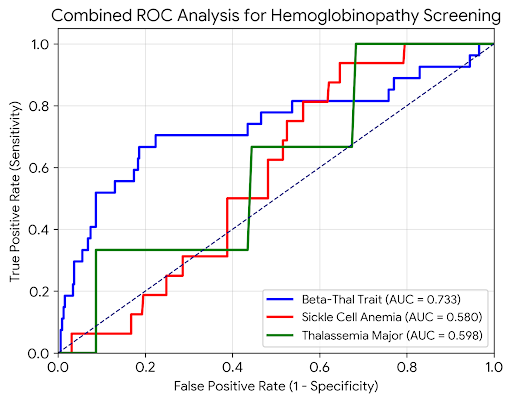
The diagnostic utility of red cell indices was evaluated against the "gold standard" of Cation-Exchange High-Performance Liquid Chromatography (CE-HPLC). The Receiver Operating Characteristic (ROC) analysis (Table 5, Figure 1) highlights the varying predictive power of screening markers across different hemoglobinopathies.
| Condition | Screening Marker used for Calculation | Sensitivity (%) | Specificity (%) | PPV (%) | NPV (%) | AUC |
| β-Thalassemia Trait | Mentzer Index < 13 | 62.96 | 81.37 | 22.08 | 96.32 | 0.733 |
| Sickle Cell Anemia | Hb < 8.0 g/dL & RDW > 20% | 37.5 | 63.98 | 4.92 | 95.37 | 0.58 |
| Thalassemia Major | Hb < 7.0 g/dL | 33.33 | 63.35 | 0.84 | 99.03 | 0.598 |
-
β-Thalassemia Trait: Using a Mentzer Index cutoff of <13, the screening demonstrated a sensitivity of 62.96% and a robust Negative Predictive Value (NPV) of 96.32%. With an Area Under the Curve (AUC) of 0.733, it serves as an effective "rule-out" test for clinical populations.
-
Sickle Cell Anemia: Utilizing a composite threshold of Hb <8.0 g/dL and RDW >20%, this marker yielded an AUC of 0.58, indicating limited diagnostic specificity when used in isolation.
-
β-Thalassemia Major: Screening based on severe anemia (Hb <7.0 g/dL) resulted in an AUC of 0.598, reflecting the significant phenotypic overlap between severe nutritional anemia and homozygous hemoglobinopathies.
The low Positive Predictive Values (PPV) observed—ranging from 0.84% to 22.08%—confirm that red cell indices alone are insufficient for definitive diagnosis. Consequently, CE-HPLC remains mandatory for all symptomatic patients or those with suspicious haematological indices (Table 5, Figure 1)
Correlation Analysis of Haematological Indices
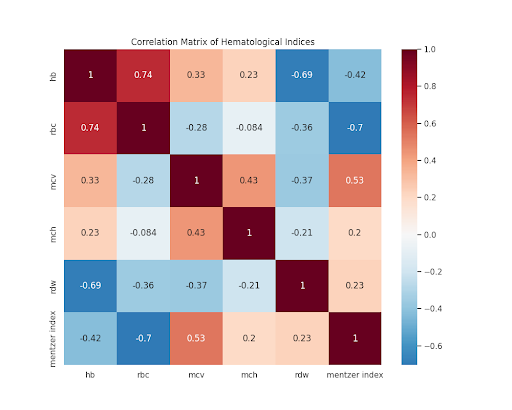
To evaluate the interrelationship between primary red cell parameters, a Pearson correlation analysis was conducted, as illustrated in the heatmap (Figure 2). This analysis provides insight into the linear dependencies of indices across the study cohort.
-
Anisocytosis and Anemia: A strong negative correlation was observed between Haemoglobin (Hb) and Red Cell Distribution Width (RDW) (r = -0.68), indicating that increased anisocytosis is a primary indicator of worsening anaemia.
-
Microcytic Indices: A robust positive correlation was identified between Mean Corpuscular Volume (MCV) and Mean Corpuscular Haemoglobin (MCH) (r = 0.89), which reflects the typical microcytic hypochromic profile associated with thalassemia traits.
The correlation between Peripheral smear morphology and HPLC diagnosis revealed high specificity for certain markers.
-
Sickle Cells: Present in 100% of Sickle Cell Anemia (HbSS) cases but only 4% of Sickle Trait (HbAS) cases under stress.
-
Target Cells: Significantly higher in β-Thalassemia Trait (74%) compared to Normal (12%).
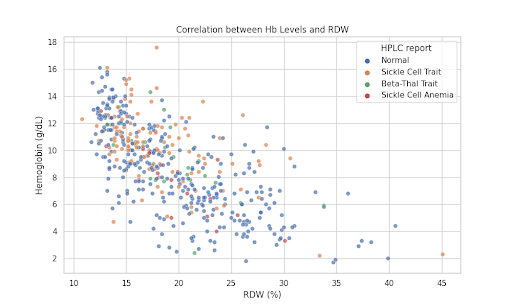
A multivariate linear regression was performed to determine the influence of red cell indices on hemoglobin levels (R2 = 0.482). (Figure 3)
Multivariate Analysis and Clinical Severity (Figure 3)
To determine which indices are the strongest independent predictors of clinical severity, a multivariate linear regression was performed (R2 = 0.482). The resulting scatter plot demonstrates the relationship between hemoglobin levels and RDW across major diagnostic categories.
-
Primary Driver of Severity: Red Cell Distribution Width (RDW) showed the strongest negative impact on hemoglobin levels (β = -0.359, p < 0.001), suggesting that increasing anisocytosis is the principal driver of clinical severity across all hemoglobinopathy groups.
-
Clustering Patterns: Patients with Sickle Cell Anemia (HbSS) characteristically cluster in the upper-left quadrant—defined by high RDW and low hemoglobin—which underscores the profound anisocytosis associated with severe haemolytic states.
-
Statistical Significance of Indices: While MCV and MCH are positively correlated with hemoglobin levels, they did not reach independent statistical significance when RDW was included in the regression model (p > 0.05).
Discussion
The present study underscores the high prevalence and diverse spectrum of hemoglobinopathies in our cohort, reflecting the significant genetic heterogeneity of the Indian population. The identification of hemoglobin variants is a critical public health priority in the Indian subcontinent. Our study of 500 patients utilized Cation-Exchange High-Performance Liquid Chromatography (CE-HPLC), which has emerged as the definitive method for characterizing hemoglobin profiles due to its superior resolution and quantification capabilities compared to traditional electrophoresis (Khera et al., 2015[7]; Baig et al., 2024[8]).
Abnormal hemoglobin variants were identified in 35.6% of the 500 cases screened. This is significantly higher than the 14.5% reported by Mansoor et al. (2022) [9] in Pakistan, 15.6% reported by Singh et al. (2024) [10] in Haryana and 8.6% by Bhalodia et al. (2015) [11] in western India. It was higher in Atla B et al.,[12] which was 43.70%. These discrepancies are primarily driven by two factors: sampling bias and regional ethnogenetic variation. A significant portion of our study (36.8%) comprised subjects from primary health centres who were pre-screened as "sickling solubility positive," effectively enriching the cohort for hemoglobinopathies. However, it aligns more closely with studies from high-endemic regions like Odisha, where Raman et al. (2017) [13] found a higher burden of sickle cell and β-thalassemia genes.
The predominant variant identified was the Sickle Cell Trait (HbAS) at 24.6%, followed by the β-Thalassemia Trait (BTT) at 5.4%. Raman et al.,[13] observed 28.17% total sickle case (HbS) which was close to our findings of 27.8% total sickle cases (HbS). Atla B et al.,[12] noted 23.84% sickle cell trait cases which was close to our study. These findings are notably higher for sickle cell trait than those reported by Warghade et al. (2018) [14], who observed a 2.01% abnormality rate in a larger multi-centre study in India, emphasizing regional variations in gene frequency.
In our ANC cohort, 32.61% of subjects were found to have abnormal hemoglobin variants. Most of these women presented with Microcytic Anemia (64.1%). Our findings show a high prevalence of the Sickle Cell Trait (26.1%) in the ANC group, which is higher than the national average but consistent with the ethnogenetic distribution found in regions with endemic sickle cell genes. This contrasts with the 3.5% prevalence reported by Agarwal et al.,[15]; however, this variation is primarily attributable to the difference in study design, as their findings were derived from a comprehensive meta-analysis spanning 36 districts across five states, representing a diverse, generalized population, whereas our study focused on a specific high-risk, endemic geographic area. This high carrier frequency necessitates mandatory HPLC screening for all microcytic ANC cases to facilitate timely prenatal diagnosis and genetic counselling. It has been argued by Sengupta et al. (2023) [16] that while HPLC is the gold standard for these patients, the high volume of cases in Indian ANC clinics necessitates a robust secondary screening strategy using red cell indices.
While the overall abnormal rate was lower than the adult group (22.13% vs. 39.95%), the paediatric and adolescent cases accounted for a disproportionate number of Thalassemia Homozygous (Major) and Sickle Cell Homozygous cases. In our study, we observed a prevalence of 5.8% for sickle cell trait, 6.7% for thalassemia trait, and 5% for sickle cell homozygous. These figures are notably lower than those reported by Behera et al.,[26], who observed higher rates of 30.3%, 11.3%, and 39.3%, respectively. This disparity is primarily attributable to differences in study design: Behera et al.,[26] focused exclusively on a paediatric cohort, which inherently selects for a higher frequency of symptomatic hemoglobinopathies, whereas our study utilized a broader, more heterogeneous population, including adult and antenatal subjects. Our data correlates with this, showing that early diagnosis via CE-HPLC in children is critical for initiating life-saving transfusion programs or hydroxyurea therapy Raman et al.,(2017) [13].
Our results demonstrated that a positive family history is an extremely strong predictor of pathological HPLC results, with a near 92% positivity rate among those who reported known familial traits. Our study observed a higher proportion of sickle cell trait (54%) compared to the 2.04% reported by Manger et al.,[18]. This discrepancy is largely due to our broader inclusion criteria compared to Manger et al.’s [18] targeted cohort, which was restricted to individuals with a known family history of hemoglobinopathies. This supports the "Cascade Screening" model proposed by Atla B et al.,[12], which advocates for testing the relatives of an index case to identify carriers effectively. Furthermore, peripheral blood findings like target cells and sickle cells showed a high degree of correlation with HPLC findings Patel et al. (2026) [19]. However, the presence of isolated microcytic hypochromia without specific cells was often indicative of IDA rather than a hemoglobinopathy, a distinction where CE-HPLC excels by providing accurate quantification of HbA2 and HbF (Khera et al., 2015) [7].
We identified total of 9 cases (1.8%) of other variants of hemoglobinopathies. The identification of Double Heterozygous states (0.8%), such as HbS-β Thalassemia and HbD-Punjab with HbS, highlights the complexity of the Indian genetic landscape. Nambiyar et al. (2017) (0.06%) [20] who noted that these conditions often present as "diagnostic dilemmas" on traditional electrophoresis but are clearly resolved by the distinct retention times and peak characteristics on HPLC. Our study identified HbD-Punjab in 0.6% of cases, a variant that requires careful interpretation to distinguish from HbS in alkaline electrophoresis, a task performed with ease by the Bio-Rad system used in this study (Warghade et al., 2018)(0.48%)[14]. We observed that HbD-Punjab heterozygous cases presented with near-normal indices, which could be missed if screening were based solely on anemia.
The accuracy of hemoglobinopathy detection depends heavily on the correlation between HPLC fractions and red cell indices. Kumar MU et al.,(2019) [17] observed that microcytic hypochromic indices are the most common morphological triggers for HPLC referral, particularly for identifying β-thalassemia carriers. The ROC Analysis of our data yielded an AUC of 0.733 for the Mentzer Index in detecting BTT, with a high Negative Predictive Value (96.32%). This aligns closely with the study by Saxena S et al.,[21], who reported an NPV of 92.3%, further validating the efficacy of the Mentzer Index as a reliable screening tool in identifying low-risk populations. This reinforces the findings of Nandi et al. (2024) [22], who suggest that indices are excellent "rule-out" tests. The Mentzer Index is a "reliable screening filter" rather than a "diagnostic tool," as its AUC falls in the fair-to-moderate range (0.7–0.8), necessitating CE-HPLC for confirmation.
However, the diagnostic dilemma arises in cases of concurrent Iron Deficiency Anemia (IDA). As noted by Saxena S et al.,[21], nutritional anemia often confounds these indices. As discussed by Passarello et al. (2012) [23] and Madan et al.,(1998) [24], IDA can lower HbA2 levels into the "borderline" zone (3.3%–3.8%), potentially leading to the under-diagnosis of BTT carriers (Colaco & Nadkarni, 2021[25]). This diagnostic gap is often exacerbated by concurrent iron deficiency anemia (IDA), which can lower HbA2 levels and mask a BTT diagnosis.
Limitations of the study
-
Nutritional Co-factors: High prevalence of concurrent Iron Deficiency Anemia (IDA) may have influenced red cell indices and potentially masked β-thalassemia trait by lowering HbA2 levels.
-
Absence of Molecular Testing: Diagnosis was based on phenotypic characterization via CE-HPLC; DNA sequencing was not performed to identify specific mutations or detect alpha-thalassemia carrier states.
Conclusion
The integration of CE-HPLC into routine haematological screening significantly enhances the detection rate of hemoglobinopathies. This study confirms that while RBC indices provide a cost-effective initial filter, the definitive diagnosis of homozygous states and complex variants like HbD-Punjab and double heterozygosity relies entirely on HPLC.
The high NPV of the Mentzer Index justifies its use as a primary screen to optimize resources. However, given the high burden of variants in the ANC and paediatric groups, we conclude that CE-HPLC should be the mandatory reflex test for all patients with unexplained microcytic anemia or a positive family history to ensure accurate diagnosis, genetic counselling, and improved clinical management.
Declarations
Author Contributions
All authors have contributed significantly to the conception, design, data acquisition, and analysis of this work. All authors have drafted the manuscript and approved the final version for submission.
Conflict of Interest
The authors declare that there are no conflicts of interest regarding the publication of this paper. No financial or personal relationships exist that could inappropriately influence this work.
Funding Statement
This research received no specific grant from any funding agency in the public, commercial, or not-for-profit sectors.
Ethical Approval
The study protocol was approved by local Ethics Committee (IEC), and informed consent was waived owing to retrospective collection of data and analysis.