Introduction
Sepsis and septic shock continue to represent major global healthcare challenges associated with substantial morbidity, mortality, and economic burden. According to the Global Burden of Disease Study, nearly 49 million cases of sepsis and approximately 11 million sepsis-related deaths occur annually worldwide, accounting for almost one-fifth of all global deaths. Despite improvements in antimicrobial therapy, intensive care support, and early goal-directed management strategies, septic shock remains associated with mortality rates ranging from 30% to 60%, particularly in critically ill patients with multiorgan dysfunction.[1,2]
The Third International Consensus Definitions for Sepsis and Septic Shock (Sepsis-3) define sepsis as life-threatening organ dysfunction caused by a dysregulated host response to infection, while septic shock is characterized by persistent hypotension requiring vasopressor support to maintain mean arterial pressure ≥65 mmHg and serum lactate levels >2 mmol/L despite adequate fluid resuscitation.[3] Septic shock represents the most severe end of the sepsis spectrum and is associated with profound circulatory, cellular, and metabolic abnormalities leading to tissue hypoperfusion and organ failure.[4]
Early risk stratification remains a cornerstone in the management of septic shock because timely identification of high-risk patients facilitates prompt initiation of aggressive resuscitative measures, organ support, and intensive monitoring. Clinical scoring systems such as SOFA and qSOFA are widely utilized for prognostication; however, their predictive performance may vary depending on patient population and disease severity.[5] Consequently, considerable attention has been directed toward identifying reliable biomarkers that can complement clinical evaluation and improve prognostic accuracy in sepsis.
Among the available biomarkers, serum procalcitonin (PCT) has emerged as a promising indicator of systemic bacterial infection and inflammatory response. Procalcitonin is a 116-amino-acid precursor peptide of calcitonin, normally produced in thyroid C-cells in minimal concentrations. During bacterial infections, however, widespread extra-thyroidal synthesis occurs under stimulation by inflammatory cytokines including interleukin-1β, tumor necrosis factor-α, and interleukin-6.[6] Serum PCT levels rise rapidly within 4–6 hours of infection onset and correlate with bacterial burden and severity of systemic inflammation.[5]
Several studies have evaluated the role of PCT in diagnosing sepsis, guiding antimicrobial therapy, and predicting clinical outcomes. Elevated PCT levels and impaired PCT clearance have been associated with increased mortality, severe organ dysfunction, and prolonged intensive care stay.[7] Nevertheless, conflicting evidence persists regarding the utility of a single admission PCT measurement as an independent prognostic marker in septic shock. While some investigations have demonstrated significant associations between elevated PCT levels and mortality, others have reported limited predictive accuracy when used alone.[8,9]
Given these inconsistencies and the limited data from resource-constrained settings in developing countries, the present study was undertaken to evaluate the prognostic significance of admission serum procalcitonin levels in patients with septic shock and to determine its association with in-hospital outcomes.
Materials and Methods
Study Design and Setting
This prospective observational study was conducted in the Department of General Medicine at Sri Guru Ram Das Institute of Medical Sciences and Research from July 2024 to December 2025. The study adhered to the Strengthening the Reporting of Observational Studies in Epidemiology (STROBE) guidelines for observational research.
Ethical Approval
The study protocol was approved by the Institutional Ethics Committee of Sri Guru Ram Das Institute of Medical Sciences and Research. Written informed consent was obtained from all participants or their legally authorized representatives prior to enrolment.
Study Population
Adult patients admitted to the emergency department or intensive care unit with septic shock were screened consecutively for eligibility.
Inclusion Criteria
Age ≥18 years, Diagnosis of septic shock according to Sepsis-3 criteria: Suspected or confirmed infection, Requirement of vasopressors to maintain MAP ≥65 mmHg after adequate fluid resuscitation, Serum lactate level >2 mmol/L
Exclusion Criteria
Pregnancy, Polytrauma, Recent major surgery, Drug-induced systemic inflammatory response, Thyroid malignancy, known coronary artery disease, cardiogenic or hypovolemic shock, refusal to provide consent
Sample Size
A total of 108 patients fulfilling inclusion criteria were enrolled using consecutive sampling during the study period.
Data Collection
Baseline demographic details, presenting complaints, comorbidities, hemodynamic parameters, laboratory investigations, therapeutic interventions, and clinical outcomes were recorded using a structured case-record form.
Vital parameters included
Systolic blood pressure, Mean arterial pressure, Pulse rate, Respiratory rate Laboratory investigations included: Serum lactate, Serum creatinine, Liver function tests, C-reactive protein, Erythrocyte sedimentation rate, Serum procalcitonin
SOFA and qSOFA scores were calculated at admission.
Measurement of Serum Procalcitonin
Venous blood samples (3-5 ml) were collected within 12 hours of hospital admission under aseptic precautions. Serum PCT estimation was performed using enhanced chemiluminescence immunoassay on the Vitros 5600 automated analyzer. Patients were categorized into: Low PCT: <2 ng/mL; Moderate PCT: 2–10 ng/mL and High PCT: >10 ng/mL
Outcome Measures
Primary Outcome includes-In-hospital mortality and Secondary Outcomes included ICU stay duration, hospital stay duration, requirement of vasopressors, requirement of mechanical ventilation
Statistical Analysis
Data were entered into Microsoft Excel and analysed using SPSS version 26.0. Continuous variables were expressed as mean ± standard deviation, whereas categorical variables were represented as frequencies and percentages. Student’s t-test and chi-square test were used for comparison between survivors and non-survivors. Spearman correlation analysis assessed relationships between serum PCT and clinical variables. Receiver operating characteristic (ROC) curve analysis evaluated the prognostic performance of admission PCT. A p-value <0.05 was considered statistically significant.
Results
A total of 108 patients with septic shock were included. Baseline demographic and clinical characteristics were comparable between survivors and non-survivors (Table 1). The mean age did not differ significantly between the two groups (60.1 ± 14.7 vs. 57.6 ± 15.5 years; p=0.412). Although male predominance was observed in both groups, a relatively higher proportion of males was noted among survivors compared to non-survivors (71.1% vs. 57.1%), without reaching statistical significance (p=0.148). Respiratory presentation was the most frequent clinical manifestation and occurred with similar frequency in survivors and non-survivors (26.3% vs. 25.7%; p=0.944). Altered sensorium was more common among non-survivors (12.9% vs. 7.9%), though the difference was not statistically significant (p=0.428). Hepatobiliary source of infection was observed exclusively in non-survivors; however, this association also did not achieve statistical significance (p=0.121). Overall, no significant differences in baseline demographic profile or presenting clinical features were identified between the two groups (Table 1).
| Variable | Survivors (n=38) | Non-survivors (n=70) | p-value |
| Mean age (years) | 60.1 ± 14.7 | 57.6 ± 15.5 | 0.412 |
| Male sex, n (%) | 27 (71.1) | 40 (57.1) | 0.148 |
| Respiratory presentation, n (%) | 10 (26.3) | 18 (25.7) | 0.944 |
| Altered sensorium, n (%) | 3 (7.9) | 9 (12.9) | 0.428 |
| Hepatobiliary source, n (%) | 0 | 4 (5.7) | 0.121 |
Non-survivors demonstrated significantly greater physiological derangement at presentation compared to survivors. Tachypnea, defined as respiratory rate >22/min, was markedly more frequent among non-survivors (74.3% vs. 36.8%; p<0.001), indicating a strong association with adverse outcome. Serum lactate levels were also significantly higher in non-survivors (5.11 ± 3.07 mmol/L) compared to survivors (3.93 ± 1.84 mmol/L; p=0.033), reflecting increased tissue hypoperfusion and disease severity. In contrast, serum creatinine and total bilirubin levels were comparable between the two groups, with no statistically significant differences observed. Similarly, CRP levels were elevated in both survivors and non-survivors but did not differ significantly (264.9 ± 137.7 vs. 235.3 ± 142.2 mg/L; p=0.301). These findings suggest that respiratory distress and hyperlactatemia were more closely associated with mortality than routine biochemical inflammatory markers in the present cohort (Table 2).
| Parameter | Survivors | Non-survivors | p-value |
| Respiratory rate >22/min, n (%) | 14 (36.8) | 52 (74.3) | <0.001 |
| Serum lactate (mmol/L) | 3.93 ± 1.84 | 5.11 ± 3.07 | 0.033 |
| Serum creatinine (mg/dL) | 2.95 ± 1.34 | 2.69 ± 1.94 | 0.466 |
| Total bilirubin (mg/dL) | 2.99 ± 3.18 | 3.13 ± 3.29 | 0.824 |
| CRP (mg/L) | 264.9 ± 137.7 | 235.3 ± 142.2 | 0.301 |
Higher serum procalcitonin levels were significantly associated with mortality, with PCT >10 ng/mL observed more frequently among non-survivors than survivors (82.9% vs. 68.4%; p=0.032). Although severe organ dysfunction, reflected by qSOFA score of 3 and SOFA score ≥10, was more common in non-survivors, these differences did not reach statistical significance (p=0.589 and p=0.362, respectively). These findings indicate that elevated serum PCT showed a stronger association with adverse outcome than severity scores in the present cohort (Table 3).
| Variable | Survivors | Non-survivors | p-value |
| PCT >10 ng/mL, n (%) | 26 (68.4) | 58 (82.9) | 0.032 |
| qSOFA score = 3, n (%) | 15 (39.5) | 35 (50.0) | 0.589 |
| SOFA ≥10, n (%) | 8 (21.1) | 20 (28.6) | 0.362 |
Non-survivors required significantly greater hemodynamic and respiratory support during ICU stay. The need for three inotropes was markedly higher among non-survivors compared to survivors (61.4% vs. 18.4%; p<0.001), and vasopressin use was also significantly more frequent in this group (84.3% vs. 28.9%; p<0.001). Mechanical ventilation was required in a substantially higher proportion of non-survivors (68.6% vs. 34.2%; p=0.012), reflecting greater severity of critical illness. Despite higher mortality, non-survivors had significantly shorter ICU and hospital stays than survivors (3.2 ± 2.4 vs. 4.8 ± 2.9 days, p=0.038; and 2.8 ± 1.9 vs. 6.8 ± 4.8 days, p=0.001, respectively), likely due to early deterioration and death during hospitalization (Table 4).
| Parameter | Survivors | Non-survivors | p-value |
| Three inotropes required, n (%) | 7 (18.4) | 43 (61.4) | <0.001 |
| Vasopressin use, n (%) | 11 (28.9) | 59 (84.3) | <0.001 |
| Mechanical ventilation, n (%) | 13 (34.2) | 48 (68.6) | 0.012 |
| ICU stay (days) | 4.8 ± 2.9 | 3.2 ± 2.4 | 0.038 |
| Hospital stay (days) | 6.8 ± 4.8 | 2.8 ± 1.9 | 0.001 |
Serum procalcitonin demonstrated significant positive correlations with markers of disease severity and systemic inflammation. The strongest correlation was observed with serum lactate levels (r=+0.312, p=0.001), followed by SOFA score (r=+0.284, p=0.003) and CRP levels (r=+0.268, p=0.005). A weaker but statistically significant correlation was also noted with respiratory rate (r=+0.218, p=0.024). These findings suggest that higher serum PCT levels were associated with greater physiological derangement and severity of septic illness (Table 5).
| Parameter | Correlation coefficient (r) | p-value |
| Serum lactate | +0.312 | 0.001 |
| SOFA score | +0.284 | 0.003 |
| CRP | +0.268 | 0.005 |
| Respiratory rate | +0.218 | 0.024 |
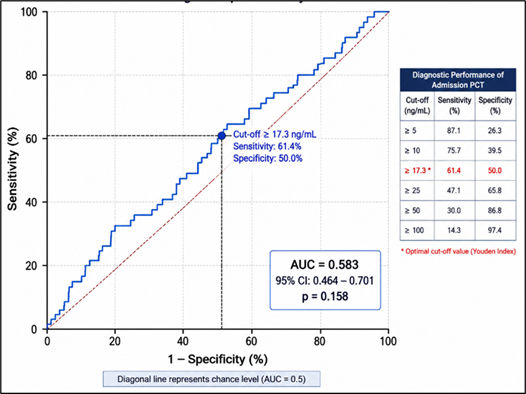
Receiver operating characteristic (ROC) curve analysis was performed to evaluate the ability of admission serum procalcitonin (PCT) to predict in-hospital mortality in patients with septic shock (Figure 1). The analysis demonstrated limited discriminatory performance, with an area under the curve (AUC) of 0.583 (95% CI: 0.464–0.701), which was not statistically significant (p=0.158). An AUC value close to 0.5 indicates poor predictive accuracy and suggests that admission PCT alone had limited utility in differentiating survivors from non-survivors in the present cohort.
Using the Youden index, the optimal cut-off value for serum PCT was identified as ≥17.3 ng/mL, which yielded a sensitivity of 61.4% and specificity of 50.0%. Lower cut-off values increased sensitivity at the expense of specificity, whereas higher cut-offs improved specificity but markedly reduced sensitivity. For example, a threshold of ≥5 ng/mL demonstrated high sensitivity (87.1%) with poor specificity (26.3%), while a threshold of ≥100 ng/mL showed very high specificity (97.4%) but low sensitivity (14.3%). Overall, these findings indicate that although elevated admission PCT levels were associated with mortality, its standalone prognostic performance for predicting in-hospital death was suboptimal (Figure 1).
Discussion
The present prospective observational study evaluated the prognostic significance of admission serum procalcitonin levels in patients with septic shock and demonstrated an overall in-hospital mortality rate of 64.8%. The high mortality observed in our cohort reflects the severe disease burden and advanced hemodynamic compromise among critically ill septic shock patients. Similar mortality patterns have been reported in previous studies evaluating severe sepsis and septic shock populations.[6,10]
The majority of patients in our study were elderly males, which is consistent with the epidemiological profile reported in global sepsis literature. Advanced age has been recognized as an important contributor to adverse outcomes because of immunosenescence, increased comorbidities, and reduced physiological reserve.[1] However, neither age nor sex showed a statistically significant association with mortality in our study, suggesting that severity of organ dysfunction and circulatory failure may outweigh demographic factors once septic shock develops.
Respiratory tract infections represented the most common source of sepsis in our cohort, followed by gastrointestinal infections and febrile illnesses. These findings are comparable to those reported by Edathadathil et al.,[12] and Sudhir et al.,[13] who identified pulmonary infections as the predominant focus of sepsis among critically ill patients. Patients presenting with altered sensorium and hepatobiliary infections demonstrated particularly poor outcomes, likely reflecting delayed presentation and advanced systemic involvement.
Among clinical variables, tachypnoea emerged as one of the strongest predictors of mortality. Respiratory rate >22/min was significantly associated with adverse outcomes, supporting its role within the qSOFA scoring system. Elevated respiratory rate reflects compensatory physiological response to metabolic acidosis, tissue hypoxia, and systemic inflammatory stress. Similar observations have been documented by Sanchez & Pienaar [14] who demonstrated significant associations between respiratory compromise and mortality in septic patients.
Serum lactate levels were significantly higher among non-survivors and positively correlated with serum procalcitonin levels. Lactate is a well-established marker of tissue hypoperfusion and impaired cellular metabolism in septic shock. The Surviving Sepsis Campaign guidelines emphasize lactate assessment for early risk stratification and resuscitation monitoring.[3] Our findings reinforce the prognostic relevance of hyperlactatemia in critically ill septic patients.
Most patients demonstrated markedly elevated serum PCT concentrations, indicating severe systemic bacterial infection. Although mean PCT values were higher among non-survivors, ROC analysis revealed poor discriminatory performance for mortality prediction. These findings suggest that admission PCT reflects inflammatory burden rather than serving as an independent mortality predictor. Similar results were reported by Naderpour et al.[15] who observed limited prognostic utility of single-point PCT measurements in severe sepsis.
Conversely, studies by Schuetz et al.,[16] demonstrated that serial PCT kinetics and clearance patterns provide superior prognostic information compared with isolated baseline measurements. Persistently elevated PCT levels may indicate ongoing systemic inflammation, inadequate infection control, and higher mortality risk. Likewise, Liu et al.,[17] reported that reduced PCT clearance was independently associated with poor outcomes in septic shock. These observations highlight the importance of dynamic biomarker monitoring rather than reliance on a single admission value.
The requirement for multiple vasopressors and mechanical ventilation was strongly associated with mortality in our study. Patients requiring three inotropes exhibited mortality exceeding 85%, reflecting profound circulatory collapse and refractory shock. Early deaths within the first 48 hours accounted for shorter ICU and hospital stays among non-survivors. These findings underscore the aggressive clinical course of septic shock and the importance of prompt recognition and intensive organ support.
Overall, our study demonstrates that serum procalcitonin is a useful adjunct biomarker reflecting systemic inflammatory severity; however, its standalone prognostic performance for predicting mortality remains limited. Integration of PCT with lactate levels, organ dysfunction scores, and hemodynamic parameters may provide more accurate prognostic stratification in septic shock.
Limitations
Sample size was relatively modest. Serial procalcitonin measurements and PCT clearance were not evaluated. Microbiological profile and pathogen-specific analysis were not comprehensively assessed. Multivariate logistic regression analysis could not be performed because of sample constraints.
Future Directions
Future multicentric studies with larger sample sizes are required to validate the prognostic utility of serum procalcitonin in septic shock. Serial monitoring of PCT kinetics and clearance should be investigated in combination with lactate-guided resuscitation and organ dysfunction scores. Integration of biomarkers with machine learning–based predictive models may further improve early risk stratification and individualized management strategies in critically ill septic patients.
Conclusion
Admission serum procalcitonin levels correlate significantly with systemic inflammatory burden and severity of illness in patients with septic shock. However, its ability to independently predict in-hospital mortality remains limited. Clinical indicators including tachypnoea, hyperlactatemia, vasopressor requirement, and mechanical ventilation demonstrated stronger associations with adverse outcomes. Therefore, serum procalcitonin should be considered an adjunctive biomarker rather than a standalone prognostic tool. Combined utilization of biochemical markers, clinical assessment, and severity scoring systems may provide superior prognostic accuracy and aid early risk stratification in septic shock.
Declarations
Ethical Approval and Consent to Participate
All procedures performed in this study were carried out in accordance with the ethical standards of the Institutional Ethics Committee and the principles of the 1964 Declaration of Helsinki and its subsequent amendments. Ethical clearance was obtained from the Institutional Ethics Committee (Approval No. SGRD/IEC/2024-361). Written informed consent was obtained from all participants or their legally authorized representatives prior to inclusion in the study.
Consent for Publication
Written informed consent for publication of clinical information and relevant images was obtained from the patients or their legal representatives. All identifying information was removed to maintain patient confidentiality and privacy.
Availability of Data and Materials
The data generated and analysed during the present study are available from the corresponding author upon reasonable request, subject to institutional and ethical guidelines.
Competing Interests
The authors declare that there are no competing financial or non-financial interests related to this study.
Funding
No financial support or specific funding was received from any public, commercial, or non-profit funding agency for the conduct of this study.
Authors’ Contributions
All authors contributed to the conception and design of the study, data collection, analysis, and interpretation of results. All authors were involved in drafting and revising the manuscript critically for important intellectual content and approved the final version prior to submission.