Introduction
Thyroid disorders represent one of the most common endocrine abnormalities encountered in clinical practice, with thyroid nodules being highly prevalent in the general population. Although most thyroid nodules are benign, a small proportion ranging from 5% to 15% may harbor malignancy, making accurate diagnosis essential for appropriate clinical management [1]. The challenge in clinical practice lies in differentiating benign from malignant lesions to avoid unnecessary surgeries while ensuring timely intervention for malignant cases.
Fine needle aspiration cytology (FNAC) has emerged as the gold standard initial diagnostic modality for evaluating thyroid nodules due to its simplicity, safety, cost-effectiveness, and high diagnostic accuracy [2]. FNAC allows rapid assessment of thyroid lesions and plays a crucial role in guiding treatment decisions by categorizing nodules into those requiring surgical intervention and those suitable for conservative management. Advances in ultrasound-guided FNAC have further improved diagnostic yield and accuracy, enhancing its reliability in routine practice [3].
Despite its widespread use, variability in reporting thyroid cytology previously posed significant challenges in interpretation and clinical decision-making. To address this issue, the National Cancer Institute introduced the Bethesda System for Reporting Thyroid Cytopathology (TBSRTC) in 2007, which provided a standardized reporting framework with defined diagnostic categories, associated risk of malignancy, and management guidelines [4]. This system revolutionized thyroid cytology by improving communication between pathologists and clinicians and ensuring uniformity in reporting.
The Bethesda System classifies thyroid cytology into six diagnostic categories: nondiagnostic, benign, atypia of undetermined significance (AUS), follicular neoplasm, suspicious for malignancy, and malignant [5]. Each category is associated with a specific risk of malignancy and recommended clinical management, thereby facilitating evidence-based decision-making. Subsequent revisions in 2017 and the latest 2023 update have refined diagnostic criteria and improved risk stratification, reflecting advancements in cytopathology and molecular diagnostics [6].
Recent studies have emphasized the importance of the Bethesda system in predicting malignancy risk and guiding surgical decisions. For instance, higher malignancy rates have been reported in indeterminate categories such as Bethesda III and IV, highlighting the need for careful evaluation and follow-up [7]. Additionally, integration of cytological findings with imaging modalities such as TIRADS has further enhanced diagnostic accuracy and clinical utility [8].
The Bethesda system not only standardizes reporting but also reduces interobserver variability and improves reproducibility in thyroid cytology interpretation. Studies have demonstrated that FNAC interpreted using the Bethesda system shows high sensitivity and specificity in detecting malignant thyroid lesions, making it a reliable diagnostic tool in clinical practice [9]. Moreover, it helps reduce unnecessary thyroid surgeries by accurately identifying benign lesions, thereby minimizing patient morbidity and healthcare costs.
With ongoing advancements, the role of cytological evaluation continues to evolve, incorporating newer diagnostic techniques and molecular markers to improve accuracy in indeterminate cases. However, FNAC with Bethesda classification remains the cornerstone of thyroid nodule evaluation due to its accessibility, efficiency, and strong diagnostic performance [10].
Therefore, cytological evaluation of thyroid lesions using the Bethesda System is essential for effective risk stratification, guiding clinical management, and improving patient outcomes, making it a critical component of modern thyroid pathology.
Aims and Objectives
-
To study the cyto-morphological features of thyroid lesions and categorize them according to the Bethesda System for Reporting Thyroid Cytology.
-
To correlate cytological findings with histopathological findings wherever available.
-
To compare the findings of the present study with those of previous studies.
Materials and Methods
This prospective study was conducted in the Department of Pathology at Narendra Modi Medical College and Sheth L.G. General Hospital over period of two years from June 2022 to May 2024. A total of 200 patients presenting with thyroid swelling were included in the study. These patients were referred from the departments of Surgery, Medicine, and ENT for cytological evaluation of thyroid lesions.
All patients presenting with palpable thyroid swelling in the neck and those who had undergone prior radiological evaluation were included in the study. Cases referred for ultrasound-guided or CT-guided FNAC were also considered. Patients with swellings other than thyroid origin, inadequate aspirated material, and those who did not provide consent were excluded from the study.
Fine needle aspiration cytology (FNAC) was performed using disposable needles of 20–24 gauge and 3–5 cm length attached to 10 ml disposable plastic syringes. The procedure was explained to each patient prior to the procedure, and informed consent was obtained. The swelling was identified and stabilized, and the skin overlying the lesion was cleaned with antiseptic solution. The needle was inserted into the swelling, and multiple to-and-fro motions were made to obtain adequate cellular material. Once the material appeared in the hub of the needle, suction was released, and the needle was withdrawn.
In cases where fluid was aspirated, the sample was processed using cytospin technique and smears were prepared. The aspirated material was expelled onto clean glass slides, and smears were made by gentle spreading. The slides were immediately fixed in methanol for proper preservation of cellular details. The smears were subsequently stained using Hematoxylin and Eosin (H&E) stain and mounted using DPX for microscopic examination.
All prepared slides were examined under light microscopy, and cytomorphological features were carefully evaluated. The cytological diagnosis was rendered according to the Bethesda System for Reporting Thyroid Cytopathology (TBSRTC), which classifies thyroid lesions into six diagnostic categories based on morphological criteria. Wherever available, cytological findings were correlated with histopathological examination to assess diagnostic accuracy and validate cytological interpretation.
All the data obtained were recorded systematically and tabulated. Statistical analysis was performed using Microsoft Excel. Descriptive statastic such as frequency, percentage, mean and ration were used to analyze age distribution, sex distribution, clinical features and cytological findings. The results were presented in the form of tables and charts to facilitate the interpretation.
Ethical clearance for the study was obtained from the Institutional Review Board prior to commencement of the study. All procedures were conducted in accordance with ethical standards. Confidentiality of patient information was strictly maintained and participation was voluntary, with the option to withdraw from the study at any time without affecting patient care.
Results
| Category | Diagnosis | Number of Cases | Percentage |
| I | Nondiagnostic | 3 | 1.5% |
| II | Benign | 165 | 82.5% |
| III | Atypia of Undetermined Significance (AUS) | 15 | 7.5% |
| IV | Follicular Neoplasm | 7 | 3.5% |
| V | Suspicious for Malignancy | 3 | 1.5% |
| VI | Malignant | 7 | 3.5% |
| Total | 200 | 100% |
The distribution of thyroid lesions according to Bethesda diagnostic categories, as shown in Table 1, revealed that the majority of cases belonged to Category II (Benign), accounting for 165 out of 200 cases (82.5%), making it the most common category in the study. Category III (Atypia of undetermined significance) constituted 15 cases (7.5%), followed by Category IV (Follicular neoplasm) with 7 cases (3.5%). Category VI (Malignant) also accounted for 7 cases (3.5%), while Category I (Nondiagnostic) and Category V (Suspicious for malignancy) were the least common, each with 3 cases (1.5%). This distribution clearly highlights the predominance of benign lesions in thyroid FNAC evaluation.
| Category | Nandedkar SS et al (2018) | Chandan RH et al (2019) | Shete Smita S et al (2020) | Hashmi et al (2023) | Present Study |
| I. Nondiagnostic | 26 (4.29%) | 08 (2.16%) | 04 (2.42%) | 13 (2.1%) | 03 (1.5%) |
| II. Benign | 501 (82.67%) | 351 (94.86%) | 146 (88.5%) | 553 (89.19%) | 165 (82.5%) |
| III. AUS | 05 (0.83%) | 01 (0.27%) | 03 (1.82%) | 05 (0.81%) | 15 (7.5%) |
| IV. Follicular Neoplasm | 55 (9.08%) | 03 (0.81%) | 07 (4.24%) | 33 (5.32%) | 07 (3.5%) |
| V. Suspicious for Malignancy | 07 (1.16%) | 01 (0.27%) | 02 (1.21%) | 05 (0.81%) | 03 (1.5%) |
| VI. Malignant | 12 (2.0%) | 06 (1.62%) | 03 (1.82%) | 11 (1.77%) | 07 (3.5%) |
| Total | 606 (100%) | 370 (100%) | 165 (100%) | 620 (100%) | 200 (100%) |
The comparative incidence of Bethesda categories with other studies, as shown in Table 2, demonstrates that the present study findings are consistent with previous literature, with benign lesions forming the largest proportion across all studies. In the present study, benign cases constituted 82.5%, which is comparable to other studies such as Hashmi et al. (89.19%) and Shete et al. (88.5%). The nondiagnostic category was low in the present study at 1.5%, compared to 2.1%–4.9% in other studies. Category III (AUS) was relatively higher in the present study (7.5%) compared to other studies where it ranged from 0.27% to 1.82%, indicating a higher proportion of indeterminate cases.
| Age Group | Number of Cases | Percentage |
| 0-10 years | 00 | 00% |
| 11-20 years | 09 | 4.5% |
| 21-30 years | 45 | 22.5% |
| 31-40 years | 37 | 18.5% |
| 41-50 years | 40 | 20% |
| 51-60 years | 42 | 21% |
| 61 and above | 27 | 13.5% |
| Total | 200 | 100% |
The age-wise distribution of thyroid lesions, as summarized in Table 3, showed that the peak incidence of thyroid lesions was observed in the 3rd decade of life (22.5%), followed by 6th decade of life (21%) and least number of cases were observed in 2nd decade of life.
| Age group(years) | Shete Smita S et al 2020 | Present Study |
| 1-10 | 1.82% | 00% |
| 11-20 | 4.85% | 4.5% |
| 21-30 | 20.61% | 22.5% |
| 31-40 | 32.12% | 18.5% |
| 41-50 | 20% | 20% |
| 51-60 | 9.7% | 21% |
| 60 and above | 10.9% | 13.5% |
| Total | 100% | 100% |
In present study, the thyroid lesions are most common in the age group of 21- 30 year of age (22.5%) which is analogous to other
study as shown in Table no. 4.
| Gender | Number of Cases | Percentage |
| Male | 26 | 13% |
| Female | 174 | 87% |
| Total | 200 | 100% |
The gender distribution of thyroid lesions, as depicted in Table 5, showed a strong female predominance, with 174 females (87%) and 26 males (13%) out of 200 cases. This indicates that thyroid lesions are significantly more common in females compared to males.
| Parameter | Number of Cases | Percentage |
| True Positive | 03 | — |
| True Negative | 35 | — |
| False Positive | 01 | — |
| False Negative | 01 | — |
| Total Cases | 40 | 100% |
| Accuracy | — | 95% |
| Sensitivity | — | 75% |
| Specificity | — | 97.22% |
The cytohistopathological correlation, as shown in Table 6, was performed in 40 cases, out of which 38 cases were correctly diagnosed, while 2 cases showed discordance, including 1 false positive and 1 false negative case. The study demonstrated a diagnostic accuracy of 95%, sensitivity of 75%, and specificity of 97.22%, confirming FNAC as a highly reliable diagnostic tool for thyroid lesions.
Photographs
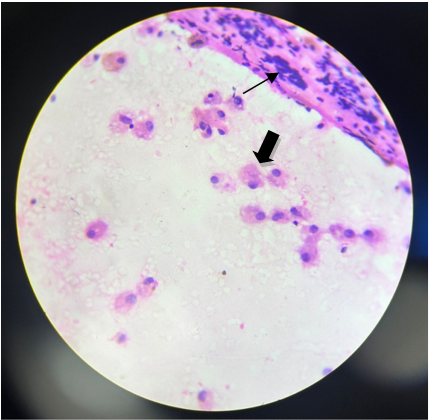
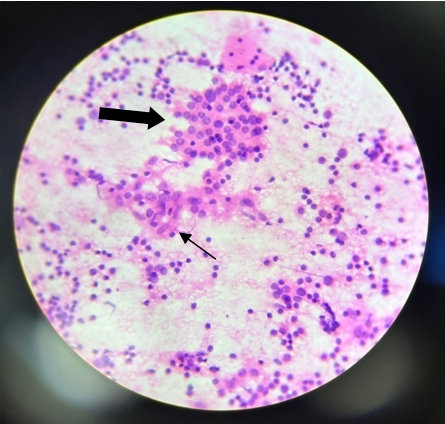
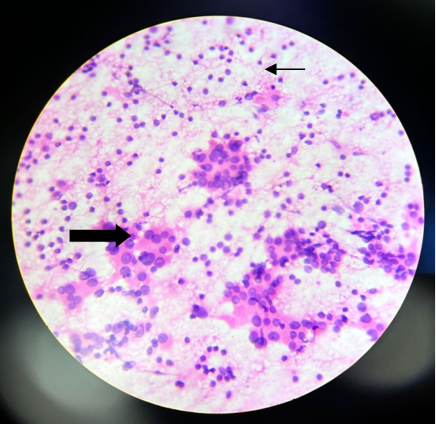
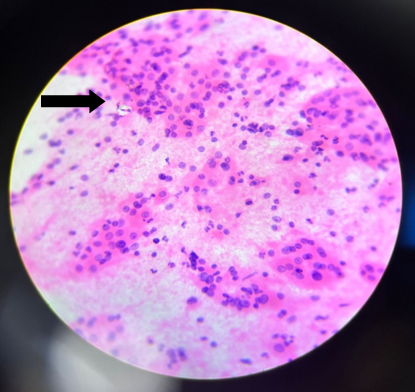
Discussion
The present study evaluated thyroid lesions using FNAC and classified them according to the Bethesda System, demonstrating that the majority of cases were benign, accounting for 165 out of 200 cases (82.5%), as shown in Table 1. This predominance of benign lesions is consistent with previous literature, where benign thyroid nodules constitute the largest proportion of cytological diagnoses. Studies by Layfield et al. [11] have emphasized that the Bethesda System provides a structured approach that consistently identifies benign lesions as the most frequent category, thereby reducing unnecessary surgical interventions. The low proportion of nondiagnostic cases (1.5%) in the present study further reflects adequate sampling and proper cytological technique, which is comparable with findings reported in other standardized cytology-based studies.
The proportion of atypia of undetermined significance (AUS) in the present study was 7.5%, which is relatively higher compared to other studies, as demonstrated in Table 2. This variation can be attributed to differences in interpretative criteria and institutional practices. Layfield et al.,[11] highlighted that the AUS category should ideally be limited; however, variability among pathologists may lead to its increased use. The presence of higher AUS cases in the present study indicates the need for careful follow-up and possible repeat FNAC to avoid misdiagnosis.
The incidence of follicular neoplasm (3.5%) and suspicious for malignancy (1.5%) categories in the present study was relatively low and comparable to other studies, suggesting that the Bethesda System effectively stratifies intermediate-risk lesions. The malignant category accounted for 3.5% of cases, with papillary thyroid carcinoma being the most common malignancy, which aligns with findings reported by Chandan et al.,[12], who also identified papillary carcinoma as the predominant malignant thyroid lesion. This consistency reinforces the reliability of FNAC in identifying clinically significant malignancies.
Age-wise distribution of thyroid lesions, as depicted in Table 3, showed a peak incidence in the third decade (22.5%), which is analogous to other study showed in table 4.
The gender distribution in the present study revealed a marked female predominance (87%), as shown in Table 5, which is consistent with the established epidemiological pattern of thyroid disorders. Studies such as those by Chandan et al.,[12] and Prathima et al.,[13] have also reported a significantly higher incidence of thyroid lesions in females, which may be attributed to hormonal influences and autoimmune predisposition.
The cytohistopathological correlation performed in 40 cases demonstrated a high diagnostic accuracy of 95%, sensitivity of 75%, and specificity of 97.22%, as shown in Table 6. These findings are comparable with those reported by Anand et al.,[14], who also highlighted high specificity and overall accuracy of FNAC in thyroid lesions. The presence of only one false positive and one false negative case further supports the reliability of FNAC as a diagnostic modality. Additionally, studies by Kocjan et al.,[15] have emphasized that FNAC, when combined with Bethesda classification, provides excellent diagnostic performance and helps in appropriate clinical decision-making.
Overall, the findings of the present study validate the utility of the Bethesda System in standardizing thyroid cytology reporting, improving diagnostic accuracy, and aiding in effective risk stratification. The high proportion of benign lesions, low rate of nondiagnostic cases, and strong cytohistopathological correlation underscore the role of FNAC as a first-line investigation in thyroid nodules.
Limitation of study
Fine-needle aspiration cytology (FNAC) of thyroid lesions has several important limitations despite being a widely used diagnostic tool. Bethesda Categories III (AUS) and IV (Follicular Neoplasm) remain diagnostically challenging because benign and malignant lesions often show overlapping cytological features, resulting in variable malignancy risk and difficulty in clinical decision-making. Unsatisfactory or non-diagnostic samples are also common due to scant cellularity, blood contamination, or cystic fluid, and repeat aspirations may still remain non-diagnostic. The accuracy of FNAC further depends on the skill of the clinician performing the procedure and the experience of the reporting pathologist, with palpation-guided FNAC showing lower accuracy than ultrasound-guided techniques, especially for small or deep nodules. In addition, low-grade malignancies may mimic benign lesions, while technical artifacts can create false cytological appearances, leading to diagnostic errors. FNAC also cannot reliably differentiate follicular adenoma from follicular carcinoma because confirmation of malignancy requires identification of capsular or vascular invasion on histopathological examination after surgery.
Conclusion
The present study concludes that fine needle aspiration cytology, when interpreted using the Bethesda System, is a highly reliable, cost-effective, and minimally invasive diagnostic tool for evaluating thyroid lesions. The majority of thyroid nodules were benign, with a small proportion of malignant lesions, predominantly papillary carcinoma. The Bethesda system effectively categorizes thyroid lesions and aids in risk stratification and clinical decision-making. High diagnostic accuracy, sensitivity, and specificity observed in the study further support the role of
FNAC as the primary diagnostic modality, reducing unnecessary surgical interventions and improving patient management.
Declarations
Acknowledgment
The authors sincerely acknowledge the support and guidance provided by the Department of Pathology, Narendra Modi Medical College and Sheth L.G. General Hospital, Ahmedabad, Gujarat, India, for facilitating this study. We are grateful to the faculty members, technical staff, and laboratory personnel for their valuable assistance in specimen processing, data collection, and histopathological evaluation throughout the study period. We also extend our heartfelt thanks to all patients whose clinical samples and records contributed to this research. Their cooperation made this study possible. Finally, we acknowledge the encouragement and constructive suggestions provided by our colleagues and mentors, which greatly contributed to the successful completion of this work.
Conflict of interest
No! Conflict of interest is found elsewhere considering this work.
Source of Funding
There was no financial support concerning this work.