Introduction
Cirrhosis represents the terminal stage of chronic liver disease characterized by diffuse hepatic fibrosis, regenerative nodule formation, and progressive distortion of normal hepatic architecture, ultimately leading to portal hypertension and hepatic insufficiency. Despite advances in antiviral therapy and chronic liver disease management, cirrhosis continues to impose a major global health burden. Recent Global Burden of Disease estimates indicate a substantial rise in cirrhosis prevalence and mortality worldwide, driven predominantly by viral hepatitis, alcohol-related liver disease, and the increasing incidence of metabolic dysfunction-associated steatotic liver disease (MASLD/NAFLD) [1].
Portal hypertension is the principal pathophysiological consequence of cirrhosis and forms the basis for most life-threatening complications, including ascites, hepatic encephalopathy, and variceal haemorrhage. Esophageal varices develop secondary to increased intrahepatic vascular resistance and compensatory portosystemic collateral formation. Their presence reflects clinically significant portal hypertension and advanced hepatic decompensation. Approximately 50–60% of cirrhotic patients develop esophageal varices, with the risk increasing proportionally with disease duration and severity [2]. Variceal bleeding remains one of the most life-threatening complications of cirrhosis, carrying a 6-week mortality rate of nearly 15–20% despite improvements in endoscopic and pharmacological therapy [3].
Upper gastrointestinal endoscopy remains the gold standard for diagnosing esophageal varices; however, it is invasive, expensive, resource-intensive, and often inaccessible in low-resource settings. Consequently, there is growing interest in reliable non-invasive predictors that can identify patients at high risk while minimizing unnecessary endoscopic procedures [4]. Among these, ultrasonographic parameters such as portal vein diameter, spleen size, splenic vein diameter, and the presence of ascites have shown significant association with portal hypertension and variceal formation [5]. Additionally, thrombocytopenia resulting from hypersplenism and reduced thrombopoietin synthesis has emerged as an important haematological marker of clinically significant portal hypertension [6]. Clinically significant portal hypertension results in progressive splanchnic vasodilatation, collateral vessel formation, and splenic sequestration of platelets, thereby contributing to variceal development and thrombocytopenia.
Recent studies have demonstrated that combining platelet count with ultrasonographic indices substantially improves predictive accuracy for esophageal varices compared with isolated parameters alone [7]. Such approaches are particularly valuable in resource-constrained healthcare systems where universal endoscopic screening may not be feasible. Early identification of high-risk patients through simple, accessible, and cost-effective markers may facilitate timely prophylactic intervention, reduce variceal bleeding, and improve clinical outcomes.
Therefore, the present study was undertaken to evaluate the diagnostic utility of platelet count and ultrasonographic parameters in predicting esophageal varices among patients with liver cirrhosis, using upper gastrointestinal endoscopy as the reference standard.
Materials and Methods
Study Design and Setting
This prospective observational study was conducted in the Department of Medicine at Sri Guru Ram Das Institute of Medical Sciences and Research between July 2024 and December 2025. The study included patients admitted to Sri Guru Ram Das Charitable Hospital, Amritsar, Punjab, India.
Ethical Approval
The study protocol was approved by the Institutional Ethics Committee of Sri Guru Ram Das Institute of Medical Sciences and Research (SGRD/IEC/2024-359), Amritsar. Written informed consent was obtained from all participants prior to enrolment, and the study was conducted in accordance with the Declaration of Helsinki.
Study Population
Consecutive adult patients newly diagnosed with liver cirrhosis and portal hypertension were screened for eligibility during the study period. Diagnosis of cirrhosis was established on the basis of clinical findings, biochemical investigations, and radiological evidence suggestive of chronic liver disease and portal hypertension. Written informed consent was obtained from all participants prior to enrolment and sample collected as per convenient sampling technique.
Eligibility Criteria
Inclusion Criteria: Age ≥18 years, diagnosed chronic liver disease/cirrhosis, patients willing to undergo ultrasonography and upper gastrointestinal endoscopy
Exclusion Criteria: Current or previous history of gastrointestinal bleeding, previous endoscopic or surgical intervention for portal hypertension, portal vein thrombosis, non-cirrhotic portal hypertension, primary haematological disorders affecting platelet count, hepatocellular carcinoma detected on ultrasonography, severe comorbid illness precluding endoscopic evaluation
Clinical and Laboratory Assessment: A detailed clinical history and physical examination were performed for all patients at admission. Demographic characteristics, etiology of liver disease, alcohol intake, history of blood transfusion, and clinical features of chronic liver disease and portal hypertension were recorded systematically.
Laboratory investigations included complete blood count, platelet count, liver function tests, serum albumin, bilirubin, alanine aminotransferase, aspartate aminotransferase, prothrombin time, and international normalized ratio (INR). Viral markers including hepatitis B surface antigen and anti-hepatitis C virus antibody were assessed using enzyme immunoassay techniques. Additional investigations for autoimmune, metabolic, or hereditary liver diseases were performed when clinically indicated.
Severity of liver disease was assessed using the Child–Pugh classification. Patients were categorized as Child–Pugh class A (5-6 points), class B (7-9 points), or class C (10-15 points). MELD-Na score was also calculated where applicable.
Ultrasonographic Evaluation: All participants underwent abdominal ultrasonography after overnight fasting using standard imaging protocols. Ultrasonographic parameters recorded included liver surface nodularity, portal vein diameter, spleen size, splenic vein diameter, and presence of ascites.
Portal vein diameter >13 mm, spleen size >13 cm, and splenic vein diameter >10 mm were considered abnormal. Ascites was graded as mild, moderate, or severe according to ultrasonographic and clinical findings.
Endoscopic Assessment: Upper gastrointestinal endoscopy was performed within 48-72 hours of admission using a Fujinon video gastroscope by experienced endoscopists blinded to ultrasonographic findings. Presence and grade of esophageal varices were documented and considered the reference standard for analysis.
Outcome Measures: The primary outcome was the presence of esophageal varices on upper gastrointestinal endoscopy. Secondary outcomes included the association of platelet count, portal vein diameter, spleen size, splenic vein diameter, and ascites with endoscopic findings.
Statistical Analysis
Data were analysed using SPSS version 26.0. Continuous variables were expressed as mean±standard deviation, while categorical variables were presented as frequency and percentage. Comparisons between groups were performed using independent Student’s t-test for continuous variables and Chi-square test or Fisher’s exact test for categorical variables, as appropriate.
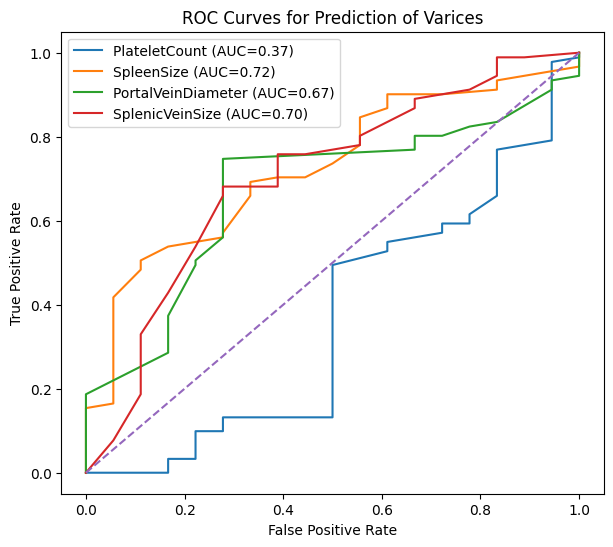
Receiver operating characteristic (ROC) curve analysis was used to determine optimal cutoff values and diagnostic performance of platelet count and ultrasonographic parameters. Sensitivity, specificity, positive predictive value, negative predictive value, area under the curve (AUC), and Youden index were calculated. Odds ratios with 95% confidence intervals were derived through univariate analysis. A p-value <0.05 was considered statistically significant.
Results
Table 1 summarizes the baseline demographic and clinical profile of 109 patients with liver cirrhosis included in the study. The cohort predominantly consisted of middle-aged individuals, with the highest proportion belonging to the 41–50-year age group (33.0%) and a mean age of 53.42 ± 12.65 years. A marked male predominance was observed (81.7%), and alcohol-related cirrhosis emerged as the leading etiology (67.9%), followed by combined alcohol and HCV-related disease (10.1%). Most patients presented with features of decompensated cirrhosis, including ascites (72.5%) and hepatic encephalopathy (22.9%). Esophageal varices were detected in a substantial majority of patients (83.5%), with small varices being more common than large varices. Additionally, portal hypertensive gastropathy was present in 77.1% of cases, reflecting the high burden of clinically significant portal hypertension in the study population.
| Variable | Number (%) |
| 30–40 years | 16 (14.7) |
| 41–50 years | 36 (33.0) |
| 51–60 years | 23 (21.1) |
| 61–70 years | 21 (19.3) |
| >70 years | 13 (11.9) |
| Mean age±SD years | 53.42±12.65 |
| Male | 89 (81.7) |
| Female | 20 (18.3) |
| Alcohol-related cirrhosis | 74 (67.9) |
| Alcohol + HCV | 11 (10.1) |
| Other etiologies | 24 (22.0) |
| Ascites present | 79 (72.5) |
| Hepatic encephalopathy | 25 (22.9) |
| Esophageal varices present | 91 (83.5) |
| Small varices | 77 (70.6) |
| Large varices | 14 (12.8) |
| Portal hypertensive gastropathy | 84 (77.1) |
Table 2 depicts the laboratory and disease severity profile of the study population, highlighting advanced hepatic dysfunction in most patients. Elevated bilirubin levels were observed in 73.4% of cases, while hypoalbuminemia was highly prevalent (87.2%), indicating impaired hepatic synthetic function. Hyponatremia was present in 60.6% of patients, reflecting significant portal hypertension and circulatory dysfunction associated with decompensated cirrhosis. Liver enzyme abnormalities were comparatively less marked, with elevated AST and ALT observed in 36.7% and 20.2% of patients, respectively. Severity assessment revealed that the majority of patients belonged to Child–Pugh classes B and C (86.2%), and the mean MELD-Na score of 20.26 ± 8.24 further emphasized the advanced stage of liver disease in the study cohort.
| Parameter | Findings |
| Total bilirubin (mg/dL) | 4.59 ± 5.28 |
| Elevated bilirubin (>1.3 mg/dL) | 80 (73.4%) |
| SGOT/AST (IU/L) | 71.41 ± 72.60 |
| Elevated AST (>59 IU/L) | 40 (36.7%) |
| SGPT/ALT (IU/L) | 45.78 ± 48.73 |
| Elevated ALT (≥50 IU/L) | 22 (20.2%) |
| Serum albumin (g/dL) | 2.87 ± 0.63 |
| Hypoalbuminemia (<3.5 g/dL) | 95 (87.2%) |
| Serum sodium (mEq/L) | 132.61 ± 5.63 |
| Hyponatremia (<135 mEq/L) | 66 (60.6%) |
| Serum potassium (mEq/L) | 4.28 ± 0.74 |
| Child–Pugh Class A | 15 (13.8%) |
| Child–Pugh Class B | 46 (42.2%) |
| Child–Pugh Class C | 48 (44.0%) |
| MELD-Na score | 20.26 ± 8.24 |
Tables 3A and 3B demonstrate a significant association between thrombocytopenia, ultrasonographic parameters, and the presence of esophageal varices in cirrhotic patients. Platelet count ≤1.5×10⁵/μL showed the strongest association with varices, conferring nearly eightfold higher odds of variceal presence (OR 8.23, p=0.0002). Similarly, splenomegaly, portal vein dilatation, splenic vein dilatation, and ascites were all significantly associated with varices, reflecting progressive portal hypertension. Comparative analysis further revealed that patients with varices had significantly lower mean platelet counts and significantly higher mean spleen size, portal vein diameter, and splenic vein diameter compared to those without varices. These findings highlight the clinical utility of combined hematological and ultrasonographic markers as effective non-invasive predictors of esophageal varices in liver cirrhosis.
Table 3A: Association of Platelet Count and Ultrasonographic Parameters with esophageal Varices
| Parameter | Varices Present (n=91) | Varices Absent (n=18) | Odds Ratio (95% CI) | p-value |
| Platelet count ≤1.5×10⁵/μL | 79 (87.0%) | 8 (44.0%) | 8.23 (2.71–24.98) | 0.0002 |
| Platelet count >1.5×10⁵/μL | 12 (13.0%) | 10 (56.0%) | — | — |
| Spleen size ≥13 cm | 60 (66.0%) | 6 (33.0%) | 3.87 (1.33–11.30) | 0.013 |
| Portal vein diameter ≥13 mm | 51 (56.0%) | 5 (28.0%) | 3.31 (1.09–10.07) | 0.034 |
| Splenic vein diameter ≥10 mm | 60 (66.0%) | 5 (28.0%) | 5.03 (1.64–15.40) | 0.004 |
| Ascites present | 71 (78.0%) | 8 (44.4%) | 4.43 (1.54–12.72) | 0.005 |
| 3B: Comparison of Mean Haematological and Ultrasonographic Parameters According to Variceal Status | ||||
| Platelet count (×10⁵/μL) | 1.33 ± 0.50 | 1.88 ± 1.16 | 0.001 | |
| Spleen size (cm) | 13.82 ± 2.56 | 12.04 ± 1.69 | 0.006 | |
| Portal vein diameter (mm) | 12.88 ± 2.30 | 11.53 ± 1.67 | 0.019 | |
| Splenic vein diameter (mm) | 10.40 ± 2.32 | 8.91 ± 2.46 | 0.015 |
Data are presented as mean±standard deviation. Independent sample t-test applied for between-group comparison. Chi-square test applied for categorical variable comparison
The diagnostic performance analysis demonstrated that platelet count had the highest sensitivity (86.8%) for predicting esophageal varices, although its specificity was relatively low (50.0%), indicating its usefulness as a screening marker. In contrast, ultrasonographic parameters showed better specificity, with portal vein diameter and splenic vein diameter each demonstrating a specificity of 77.8%. Among all parameters, spleen size exhibited the best overall diagnostic accuracy with the highest AUC (0.725), followed by splenic vein diameter (0.704) and portal vein diameter (0.673). These findings suggest that while thrombocytopenia is highly sensitive for identifying patients at risk, ultrasonographic markers provide better discriminatory ability, and their combined use may improve non-invasive prediction of esophageal varices in cirrhotic patients (Table 4; Figure 1).
| Parameter | Cutoff Value | Sensitivity (%) | Specificity (%) | AUC (95% CI) |
| Platelet count | ≤1.5×10⁵/μl | 86.8 | 50.0 | 0.635 |
| Spleen size | ≥13 cm | 57.1 | 72.2 | 0.725 |
| Portal vein diameter | ≥13 mm | 50.5 | 77.8 | 0.673 |
| Splenic vein diameter | ≥10 mm | 53.8 | 77.8 | 0.704 |
Discussion
This prospective observational study evaluated the role of platelet count and ultrasonographic parameters as non-invasive predictors of esophageal varices in patients with liver cirrhosis. The study population predominantly comprised middle-aged males with alcohol-related cirrhosis and advanced hepatic dysfunction, characterized by high frequencies of Child–Pugh class B/C disease, elevated MELD-Na scores, hypoalbuminemia, ascites, and portal hypertensive gastropathy. These findings are consistent with recent epidemiological data from South Asia, where alcohol remains a major contributor to decompensated cirrhosis and portal hypertension [1,8].
The mean age of 53.4 years and marked male predominance observed in the present study are comparable to previous Indian studies reporting the highest burden of cirrhosis in the fifth and sixth decades of life, primarily related to chronic alcohol exposure and delayed healthcare access [9,10]. Alcohol-related cirrhosis constituted nearly two-thirds of cases, reaffirming its dominant etiological role in North Indian populations, unlike Western countries where metabolic dysfunction-associated steatotic liver disease is increasingly emerging as a leading cause of cirrhosis [11].
Most patients presented with decompensated liver disease manifested by ascites, jaundice, hepatic encephalopathy, hypoalbuminemia, and hyperbilirubinemia, indicating advanced hepatic synthetic dysfunction. The predominance of Child–Pugh B/C status and elevated MELD-Na scores further highlight late-stage presentation, which has similarly been reported in multicenter cohorts from India and Southeast Asia [12].
Esophageal varices were identified in 83.5% of patients, with small varices being more frequent than large varices. This prevalence is comparable to earlier studies reporting varices in 60–90% of patients with decompensated cirrhosis [13]. The high prevalence of portal hypertensive gastropathy in the present study additionally reflects clinically significant portal hypertension and correlates with increased variceal burden.
Thrombocytopenia demonstrated a strong association with esophageal varices. Patients with varices had significantly lower platelet counts, and thrombocytopenia (≤1.5×10⁵/μl) was associated with a markedly increased risk of variceal presence. These observations support previous studies suggesting that reduced platelet count serves as an indirect marker of hypersplenism and portal hypertension severity [14,15]. Although platelet count showed high sensitivity, its moderate specificity indicates that it is more useful as a screening tool rather than a standalone diagnostic marker.
Among ultrasonographic parameters, spleen size demonstrated the best diagnostic performance, followed by splenic vein diameter and portal vein diameter. Splenomegaly reflects chronic portal venous congestion and has consistently been identified as a reliable non-invasive indicator of clinically significant portal hypertension [16,17]. Similarly, portal vein and splenic vein dilatation were significantly associated with variceal presence, supporting earlier studies that emphasized the utility of Doppler-based ultrasonographic parameters in predicting portal hypertensive complications [16]. However, the predictive accuracy of individual ultrasonographic variables remained modest, suggesting that combined assessment provides superior risk stratification.
Ascites was significantly more common among patients with esophageal varices, reflecting advanced portal hypertension and impaired hepatic synthetic function. Similar associations have been widely documented in cirrhotic populations and indicate that ascites is an important marker of decompensated disease and clinically significant portal hypertension [18].
Overall, the present study demonstrates that while no single non-invasive parameter achieves optimal diagnostic accuracy, combining platelet count with ultrasonographic markers significantly improves prediction of esophageal varices. These findings support the growing evidence favouring multimodal non-invasive risk stratification models to identify high-risk patients, particularly in resource-limited settings where universal endoscopic screening may not be practical. The results are also in concordance with recent Baveno VII recommendations, which advocate the use of non-invasive tools to prioritize and optimize endoscopic screening rather than replace endoscopy entirely [4,17].Top of FormBottom of Form
Clinical Implications
The use of platelet count combined with spleen size and portal hemodynamic parameters may help clinicians stratify cirrhotic patients and optimize endoscopic referral. This is particularly relevant in low-resource healthcare systems where endoscopy availability is limited and cost constraints are significant.
Limitations and Future Directions
The study is limited by its single-center design and relatively small sample size, which may affect generalizability. Interobserver variability in ultrasonographic measurements and lack of longitudinal follow-up for bleeding outcomes are additional limitations. Future multicenter studies with larger cohorts and standardized Doppler protocols are needed to validate optimal cutoff values. Incorporation of elastography and composite scoring systems may further improve predictive accuracy and clinical applicability.
Conclusion
Platelet count and ultrasonographic parameters, particularly spleen size, portal vein diameter, and splenic vein diameter, are significantly associated with esophageal varices in patients with liver cirrhosis. Combined assessment of these non-invasive markers may serve as a practical and cost-effective strategy for identifying high-risk patients who require endoscopic screening. Such approaches may be especially valuable in resource-limited healthcare settings where routine endoscopic surveillance is not universally feasible. Larger multicenter studies are needed to validate these findings and develop standardized predictive models for clinical practice.
Declarations
Ethical Approval and Consent to Participate
All procedures performed in this study were carried out in accordance with the ethical standards of the Institutional Ethics Committee and the principles of the 1964 Declaration of Helsinki and its subsequent amendments. Ethical clearance was obtained from the Institutional Ethics Committee (Approval No. SGRD/IEC/2024-359). Written informed consent was obtained from all participants or their legally authorized representatives prior to inclusion in the study.
Consent for Publication
Written informed consent for publication of clinical information and relevant images was obtained from the patients or their legal representatives. All identifying information was removed to maintain patient confidentiality and privacy.
Availability of Data and Materials
The data generated and analysed during the present study are available from the corresponding author upon reasonable request, subject to institutional and ethical guidelines.
Competing Interests
The authors declare that there are no competing financial or non-financial interests related to this study.
Funding
No financial support or specific funding was received from any public, commercial, or non-profit funding agency for the conduct of this study.
Authors’ Contributions
All authors contributed to the conception and design of the study, data collection, analysis, and interpretation of results. All authors were involved in drafting and revising the manuscript critically for important intellectual content and approved the final version prior to submission.