Introduction
According to the American Diabetes Association (ADA), diabetes mellitus is defined as either a fasting blood glucose level greater than or equal to 126mg/dl or a random blood glucose level of 200mg/dl, or an HbA1c level greater than or equal to 6.5% [1]. Diabetes mellitus ranks among the leading causes of morbidity and mortality in the world, with an estimated 850 million people living with diabetes mellitus in low and middle-income countries than in high-income countries [2], with type 2 diabetes accounting for more than 90% of diabetic patients [3].
People with diabetes have a higher risk of health problems, including heart attack, stroke, and kidney failure [2,3]. Hyperglycemia, particularly type 2 diabetes mellitus, is associated with all grades of carotid atherosclerosis, ranging from early signs, as demonstrated by CIMT, to intermediate stages, characterized by the presence of carotid plaques, to advanced atherosclerosis, marked by the presence of carotid stenosis [4].
Atherosclerosis is a disease of large and medium-sized muscular arteries in which endothelial dysfunction, vascular inflammation, cholesterol accumulation, calcium, and cellular debris within the intima of the vessel wall occur [5]. Carotid IMT and plaque can be easily assessed using ultrasound imaging because they are superficially located, large in size, and immobile [6]. Increased CIMT is indicative of early atherosclerotic changes, whereas plaque presence is reflective of a more advanced atherosclerotic process [7]. CIMT varies with gender, age, and race. CIMT values of less than 0.8mm correlate well with no cardiovascular risk and are acceptable as normal values [8]. HbA1c measurements are the criterion standard for monitoring long-term glycemic control and reflect plasma glucose level control over the preceding 2-3months [1].
Measurement of plaque burden has been recently demonstrated to be more strongly predictive of cardiovascular (CV) events compared to measurement of CIMT alone [9]. Timely intervention can slow or prevent the progression of subclinical atherosclerosis to clinically manifested cardiovascular disease (CVD) such as stroke or ischemic heart disease. This study aims to determine carotid intima-media thickness, presence and size of carotid plaque, and correlate these values with HbA1c levels and random blood glucose levels.
Materials and Methods
This prospective, comparative, hospital-based study was conducted in the Radiology department of Nnamdi Azikiwe University Teaching Hospital (NAUTH), Nnewi, Nigeria. Ethical approval was received from the Ethics board of the institution of study with reference number NAUTH/CS/66/VOL.15/VER.3/316/2021/097.
Study design
Patients with diabetes mellitus presenting at the Endocrinology outpatient clinic were randomly recruited from 2022 to 2023. Age and gender-matched healthy controls with no clinical history of diabetes mellitus and no symptoms of macrovascular disease were selected from among volunteers. HbA1c estimation and random blood glucose estimation were done by the Chemical Pathology department of the hospital.
Sample size
This was done using estimation for a case-control study when the proportion is a parameter of the study [10].
n = (r+1) r * p(1-p)( Z 1-β + Z 1-α/2 )² ( p 1 ̶ p 2 )²
where n = Desired number of samples, r = Control to cases ratio (1 if same number of subjects in both groups), p1 = Proportion in cases, p2 = Proportion in controls, p = Proportion of population = ( p 1 ̶ p 2 )/2 , Z1-β = It is the desired power (0.84 for 80% power), Z1 ̶ α/2 = Critical value and a standard value for the corresponding level of confidence. (At 95% CI or 5% type I error, it is 1.96)
According to a study [11], P1 = Proportion in cases = 47.5% (0.475), P2 = Proportion in controls = 36.5% (0.365), p = Proportion of population = ( p 1 ̶ p 2 )/2 = (0.475 ̶ 0.365)/2 = 0.055.
Applying the formula.
Sample size (n) = (r+1) r * p(1-p)( Z 1-β + Z 1-α/2 )² ( p 1 ̶ p 2 )²
n = (1+1) 1 * 0.055(1-0.055)(0.84 + 1.96)² (0.475-0.365)²
Where n = 2 * 33.68 = 67.3, n = 67 + 7 (considering 10% drop out of participants)
Sample size (n) = 74 for case and 74 for control.
Inclusion criteria were all consenting adult male or female (18 years and above) with type 2 diabetes mellitus patients and healthy age and gender-matched controls. Exclusion Criteria were patients with chronic kidney disease, patients who were unable to cooperate fully during the ultrasound examination, subjects who declined consent to participate, and patients with established clinically symptomatic macro-vascular complications or in severe clinical states like acute stroke or myocardial infarction were also excluded.
Pre-scanning procedure and scanning technique
The subjects were informed about the nature and purpose of the study, and written informed consent was obtained. Anthropometric measurements (weight, height, and waist circumference) were taken using standard protocols, and blood samples were taken for HbA1c and random plasma glucose. Each selected individual then had carotid ultrasound scans done and findings/measurements documented. Ultrasound examinations were done using a MindRay DC-32 Diagnostic Ultrasound System (Shenzhen, China, 2019) equipped with a linear transducer (frequency 7 - 10MHz) and an ultrasound coupling gel.
Each patient was positioned supine with the head slightly hyperextended. The patient’s head was turned to face opposite the side to be scanned at 45 degrees, with the radiologist seated at the patient’s side. A coupling gel was applied to the transducer scanning surface. Longitudinal and transverse views were done through an anterior, lateral, and postero-lateral approach.
Carotid intima-media thickness was measured as the thickness of the double-line pattern of the far wall in a longitudinal image at right angle to the ultrasound beam, from the lumen-intima interface to the media-adventitia interface; at the carotid bulb and common carotid artery at least 1cm proximal to the carotid bifurcation. CIMT measurements were done in a region free of plaque. Serial measurements were taken and averaged for the right and left sides. The presence, number, echogenicity, thickness, and surface of any carotid plaque visualized at the carotid bifurcation and the common carotid artery were noted.
Data Analysis
Data analysis was done using SPSS Version 25.0 (IBM Corp. 2017, IBM SPSS Statistics for Windows, Armonk, NY: IBM Corp.). Anthropometric variables and carotid artery ultrasound measurements were represented as means ± SD if normally distributed or median if non-normally distributed. The prevalence of increased carotid artery intima-media thickness and carotid plaque was presented in frequency and percentage tables. Pearson correlation analysis was used to determine the level of correlation between carotid artery intima thickness and plaque characteristics (plaque number and maximum thickness) and HbA1c levels. The level of correlation between carotid artery intima-media thickness and plaque burden (plaque number and maximum size) and RBS in type 2 diabetes mellitus patients was determined using Pearson’s correlation analysis.
Results
Fifty-eight (78.40%) of the patients with diabetes had HbA1c levels above 6.40%. Nine (12.20%) in the diabetic group and eight (10%) in the control group had suboptimal HbA1c levels (5.70-6.40%). Thirty-one (41.50%) of the patients in the diabetic group were hypertensive. Sixty-four (86.50%) of patients in the control group were not on medications, and only ten (13.50%) of them were on anti-hypertensive medications. Mean BMI for the diabetic group was 28.99± 0.33 while the mean BMI for the control group was 26.87± 3.89. The mean HbA1c of the diabetic and the control group were 7.81± 1.82 and 4.87± 0.71 (in %), respectively. Statistically significant difference was noted in mean BMI (p = 0.001), HbA1c (p <0.001), and RBS (p <0.001). Table 1.
| Variables | Study group (Mean ±SD) | t-value | p-value | |
| Control (n=74) | Diabetics (n=74) | |||
| Age (years) | 56.93± 10.86 | 57.93± 10.86 | -0.55 | 0.576 |
| Weight | 78.71± 10.13 | 83.61± 11.72 | -2.72 | 0.007* |
| Height | 1.71± 0.05 | 1.69± 0.00 | 1.77 | 0.078 |
| BMI (kg/m2) | 26.87± 3.89 | 28.99± 0.33 | -3.33 | 0.001* |
| HBA1c (%) | 4.87± 0.71 | 7.81± 1.82 | -12.92 | <0.001* |
| RBS (mmol/L) | 5.42± 0.53 | 7.33± 1.69 | -9.29 | <0.001* |
The mean and maximum CIMT in the diabetic group were significantly higher when compared with the control group at all levels. Statistically significant differences were observed in the mean values obtained for right common carotid artery [CCA] IMT, right carotid bulb [CB] IMT, left CCA IMT, and left CB IMT, all with p<0.001 between the diabetic group and the control group. The CIMT measured at corresponding levels was slightly higher on the left side compared to the right side in the diabetic group. Table 2.
| Variables | Study group (Mean ±SD) | t-value | p-value | |
| Diabetics (n=74) | Control (n=74) | |||
| Right CCA IMT | 0.09±0.02 | 0.07±0.12 | 7.61 | <0.001* |
| Right CB IMT | 0.11± 0.03 | 0.07 ±0.01 | 13.31 | <0.001* |
| Left CCA IMT | 0.10 ±0.06 | 0.07± 0.01 | 4.02 | <0.001* |
| Left CB IMT | 0.12± 0.03 | 0.07 ±0.02 | 11.31 | <0.001* |
Values reported are means (M) ± standard deviations (S.D.) for quantitative variables, * =significant p-value.
Thirty-three (44.60%) in the diabetic group had carotid plaques. No carotid plaque was seen in the control group. The mean plaque length in the diabetic group was 0.31cm. The most predominant location of carotid plaque in the diabetic group was in the left carotid bulb Table 3.
| Plaque characteristics | Study Group | |
| Diabetics | Control | |
| Maximum plaque length | 0.31±0.06 | 0 (0) |
| Plaque echogenicity (n=33) | ||
| Hyperechoic | 16 (48.5) | 0 (0) |
| Hypoechoic | 1 (3.0) | 0 (0) |
| Isoechoic | 3 (9.1) | 0 (0) |
| Mixed echogenic | 13 (39.4) | 0 (0) |
| Number of plaques | ||
| 1 | 17 (51.5) | 0 (0) |
| 2 | 12 (36.4) | 0 (0) |
| 3 | 4 (12.1) | 0 (0) |
| Plaque location | ||
| Lt CB | 11 (33.3) | 0 (0) |
| Lt CB, Lt CB | 2 (6.1) | 0 (0) |
| Lt CB, Lt CCA | 3 (9.1) | 0 (0) |
| Rt & Lt CB | 2 (6.1) | 0 (0) |
| Rt CB | 4 (12.1) | 0 (0) |
| Rt CB, Lt CB | 6 (18.2) | 0 (0) |
| Rt CB, Rt CCA | 1 (3.0) | 0 (0) |
| Rt CB, Rt CCA, Lt CB | 2 (6.1) | 0 (0) |
| Rt CCA | 2 (6.1) | 0 (0) |
CB = Carotid bulb, CCA = Common carotid artery, Lt = left, and Rt = right.
The values reported are means (M) ± standard deviations (S.D.) for quantitative variables, and Values reported are frequencies (percent) for categorical variables
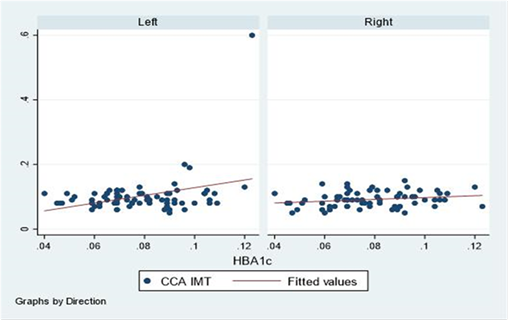
There is a statistically significant association between HbA1c and left common carotid artery IMT values (p = 0.003). No statistically significant association was observed between HbA1c and right common carotid artery IMT, right and left carotid bulb IMT, and carotid plaque burden (number of plaques and maximum plaque thickness). A significant correlation was observed between RBS and right common carotid artery IMT p <0.001, right carotid bulb IMT p <0.001, and left carotid bulb IMT p <0.001. There was no correlation between RBS and carotid plaque burden (number of plaques and maximum plaque thickness). Table 4
| Variables | HbA1c Correlation coefficient (p-value) | RBS Correlation coefficient (p-value) |
| Right CCA IMT | 0.208 (0.074) | 0.480 (<0.001*) |
| Left CCA IMT | 0.339 (0.003*) | 0.213 (0.009) |
| Right CB IMT | 0.215 (0.065) | 0.580 (<0.001*) |
| Left CB IMT | 0.128 (0.274) | 0.524 (<0.001*) |
| Number of plaques | 0.122 (0.498) | 0.077 (0.667) |
| Maximum plaque thickness | 0.320 (0.068) | -0.006 (0.972) |
*=significant p-value
A scatter plot showed a linear relationship between left and right CCA IMT and HbA1c in the diabetic group. This suggests a weak positive correlation between left and right CCA IMT and HbA1c in the diabetic group. Figure 1
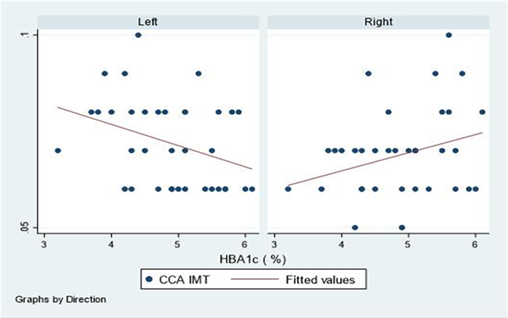
The scatter plot showed a linear relationship between left and right CCA IMT versus HbA1c in the control group. This suggests a weak negative correlation between left CCA IMT and HbA1c in this group. There is a weak positive correlation between right CCA IMT and HbA1c in the control group. Figure 2
Discussion
Ultrasonographic assessment of CIMT and carotid plaques is an inexpensive, non-invasive, and reproducible method for evaluating the risk of cardiovascular disease, with the added benefit of improving the life expectancy of diabetic patients. This helps in early detection/treatment of cardiovascular disease as well as atherosclerotic risk assessment, stratification, and/or prevention. The exact upper limit of the normal range of CIMT values has been a contentious issue in the past and varies with age, gender, and race. However, values of less than 0.8mm correlate well with an absence of coronary artery disease, while values above 0.8mm have been associated with severe coronary artery disease, myocardial infarction, and stroke [9].
Previous studies from other parts of Nigeria and the world have shown a higher prevalence of carotid intima-media thickening in patients with type 2 diabetes mellitus compared to apparently healthy controls [11,12]. This was also observed in this study, and it was found to persist with the presence of co-morbidity like hypertension, presence or absence of anti-diabetic medications, as well as differences in demographics in both diabetic and control groups.
This study showed no statistically significant difference in mean CIMT values between males and females in both the diabetic and the control groups, which is similar to that reported by Baba et al, Okeahialam et al, and Lorenz et al.,[11,13,14].
Our study showed mean CIMT values to be slightly higher on the left side compared to the right side, and it is comparable to the findings reported by Bartman et al.,[12]. Conversely, Baba et al.,[11], Okeahialam et al., [13], and Lorenz et al.,[14] reported contrary findings. The differences between the findings may be because of changes in the intrinsic intraluminal forces affecting the vessel wall, that is created by anatomical and haemodynamic differences between the right and left carotid vessels [12]. This was explained in the study showing the left common carotid artery, being a direct branch of the aorta and more likely to be influenced by haemodynamic changes than the right common carotid artery, which is not a direct branch of the aorta but rather arises from the brachiocephalic trunk [15].
We also found that there was a markedly increased prevalence of carotid plaques in patients with diabetes compared with apparently healthy controls. Carotid plaque has been found in recent studies to be more predictive of future adverse cardiovascular events, as carotid plaque burden correlates more with coronary calcium scores than CIMT [8]. We found no occurrence of carotid plaque in the control groups, even among subjects with a history of hypertension. This suggests that the cardiovascular risk for future adverse events is higher in diabetes than in other risk factors like hypertension and advanced age. This possibility was reported in the study by Okeahialam et al.,[13]. Our study showed a weak positive correlation between CIMT and HbA1c, which is similar to that reported by Baba et al.,[11] and Nazish et al.,[15]. The level of correlation reported by Baba et al.,[11] and Nazish et al.,[15] was higher than that reported in our study. This higher correlation may be as a result of variability in diabetic control in the different subject groups.
Our study did not find a correlation between carotid artery plaque and HbA1c values; it concurs with that reported by Nazish et al.,[15]. Jorgensen et al.,[16] reported a significant association between HbA1c levels and carotid plaque formation. Increased HbA1c values have been shown to contribute significantly to plaque formation and HbA1c levels greater than 6.3% were shown to be associated with carotid plaque instability in patients who developed ischaemic stroke [17]. The variation in the findings from that in this study may be as a result of differences in the methodology. A majority of the recruited subjects in this study were chronic diabetes (not recently diagnosed), and this was reflected in their HbA1c levels. They had been on anti-diabetic medications with varying levels of diabetic control. Our study, however, found a significant positive association between CIMT and RBS values, contrary to that reported by Kowall & colleagues [18], and it may be explained by the differences in sample size.
Due to the superficial location of the carotid vessels in the neck, B-mode ultrasonography provides a readily available means of assessing CIMT, which is a reliable tool of cardiovascular risk assessment and predictor of future cardiovascular events such as stroke, myocardial infarction, or death, even without prior history of cardiovascular disease [14,19]. The additional assessment of carotid plaque improves its cardiovascular risk predictability [6]. With the high association between diabetes mellitus, atherosclerosis, and future adverse cardiovascular events as found in several studies, the sonographic assessment of CIMT and carotid plaque assumes an important role in the implementation of cost-effective preventive measures in the clinical management of diabetic patients. Patients with diabetes in this study showed carotid intima-media thickening and a higher prevalence of carotid plaques than the controls. LIMITATION: The sample size is not large enough to be representative of the population.
Conclusion
High HbA1c levels were significantly associated with high CIMT values but not with carotid plaques. Therefore, HbA1c levels may be useful as an indirect marker of the early stages of carotid artery atherosclerosis and should be routinely done in the evaluation of subjects with diabetes mellitus.
Declarations
Author contributions
Conception of study - OKU, NCS, UEO, ECM; Study design – OKU, UEO, NCS, ECM; Data collection – OKU, OCM, CG, AC, US, NCS, UEO, ECM; Data analysis – OKU, OCM, CG; Revision of manuscript for intellectual content – All authors contributed, and Final approval for publication of the manuscript – All authors gave their approval.
Ethical approval
This was received from NAUTH, Nnewi ethical board with reference number NAUTH/CS/66/VOL.15/VER.3/316/2021/097.
Informed consent
Informed consent was obtained from each participant before enrollment into the study.
Declaration of patient’s consent
The authors certify that we obtained all appropriate patient consent for their clinical information and data after the scan to be reported in the journal. They understood that their names and personal details would not be published, and due efforts would be made to conceal their identity.
Declaration of Helsinki
The study was conducted according to the principles of the Helsinki Declaration.
Data
Anonymized data could be made available by the corresponding author upon reasonable request.
Funding
No funding for the study was received.
Conflict of interest
The authors have no conflict of interest.
Acknowledgement
Special appreciation to the Chemical Pathology Department of NAUTH and the participants of the study, who were essential to the success of this work.
AI contribution
No AI app [ChatGPT, MetaAI] was used in any part of the manuscript writing or revision.