Introduction
Proprotein convertase subtilisin/kexin type 9 (PCSK9) inhibitors (PCSK9i) are potent low-density lipoprotein cholesterol (LDL-C)–lowering agents that have transformed the management of residual cardiovascular (CV) risk [1]. Randomized controlled trials (RCTs) that led to Food and Drug Administration (FDA) approval in patients with established atherosclerotic cardiovascular disease (ASCVD) and/or familial hypercholesterolaemia (FH) demonstrated consistent LDL-C reductions in the range of 50–60% [2-16]. A sub-analysis of the FOURIER trial showed that 90% of participants achieved at least 50% LDL-C reduction with evolocumab [17]. Similarly, in the ODYSSEY programme, 98.9% of patients treated with alirocumab achieved at least a 15% reduction in LDL-C [18]. Collectively, these data indicate that the vast majority of patients experience substantial and consistent LDL-C lowering with PCSK9i therapy (“usual responders”).
PCSK9 plays a central role in cholesterol metabolism through regulation of LDL receptor recycling. By promoting LDL receptor degradation, PCSK9 increases circulating LDL-C levels; inhibition of this pathway results in enhanced LDL receptor availability and reduced plasma LDL-C concentrations (Fig. 1).
Several factors should be considered when assessing therapeutic response to pharmacotherapy, including timing, magnitude, and consistency of effect. With PCSK9i therapy, maximal LDL-C reduction is typically observed within 7 days after the first dose, with steady-state effects reached after 2–3 doses [19,20]. Accordingly, maximal pharmacodynamic response is generally expected by the third dose or approximately one month after initiation, which is commonly used as the first clinical time point for response assessment.
Given that most patients achieve a 50–60% reduction in LDL-C, the definition of suboptimal response requires careful consideration. The term hypo-responsiveness has previously been defined as <15% LDL-C reduction [18], based on historical thresholds used for earlier lipid-lowering therapies with more modest efficacy and regulatory criteria for drug approval [21]. However, this definition may not adequately reflect expected response patterns for PCSK9i therapy. Based on data from Qamar et al. [17], a threshold of <30% LDL-C reduction may more appropriately define hypo-responsiveness, as this lies beyond two standard deviations from the mean expected response and is observed infrequently in clinical trials.
Long-term cardiovascular outcome trials of PCSK9i therapy have demonstrated sustained LDL-C lowering throughout follow-up periods [15,16]. In the absence of changes to PCSK9i dosing or background lipid-lowering therapy, loss of response may therefore be defined as a transition from a standard response (50–60% LDL-C reduction from baseline) to hypo-responsiveness (<30% LDL-C reduction from baseline).
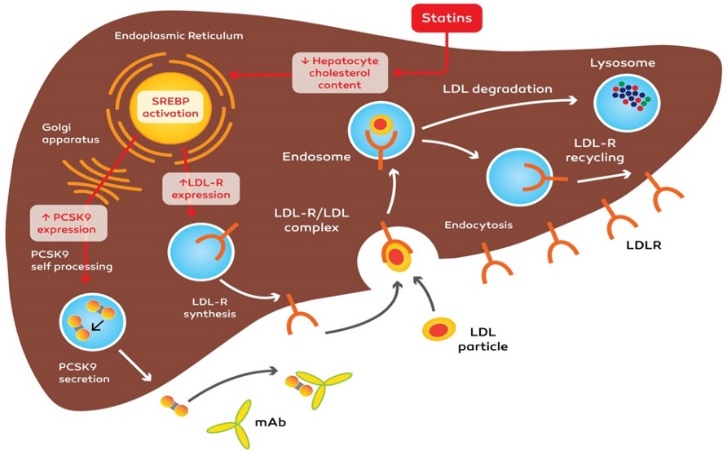
Monoclonal antibodies bind PCSK9 leading to an increase expression of LDL-R required to for the uptake of LDL-C particles due to the activation of SREBP. [LDLR: low-density lipoprotein cholesterol receptor, PCSK9: Proprotein convertase, subtilisin/kexin type 9].
When referring to those with an “unusual” PCSK9i response, data from prior studies [17,18] have shown this to be a rare event in the RCT setting. However, these studies solely focused on the degree of LDL-C reduction and did not identify types of unusual response or delve into, and suggest, possible biologic causes. The determination of identifying non-responders matters because this could be an indicator for alternative therapies, missed risk reduction and also reduce wasted treatment costs.
The aim of this study was to characterize responsiveness to PCSK9i injection therapy in achieving significant reduction in LDL-C to meet optimal target in a real-world lipid clinical setting in patients been treated for dyslipidaemia in a secondary care facility in the Hampshire area of the United Kingdom.
Materials & Methods
Study design and Cohort
Design
This retrospective study was a clinic-based audit conducted at the secondary referral lipid clinic at NHS Basingstoke and North Hampshire Hospital. It involved a detailed and systematic review of lipid profile results from the case notes of patients being treated for dyslipidaemia who attended routine clinic visits and had not achieved their optimal lipid targets. These patients were subsequently prescribed PCSK9 inhibitor monoclonal antibodies over a five-year period (March 2017–July 2022).
Standards
This retrospective study was based on the standards outlined by the ASC/EAS guidelines for LDL-C targets with cardiovascular risk in very low risk [<3.0mmol/L], moderate risk [<2.6mmol/L], high-risk [<1.8mmol/L] and very high-risk [<1.4mmol//L].
Cohort
Data were systematically extracted exclusively from case notes, with no direct patient contact and no collection of patient demographic information. The study cohort comprised 73 adult patients attending routine outpatient lipid clinics who failed to achieve recommended LDL-C targets and were subsequently initiated on PCSK9i (subcutaneous alirocumab or evolocumab). Dosing regimens included 75 mg or 150 mg administered every two weeks, with adjustments to monthly dosing where clinically indicated. LDL-C levels were recorded prior to treatment initiation and during follow-up for up to 12 months after commencement of therapy.
Data Extraction
A total of 151 patient records were identified and screened from routine lipid clinic attendees. All records were reviewed for eligibility, and identifiable patient information (names, contact details, and addresses) was excluded in accordance with data protection regulations.
Of the 151 records screened, 62 were excluded due to missing recent LDL-cholesterol (LDL-C) results, leaving 89 eligible patient records for further assessment. Among the 89 eligible patients, 16 declined PCSK9 inhibitor (PCSK9i) therapy, resulting in a final study cohort of 73 patients who initiated PCSK9i treatment (alirocumab or evolocumab). All 73 patients were followed up and included in the final analysis this can be seen in the flowchart in Figure 2.
The patient records with missing data including LDL-C results were screened out and excluded, and there was a reduced risk of selection bias due to set criteria before selection process and simple randomization patient records were used selection process.
Ethical Consideration
Prior to data extraction from patient records, a comprehensive face-to-face explanation regarding the use of clinical records was provided, and patients were given the option to decline the use of their records. Patient confidentiality and anonymity were maintained throughout the handling of clinic records. Electronic data were password-protected and accessible only to authorise members of the research team, ensuring strict adherence to data protection standards throughout the study.
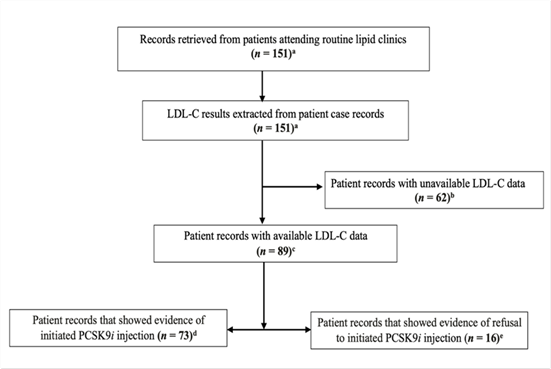
-
151 patients’ files were accessed and some of these results were older than the period assessed
-
62 patient files were screened out due to outdated or unavailable LDL-C results
-
89 patients’ files were selected that met the period assessed (2017- 2022)
-
73 opted and received PCSK9i treatment regimen and followed up for 12 months
-
16 patients declined due to the use of a intramuscular needle and the frequency needed to maintain treatment regimen.
The Inclusion and Exclusion Criteria
This study followed strict selection inclusion and exclusion criterion factors for assessed outpatient case notes attending their routine clinic visits.
Inclusion Criteria
-
Patients ≥18 years old with LDL-C ≥3.5 mmol/L
-
Patients who were statin intolerant, met LDL-C targets on other anti-lipid drugs (ezetimibe, bempedoic acid, and fibrates),
-
Patients placed on a PCSK9i injections.
Exclusion Criteria
-
Patients who were not prescribed PCSK9i injections, l
-
Lack of LDL-C result
-
LDL-C result data that was either too old or outside the specified study period.
Statistical analysis
The data was analysed using Statistical Package for Social Sciences (SPSS), version 21 (IBM, Chicago, IL, USA). We used the student’s t-test to determine the differences between two independent means; Pearson’s corelation measured the relationship between variables; results were presented as mean ±standard deviation (SD), while categorical variables were reported as numbers or percentages using descriptive studies. Statistical significance was set at P < 0.05.
Results
Seventy-three patient records were included in the study cohort. These cases were assessed for age and LDL-C values at baseline and post-treatment among patients initiated on PCSK9 inhibitors (Repatha or Praluent). Patients were subsequently classified as: Responders (n = 59): ≥30% reduction in LDL-C and Non-responders (n = 14): <30% reduction in LDL-C.
The mean LDL-C levels were higher at baseline than after treatment for the majority of patients receiving PCSK9 inhibitor therapy (4.37 ± 1.49 vs 2.54 ± 1.57 mmol/L; p = 0.039).Comparison between responders and non-responders showed significant differences in all variables except age, which did not differ significantly between groups (responders [n = 59] vs non-responders [n = 14]: 62.4 vs 57.6 years; p = 0.071).(Table 1)
| Variables | Whole Cohort (n =73) | Response Status | ||
| Responders (n =59) | Non-Responders (n =14) | p | ||
| Age (years) | 61.5 (43,81) | 62.4 (38, 81) | 57.6(42, 74) | 0 .071 |
| Initial LDL-C (mmol/L) | 4.4 (2.0, 10.1) | 4.2 (2.0, 7.4) | 4.8 (2.4, 10.1) | 0.092 |
| Post treatment LDL-C (mmol/L) | 1.4 (1.0, 2.0) | 1.4 (1.0, 2.0) | 1.6 (1.1, 2.2) | < 0.001 |
| Average LDL-C (mmol/L) | 3.4 (1.5, 9.4) | 3.1 (1.5, 6.4) | 4.7 (2.4, 9.4) | < 0.001 |
| Difference (mmol/L) | 1.8 (-0.9, 5.3) | 2.2 (0.7, 5.3) | 0.3 (-0.9, 1.7) | < 0.001 |
| %Difference | 60.2 (-15.4, 134.2) | 73.4 (31.1, 134.2) | 4.6 (-15.4, 27.0) | < 0.001 |
Note 0(0,0) is the median with the range from lowest to highest;
The Pearson’s correlation between age and initial LDL-C concentration was r(73) = –0.2464, p = 0.036, while the correlation between age and post-treatment LDL-C concentration was r(73) = –0.25, p = 0.033. Both correlations were statistically significant, indicating a modest but negative association as seen in Table 2.
| Comparison | r (correlation coefficient) | p |
| Age vs. Initial LDL-C | –0.2464 | 0.036 |
| Age vs. Post-treatment LDL-C | –0.2500 | 0.033 |
| Classification | Age (yrs) | Initial LDL (mmol/L) | Post treatment LDL (mmol/L) | % (MeanSD) | p |
| Responders N= 59 (81%) | 62.4 | 4.2 | 2.0 | 73.5 (73.46 27.03) | <0.0001 |
| Non-responders N =14 (19%) | 57.6 | 4.8 | 4.6 | 4.6 (4.56 14.42) | 0.37 |
The comparison of values of the LDL-C post-treatment was significant for responders, with a 52.4% reduction in LDL-C from initial LDL-C (p<0.001). The average LDL-C reduction of 52.4% was greater than the threshold value (>30%) for treatment responsiveness. On the other hand, the non-responders decreased by just 4.2%(p=0.37), which was significantly lower than the threshold of >30%, as seen in Table 3. In Figure 3 it depicts the comparison between responders and non-responders to PCSK9i showing a lesser proportion of the patients with LDL-C reduction of <30%.
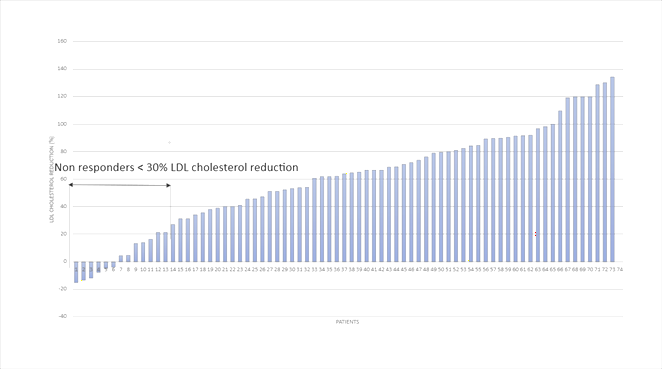
A greater proportion of the patients were responsive to the PCSK9 monoclonal antibodies, there are non-responders with <30% LDL-C cholesterol reduction
Risk stratification showed that patients classified as low cardiovascular risk had an LDL-C threshold of <3.0 mmol/L (mean ± SD: 2.76 ± 0.11), whereas high-risk patients required stricter LDL-C control of <1.8 mmol/L (1.62 ± 0.11). The difference in mean ± SD across risk categories was statistically significant (p< 0.001), as shown in Table 4. Patients at higher cardiovascular risk required closer monitoring and more stringent LDL-C control compared with those at lower risk.
| CV Risk Category | n | % | LDL MeanSD (mmol/L) |
| Low Risk (<3.0) | 40 | 54.8 | 2.76 0.11 |
| Moderate Risk (<2.6) | 15 | 20.5 | 2.28 0.19 |
| High Risk (<1.8) | 13 | 17.8 | 1.62 0.11 |
| Above Low Risk (≥3.0) | 5 | 6.8 | 4.28 1.39 |
| 73 | 100 | p <0.001* |
Discussion
Non-response to PCSK9 inhibitors (PCSK9i) has been described in clinical and translational studies, with proposed mechanisms including LDL receptor (LDLR) deficiency in familial hypercholesterolaemia, anti-drug antibody formation, genetic determinants of lipid metabolism, and technical factors related to drug administration [11]. PCSK9 genetic variants have been associated with inter-individual variability in circulating LDL-C levels and cardiovascular risk phenotypes.
PCSK9 variants are broadly classified as gain-of-function or loss-of-function mutations. Gain-of-function variants are associated with increased PCSK9 activity and elevated LDL-C levels, whereas loss-of-function variants are associated with reduced circulating PCSK9 concentrations and lower LDL-C levels [12].
In the present cohort, both cases of hypercholesterolaemia were characterised by heterozygous LDLR mutations consistent with autosomal dominant familial hypercholesterolaemia. Prior clinical evidence, including the TESLA program [24], has demonstrated attenuated LDL-C lowering with PCSK9 inhibition in patients with LDLR-defective states, consistent with dependence of PCSK9 monoclonal antibody efficacy on functional LDL receptor pathways [13]. Across our study population, treatment with PCSK9i resulted in heterogeneous LDL-C responses. Responders achieved a mean LDL-C reduction of 2.2 mmol/L, corresponding to a 73.5% decrease from baseline, consistent with established efficacy benchmarks for this therapeutic class. In contrast, non-responders exhibited a mean reduction of 0.2 mmol/L (4.6%), indicating marked attenuation of pharmacodynamic response. Our study agreed with a lshahrani et al. [25] in the area of certain patients who did not respond to PCSK9i whose multicentre retrospective cohort study included 28 HoFH patients treated with PCSK9i, a large proportion of the patients failed to achieve 15% of LDL-C reduction due to the presence of LDLR null/null mutation. in stark contrast to our study, we had a better response greater >30% in 69 (81%) patients. However, we didn’t ascertain the genetic component of our patient records.
Mechanistic explanations proposed in the literature for variability in LDL-C response include inter-individual differences in LDL receptor activity, PCSK9 kinetics during monoclonal antibody therapy, and formation of antibody PCSK9 complexes that may influence measured circulating PCSK9 concentrations. Given that PCSK9 clearance is LDLR-dependent, circulating PCSK9 levels during treatment have been used as a pharmacodynamic marker of target engagement in clinical studies. In this context, attenuated LDL-C reduction has been operationally used to define suboptimal biochemical response to therapy.
No statistically significant difference in age was observed between responders and non-responders. The mean age of the cohort was 61.5 years (61.49 ± 10.82), with younger age observed in the non-responder subgroup.
Baseline LDL-C concentrations were higher in non-responders compared with responders this could be due to variability in response to PCSK9i, this could be supported by another study by Zhang et al. [26] whose study showed variability in patients suggested Pathogenic genetic analysis may be necessary for the efficacy of PCSK9i. in our study following treatment using PCSK9i, absolute LDL-C reduction was lower in responders vs non-responders (1.4 mmol/L vs 1.6 mmol/L), corresponding to a 13.3% between-group difference. Post-treatment LDL-C levels of approximately 1.4 mmol/L in the responder group fall within ESC/EAS guideline-recommended targets for very high-risk cardiovascular populations, although achieved through comparatively reduced percentage LDL-C lowering.
Public Health/Economic and Clinical Implications of Non-Response to PCSK9i
The public health implications of non-response extend beyond the individual patient, as treatment failure has a negative impact on healthcare systems such as the NHS due to inefficient use of resources that could otherwise be allocated to other patients. Additionally, non-response may increase the treatment burden on both the patient and the treating physician.
From a public health perspective, suboptimal response limits the anticipated reduction in atherosclerotic cardiovascular disease (ASCVD) risk at the population level. This may lead to increased hospital admissions and longer hospital stays due to associated complications. The variability in response to these monoclonal antibodies may also necessitate additional diagnostic workup, such as genetic variant analysis, which can increase testing burden and healthcare costs, potentially complicating treatment initiation due to overall expense.
PCSK9i remain among the most expensive lipid-lowering agents. In non-responders, the cost per mmol/L reduction in LDL-C and the cost per quality-adjusted life year (QALY) gained increase significantly, thereby reducing cost-effectiveness compared with statins or ezetimibe. This may impact health system-level resource allocation and the clinical implication underscoring the importance of early identification of suboptimal responders and timely intensification of therapy to prevent persistent LDL-C elevation and subsequent escalation to PCSK9i use.
Study Strength
The strength of this study takes into account the clinic follow-up of patients placed on PCSK9i during the early days of PCSK9i introduction, who were followed over a few years, and the LDL-C values were monitored, and the responders were identified and compared to the non-responders. This was during a period outcome data had not been published to show evidence of real-world use in the clinics. On the other hand, the limitation of this study was the number of case notes reviewed, as the adoption rate for the use of PCSK9i was slower and didn’t see an uptick until 2024. Additionally, we could not carry out genetic studies due to resource and time constraints, which have been necessary to identify and ascertain interindividual response due to PCSK9i at the molecular level in order to better understand dosing, duration, and the strength of this study lies in its real-world clinical follow-up of patients initiated on PCSK9i during the early phase of introduction into the clinic by the pharmaceutical companies. Patients were followed over several years, with serial LDL-C measurements used to identify responders and compare them with non-responders. This was undertaken at a time when real-world outcome data on PCSK9 inhibitor use in routine clinical practice were still limited.
Overall, the analysis demonstrates a clear dichotomy in LDL-C response to PCSK9 inhibitor therapy, with 81% of patients classified as responders and 19% as non-responders. Responders achieved a clinically meaningful reduction in LDL-C, with an average decrease of 2.2 mmol/L (73.5% reduction from baseline), consistent with the expected efficacy of PCSK9 inhibition. In contrast, non-responders showed minimal LDL-C reduction (0.2 mmol/L; 4.6%), suggesting limited therapeutic effect despite elevated baseline LDL-C levels.
Limitations
The observed lack of response in a subset of patients may reflect underlying pharmacogenomic variation, immunogenicity, or dysfunction within the LDL receptor pathway, potentially impairing PCSK9 binding or receptor recycling. However, genetic data were not available from the patient records and therefore could not be assessed. This highlights the importance of considering inter-individual genetic variability in patients treated with monoclonal antibodies, as therapeutic response may vary between individuals. However, the study is limited by the relatively small number of case notes reviewed, partly due to the slow adoption rate of PCSK9 inhibitors, which did not significantly increase until 2024. In addition, genetic analyses could not be performed due to resource and time constraints. This limits the ability to explore inter-individual variability in response at a molecular level, which is important for understanding dosing strategies, treatment duration, and personalised therapy. There is therefore a need to identify predictive biomarkers, such as anti-drug antibodies and inflammatory markers, to help identify patients most likely to benefit from PCSK9 inhibitor therapy. In addition, there were no evidences for assessment of adherence (a major cause of non-response) and evaluation of injection technique errors.
Conclusion
These findings underscore the importance of biomarker-guided stratification and genetic profiling in optimizing lipid-lowering strategies, particularly in populations with variable response patterns.
List of Abbreviations
PCSK9: Proprotein Convertase Subtilisin/Kexin Type 9
PCSK9i: Proprotein Convertase Subtilisin/Kexin Type 9 inhibitors
LDL-C: Low-Density Lipoprotein Cholesterol
CV: Cardiovascular
RCT: Randomized Controlled Trial
FDA: Food and Drug Administration
ASCVD: Atherosclerotic Cardiovascular Disease
FH: Familial Hypercholesterolemia
LDLR: Low-Density Lipoprotein Receptor
SREBP: Sterol Regulatory Element-Binding Protein
SCI: Subcutaneous Injection
ASC/EAS: American Society of Cardiology / European Atherosclerosis Society
SD: Standard Deviation
SPSS: Statistical Package for the Social Sciences
GDPR: General Data Protection Regulation
Declarations
Acknowledgements
None
Conflict of Interest
None declared
Funding
Nil
Data Availability Statement
The data that support the findings of this study are available from the corresponding author upon reasonable request.