Introduction
Adolescence represents a critical developmental period characterized by rapid cognitive, emotional, and academic demands, during which adequate sleep is essential for optimal learning and mental functioning. Insufficient sleep among adolescents has been widely recognized as a global public health concern, with numerous studies linking short sleep duration to impaired academic performance, reduced attention, and adverse mental health outcomes. Consequently, both research and policy efforts have predominantly emphasized increasing sleep duration as a primary strategy to improve adolescent well-being and educational achievement.
However, emerging evidence suggests that sleep duration alone may not fully account for persistent daytime fatigue and learning difficulties observed among adolescents. A substantial proportion of students report obtaining the recommended 7–8 hours of sleep per night yet continue to experience morning tiredness, reduced classroom engagement, and impaired learning readiness. This paradox raises critical questions regarding the adequacy of current sleep-focused frameworks and indicates that sleep quantity may not accurately reflect sleep recovery or functional sleep quality.
Concurrently, the pervasive use of smartphones and digital devices has fundamentally reshaped adolescents’ pre-sleep behaviors. Mobile phone use before bedtime is nearly ubiquitous, often involving social media engagement, multimedia consumption, and real-time communication. While prior research has linked overall screen time to sleep disturbances, most studies have treated digital exposure as a cumulative daily measure, paying limited attention to the timing of device use. Notably, the period immediately preceding sleep represents a biologically sensitive window during which exposure to blue light and cognitively stimulating content may disrupt melatonin secretion, delay sleep onset, and impair sleep efficiency. Despite this, bedtime-specific digital behaviors remain underexplored in relation to sleep quality and academic functioning.
Importantly, the co-occurrence of adequate sleep duration and poor daytime functioning suggests the presence of a distinct sleep-related phenomenon that is not adequately captured by traditional sleep metrics. To address this gap, the present study introduces the concept of digital-induced pseudo-sufficient sleep (DIPSS), defined as a condition in which individuals achieve an ostensibly sufficient amount of sleep yet experience compromised sleep quality and reduced cognitive recovery due to digital device use prior to bedtime. This concept reframes adolescent sleep problems by shifting the focus from sleep quantity to sleep quality distortion driven by the timing of digital exposure.
From an educational perspective, sleep quality plays a pivotal role in shaping daytime cognitive readiness, including morning freshness, sustained attention, and learning comprehension—factors that directly influence classroom engagement and academic performance. However, few studies have systematically examined whether sleep quality mediates the relationship between bedtime mobile phone use and academic functioning, independent of sleep duration. Understanding this mechanism is particularly important in school settings, where recommendations often emphasize sleep hours while overlooking digital habits that may undermine sleep recovery.
Accordingly, this study aims to examine the relationships between bedtime mobile phone use, sleep quality, daytime cognitive readiness, and academic functioning among adolescents. By integrating sleep science, digital behavior, and educational outcomes, the study seeks to advance a more nuanced understanding of adolescent sleep in the digital age and to inform evidence-based interventions that extend beyond conventional sleep duration guidelines.
Research Questions
To address these objectives, the study seeks to answer the following research questions:
-
Does mobile phone use before bedtime contribute to poor sleep quality despite adequate sleep duration among adolescents?
-
Is compromised sleep quality associated with reduced daytime cognitive readiness, including morning freshness, classroom focus, and learning comprehension?
-
Does sleep quality mediate the relationship between bedtime mobile phone use and academic functioning?
Methods
Study Design and Participants
This study employed a cross-sectional analytical design to investigate the relationships between bedtime mobile phone use, sleep quality, daytime cognitive readiness, and academic functioning among adolescents. Data were collected using a self-administered questionnaire distributed to secondary school students (Grades 7–12) and first-year university students in Thailand. A total of 233 participants completed the survey and were included in the analysis.
Participants were recruited through school-based coordination and voluntary participation. Inclusion criteria were (1) enrollment in secondary education or first-year university programs, (2) ability to comprehend the questionnaire, and (3) provision of informed consent. Participation was anonymous, and no personally identifiable information was collected.
Measures
Bedtime Mobile Phone Use
Bedtime mobile phone use was assessed using a single-item measure capturing the frequency of mobile phone use within one hour prior to sleep. Responses were recorded on a 5-point Likert scale ranging from 1 (“very frequently”) to 5 (“never”), with lower scores indicating more frequent bedtime mobile phone use. This measure focused specifically on the pre-sleep period to capture the timing-related impact of digital exposure rather than overall daily screen time.
Sleep Duration
Sleep duration was measured by self-reported average hours of sleep per night on school days. Participants reported their typical sleep duration in hours, which was later categorized for descriptive analyses and treated as a continuous variable for correlational analyses. Sleep duration was included as a control variable to distinguish sleep quantity from sleep quality effects.
Sleep Quality
Sleep quality was assessed using multiple subjective indicators reflecting sleep initiation, continuity, and recovery. These included:
-
Easy of falling asleep on school nights
-
Frequency of nighttime awakenings
-
Morning freshness upon waking
Each item was rated on a 5-point Likert scale, with higher scores indicating better sleep quality (e.g., easier sleep onset, fewer awakenings, greater freshness). These indicators were analyzed both individually and as a composite representation of sleep quality in subsequent analyses.
Daytime Cognitive Readiness
Daytime cognitive readiness was operationalized through self-reported measures of classroom functioning, including:
-
Ability to maintain focus during morning classes
-
Frequency of daytime sleepiness or mental fatigue
-
Ability to understand lesson content upon first exposure
Items were rated on a 5-point Likert scale, with higher scores indicating better cognitive readiness (e.g., greater focus, less sleepiness, better comprehension).
Academic Functioning
Academic functioning was assessed using two indicators:
-
Academic performance, measured by self-reported grade point average (GPAX).
-
Academic engagement, assessed through a Likert-scale item measuring the consistency of homework or assignment submission.
These indicators were used to capture both performance-based and behavioral aspects of academic functioning.
Statistical Analysis
Descriptive statistics were calculated for all study variables and reported as means and standard deviations for continuous variables and frequencies and percentages for categorical variables. Pearson’s correlation coefficients were computed to examine bivariate associations among bedtime mobile phone use, sleep quality indicators, daytime cognitive readiness, and academic functioning.
To examine whether sleep quality mediated the relationship between bedtime mobile phone use and academic functioning, mediation analyses were conducted using regression-based methods. Sleep quality indicators were specified as mediators, bedtime mobile phone use as the independent variable, and academic functioning outcomes as dependent variables. Sleep duration was included as a covariate in all regression models to isolate the effect of sleep quality independent of sleep quantity.
All statistical analyses were conducted using standard statistical software, with statistical significance set at p < 0.05.
Ethical Considerations
The study was conducted in accordance with ethical principles for research involving human participants. Participation was voluntary, informed consent was obtained prior to data collection, and confidentiality of responses was ensured throughout the study.
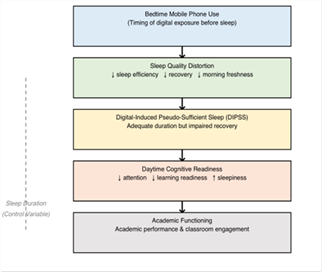
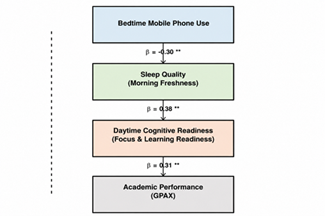
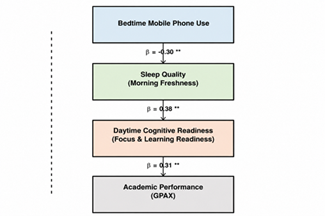
Figure 1 presents the conceptual framework illustrating the mediation pathway linking bedtime mobile phone use to academic functioning through digital-induced pseudo-sufficient sleep, independent of sleep duration.
Results
Participant Characteristics
A total of 233 adolescents participated in the study, including secondary school students and first-year university students. The majority of participants reported residing in Bangkok. Most respondents reported an average sleep duration of 7–8 hours per night on school days, indicating generally adequate sleep quantity across the sample.
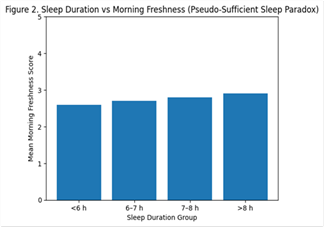
As shown in Figure 2, morning freshness did not increase proportionally with sleep duration. Notably, students sleeping 7–8 hours per night continued to report only moderate levels of freshness, suggesting that adequate sleep duration alone may not ensure optimal sleep recovery.
Descriptive Statistics of Sleep, Digital Behavior, and Academic Variables
Table 1 presents the means and standard deviations of the key study variables. Although average sleep duration was within the recommended range, indicators of sleep quality revealed moderate levels of morning freshness and daytime alertness. Bedtime mobile phone use was common, with relatively low mean scores indicating frequent use within one hour before sleep.
| Variable | Mean | SD |
| Bedtime mobile phone use * | 2.12 | 1.42 |
| Sleep duration (hours/night) | 7.42 | 0.96 |
| Ease of falling asleep | 3.55 | 1.17 |
| Nighttime awakenings | 4.10 | 1.20 |
| Morning freshness | 2.74 | 1.12 |
| Classroom focus | 3.26 | 1.09 |
| Daytime sleepiness ** | 3.07 | 1.28 |
| Learning comprehension | 3.34 | 1.09 |
| Homework submission consistency | 3.91 | 1.10 |
| Academic performance (GPAX) | 3.60 | 0.42 |
-* Lower scores indicate more frequent bedtime mobile phone use
- **Higher scores indicate lower frequency of daytime sleepiness
Bivariate Correlations
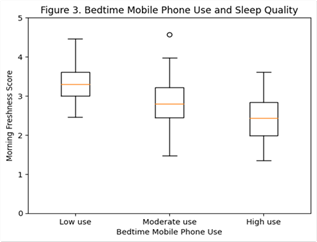
Pearson’s correlation analyses revealed significant associations between bedtime mobile phone use, sleep quality indicators, and daytime cognitive readiness (Table 2). More frequent bedtime mobile phone use was significantly associated with lower morning freshness and greater daytime sleepiness. Sleep quality indicators demonstrated stronger associations with classroom focus and learning comprehension than sleep duration.
| Variable | 1 | 2 | 3 | 4 | 5 |
| 1. Bedtime mobile phone use | — | ||||
| 2. Morning freshness | −0.30* | — | |||
| 3. Classroom focus | −0.18* | 0.38* | — | ||
| 4. Learning comprehension | −0.12 | 0.34* | 0.45* | — | |
| 5. Academic performance (GPAX) | 0.04 | 0.01 | 0.23* | 0.31* | — |
p < 0.05
Sleep duration was weakly correlated with most outcome variables and did not demonstrate significant associations with academic performance.
Mediation Analysis
To examine whether sleep quality mediated the relationship between bedtime mobile phone use and academic functioning, regression-based mediation analyses were conducted while controlling for sleep duration.
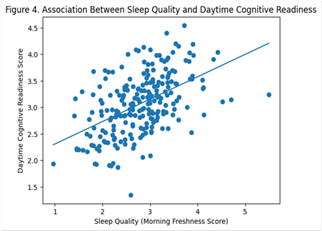
Bedtime mobile phone use was a significant predictor of sleep quality, particularly morning freshness (β = −0.30, p < 0.01). Morning freshness, in turn, significantly predicted classroom focus (β = 0.38, p < 0.01) and learning comprehension (β = 0.34, p < 0.01). Classroom focus and learning comprehension were both significant predictors of academic performance, with learning comprehension demonstrating the strongest association with GPAX (β = 0.31, p < 0.01).
When sleep quality indicators were included in the model, the direct association between bedtime mobile phone use and academic performance was attenuated and became non-significant, indicating an indirect effect through sleep quality and daytime cognitive readiness. These findings suggest that the impact of bedtime mobile phone use on academic functioning operates primarily through its influence on sleep quality rather than through sleep duration.
| Pathway | Standardized β | p-value |
| Bedtime mobile phone use → Morning freshness | −0.30 | <0.01 |
| Morning freshness → Classroom focus | 0.38 | <0.01 |
| Classroom focus → GPAX | 0.23 | <0.05 |
| Morning freshness → Learning comprehension | 0.34 | <0.01 |
| Learning comprehension → GPAX | 0.31 | <0.01 |
| Direct effect: Mobile use → GPAX | 0.04 | ns |
Summary of Key Findings
Overall, the results demonstrate that bedtime mobile phone use is associated with compromised sleep quality despite adequate sleep duration. Sleep quality indicators, particularly morning freshness, were strongly linked to daytime cognitive readiness and academic functioning. The mediation analyses support the proposed digital-induced pseudo-sufficient sleep (DIPSS) framework, indicating that the academic consequences of bedtime mobile phone use are indirectly driven by sleep quality distortion rather than insufficient sleep quantity.
Discussion
This study provides novel evidence that adolescent sleep-related academic impairment may arise not from insufficient sleep duration but from compromised sleep quality driven by bedtime mobile phone use. By integrating sleep science, digital behavior, and educational outcomes, the findings support the proposed framework of digital-induced pseudo-sufficient sleep (DIPSS), a condition in which adolescents obtain an adequate amount of sleep yet experience impaired recovery and reduced cognitive readiness for learning.
Sleep Duration Is Not Synonymous with Sleep Recovery
Consistent with prior literature, a substantial proportion of participants in this study reported sleeping within the recommended range of 7–8 hours per night. However, Figure 2 demonstrates that adequate sleep duration did not correspond to high levels of morning freshness, highlighting a critical paradox in adolescent sleep research. This finding challenges the long-standing assumption that sleep quantity alone is sufficient to ensure optimal daytime functioning and suggests that sleep recovery should be evaluated independently from sleep duration.
Bedtime Mobile Phone Use as a Key Disruptor of Sleep Quality
The results indicate that bedtime mobile phone use plays a central role in distorting sleep quality. As illustrated in Figure 3, increased frequency of mobile phone use within one hour before sleep was associated with significantly lower morning freshness, reflecting poorer subjective sleep recovery. Unlike previous studies that have focused on total daily screen time, the present findings emphasize the importance of timing-specific digital exposure, particularly during the biologically sensitive pre-sleep period. This supports emerging evidence that blue light exposure and cognitive arousal prior to bedtime can disrupt circadian regulation and sleep efficiency, even when total sleep duration is preserved.
Sleep Quality as a Mechanism Linking Digital Behavior to Learning Readiness
Importantly, sleep quality emerged as a critical mechanistic link between bedtime mobile phone use and daytime cognitive functioning. Figure 4 demonstrates a clear positive association between morning freshness and daytime cognitive readiness, including classroom focus and learning comprehension. Adolescents who reported better sleep recovery were more attentive and better prepared to process new information during school hours. These findings align with neurocognitive models suggesting that sleep-dependent restoration processes are essential for attention, executive functioning, and learning capacity.
Evidence for a Full Mediation Model
The mediation analysis provides strong support for the DIPSS framework. As shown in Figure 5, the relationship between bedtime mobile phone use and academic performance was fully mediated by sleep quality and daytime cognitive readiness, while the direct effect of mobile phone use on academic performance was non-significant. This pattern suggests that bedtime mobile phone use does not impair academic outcomes directly but exerts its influence through a cascade of sleep-related mechanisms. By controlling for sleep duration, the present study demonstrates that sleep quality—not sleep quantity—is the primary pathway through which digital behaviors affect academic functioning.
Theoretical Contributions
This study makes several important theoretical contributions. First, it introduces the concept of digital-induced pseudo-sufficient sleep, extending existing sleep frameworks by distinguishing sleep recovery from sleep duration. Second, it advances a timing-based perspective on digital behavior, highlighting bedtime mobile phone use as a critical determinant of sleep quality. Third, it bridges sleep science and educational psychology by positioning daytime cognitive readiness as a key intermediary between sleep and academic performance.
Practical and Policy Implications
The findings have important implications for adolescent health and education policies. Current recommendations often emphasize obtaining sufficient sleep hours while paying limited attention to pre-sleep digital habits. The present results suggest that interventions aimed solely at increasing sleep duration may be insufficient. Instead, digital curfew strategies that limit mobile phone use before bedtime may be more effective in improving sleep recovery and learning readiness. Schools, parents, and policymakers should consider integrating sleep timing hygiene and digital behavior education into adolescent well-being programs.
Limitations and Future Directions
Several limitations should be acknowledged. The cross-sectional design precludes causal inference, and future longitudinal or experimental studies are needed to confirm the temporal ordering proposed in the DIPSS framework. Sleep measures were self-reported and may be subject to reporting bias; incorporating objective sleep metrics such as actigraphy would strengthen future research. Additionally, the study focused on adolescents in a specific cultural context, and replication across diverse populations is warranted.
Future research should further explore digital-induced pseudo-sufficient sleep using experimental designs, examine specific types of digital content consumed before bedtime, and investigate potential moderating factors such as chronotype, stress, and mental health. Intervention studies testing the effectiveness of bedtime digital restriction on sleep recovery and academic outcomes would be particularly valuable.
Conclusion
This study provides compelling evidence that adequate sleep duration alone does not guarantee optimal sleep recovery or academic functioning among adolescents. The findings demonstrate that bedtime mobile phone use is associated with compromised sleep quality, resulting in a state of digital-induced pseudo-sufficient sleep (DIPSS), a condition characterized by sufficient sleep quantity but impaired cognitive recovery. Through a mediation framework, the study shows that the adverse academic effects of bedtime mobile phone use operate indirectly through sleep quality distortion and reduced daytime cognitive readiness rather than through sleep duration.
By shifting the focus from sleep quantity to sleep quality and the timing of digital exposure, this study advances a more nuanced understanding of adolescent sleep in the digital age. The results highlight the critical role of pre-sleep digital behaviors in shaping learning readiness and academic performance, underscoring the need for interventions that extend beyond traditional sleep duration recommendations. Promoting sleep timing hygiene and implementing evidence-based digital curfew strategies may represent effective approaches to improving adolescent sleep recovery and educational outcomes.
Strengths and Limitations
Strengths
This study has several notable strengths. First, it introduces a novel conceptual framework, digital-induced pseudo-sufficient sleep (DIPSS), that addresses a critical gap in existing sleep research by distinguishing sleep recovery from sleep duration. Second, the study adopts a timing-specific approach to digital behavior, focusing on mobile phone use within one hour before bedtime rather than overall daily screen time, thereby capturing a biologically and cognitively sensitive exposure window. Third, the integration of sleep quality, daytime cognitive readiness, and academic functioning within a mediation model provides a mechanistic understanding of how digital behaviors influence learning outcomes. Finally, the use of multiple complementary visualizations strengthens the interpretability and coherence of the findings.
Limitations
Several limitations should be acknowledged. The cross-sectional design limits causal inference, and longitudinal or experimental studies are required to confirm the temporal relationships proposed in the DIPSS framework. All sleep and digital behavior measures were self-reported, which may introduce recall or social desirability bias; future research incorporating objective sleep assessments such as actigraphy or digital usage logs would enhance measurement precision. Additionally, the study sample was drawn from a specific cultural and educational context, which may limit generalizability to other populations. Future studies should replicate these findings across diverse settings and examine potential moderators such as chronotype, mental health status, and academic stress.
Declarations
Acknowledgements
None
Ethical Clearance
Yes
Funding statement
Authors declare that this research received no funding from any external source.
Conflict of Interest
The authors declare that there is no conflict of interest regarding the publication of this article.