Introduction
Sepsis in pregnancy is third leading cause of preventable maternal death in India. The reported incidence in high income countries varies from 12 to 35 per 100,000 deliveries with accompanying maternal mortality ranging from 0.85 to 1.13 per 100,000 maternities [1]. The sepsis in obstetrics score was created by modifying validated scoring system in accordance with recognised physiological changes of pregnancy [2]. The SOS was applied to a retrospective cohort of antenatal postabortal, postpartum patient with clinical suspicion of sepsis. The primary outcome was ICU admission, the secondary outcome was telemetry unit admission, length of ICU stays. Receiver operating curves were constructed to estimate optional score for identification of risk of ICU admission.
Severe sepsis is the leading cause of death in critically ill adult in noncoronary intensive care unit in United States accounting for 50% mortality of those admitted with septic shock [3]. Maternal sepsis especially puerperal sepsis, leading cause of maternal mortality, up to 28% of maternal death ,15% of maternal admission to ICU
SSC introduced definition for SIRS, severe sepsis and septic shock [4].
Idea behind SIRS was to describe a clinical response to a nonspecific insult of either infectious or non-infectious origin. There is considerable overlap between SIRS criteria and normal physiological parameters during pregnancy as normal pregnancy is associated with an increase in heart rate, decrease in diastolic blood pressure because of decreased systemic vascular resistance and an increase in leukocyte count and a decrease in Central venous pressure.
Severity of illness scoring system -
The Surviving Sepsis Campaign (SSC) strongly advocated for the development of tool to assess the severity of sepsis and to enable early detection of cases at risk for rapid clinical deterioration, Apache I, II, III overestimate morbidity and mortality in pregnancy
SIRS
Its use outside of pregnancy is considered an accurate and reliable prediction of sepsis related morbidity and mortality but in pregnancy related sepsis, this goal not achieved due to considerable overlap between SIRS criteria and normal physiological parameters during pregnancy and postpartum period.
Normal physiological changes seen in pregnancy increase the score for all existing validated scoring system thereby biasing the scores to be worse.
So, identification and prompt treatment of sepsis in pregnancy will remain imprecise until other alternative criteria developed- one such scoring system is Sepsis obstetrics score (SOS).
Objective
We sought to design an emergency department sepsis scoring system to identify risk of intensive care unit (ICU) admission in antenatal, postabortal and postpartum cases.
Methods
Study design: observational study
Place of Study: Study were carried out in department of Obstetrics & Gynaecology, Upper India Sugar Exchange Maternity Hospital, GSVM Medical College, Kanpur Uttar Pradesh, India.
Inclusion Criteria: All pregnant women, post-partum and post abortal women were included in my study.
Exclusion Criteria: We were excluding subjects with previously known history or diagnosed pathology of pulmonary, cardiac, renal, hepatobiliary and nervous system.
Statistical analysis: All the data were analysed by appropriate statistical tools.
Informed consent: Inform consent were obtained from all individual participants included in my study.
Sample size- 100 patients
After informed consent were obtained from all individual participants, which was enrolled to my study. A detailed general and obstetrical examination were performed. Relevant laboratory and imaging tests had taken. All women who met inclusion criteria were investigated using SIRS/sepsis criteria and then SOS score was applied on them.
Results
| ICU Requirement | Group I (SOS<6) (n=36) | Group II (SOS>=6) (n=64) | Total (n=100) |
| No ICU required | 30 | 34 | 64 |
| Mechanical ventilation/ICU required | 5 | 17 | 22 |
| ICU required but bed not available | 1 | 13 | 14 |
Group II required mechanical ventilation in 17 patient (26.5%) compared to 5 in group I (13.88%) which was significantly higher (p value= 0.003). Because limited availability of the bed in ICU only 13 in Group II and 1 in Group I could not got ICU admission
Thus, significantly higher patients in group II required mechanical ventilation (26.5) compared to 1 in group I (13.88 %). Hence S0S using cut off of 6 could predict higher chances of requiring mechanical ventilation with sensitivity of 80% and specificity of 50 %.
| B (Regression coefficient) | Wald statistic | Df (Degree of Freedom) | ‘p. value | Ó.R. | 95% C.I. for O.R. | ||
| Lower | Upper | ||||||
| Requirement of ICU SOS>6 | 1.484 | 8.385 | 1 | .004 | 4.412 | 1.615 | 12.048 |
| Constant | -1.609 | 12.951 | 1 | .000 | .200 |
| B | Wald | Df | p value | O.R. | 95% C.I. for O.R. | ||
| Lower | Upper | ||||||
| Sepsis Severity SOS>6 | 2.054 | 19.024 | 1 | .0001 | 7.800 | 3.099 | 19.632 |
| Constant | -.956 | 6.594 | 1 | .010 | .385 |
Table 2 a show that SOS is a good predictor of ICU and chance of going to ICU is at least 1.5 times
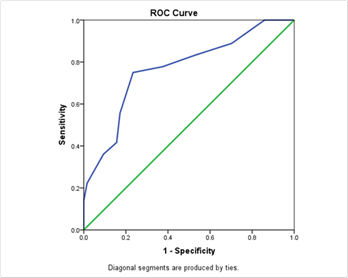
| Area | Std. Errora | ‘p’ | Asymptotic 95% Confidence Interval of AUC | |
| Lower Bound | Upper Bound | |||
| 0.768 | 0.050 | 0.000 | 0.669 | 0.867 |
a. Under the nonparametric assumption; b. Null hypothesis: true area = 0.5
| Test Result Variable(s): SOS | ||
| Positive if Greater Than or Equal Toa | Sensitivity | 1 – Specificity |
| .0000 | 1.000 | 1.000 |
| 1.5000 | 1.000 | .984 |
| 2.5000 | 1.000 | .953 |
| 3.5000 | 1.000 | .859 |
| 4.5000 | .889 | .703 |
| 5.5000 | .833 | .531 |
| 6.5000 | .778 | .375 |
| 7.5000 | .750 | .234 |
| 8.5000 | .556 | .172 |
| 9.5000 | .417 | .156 |
| 10.5000 | .361 | .094 |
| 11.5000 | .222 | .016 |
| 13.0000 | .139 | .000 |
| 14.5000 | .083 | .000 |
| 17.0000 | .056 | .000 |
| 20.5000 | .028 | .000 |
| 23.0000 | .000 | .000 |
Considering the above table SOS<6 seems to be the best cut-off point based on Sensitivity & Specificity has been shown in table.
Discussion
Pregnancy-associated sepsis continues to be a leading cause of maternal morbidity and mortality worldwide, particularly in low and middle-income countries. Physiological and immunological changes during pregnancy often obscure early signs of infection, resulting in delayed diagnosis and treatment. Early identification of high-risk patients is therefore essential.
In the present study, the Sepsis Obstetric Score (SOS) was evaluated as a predictor of severity and need for intensive care. Patients were classified using a cut-off value of 6, as proposed by Catherine M. Albright et al. A majority of patients (64%) had SOS ≥6, indicating a high burden of severe sepsis in the study population.
A statistically significant association was observed between higher SOS scores and increased need for mechanical ventilation and ICU admission (p=0.003). These findings are consistent with previous studies, which have demonstrated that higher SOS scores correlate with increased maternal morbidity and adverse outcomes [10-12].
Logistic regression analysis showed that SOS ≥6 significantly increased the odds of ICU admission (OR = 4.412) and severe sepsis (OR = 7.8). These findings are comparable with earlier validation studies, confirming that SOS is an independent predictor of adverse maternal outcomes [10,12].
The ROC curve analysis yielded an AUC of 0.768, indicating good predictive ability of SOS for ICU requirement. Similar studies have reported AUC values ranging from 0.70 to 0.85, supporting its clinical utility [8,11]. The chosen cut-off of 6 demonstrated high sensitivity (80%), making it useful for early screening, although specificity was moderate.
An important observation in this study was the limitation in ICU bed availability, which affected patient management. Some patients who required ICU care could not be admitted, reflecting challenges commonly faced in resource-limited settings. This highlights the importance of triage tools like SOS for prioritization of care.
According to guidelines by the Society of Obstetric and Gynaecological Societies of India, early recognition, prompt resuscitation, and timely referral are critical in reducing maternal mortality due to sepsis. The use of structured scoring systems such as SOS aligns with these recommendations and can facilitate early decision-making and escalation of care.
The predominance of postpartum sepsis in this study is consistent with global data, where puerperal infections remain a major contributor to maternal morbidity [7,9]. Preventive strategies such as aseptic techniques, early diagnosis, and appropriate antimicrobial therapy are essential to reduce the burden.
Overall, the finding of this study, along with supporting literature including recent work by Sushmita Dey et al., reinforce that SOS is a simple, effective, and reproducible tool for early identification of high-risk obstetric patients with sepsis.
Conclusion
The present study demonstrates that the Sepsis Obstetric Score (SOS) is a valuable tool for predicting the severity of sepsis and the need for ICU admission in obstetric patients.
An SOS score ≥6 is significantly associated with:
Increased requirement for mechanical ventilation
Higher likelihood of ICU admission
Greater severity of sepsis
The score showed good predictive accuracy with an AUC of 0.768 and high sensitivity (80%), making it useful as a screening tool for early identification of high-risk patients.
In accordance with recommendations by the Society of Obstetric and Gynaecological Societies of India, implementation of scoring systems like SOS can improve triage, optimize resource utilization, and ensure timely intervention in pregnancy-associated sepsis [4,11]. However, due to moderate specificity and limitations such as single-centre design and resource constraints, further multicentric studies with larger sample sizes are recommended to validate these findings.
In conclusion, SOS has strong potential to be incorporated into routine clinical practice as a triage tool to improve maternal outcomes in sepsis.
Declarations
Acknowledgements
None
Conflict of interest
There is no conflict of interests.
Ethical Clearance
Yes