Introduction
Hydatid disease, or echinococcosis, is a parasitic infestation caused mainly by the larval form of Echinococcus granulosus and less commonly by E. multilocularis, E. vogeli, or E. oligarthrus. The disease remains endemic in sheep-rearing regions, including the Mediterranean basin, Middle East, South America, Australia, New Zealand, and parts of Africa [1,2]. However, increasing migration and travel have resulted in cases being detected in previously non-endemic regions, making radiological recognition important worldwide.
Dogs serve as the definitive hosts, sheep as intermediate hosts, and humans become accidental intermediate hosts by ingesting eggs from dog feces. After ingestion, oncospheres penetrate the intestinal wall, enter the portal circulation, and are usually filtered first by the liver and then by the lungs [3]. This explains the predominance of hepatic and pulmonary involvement. Less commonly, bypass of these filters through systemic circulation or lymphatic channels results in disease at unusual locations, where diagnosis may be challenging.
This review aims to provide a practical guide to the imaging spectrum of hydatid cysts across common and uncommon anatomical sites, emphasizing the key features across various imaging modalities that help establish an accurate diagnosis and guide appropriate management.
Pathophysiology and Classification
After reaching the target organ, the embryo develops into a hydatid cyst with three layers: an outer pericyst composed of compressed host tissue, a middle acellular laminated membrane composed of chitin, and an inner germinal layer that produces brood capsules containing protoscolices [4]. Daughter cysts may subsequently form within the parent cyst, producing characteristic imaging appearances.
Although the older Gharbi classification has been widely used, many centres now prefer the World Health Organization Informal Working Group on Echinococcosis (WHO-IWGE) classification system. This system categorizes hydatid cysts as follows:
-
Active: CE1 (unilocular cysts with uniform anechoic content) and CE2 (multivesicular cysts with daughter cysts).
-
Transitional: CE3a (cysts with detached endocyst) and CE3b (cysts with daughter cysts in a solid matrix).
-
Inactive: CE4 (heterogeneous content without daughter cysts) and CE5 (calcified cysts).
This classification is useful for treatment planning and prediction of response, although categorization may occasionally be difficult in clinical practice.
Imaging Modalities and Features
Ultrasonography
Ultrasonography is the preferred initial imaging modality for suspected hydatid disease, especially in abdominal locations. It is sensitive, widely available, and does not involve ionizing radiation. Typical sonographic appearances include:
Stage 1: Homogeneously hypoechoic, thin-walled cystic lesion.
Stage 2: Septated cystic lesion
Stage 3: Cystic lesion with daughter cysts.
Stage 4: Pseudo-tumor lesion
Stage 5: Calcified or partially calcified lesion (inactive cyst)
Computed Tomography
CT provides excellent anatomical detail and is invaluable for surgical planning and detection of complications. Important CT features include:
-
Well-defined fluid-attenuation lesion (3-30 HU) with a visible wall.
-
Daughter cysts: peripheral, lower-attenuation vesicles within the parent cyst; these may be subtle but are diagnostically valuable when present.
-
Crescent sign: air between the pericyst and detached endocyst in cases of rupture, an important finding requiring prompt management.
-
Calcification: partial or complete cyst-wall calcification, sometimes with an eggshell appearance.
-
Enhancement: usually absent in uncomplicated cysts, but pericystic enhancement may be seen in infected or complicated cysts.
Magnetic Resonance Imaging
MRI provides excellent soft-tissue contrast and better characterization of cyst contents. Typical MRI features include:
-
T1-weighted images: the cyst is usually hypointense, with a hypointense rim.
-
T2-weighted images: the cyst is markedly hyperintense with a hypointense pericystic rim.
-
Detached membranes: serpentine hypointense structures within hyperintense fluid on T2-weighted images.
-
Daughter cysts: These appear as peripheral hypointense vesicles on T1WI but hyperintense on T2WI.
-
Rim enhancement: may be seen in infected or inflamed cysts after contrast administration.
Common Locations
Hepatic Hydatid Disease
The liver is the most frequent site of hydatid disease (60-70%), with the right lobe involved in approximately 75% of cases because of preferential portal venous flow.
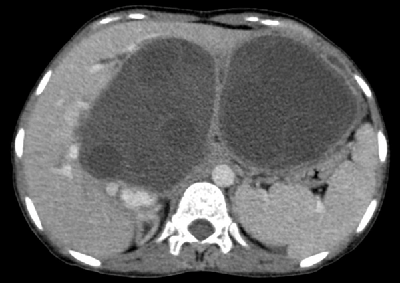
A 35-year-old female presented with abdominal pain for 3 months. Ultrasonography revealed multiloculated cystic lesions in the liver. CECT abdomen showed a well-defined hypodense cystic lesion with daughter cysts in the right lobe of the liver (CE2) and another well-defined round cystic lesion with homogeneous water-attenuation contents measuring 10-20 HU (CE1).
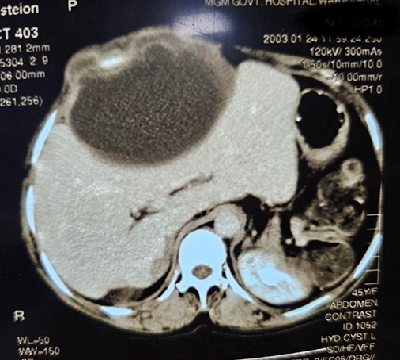
A 20-year-old male presented with abdominal pain and vomiting. Ultrasonography revealed a well-defined cystic lesion with an undulating internal membrane (not shown). Axial portovenous phase CECT images demonstrated a well-defined cystic lesion with a detached membrane, corresponding to a CE3a hydatid cyst.
Pulmonary Hydatid Disease
The lungs represent the second most common site (20-30%) of involvement, with lower lobes and peripheral locations predominating.
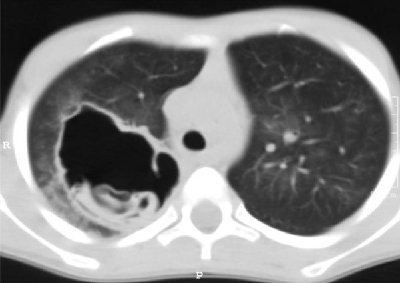
A 29-year-old male presented to the pulmonary medicine outpatient department with cough and shortness of breath for 5 months, without weight loss or hemoptysis. HRCT revealed a well-defined cavitary lesion with internal undulating membranes, producing the water-lily appearance, with adjacent ground-glass opacities in the posterior segment of the right upper lobe.
Uncommon Locations
Splenic Hydatid Disease
Splenic involvement is uncommon (0.5-8% of abdominal hydatidosis) [8] and typically occurs via arterial route or retrograde spread from hepatic involvement.
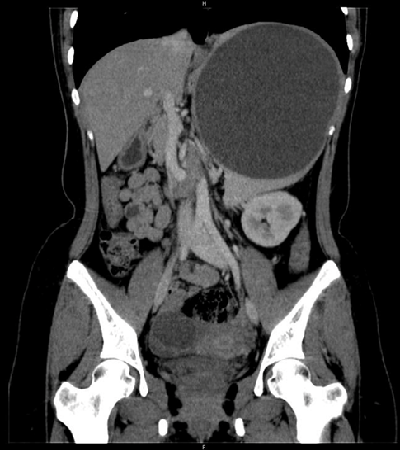
A 27-year-old female presented with abdominal discomfort for 6 months. Ultrasonography (not shown) revealed a large anechoic cystic lesion occupying the spleen. CECT abdomen showed a well-defined cystic lesion occupying almost the entire spleen and causing caudal displacement of the left kidney.
Renal Hydatid Disease
Renal involvement (2-3% of cases) typically occurs via hematogenous dissemination [9].
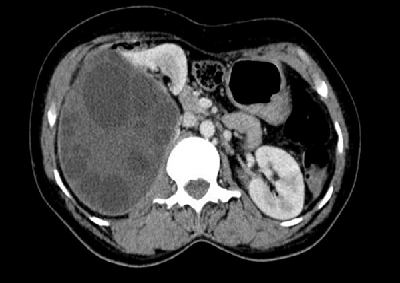
A 45-year-old female presented with right flank pain for 6 months. Axial CECT showed a well-defined hypodense lesion with multiple daughter cysts in the right kidney, consistent with a CE3b hydatid cyst.
Central Nervous System Hydatid Disease
CNS involvement is uncommon (1-2%) and usually presents as solitary, large, spherical cysts, most often in the middle cerebral artery territory. Typical imaging features are described below:
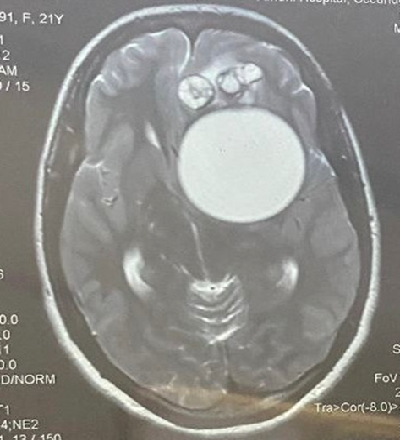
A 40-year-old male presented to the emergency department with two episodes of seizures, each lasting approximately 3 minutes. MRI was advised. Axial T2-weighted imaging revealed a well-defined hyperintense cystic lesion without internal septations in the left frontal lobe and without adjacent edema, suggestive of a CE1 hydatid cyst.
Two additional well-defined cystic lesions with internal daughter cysts were seen adjacent to the above lesion, suggestive of CE2 hydatid cysts.
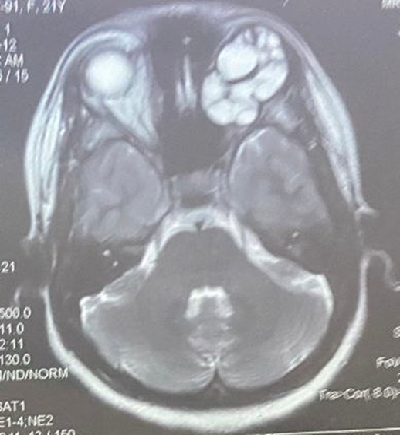
Orbital hydatid disease is very rare. In our series, a 40-year-old male presented to the ophthalmology department with proptosis and decreased visual acuity of the left eye for 1 year, without associated pain. MRI of the orbits showed a well-defined T2-weighted hyperintense cystic lesion with multiple daughter cysts occupying the left orbit. The lesion was diagnosed radiologically as a CE2 hydatid cyst and was confirmed postoperatively.
Spinal cord hydatid disease
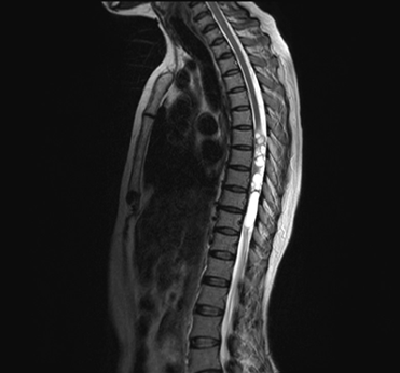
A 40-year-old male presented to the emergency department with paraplegia. Sagittal T2-weighted MRI showed multiple intradural intramedullary cystic lesions in the dorsal spinal cord with surrounding cord T2 hyperintensity. An initial diagnosis of astrocytoma was considered; however, histopathology confirmed hydatid disease.
Musculoskeletal Hydatid Disease
Bone involvement is rare (0.5-4%) and predominantly affects the spine (approximately 45%), followed by the pelvis, long bones, and skull [12]. Osseous hydatid disease is among the most challenging forms to diagnose on imaging.
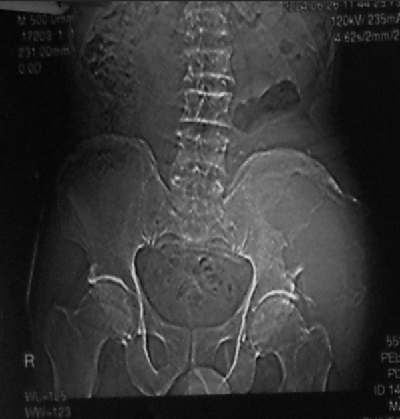
A 35-year-old male presented to the orthopaedic outpatient department with hip pain. The scout radiograph showed an expansile lytic lesion with a narrow zone of transition and cortical breach in the left iliac bone.
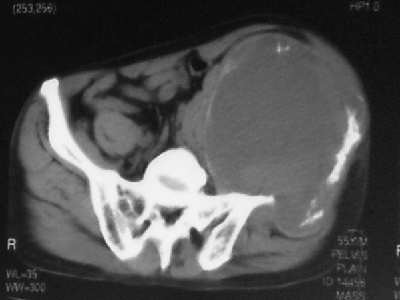
Axial CT showed a well-defined expansile cystic lesion with a narrow zone of transition and cortical breach involving the left iliac bone. A provisional diagnosis of giant cell tumor was made and the patient underwent surgery. Histopathology revealed hydatid disease. Although hydatid involvement of pelvic bones is very rare, it should be considered in the differential diagnosis of such lesions in endemic regions.
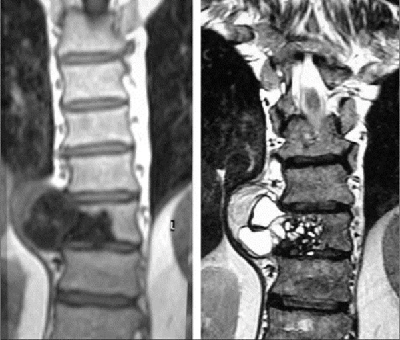
A 62-year-old male presented with progressively worsening back pain for 4 months, without neurological deficits. Spine radiographs showed structural and morphological changes in the body of the eighth thoracic vertebra. MRI demonstrated a cystic mass eroding the vertebral body and right pedicle.
On T1- and T2-weighted images, the mass showed signal characteristics consistent with a fluid-containing cyst. CT (not shown) demonstrated reactive sclerosis bordering the lesion.
The patient underwent surgical excision and spinal stabilization. Histopathology confirmed spinal hydatid disease. At 6-month follow-up, the patient was clinically well, with no back pain or neurological impairment.
Soft-tissue involvement without bone involvement is extremely rare and usually manifests as a multiloculated cystic mass.
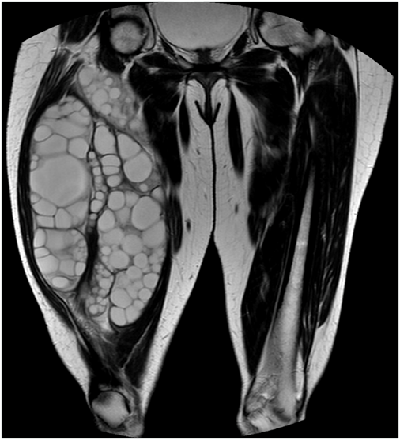
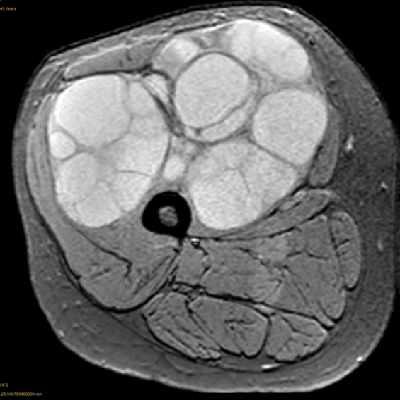
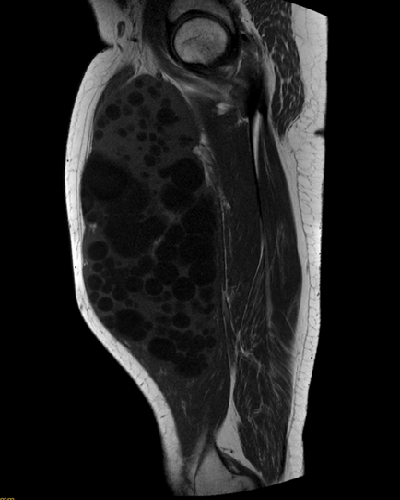
A 28-year-old female presented to the general surgery outpatient department with gradually increasing swelling of the right thigh for 6 months. Ultrasonography showed a multiloculated cystic lesion in the vastus muscle group. MRI of the thigh showed multiple multiloculated cystic lesions that were hypointense on T1-weighted images and hyperintense on T2-weighted images, with a hypointense rim on T2-weighted images. The diagnosis of hydatid cyst was confirmed at surgery.
Other Rare Locations
Pancreatic hydatid disease
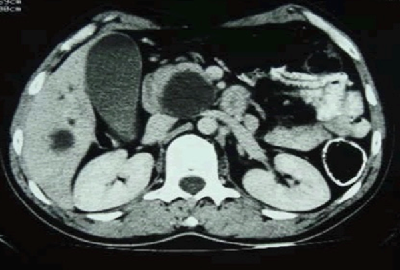
The only pancreatic case in our series involved a 50-year-old male with multiorgan hydatid involvement. Multiple unilocular cysts were seen in the liver and pancreas, simulating polycystic liver disease. Axial CECT demonstrated a well-defined hypodense cystic lesion in the head of the pancreas and another cystic lesion in the right lobe of the liver. Surgical findings confirmed hydatid disease.
Peritoneal Hydatid Disease
Peritoneal involvement accounts for approximately 13% of abdominal hydatidosis and occurs primarily after spontaneous or iatrogenic rupture of hepatic cysts; less commonly, it may result from hematogenous spread [13]. Multiple cystic lesions of varying sizes may be distributed throughout the peritoneal cavity, especially in the pelvis and paracolic gutters.
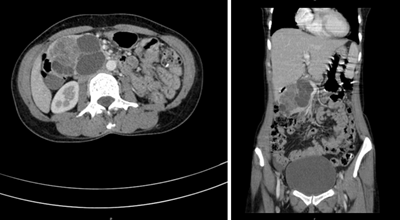
A 53-year-old male presented to the emergency department with abdominal pain. CECT abdomen was performed. Axial and coronal portovenous phase images showed a well-defined hypodense lesion with multiple daughter cysts in the mesenteric cavity, displacing the superior mesenteric artery.
Retroperitoneal Hydatid Disease
Retroperitoneal involvement is rare, usually secondary to hematogenous spread or rupture of hepatic hydatid cysts.
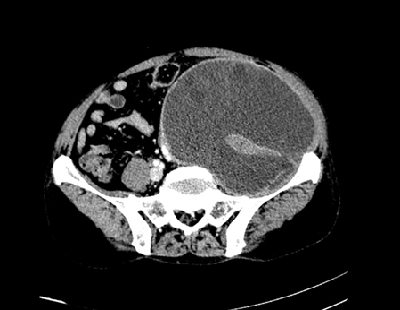
Axial venous phase CECT abdomen showed a well-defined cystic lesion with internal daughter cysts in the retroperitoneal cavity, causing displacement of the iliac vessels and compression of the left iliac vein, consistent with CE2 hydatid disease.
Pelvic Hydatid Disease
Primary pelvic hydatid disease is rare and may involve the ovaries, uterus, or pelvic peritoneum. In female patients, it may mimic ovarian cystadenoma or cystadenocarcinoma; however, daughter cysts and detached membranes suggest hydatid disease.
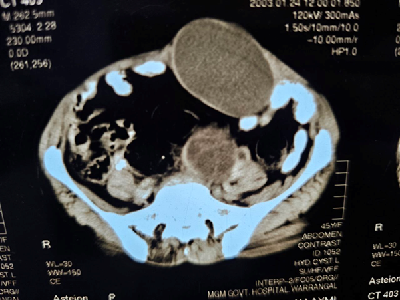
Axial venous phase CECT images showed a well-defined cystic lesion with multiple daughter cysts in the left adnexa. The left ovary was not seen separately, suggesting a left ovarian hydatid cyst (CE2).
An additional cystic lesion without internal septations was seen in the anterior abdominal wall, consistent with a CE1 cyst.
Diagnostic Challenges and Differential Diagnosis
Differentiating hydatid cysts from other cystic lesions can be challenging, particularly at uncommon sites. Important differential diagnoses include:
-
Hepatic: Simple cyst, abscess, cystadenoma, necrotic metastasis
-
Pulmonary: Bronchogenic cyst, lung abscess, cavitary neoplasm
-
Splenic: Simple cyst, abscess, hemangioma, lymphangioma
-
Renal: Simple cyst, cystic neoplasm, abscess
-
Cardiac: Myxoma, cystic degeneration of tumor
-
CNS: Arachnoid cyst, abscess, cystic neoplasm
-
Bone: Tuberculosis, metastasis, giant cell tumor
-
Soft tissue: Abscess, cystic neoplasm, lymphangioma
The presence of daughter cysts, detached membranes, or hydatid sand is highly suggestive of hydatid disease, while serology and a history of exposure or residence in an endemic region provide supportive evidence.
Conclusion
Hydatid disease has diverse imaging manifestations across multiple anatomical locations. Familiarity with characteristic features on ultrasonography, CT, and MRI facilitates accurate diagnosis, guides management, and helps prevent complications. While typical appearances in common sites are well recognized, awareness of imaging patterns at uncommon locations is equally important to avoid misdiagnosis and inappropriate treatment. A multimodality imaging approach, combined with clinical and serological correlation, remains central to the comprehensive evaluation of hydatid disease.
List of abbreviations
CE: cystic echinococcosis
CECT: contrast-enhanced computed tomography
CNS: central nervous system
CT: computed tomography
HC: hydatid cyst
HRCT: high-resolution computed tomography
HU: Hounsfield units
MRI: magnetic resonance imaging
OPD: outpatient department
USG: ultrasonography
WHO-IWGE: World Health Organization Informal Working Group on Echinococcosis
Declarations
Ethics approval and consent to participate
This study is a retrospective case series based on anonymized imaging data collected during routine clinical practice. Institutional Ethics Committee approval was not required as per institutional policy for retrospective case-based studies. Patient confidentiality was strictly maintained, and all identifying information was removed from the images and manuscript.
Consent for publication
Written informed consent was obtained from all patients for publication of anonymized clinical details and radiological images.
Data Availability
Data supporting the findings of this case series are available from the corresponding author on reasonable request. Patient-identifying information and original imaging data are not publicly available to protect patient confidentiality.
Conflicts of Interest
The authors declare that there is no conflict of interest regarding the publication of this paper.
Funding Statement
No specific funding was received for this study.
Authors' contributions
DPK (Dr. Devatha Pranav Kumar) contributed to case collection, imaging review, literature review, manuscript drafting, and figure preparation. NLNM (Dr. N. L. N. Moorthy) supervised the study, reviewed the imaging findings, critically revised the manuscript, and approved the final version. RG (Dr. Ramesh Goud) contributed to case selection, clinical correlation, image review, manuscript editing, and critical revision of the manuscript. All authors read and approved the final manuscript.
Acknowledgments
The authors thank the Department of Radiodiagnosis, AIMSR, Hyderabad, for support during preparation of this manuscript.