1. Introduction
Epilepsy is a chronic neurological disorder characterized by recurrent seizures, affecting more than 70 million people worldwide, 80% of whom live in low- or middle-income countries, where gaps in treatment coverage often exceed 75% [1].
Beyond seizures, epilepsy is frequently accompanied by psychiatric comorbidities, for which documentation in sub-Saharan Africa remains even more limited than that for epilepsy itself. Yet these disorders constitute major sources of disability among children and adults with epilepsy, a finding now fully integrated into the new definition and classification of epilepsy proposed by the International League Against Epilepsy (ILAE) [2,3].
According to the DSM-5, generalized anxiety disorder (GAD) is defined as excessive anxiety and worry occurring most days for at least six months [4].
In its 2024–2025 report, the World Health Organization (WHO) estimates that 359 million people worldwide suffered from an anxiety disorder in 2021 [5]. In the Democratic Republic of the Congo (DRC), the prevalence of anxiety in the general population remains unknown. However, a national study conducted among healthcare professionals revealed a prevalence of 4% (GAD-7 > 5) [6].
Mood disorders are the most common psychiatric comorbidities in epilepsy, with an estimated prevalence of between 20% and 50%, particularly in refractory forms [7]. Data from meta-analyses and studies conducted primarily in European and Western populations estimate the average prevalence of anxiety among people with epilepsy at approximately 20%, with variations ranging from 15% to 40% [8-10]. A systematic review and meta-analysis conducted in low- and middle-income countries identified anxiety in 16 out of 33 studies, making it the second most common psychiatric comorbidity among people with epilepsy after depression [11]. In African contexts, although data remain limited and heterogeneous, available studies suggest generally higher prevalence rates. For instance, a study conducted in Ethiopia [12] reports a 33.5% prevalence of anxiety among patients with epilepsy, while in Benin, a prevalence of 79.8% is reported [13].
Several factors have been identified as associated with anxiety in people with epilepsy, including female gender, poor seizure control, low educational attainment, polypharmacy, a history of suicide attempts, and stigma [14-16].
In this context, the lack of local data in the DRC on anxiety among adults with epilepsy represents a major gap. Thus, the objective of our study is to assess the prevalence of anxiety and identify its determinants among adults with epilepsy in our setting, in order to optimize integrated care, reduce morbidity associated with this comorbidity, and alleviate the combined burden of epilepsy and anxiety.
2. Materials and methods
2.1. Study Design
A cross-sectional study was conducted from October 1, 2023, to December 31, 2024. Four mental health referral centers, each with a full-time neurologist, a high volume of consultations, and a socioculturally diverse patient population, were selected.
2.2. Sampling
Using the OpenEpi software (version 3.01), the sample size was estimated based on a theoretical prevalence of 50%, an alpha of 5%, and a power of 80%, resulting in 384 subjects. After a 10% margin of error, 414 participants were required. Ultimately, only 292 patients were included.
The study included participants aged 18 years or older who were being treated or had consulted at one of the four healthcare facilities and had been diagnosed with epilepsy according to the criteria of the International League Against Epilepsy [2,3], and who had provided informed consent. Subjects with major cognitive impairments were excluded, as were those with incomplete records or whose medical history was deemed unreliable.
2.3. Data collection procedure and variables studied
2.3.1. Data collection procedure
Participants were identified from the centers’ records, then contacted for inclusion or included during consultations. Data were collected through a face-to-face interview using a standardized form supplemented by a review of the medical record, based on the epilepsy investigation form for tropical settings [17].
Anxiety screening was performed using the GAD-7 scale [18]. This is a rapid, reliable screening tool, validated in French, and relevant for screening generalized anxiety disorder in patients with epilepsy. This self-report questionnaire covers the 2 weeks preceding the assessment. It consists of 7 items rated from 0 (never) to 3 (almost every day), allowing a total score between 0 and 21 to be calculated for each patient. The total GAD-7 score is obtained by adding the points assigned to each of the seven items. Thresholds of ≥ 5, ≥ 10, and ≥ 15 correspond to mild, moderate, and severe levels of anxiety symptoms, respectively [19]. In our study, a diagnosis of generalized anxiety disorder was made for any score ≥ 7 [20]. Thus, the severity categories were defined as follows: ≥ 7: mild anxiety, ≥ 10: moderate anxiety, ≥ 15: severe anxiety.
The French version of this scale was translated into Lingala, a language spoken in Kinshasa, by two independent translators from the Language Observatory of the Ministry of Culture, and Arts, before a final version was developed following evaluation by the study’s neurologists.
Data collection was conducted by two residents and three neurologists who had received prior training
Participants were scheduled according to a schedule specific to each center. Each interview lasted 30 to 45 minutes
2.3.2. Variables Studied
The dependent variable was anxiety, defined as a score ≥ 7 on the GAD-7 scale.
The independent variables included: Sociodemographic factors: age, sex, marital status, educational level, and occupational status; Prenatal risk factors: abnormal course of pregnancy, abnormal duration of labor, abnormal delivery, abnormal birth status, abnormal degree of maturity at birth, abnormal birth weight; History: family history of epilepsy, personal history (febrile seizure, head trauma, stroke, neuroinfection, use of psychoactive substances, psychiatric disorder); History of epilepsy: age at first seizure, time to diagnosis, duration of epilepsy, seizure frequency, treatment; Type of seizure; Epilepsy: defined by any of the following manifestations [2,3]: at least two unprovoked (or reflex) seizures separated by more than 24 hours; a single unprovoked (or reflex) seizure but associated with a high probability of recurrence (≥60% over the next ten years), equivalent to the risk observed after two unprovoked seizures; the identification of a recognized epileptic syndrome.
The operational syndromic diagnosis of epilepsy is based on three main categories: definite generalized epilepsy, definite focal epilepsy, and epilepsy of unknown type.
Definite generalized epilepsy is characterized by complete amnesia of the event reported by the patient, with a witness able to accurately describe the seizure. Consciousness is immediately impaired. The observed seizures are absence seizures, generalized tonic-clonic seizures, or other generalized seizures (myoclonic, atonic, tonic, etc.). The interictal electroencephalogram (EEG) shows generalized epileptic discharges, although it may sometimes be normal, particularly in the presence of morning myoclonus.
Definite focal epilepsy is identified when the patient or a witness correctly describes the seizure. Consciousness may be preserved or impaired. Manifestations include focal motor or non-motor seizures, or focal seizures progressing to generalization as a tonic-clonic . The interictal EEG reveals focal epileptic discharges, sometimes followed by generalization, but may also be normal.
Finally, epilepsy is classified as unknown when neither the patient nor any witnesses can accurately describe the seizure, or when there are no witnesses at all. Consciousness may be preserved, impaired, or unknown. The observed seizures are bilateral tonic-clonic seizures (of focal or generalized origin), but the available information does not allow for a precise determination of their characteristics. The EEG is either not performed, non-informative, or normal, which does not allow for a definitive determination of the type of epilepsy.
2.4. Data Processing and Statistical Analyses
Analyses were performed using R version 4.5.2. Continuous variables were described using the median and quartiles (Q1–Q3), and categorical variables using frequencies and percentages. Differences between groups were assessed using the Wilcoxon test for nonparametric continuous variables, the Chi-square test, or Fisher’s exact test for categorical variables, depending on the sample sizes.
Factors associated with anxiety were identified using binary logistic regression. Variables included in the multivariate model were selected based on a p-value < 0.20 in univariate analysis and their clinical relevance. Odds ratios (OR) and their 95% confidence intervals (CI) were calculated for each variable.
Analyses were two-sided, with a significance threshold set at p < 0.05. ORs were interpreted as risk factors (OR > 1) or protective factors (OR < 1), and unstable values were examined to rule out issues with separation or small sample sizes.
Model performance was assessed using the ROC curve and AUC, while the quality of fit was verified using the Hosmer-Lemeshow test, with a p-value > 0.05 indicating a satisfactory fit.
2.5. Ethical Considerations
The protocol was approved by the National Health Ethics Committee (No. 182/CNES/BN/PMMF/2024). Participants were recruited on a voluntary basis and provided written informed consent. The data were anonymized.
3. Results
3.1. Prevalence of generalized anxiety disorder
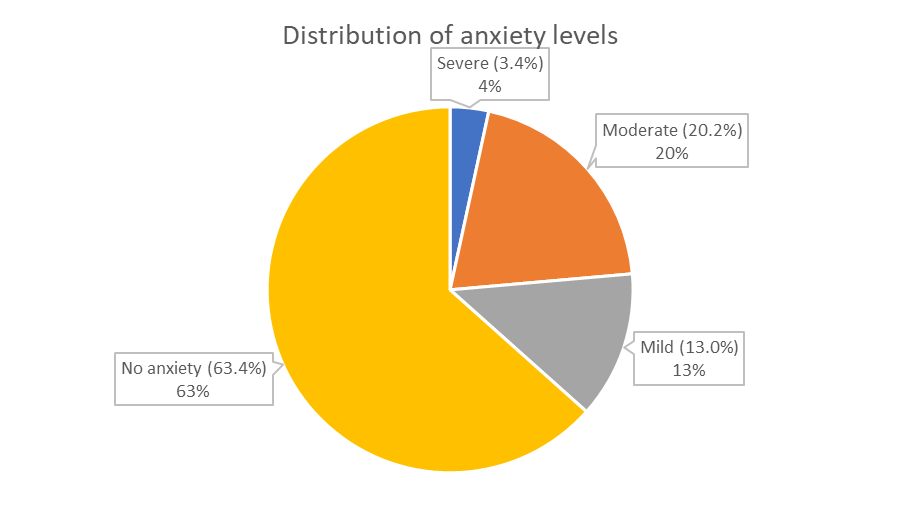
Analysis of the anxiety status of the 292 participants in Figure 1 shows that 36.6% had generalized anxiety disorder (GAD-7 ≥ 7), including 13% with mild anxiety, 20% with moderate anxiety, and 3.4% with severe anxiety.
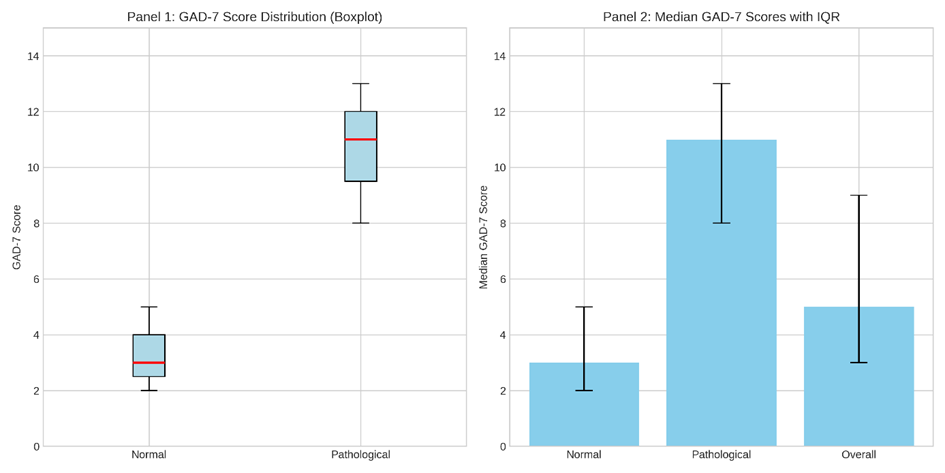
The median GAD-7 score shown in Figure 2 is significantly higher in the group of anxious participants with (11 [IQR: 9–13]) compared to those without anxiety, who had a median of 3 (IQR: 2–5) (p < 0.001).
3.2. Overall characteristics of the cohort
3.2.1. Sociodemographic profile
Table 1 describes the sociodemographic profile of participants according to their anxiety status. The median age of participants is similar in both groups (32 years [IQR: 24, 47]), with no statistically significant difference (p = 0.6). However, when analyzed by age group, a significant difference emerges (p = 0.025). Indeed, the proportion of participants aged 50 and older is higher in the anxious group 28 (26%) compared to the normal group 32 (17%), while participants aged 30 to 49 are less represented among the anxious group 28 (26%) vs. 76 (41%).
Educational level is strongly associated with anxiety (p < 0.001). Anxious participants are more likely to have a primary school education 28 (26%) vs. 7 (3.8%) and less likely to have a higher education or college degree 20 (19%) vs. 60 (32%) compared to non-anxious participants. Occupation does not show a significant overall association with anxiety (p = 0.9), although a higher proportion of anxious participants are unemployed 50 (47%) vs. 36 (19%).
| Characteristic | Normal (n=185)1 | Pathological (n=107)1 | Overall (N=292)1 | p-value2 |
| Age | 32 (24, 43) | 32 (24, 54) | 32 (24, 47) | 0.6 |
| Age group | 0.025 | |||
| 18–29 years | 77 (42%) | 51 (48%) | 128 (44%) | |
| 30–49 | 76 (41%) | 28 (26%) | 104 (36%) | |
| 50 and older | 32 (17%) | 28 (26%) | 60 (21%) | |
| Gender | 0.7 | |||
| Female | 87 (47%) | 53 (50%) | 140 (48%) | |
| Male | 98 (53%) | 54 (50%) | 152 (52%) | |
| Marital status | >0.9 | |||
| Single | 112 (61%) | 68 (64%) | 180 (62%) | |
| Divorced | 3 (1.6%) | 2 (1.9%) | 5 (1.7%) | |
| Married | 67 (36%) | 36 (34%) | 103 (35%) | |
| Widowed | 3 (1.6%) | 1 (0.9%) | 4 (1.4%) | |
| Education | <0.001 | |||
| None | 1 (0.5%) | 0 (0%) | 1 (0.3%) | |
| Primary | 7 (3.8%) | 28 (26%) | 35 (12%) | |
| Secondary | 117 (63%) | 59 (55%) | 176 (60%) | |
| Higher education/University | 60 (32%) | 20 (19%) | 80 (27%) | |
| Occupation | 0.9 | |||
| Farmer/Rancher | 5 (2.7%) | 6 (5.6%) | 11 (3.8%) | |
| Artisan or Merchant | 33 (18%) | 2 (1.9%) | 35 (12%) | |
| Student | 37 (20%) | 10 (9.3%) | 47 (16%) | |
| Housewife | 19 (10%) | 15 (14%) | 34 (12%) | |
| Self-employed | 26 (14%) | 9 (8.4%) | 35 (12%) | |
| Employee or civil servant | 29 (16%) | 15 (14%) | 44 (15%) | |
| Unemployed | 36 (19%) | 50 (47%) | 86 (29%) | |
| Blood relation | >0.9 | |||
| No | 183 (98.7%) | 106 (99%) | 289 (99%) | |
| Yes | 2 (1.1%) | 1 (0.9%) | 3 (1.0%) | |
| 1 Median (Q1, Q3); n (%) | ||||
| 2 Wilcoxon rank sum test; Pearson’s chi-squared test; Fisher’s exact test |
3.2.2. Medical history
Table 2 describes the distribution of medical history according to participants’ anxiety status. Overall, the majority of medical histories examined show no significant difference between the groups. However, several factors appear to be strongly associated with anxiety. Participants with a personal history of seizures are significantly more numerous in the anxious group than in the non-anxious group 48 (45%) vs. 37 (20%), p < 0.001. Similarly, a history of previous neurological infection was more common among anxious participants 30 (28%) vs. 30 (16%), revealing a statistically significant association (p = 0.016). Finally, a personal history of psychiatric disorder was significantly overrepresented in the anxious group 22 (21%) vs. 13 (7%), constituting one of the factors most strongly associated with anxiety in this cohort (p < 0.001).
| Characteristic | Normal (n=185)1 | Pathological (n=107)1 | Overall (N=292)1 | p-value2 |
| Family history of epilepsy | 0.3 | |||
| Absent | 132 (71%) | 70 (65%) | 202 (69%) | |
| Unknown | 5 (2.7%) | 6 (5.6%) | 11 (3.8%) | |
| Present | 48 (26%) | 31 (29%) | 79 (27%) | |
| History of febrile seizures | <0.001 | |||
| Absent | 133 (72%) | 59 (55%) | 192 (66%) | |
| Unknown | 15 (8.1%) | 0 (0%) | 15 (5.1%) | |
| Present | 37 (20%) | 48 (45%) | 85 (29%) | |
| Traumatic brain injury | 0.2 | |||
| Absent | 163 (88%) | 99 (93%) | 262 (90%) | |
| Present | 22 (12%) | 8 (7.5%) | 30 (10%) | |
| Stroke | 0.7 | |||
| Absent | 167 (90.3%) | 94 (88%) | 260 (89%) | |
| Present | 18 (9.7%) | 13 (12%) | 31 (11%) | |
| Neuroinfection | 0.016 | |||
| No | 155 (84%) | 77 (72%) | 232 (79%) | |
| Yes | 30 (16%) | 30 (28%) | 60 (21%) | |
| SPA consumption | 0.6 | |||
| No | 138 (75%) | 77 (72%) | 215 (74%) | |
| Yes | 47 (25%) | 30 (28%) | 77 (26%) | |
| Personal history of psychiatric disorder | <0.001 | |||
| No | 172 (93%) | 85 (79%) | 257 (88%) | |
| Yes | 13 (7.0%) | 22 (21%) | 35 (12%) | |
| 1 n (%) | ||||
| 2 Fisher’s exact test; Pearson’s chi-square test |
3.2.3. History of epilepsy
Table 3 presents characteristics related to epilepsy history and treatment according to participants’ anxiety status. The age at first seizure is significantly lower among anxious participants, with a median of 13 years (IQR: 4-48), compared to 20 years (IQR: 11–40) among non-anxious participants (p = 0.022). This difference is confirmed in the categorical al analysis: onset before age 5 is significantly more common in the anxious group 30 (28%) vs. 16 (8.6%), while onset at ≥18 years predominates in the normal group [106 (57%) vs. 43 (40%), p < 0.001].
The frequency of attacks is also strongly associated with anxiety (p < 0.001). Anxious participants more often reported frequent seizures, particularly one seizure per week 21 (20%) vs. 5 (2.7%) or at least one seizure per month 50 (55%) vs. 43 (23%), whereas rare seizures (≤1 seizure every six months or 1 seizure/year) were more common among non-anxious participants.
The distribution of epilepsy types showed no significant difference between anxious and non-anxious participants (p = 0.20). In the cohort, focal epilepsy was the most common form 133 (46%), followed by undetermined epilepsies 109 (37%) and generalized epilepsies 50 (17%). Among anxious participants, undetermined forms were most common 46 (43%), followed by focal epilepsies 41 (38%) and generalized epilepsies 20 (19%), with no statistically significant difference.
Finally, the type of treatment showed a significant association with anxiety (p < 0.001). Combination therapy was more common among anxious participants 73 (68%) vs. 77 (42%), while monotherapy predominated in the non-anxious group 100 (54%) vs. 31 (29%).
| Characteristic | Normal (n=185)1 | Pathological (n=107)1 | Overall (N=292)1 | p-value2 |
| Age at first attack | 20 (11, 40) | 13 (4, 48) | 18 (10, 41) | 0.022 |
| Age at first seizure, category | <0.001 | |||
| <5 years | 16 (8.6%) | 30 (28%) | 46 (16%) | |
| 5–17 years | 63 (34%) | 34 (32%) | 97 (33%) | |
| 18 years and older | 106 (57%) | 43 (40%) | 149 (51%) | |
| Duration of epilepsy | 0.5 | |||
| Less than 1 year | 11 (5.9%) | 6 (5.6%) | 17 (5.8%) | |
| 1–3 years | 52 (28%) | 25 (23%) | 77 (26%) | |
| 4–6 years | 27 (15%) | 10 (9.3%) | 37 (13%) | |
| 7–9 years | 18 (9.7%) | 11 (10%) | 29 (9.9%) | |
| Over or under 10 years | 76 (41%) | 55 (51%) | 131 (45%) | |
| Unknown | 1 (0.5%) | 0 (0%) | 1 (0.3%) | |
| Frequency of attacks | <0.001 | |||
| One attack per week | 5 (2.7%) | 21 (20%) | 26 (8.9%) | |
| At least one seizure per month | 43 (23%) | 59 (55%) | 102 (35%) | |
| At most one seizure every six months | 96 (52%) | 22 (21%) | 118 (40%) | |
| One seizure per year | 41 (22%) | 5 (4.7%) | 46 (16%) | |
| Type of epilepsy | 0.2 | |||
| Focal epilepsy | 92 (50%) | 41 (38%) | 133 (46%) | |
| Generalized epilepsy | 30 (16%) | 20 (19%) | 50 (17%) | |
| Unspecified epilepsy | 63 (34%) | 46 (43%) | 109 (37%) | |
| Drug treatment | 0.2 | |||
| No | 1 (0.5%) | 2 (1.9%) | 3 (1.0%) | |
| Yes | 177 (96%) | 104 (97%) | 281 (96%) | |
| Unknown | 7 (3.8%) | 1 (0.9%) | 8 (2.7%) | |
| Type of therapy | <0.001 | |||
| Unknown | 8 (4.3%) | 3 (2.8%) | 11 (3.8%) | |
| Monotherapy | 100 (54%) | 31 (29%) | 131 (45%) | |
| Combination therapy | 77 (42%) | 73 (68%) | 150 (51%) | |
| Traditional treatment | 0.11 | |||
| No | 96 (52%) | 45 (42%) | 141 (48%) | |
| Yes | 89 (48%) | 62 (58%) | 151 (52%) | |
| 1 Median (Q1, Q3); n (%) | ||||
| 2 Wilcoxon rank sum test; Pearson’s chi-squared test; Fisher’s exact test |
3.3. Determinants of anxiety in the cohort
In univariate analysis, several factors appear to be significantly associated with anxiety. Participants aged 30–49 years have a lower probability of anxiety compared to the 18–29 age group (OR = 0.56; 95% CI: 0.32–0.97; p = 0.039), whereas age ≥50 years is not significantly associated (OR = 1.32; 95% CI: 0.71–2.45; p = 0.378).
A history of febrile seizures is strongly associated with anxiety (OR = 2.92; 95% CI: 1.73–4.98; p < 0.001). Similarly, participants who reported a neuroinfection had an increased risk (OR = 2.01; 95% CI: 1.13–3.59; p = 0.017). A personal psychiatric history is also associated with a higher likelihood of anxiety (OR = 3.42; 95% CI: 1.67–7.31; p = 0.001).
Age at the first seizure shows a protective effect when seizures begin later: 5–17 years (OR = 0.22; 95% CI: 0.11–0.43; p < 0.001) or ≥18 years (OR = 0.29; 95% CI: 0.14–0.59; p < 0.001) compared to onset before age 5.
Seizure frequency is strongly associated with anxiety. Compared to patients with one attack per year, those with one attack per week (OR = 34.4; 95% CI: 9.84–149; p < 0.001) or at least one attack per month (OR = 11.3; 95% CI: 4.45–34.7; p < 0.001) have a significantly higher risk.
In the multivariate analysis, several factors remain significantly associated with anxiety.
Compared to participants aged 18–29, those aged ≥50 have a significantly increased risk of anxiety (aOR = 9.42; 95% CI: 3.12–30.8; p < 0.001).
Age at the first attack remains a protective factor: 5–17 years (ORa = 0.25; 95% CI: 0.09–0.65; p = 0.005) and ≥18 years (ORa = 0.07; 95% CI: 0.02–0.22; p < 0.001) compared to onset before age 5.
Seizure frequency remains the factor most strongly associated with anxiety. Compared to people with epilepsy who have only one seizure per year, those with a weekly seizure have an extremely high risk of anxiety (ORa = 49.1; 95% CI: 11.3–271.2; p < 0.001), while subjects with at least one seizure per month also exhibit a marked increase in risk (ORa = 16.5; 95% CI: 5.63–58.1; p < 0.001). Conversely, patients with infrequent attacks (≤ 1 attack every six months) do not show a significant increase in risk.
A history of psychiatric disorders remains associated with a higher probability of anxiety, but with borderline significance (ORa = 2.84; 95% CI: 1.01–8.39; p = 0.051).
| Factors | Odds Ratio Unadjusted | 95% CI | p-value | Odds Ratio Adjusted | 95% CI | p-value |
| Age group | ||||||
| Ages 18–29 | Ref | - | - | - | - | - |
| 30–49 years old | 0.556 | 0.315 - 0.968 | 0.039 | 0.01 | 0.443 - 2.31 | 0.985 |
| 50 years and older | 1.32 | 0.711 - 2.45 | 0.378 | 9.42 | 3.12 - 30.8 | <0.001 |
| Education | ||||||
| None | Ref | |||||
| Primary | 8.47E+06 | <0.001 - NA | 0.986 | - | - | - |
| Secondary | 1.07E+06 | <0.001 - NA | 0.987 | - | - | - |
| Higher education/University | 7.06E+05 | <0.001 - NA | 0.988 | - | - | - |
| History of febrile seizures | ||||||
| None | Ref | - | - | - | - | - |
| Unknown | <0.001 | NA - 4.7e+10 | 0.981 | 1.82 | NA - 6.23e+15 | 0.983 |
| Present | 2.92 | 1.73 - 4.98 | <0.001 | 1.81 | 0.845 - 3.82 | 0.983 |
| Neuro Infection | ||||||
| No | Ref | - | - | - | - | - |
| Yes | 2.01 | 1.13 - 3.59 | 0.017 | 1.11 | 0.472 - 2.52 | 0.821 |
| History of psychiatric disorders | ||||||
| No | Ref | - | - | - | - | - |
| Yes | 3.42 | 1.67 - 7.31 | 0.001 | 2.84 | 1.01 - 8.39 | 0.051 |
| Age at first seizure | ||||||
| <5 years | Ref | - | - | - | - | - |
| Ages 5–17 | 0.216 | 0.105 - 0.431 | <0.001 | 0.247 | 0.089–0.653 | 0.005 |
| 18 and older | 0.288 | 0.135–0.594 | <0.001 | 0.07 | 0.021–0.217 | <0.001 |
| Seizure frequency | ||||||
| One seizure/year | Ref | - | - | - | - | - |
| A crisis week | 34.4 | 9.84 - 149 | <0.001 | 49.1 | 11.3 - 271.2 | <0.001 |
| ≥ 1 seizure/month | 11.3 | 4.45–34.7 | <0.001 | 16.5 | 5.63 - 58.1 | <0.001 |
| ≤ 1 seizure/six months | 1.88 | 0.713–5.91 | <0.001 | 1.69 | 0.561 - 5.91 | <0.001 |
| Type of therapy | ||||||
| Unknown | Ref | - | - | - | - | - |
| Monotherapy | 0.827 | 0.223 - 3.95 | 0.788 | - | - | - |
| Combination therapy | 2.53 | 0.701 - 11.9 | 0.183 | - | - | - |
3.4. Performance and Internal Validation of the Logistic Model
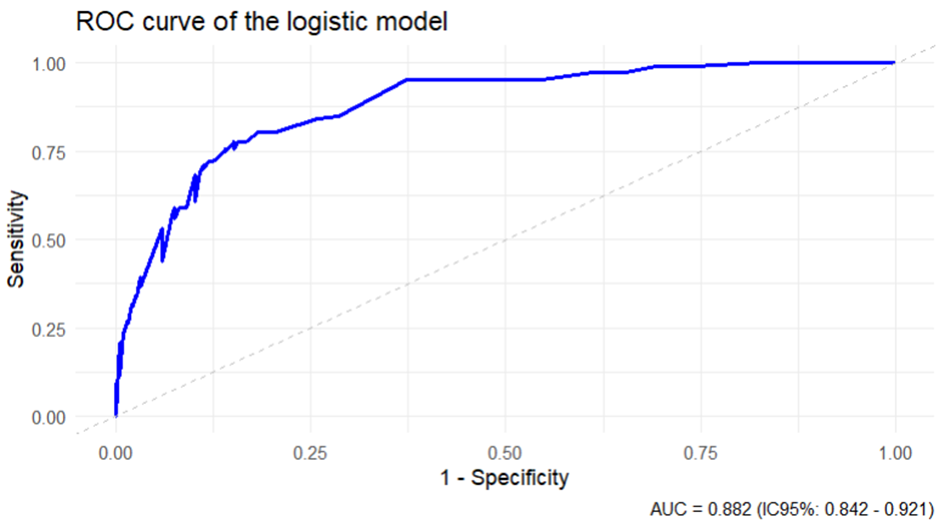
This ROC curve illustrates the discriminatory power of the multivariate logistic model to distinguish participants with anxiety from those without.
The area under the curve (AUC) is 0.882 with a 95% CI [0.842–0.921], indicating excellent discriminatory power of the model.
Indeed, an AUC greater than 0.80 generally reflects good discrimination, and a value close to 0.90 indicates very good discrimination.
The overall model fits the data well (Hosmer and Lemeshow test p-value = 0.19); (no statistically significant difference between observed and predicted values).
4. Discussion
The objective of this study was to document the prevalence and determinants of anxiety among adults with epilepsy in the Democratic Republic of the Congo. We found a high prevalence of generalized anxiety disorder (36.6%, of which 23.4% were moderate to severe), with a median GAD-7 score of 11 (IQR: 9–13). This prevalence exceeds estimates from international meta-analyses, which place the average prevalence around 20% [8-10], but remains consistent with available African data.
Indeed, several studies conducted in Ethiopia [12], Nigeria [21], and Sierra Leone [22] report prevalences ranging from 27% to 33.5%, levels close to those observed in our cohort. Conversely, the study conducted in Benin reports a significantly higher prevalence (79.8%) [13]. This outlier could be explained by methodological differences: the use of the GAD-7 in our study versus the Goldberg scale in the Benin study, as well as community-based rather than hospital-based recruitment, which may have included more heterogeneous and potentially more vulnerable profiles.
4.1. Sociodemographic factors
Unlike several studies that have identified female gender as a major determinant of anxiety among people with epilepsy [14-16], our study does not reveal a significant association between gender and the presence of an anxiety disorder. However, while the median age did not differ between groups, age ≥ 50 years emerged, after adjustment, as a factor strongly associated with anxiety (ORa = 9.42; p < 0.001). Data from other African settings suggest that socioeconomic factors, chronicity of the illness, and cumulative exposure to stigma may increase the psychological vulnerability of older individuals [12,13]. Our results align with this perspective and indicate that, in our context, age may serve as an indirect marker of psychosocial fragility.
4.2. Medical history
A history of psychiatric disorders appears to be one of the strongest predictors of anxiety in our cohort (ORa = 2.84; p = 0.051). This finding is consistent with studies showing that the presence of psychiatric comorbidities significantly increases vulnerability to anxiety in people with epilepsy [14-16]. It also aligns with the broader literature highlighting the strong bidirectional relationship between epilepsy and psychiatric disorders [7], where each condition can reinforce or exacerbate the other.
4.3. History of epilepsy
Compared to participants who experienced their first seizures before the age of 5, those whose epilepsy began between the ages of 5 and 17 had a significantly reduced risk of anxiety (ORa = 0.25; p = 0.005). This protective effect is even more pronounced among participants whose epilepsy began in adulthood (ORa = 0.07; p < 0.001). This temporal gradient suggests that prolonged exposure to the disease, early neurodevelopmental disruptions, and altered psychosocial trajectories may contribute to increased anxiety vulnerability [15,16].
The severity of epilepsy, measured by seizure frequency, is the factor most strongly associated with anxiety, with extremely high adjusted ORs for weekly seizures (ORa = 49.1; p < 0.001) and monthly seizures (ORa = 16.5; p < 0.001). This finding confirms that poor seizure control is a key determinant of psychological distress, as previously reported in several studies [14,15]. The fear of unpredictable seizures, the resulting functional limitations, and the social consequences (job loss, isolation) could be plausible mechanisms explaining this association.
4.4. Strengths and limitations of the study
This study has several limitations. Its cross-sectional design does not allow for the establishment of a causal relationship between the identified factors and anxiety. The sample size, which was smaller than initially planned, may have reduced the statistical power for certain associations. The absence of a clinical psychiatric evaluation, despite the use of the GAD-7 as a screening tool, also constitutes a methodological limitation. Furthermore, the syndromic classification was limited by a significant proportion of undetermined epilepsies, reflecting local diagnostic constraints. Finally, recruitment exclusively from hospitals may limit the generalizability of the results to the entire Congolese epilepsy population.
However, the study has major strengths. To our knowledge, this is the first Congolese study dedicated to anxiety in adults with epilepsy, thereby filling a significant gap in the national literature. Anxiety screening was conducted using the GAD-7, a tool validated in French for anxiety disorders in people with epilepsy and translated into Lingala by experts, ensuring optimal understanding by participants. Furthermore, the integrated analysis of clinical, historical, therapeutic, and psychosocial dimensions offers a comprehensive and nuanced understanding of the determinants of anxiety in epilepsy within the Congolese context.
5. Conclusion
The results of this study confirm the significant burden of psychiatric comorbidities in epilepsy and highlight the need for systematic screening for anxiety at all ages. Four profiles should be prioritized: individuals aged 50 and older, those with early-onset epilepsy, those with a high frequency of seizures, and patients with a history of psychiatric disorders. In the Congolese context, characterized by limited resources, the use of validated tools such as the GAD-7 and the development of appropriate psychosocial approaches are priorities for improving the quality of care.
Declarations
Acknowledgements
We would like to thank Dr. Milambu Ronsard and Dr. Badi Osée for their commitment and their decisive contribution to data collection. Their availability and rigor were essential to the successful completion of this study
Disclosures
National Health Ethics Committee issued approval 182/CNES/BN/PMMF/2024
Conflicts of interest
In compliance with the ICMJE uniform disclosure form, all authors declare the following: Payment/services info: All authors have declared that no financial support was received from any organization for the submitted work.
Financial relationships
All authors have declared that they have no financial relationships at present or within the previous three years with any organizations that might have an interest in the submitted work.
Other relationships
All authors have declared that there are no other relationships or activities that could appear to have influenced the submitted work.
Author Contributions
Concept and design: All authors
Acquisition, analysis, or interpretation of data: Job Osango omba, Ange Mubiala, Daniel Okitundu
Drafting of the manuscript: Job Osango omba
Critical review of the manuscript for important intellectual content: All authors
Supervision: Lelo Mananga, Adelin Nsitu, Daniel Okitundu
All authors have reviewed the final version to be published and agreed to be accountable for all aspects of the work