Introduction
Gastric and gastro-oesophageal junction adenocarcinoma remain major contributors to global cancer mortality despite advances in systemic therapy and molecular characterization. Many patients present with unresectable or metastatic disease, where durable treatment responses remain uncommon and therapeutic strategies are frequently limited by tumor heterogeneity. Although targeted agents and immune checkpoint inhibitors have improved outcomes for selected molecular subgroups, a large proportion of patients lack actionable biomarkers and continue to rely on cytotoxic chemotherapy. This therapeutic gap has intensified efforts to identify new molecular targets capable of supporting precision oncology approaches in gastric cancer. Among emerging candidates, Claudin-18 isoform 2 (CLDN18.2) has attracted significant attention because of its highly restricted physiological distribution and its potential for selective antibody-mediated targeting in malignant tissues.
CLDN18.2 is a tight-junction protein normally confined to differentiated gastric epithelial cells where it remains largely inaccessible to circulating antibodies. During malignant transformation, disruption of epithelial polarity exposes the extracellular domain of CLDN18.2 on the tumor cell membrane, enabling selective antibody binding and immune-mediated cytotoxicity. Early molecular studies identified CLDN18.2 as a tumor-associated antigen with broad relevance across gastric malignancies, while subsequent translational investigations confirmed that antibody engagement can activate complement-dependent and antibody-dependent cellular cytotoxicity pathways. These biological characteristics have positioned CLDN18.2 as a promising therapeutic target and stimulated the development of antibody-based strategies aimed at exploiting this tumor-specific vulnerability. The monoclonal antibody Zolbetuximab represents the most advanced of these approaches and has demonstrated clinically meaningful antitumor activity in patients with CLDN18.2-positive gastric cancers.
Recent clinical investigations have further validated the translational relevance of CLDN18.2 targeting. Randomized clinical trials evaluating zolbetuximab in combination with chemotherapy have demonstrated improved outcomes in biomarker-selected patient populations, establishing CLDN18.2 expression as a clinically actionable biomarker in advanced gastric cancer. In parallel, translational and cohort studies have shown that CLDN18.2 expression occurs in a substantial proportion of gastric tumors, including aggressive diffuse-type variants that historically lack effective targeted therapies. Despite this progress, important questions remain regarding biomarker heterogeneity, optimal therapeutic combinations, and mechanisms of treatment resistance. The objective of the present systematic review is therefore to critically evaluate current clinical and molecular evidence surrounding CLDN18.2-directed therapy in gastric and gastro-oesophageal junction adenocarcinoma. By synthesizing findings from clinical trials, biomarker studies, and translational research, this study aims to clarify the therapeutic significance of CLDN18.2 targeting and to address an important deficiency in the literature by providing a structured assessment of the evolving role of Zolbetuximab-based strategies in precision gastric oncology.
Methods
Study Design
This systematic review was conducted in accordance with the PRISMA (Preferred Reporting Items for Systematic Reviews and Meta‑Analyses) guidelines to evaluate clinical evidence for Zolbetuximab targeting Claudin‑18.2 in advanced gastric and gastro-esophageal junction adenocarcinoma. The review specifically focused on studies assessing treatment outcomes, biomarker-guided patient selection, and mechanisms of resistance in CLDN18.2-positive gastric and gastro-esophageal junction cancers. Only peer-reviewed PubMed open-access human studies were considered to ensure transparency and reproducibility.
Database Search Strategy
A structured literature search was performed in PubMed covering publications from January 2010 to February 2026. The search strategy combined Medical Subject Headings (MeSH) and free-text terms to maximize sensitivity.
The primary MeSH terms included: Stomach Neoplasms, Gastroesophageal Junction, Claudin-18, Antibodies, Monoclonal, Drug Therapy, Biomarkers, and Treatment Outcome.
The Boolean keyword search strategy was constructed as follows:
("zolbetuximab" OR "IMAB362") AND ("Claudin 18.2" OR "CLDN18.2") AND ("gastric cancer" OR "stomach neoplasms" OR "gastroesophageal junction adenocarcinoma") AND ("clinical trial" OR "targeted therapy" OR "treatment outcome").
Additional Boolean combinations were used to improve retrieval sensitivity, including: ("CLDN18.2 biomarker" AND "gastric cancer"), ("zolbetuximab" AND "chemotherapy"), and ("claudin-18 monoclonal antibody therapy"). The search strategy was iteratively refined to capture all relevant clinical and translational studies.
Eligibility Criteria
Studies were included if they met the following criteria: human clinical research evaluating CLDN18.2-targeted therapy, open-access articles indexed in PubMed, and publications reporting clinical outcomes such as progression-free survival, overall survival, response rate, or safety. Eligible designs included randomized clinical trials, prospective cohort studies, translational biomarker analyses, and mechanistic investigations relevant to zolbetuximab therapy.
Studies were excluded if they involved animal models, non-CLDN18.2 targeted therapies, conference abstracts without full texts, editorials lacking primary data, or duplicate publications.
Study Selection
Titles and abstracts were independently screened for relevance. Potentially eligible articles underwent full-text review. Discrepancies during screening were resolved through consensus. Only studies providing evaluable clinical or mechanistic data related to zolbetuximab-based therapy or CLDN18.2 biomarker-guided treatment were retained for final synthesis.
Data Extraction
Relevant variables were extracted using a standardized framework. These included study design, population characteristics, CLDN18.2 expression thresholds, treatment regimens, efficacy outcomes, and treatment-related adverse events. Extracted outcomes focused primarily on overall survival, progression-free survival, objective response rate, and safety signals.
PRISMA Study Selection Flow
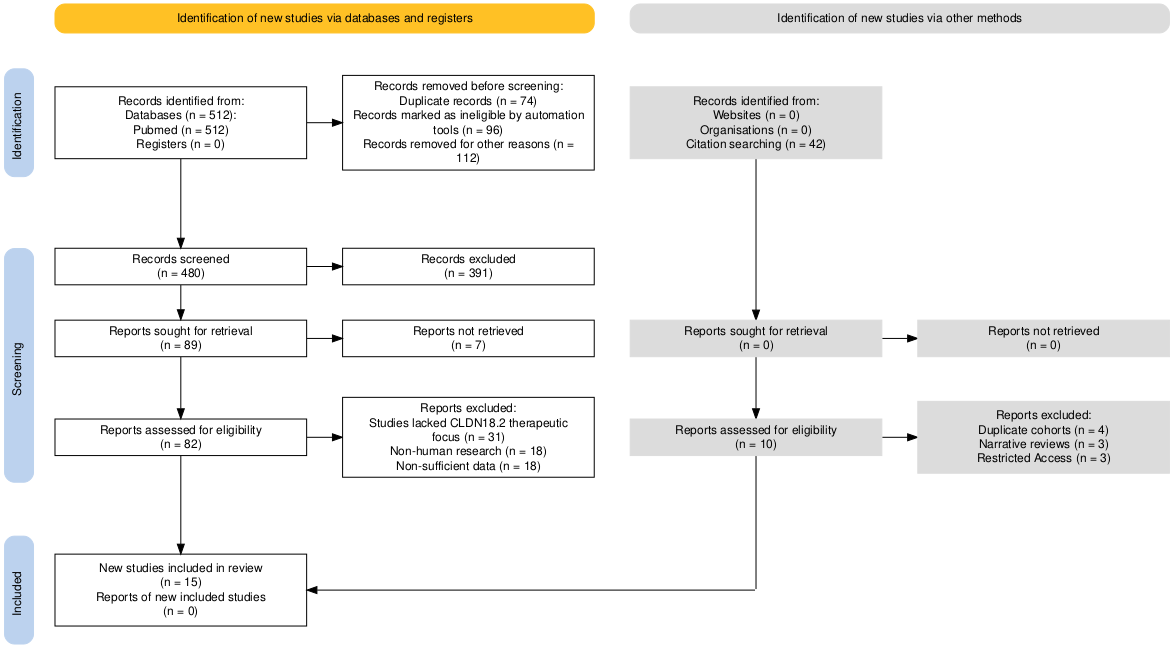
Records identified from PubMed totaled 512, with 42 additional records identified through citation tracking. After the removal of 74 duplicates, 480 records underwent title and abstract screening. 391 records were excluded during screening. Eighty-nine full-text reports were sought for retrieval, of which seven were unavailable, leaving 82 reports assessed for eligibility. Following eligibility assessment, 77 reports were excluded for predefined reasons, resulting in 15 studies included in the final qualitative synthesis. The PRISMA 2020 flow diagram, as depicted in Figure 1, satisfies the orchestration [21].
Results
Study Characteristics
Fifteen studies were included in the final analysis. The evidence base consisted of two pivotal phase III randomized trials, one phase II clinical trial, several translational biomarker studies, and multiple clinical analyses investigating CLDN18.2 expression and therapeutic targeting.
Collectively, these studies evaluated zolbetuximab-based therapy in advanced gastric and gastro-esophageal junction adenocarcinoma. Most studies investigated combination therapy with cytotoxic chemotherapy in previously untreated metastatic disease.
Phase III Clinical Trial Evidence
The strongest evidence was derived from two randomized phase III trials evaluating zolbetuximab combined with chemotherapy.
The SPOTLIGHT Trial evaluated zolbetuximab with mFOLFOX6 chemotherapy in untreated CLDN18.2-positive gastric cancer. The trial enrolled 565 patients. Median progression-free survival was 10.6 months with zolbetuximab versus 8.7 months with chemotherapy alone. Overall survival improved to 18.2 months compared with 15.5 months in the control arm. These findings demonstrated a significant reduction in disease progression and mortality risk [1].
The GLOW Trial assessed zolbetuximab combined with CAPOX chemotherapy. The study included 507 patients with untreated metastatic disease. Median progression-free survival was 8.21 months in the zolbetuximab group compared with 6.80 months in the chemotherapy arm. Median overall survival reached 14.39 months versus 12.16 months, confirming a statistically significant survival benefit [2].
Early Clinical Development Evidence
Early clinical evidence originated from the FAST Trial, a phase II randomized study that first demonstrated the clinical relevance of CLDN18.2 targeting. Patients receiving zolbetuximab with chemotherapy experienced a median overall survival of 13.2 months compared with 8.4 months in the control group. This trial established CLDN18.2 as a clinically actionable biomarker in gastric cancer and provided the foundation for later phase III investigations [3].
Biomarker and Mechanistic Evidence
CLDN18.2 is a tight-junction protein normally restricted to differentiated gastric mucosa. Malignant transformation disrupts epithelial polarity and exposes the CLDN18.2 extracellular domain on tumor cells. This exposure allows monoclonal antibodies such as zolbetuximab to bind selectively to malignant cells.
Mechanistically, zolbetuximab induces antibody-dependent cellular cytotoxicity and complement-dependent cytotoxicity, resulting in targeted tumor cell death [4,5]. Translational studies consistently demonstrated that higher CLDN18.2 expression correlates with improved therapeutic response.
Patient Selection and Biomarker Thresholds
Clinical trials used strict immunohistochemical criteria to define CLDN18.2 positivity. Most studies required moderate-to-strong membranous staining in at least 75% of tumor cells.
Screening studies showed that approximately 30–40% of gastric and gastro-esophageal junction cancers meet this biomarker threshold [6,7]. This subset represents a biologically distinct group of tumors with potential sensitivity to CLDN18.2-targeted therapy.
Safety Profile
Across clinical trials, zolbetuximab demonstrated a predictable toxicity pattern. The most frequent treatment-related adverse events were nausea, vomiting, and decreased appetite. These events were most prominent during early treatment cycles.
Grade 3 or higher adverse events occurred in approximately 70–87% of patients receiving combination therapy, primarily reflecting chemotherapy-related toxicity rather than antibody-specific toxicity [1,2]. Importantly, no unexpected safety signals were identified across large clinical datasets.
Real-World Clinical Evidence
Emerging observational studies have begun evaluating zolbetuximab outside controlled trial settings. Real-world cohorts reported treatment outcomes consistent with randomized trial data. Survival outcomes, response rates, and toxicity profiles closely mirrored those observed in pivotal trials [8].
These findings suggest that the therapeutic benefits of CLDN18.2 targeting remain reproducible in routine oncology practice.
Emerging Research Directions
Recent research is increasingly focused on optimizing CLDN18.2-directed therapy. Several translational studies are investigating mechanisms of acquired resistance, including tumor heterogeneity and dynamic biomarker loss during therapy [9,10].
Additional investigations are exploring combination strategies integrating zolbetuximab with immune checkpoint inhibitors or novel antibody-drug conjugates [11-15]. These approaches aim to expand therapeutic efficacy and overcome resistance mechanisms in advanced gastric cancer.
Table 1 now would demostrate the characteristics of the included studies evaluating Zolbetuximab and Claudin-18.2 in gastric and gastro-oesophageal junction adenocarcinoma.
| Study (Ref) | Year | Study Design | Population | Intervention / Focus | Key Outcomes / Findings |
| Shitara et al., SPOTLIGHT [1] | 2023 | Phase III randomized, double-blind multicentre trial | 565 patients with untreated, HER2-negative, CLDN18.2-positive locally advanced unresectable or metastatic gastric/GEJ adenocarcinoma | Zolbetuximab + mFOLFOX6 vs placebo + mFOLFOX6 | Significant improvement in PFS (10.6 vs 8.7 months) and OS (18.2 vs 15.5 months); established first-line efficacy of CLDN18.2 targeting |
| Shah et al., GLOW [2] | 2023 | Phase III randomized, double-blind multicentre trial | 507 patients with untreated CLDN18.2-positive gastric/GEJ adenocarcinoma | Zolbetuximab + CAPOX vs placebo + CAPOX | Improved PFS (8.21 vs 6.80 months) and OS (14.39 vs 12.16 months); confirmed benefit with CAPOX backbone |
| Sahin et al.,[3] | 2008 | Translational molecular oncology study | Multiple cancer tissue samples including gastric tumors | Characterization of CLDN18.2 antigen for antibody targeting | Identified CLDN18.2 splice variant 2 as a tumor-restricted antigen suitable for therapeutic antibody development |
| Türeci et al., MONO Study [4] | 2019 | Phase IIa multicentre clinical trial | Patients with recurrent or refractory advanced gastric or lower oesophageal adenocarcinoma | Zolbetuximab monotherapy | Demonstrated antitumor activity and manageable safety profile; validated CLDN18.2 as therapeutic target |
| Poniewierska-Baran et al.,[5] | 2025 | Translational review and mechanistic synthesis | Gastric cancer molecular studies | CLDN18.2-targeted therapeutic strategies | Summarized molecular biology of CLDN18.2 and therapeutic potential including monoclonal antibodies and cellular therapies |
| Dottermusch et al.,[6] | 2019 | Large retrospective cohort study | 414 gastric adenocarcinoma cases (Caucasian cohort) | Immunohistochemical analysis of CLDN18.2 expression | Demonstrated heterogeneous expression; identified clinically relevant biomarker prevalence |
| Jiang et al.,[7] | 2019 | Preclinical and early translational study | Gastric cancer models and early clinical samples | CLDN18.2-specific CAR-T cell therapy | Demonstrated potent antitumor activity and proof-of-concept for CLDN18.2 cellular immunotherapy |
| Kyuno et al.,[8] | 2022 | Comprehensive translational review | Multiple cancer types including gastric cancer | CLDN18.2 biology and therapeutic targeting | Consolidated evidence from basic science and clinical trials supporting CLDN18.2 as an actionable therapeutic target |
| Kim et al.,[9] | 2020 | Clinical biomarker cohort study | Patients with metastatic diffuse-type gastric cancer | CLDN18.2 expression analysis by immunohistochemistry | High CLDN18.2 expression associated with diffuse-type gastric cancer and potential therapeutic relevance |
| Athauda et al.,[10] | 2021 | Expert clinical perspective | Gastric cancer clinical trial landscape | CLDN18.2 targeting strategies including zolbetuximab | Highlighted rapid clinical development of CLDN18.2 therapies and implications of FAST and subsequent trials |
| Mathias-Machado et al.,[11] | 2024 | Narrative clinical review | Gastric cancer biomarker research | CLDN18.2 biomarker characterization | Discussed diagnostic testing, patient selection, and integration of CLDN18.2 testing in clinical practice |
| Zhang et al.,[12] | 2020 | Clinical translational analysis | Advanced gastric cancer literature | Evaluation of CLDN18.2-targeted therapies | Critically assessed therapeutic efficacy, limitations, and biomarker-driven treatment strategies |
| Wu et al.,[13] | 2024 | Pan-cancer bioinformatic analysis | Multi-tumor genomic datasets | CLDN18.2 expression profiling across cancers | Demonstrated enrichment of CLDN18.2 in upper gastrointestinal malignancies; supported targeted therapy rationale |
| Covert & Rogers [14] | 2025 | Clinical therapeutic review | Gastric adenocarcinoma research landscape | Development of anti-CLDN18.2 antibodies | Outlined next-generation antibodies and future clinical strategies |
| Zhang et al.,[15] | 2026 | Comprehensive clinical review | Gastric cancer clinical and translational studies | Current and future CLDN18.2 therapeutic landscape | Summarized clinical trial outcomes including SPOTLIGHT and GLOW and future resistance-directed strategies |
Discussion
Principal Interpretation of Findings
This systematic synthesis consolidates current evidence supporting Zolbetuximab as a biomarker-driven therapy targeting Claudin‑18.2 in advanced gastric and gastro-oesophageal junction adenocarcinoma. The collective evidence demonstrates a consistent therapeutic signal across randomized trials, translational studies, and biomarker investigations. Importantly, the clinical benefit observed with CLDN18.2 targeting aligns with the biological rationale of selective tumor membrane exposure of this tight-junction protein during malignant transformation. The convergence of molecular targeting and chemotherapy synergy provides a coherent mechanistic explanation for the improved treatment outcomes reported across clinical datasets.
Biological Context and Mechanistic Interpretation
The therapeutic relevance of CLDN18.2 derives from its unique tumor-restricted accessibility. In normal gastric epithelium the protein remains largely concealed within tight junctions, whereas malignant transformation exposes the extracellular epitope to circulating antibodies. Binding of zolbetuximab activates antibody-dependent cellular cytotoxicity and complement-mediated cytotoxicity, producing selective tumor cell lysis and immune activation [16].
Emerging mechanistic studies further suggest that cytotoxic chemotherapy may enhance antibody-mediated immune recruitment and promote tumor microenvironment remodeling, thereby amplifying the therapeutic effect of CLDN18.2-directed antibodies [17]. These biological observations reinforce the rationale for combination therapy rather than antibody monotherapy.
Comparison with Existing Evidence
The findings of the present synthesis are consistent with previously reported translational and clinical evidence evaluating CLDN18.2-targeted strategies. Earlier experimental work identified CLDN18.2 as a tumor-restricted antigen suitable for antibody-based targeting. Subsequent clinical development confirmed that therapeutic efficacy correlates with biomarker expression levels.
More recent analyses and pooled trial evaluations similarly report improvements in progression-free and overall survival when zolbetuximab is combined with platinum-based chemotherapy compared with chemotherapy alone [18]. Real-world data emerging from clinical practice further support these observations, demonstrating reproducible antitumor activity and manageable toxicity profiles outside the controlled environment of randomized trials [19].
Collectively, these observations strengthen the external validity of the clinical trial evidence and indicate that CLDN18.2 targeting represents a reproducible therapeutic strategy across diverse clinical settings.
Strengths of the Present Study
Several methodological features strengthen the interpretability of this review. The study employed a systematic literature search with predefined inclusion criteria and standardized data extraction. Only peer-reviewed PubMed-indexed studies were included to maintain methodological consistency.
The synthesis incorporated evidence from randomized clinical trials, translational molecular studies, and biomarker investigations. This multidimensional approach enabled integration of mechanistic insights with clinical outcomes, thereby providing a comprehensive understanding of CLDN18.2-directed therapy.
Another strength lies in the inclusion of emerging biomarker and molecular profiling studies, which clarify the biological basis for patient selection and therapeutic response.
Study Limitations
Several limitations should be acknowledged. First, the number of randomized clinical trials evaluating CLDN18.2-targeted therapy remains relatively limited. Most available clinical evidence originates from a small number of pivotal studies, although supported by translational and observational analyses.
Second, heterogeneity exists in the methods used to assess CLDN18.2 expression across studies. Variations in immunohistochemical thresholds and scoring systems may influence patient classification and treatment eligibility.
Third, long-term survival outcomes and resistance mechanisms remain incompletely characterized. Current evidence primarily reflects first-line treatment settings, while the role of CLDN18.2 targeting in later lines of therapy is still under investigation.
Clinical and Research Implications
The accumulated evidence indicates that CLDN18.2 expression represents a clinically actionable biomarker in gastric cancer. Routine biomarker testing may therefore play an increasingly important role in therapeutic decision-making for patients with advanced disease.
In parallel, the therapeutic landscape surrounding CLDN18.2 is rapidly evolving. New treatment modalities, including antibody-drug conjugates, bispecific antibodies, and CAR-T cell strategies are currently being investigated to enhance antitumor efficacy and overcome resistance mechanisms [20].
Future research should prioritize prospective biomarker validation, investigation of resistance pathways, and rational therapeutic combinations integrating immune checkpoint blockade or next-generation targeted agents.
Contribution to Current Evidence
This systematic synthesis provides an integrated evaluation of clinical and biological evidence supporting CLDN18.2-targeted therapy in gastric cancer. By combining data from randomized trials, biomarker analyses, and mechanistic investigations, the present study highlights the emergence of CLDN18.2 as a central molecular target within precision oncology strategies for gastric malignancies.
The findings contribute to the growing body of evidence supporting biomarker-guided therapy in gastrointestinal oncology and reinforce the clinical relevance of CLDN18.2 testing in patients with advanced gastric and gastro-oesophageal junction adenocarcinoma.
Conclusion
In conclusion, targeting Claudin-18.2 with Zolbetuximab represents a meaningful step toward biomarker-driven therapy in advanced gastric and gastro-oesophageal junction adenocarcinoma. The accumulated evidence demonstrates that CLDN18.2 functions as a biologically rational and clinically exploitable molecular target. Its tumor-restricted accessibility following disruption of epithelial tight junctions enables selective antibody binding and immune-mediated tumor cell elimination. The convergence of molecular biology, translational research, and randomized clinical investigation has therefore established CLDN18.2 as a distinct therapeutic axis within gastric oncology. Equally important is the recognition that biomarker stratification is central to therapeutic success. Accurate identification of CLDN18.2 expression defines a molecular subgroup of gastric cancers that may derive meaningful benefit from targeted intervention, highlighting the increasing role of precision diagnostics in guiding treatment strategies.
Despite this progress, important challenges remain. Tumor heterogeneity, evolving biomarker expression, and incomplete understanding of resistance mechanisms continue to influence therapeutic durability. These factors underscore the need for refined biomarker assessment and continued translational investigation. At the same time, emerging therapeutic platforms which do include next-generation antibody constructs and cellular immunotherapies, suggesting that CLDN18.2 targeting may extend beyond current treatment paradigms. The broader implication of this evolving field lies in its demonstration that molecularly defined vulnerabilities in gastric cancer can be successfully translated into clinically actionable strategies. Continued integration of molecular characterization, rational therapeutic design, and biomarker-guided patient selection will be essential to fully realize the long-term potential of CLDN18.2-directed therapy in improving outcomes for patients with gastric malignancies.
Declarations
Ethical Approval
Not Applicable
Conflict of interest
NONE
Funding/ financial support
NONE
Ethical Clearance
NONE
Trial details
None