Introduction
The tympanic membrane is impacted by the pathologic condition known as myringosclerosis [1,2]. It manifests as sclerotic, white plaques in specific tympanic membrane regions [3]. Any untreated inflammatory disease of the middle ear, whether specific or nonspecific, can lead to this condition, which is characterised by structural distortion that impairs function. Tympanosclerosis is a healing condition characterised by the deposition of vast volumes of collagenous fibrous tissue in proximity to the middle ear. Collagen thickening and fusing may ensue, resulting in the development of a uniform hyaline bulk where dispersed intracellular & extracellular phosphate and calcium crystals may eventually collect. The main fibrous layer of the tympanic membrane, the bony walls of tympanic cavity, as well as the submucosal connective tissue layer covering the auditory ossicles are all where the process takes place [4].
Acute otitis media with effusion, chronic otitis media, and multiple acute episodes of acute otitis media can all lead to myringosclerosis [5]. Treatment with myringotomy or the insertion of a ventilation tube is also associated with it [6,7]. There have been reports of myringosclerosis in children as young as two years old, although it can happen at any age [8]. Due to the higher prevalence of secretory otitis media in children and the corresponding usage of ventilation tubes, the incidence is highest in this age group. On the other hand, adults are more likely to develop intratympanic tympanosclerosis. Because it interferes with the middle ear structures ability to transmit sound vibrations, the myringosclerotic mass may become clinically significant. Significant conductive hearing loss is often linked to it. On the other hand, since myringosclerosis usually has a negligible impact on hearing, it may not cause any symptoms [9].
Sclerotic plaques in the ear drum's prevalence ranges from 1.7% to 22.4%, according to some epidemiological studies conducted on non-selected groups [10]. Depending on the tympanic membrane's integrity, intratympanic tympanosclerosis has been classified as either "open" or "closed” [11]. In ears with tympanosclerosis, a central perforation is by far the most frequent otological finding (54%). Tympanic membrane integrity is the next most frequent observation [12]. This study aims to determine the common site of myringosclerosis and its relationship to the patients' age, sex, hearing loss, and graft uptake.
Materials and Methods
Study design and sampling: Patients of age group 18 – 60 years who were admitted in a tersiary care center, having chronic tubotympanic otitis media with central drum perforation and myringosclerotic patch in the same ear and who had underwent tympanoplasty during the period of Jan 2017- Dec 2020were included after getting informed consent. Details regarding patient age, sex, average preoperative hearing loss, site of myringosclerosis and graft uptake were collected from the departmental database and patient clinical case notes. Those patients diagnosed with only myringosclerosis and intact ossicular status excluding the tympanosclerosis group were taken up for the study. The study procedure was approved by Institutional Research Committee and ethical permission was obtained from Institutional Ethics Committee (Ref. No: 33/IES/21/AIMS).
Sample size calculation: Sample size in this study was based on the observation that, the frequency of myringosclerosis has increased among patients with com. Hence we decided to include all patients with com and myringosclerosis requiring tympanoplasty, who presented to ENT out patient department during the period of Jan 2017- Dec 2020
Study procedure: Patients were examined in ENT department and preoperative hearing was tested. Patients were posted for tymapanoplasty and surgery was carried out. Grafting was done using the temporalis fascia after a postauricular approach. Tympanoplasty using the underlay technique was used in all patients. Information regarding the graft uptake was obtained during the follow up visits in the 4th,6th, 8th week postoperatively. Patients with history of previous ear surgeries were excluded.
Statistical Analysis: The data was entered into Microsoft Office Excel and analysis was performed using SPSS27. Results on continuous measurements are presented on mean ± SD and results on categorical measurements are present in frequency (%). Association between qualitative variables were assessed using Fischer’s exact test. Significance is assessed at 5% level.
Results
The mean age of the 48 patients with chronic tubotympanic otitis media who took part in this study was 38.04±9.93 years. The majority of study participants (70.8%) are between the ages of 30 and 50, with those under 30 years old coming in second (20.8%). Women made up more than half (58.3%) of the study participants.
Hearing loss
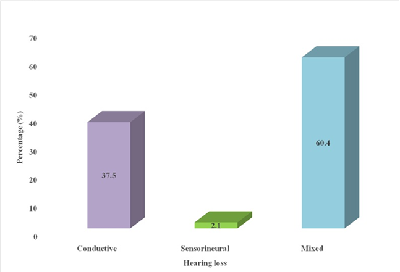
The majority of study participants (60.4%) experienced mixed hearing loss, whereas the smallest percentage (2.1%) had sensorineural hearing loss (Figure 1). 29.2% had mild hearing loss, 20.8% had relatively severe hearing loss, 39.6% had moderate hearing loss, and the least amount had severe, and not significant hearing loss (6.3% and 4.2%, respectively).
Myringosclerosis site and graft uptake
The majority of research subjects (83.3%) had anterosuperior myringosclerosis, while 16.7% had anteroinferior myringosclerosis. Graft uptake occurred in the majority of research participants (95.8%) after the procedure.
Association between General characteristics and graft uptake
| General characteristics | Graft uptake | χ2 | p value | |
| Present (n=46) n(%) | Absent (n=2) n(%) | |||
| Age (years) | ||||
| <30 | 10 (21.7) | 0 (0.0) | 3.65 | 0.20 |
| 30-50 | 33 (71.7) | 1 (50.0) | ||
| >50 | 3 (6.5) | 1 (50.0) | ||
| Gender | ||||
| Male | 19 (41.3) | 1 (50.0) | 0.060 | 1.00 |
| Female | 27 (58.7) | 1 (50.0) |
Test used: Fischer’s exact test p value <0.05: Statistically significant
Of the study participants who had graft uptake, nearly three-fourths (71.7%) were in the 30–50 age range, followed by those under 30 years old (21.7%). Of those who did not have graft uptake, half were in the 30–50 age group and the other half were in the >50 age group. Compared to their counterparts, half of the study participants with graft uptake were female (58.7%), with the remaining half being of each gender. Regarding graft absorption, there is no statistically significant association between age and gender (p value >0.05).
Association between Myringosclerosis site and hearing loss with respect to graft uptake
| Variables | Graft uptake | χ2 | p value | |
| Present (n=46) n(%) | Absent (n=2) n(%) | |||
| Hearing loss | ||||
| Conductive | 18 (39.1) | 0 (0.0) | 2.42 | 0.54 |
| Sensorineural | 1 (2.2) | 0 (0.0) | ||
| Mixed | 27 (58.7) | 2 (100) | ||
| Myringosclerosis site | ||||
| Anterosuperior | 38 (82.6) | 2 (100) | 0.42 | 1.00 |
| Anteroinferior | 8 (17.4) | 0 (0.0) |
Test used: Fischer’s exact test p value <0.05: Statistically significant
Compared to study participants without graft uptake, all of whom had mixed hearing loss, approximately 58.7% of those with graft uptake had mixed hearing loss, followed by conductive hearing loss (39.1%). The majority of research participants in both groups exhibited anterosuperior myringosclerosis sites (82.6% with graft uptake and 100% without). Regarding myringosclerosis location and hearing loss, there was no statistically significant difference between the two groups (p value >0.05).
Association between General characteristics and hearing loss with respect to myringosclerosis site
| General characteristics | Myringosclerosis site | χ2 | p value | |
| Anterosuperior (n=40) n (%) | Anteroinferior (n=8) n (%) | |||
| Age (years) | ||||
| <30 | 9 (22.5) | 1 (12.5) | 0.52 | 0.84 |
| 30-50 | 28 (70.0) | 6 (75.0) | ||
| >50 | 3 (7.5) | 1 (12.5) | ||
| Gender | ||||
| Male | 17 (42.5) | 3 (37.5) | 0.07 | 1.00 |
| Female | 23 (57.5) | 5 (62.5) | ||
| Hearing loss | ||||
| Conductive | 13 (32.5) | 5 (62.5) | 2.87 | 0.36 |
| Sensorineural | 1 (2.5) | 0 (0.0) | ||
| Mixed | 26 (65.0) | 3 (37.5) |
Test used: Fischer’s exact test p value <0.05: Statistically significant
Majority of the study subjects in both the groups (Anterosuperior and anteroinferior site) belongs to the age group of 30-50 years and female gender. With respect to hearing loss, majority (65%) of the study subjects with anterosuperior myringosclerosis site had mixed type hearing loss followed by conductive type (32.5%) when compared to their counterpart (conductive hearing loss (62.5%) followed by mixed hearing loss (37.5%). There is no statistically significant association was found between the aforementioned variables and myringosclerosis site among the study subjects (p value >0.05).
Discussion
This study's main goal was to assess the clinical traits and variables linked to graft uptake in patients receiving tympanoplasty who had persistent tubotympanic otitis media. The results offer important new information about the demographics of this patient group and the variables that could affect the results of surgery.
With a mean age of 38.04±9.93 years, the majority of participants (70.8%) in our study were between the ages of 30 and 50. This population is in line with other research showing that chronic otitis media is a common ailment affecting working-age individuals, frequently affecting their productivity and quality of life [13]. The increased incidence of CSOM in middle-aged people as a result of the long-term impact of eustachian tube dysfunction and repeated infections. This study reveals a slight female majority in our population (58.3%). This observation aligned with a few authors' findings [14-16], even if there aren't always gender variations in the occurrence of CSOM and in contrast to other research where a notable masculine preponderance has been observed [17,18].
One of our study's main conclusions is that a stunning 95.8% of individuals had effective graft uptake. This success percentage is higher than the results that have been documented in the literature, which normally fall between 70% and 90% [19-21]. Numerous factors, such as the surgical method used, the kind of graft material used, as well as the patient's meticulous postoperative care, could be to blame for this. Tympanoplasty's high success rate is a noteworthy benefit since it is directly linked to better hearing and a lower risk of recurring infections.
With regard to the pathology's features, the most prevalent kind was mixed hearing loss, which affected 60.4% of our participants. Conductive hearing loss came in second (37.5%). This is a typical presentation of chronic tubotympanic otitis media, where a mixed audiometric pattern may result from middle ear disease and inner ear injury. Most patients also had anterosuperior myringosclerosis (83.3%) at presentation, which could be caused by the chronic nature of the inflammatory disease or structural reasons.
Determining if any general or clinical factors were linked to graft absorption was a key component of our investigation. In line with previous research, our results revealed no statistically significant relationship between graft uptake and age or gender (p value >0.05) [22,23]. According to this, tympanoplasty is a successful surgical procedure for patients of all ages and genders, and surgical success does not seem to be significantly predicted by these demographic characteristics alone.
Furthermore, there was not a statistically significant association (p value >0.05) between graft uptake and the kind of hearing loss. Although the majority of our graft-uptake patients had anterosuperior myringosclerosis (82.6%) and mixed hearing loss (58.7%), it is challenging to draw firm conclusions because there were so few people without graft-uptake. The absence of association with the kind of hearing loss or the location of myringosclerosis further suggests that surgical technique, intraoperative findings, & postoperative carerather than these particular clinical manifestationsare the main factors influencing transplant success. The fact that all subjects without graft uptake had mixed hearing loss as well as anterosuperior myringosclerosis, however, is noteworthy and points to a potentialalbeit statistically insignificantcorrelation that needs more research using a larger sample size of unsuccessful cases.
It was shown that mixed loss was more prevalent in the anterosuperior group when comparing the type of hearing loss with the location of myringosclerosis, while conductive loss was more prevalent in the anteroinferior group. Depending on the site of myringosclerosis, this difference may indicate minor pathophysiological variations in how the illness progresses and affects hearing, even if it was not statistically significant. The strength of this observation is, however, limited by the small number of individuals with anteroinferior involvement.
The small number of graft failure patients (n=2) in our study is a serious drawback, as it significantly reduces the statistical power to identify any meaningful relationships. Although clinically desired, the procedure's high success rate makes it difficult to pinpoint the precise causes of failure. Because of the modest predicted cell counts in these cases, Fisher's exact test had to be used. As a result, even if our results point to no connection, this should be read cautiously. To gather enough graft failures to conduct a more thorough analysis, a bigger, multi-center study would be required.
Conclusion
Our research demonstrates the high success rate of graft uptake following tympanoplasty for chronic tubotympanic otitis media. The kind of hearing loss and the location of myringosclerosis, as well as demographic variables including age and gender, weren't statistically significant predictors of operative success in our sample. The results validate the procedure's continued usage as a dependable therapeutic approach. More patients should be the subject of future studies in order to more thoroughly uncover potential risk factors for transplant failure.
Recommendations
The study's high graft uptake rate indicates that tympanoplasty, irrespective of age, gender, type of hearing loss, or location of myringosclerosis, provides positive results in patients with chronic tubotympanic otitis media with myringosclerosis. Particularly for patients who present with mixed hearing loss, early diagnosis and prompt surgical surgery should be promoted to stop the progression of hearing loss. It is advised to do larger, multicentric research to confirm these results and investigate other prognostic variables.
Declarations
Acknowledgment
We sincerely acknowledge Dr. Binitha P P, Research officer, Department of Library and Research Documentation, Amala Institute of Medical Sciences, for her valuable support in the publication process.
Conflict of Interest
The authors declare that there is no conflict of interest related to this manuscript.
Funding Statement
No external funding or financial support was received for conducting this study.
Previous Publication Statement
This manuscript has not been published previously and is not under consideration for publication elsewhere in any form.
Authors Contribution
Dr. Andrews supervised and guided the study and performed the final editing and critical review of the manuscript. Dr. Rosemol Antony contributed to the investigation, literature search, drafting of the manuscript, data compilation, and preparation of the final manuscript. All authors reviewed and approved the final submitted version of the manuscript.
AI Usage Statement
Artificial Intelligence tools were used only for language correction and grammatical refinement. No AI tool was used for data generation, interpretation, scientific analysis, or decision-making.
Data Availability Statement
The datasets used and/or analysed during the current study are available from the corresponding author upon reasonable request.
Ethical Approval and Consent
The study was conducted in accordance with the ethical principles of the Declaration of Helsinki. Appropriate ethical approval and informed patient consent were obtained prior to the commencement of the study.