Introduction
Cerebral palsy (CP) is not a separate disease but an umbrella term encompassing diverse symptoms that change with time. It can be defined as a movement and posture disorder consequent to a non-progressive, immature, or in-development brain lesion that provokes clinical manifestations. The motor disorder may be accompanied by cognition, communication, perception, and/or epilepsy disorder [1].
CP is among the most disabling childhood neurological conditions, prevailing 2.95 per 1000 children surveyed (95% CI= 2.03-3.88), according to the systematic review done by Chauhan et al., 2019 [2]. Although CP is a static encephalopathy of the brain but the disability caused by the condition increases as the age of the child progresses due to insufficient motor control, but increased demand for motor control with growth and development. The etiology and clinical presentation of CP vary according to the timing, location and extent of the brain lesion [3].
Also, there exist some metabolic and non-progressive genetic disorders that are present along with some Motor dysfunction, resembling Cerebral palsy. These are often categorized as CP mimics [4].
Once the child is diagnosed with Cerebral palsy, the care for the child with CP is a long-term process. The main aim of care includes the best possible QoL for both the child and family. This can only be achieved with a multidirectional approach, which includes comprehensive rehabilitation, specialist medical care, psychological and social support [5]. Each one of the different professionals contributes with expertise to minimize the impairment and its effect, and makes the child as independent as possible in BADLs and IADLs, and makes their increased participation at the community level [6].
In a physical rehabilitation program for Cerebral palsy, there are various strategies and rehabilitation methods that are available to manage the condition by improving QoL, as each approach is based upon the disability and impairment that we find from our clinical examination. The challenges faced by clinicians in managing the condition are the lack of sufficient literature for practicing the multiple interventions in physical rehabilitation, which are effective for improving particular deficits based on the disability categorized by the particular level of the classification system.
This literature review aims to assemble an inventory of therapeutic intervention strategies utilized for children diagnosed with spastic CP based on different levels GMFCS.
Definition
According to Rosenbaum et. al in 2006, Cerebral palsy is defined as “A group of permanent disorders of the development of movement and posture, causing activity limitation that are attributed to the non-progressive disturbances and occur in the developing fetal and infant brain. Motor disorders of Cerebral palsy are often accompanied by disturbances of sensations, perception, cognition, communication, and behavior, and by secondary musculoskeletal problems [3].
Prevalence and Incidence
In a meta-analysis using birth weight (from 1980-2003) as a measure by Sellier et al., 2015, there was a decrease of 2% per annum in moderate to severe Cerebral palsy in the overall prevalence of CP due to improvement in neonatal care [7]. In a meta-analysis pooling 19 studies using live birth weight as the denominator by Oskoni et al. in 2016, the overall prevalence of CP was 2.11 per 1000 live births (95% CI 1.98-2.25). The meta-analysis also demonstrates that the overall prevalence of CP has remained constant even with the addition of studies over the past 10 years, including post-natal cases [8]. Recent studies based on population around the world by Galea et al. (2019) report prevalence estimates of CP from 1 to nearly 4 per 1000 live births [9].
Etiology
The known causes of CP are classified according to the timing of the brain insult, i.e., whether antenatal, perinatal, or postnatal.
Antenatal causes of CP
It includes congenital brain malformations, including malformations of cortical development. This is strongly associated with Cerebral palsy [10]. Some more antenatal causes of Cerebral palsy are vascular events, i.e., Middle cerebral artery occlusion as demonstrated by brain imaging, maternal infection during the first and second trimesters of pregnancy (rubella, cytomegalovirus, toxoplasmosis). Less common antenatal causes of CP include metabolic disorders, maternal ingestion of toxins, and rare genetic syndromes [11].
Perinatal causes of CP
Asphyxiation in an infant resulting from anoxia during labor and delivery is defined as a cause of CP, but to a small percentage [12]. This can be due to prolonged or difficult labor, due to breech presentation, or the presence of a prolapsed umbilical cord.
With the advent of imaging, perinatal ischemic stroke is now recognized as a major cause of CP. Risk factors for the same can be related to the mother, infant, and placenta. Central infarction may occur due to thrombosis triggered by inflammation and infection [13].
Postnatal causes of CP
Brain damage in the infant or toddler can be acquired secondary to brain hemorrhage, trauma, infection, or anoxia. It can be related to motor vehicle accidents, shaken baby syndrome, near-drowning, or lead exposure, etc. Meningitis and encephalitis have also been shown to cause CP in 60% of cases [14].
Types of Cerebral Palsy
It is very important to classify Cerebral palsy to properly manage the condition because otherwise, the designation “Cerebral palsy” doesn’t convey much specific information about the type and severity of movement dysfunction a child exhibits.
There are 3 following different ways in which CP can be classified:
-
By the distribution of movement
-
Type of abnormal muscle tone and movement
-
By severity, best described according to the GMFCS [15].
Classification of CP based on the distribution of movement
It is based upon the topographical classification. It can be Quadriplegic Cerebral palsy, in which there is involvement of the entire body, with the upper extremity usually more affected than the lower extremities. These children have difficulty developing head and neck control. The children having primarily lower extremity involvement, although the trunk is also affected, are classified as Diplegic Cerebral palsy. If the involvement is only in one side of the body, where damage in the brain is in the contralateral part, it is classified as Hemiplegic Cerebral palsy. If there is more involvement of both the lower limbs and the upper limbs are involved, it is classified as Paraplegic Cerebral palsy [13].
On the basis of abnormal muscle tone and movement
Tone abnormalities seen in the case of Cerebral palsy range from almost no tone to high tone. Floppy infants are children with an Atonic type of CP in which tone of muscles can change over time as infant tends to move against gravity, with initially no tone in the muscles to high tone later in life. Tonal fluctuations are seen in the Dyskinetic or Athetoid type of CP. In this case, abnormal tone is easily recognized, but its relationship with the movement is not so clear [13]. In a dyskinetic type of CP, the child with diplegia may present with some hypotonic muscles in the trunk, while some hypertonic muscles are present in the lower limb.
In many cases where spasticity is seen as the most common type of abnormal muscle tone, it is called Spastic CP. In this type of CP, spasticity is seen in flexors and extensors of the lower extremities and flexors of the upper extremities, as these are antigravity muscles [13]. In 60% of all pre-term infants with low birth weight and even in some term infants, the condition called Transient dystonia is seen, in which characteristics seen during infancy may be transient, which have been linked to behavior deficits later in life. It is characterized by increased tone in neck extensor muscles along with hypotonia, lethargy, and irritability during the neonatal period.
There is one more uncommon type of tone seen in CP, i.e., Rigidity. In this type of CP, the muscle tone is such that the postures are held rigidly, and movement in any direction is impeded. In case of Dyskinetic CP, athetosis is seen, which is characterized by disordered movement of the extremities within the mid-range [13].
Functional classification of Cerebral palsy
This classification is based upon the World Health Organization’s International Classification of Functioning, Disability and Health model. It is based upon the following scales:
-
Gross Motor Function Classification System (GMFCS) [15]: to classify mobility in children with CP.
-
Manual Ability Classification System (MACS) [16]: to classify how children with CP use their hands in performing the Activities of Daily Living (ADLs)
-
Communication Function Classification System (CFCS) [17]: to identify the communication issues in children with CP.
Diagnosis of Cerebral Palsy
Early signs of Cerebral palsy may be present from birth, but many children may not be diagnosed as having CP until after 6 months of age. In case of severe insult to the nervous system, as in the case of Quadriplegia, diagnosis may not be difficult. However, in children with Hemiplegia or Diplegia with mild involvement, it can go undetected until they have difficulty in pulling to stand at around the age of 9 months [13].
Hypotonia in infancy may be a precursor to athetosis and may be observed as the child moves to work against gravity [18]. There are some sensitive assessment tools that allow the child to be identified with CP as early as 4 to 6 months of age. It has been proposed that observation of a child’s movement in a certain anti-gravity posture may give a clearer picture of the child than testing reflexes or assessing developmental milestones [19]. The early prediction of the child with CP improves with the use of multiple tools such as Neuroimaging, Neurological, and Neuro motor examination, and Neurophysiological assessment. The following are the most common and frequently used assessment methods that are used in the early prediction of Cerebral palsy.
Neurological and Neuromotor Assessment
These tools are used to monitor the development of high-risk infants. The use of the Hammersmith Infant Neurological Examination (HINE) [20] for neurological assessment has been shown to be useful in early prediction of CP because of its good predictive validity [21]. The General Movement Assessment (GMA) is the best-known Neuromotor assessment tool. General movements are the mostly used tools from the early fetal age until 3-4 months post-term [22]. It provides information about the integrity of the brain via the quality of these movements [23].
Neuroimaging
Cranial Ultrasound (CUS) and Magnetic Resonance Imaging (MRI) are widely used tools for neuroimaging in diagnosing Cerebral palsy [24].
Neurophysiological tests
It is being used in term infants with neonatal encephalopathy. According to Laerhoven et al. in 2013, the amplitude-integrated electroencephalogram (aEEG) and traditional electroencephalogram predict the outcome well [25].
Physiotherapy Assessment in Cerebral Palsy
The importance of multidimensional assessment in Cerebral palsy is that the fundamental problem of a child can be identified to select the most appropriate treatment technique according to the requirement and to reveal the change occurring over time with the therapy. The dimensions of the International Classification of Functioning, Disability and Health, child and young version (ICF-CY), which is a classification system established by WHO, can be used in the selection of assessment methods [26].
According to ICF- CY, the following instruments are used for assessing body structures and functions, such as problems of muscle tone, muscle strength, and selective motor control; instruments assessing activities and participation, such as activities of daily life (ADL) and QoL; and instruments assessing environmental factors, such as the impact of the family or the environment.
History and Observation
The history plays a very important role in making the Physical Therapy diagnosis of a child with CP. It includes prenatal, natal, and post-natal history, family history, developmental story, adaptive equipment used, previous PT treatment (if any), medical history, surgical history, and educational status of the family [27].
Observation plays an important role in determining spontaneous motion and motion strategies, a child’s functional skills, and underlying functional problems. It should be done in a very comfortable and familiar environment for the child. Various toys and materials are used to observe the general state of the child, quality of movement, protective reactions, upper and lower limb functions, and motor strategies [28].
Assessment of reflexes and reactions
It tells about the severity of the influence of the cerebral insult on the nervous system. It includes observation of balance and protective reactions to support the motor developmental process [29]. In case of a dyskinetic type of CP, symmetric tonic and abnormal tonic neck reflex (ATNR) still continue in adolescent age. It is important to check for these reflexes, as their presence can complicate the therapy. For example, in cases with persistence of ATNR, the orientation of the head and extremity has to be in the midline as the target of therapy [29].
Assessment of muscle tone
Spastic type of CP is the most common type of CP. Hence, spasticity is the major tonal abnormality seen in CP [30]. The Modified Tardieu Scale (MTS) is used to grade spasticity. MTS grades spasticity in three different velocities, and goniometric measurements are also included for all velocities [31]. Modified Ashworth Scale (MAS) [32] is also a widely used instrument to grade spasticity as given in Table 1.1.
| Grade | Description |
| 0 | No increase in muscle tone |
| 1 | Slight increase in muscle tone, manifested by catch and release or by minimal resistance at the end of the ROM when the affected part(s) moves in flexion or extension |
| 1+ | Slight increase in muscle tone, manifested by a catch, followed by minimal resistance in less than half of the ROM. |
| 2 | More marked increase in muscle tone throughout the increase in ROM, but the affected part(s) easily moved. |
| 3 | Considerable increase in muscle tone, and passive movement is difficult. |
| 4 | Affected part(s) are rigid in flexion or extension. |
In addition to this, muscle fluctuation and hypotonia are also seen in some particular types of CP. There is no tool used to assess hypotonia routinely, but the Unified Dystonia Rating Scale is widely used to assess dystonia in CP [33].
Assessment of muscle strength
Muscle weakness is seen in all types of CP due to central nervous system impairment, inactivation, learned non-use, and inadequate selective motor control [34]. It may be difficult to get a clean picture of muscle strength in CP due to increased co-contractions in agonist-antagonist and due to cognitive limitations (35). Manual muscle testing using MRC grading is a widely used clinical tool in assessing muscle strength (Table 1.2).
Isokinetic dynamometer, handheld dynamometer, or the measurement of maximum repetition of functional movements are used frequently in assessing the muscle strength in CP [36].
| Grade | Description |
| 0 | No movement is observed. |
| 1 | Only a trace or flicker of movement is seen or felt in the muscle or fasciculations are observed in the muscle. |
| 2 | Muscle can move only if the resistance of gravity is removed. As an example, the elbow can be fully flexed only if the arm is maintained in a horizontal plane. |
| 3 | Muscle strength is further reduced such that the joint can be moved only against gravity with the examiner’s resistance completely removed. As an example, the elbow can be moved from full extension to full flexion, starting with the arm hanging down at the side. |
| 4 | Muscle strength is reduced, but muscle contraction can still move the joint against resistance. |
| 5 | Muscle contract normally against full resistance. |
Assessment of physical fitness
Physical activity of the child can be assessed using the Activity scales for kids [37] and Physical Activity Questionnaire for adolescents [38].
General physical endurance can be assessed by using 6 Minute Walk Test [39].
Assessment of gait
It has been observed that children with unilateral CP and with GMFCS levels I and II [15] are capable of independent locomotion. However, in some cases, walking aids according to the disability are required for locomotion. Either of the following methods can be used for gait assessment in children with CP, i.e., Observational gait scale- Video records, Time-Distance characteristics, Instrumental gait analysis using EMG activity and 3-D joint kinetic and kinematic values in the laboratory setting [40]. Various scales, such as the Observational Gait Scale [41] and the Visual Gait score [42], are widely used tools in gait assessment.
Assessment of Balance
Balance capacity in children with CP is negatively affected because of abnormal postural control and muscle tone impairment [43]. Proactive and Reactive balance control is checked. The following scales are used to assess balance: Pediatric Reach Test, which is a modified form of Functional Reach Test and measures side reaching as well as forward reaching in sitting and standing positions [44] and Pediatric Balance Scale which is a modified version of Berg Balance Scale, with 14 items scored from 0 means lowest function to 4 means highest function).
Assessment of Trunk Impairment
Assessment of postural control in the sitting position is used to determine weakness of trunk muscles. Hence, instruments used to assess postural control and balance during sitting can be used to assess the trunk impairment. The following scales are used to assess trunk impairment: Pediatric Balance scale [44], Pediatric Reach Test [45], Gross Motor Function Measurement and Trunk Control Measurement Scale, which is a scale with 15 questions measuring static and dynamic sitting Balance and dynamic reaching in children [46]. It is the best option to assess trunk impairment as it is less cumbersome to use in the clinical setting.
Assessment of Health-related Quality of Life
Due to impairment, the ADLs and functional independence are influenced in children with CP. QoL should be self-reported by the person in the form of a questionnaire due to its nature. Although surveys assessing QoL answered by family or caregiver are used in children who are under 8 years of age with cognitive and communication impairment. Questionnaires such as the Child Health Questionnaire [47], which is a self-reported outcome measure to assess QoL in children from 5 to 18 years of age, has 50 items measuring 14 unique physical and psychosocial health outcomes. Another commonly used tool in a clinical setup is CP QoL- Child [48], used for children from 4-12 years of age.
Assessment of Activity of Daily Living
Children with CP have difficulty performing ADLs and may need adaptive equipment or family assistance [49]. The Pediatric Evaluation of Disability Inventory [50] is used to assess key functional capabilities and performance in children aged 6 months to 7 years. It is based upon ADL items and psychometric elements.
Assessment of Functional level and motor development
To determine the current state of children with CP, it is crucial to assess motor development, functional skills and activity limitations, which is being done most frequently by a standardized measurement instrument called Gross Motor Function Measure (GMFM), which assesses five different dimensions and all skills that are used during supine/prone position, sitting, crawling, standing up and walking. This tool is used to assess change in gross motor functions.
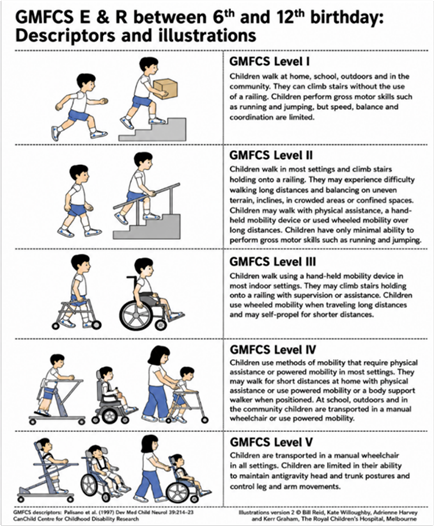
Gross Motor Function Classification System (GMFCS) [15] is another frequently used classification system to define motor level in children with CP. According to this system, gross motor skills of a person with CP are categorized into five levels. This scale was first described by Palisano in 1997. This system discriminates clinically meaningful distinctions in motor functions based on self-initiated movement and the use of assistive devices like walkers, wheelchairs, crutches, and canes during ADLs for mobility. Initially, it was designed for children aged 2-12 years of age of children with CP [3], but in 2007, after the expansion and revision of the scale, it also included children aged 12-18 years also [15]. Following is the description of all GMFCS levels based on the revised and expanded version of the scale in 2007.
GMFCS level I: An Individual classified in this level is able to walk without limitations. Children who are less than 2 years of age are able to crawl on hands and knees, pull to stand, cruise when holding onto furniture, and are able to walk independently between the ages of 18 months and 2 years. Children between 2 to 4 years of age are able to sit and can make transitions between sitting and standing independently. Between the ages of 4 and 6, an individual is able to walk indoors and outdoors independently and can climb stairs and start to run, and jump. Between ages 6 and 18, additionally child can walk up and down curbs, can ascend and descend stairs without a railing, walk community distances, and can run and jump (all these activities are done with some limitations).
GMFCS level-II: An individual classified in this level is able to walk with limitations, which include balance or endurance issues, use of a hand-held mobility device prior to age of 4, use of a railing on stairs, or an inability to run or jump. A person may be dependent on wheeled mobility for community distances. Child under the age of 2 can sit with upper extremity support, crawl on their stomach, and be able to pull to stand and cruise with support. Between ages 2 and 4, the child can transition into and out of sitting without support, can crawl on hands and knees, cruise with support, and walk with a mobility device. Between ages 4 and 6, a person can transition in and out of standing without support, walk short flat distances without an assistive device, can do stair climbing without the railing, but is unable to run or jump. From age 6-12, a person can walk in most terrain with limitations of distance or uneven surface, may use wheeled mobility for long distances, cannot run or jump independently, but can do stairs and the railing. Between ages 12 and 18, the abilities are the same as age 6 to 12, but a handheld mobility device may be used for safety.
GMFCS level-III: Individuals classified in this level who are less than 2 years of age can roll and occasionally crawl forward when lying on their stomach and can sit with some low back support. Between the ages of 2 and 4, children can crawl on his/her stomach or creep on all four limbs and may pull to stand and walk short distances using a handheld mobility device with some assistance for maneuvering. A child can also ‘W’ sit on the floor with some support. From age 4 to 6, a child can sit in a standard chair but may require extra support to allow upper extremity function, walk with a handheld mobility device, and do stairs with assistance. Typically, wheeled mobility is used for longer distances. Children from 6-12 years of age can walk with a handheld mobility device indoors and use wheeled mobility (either manual or powered) for distance. A child needs assistance to move between floors, sit and stand, and negotiate stairs with assistance. For 12-18-year-olds, additionally, more variability is demonstrated in primary mobility preference.
GMFCS level-IV: Individuals classified in this level before the age of 2 have head control and can roll, but require truncal support to sit. Between ages 2 and 4, a child in GMFCS IV can sit with upper extremity support, require assistance to transition into sitting, and may require adaptive equipment for standing or sitting. At this age, some self-mobility is possible via rolling or stomach crawling short distances, but reciprocal leg movement is not present. From age 4 to 6, adaptive equipment is required for trunk control to allow sitting and assistance to move between positions. Children may walk short distances with a mobility device and with assistance, and use wheeled mobility for distances, and/or be independent with powered mobility. Children between the ages of 6 to 18 require adapted seating and assistance with transfers, and utilize wheeled power mobility independently or manual mobility with assistance in most settings. Many children can have independent floor mobility with crawling or rolling, or may walk short distances with assistance.
GMFCS level-V: Individuals classified in this level before the age of 2 do not have independent head or trunk control and require assistance to roll. Between the ages of 2 and 4, a child has no independent movement and requires assistance for transport using manual mobility devices. Adaptive equipment is required for sitting and standing, but the function is still limited. It is possible to become independent using power mobility with additional adaptations. From age 4 onwards, the abilities of children in GMFCS V are stable, with a need for complete assistance with transfers emerging after age 6 (Fig. 1.1).
Methodology
Relevant data for this review were extracted manually from selected articles, including study design, sample characteristics, GMFCS levels, type of intervention, duration, outcome measures, and key findings. The interventions were then categorized based on their applicability to specific GMFCS levels (I to V) and grouped under active, assisted, and passive modalities. Emphasis was placed on both functional outcomes and sustainability of improvement across follow-up periods. This review was conducted as a narrative synthesis and did not involve meta- analysis.
Search Strategy, Data extraction and synthesis
This study employed a narrative review design to comprehensively synthesize evidence-based rehabilitation interventions for children with Cerebral palsy (CP), categorized according to the GMFCS levels I to V. The objective was to highlight effective, level-specific therapeutic strategies and assessment tools aligned with the ICF-CY framework, thus facilitating practical clinical application.
A systematic literature search was conducted manually across multiple electronic databases, including PubMed, Scopus, Web of Science, Cochrane Library, and Google Scholar. The search was limited to articles published in English from 2000 to 2024. The following keywords and MeSH terms were used in various combinations: "Cerebral palsy", "rehabilitation", "physical therapy", "GMFCS", "robot-assisted gait training", "functional electrical stimulation", "virtual reality therapy", "whole-body vibration", "strength training", "hippotherapy", and "gross motor function".
Inclusion Criteria
-
Studies involving children aged 0–18 years with spastic Cerebral palsy.
-
Studies that utilized validated assessment tools such as GMFM, PEDI, CPQoL, MAS, MTS, or 6MWT.
-
Randomized controlled trials (RCTs), controlled clinical trials, cohort studies, and systematic reviews.
-
Interventions that assessed motor function, mobility, balance, or QoL.
-
Articles that classified participants using GMFCS levels.
Exclusion Criteria
-
Non-English articles or those lacking full text.
-
Interventions not tailored to specific GMFCS levels.
-
Case reports, editorials, and expert opinions.
-
Studies involving adults or other neurological disorders.
Quality Appraisal
Although this is a narrative review, methodological quality of included studies was considered using a descriptive approach to assess study design rigor, sample size adequacy, and outcome validity. High-quality RCTs and longitudinal studies were given greater interpretative weight.
Rehabilitation Interventions Based on GMFCS
The effectiveness of interventions for Cerebral palsy varies significantly based on an individual’s GMFCS level. Each classification necessitates a tailored rehabilitation approach, as different therapies yield optimal outcomes depending on the degree of mobility limitation [51].
GMFCS Levels I and II: Maximizing Independent Mobility
For individuals classified as GMFCS Level I and II, who are capable of walking independently with minimal or no limitations [52,53]. Several interventions have shown promising results in improving mobility, balance, and muscle function [54,55]. These include task-specific training, virtual reality (VR)-based therapy, functional strength training (FST), treadmill training, and whole-body vibration therapy (WBVT).
Virtual Reality-Based Therapy
VR interventions, like Kinect games and the web-based therapy "Move it to Improve it" (Mitii), enhance postural control, fine motor coordination, and daily functional independence. Şahin et al. (2019) studied Kinect-based VR gaming on motor function in children with unilateral spastic Cerebral palsy (USCP). Sixty children (mean age 10.5 years) were split into two groups: one received VR plus traditional occupational therapy (TOT), while the other received TOT alone for eight weeks. Significant improvements in gross and fine motor skills were noted, with the VR group showing better daily living independence. In another study by James et al. (2015), 102 children (mean age 11.8 years) were divided between an intervention and a control group. The Mitii group showed notable enhancements in ADLs, motor skills, hand dexterity, and visual perception [56]. VR therapy is motivating and immersive, promoting motor learning and neuroplasticity through real-time feedback. It's particularly effective for improving upper limb function and fine motor skills, making it valuable for children with mild CP needing focused dexterity training.
Functional Strength Training
In addition to VR, Functional Strength Training (FST) has become essential for individuals with GMFCS Levels I and II to enhance muscle strength, endurance, and walking efficiency. A randomized controlled trial by Kaya Kara et al. (2019) showed that children with unilateral Cerebral palsy improved significantly in muscle power, gross motor function, walking distance, and dynamic balance through functional progressive strength and power training. FST includes progressive resistance exercises, plyometric drills, and lower-limb strengthening, boosting power during walking and postural control [55]. Although Fosdahl et al. (2019) found that isolated strength training doesn't directly improve gait mechanics, combining it with functional tasks like stair climbing and squatting significantly enhances dynamic balance, agility, and speed [57].
Treadmill and Partial body-weight-supported treadmill training
Some studies have emphasized other important interventions like treadmill training, particularly through overground treadmill walking and partial body-weight-supported treadmill training (PBWSTT) for these individuals. In a randomized controlled trial by Chrysagis et al. (2012) and Grecco et al. (2013), conducted on ambulatory adolescents and ambulatory children with spastic Cerebral palsy, respectively, treadmill-based therapy has been shown to enhance walking endurance, step length, and cadence, thereby enhancing overall gait efficiency and mobility independence [52,58]. Interestingly, the study also indicated that overground walking may offer comparable advantages to treadmill training, especially when combined with functional walking tasks in real-world settings. A trial by Cherng et al. (2007) suggests that PBWSTT is particularly beneficial for children transitioning from assisted to independent walking, as it significantly improved the children's gait (increases in stride length and decreases in double-limb support percentage of gait cycle) [59].
Whole-Body Vibration Therapy
WBVT has emerged as an effective neuromuscular stimulation technique for individuals classified as GMFCS I and II. Hegazy et al. (2021) studied the effects of WBV training alongside conventional physiotherapy on muscle strength, endurance, and power in children with hemiparetic Cerebral palsy. In their study, children aged 4 to 8 were divided into a control group (physiotherapy only) and a study group (physiotherapy plus WBV) for eight weeks. Results showed significantly greater improvements in the WBV group [53].
Transcranial Direct Current Stimulation
In electrotherapeutic interventions, Transcranial Direct Current Stimulation (tDCS) has also been proven effective for improving gait function in this population. Radwan et al. (2023) conducted a randomized clinical trial comparing the effects of tDCS and VR on improving gait in children with bilateral spastic Cerebral palsy aged between 7 and 12 years. Forty participants underwent either tDCS or VR training in conjunction with standard gait therapy for two weeks, followed by assessments after 10 weeks. Both groups demonstrated improvements in gait velocity, cadence, stance time, step length, and stride length. Notably, the tDCS group exhibited significantly greater enhancements in maximum force, peak pressure, and sustained improvements during follow-up, indicating that tDCS may offer a more lasting effect on gait function [60].
GMFCS Level III: Enhancing Supported Ambulation and Gait Efficiency
For those in GMFCS Level III, who can walk with assistive devices but face considerable challenges regarding endurance, balance, and coordination, interventions such as robot-assisted gait training (RAGT), functional electrical stimulation (FES), ankle-foot orthoses (AFOs), and hippotherapy (equine-assisted therapy) have proven more effective.
Robot-Assisted Gait Training (RAGT)
RAGT helps individuals with moderate mobility impairments practice walking with biomechanical support. Jin et al. (2020) conducted a study with 20 children, comparing 6 weeks of RAGT with standard care. Results showed significant improvements in standing, walking skills, mobility independence, and overall function, as well as increased muscle mass and reduced energy cost of walking [61]. In another prospective controlled study, Yazıcı et al. (2019) conducted a study on 24 children with hemiparetic Cerebral palsy to evaluate the effects of RAGT combined with physiotherapy. Over 12 weeks, the RGT group demonstrated significant improvements in walking speed, endurance, and muscle oxygenation, indicating enhanced aerobic capacity. These gains were better retained at a 3-month follow-up, suggesting RGT is effective for improving gait and functional performance in children with CP [62].
Functional Electrical Stimulation (FES)
FES uses electrical impulses to activate weakened muscles, improve gait, and reduce foot drop. Armstrong et al. (2019) conducted a randomized controlled trial on FES cycling, recreational cycling, and goal-directed functional training in children with CP, focusing on 40 children aged 6 to 8. Participants were divided into an intervention group receiving 8 weeks of supervised FES cycling and training, and a waitlist control group, to assess improvements in functional independence and mobility [63]. To further substantiate the hypothesis, Sansare et al. (2021) studied FES-assisted cycling compared to volitional cycling and a control group in children with spastic CP aged 10–18 over 8-weeks. While the FES group achieved higher cycling cadences post-intervention, there were no significant differences in peak oxygen uptake or heart rate. The study concluded that FES enhances motor coordination but suggests higher-intensity training for better cardiorespiratory benefits, while still promoting sustained physical activity in children with CP [64].
Orthotic Management
Additionally, ankle-foot orthoses (AFOs) offer external support to the lower extremities, decreasing excessive energy expenditure during walking and promoting proper foot positioning, which makes ambulation more efficient and less fatiguing. Bhise et al. (2016) studied the physiological cost index (PCI) of walking in children with spastic diplegic CP, comparing those with and without ankle-foot orthoses (AFOs) to healthy children. Their study of 41 children aged 6 to 18 found that using AFOs improved energy efficiency (lower PCI) but did not fully normalize gait [65]. In a separate study, Pasin Neto et al. (2017) conducted a randomized controlled trial with 24 children aged 4 to 12, comparing postural insoles to a placebo. The experimental group showed significant improvements in gait velocity, cadence, foot dorsiflexion, reduced knee flexion, and decreased internal rotation. However, these improvements diminished after the insoles were removed, suggesting continuous use is necessary for long-term benefits [66].
Hippotherapy
Hippotherapy, or equine-assisted therapy, serves as another valuable intervention for those at GMFCS Level III. Park et al. (2014) studied its effects on movement in children with CP. In their 8-week program, 92 children had 30-minute sessions twice a week. The hippotherapy group showed significant improvements in gross motor function and balance compared to the control group, especially in those with more moderate to severe conditions [67]. In a separate study, Lucena-Antón et al. (2018) looked at a 12-week hippotherapy program's effect on muscle tightness in 44 children with spastic CP. They were split into two groups: one received regular therapy, and the other received both hippotherapy and regular therapy. The hippotherapy group had significant reductions in the tightness of the hip adductor muscles. The study concluded that hippotherapy offers short-term benefits in alleviating muscle spasticity, making it a highly effective adjunct therapy for individuals with moderate Cerebral palsy [68].
Stationary Cycling
Fowler et al. (2010) conducted a randomized controlled trial (RCT) to investigate the impact of stationary cycling on muscle strength, locomotor endurance, and gross motor function in children with spastic diplegic Cerebral palsy. Sixty-two children aged 7 to 18 (GMFCS level I-III) were assigned to either a cycling intervention group or a control group for over 12 weeks. The cycling group demonstrated significant enhancements in locomotor endurance. However, there were no improvements in preferred walking speed. These findings suggest that while cycling can be beneficial for certain aspects of strength and endurance, further research is required to confirm its overall effectiveness [69].
GMFCS Level IV: Facilitating Passive Mobility and Preventing Complications
For individuals classified as GMFCS Level IV, who experience significant limitations in mobility and require assistive devices for movement, passive interventions such as robotic gait training, electrical stimulation, and WBVT have been proven more effective.
Robotic Gait Training
Although independent walking may not be achievable at this stage, RAGT serves a crucial role in supporting joint mobility and enhancing muscle tone. A randomized controlled trial conducted by Klobucka et al. (2020) examined the effects of RAGT on motor function in adolescents and young adults with bilateral spastic Cerebral palsy. The study included 47 participants, with a mean age of 21.2 years, who were randomly assigned to either receive 20 sessions of RAGT or conventional therapy. The results indicated that the RAGT group experienced significantly greater improvements in gross motor function across all dimensions, including standing, walking, running, and jumping, when compared to the control group. Remarkably, these improvements were sustained during a follow-up period of 3 to 4 months, suggesting that RAGT provides lasting benefits for motor function [70]. The structured movements facilitated by robotic gait systems encourage neuromuscular activation, thereby reducing the risk of disuse-related atrophy and contractures.
Whole-Body Vibration Therapy
WBVT effectively manages spasticity and improves circulation, enhancing lower limb activation and reducing muscle tightness. Cheng et al. (2015) conducted a randomized crossover trial with 16 children (mean age 9.2) to assess an 8-week WBV regimen. Results showed significant reductions in spasticity and increased active knee range of motion (ROM) and mobility, effects lasting up to three days post-intervention [71]. Ahlborg et al. (2006) compared WBV training to resistance training (RT) in adults with spastic diplegic CP (ages 21 to 41) in an 8-week study. WBV significantly reduced knee extensor spasticity and improved gross motor function, while RT improved strength at lower velocities. Ultimately, the research indicated that regular WBVT sessions enhance muscle strength, flexibility, and postural control, improving comfort and physical function for individuals with mobility constraints [72].
Functional Electrical Stimulation
FES therapy in GMFCS Level IV is primarily employed for neuromuscular maintenance, preventing muscle atrophy, and improving foot clearance during supported standing or assisted walking [63,64].
GMFCS Level V: Prioritizing Comfort, Postural Support, and Prevention of Complications
At GMFCS Level V, where voluntary mobility is severely limited and individuals depend entirely on external support, interventions primarily focus on preventing musculoskeletal complications, reducing spasticity, and maintaining posture. In this context, virtual reality robot-assisted therapy plays a crucial role in facilitating passive mobilization. While motor function gains are limited, postural control and spasticity reduction are noted, especially with neuromuscular electrical stimulation (NMES) and weight-bearing therapy [54].
Conclusion
Overall, the selection of interventions for individuals with Cerebral palsy should be highly personalized, considering their GMFCS level, functional goals, and specific movement restrictions. While active task-based training, virtual reality therapy, and strength training tend to be more effective for those with mild CP, individuals with moderate to severe impairments often derive greater benefits from robotic gait training, electrical stimulation, and supportive assistive devices. A multidisciplinary approach, involving physical therapists, occupational therapists, and specialists in assistive technology, is crucial to ensure that each person receives tailored interventions that address their unique needs. Personalized interventions informed by robust evidence hold the potential to enhance functional independence, QoL, and sustained physical well-being for individuals with CP.
Declarations
Author contribution
AG: concept, study design, literature search, and writing the first draft of the manuscript, KS- concept, review of literature, manuscript review, and finalization, SC – manuscript framework and editing, literature search strategy, manuscript editing, and finalization, SSH – literature search strategy, manuscript editing, and finalization, CK- literature search strategy, manuscript editing, and finalization, HSC-literature search strategy, manuscript editing, and finalization.
Funding
Nil
Conflicts of interest
Nil
Ethical Considerations
As this review was based on secondary data from previously published studies, no ethical approval was required. However, all efforts were made to appropriately cite original sources and maintain academic integrity.