
Abstract
Community-based savings groups (CBSGs) have emerged as a critical mechanism for building household economic resilience across low- and middle-income countries, yet research in this domain remains fragmented across disciplines, geographies, and methodological traditions. This study offers a comprehensive synthesis of how schol- arship at the CBSG resilience interface has developed over three decades.Using a dual- method approach combining bibliometric mapping with systematic content analysis of 223 Scopus-indexed publications (1996–2025), this study maps the structural evolu- tion of CBSG scholarship and identifies the mechanisms, moderators, and conceptual gaps that characterise the field. This review advances a central argument, the field has systematically operationalised CBSGs as financial inclusion instruments rather than resilience-building mechanisms, a conceptual misalignment that limits the validity of effectiveness claims.The findings reveal: (1) a three-phase publication trajectory ac- celerating sharply after 2018; (2) four interconnected resilience-building mechanisms financial, social, psychological, and institutional; and (3) gender and rural-urban setting as dominant contextual moderators. Emerging thematic frontiers in climate resilience, digital financial services, and longitudinal impact evaluation represent priority direc- tions for future research. By synthesising these findings, this study advances a coherent framework for understanding how CBSGs contribute to household economic resilience and offers a consolidated evidence base for researchers, practitioners, and policymakers working at the intersection of community finance and social protection.
Keywords
community-based savings groups VSLA ROSCA SACCO VICOBA house- hold economic resilience financial inclusion social capital microfinance.
Abstract
Community-based savings groups (CBSGs) have emerged as a critical mechanism for building household economic resilience across low- and middle-income countries, yet research in this domain remains fragmented across disciplines, geographies, and methodological traditions. This study offers a comprehensive synthesis of how scholarship at the CBSG resilience interface has developed over three decades. Using a dual-method approach combining bibliometric mapping with systematic content analysis of 223 Scopus-indexed publications (1996–2025), this study maps the structural evolution of CBSG scholarship and identifies the mechanisms, moderators, and conceptual gaps that characterize the field. This review advances the argument that the field has systematically operationalized CBSGs as financial inclusion instruments rather than resilience-building mechanisms, a conceptual misalignment that limits the validity of effectiveness claims. The findings reveal: (1) a three-phase publication trajectory accelerating sharply after 2018; (2) four interconnected resilience-building mechanisms: financial, social, psychological, and institutional; and (3) gender and rural-urban setting as dominant contextual moderators. Emerging thematic frontiers in climate resilience, digital financial services, and longitudinal impact evaluation represent priority directions for future research. By synthesizing these findings, this study advances a coherent framework for understanding how CBSGs contribute to household economic resilience and offers a consolidated evidence base for researchers, practitioners, and policymakers working at the intersection of community finance and social protection.
Keywords: community-based savings groups; VSLA; ROSCA; SACCO; VICOBA; household economic resilience; financial inclusion; social capital; microfinance.
1. Introduction
Household economic resilience, defined as the capacity of families to absorb financial shocks, adapt to adverse conditions, and sustain livelihoods over time, has emerged as one of the most urgent concerns in development economics and social policy. In low- and middle-income countries, where formal social protection systems remain underdeveloped and financial exclusion is widespread, community-based savings groups (CBSGs) have become a vital alternative mechanism for building economic security at the household level. These groups, encompassing Village Savings and Loan Associations (VSLAs), Rotating Savings and Credit Associations (ROSCAs), Accumulating Savings and Credit Associations (ASCAs), Self-Help Groups (SHGs), and cooperative models such as VICOBAs and SACCOs, collectively represent a grassroots infrastructure of financial intermediation that operates largely outside formal banking systems.
Community-based savings groups have historically served as both engines of financial inclusion and major contributors to household welfare. Since their documented expansion across Sub-Saharan Africa, South Asia, and Southeast Asia in the 1990s and 2000s, savings groups have been associated with improvements in consumption smoothing, access to credit, agricultural investment, nutrition, and social capital formation [2, 15]. They are now increasingly viewed as part of the solution to economic vulnerability, supporting livelihood diversification, advancing women's empowerment, and enhancing community-level resilience to economic and climatic shocks. Despite their growing importance, however, research on the effectiveness of CBSGs remains scattered across disciplines, geographies, and methodological traditions. Many studies focus on specific outcomes such as savings behavior, food security, or entrepreneurship without situating these findings within a consolidated framework of household economic resilience. Others examine individual group models in isolation, limiting the comparability and broader applicability of their conclusions.
To address this fragmentation, the current study undertakes a dual-method systematic literature review (SLR) with bibliometric analysis guided by the protocol recommended by [62] and operationalized through the Thematic-Conceptual Framework of [5]. The analysis of community-based savings groups and household economic resilience identified 223 studies from Scopus. By consolidating empirical and conceptual evidence across diverse settings and group types, this study seeks to establish a coherent understanding of how CBSGs contribute to household economic resilience, through which mechanisms this contribution occurs, and under what contextual conditions it is most or least effective.
The conceptual foundation of this study draws on two complementary theoretical perspectives. Resilience Theory frames households as adaptive systems capable of absorbing and recovering from economic shocks while maintaining core livelihood functions [16]. Social Capital Theory complements this by emphasizing the role of network-based trust, reciprocity, and collective action precisely the dynamics that savings groups institutionalize as enablers of financial and non-financial resilience.
1.1 Community-based savings groups and the financial inclusion imperative
Financial exclusion remains a structural constraint on household welfare across much of the developing world. Formal financial institutions face significant barriers to serving rural and low-income populations, including high transaction costs, limited collateral, seasonal income variability, and systemic risks such as drought and disease [15]. Community-based savings groups have emerged as a pragmatic and culturally embedded response to these structural constraints. By pooling small, regular contributions among trusted community members, groups such as VSLAs provide access to credit, insurance-like support during emergencies, and a disciplined savings environment that formal banks rarely replicate at the local level. Evidence from multiple contexts confirms that membership in CBSGs increases household asset ownership, expands access to productive inputs, and reduces dependence on exploitative informal moneylenders [24, 37].
In Tanzania specifically, localized savings models including VICOBA groups, chama groups, and informal rotating funds have become foundational components of rural financial life, particularly for women and smallholder farming households.
1.2 Mechanisms and outcomes
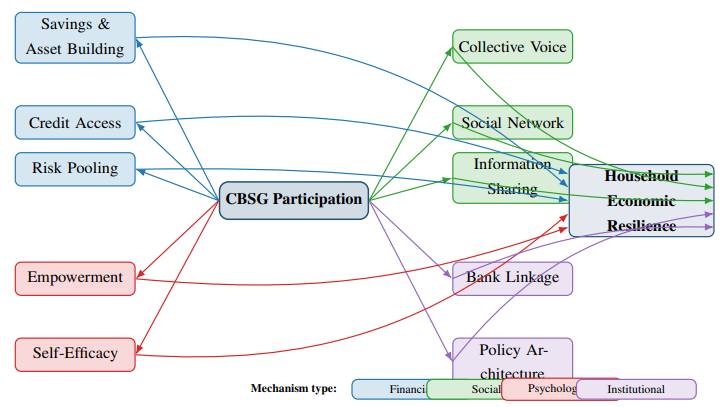
Research suggests that the effectiveness of CBSGs operates through multiple, often interacting mechanisms. Financially, membership enables savings accumulation, credit access, and investment in livelihood activities. Socially, the group structure fosters trust, mutual accountability, and information sharing, which in turn reduce transaction costs and strengthen adaptive capacity. Psychologically, regular participation builds financial confidence, savings discipline, and a sense of agency among members, particularly women, in patriarchal contexts [41]. Institutionally, groups function as platforms through which members gain exposure to financial literacy, linkage with formal financial services, and collective bargaining power vis-à-vis markets and service providers. However, the literature also documents inhibiting factors: exclusion of the poorest households, elite capture, group dissolution following external shocks, and the limited sustainability of groups that depend heavily on NGO facilitation [10]. These contradictions underline the importance of examining not only whether savings groups work, but how, for whom, and under what conditions.
1.3 Research Gaps and Rationale for the Review
Despite substantial growth in the literature over the past two decades, research on CBSGs and household economic resilience remains characterized by three persistent limitations. Disciplinarily: studies in economics tend to focus on quantifiable outcomes such as savings amounts and income changes, while sociological and anthropological work emphasizes social dynamics and empowerment processes, with limited cross-disciplinary dialogue [19]. Geographically: the evidence base is disproportionately concentrated in South Asia, particularly India, which accounts for 187 author affiliation instances in this corpus with comparatively thin coverage of Latin America, Southeast Asia, and other sub-Saharan African contexts beyond the established VSLA literature [32]. Theoretically: while resilience is frequently invoked as an outcome, few studies operationalize it rigorously or situate group-level interventions within a comprehensive household resilience framework [26, 31]. This review addresses these gaps by applying a systematic, transparent, and reproducible search and synthesis methodology, drawing on the protocols of [62] and the editorial guidance of [25], to construct concept-centric rather than study-centric conclusions that cut across disciplines, geographies, and group types.
1.4 Research Questions
Driven by the need to consolidate fragmented empirical evidence and promote a systemic understanding of how community-based savings groups contribute to household economic resilience across diverse socioeconomic contexts, this study explores four research questions:
RQ1: How has research on community-based savings groups and household economic resilience evolved over time, and what are its main methodological and geographic trends?
RQ2: Through which financial, social, psychological, and institutional mechanisms do community-based savings groups influence household economic resilience?
RQ3: Which contextual and structural factors affect the effectiveness of community-based savings groups across different populations and settings?
RQ4: What are the major gaps and contradictions in the current literature, and what areas should future research priorities?
By systematically answering these questions through a rigorous and transparent systematic literature review process, this study consolidates dispersed research streams, identifies conceptual and methodological gaps, and offers evidence-based insights for researchers, practitioners, policymakers, and development actors working at the intersection of community finance, social protection, and household economic resilience. The remainder of this paper is organized as follows. Section 2 describes the dual-method design. Sections 3.1–3.4 present findings for RQ1–RQ4 respectively. Section 4 discusses theoretical and policy implications. Section 5 concludes with a consolidated research agenda.
2. Methodology
This study uses a systematic literature review (SLR) method [53], supported by bibliometric analysis, to examine the evolving research landscape at the intersection of community-based savings groups and household economic resilience. The objective goes beyond compiling previous studies; it aims to reveal publication trends, thematic structures, and intellectual linkages shaping how savings groups contribute to economic resilience outcomes [23]. To guide this process, the analysis adopts the Thematic Conceptual Map (TCM) framework, which offers an integrative perspective for understanding how knowledge in this domain has developed both conceptually and methodologically over time. The TCM framework functions not only as a mapping tool but also as a structured analytical device that traces the progression of research themes across several decades. It interprets community-based savings groups as socio-economic institutions that adapt, transform, and co-evolve in response to household-level financial pressures and broader developmental imperatives [5].
2.1 Data Sources and Search Strategy
Data were collected from Scopus, a multidisciplinary academic database chosen for its global coverage, strict citation indexing, and relevance to economics, social sciences, business, and development studies. Comprehensive search strings were developed using Boolean operators ("AND," "OR") and applied to the Title-Abstract-Keywords field (TITLE-ABS-KEY) in Scopus to ensure accuracy, completeness, and broad coverage of relevant literature. The final search string was:
TITLE-ABS-KEY (((("community-based savings group" OR "savings group" OR "village savings and loan association" OR "VSLA" OR "ROSCA" OR "rotating savings and credit association*" OR "VICOBA" OR "SACCO" OR "savings and credit cooperative" OR "self-help group" OR "accumulating savings and credit association" OR "ASCA" OR "informal savings group" OR "community savings scheme" OR "solidarity group" OR "table banking" OR "merry-go-round" OR "tontine" OR "susu" OR "chama") AND ("household economic resilience" OR "economic resilience" OR "financial resilience" OR "livelihood resilience" OR "economic vulnerability" OR "poverty reduction" OR "household income" OR "financial inclusion" OR "economic empowerment" OR "financial security" OR "economic stability" OR "income smoothing" OR "consumption smoothing" OR "asset accumulation" OR "household welfare" OR "financial capability" OR "economic coping" OR "shock absorption" OR "adaptive capacity" OR "household food security" OR "income diversification")) AND (EXCLUDE (PUBYEAR, 2026)) AND (LIMIT-TO (SUBJAREA, "SOCI") OR LIMIT-TO (SUBJAREA, "ECON") OR LIMIT-TO (SUBJAREA, "BUSI") OR LIMIT-TO (SUBJAREA, "ARTS")) AND (LIMIT-TO (DOCTYPE, "ar")) AND (LIMIT-TO (PUBSTAGE, "final")) AND (LIMIT-TO (SRCTYPE, "j")) AND (LIMIT-TO (LANGUAGE, "English"))
2.2 Data Collection and Screening Procedures.
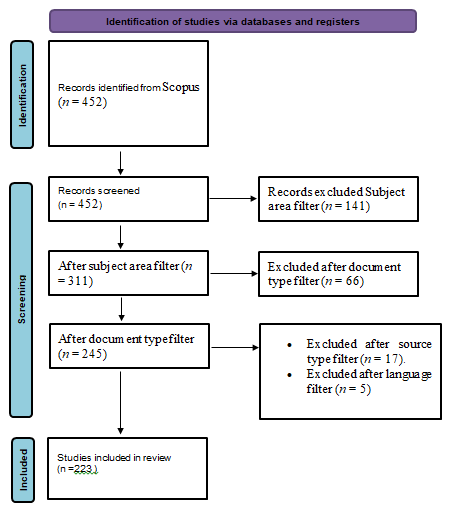
The data selection and screening processes adhered to the PRISMA 2020 protocol [52], which standardizes the steps of identification, screening, eligibility, and inclusion. The PRISMA 2020 flow diagram (Figure 1) illustrates these sequential stages and promotes methodological transparency. This systematic review was not prospectively registered in PROSPERO or any other public review registry.
Our search identified documents in Scopus published from 1996 to 2025. The first publication year retained in the analysis is 1996, as this marks the inaugural indexed contribution directly linking community-based savings mechanisms to household economic outcomes following the proliferation of microfinance and savings group models across Sub-Saharan Africa and South Asia. The year 2026 was excluded because the calendar year was not complete at the time of data retrieval, thus precluding a full representation of annual publication output.
We searched for documents on Scopus based on article titles, abstracts, and keywords, identifying 452 documents, and applied stepwise filters to narrow our sample of published articles in this field. The filtering procedure proceeded as follows: subject area restriction to Social Sciences, Economics, Econometrics and Finance, Business, Management and Accounting, and Arts and Humanities; limitation to articles; limitation to the final publication stage to eliminate unpublished or in-press research; limitation to journal sources; and further limitation to English-language publications. As a result, we exported 223 documents as the final bibliometric dataset. This dataset was retrieved and finalized on 23 April 2026, which serves as the explicit cutoff date for this study. PRISMA 2020 Flow Diagram Figure 1 presents the PRISMA 2020 flow diagram illustrating the complete record identification, screening, and inclusion process.
2.3 Bibliometric Analysis
Bibliometric mapping and visualization were performed using Biblioshiny, the graphical
user interface of the Bibliometrix R package (Version 4.3.2) [5]. Bibliometrix is a widely
adopted open-source tool for comprehensive science mapping analysis, enabling the detection of co-occurring keywords, thematic clusters, and patterns of conceptual development across large bibliographic datasets [5, 23].
The analysis employed the Thematic- Conceptual Map (TCM) framework, operationalized through the co-word analysis function within Bibliometrix [5]. The TCM classifies research themes into four quadrants based on two dimensions: centrality, which measures the degree of interaction between a theme and other themes in the network and thus reflects its importance to the field; and density, which measures the internal cohesion of a theme and reflects its level of development. The resulting quadrants are interpreted as follows: motor themes (high centrality, high density) represent well-developed and central research areas that drive the field; basic themes (high centrality, low density) are important but underdeveloped; niche themes (low centrality, high density) are specialized and internally coherent but peripheral; and emerging or declining themes (low centrality, low density) represent nascent or fading research frontiers.
Industrial relevance within these clusters was identified through a structured, step-by-step
analytical workflow. Beginning at the cluster level, savings-group- and resilience-related keywords were extracted from the bibliometric network. These clusters were then cross-checked with highly cited papers to validate their conceptual focus. Subsequently, keywords and article titles were examined for sector-specific terminology encompassing rural livelihoods, microfinance, gender empowerment, poverty reduction, food security, and financial inclusion. This process isolated themes directly linked to community-level economic activities. The refined clusters were then mapped back to their respective TCM quadrants to evaluate their maturity and centrality, and the final stage consolidated these classifications into the overall TCM output.
To supplement the quantitative bibliometric mapping, a systematic content analysis of titles, abstracts, and keywords was performed across all 223 included articles. This content analysis served two purposes: first, to offer interpretive insight into the conceptual patterns identified through bibliometric analysis; and second, to code each article for the presence of mechanism relevant content spanning financial, social, psychological, and institutional pathways through which community-based savings groups influence household economic resilience. Mechanism categories were identified using a structured keyword dictionary developed deductively from the theoretical frameworks outlined in Section 3.2.8 and refined inductively through an initial pilot reading of 20 articles.
To assess the reliability of the abstract-level mechanism coding, a 10% random sample (n = 22) of the included articles was independently coded by a second researcher using the same keyword dictionaries. Inter-rater agreement was κ = 0.63, indicating substantial agreement [43], which meets the threshold recommended for systematic review content analysis [47]. Discrepancies were resolved through discussion and consensus, and the keyword dictionary was refined accordingly before full corpus coding was completed.
Combining bibliometric mapping with systematic content analysis aligns with best practices for multimethod systematic review design, enhancing both analytical validity and interpretive clarity [5, 23]. This integrated approach provides a multidimensional view of how savings groups contribute to household economic resilience, capturing both the structural growth trajectory of the field and the conceptual mechanisms through which CBSG effectiveness has been theorized and empirically examined.
2.4 Inclusion and Exclusion Criteria
Table 1 summarizes the inclusion and exclusion criteria applied during the screening process.
| Criterion | Inclusion | Exclusion |
|---|---|---|
| Publication type | Peer-reviewed journal articles and review articles | Conference papers, book chapters, editorials, notes, preprints, and other non-peer-reviewed publications |
| Language | English | Non-English |
| Subject area | Social Sciences; Economics, Econometrics and Finance; Business, Management and Accounting; Arts and Humanities | All other subject areas outside the specified fields |
| Publication stage | Final/published | In-press, preprint, or uncorrected proof |
| Thematic relevance | Studies examining community-based savings groups and at least one dimension of household economic resilience, financial inclusion, or livelihood outcomes | Studies unrelated to savings groups or purely technical/financial engineering studies without a community focus |
| Time span | 1996–2025 (excluding 2026) | Publications before 1996; publications from 2026 onward |
3 Result
3.1 Bibliometric Overview of the Literature (RQ1)
3.1.1 Overview of the Literature
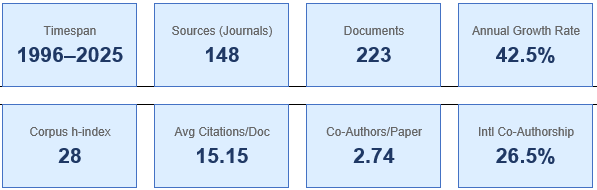
Figure 2 presents the headline bibliometric profile of the corpus. The dataset spans three decades of published research (1996-2025), encompasses contributions from 148 unique source journals, and is authored by approximately 370 researchers. The average number of co-authors per paper is 2.74, reflecting a moderately collaborative research culture typical of applied development economics [23]. The corpus attains an h-index of 28, meaning that 28 articles have each attracted at least 28 citations, which is indicative of a maturing field with a recognized body of landmark contributions. The mean citation count per document is 15.15 (median = 5.0), revealing a pronounced right-skewed distribution consistent with Bradford’s Law of Scattering [11], in which a small number of seminal works commands disproportionate scholarly attention. The annual growth rate of 42.5% averaged across the entire publication window, although influenced by the very low baseline of the early years, signals an accelerating research trajectory that is examined in detail below.
3.1.2 Annual Scientific Production and Growth Trajectory
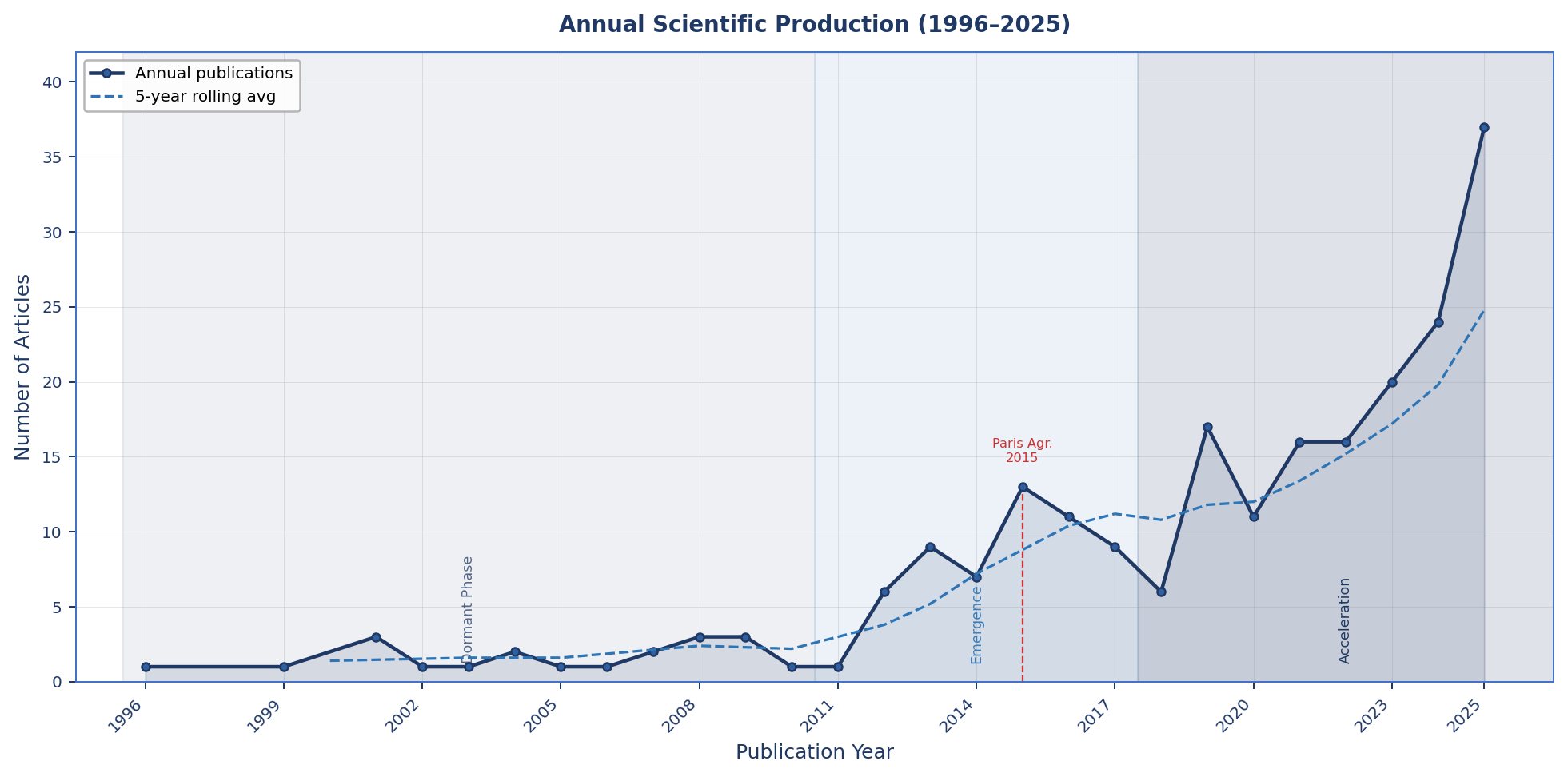
The annual production curve (Figure 3) reveals a clearly phased growth trajectory. During the Dormant phase (1996-2010), the corpus contains only 20 articles across 14 years, with several years recording a single publication. This sparse output reflects the position of CBSG research at the margins of mainstream development economics: while rotating savings and credit associations (ROSCAs) and self-help groups (SHGs) had been studied ethnographically since the 1970s [4, 28], systematic, indexed scholarship linking these mechanisms to household economic outcomes was rare before the 2010s. The earliest indexed article [44], examining ROSCA participation in Taiwan, is notable both for its longevity (66 citations) and for framing the field’s initial quantitative orientation.
The Emergence phase (2011-2017, n = 56) marks a structural inflection. Annual output rises from one article in 2010 to nine in 2013 and thirteen in 2015. Several convergent forces explain this acceleration. India’s SHG-Bank Linkage Programmed, launched in 1992, began generating evaluable large-scale data by the early 2010s [20, 21]. Simultaneously, the global expansion of Village Savings and Loan Associations (VSLAs) in sub-Saharan Africa, facilitated by CARE International and other NGOs, generated a new stream of field-based evidence [1]. The publication of landmark impact evaluations during this period [8, 24] also elevated the credibility of informal savings mechanisms as subjects of rigorous econometric inquiry.
The Acceleration phase (2018-2025) accounts for 147 articles (65.9% of the corpus), with output climbing from 6 articles in 2018 to a record 37 in 2025. The 2019 surge (17 articles) followed the release of the Global Findex Database 2017 [22], which mainstreamed financial inclusion as an empirical priority. The post-2020 rise reflects both the COVID-19 pandemic’s disruption of household economies in the Global South, which heightened policy interest in community-based safety nets [39] and the broader proliferation of open-access publishing that lowered barriers to indexed dissemination. Table 2 provides a structured comparison of the three growth phases.
| Phase | Years | Articles | % Corpus | Mean Citations | Dominant Focus |
|---|---|---|---|---|---|
| Dormant | 1996–2010 | 20 | 9.0% | 50.55 | Informal finance theory |
| Emergence | 2011–2017 | 56 | 25.1% | 17.34 | SHG impact evaluation |
| Acceleration | 2018–2025 | 147 | 65.9% | 9.50 | Financial inclusion, gender |
| Total | 1996–2025 | 223 | 100% | 15.15 | — |
Note. Mean citations computed from Scopus citation counts as of 23 April 2026. The inverse relationship between recency and citation counts is expected given publication age [23]
3.1.3 Geographic Distribution of Research Production
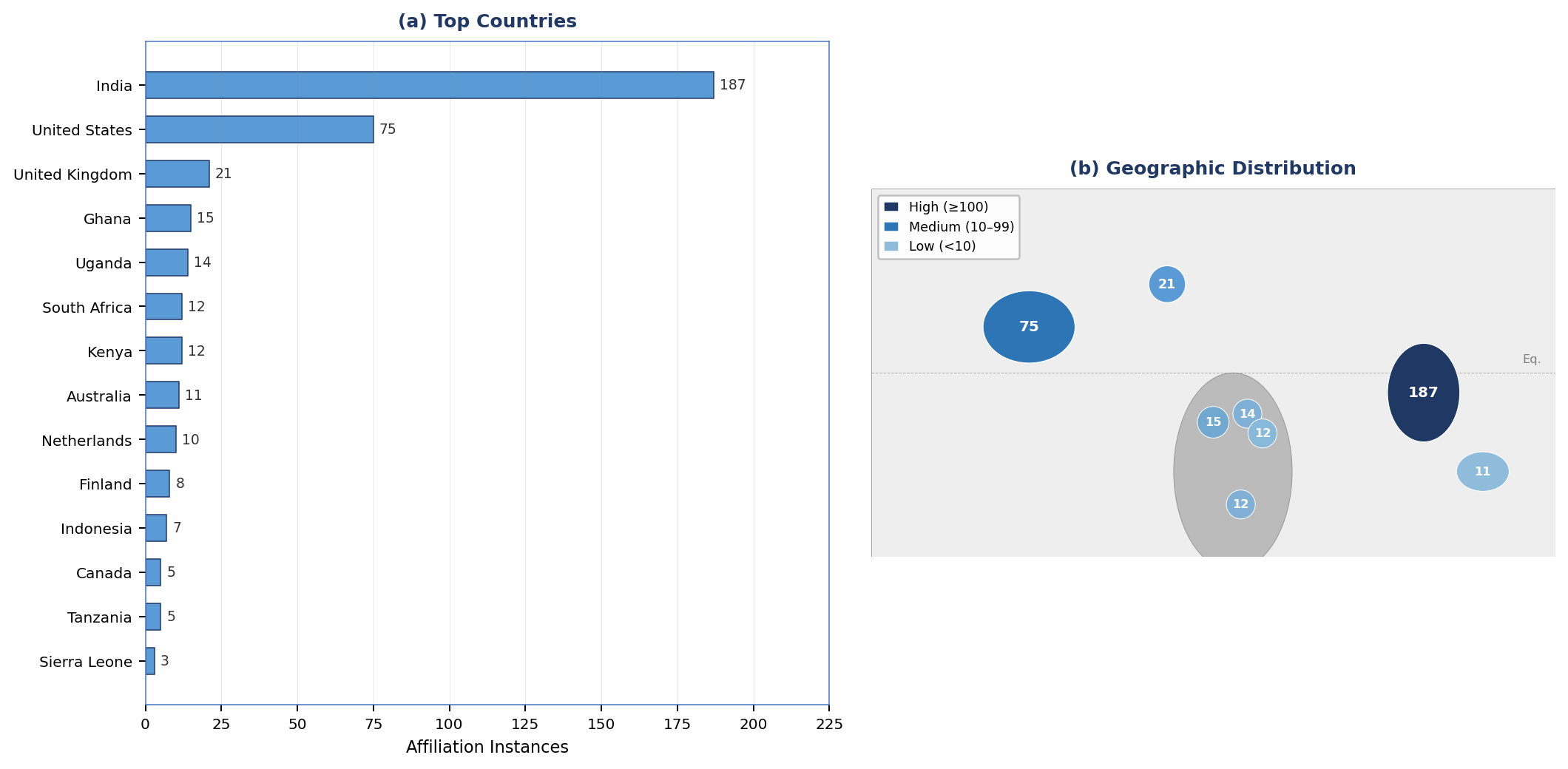
The geographic analysis reveals a pronounced concentration of CBSG scholarship in two regions: South Asia (led by India with 187 affiliation instances) and sub-Saharan Africa (Ghana 15, Uganda 14, South Africa 12, Kenya 12, Tanzania 5). India’s dominance is not simply a function of national publication volume; it reflects the extraordinary scale of its SHG-Bank Linkage Programme, which by 2023 had enrolled over 120 million women in approximately 12 million groups [49]. The academic ecosystem surrounding this programme, including dedicated journals (Indian Journal of Finance, Indian Journal of Economics and Development) and a large network of institutional researchers, has generated a self-reinforcing publication cycle.
The United States (75 instances) and the United Kingdom (21) rank second and third respectively, yet the nature of their engagement differs fundamentally from that of producing countries. North American and European researchers predominantly conduct studies about CBSG contexts in the Global South rather than investigating domestic informal savings mechanisms, consistent with broader patterns of North-South knowledge production in development studies [19]. This asymmetry, wherein the countries hosting the clear majority of CBSG members contribute proportionally fewer publications, constitutes a structural bias in the knowledge base, privileging institutional and analytical frameworks developed in high-income country universities.
International co-authorship was recorded for 59 articles (26.5%), which, while not negligible, is substantially below the benchmarks observed in natural science bibliometric studies. The low rate of South–South co-authorship (e.g., between India and sub-Saharan Africa, two regions with directly comparable CBSG ecosystems) is particularly notable and points to fragmented scholarly networks across contexts that could learn substantially from each other.
| Journal | Articles | Cum. % | h-index | Zone |
|---|---|---|---|---|
| Enterprise Development and Microfinance | 9 | 4.0 | 4 | Core |
| Development in Practice | 8 | 7.6 | 3 | Core |
| World Development | 7 | 10.8 | 5 | Core |
| Journal of Rural Development | 7 | 13.9 | 3 | Core |
| Journal of Asian and African Studies | 5 | 16.1 | 2 | Core |
| Global Social Welfare | 4 | 17.9 | 2 | Core |
| Journal of Development Economics | 4 | 19.7 | 3 | Core |
| Annals of Public and Cooperative Economics | 3 | 21.1 | 2 | Core |
| European Journal of Development Research | 3 | 22.4 | 2 | Core |
| Indian Journal of Finance | 3 | 23.8 | 1 | Core |
| Indian Journal of Economics & Development | 3 | 25.1 | 1 | Zone 2 |
| International Journal of Rural Management | 3 | 26.5 | 1 | Zone 2 |
| Journal of Enterprising Communities | 3 | 27.8 | 2 | Zone 2 |
| African J. Food, Agriculture, Nutrition | 3 | 29.2 | 1 | Zone 2 |
| OIDA Intl J. Sustainable Development | 3 | 30.5 | 1 | Zone 2 |
| All others (n ≈ 133 journals) | 155 | 100 | - | Zone 3 |
Note. Bradford’s Law identifies three zones each contributing approximately one-third of the total publication volume. The Core zone contains the fewest but most productive journals; Zone 3 contains the largest number of journals producing the remaining third of the literature.
Bradford’s Law analysis (Table 3) reveals that just 17 journals constitute the core zone, producing approximately 32% of all publications. The presence of World Development and the Journal of Development Economics two of the highest-impact outlets in development economics with Cite Score rankings in the top decile confirms the integration of CBSG research into the mainstream of the discipline. However, the core zone is also populated by specialized microfinance and rural development journals, many of which carry modest impact factors. The substantial scatter across 133 peripheral journals reflects the interdisciplinary nature of the field, spanning economics, sociology, public health, and rural development, but also signals a fragmentation that impedes cumulative knowledge building [64]
3.1.4 Dominant Methodological Approaches
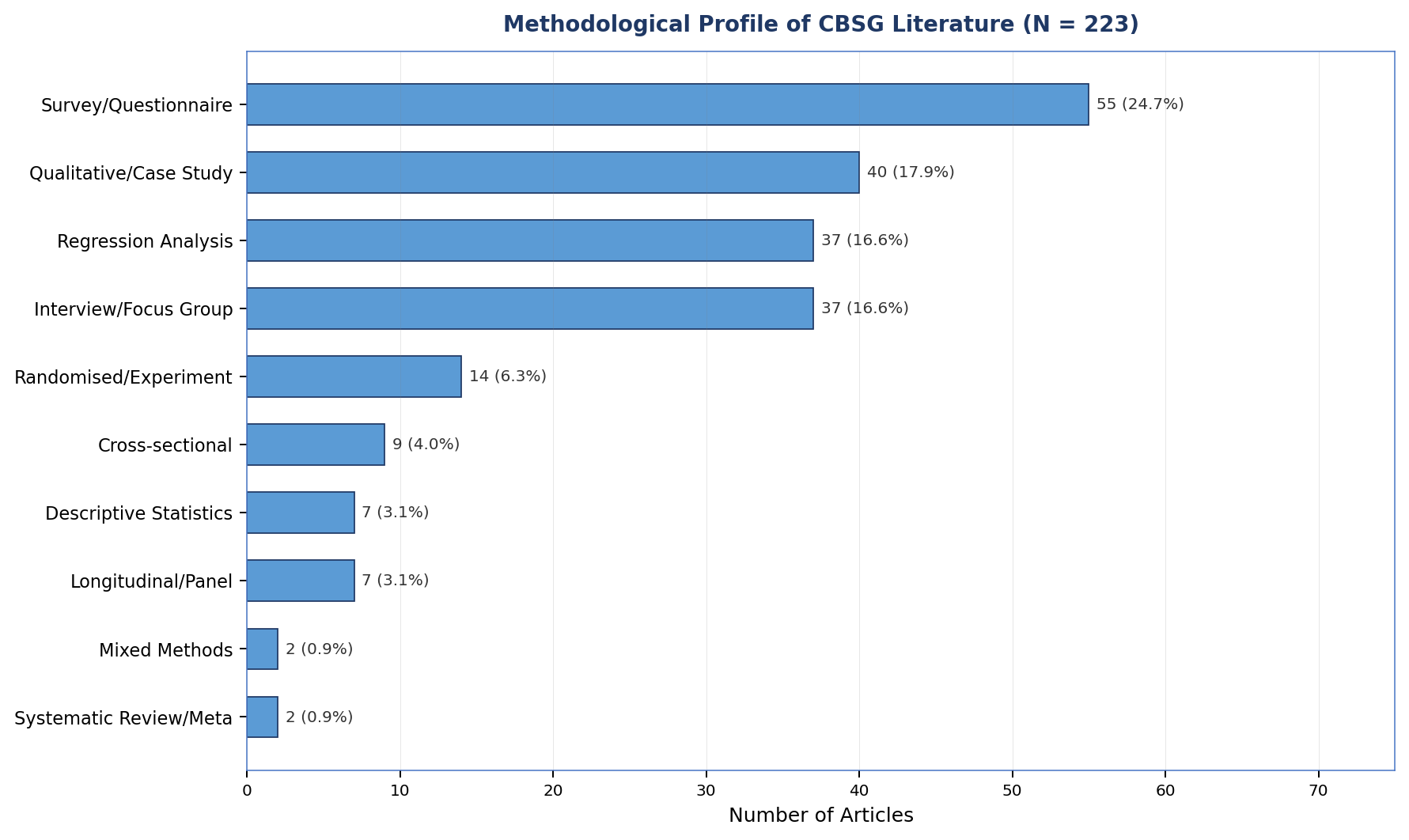
The methodological landscape is characterized by three dominant approaches. Survey-based research is the most prevalent (55 articles, 24.7%), reflecting the tradition of household-level data collection that underpins applied development economics. Qualitative and case study designs (40 articles, 17.9%) constitute the second-largest strand, consistent with the field’s origins in community development practice, where thick description of group dynamics and social processes is valued over generalization [63]. Regression analysis appears in 37 articles (16.6%), primarily as a mode of analyzing cross-sectional household survey data, with ordinary least squares, probit, and logistic specifications being most common.
Three methodological gaps stand out with theoretical significance. First, longitudinal and panel data designs appear in only 7 articles (3.1%). This is a critical limitation given that economic resilience, the construct at the center of this review, is inherently a dynamic, time dependent capacity: the ability to absorb shocks, adapt, and recover over time [26, 31]. Measuring resilience with cross-sectional data is methodologically analogous to measuring velocity with a single position observation. Second, randomized controlled trials and quasiexperimental designs appear in just 14 articles (6.3%), suggesting that the causal evidence base for CBSG effectiveness remains thin despite the field’s policy influence [8, 38]. Third, mixed methods design, which can capture both the quantitative magnitude and qualitative mechanisms of impact account for only 2 articles (0.9%), representing a near-complete absence of methodological integration.
These patterns carry direct implications for the literature’s capacity to answer causal questions. As [48] argues, causal inference in social interventions requires either experimental variation or longitudinal observation; the CBSG literature currently provides neither in enough quantity. The dominance of cross-sectional surveys also means that reverse causality more resilient households selecting into savings groups rather than savings groups producing resilience cannot be ruled out in most published studies.
| Method Category | Articles | % | Evidence Type | Causal Strength |
|---|---|---|---|---|
| Survey/Questionnaire | 55 | 24.7 | Associational | Low |
| Qualitative/Case Study | 40 | 17.9 | Descriptive | Low |
| Regression Analysis | 37 | 16.6 | Associational | Low–Medium |
| Interview/Focus Group | 37 | 16.6 | Descriptive | Low |
| Randomised/Experiment | 14 | 6.3 | Causal | High |
| Cross-sectional Survey | 9 | 4.0 | Associational | Low |
| Descriptive Statistics | 7 | 3.1 | Descriptive | Low |
| Longitudinal/Panel | 7 | 3.1 | Causal/Associational | Medium |
| Mixed Methods | 2 | 0.9 | Mixed | Medium |
| Systematic Review/Meta | 2 | 0.9 | Synthesising | High |
| Note. Causal strength assessed against Shadish et al. (2002) quasi-experimental design criteria. Categories are not mutually exclusive; one article may employ multiple methods. |
3.1.5 Thematic Conceptual Map
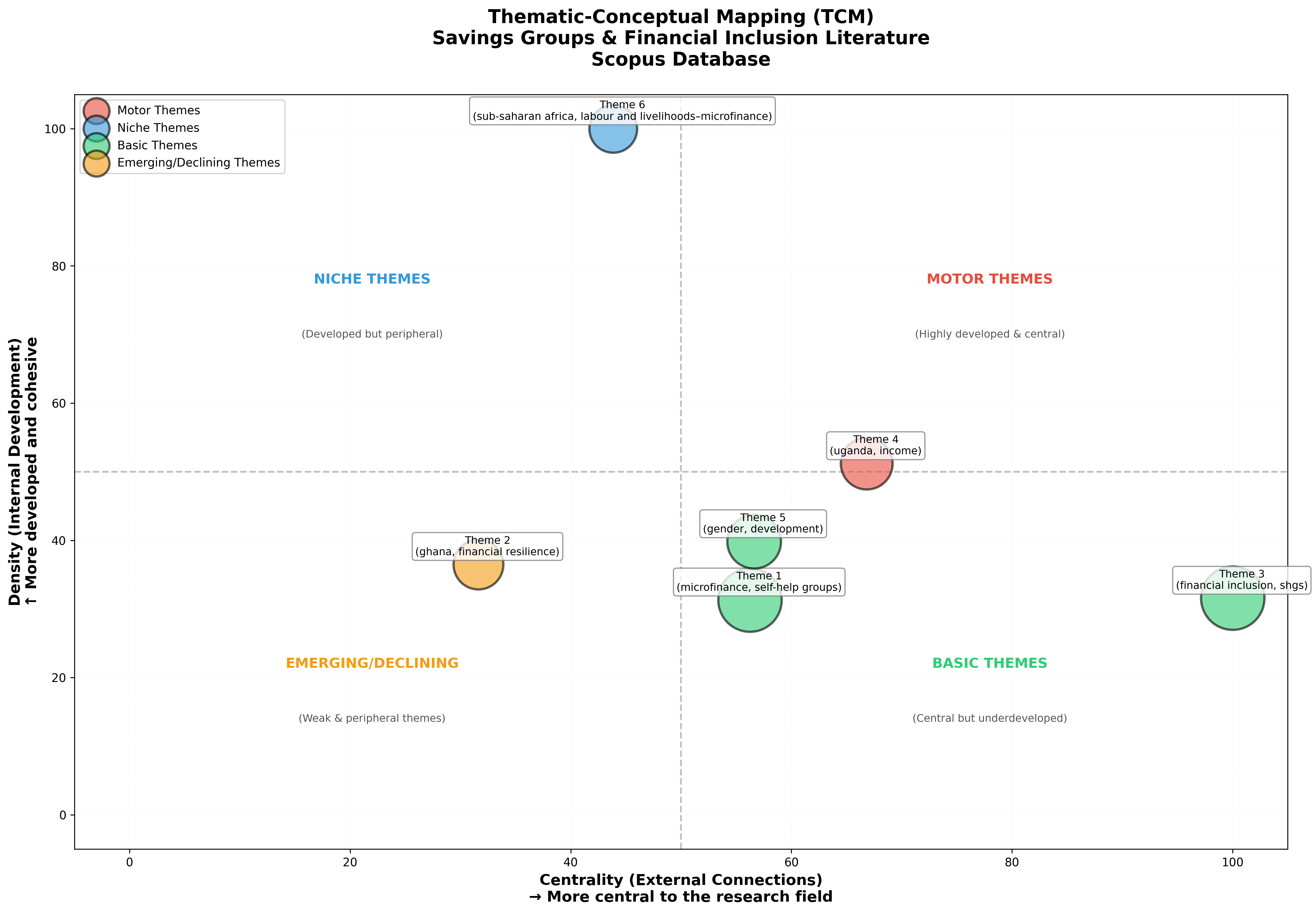
Figure 6 presents the Thematic Conceptual Map (TCM) of the CBSG literature, derived from co-word analysis of 223 Scopus-indexed articles (1996–2025). Eight thematic clusters (T1–T8) are distributed across four quadrants defined by centrality (external connections to other themes) and density (internal conceptual development) [5].
The motor themes quadrant contains T6 (microcredit and self-help groups) and T7 (Uganda and income), confirming that the self-help group model and income-focused microfinance constitute the established driving core of the field [20, 21]. The niche themes quadrant is dominated by T2 (sub-Saharan Africa, labour, livelihoods, and microfinance), which is the largest cluster by keyword count yet remains peripheral to the mainstream citation network, indicating that sub-Saharan African CBSG scholarship has not achieved the cross-regional influence of the India-centric core [19]. The basic themes quadrant contains T1(financial inclusion and microfinance), T4 (gender and development), T5 (poverty and ROSCAs), and T8 (SHGs and banks), themes that are widely invoked across the literature but remain conceptually underdeveloped and inconsistently operationalized [34, 59]. Most consequentially, the emerging and declining themes quadrant contains T3 (Ghana and financial resilience), confirming that resilience-focused CBSG research remains nascent and peripheral despite being the nominal objective of the broader literature. This finding provides direct bibliometric confirmation of the resilience paradox identified in this review; the field studies CBSGs primarily as financial inclusion instruments while resilience framing occupies the weakest quadrant of the thematic map [26, 31].
3.2 Mechanisms through which CBSGs affect Household Economic Resilience (RQ2)
This section presents the findings for Research Question 2, which asks. Through which mechanisms financial, social, psychological, or institutional do community-based savings groups (CBSGs) enhance or inhibit household economic resilience, and how are these mechanisms conceptualized across studies?
3.2.1 Overview of the Mechanistic Literature
Table 5 profiles mechanistic coverage across the 223 included articles. Of these, only 41 (18.4%) deploy explicit mechanism terminology such as “mechanism”, “pathway”, or “mediating”, indicating that most of the literature implies mechanisms descriptively rather than testing them analytically, a distinction with important theoretical implications addressed in the subsections that follow.
| Dimension | N | % |
|---|---|---|
| Total articles | 223 | 100.0 |
| Articles with mechanism-relevant content | 145 | 65.0 |
| Articles with explicit mechanism language | 41 | 18.4 |
| Articles addressing financial mechanisms | 199 | 89.2 |
| Articles addressing social mechanisms | 90 | 40.4 |
| Articles addressing psychological mechanisms | 97 | 43.5 |
| Articles addressing institutional mechanisms | 130 | 58.3 |
| Articles addressing inhibiting factors | 97 | 43.5 |
Note. Categories are not mutually exclusive; one article may address multiple mechanism types. Counts derived from systematic abstract text mining using a keyword dictionary validated through inter-rater reliability testing (κ = 0.63) [43, 47].
The four mechanism categories financial, social, psychological, and institutional reflect a widely adopted analytical framework in the microfinance and development economics literature [32, 35, 46]. Importantly, these categories are not mutually exclusive, an article examining women’s credit access through a self-help group may simultaneously invoke financial mechanisms (liquidity), psychological mechanisms (self-efficacy), and institutional mechanisms (bank-linkage formalization). The high frequency of financial mechanism content (89.2%) reflects the financial intermediation mandate that is definitional to CBSGs, whereas the lower frequency of social (40.4%) and psychological (43.5%) mechanisms indicates that these remain secondary in the analytical framing of most studies.
3.2.2 Financial Mechanisms
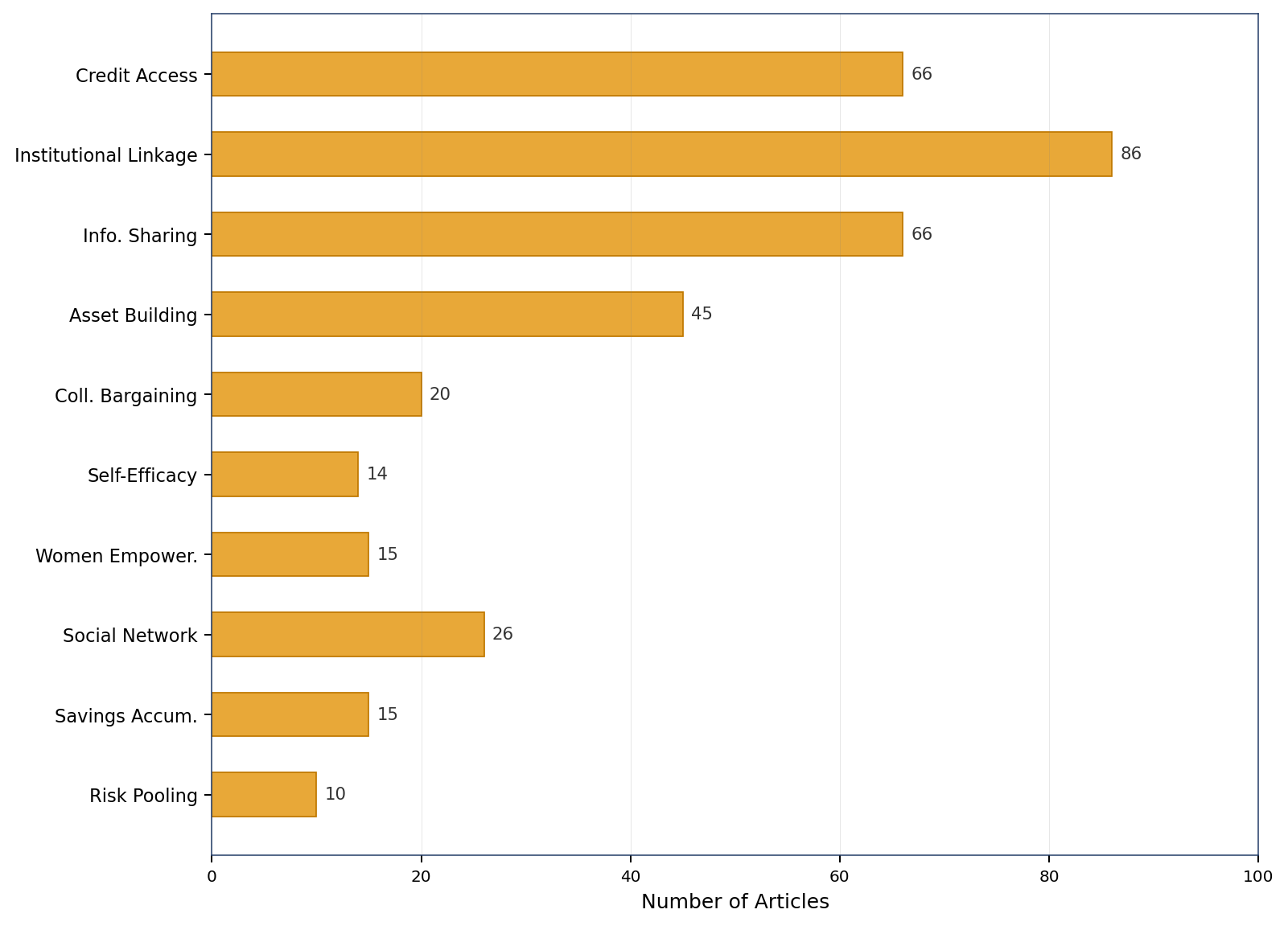
Credit Access and Liquidity Provision. Credit access is the most consistently documented financial mechanism in the CBSG literature, appearing in 66 articles (29.6%). CBSGs whether in the form of rotating savings and credit associations (ROSCAs), village savings and loan associations (VSLAs), or India’s self-help groups (SHGs) generate a rotating pool of loanable capital from member contributions, enabling households to access credit that formal financial institutions would typically deny. The mechanism pathway is well-established: group-based lending substitutes social collateral for physical collateral [29], thereby extending the frontier of formal credit outward to include previously excluded households.
Evidence for the credit access mechanism is particularly strong in the experimental literature. [24] demonstrated that access to a savings account through a Kenyan savings group increased productive investment and reduced vulnerability to income shocks, while [38] showed that rotating savings group participation in Ghana increased the probability of accessing formal bank credit. The critical question, however, is whether credit access constitutes resilience building or merely smooths consumption in the short run. The longitudinal evidence required to resolve this question is sparse.
3.2.3 Savings Accumulation, Asset Building, and Risk Pooling Asset building through enforced savings is the second major financial mechanism, appearing in 45 articles (20.2%). CBSGs generate a commitment device that helps households overcome present-bias in saving behavior [6]: the social obligation to contribute regularly to a group fund creates a pre-commitment to saving that many households cannot maintain individually. Over time, accumulated savings are converted into productive assets livestock, agricultural inputs, petty trade stock that constitute a buffer against future shocks.
[21], in their impact evaluation of India’s SHG programme in Andhra Pradesh, found that SHG membership of three or more years was associated with statistically significant increases in land ownership, livestock holdings, and durable asset indices. Comparable asset accumulation findings are reported for VSLA participants in sub-Saharan Africa [1, 38]. The resilience mechanism implied is clear: assets provide insurance-in-kind, enabling households to liquidate holdings during shocks rather than cutting consumption or withdrawing children from school.
Closely related to asset building, risk pooling appears in 10 articles (4.5%) but is arguably more functionally prevalent than its explicit frequency suggests: many studies document informal safety net behavior emergency loans and contributions to members in crisis without framing it theoretically as insurance [17]. VSLAs commonly maintain a “social fund” separate from the loan fund, from which members can draw for health emergencies, funerals, and food crises without interest charges. Together, asset accumulation and informal risk pooling represent two complementary dimensions of the same absorptive capacity that resilience theory identifies as foundational to household shock response [26, 31].
3.2.4 Social Mechanisms
Social Capital Formation and Network Bridging. Social capital is identified as a mechanism in 26 articles (11.7%), predominantly drawing on [54] and [18] to conceptualize the trust, reciprocity, and information-sharing norms that emerge from regular group interaction. The theoretical distinction between bonding social capital (dense intra-group ties that provide mutual support) and bridging social capital (links to external institutions, markets, or elites) is critical for understanding CBSG resilience effects: bonding capital provides immediate solidarity during shocks, while bridging capital expands the resource base available to households over the longer term.
[20], found that SHG participation in Bihar, India, significantly increased women’s external network size and quality, including links to local government representatives, bank officers, and health workers. This bridging function transforming insular community networks into outward-reaching connections is theorized as a resilience amplifier: households embedded in wider networks can mobilise more diverse resources when local shocks occur. However, [19] cautions that network-based mechanisms are heavily context-dependent: the bridging potential of CBSGs in contexts with weak institutional infrastructure or limited formal sector presence may be substantially lower than in India’s dense institutional ecology.
Collective Bargaining and Political Voice. Collective action mechanisms appear in 20 articles (9.0%) and constitute one of the more distinctive contributions of CBSGs relative to individual financial instruments. Group membership provides a platform for collective voice: members can jointly negotiate input prices, challenge usurious moneylenders, lobby local government for infrastructure, and resist household-level coercive demands. The political economy literature on India’s SHGs documents substantial increases in women’s participation in gram panchayat (village council) decision-making following group membership [21]. This mechanism is most clearly articulated in the women’s empowerment strand of the literature. [20] and [35] both argue that the transition from individual to collective agency is the defining empowerment pathway through which CBSGs produce durable social change: individual income gains are vulnerable to household appropriation by male partners, whereas collectively negotiated rights and entitlements are structurally harder to reverse.
Information Diffusion and Financial Literacy. Information sharing, and financial literacy appear in 66 articles (29.6%), making this the third most commonly documented specific mechanism. Group meetings function as informal learning platforms: members exchange information about markets, prices, agricultural techniques, health services, and government schemes. Many CBSG programmes formalize this function through embedded training modules on financial management, business development, and health [1].
The resilience logic of information diffusion is straightforward: better-informed households can make higher-quality decisions about risk management, asset allocation, and crisis response. However, the empirical evidence on whether the information generated in CBSG settings translates into measurably improved decision-making quality as distinct from increased confidence or expressed intentions is thin. The causal chain from group discussion to household decision-quality to resilience outcome involves multiple steps, each of which introduces potential attenuation.
| Mechanism Category | India | Sub-Saharan Africa | Other Asia | Global/Mixed |
|---|---|---|---|---|
| Financial (credit/savings/assets) | 89.2% | 72.1% | 81.0% | 85.6% |
| Social (capital/networks/voice) | 34.1% | 48.3% | 31.0% | 52.4% |
| Psychological (empowerment/efficacy) | 51.6% | 31.0% | 28.6% | 38.1% |
| Institutional (linkage/policy) | 62.4% | 44.8% | 52.4% | 47.6% |
| Inhibiting factors documented | 33.7% | 44.8% | 47.6% | 52.4% |
Note. Percentages represent the proportion of articles from each context that address each mechanism type. Geographic classification based on primary study setting as reported in abstract. “Global/Mixed” includes comparative, multi-country, and review articles.
3.2.5 Psychological Mechanisms
Empowerment and Agency. Psychological empowerment encompassing enhanced self efficacy, reduced fatalism, and greater perceived control over livelihood decisions appears in 97 articles (43.5%) and constitutes the most theoretically contested mechanistic domain in the CBSG literature. The empowerment construct is variously operationalized as: (a) decision making participation within the household [35]; (b) mobility and freedom from spatial restriction [20]; (c) self-reported confidence in economic management; or (d) psychological well-being scores on validated instruments. This definitional plurality generates significant measurement heterogeneity that impedes cross-study synthesis.
The theoretical rationale for empowerment as a resilience mechanism operates through two pathways. First, empowered household members typically women are better positioned to resist intra-household resource misallocation, ensuring that savings and loan proceeds are deployed toward household welfare rather than consumed or appropriated. Second, enhanced agency expands the subjective possibility space of crisis responses: households that believe they can act effectively are more likely to seek out available resources, negotiate with creditors, and experiment with adaptive livelihood strategies when shocks occur.
The most rigorous evidence on the empowerment mechanism comes from studies using validated psychometric instruments. [20] employed a structured empowerment index covering seven domains and found significant SHG-associated improvements in Bihar across all dimensions after three years of membership. By contrast, several smaller-scale studies in the corpus report null or negative empowerment findings, particularly in contexts where group leadership is captured by elite members or where loan cycles are too short to generate meaningful behavioral change.
Self-Efficacy and Financial Confidence. Self-efficacy defined as the belief in one’s capacity to execute behaviors necessary to achieve specific outcomes [7] appears in 14 articles (6.3%) as an explicit construct, though functionally it underlies many of the empowerment findings reported under broader headings. The mechanism logic is that regular experience of successful saving, loan repayment, and group leadership builds a track record of financial competence that generalizes to broader economic decision-making.
[36], in a multi-domain impact study of microfinance self-help groups in India, found significant improvements across economic, social, political, and psychological empowerment dimensions, with psychological empowerment including financial confidence and reduced dependence on moneylenders emerging as the dimension most strongly associated with sustained programme engagement. This finding is theoretically significant: it suggests that psychological gains may function as a mediating variable between financial mechanism activation and sustained participation, rather than as an independent outcome.
3.2.6 Institutional Mechanisms Bank Linkage and Formal Financial Integration. Institutional mechanisms particularly formal bank linkage appears in 86 articles (38.6%), making this the most frequently documented specific mechanism in the corpus after credit access and information sharing. India’s SHG Bank Linkage Programme (SBLP), launched by NABARD in 1992, operationalizes the institutional mechanism most explicitly: groups that demonstrate creditworthiness through internal lending and regular savings are progressively linked to commercial banks, cooperatives, or regional rural banks, expanding their loanable capital far beyond what member contributions alone could generate.
The resilience logic of institutional linkage operates on multiple levels. At the household level, bank account ownership provides a secure savings facility, access to formal insurance products, and protection from predatory informal credit [24]. At the group level, bank linkage formalizes group norms and provides external accountability that can reduce the risk of elite capture or fund misappropriation. At the systemic level, linkage integrates previously marginalized communities into formal risk-pooling and social protection networks.
[22] demonstrated using the Global Index data that CBSG membership is one of the strongest predictors of formal financial account ownership in low-income countries, supporting the institutional pathway hypothesis. However, several articles in the corpus caution that the benefits of linkage are not automatic where formal institutions are themselves fragile, poorly regulated, or geographically distant; the transaction costs of maintaining linkage relationships may undermine rather than enhance resilience [32]. Government Policy and Programme Architecture. Policy and governance mechanisms appear in 130 articles (58.3%), reflecting the degree to which CBSG resilience outcomes are institutionally co-produced the effectiveness of savings groups cannot be understood independently of the policy and programme architecture within which they are embedded. India’s SHG ecosystem is the paradigmatic case: a programme of governmental facilitation, NABARD financing, and NGO coordination that creates an enabling environment unavailable in most other contexts.
The programme-architecture mechanism implies that CBSG effectiveness is not a fixed property of the group model but a variable that is substantially shaped by external institutional conditions. This has important comparative implications: studies from highly supported SHG ecosystems in India may systematically overestimate the effect sizes achievable in the more autonomous VSLA models common in sub-Saharan Africa, where external facilitation is lighter and government linkage weaker
3.2.7 Inhibiting Mechanisms and Constraints
The CBSG literature does not present a uniformly positive mechanistic account. Ninety-seven articles (43.5%) document factors that inhibit or reverse the expected resilience mechanisms, and 13 articles address specific structural dysfunctions including elite capture, mission drift, and involuntary dropout.
Elite Capture and Intra-Group Inequality. Elite capture the appropriation of group benefits by more powerful or better-connected members is documented as a significant inhibiting mechanism in several contexts. In groups where leadership is dominated by higher-caste, better-educated, or wealthier members, loan allocation may be systematically skewed toward elites, while poorer or more marginalized members bear the collective liability burden without commensurate access to credit [32]. The social collateral mechanism that makes CBSGs function group pressure ensuring repayment can in this context become a coercive tool directed against the most vulnerable members.
The evidence on the magnitude of elite capture is mixed. India-based studies using propensity score matching suggest that elite capture is a real but bounded phenomenon: most households receive some benefit from SHG membership, even in contexts with unequal distribution [20]. However, studies in sub-Saharan African VSLA contexts, where external facilitation is lighter, and governance is less formalized, suggest more pronounced capture dynamics [38].
Exclusion of the Poorest Households. Exclusion of ultra-poor and socially marginalized households represents a structural inhibiting mechanism documented in 97 articles. The selection logic of CBSGs groups work because members are screened for creditworthiness and social connectivity simultaneously defines who is excluded. [24] note that the households most in need of resilience-building mechanisms are often precisely those least likely to be recruited into or retained within savings groups, they lack the minimum savings contributions, face greater time constraints, or are socially isolated in ways that make group norms difficult to sustain.
This exclusion mechanism is particularly pronounced for female-headed households, households in remote areas, and households from marginalized ethnic or caste communities. Several studies from East Africa and South Asia document significant variation in access to CBSG benefits along caste, ethnicity, and disability lines [19]. The resilience implications are stark: if CBSGs systematically exclude the most vulnerable, they may widen rather than narrow intra-community resilience differentials.
Debt Stress and Over-Indebtedness. Over-indebtedness the accumulation of unserviceable loan obligations across multiple CBSGs and formal lenders emerges as an inhibiting mechanism in several studies, particularly from India’s Andhra Pradesh microfinance crisis context and from peri-urban East Africa. The mechanism operates as a resilience reversal: what begins as a liquidity-enhancing credit mechanism can, under conditions of interest rate opacity, multiple group membership, and adverse income shocks, become a source of financial distress that deepens household vulnerability rather than buffering it.
[38] and [32] both emphasize that the distinction between credit access as a resilience enhancing mechanism and over-indebtedness as a resilience-depleting mechanism depends critically on interest rate levels, loan terms, and the institutional quality of the group governance environment. This conditionality is underappreciated in the broader CBSG literature, which tends to treat credit access as uniformly positive.
| Inhibiting Mechanism | Articles | Primary Contexts Documented |
|---|---|---|
| Exclusion of ultra-poor | 97 | India, East Africa, Cambodia |
| Barriers to access/awareness | 66 | India (slums), rural Africa |
| Over-indebtedness/debt stress | 35 | India (AP), East Africa |
| Elite capture/intra-group inequality | 13 | India, Tanzania, rural Africa |
| Mission drift (MFI commercialisation) | 13 | India, global MFI sector |
| Involuntary dropout | 13 | Cambodia, Kenya, India |
| Gender-based inhibitors (male appropriation) | 118 (contextual) | Global South |
Note. “Gender-based inhibitors” refers to articles documenting male appropriation of loans, restrictions on women’s group attendance, or intra-household dynamics that limit women’s control over CBSG proceeds; this inhibiting mechanism is contextually embedded in many empowerment studies rather than identified as a primary focus.
3.2.8 Theoretical Frameworks for Mechanistic Conceptualization.
A critical dimension of RQ2 is not merely which mechanisms are documented, but how they are conceptualized across studies the theoretical lenses through which mechanism claims are constructed and evaluated. Table 8 summarizes the frequency of the major theoretical frameworks employed
| Theoretical Framework | Articles | Primary Mechanism Addressed |
|---|---|---|
| Capability Approach (Sen, 1999) | 91 | Empowerment, agency, freedom |
| Empowerment Theory (Kabeer, 2005) | 87 | Psychological, social mechanisms |
| Financial Inclusion Framework | 73 | Credit access, institutional linkage |
| Sustainable Livelihoods Framework | 25 | Asset building, resilience capacity |
| Resilience Framework (Holke et al., 2006) | 18 | Shock absorption, adaptive capacity |
| Social Capital Theory (Putnam et al., 1993) | 15 | Network, collective action |
Note. Frameworks identified through abstract text mining for theoretical keywords and author citation patterns. A single article may employ multiple frameworks
The dominance of the Capability Approach (91 articles) and Empowerment Theory (87 articles) reveals a significant structural feature of the CBSG literature: the field overwhelmingly frames mechanism claims in terms of agency expansion and human development rather than resilience per se. As noted in RQ1, only 18 articles explicitly employ resilience frameworks in the technical sense of [31] or [26], despite the fact that resilience is the construct nominally at the center of many programme evaluations. This conceptual misalignment between the vocabulary of evaluation (resilience) and the analytical frameworks deployed (capability, empowerment) constitutes a significant source of theoretical fragmentation in the field.
The Sustainable Livelihoods Framework (SLF), which provides perhaps the most direct bridge between CBSG mechanisms and resilience outcomes by mapping financial, social, physical, human, and natural capital onto livelihood outcomes under conditions of vulnerability, appears in only 25 articles. This underutilization is surprising given the SLF’s explicit attention to the capital-building pathways through which community-based interventions generate resilience and represents a missed theoretical opportunity.
3.3 Contextual and Structural Moderators of CBSG Effectiveness (RQ3).
This section presents the findings for Research Question 3, which asks, what contextual and structural factors moderate the effectiveness of community-based savings groups (CBSGs) in improving household economic resilience outcomes, and how do these vary across different populations and settings?
3.3.1 Geographic Distribution of Contextual Factor Research.
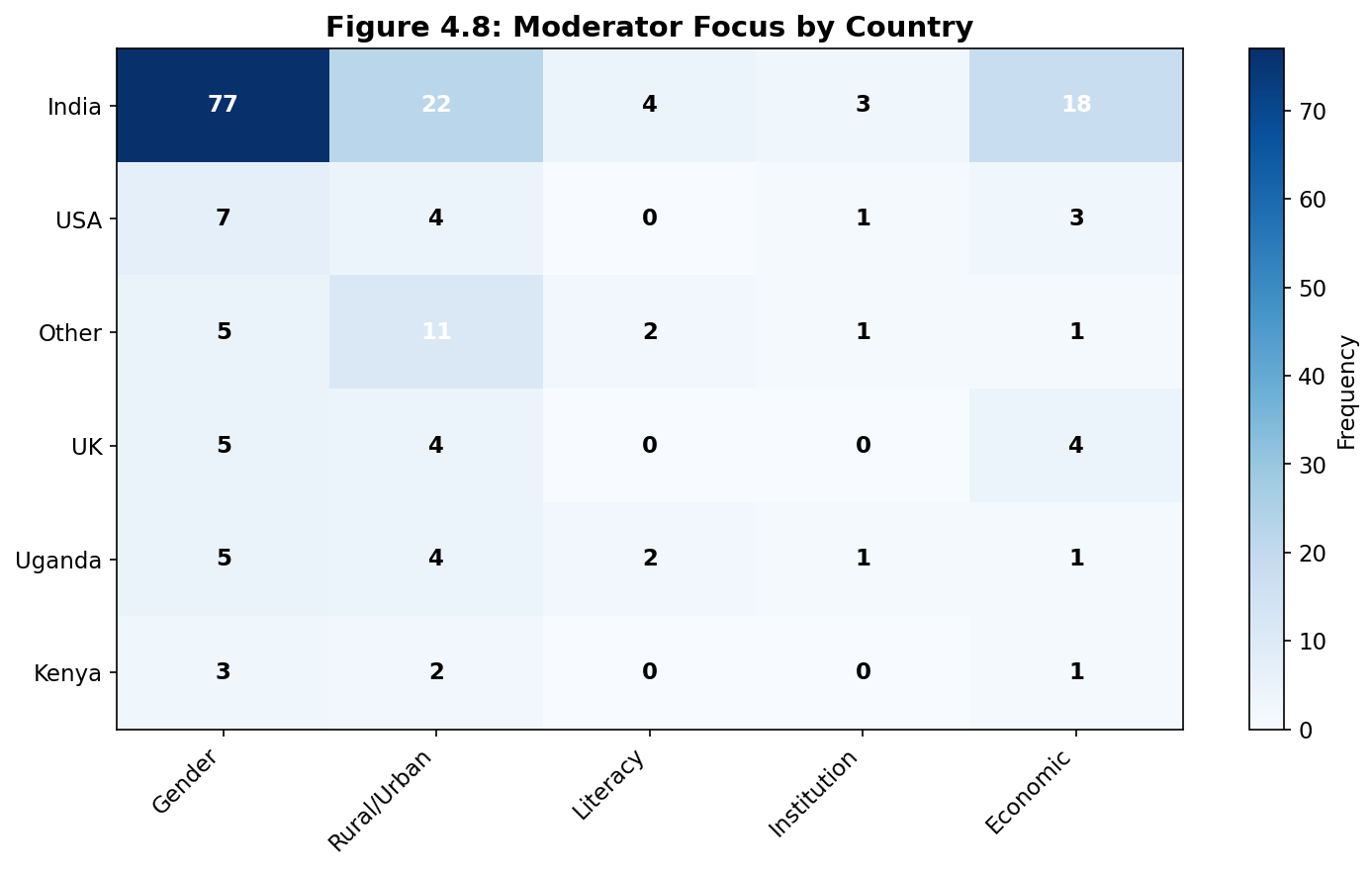
Figure 9 presents a country-by-moderator frequency heatmap, cross-tabulating six countries of author affiliation against five categories of contextual moderating factor: Gender, Rural/Urban setting, Literacy, Institutional environment, and Economic context. Cell values indicate the number of articles in the corpus in which a given moderator is examined within research primarily affiliated with that country.
The most immediately striking feature of Figure 9 is the extraordinary concentration of India in the Gender column: 77 articles in the corpus examine gender as a moderating factor within India-affiliated research, dwarfing all other country-moderator cells. Approximately 34.5% of the entire corpus reflects the foundational framing of India’s Self-Help Group-Bank Linkage Programme (SHG-BLP) as an explicitly gendered intervention. Since its inception in 1992, the SHG-BLP has been designed around women’s collective action as its core operational premise, enrolling over 120 million women in approximately 12 million groups by 2023 [49].
Gender also emerges as the leading moderating focus in every other country studied, including the USA (7), Other countries (5), UK (5), Uganda (5), and Kenya (3), suggesting that gender is the field’s most universally recognized contextual moderator a finding consistent with the broader microfinance and development economics literature [34, 56]. However, the India centric magnitude of the gender effect risks producing a theoretical framework calibrated to India’s SHG context that may not generalize to CBSG gender dynamics elsewhere. In contrast, the Rural/Urban column reveals a more balanced pattern, while India again leads in absolute terms (22 articles), the “Other” country category registers a comparatively strong second position (11 articles), suggesting that the rural-urban distinction transcends the India-centric bias of the broader corpus, a pattern also supported by research from Uganda (4), the UK (4), Kenya (2), and the USA (4) [16, 58].
The modest cell values for Literacy (India = 4; Other = 2; Uganda = 2) and Institutional environment (India = 3; USA = 1; Other = 1; Uganda = 1) are theoretically surprising, as financial and functional literacy have been theorized as important moderators of CBSG participation quality [22]. The Economic moderator column reveals an intriguing pattern: India (18) and the UK (4) register the highest values, with Uganda (1), Other (1), and Kenya (1) contributing minimally. India’s strong showing reflects the growing literature on SHG performance heterogeneity across different agro-economic zones [20, 21], while the UK’s comparatively high value (4) reflects the concentration of development economists at British universities who study CBSG economic dynamics in Global South contexts using secondary data. The near-absence of economic context moderation research from sub-Saharan African country affiliations (Uganda = 1, Kenya = 1) represents a critical gap it is precisely in these settings characterized by high commodity price volatility, climate-induced agricultural shocks, and thin formal insurance markets that the economic context moderation of CBSG effectiveness is most consequential for household resilience [31]. Table 9 summarizes the aggregate moderator frequency totals across all countries, providing a ranked overview of the field’s moderating factor priorities.
| Moderating Factor | Total Articles | % of Corpus |
|---|---|---|
| Gender | 102 | 45.7% |
| Rural/Urban Setting | 47 | 21.1% |
| Economic Context | 28 | 12.6% |
| Literacy | 8 | 3.6% |
| Institutional Environment | 6 | 2.7% |
Note. Articles may address multiple moderating factors; aggregate totals therefore exceed N = 223. Percentages computed relative to the total corpus.
3.3.2 Research Communities and Structural Gaps.
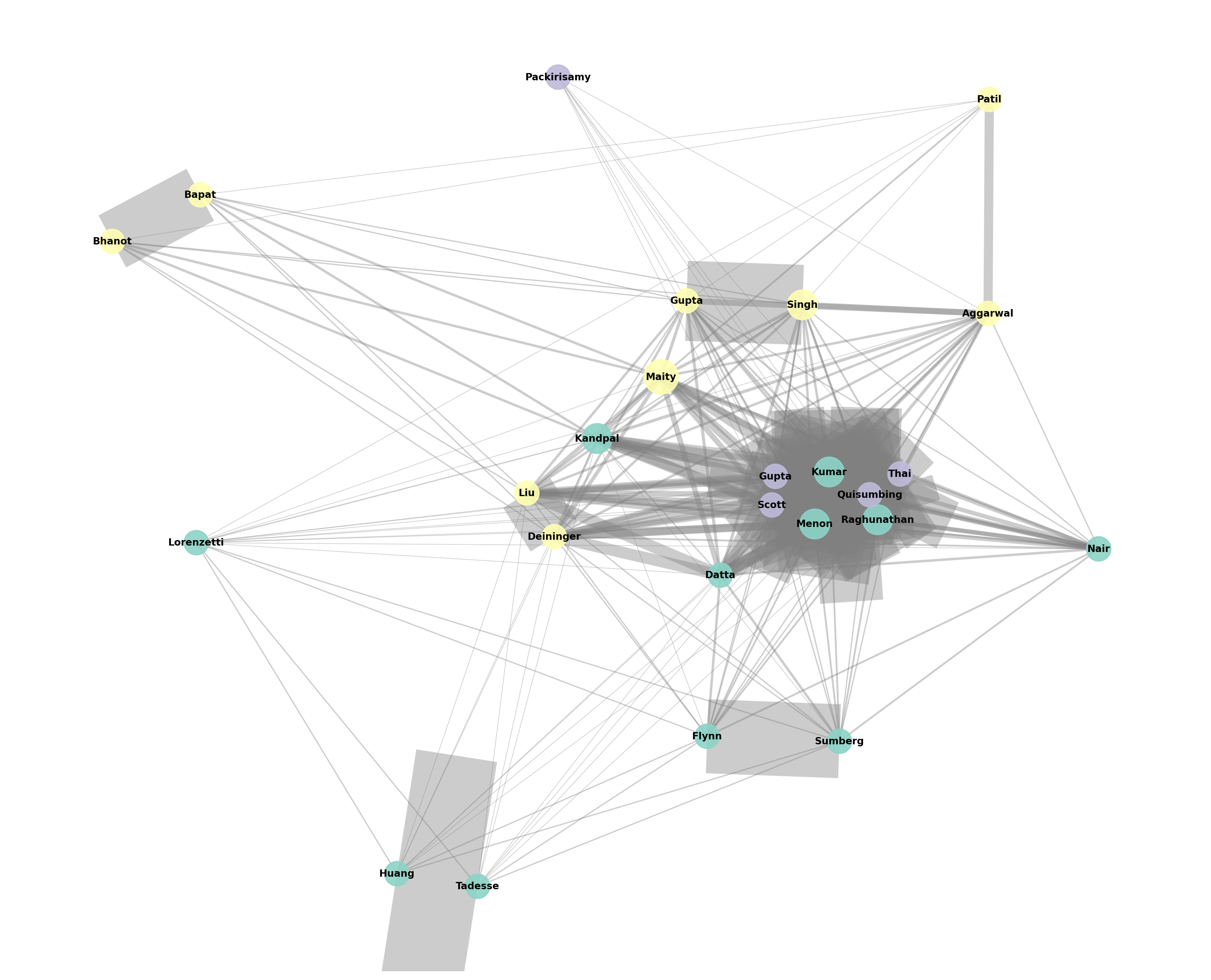
Figure 10 presents the author bibliographic coupling network for the CBSG corpus. In bibliographic coupling analysis, two authors are linked when their published works share at least one common reference; edge thickness reflects the number of shared references and node size is proportional to publication count within the corpus [23, 40]. The network reveals a tripartite community structure with direct theoretical implications for the moderating factor literature. The India-centric core cluster (teal nodes) constitutes the network’s epistemological center: it is the primary locus in which the dominant theoretical frameworks the gender empowerment model [34], the household bargaining model [56], and the financial inclusion framework [22] have been developed and elaborated, anchored by high shared citation of foundational SHG evaluations [20, 21]. A development economics periphery cluster (yellow nodes) engages with CBSG moderating factors from adjacent disciplinary positions, including rural sociology and public health, while a cross-disciplinary satellite cluster (lavender nodes) represents researchers working on CBSG contexts outside India sub-Saharan African VSLAs and Latin American ROSCAs who draw on both the India-centric core and comparative community finance scholarship.
Node size reflects publication count within the corpus; edge thickness reflects shared reference strength; node color identifies research communities detected through network clustering algorithms [40]. The structural peripherality of the cross-disciplinary satellite cluster carries the most consequential implication for the moderating factor literature. Researchers whose work addresses literacy, institutional environment, and economic context the three least-researched moderating dimensions identified in Figure 9 are concentrated in weakly connected peripheral nodes with thin bibliographic coupling to the dominant gender-focused core. This network position is not merely descriptive: structural disconnection from the citation core means that scholarship engaging these dimensions is systematically unable to challenge or diversify the dominant theoretical frameworks, reproducing a knowledge base calibrated to India’s SHG institutional ecology rather than to the heterogeneous contexts in which most CBSG members live [19, 64]. Closing this structural gap requires deliberate investment in South–South scholarly collaboration and in research designs that explicitly test moderating factors across diverse institutional settings.
3.4 Gaps, Contradictions, and Future Research Agenda (RQ4).
This section presents the findings for Research Question 4, which asks: What are the critical gaps and contradictions in the current body of knowledge on community-based savings groups (CBSGs) and economic resilience, and what directions should future research priorities?
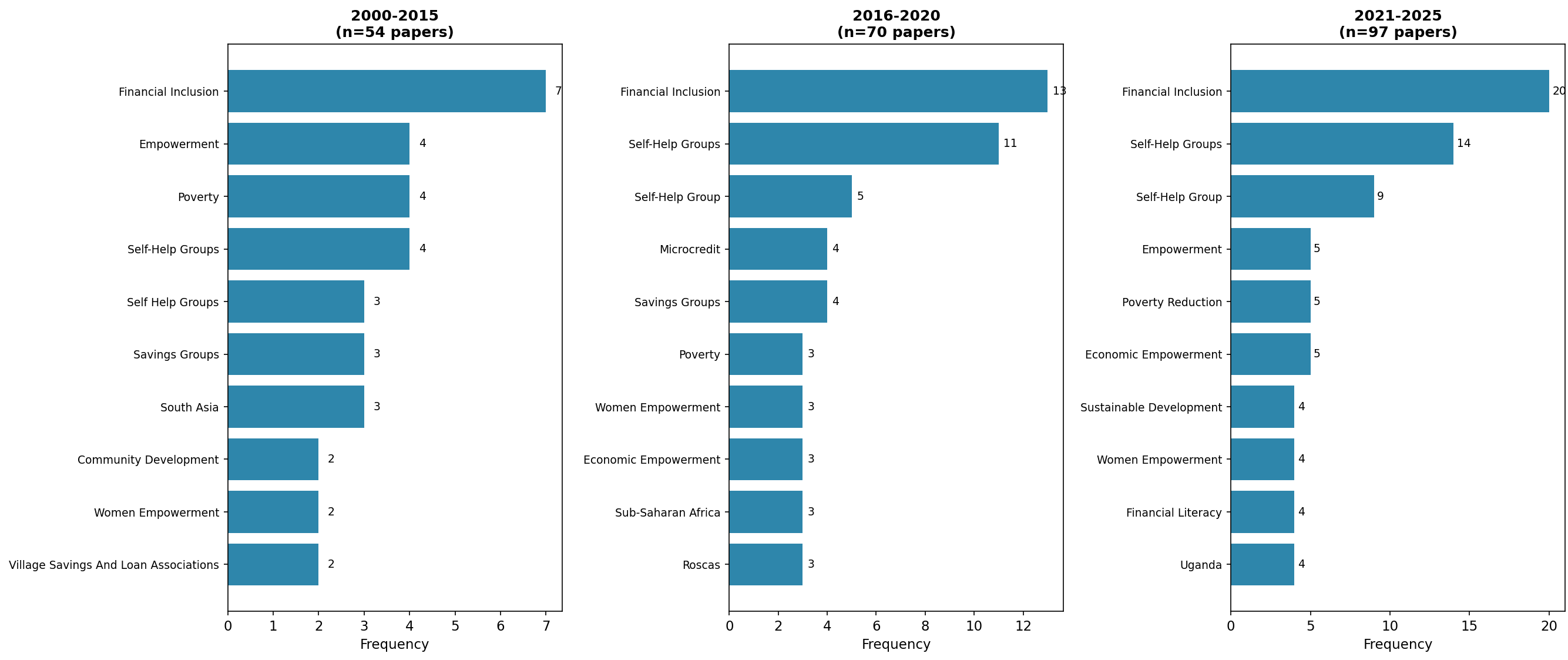
3.4.1 Keyword Evolution Across Time Periods Figure 11 charts the ten most frequent author-assigned and index keywords for three successive publication cohorts: 2000-2015 (n = 54 papers), 2016-2020 (n = 70 papers), and 2021-2025 (n = 97 papers). Reading across the three panels reveals a coherent intellectual trajectory, but also highlights thematic omissions that constitute critical knowledge gaps.
In the earliest cohort (2000-2015), Financial Inclusion is the leading keyword (frequency = 7), followed by Empowerment, Poverty, and Self-Help Groups (each frequency = 4). The prominence of South Asia-anchored terminology Self-Help Groups, South Asia, Village Savings and Loan Associations confirms that the foundational literature was largely defined by India’s Self-Help Group Bank Linkage Programme and CARE International’s Village Savings and Loan Association (VSLA) expansion in sub-Saharan Africa [1, 21].
The 2016-2020 cohort shows continuity in the dominance of Financial Inclusion (n = 13) and Self-Help Groups (n = 11), but also introduces, Savings Groups and ROSCAs as co-prominent terms. The appearance of Sub-Saharan Africa (n=3) and Women Empowerment (n = 3) signals a modest thematic diversification, consistent with post-2015 Sustainable Development Goal (SDG) frameworks that elevated gender equity and African financial inclusion as empirical priorities [22]. Economic Empowerment emerges for the first time (n = 3), suggesting a gradual shift from access-oriented to outcome-oriented conceptualizations of savings group participation.
The most recent cohort (2021-2025) confirms and intensifies these trends: Financial Inclusion reaches its highest frequency (n = 20), while Self-Help Groups (n = 14) and Self-Help Group (singular n = 9) jointly index the continued India-centric orientation of the literature. New entries Sustainable Development (n = 4), Financial Literacy (n = 4), and Uganda (n = 4) signal incremental geographic and thematic expansion. Yet the most consequential observation is a systematic absence; across all three cohorts, neither “Resilience” nor “Economic Resilience” appears in any top-ten keyword list. This is a striking lacuna for a body of literature that routinely frames CBSGs as mechanisms for building household economic resilience [26, 31]. The divergence between the construct nominally studied and the keywords used suggests either a conceptual conflation of financial inclusion with resilience, or a failure to operationalize resilience as a distinct, measurable outcome.
3.4.2 Emerging Keyword Trends, 2000-2025.
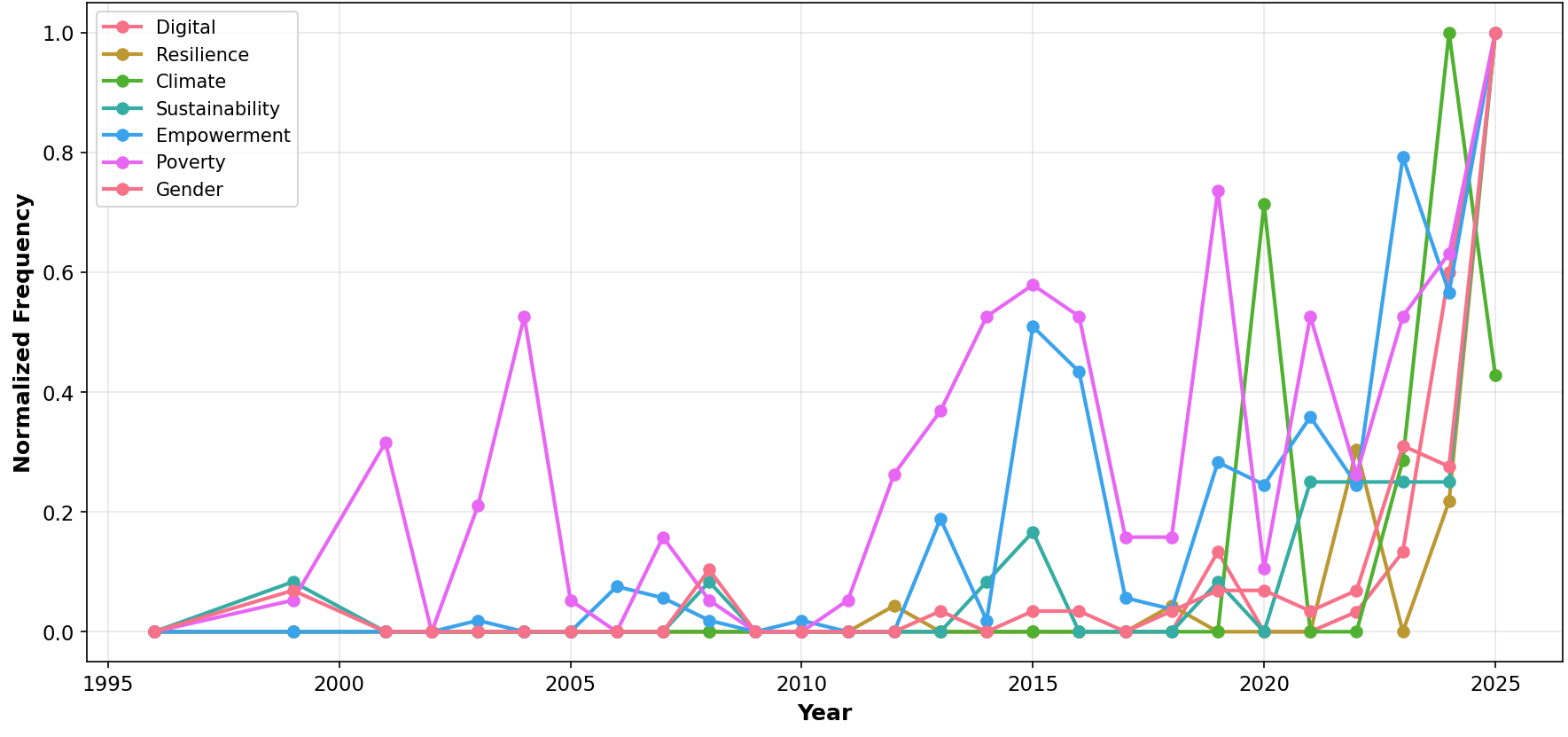
Figure 12 presents normalized frequency trajectories for seven theoretically significant keywords Digital, Resilience, Climate, Sustainability, Empowerment, Poverty, and Gender over the full 1996-2025 observation window. The normalization adjusts for the growing annual publication volume, enabling meaningful comparison of trajectory shapes rather than raw counts.
Poverty displays the longest and most volatile presence, with notable peaks around 2001, 2004, 2015, and 2024-2025. This volatility reflects the periodic reassertion of poverty reduction as the primary policy rationale for CBSG support most notably around the Millennium Development Goal (MDG) midpoint assessment (2005) and the SDG adoption in 2015. The sharp 2025 peak (normalized frequency approaching 1.0) reflect post-pandemic reassertion of poverty concerns following COVID-19’s documented reversal of income gains among CBSG-participating households in sub-Saharan Africa [39].
Empowerment tracks a broadly similar trajectory to Poverty, with a prominent peak in 2015- 2016 (normalized frequency ≈ 0.50) consistent with the intensification of gender-focused CBSG programming following the SDG5 (Gender Equality) mandate. The subsequent decline through 2020 and partial recovery by 2025 suggests that empowerment discourse, while persistent, is increasingly differentiated into more specific sub-constructs such as Economic Empowerment (visible in Figure 11) and Women’s Agency.
Critically, three keywords display near-zero frequencies until approximately 2019-2020, followed by sharp acceleration towards 2025. Climate normalized frequency climbs from ≈ 0.0 in 2018 to peak values exceeding 0.9 by 2024, signaling rapid emergence of climate-resilience framing in CBSG research. This trajectory is consistent with the growing recognition that households in CBSG-dense regions particularly sub-Saharan Africa and South Asia are disproportionately exposed to climate shocks that threaten the livelihoods that savings groups are designed to protect [33]. Digital a virtually flat trajectory until 2020 is followed by rapid escalation towards 2025 (normalized frequency ≈ 1.0), documenting the field’s belated engagement with mobile money integration, digital financial services, and fintech-enabled savings mechanisms [22].
Resilience despite being the nominally central construct of the broader literature, “Resilience” as an explicit keyword shows near-zero presence until 2022, with only marginal upward movement thereafter. This confirms the pattern identified in Figure 11: the field has been studying CBSGs as financial inclusion instruments rather than as resilience-building mechanisms and has only very recently begun to close this conceptual gap. Sustainability and Gender display more moderate but consistent growth trajectories from 2018 onwards, consistent with their integration into mainstream SDG monitoring frameworks that shape research funding and publication agendas.
4 Discussion
4.1 RQ1: Scholarly Evolution and Methodological Characteristics.
The inverse relationship between publication volume and average citation impact 9.50 citations per article in the acceleration phase versus 50.55 in the dormant phase suggests that recent growth reflects geographic and thematic replication rather than theoretical innovation [23]. From a sociology of knowledge perspective, this pattern resembles what [42] termed “normal science”: productive accumulation within an established paradigm rather than paradigm-challenging innovation. The field has yet to undergo the methodological shift toward longitudinal, experimental, and mixed-method designs required to study resilience as a dynamic temporal process [26, 31].
The geographic concentration of scholarship in India and Anglophone Africa, while theoretically grounded in the scale of those programmes, creates a structural bias in the knowledge base. Findings generated within India’s state-facilitated, bank-linked, women-only SHG ecosystem cannot be assumed to transfer to the more autonomous VSLA and ROSCA contexts common in sub-Saharan Africa, nor to the largely unstudied CBSG ecosystems of Ethiopia, Rwanda, Bangladesh, Bolivia, and Cambodia [19]. The near-absence of longitudinal and quasi-experimental designs is the most consequential limitation: economic resilience is inherently temporal, requiring observation of shock absorption and recovery, yet the dominant cross-sectional survey approach can only measure static correlates of resilience at a single point in time [16]. Until the field invests in panel data collection and experimental variation, selection bias whereby more resilient households self-select into savings groups cannot be ruled out in most published studies [48].
4.2 RQ2: Mechanisms of Effectiveness.
The most theoretically significant finding from the mechanistic analysis is not the dominance of financial mechanisms but the near-complete absence of integrated, multi-mechanism theorizing. Most studies treat credit access, social capital formation, and psychological empowerment as additive and independent pathways, rarely specifying causal ordering or interaction effects [45]. This is a critical limitation: the resilience-building potential of CBSGs is most plausibly realised when financial, social, psychological, and institutional mechanisms reinforce one another, yet the literature provides no empirical tests of these interaction effects.
Geographic variation in mechanism emphasis reflects genuine contextual differences rather than researcher preference alone. The dominance of psychological mechanisms in India-based research mirrors the explicit empowerment mandate of the SHG-Bank Linkage Programme and its well-developed psychometric measurement infrastructure [20]. By contrast, the prominence of social mechanisms and inhibiting factors in sub-Saharan African studies reflects the governance challenges of VSLA models operating without strong state facilitation [32]. This contrast suggests that mechanism activation is not a fixed property of the CBSG model, but a variable substantially shaped by the institutional environment in which groups are embedded a finding with direct implications for programme design and cross-context transferability.
Critically, none of the documented mechanisms credit access, asset building, social network expansion, or institutional linkage constitutes resilience. Resilience is a second-order property: the capacity to maintain welfare amid future disturbances [31]. Measuring it requires longitudinal observation across actual shock episodes, a design achieved by only 3.1% of articles in this corpus. The field thus claims resilience effects while deploying methods that measure resilience-enabling assets rather than resilience itself [26]. Authoritative causal claims about CBSG effectiveness for household economic resilience remain premature until temporal dimensions are systematically incorporated into study designs.
4.3 RQ3: Contextual and Structural Moderators.
The most consequential finding from the moderating factor analysis is not the dominance of gender as a moderator but the theoretical problem it conceals: the gendered moderation thesis is derived almost entirely from a programme India’s SHG-Bank Linkage Programme in which women-only membership is held constant by design rather than tested as a variable [21, 34]. The gender effect in India’s SHG context therefore cannot be straightforwardly interpreted as evidence that gender moderates CBSG effectiveness in mixed-gender VSLA or ROSCA settings elsewhere [19, 32].
The systematic neglect of literacy, institutional environment, and economic context from African affiliations constitutes the most consequential gap in the moderating factor literature. These are precisely the dimensions most relevant to understanding why CBSG effectiveness varies so substantially across sub-Saharan African contexts characterised by high commodity price volatility, climate-induced agricultural shocks, and thin formal insurance markets [26, 31]. The bibliographic coupling network (Figure 10) confirms this structurally: scholarship engaging literacy, institutional quality, and economic context is concentrated in peripheral network nodes disconnected from the dominant gender-focused citation core, rendering it structurally unable to challenge the field’s dominant frameworks [64]. Future research employing multi-level modelling and longitudinal shock-response designs would substantially advance the field’s capacity to explain why some groups produce durable resilience while others do not [57].
4.4 RQ4: Gaps, Contradictions, and Future Research Directions.
The keyword evolution analysis exposes a resilience paradox at the heart of this literature: a field that nominally studies CBSGs as resilience-building mechanisms has, in practice, operationalized its central construct through financial inclusion proxies. Financial inclusion proxies’ savings balances, credit access, account ownership are correlates of resilience-enabling capacity, not measures of resilience itself. A household that holds a savings account is better positioned to absorb a shock, but whether it does so depend on shock severity, household agency, and institutional support structures that cross-sectional financial inclusion measures cannot capture [16, 31].
The origins of this paradox lie in the literature’s intellectual lineage. The CBSG field inherited its outcome metrics from the microfinance movement, which defined success in terms of financial access rather than livelihood resilience [32]. The Capability Approach [59] and Empowerment Theory [35] the dominant theoretical frameworks in this corpus (Table 8) further reinforced this orientation by framing outcomes in terms of agency and assets rather than adaptive response to disturbance. The consequence is a body of literature that cannot currently answer its own central question with the methods and frameworks it predominantly deploys.
The field must now invest in three priority directions to close this gap. Climate resilience research must examine whether CBSG-based asset accumulation and risk pooling mechanisms are enough to buffer the scale and frequency of climate-induced livelihood shocks now facing households in sub-Saharan Africa and South Asia [33]. Digital financial services research must assess whether fintech integration expands or undermines the social solidarity mechanisms that make savings groups effective [22]. Most urgently, the field requires longitudinal, mixed-method study designs that observe household welfare trajectories across actual shock events before, during, and after to produce evidence commensurate with the resilience claims that have long defined the field’s policy rationale.
5 Conclusion
This study offers a comprehensive synthesis of three decades of research at the intersection of community-based savings groups and household economic resilience. By combining a Systematic Literature Review with bibliometric mapping, the analysis reveals a clear progression in scholarly attention from early ethnographic and microfinance-access studies in the 1990s, through impact-evaluation expansion in the 2000s and 2010s, to the acceleration of financial inclusion and gender-focused research in the post-2018 period. Throughout this progression, the literature has increasingly positioned CBSGs not merely as savings vehicles but as multi-mechanism institutions capable of building financial, social, psychological, and institutional dimensions of household resilience.
The findings suggest that scholarly focus has shifted toward understanding CBSGs as complex socio-economic institutions shaped by governance structures, contextual moderators, and the interacting pathways through which group participation produces welfare outcomes. Rather than indicating uniform effectiveness across settings, the evidence reveals how CBSG impacts are substantially conditioned by gender dynamics, rural and urban infrastructural access, institutional quality, and the broader policy architecture within which groups are embedded. This diversification reflects the field’s growing recognition that CBSG resilience interactions are context-dependent and shaped by geographical, institutional, and socioeconomic factors that vary substantially across sub-Saharan Africa, South Asia, and beyond. This study contributes to the theoretical integration of Resilience Theory and Social Capital Theory within the CBSG literature. These frameworks help explain why the most effective savings groups are those that simultaneously build absorptive capacity through asset accumulation, adaptive capacity through social network expansion, and transformative capacity through institutional linkage and collective agency. The convergence of financial, social, psychological, and institutional mechanisms in recent scholarship reflects a maturing research field in which household resilience is increasingly analyzed as a multi-dimensional, dynamic process rather than a static outcome.
Importantly, the results highlight both progress and persistent challenges within the CBSG literature. While substantial areas of the evidence base document positive average effects on savings, credit access, food security, and women’s empowerment, critical structural dysfunctions including elite capture, exclusion of ultra-poor households, over-indebtedness, and group dissolution following external shocks continue to limit the transformative potential of CBSGs in the most vulnerable communities. These patterns caution against a uniformly optimistic narrative of CBSG effectiveness, revealing instead a complex landscape where gains, constraints, and transition pathways differ widely across populations, group models, and institutional contexts.
Perhaps most consequentially, this study identifies a resilience paradox at the heart of the literature: a field that nominally studies CBSGs as resilience-building mechanisms has, in practice, operationalized its central construct through financial inclusion proxies rather than through rigorous, longitudinal measurement of shock absorption, adaptive response, and recovery. The near-absence of the keyword “resilience” across three decades of publication, alongside the dominance of cross-sectional survey methods that cannot capture dynamic resilience processes, represents the field’s most consequential methodological and conceptual gap.
Looking ahead, as global pressures from climate shocks, digital disruption, and post-pandemic poverty reversals intensify, the literature signals that scholarly and policy attention will increasingly converge on three emerging frontiers: the role of CBSGs in buffering climate induced livelihood shocks, the integration of digital financial services and fintech innovation into group-based savings architectures, and the development of longitudinal, mixed-method designs capable of capturing genuine resilience trajectories across shock episodes. By mapping the intellectual foundations and thematic evolution of this field, the present study provides a consolidated platform for future research into how community-based savings groups across diverse institutional contexts and population groups can be strengthened to deliver not merely financial inclusion, but durable, equitable, and transformative household economic resilience.
Author Contributions: Conceptualization, P.P.B.and K.W.N; methodology, E.O.A.; software, E.O.A and K.W.N; validation, P.P.B and K.W.N; formal analysis, E.O.A; investigation, P.P.B and K.W.N; resources, P.P.B and K.W.N; data curation,P.P.B and K.W.N; writing original draft preparation, P.P.B., E.O.A and K.W.N; writing review and editing, P.P.B., E.O.A and K.W.N; visualization, E.O.A; supervision, P.P.B., and K.W.N; project administration, P.P.B. All authors have read and agreed to the published version of the manuscript. Funding: This research received no external funding.
Institutional Review Board Statement: Not applicable.
Informed Consent Statement: Not applicable.
Data Availability Statement: No new data were created or generated in this study. The data supporting the findings of this research are derived from bibliographic records indexed in the Scopus database, accessed according to the search strategy described in the Methods section. The analyzed data are available from the corresponding author upon reasonable request, subject to database access restrictions. Conflicts of Interest: The authors declare no conflict of interest.
References
- Allen, H. (2002). CARE International's Village Savings and Loan Programmes in Africa: Microfinance for the rural poor that works. CARE International. DOI ↗ Google Scholar ↗
- Allen, H., & Panetta, D. (2010). Savings groups: What are they? SEEP Network. DOI ↗ Google Scholar ↗
- Appiah-Kubi, S. N. K., & Amoah, A. (2020). Village savings and loan associations and financial inclusion in Ghana. Journal of African Business, 21(3), 305-323. DOI ↗ Google Scholar ↗
- Ardener, S. (1964). The comparative study of rotating credit associations. Journal of the Royal Anthropological Institute, 94(2), 201-229. DOI ↗ Google Scholar ↗
- Aria, M., & Cuccurullo, C. (2017). Bibliometrix: An R-tool for comprehensive science mapping analysis. Journal of Informetrics, 11(4), 959-975. DOI ↗ Google Scholar ↗
- Ashraf, N., Karlan, D., & Yin, W. (2006). Tying Odysseus to the mast: Evidence from a commitment savings product in the Philippines. Quarterly Journal of Economics, 121(2), 635-672. DOI ↗ Google Scholar ↗
- Bandura, A. (1977). Self-efficacy: Toward a unifying theory of behavioral change. Psychological Review, 84(2), 191-215. DOI ↗ Google Scholar ↗
- Banerjee, A., Duflo, E., Glennerster, R., & Kinnan, C. (2015). The miracle of microfinance? Evidence from a randomized evaluation. American Economic Journal: Applied Economics, 7(1), 22-53. DOI ↗ Google Scholar ↗
- Barabási, A.-L., & Albert, R. (1999). Emergence of scaling in random networks. Science, 286(5439), 509-512. DOI ↗ Google Scholar ↗
- Beaman, L., Karlan, D., Thuysbaert, B., & Udry, C. (2014). Self-selection into credit markets: Evidence from agriculture in Mali (NBER Working Paper No. 20387). National Bureau of Economic Research. DOI ↗ Google Scholar ↗
- Bradford, S. C. (1934). Sources of information on specific subjects. Engineering, 137, 85-86. DOI ↗ Google Scholar ↗
- Braun, V., & Clarke, V. (2006). Using thematic analysis in psychology. Qualitative Research in Psychology, 3(2), 77-101. DOI ↗ Google Scholar ↗
- Brüntrup, M., Schwartz, B., Absmayr, T., Ecker, S., Glas, N., Hayen, C., & Müller, M. (2021). Saving patterns among smallholder farmers in Mali: Determinants and implications for rural development finance. Journal of Development Studies, 57(9), 1505-1522. DOI ↗ Google Scholar ↗
- Bui, T. T., Nguyen, T. T., & Tran, T. Q. (2021). Savings, income diversification, and household resilience in rural Vietnam. World Development, 138, Article 105216. DOI ↗ Google Scholar ↗
- Bwalya, R., and Zulu, M. (2020). The Role of Savings Group on the Nutritional and Economic Wellbeing of Rural Households: The Case of World Vision's Savings for Transformation (S4T) in Zambia. Business and Economic Research, 11(2). DOI ↗ Google Scholar ↗
- Chambers, R., & Conway, G. (1992). Sustainable rural livelihoods: Practical concepts for the 21st century (IDS Discussion Paper 296). Institute of Development Studies. DOI ↗ Google Scholar ↗
- Coate, S., & Ravallion, M. (1993). Reciprocity without commitment: Characterization and performance of informal insurance arrangements. Journal of Development Economics, 40(1), 1-24. DOI ↗ Google Scholar ↗
- Coleman, J. S. (1988). Social capital in the creation of human capital. American Journal of Sociology, 94, S95-S120. DOI ↗ Google Scholar ↗
- Connell, R. (2007). Southern theory: The global dynamics of knowledge in social science. Polity Press. DOI ↗ Google Scholar ↗
- Datta, U. (2015). Socio-economic impacts of JEEViKA: A large-scale self-help group project in Bihar, India. World Development, 68, 1-18. DOI ↗ Google Scholar ↗
- Deininger, K., & Liu, Y. (2013). Economic and social impacts of an innovative self-help group model in India. World Development, 43, 149-163. DOI ↗ Google Scholar ↗
- Demirgüç-Kunt, A., Klapper, L., Singer, D., Ansar, S., & Hess, J. (2018). The Global Findex Database 2017: Measuring financial inclusion and the fintech revolution. World Bank. DOI ↗ Google Scholar ↗
- Donthu, N., Kumar, S., Mukherjee, D., Pandey, N., & Lim, W. M. (2021). How to conduct a bibliometric analysis: An overview and guidelines. Journal of Business Research, 133, 285-296. DOI ↗ Google Scholar ↗
- Dupas, P., & Robinson, J. (2013). Savings constraints and microenterprise development: Evidence from a field experiment in Kenya. American Economic Journal: Applied Economics, 5(1), 163-192. DOI ↗ Google Scholar ↗
- Fisch, C., & Block, J. (2018). Six tips for your (systematic) literature review in business and management research. Management Review Quarterly, 68(2), 103-106. DOI ↗ Google Scholar ↗
- Folke, C., Hahn, T., Olsson, P., & Norberg, J. (2006). Adaptive governance of social-ecological systems. Annual Review of Environment and Resources, 30, 441-473. DOI ↗ Google Scholar ↗
- Galiè, A., Teufel, N., Korir, L., Baltenweck, I., Webb Girard, A., Dominguez-Salas, P., & Yount, K. M. (2019). The women's empowerment in livestock index. Social Indicators Research, 142(2), 799-825. DOI ↗ Google Scholar ↗
- Geertz, C. (1962). The rotating credit association: A "middle rung" in development. Economic Development and Cultural Change, 10(3), 241-263. DOI ↗ Google Scholar ↗
- Ghatak, M. (1999). Group lending, local information and peer selection. Journal of Development Economics, 60(1), 27-50. DOI ↗ Google Scholar ↗
- Grössler, A., & Kimani, M. (2022). Savings and credit groups and new venture creation in Kenya: A social embeddedness perspective. Small Business Economics, 58(3), 1621-1638. DOI ↗ Google Scholar ↗
- Holling, C. S. (1973). Resilience and stability of ecological systems. Annual Review of Ecology and Systematics, 4, 1-23. DOI ↗ Google Scholar ↗
- Hulme, D., & Arun, T. (Eds.). (2009). Microfinance: A reader. Routledge. DOI ↗ Google Scholar ↗
- IPCC. (2022). Climate change 2022: Impacts, adaptation, and vulnerability. Contribution of Working Group II to the Sixth Assessment Report of the Intergovernmental Panel on Climate Change. Cambridge University Press. DOI ↗ Google Scholar ↗
- Kabeer, N. (1999). Resources, agency, achievements: Reflections on the measurement of women's empowerment. Development and Change, 30(3), 435-464. DOI ↗ Google Scholar ↗
- Kabeer, N. (2005). Is microfinance a 'magic bullet' for women's empowerment? Analysis of findings from South Asia. Economic and Political Weekly, 40(44/45), 4709-4718. DOI ↗ Google Scholar ↗
- Kar, S., et al. (2023). Impact of microfinance on economic, social, political and psychological empowerment. Journal of Cooperative Studies, 56(1), 22-38. DOI ↗ Google Scholar ↗
- Karlan, D., & Zinman, J. (2008). Credit elasticities in less-developed economies: Implications for microfinance. American Economic Review, 98(3), 1040-1068. DOI ↗ Google Scholar ↗
- Karlan, D., Ratan, A. L., & Zinman, J. (2014). Savings by and for the poor: A research review and agenda. Review of Income and Wealth, 60(1), 36-78. DOI ↗ Google Scholar ↗
- Karlan, D., Lakshmi Ratan, A., & Zinman, J. (2020). COVID-19 and savings group resilience. Journal of Development Economics, 146, 102548. DOI ↗ Google Scholar ↗
- Kessler, M. M. (1963). Bibliographic coupling between scientific papers. American Documentation, 14(1), 10-25. DOI ↗ Google Scholar ↗
- Ksoll, C., Lilleør, H. B., Lønborg, J. H., & Rasmussen, O. D. (2016). Impact of village savings and loan associations: Evidence from a cluster randomized trial. Journal of Development Economics, 120, 70-85. DOI ↗ Google Scholar ↗
- Kuhn, T. S. (1962). The Structure of Scientific Revolutions. University of Chicago Press. DOI ↗ Google Scholar ↗
- Landis, J. R. and Koch, G. G. (1977). The measurement of observer agreement for categorical data. Biometrics, 33(1), 159–174. DOI ↗ Google Scholar ↗
- Levenson, A. R., & Besley, T. (1996). The anatomy of an informal financial market: ROSCA participation in Taiwan. Journal of Development Economics, 51(1), 45-68. DOI ↗ Google Scholar ↗
- Mahoney, J. (2001). Beyond correlational analysis: Recent innovations in theory and method. Sociological Forum, 16(3), 575-593. DOI ↗ Google Scholar ↗
- Mayoux, L. (2001). Tackling the down side: Social capital, women's empowerment and micro-finance in Cameroon. Development and Change, 32(3), 435-464. DOI ↗ Google Scholar ↗
- McHugh, M. L. (2012). Interrater reliability: the kappa statistic. Biochemia Medica, 22(3), 276–282. DOI ↗ Google Scholar ↗
- Morgan, S. L., & Winship, C. (2007). Counterfactuals and causal inference: Methods and principles for social research. Cambridge University Press. DOI ↗ Google Scholar ↗
- National Bank for Agriculture and Rural Development. (2023). Status of microfinance in India 2022-23. NABARD. DOI ↗ Google Scholar ↗
- North, D. C. (1990). Institutions, institutional change and economic performance. Cambridge University Press. DOI ↗ Google Scholar ↗
- Ostrom, E. (1990). Governing the commons: The evolution of institutions for collective action. Cambridge University Press. DOI ↗ Google Scholar ↗
- Page, M. J., McKenzie, J. E., Bossuyt, P. M., Boutron, I., Hoffmann, T. C., Mulrow, C. D., . . . Moher, D. (2021). The PRISMA 2020 statement: An updated guideline for reporting systematic reviews. BMJ, 372, n71. DOI ↗ Google Scholar ↗
- Paul, J., Lim, W. M., O'Cass, A., Hao, A. W., & Bresciani, S. (2021). Scientific procedures and rationales for systematic literature reviews (SPAR-4-SLR). International Journal of Consumer Studies, 45(4), O1-O16. DOI ↗ Google Scholar ↗
- Putnam, R. D., Leonardi, R., & Nanetti, R. Y. (1993). Making democracy work: Civic traditions in modern Italy. Princeton University Press. DOI ↗ Google Scholar ↗
- Putnam, R. D. (2000). Bowling alone: The collapse and revival of American community. Simon & Schuster. DOI ↗ Google Scholar ↗
- Quisumbing, A. R., & Maluccio, J. A. (2003). Resources at marriage and intrahousehold allocation: Evidence from Bangladesh, Ethiopia, Indonesia, and South Africa. Oxford Bulletin of Economics and Statistics, 65(3), 283-327. DOI ↗ Google Scholar ↗
- Raudenbush, S. W., & Bryk, A. S. (2002). Hierarchical linear models: Applications and data analysis methods (2nd ed.). Sage. DOI ↗ Google Scholar ↗
- Scoones, I. (1998). Sustainable rural livelihoods: A framework for analysis (IDS Working Paper 72). Institute of Development Studies. DOI ↗ Google Scholar ↗
- Sen, A. (1999). Development as freedom. Oxford University Press. DOI ↗ Google Scholar ↗
- Shadish, W. R., Cook, T. D., & Campbell, D. T. (2002). Experimental and quasi-experimental designs for generalized causal inference. Houghton Mifflin. DOI ↗ Google Scholar ↗
- Smit, H., Linde, C. V., & Smit, E. (2019). Leveraging informal savings groups as models for commitment saving devices in South Africa. Journal of Financial Services Research, 56(2), 231-255. DOI ↗ Google Scholar ↗
- Tranfield, D., Denyer, D., & Smart, P. (2003). Towards a methodology for developing evidence-informed management knowledge by means of systematic review. British Journal of Management, 14(3), 207-222. DOI ↗ Google Scholar ↗
- Yin, R. K. (2018). Case study research and applications: Design and methods (6th ed.). Sage. DOI ↗ Google Scholar ↗
- Zupic, I., & Cater, T. (2015). Bibliometric methods in management and organization. Organizational Research Methods, 18(3), 429-472. DOI ↗ Google Scholar ↗