
Abstract
Lecturers are a special social workforce because their work directly trains other human resources for society; therefore, the quality of lecturers is a crucial issue, significant for universities and the labor market. In terms of content, lecturer quality is assessed through many criteria, primarily focusing on practical professional competence. This places demands on universities to implement policies for developing professional competence – teaching capacity and research capacity – in order to maintain lecturer quality and meet the strategic goals of the institution. This study constructs a theoretical framework to analyze the impact of professional competence development policies on lecturer quality. The theoretical model includes two independent variables “Developing teaching capacity” (TEC) and “Developing research capacity” (REC), and one dependent variable “The quality of lecturers” (LEC). The author surveyed 240 lecturers, including 120 from 3 public universities and 120 from 3 non-public universities. The survey aimed to conduct an empirical analysis of the quality of university lecturers in Vietnam; to identify and compare lecturer development policies of public and non-public universities. Based on the survey results, the author concludes the study and discusses appropriate policy solutions aimed at developing university lecturers in Vietnam.
Keywords
Quality of lecturers Teaching capacity Research capacity Vietnam.
1. Introduction
University lecturers (hereinafter referred to as lecturers) are professional personnel engaged in teaching and scientific research at higher education institutions, including universities, colleges, academies, doctoral research institutes, and other educational institutions as stipulated in the Vietnamese Law on Higher Education (VNA, 2025). Vietnam currently has 238 higher education institutions (VEJ, 2026), and the goal by 2030, with a vision to 2050, is to develop a synchronous and modern network of higher education institutions with a reasonable scale, structure, and distribution; to establish an open, fair, equitable, high-quality, and efficient higher education system; and to better meet the learning needs of the people.
Developing and improving the quality of lecturers is an urgent requirement in Vietnam. Vietnam is a developing country with a population of 102.3 million, ranking third in Southeast Asia and sixteenth in the world (VGN, 2026). However, the quality of the Vietnamese workforce remains low and does not meet the demands of the labor market. There is still a shortage of skilled technical personnel, while many workers have not yet found suitable jobs. The gap between training and market demand is becoming a bottleneck for productivity and attracting investment (VOV, 2026). This creates both opportunities and pressure for universities in implementing human resource training strategies for national development goals; it also necessitates the development and improvement of lecturer quality to ensure that training meets the requirements of the labor market. This issue is attracting the attention of many education administrators and researchers in Vietnam today, and it is also the topic that the author is interested in and has chosen for this study.
2. Literature review
In the overall context of the social workforce, lecturers are a special type of workforce because their labor directly trains other human resources for society. Therefore, the quality of lecturers is a crucial issue, significant for universities and the labor market; it greatly influences the development of universities in terms of both competitiveness and the quality of products and services. Regarding this issue, Hue, N.H. et al. (2021) assessed that the quality of lecturers plays a decisive role in ensuring and improving the quality of education; therefore, lecturer development is considered a breakthrough solution to improve the quality of human resource training.
According to Christopher, B.M. et al. (2013) and Multi, S. (2014), the basic characteristics of lecturers are high professional qualifications and ethical qualities; their work is intellectual, artistic, and creative; and lecturer quality is assessed based on ethical qualities, professional qualifications, pedagogical skills, scientific research capacity, and teaching capacity. Huong, P.T. et al. (2020) and Xuan, T.T. (2020) define lecturer quality based on their actual value when they demonstrate their ethical qualities, qualifications, and abilities, with their main tasks being teaching and scientific research. From an educational management perspective, this is also the content of the professional standards and quality assessment standards for lecturers stipulated by law in many countries around the world and in Vietnam.
These studies emphasize the value of lecturers as demonstrated through ethical factors, professional qualifications, work capacity meeting prescribed professional standards, and professional work practices within the university. The scale "The quality of lecturers" (LEC) is broadly expressed, implying the main contents: Lecturers possess good ethics, high responsibility in their work, respect and treat learners fairly (LEC1); Lecturers have professional qualifications according to standards and continuously learn to improve their qualifications to meet the development requirements of higher education (LEC2); Lecturers have professional competence and continuously train to develop their careers, becoming high-quality human resources to meet the development requirements of higher education (LEC3).
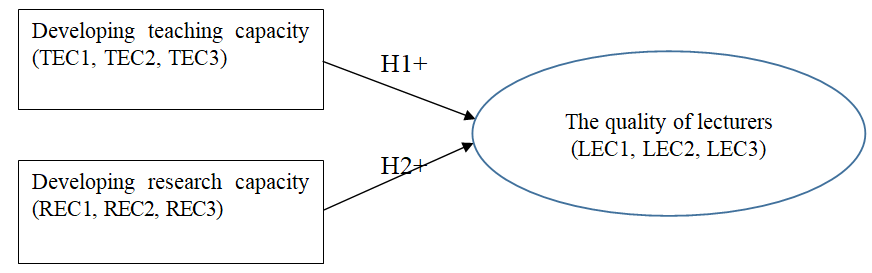
The quality of lecturers is assessed through various criteria, primarily focusing on practical professional competence. This necessitates universities implementing policies to develop professional competence – teaching capacity and research capacity – in order to maintain the quality of lecturers and meet the strategic goals of the institution. In this study, the author focuses on improving lecturer quality through two main factors: teaching capacity and research capacity. When universities prioritize and implement policies to develop lecturers in these two areas, it will enhance the quality of lecturers to serve the institution's strategic goals. With this in mind, the research hypothesis is: Developing teaching capacity (H1) and developing research capacity (H2) directly and positively influence the quality of lecturers.
Developing the teaching capacity of lecturers is a crucial and ongoing policy solution aimed at improving the quality of teaching staff in universities. This is usually implemented through policies that are appropriate to the professional characteristics of lecturers, the characteristics of the training fields, and the practical capabilities of each university. According to Huong, N.T.T (2012) and Giang, T.T. (2017), developing the teaching capacity of lecturers stems from training to develop professional qualifications, fostering teaching methods, and evaluating practical teaching abilities. Sharing this view, Thao, N.T.T. (2024) emphasizes the role of the university, stating that the institution has the responsibility to create conditions for lecturers to improve their professional qualifications and develop teaching capacity in accordance with the institution's actual situation. The scale "Developing teaching capacity" (TEC) is interpreted to imply the main contents: The university implements policies to encourage/support lecturers (funding, time, etc.) to pursue further professional development and enhance their teaching abilities (TEC1); The university implements policies to encourage/support lecturers to exchange practical experiences and professional practice to update and supplement their knowledge, skills, methods, and develop their teaching abilities (TEC2); The university implements policies to reward and develop the careers of lecturers after they complete advanced professional development training programs (TEC3).
Developing the research capacity of lecturers is a policy solution that goes hand in hand with developing teaching capacity. Explaining this issue, Hai, P.T.T. (2023) argues that lecturers must have the organizational capacity to conduct research to serve their professional teaching activities. Lan, L.C. et al (2021) argue that the research capacity of lecturers is also reflected in their ability to apply research results to achieve personal professional development goals and university development goals. Therefore, in addition to general state policies, developing the research capacity of lecturers requires specific university policies to create conditions for lecturers to conduct research, apply research results, transfer research results, and develop research capacity. The scale "Developing research capacity" (REC) is interpreted to imply the main contents: The university implements policies to encourage/support lecturers (funding, time, etc.) in research and developing their research capabilities through appropriate and feasible research programs, projects, and topics (REC1); The university implements policies to encourage/support lecturers in academic exchange, cooperation, and learning from research experiences and developing their research capabilities (REC2); The university implements policies to reward and develop research capabilities and career development based on the achievements in research and collaborative research of lecturers (REC3).
Based on a comprehensive review, a theoretical framework on the quality of lecturers was developed by analyzing the impact of policies on developing teaching capacity and research capacity on lecturer quality. The theoretical model consists of 3 scales and 9 observed variables, designed by the author as 9 questions in a survey questionnaire and measured using a 5-point Likert scale: 1 - Strongly disagree; 2 - Disagree; 3 - Neutral; 4 - Agree; 5 - Strongly agree (Table 1, Figure 1).
| No | Scales | Encode | Rating levels | ||||
|---|---|---|---|---|---|---|---|
| 1 | 2 | 3 | 4 | 5 | |||
| I | Developing teaching capacity | TEC | |||||
| 1 | The university implements policies to encourage/support lecturers (funding, time, etc.) to pursue further professional development and enhance their teaching abilities | TEC1 | |||||
| 2 | The university implements policies to encourage/support lecturers to exchange practical experiences and professional practice to update and supplement their knowledge, skills, methods, and develop their teaching abilities | TEC2 | |||||
| 3 | The university implements policies to reward and develop the careers of lecturers after they complete advanced professional development training programs | TEC3 | |||||
| II | Developing research capacity | REC | |||||
| 4 | The university implements policies to encourage/support lecturers (funding, time, etc.) in research and developing their research capabilities through appropriate and feasible research programs, projects, and topics | REC1 | |||||
| 5 | The university implements policies to encourage/support lecturers in academic exchange, cooperation, and learning from research experiences and developing their research capabilities | REC2 | |||||
| 6 | The university implements policies to reward and develop research capabilities and career development based on the achievements in research and collaborative research of lecturers | REC3 | |||||
| III | The quality of lecturers | LEC | |||||
| 7 | Lecturers possess good ethics, high responsibility in their work, respect and treat learners fairly | LEC1 | |||||
| 8 | Lecturers have professional qualifications according to standards and continuously learn to improve their qualifications to meet the development requirements of higher education | LEC2 | |||||
| 9 | Lecturers have professional competence and continuously train to develop their careers, becoming high-quality human resources to meet the development requirements of higher education | LEC3 |
Source: Compiled by the author through the review
3. Research methods
To conduct this study, the author used a combination of qualitative and quantitative methods. The qualitative method involved collecting and analyzing secondary data and constructing a theoretical framework and model. The quantitative method involved collecting and analyzing primary data through direct surveys of 120 lecturers from 3 public universities and 120 lecturers from 3 non-public universities.
In quantitative research, the minimum sample size required for regression analysis of a 3-scale, 9-observed variable model is N = 9*5 = 45 (Hair, J.F. et al., 2009). In practice, the author conducted the survey with a sample size of N = 120 lecturers from 3 public universities (N > 45) and N = 120 lecturers from 3 non-public universities (N > 45), demonstrating high reliability in conducting the survey.
The survey was conducted selectively, involving 240 lecturers with or currently pursuing doctoral degrees; questionnaires were distributed with their consent. The survey results showed 240/240 valid responses, achieving a 100% response rate.
4. Research results and discussion
First, the authors tested the reliability of the scales and observed variables in the research model using data from 240 survey questionnaires collected by lecturers, to establish the suitability of the theoretical model. According to Hair, J.F. et al. (2009), scales have reliability when meeting the Cronbach's alpha criterion > 0.6; observed variables have reliability when meeting the Corrected Item-Total Correlation criterion > 0.3. The test results showed that all 3 scales and 9 observed variables in the initial research model had sufficient reliability to perform further analysis (Table 2).
| Scales | Observed variables | N | Min | Max | Mean | Std. Deviation | Cronbach’ Alpha | Corrected Item-Total Correlation |
|---|---|---|---|---|---|---|---|---|
| 1. Developing teaching capacity (TEC) | TEC1 TEC2 TEC3 | 240 240 240 | 3 1 1 | 5 5 5 | 4.29 3.78 4.06 | .646 .723 .674 | .731 | TEC1 = .546 TEC2 = .498 TEC3 = .483 |
| 2. Developing research capacity (REC) | REC1 REC2 REC3 | 240 240 240 | 3 1 2 | 5 5 5 | 4.16 3.81 4.01 | .635 .712 .701 | .713 | REC1 = .422 REC2 = .410 REC3 = .438 |
| 3. The quality of lecturers (LEC) | LEC1 LEC2 LEC3 | 240 240 240 | 3 3 2 | 5 5 5 | 4.18 4.11 4.08 | .633 .626 .686 | .725 | LEC1 = .601 LEC2 = .567 LEC3 = .559 |
| Valid N (listwise) | 240 |
Source: Author’s survey results
The survey data in Table 2 shows that the observations of the scales “Developing teaching capacity” (TEC), “Developing research capacity” (REC), and “The quality of lecturers” (LEC) were all rated at a mean of Mean > 3.78 and Mean ≤ 4.29, which is statistically significant according to the Likert scale (1-5) as determined. This shows that:
- Firstly, from an overall perspective, lecturers possess good ethics, meet professional standards, have professional competence, and continuously learn and train to improve their skills and develop their careers, becoming high-quality human resources that meet the requirements of higher education development; universities implement policies to develop teaching and research capabilities based on the professional characteristics of lecturers, the characteristics of training disciplines, and the practical capabilities of each university.
- Secondly, in specifics, there is a certain discrepancy in the observations of the two scales, “Developing teaching capacity” (TEC) and “Developing research capacity” (REC). The observations at the highest level: Mean(TEC1) = 4.29, Mean(REC1) = 4.16, indicate that universities effectively implement policies to encourage/support lecturers in research and professional development, enhancing their teaching and research capabilities. The observations at the lowest level: Mean(TEC2) = 3.78, Mean(REC2) = 3.81, show that lecturers receive less encouragement/support for learning from practical experience, professional practice, and academic collaboration and exchange to update and supplement knowledge, skills, methods, and develop teaching and research capabilities.
The scales and observed variables met the reliability test standards, confirming the suitability of the theoretical model to the survey dataset. At the same time, the survey results contribute to demonstrating the practical aspects of the quality of university lecturers and the implementation of lecturer capacity development policies in Vietnamese universities.
With the test results meeting the standards, the scales and observed variables in the model are confirmed to be reliable and the survey dataset can be used for further analysis. The author uses multiple regression analysis to examine the relationship between the independent variables “Developing teaching capacity” (TEC), “Developing research capacity” (REC) and the dependent variable “The quality of lecturers” (LEC). The regression analysis results are shown in Table 3 below.
| Coefficientsa | ||||||||
| Model | Unstandardized Coefficients | Standardized Coefficients | t | Sig. | Collinearity Statistics | |||
| B | Std. Error | Beta | Tolerance | VIF | ||||
| Public university lecturers (N=120) R2 = .724 Durbin-Watson = 2.102 | (Constant) | 1.014 | .412 | 9.129 | .000 | |||
| TEC | .408 | .118 | .389 | 8.534 | .000 | .526 | 1.832 | |
| REC | .467 | .104 | .402 | 8.441 | .000 | .543 | 1.768 | |
| Non-public university lecturers (N=120) R2 = .733 Durbin-Watson = 2.008 | (Constant) | 1.125 | .398 | 9.087 | .000 | |||
| TEC | .394 | .108 | .322 | 8.516 | .000 | .459 | 1.775 | |
| REC | .445 | .097 | .385 | 8.374 | .000 | .512 | 1.803 | |
| a. Dependent Variable: The quality of lecturers (LEC) |
Source: Author’s survey results
Table 3 presents the regression results comparing the impact of teaching capacity development policies and research capacity development policies on the quality of lecturers, including Model 1 - Survey of public university lecturers; and Model 2 - Survey of non-public university lecturers. The survey data shows that in both models there is a correlation, a positive impact of the factors “Developing teaching capacity” (TEC) and “Developing research capacity” (REC) on “The quality of lecturers” (LEC), specifically:
- In Model 1, R2 = 0.724 (R2 > 0) confirms that the "Developing teaching capacity" (TEC) and "Developing research capacity" (REC) scales explain 72.4% of the variation in the "The quality of lecturers" (LEC) scale. VIF = 1.832 and VIF = 1.768 (1 < VIF < 2) indicate that the regression results of Model 1 do not exhibit multicollinearity; Durbin-Watson = 2.022 (1 < d < 3) indicates that the regression results of Model 1 do not exhibit autocorrelation, confirming that the "Developing teaching capacity" (TEC) and "Developing research capacity" (REC) scales are independent and jointly influence the "The quality of lecturers" (LEC) scale. Model 1 is summarized as: LEC = 1.014 + 0.408*TEC + 0.467*REC.
- In Model 2, R2 = 0.733 (R2 > 0) confirms that the "Developing teaching capacity" (TEC) and "Developing research capacity" (REC) scales explain 73.3% of the variation in the "The quality of lecturers" (LEC) scale. VIF = 1.775 and VIF = 1.803 (1 < VIF < 2) indicate that the regression results of Model 2 do not exhibit multicollinearity; Durbin-Watson = 2.022 (1 < d < 3) indicates that the regression results of Model 2 do not exhibit autocorrelation, confirming that the "Developing teaching capacity" (TEC) and "Developing research capacity" (REC) scales are independent and jointly influence the "The quality of lecturers" (LEC) scale. Model 2 is summarized as: LEC = 1.125 + 0.394*TEC + 0.445*REC.
In both regression models, the regression coefficients are positive (B > 0), confirming a positive correlation between the two independent variables “Developing teaching capacity” (TEC), “Developing research capacity” (REC), and the dependent variable “The quality of lecturers” (LEC); hypotheses H1 and H2 are accepted. Based on the regression coefficient values (B) of the scales in Model 1 and Model 2, it can be seen that the correlation between the independent variables and the dependent variable (in both models) increases in the following order: “Developing teaching capacity” (TEC), “Developing research capacity” (REC).
Based on statistical results, tests (Table 2), and regression analysis results (Table 3), this study further confirms the empirical findings in Vietnam that lecturers possess good ethics, meet professional standards, have professional competence, and continuously learn and train to improve their skills and career development, becoming high-quality human resources that meet the development requirements of higher education; universities implement policies to develop teaching and research capabilities based on the professional characteristics of lecturers, the characteristics of training fields, and the practical capabilities of each university. However, many universities have not effectively implemented policies to encourage/support lecturers in research and further education to improve their teaching and research capabilities. Specifically, lecturers are rarely encouraged/supported to exchange practical experience and professional practice; Academic cooperation and exchange aim to update and supplement knowledge, skills, and methods, and to develop teaching and research capabilities.
The conclusions of this study contribute to demonstrating the practical aspects of university lecturer quality and the implementation of lecturer capacity development policies in Vietnamese universities. To achieve the strategic goal of sustainable development, universities need to innovate their governance policies towards developing lecturer capacity by simultaneously improving professional qualifications and practical skills through a combination of on-campus learning and training, as well as collaborative training and research to create learning and training opportunities for lecturers.
Explaining the content of this policy solution, the author emphasizes that society is constantly moving and developing, and social changes always pose new demands on the awareness, thinking, and actions of social subjects, especially lecturers – a special, elite workforce in society's human resources; requiring lecturers to constantly supplement and update their knowledge, skills, and methods so that their professional activities are both academically sound and closely linked to dynamic practice. Therefore, universities need to focus on implementing policies to encourage/support the exchange of practical experience and professional practice; cooperation and academic exchange to update and supplement knowledge, skills, and methods; develop teaching capacity; develop research capacity; and enhance the ability to summarize practical experiences for lecturers.
References
- Christopher, B.M.; Mary, G.N.; Eli, K.R. (2013). “Developing Capacity for Research and Teaching in Higher Education: A Case of Makerere University”. World Journal of Education, Vol.3, No.6. DOI ↗ Google Scholar ↗
- Giang, T.T. (2017). "The process of developing teaching competencies of university lecturers". Journal of Educational Sciences, No.137. DOI ↗ Google Scholar ↗
- Hair, J.F.; Black, W.C.; Babin, B.J.; Anderson, R.E. (2009). Multivariate Data Analysis, 7th Edition. Prentice Hall. DOI ↗ Google Scholar ↗
- Hai, P.T.T. (2023). "Developing the capacity of lecturers to meet the requirements of digital transformation in higher education". Journal of Political Theory and Communication, DOI ↗ Google Scholar ↗
- Hue, N.H.; Toan, N.P. (2021). "Improving the quality of university lecturers in conjunction with training according to AUN-QA standards to meet the requirements of the 4.0 industrial revolution". From the book series "Training to meet social needs and international integration according to the CDIO model", Finance Publisher. DOI ↗ Google Scholar ↗
- Huong, N.T.T. (2012). "Developing the faculty members in universities". Journal of Science, Hanoi National University, No.28. DOI ↗ Google Scholar ↗
- Huong, P.T.; Cuong, N.H. (2020). “Academic staff quality and the role of quality assurance mechanisms: The Vietnamese case”. Quality in Higher Education, 26(3), 262-283. DOI ↗ Google Scholar ↗
- Lan, L.C.; Co, D.T.M. (2021). “Solutions for Developing University Lecturers’ Competences to Meet the Education 4.0 Requyrements”. Vietnam Journal of Education, 5(1), pp.33–43. DOI ↗ Google Scholar ↗
- Multi, S. (2014). “The relationship between professional competence and work motivation with the elementary school teacher performance”. Asian Journal of Humanities and Social Studies, Vol.2, Issue 5. DOI ↗ Google Scholar ↗
- Thao, N.T.T.; Phu, N.A.; Nhinh, T.T.; Tuan, N.T.; Chuyen, T.H. (2024). "Key Competencies of Lecturers in the Era of Education 4.0". Journal of Industry and Trade, address DOI ↗ Google Scholar ↗
- VEJ - Vietnam Education Journal (2025). "Currently the country has 238 higher education institutions, nearly 1200 vocational education institutions", address DOI ↗ Google Scholar ↗
- VGN - Vietnam Government Newspaper (2026). "Vietnam's population ranks 3rd in Southeast Asia, 16th in the world", address DOI ↗ Google Scholar ↗
- VNA - Vietnam National Assembly (2025). Law on higher education, Law No.125/2025/QH15 dated December 10, 2025. DOI ↗ Google Scholar ↗
- VOV - Voice of Vietnam (2026). “Labour is large but not strong: The economy's human resource bottleneck”, address DOI ↗ Google Scholar ↗
- Xuan, T.T. (2020). “Analyzing the competencies of Hanoi University of Home affairs’ lecturers via the scientific research competencies”. Vietnam Trade and Industry Review, No.23. DOI ↗ Google Scholar ↗